Learn how to build a brand that AI models cite and recommend. Covers entity identity, content structure, schema markup, and multi-platform authority.
AI assistants answer by citing a handful of sources per response, so being citable now matters as much as ranking. This guide covers the signals that get a brand quoted: original first-party data, clear entity definitions, consistent naming across the web, extractable answers, and third-party corroboration.
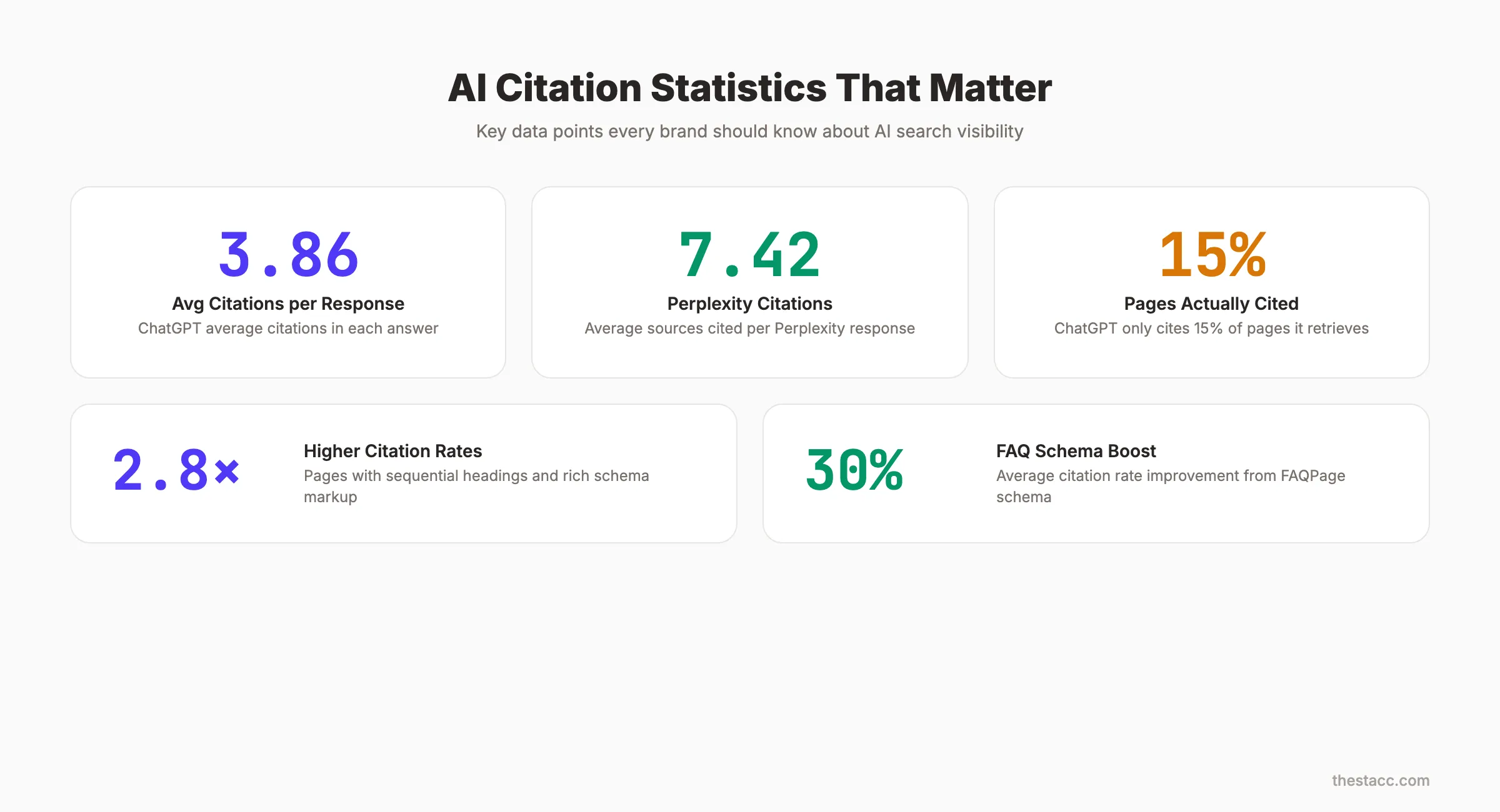
ChatGPT averages 3.86 citations per response. Perplexity includes 7.42. Google AI Overviews pulls from 6 to 8 sources per answer.
Your brand is either one of those sources, or it is invisible.
The shift from search rankings to AI citations changes what it means to be discoverable online. Traditional SEO got you onto page one. A citation-worthy brand gets you quoted, referenced, and recommended inside AI-generated answers across every major platform.
We have published 3,500+ articles across 70+ industries. The patterns that earn AI citations are consistent, measurable, and repeatable. This guide breaks down exactly how to build a brand that AI systems trust enough to cite.
Here is what you will learn:
- What makes AI models choose one source over another
- How to establish your brand as a recognized entity
- The content formats that earn the most AI citations
- Why original data is the fastest path to AI visibility
- How schema markup and technical signals increase citation rates by 2.8x
- The platforms where AI models pull the most sources
- How to measure whether AI systems are actually citing you
What Citation-Worthy Actually Means in AI Search
A citation-worthy brand is one that AI systems consistently reference when answering questions in your domain. This is different from ranking. Ranking puts you on a list. Citations put your brand name inside the answer itself.
How AI Models Select Sources
AI models do not crawl the web in real time the way Google does. They rely on training data, retrieval-augmented generation (RAG), and live web access through plugins or search APIs. Each platform handles this differently.
ChatGPT Search retrieves pages, evaluates them, and only cites 15% of what it finds. Perplexity pulls from live search results and cites more generously. Google AI Overviews synthesizes from its own index and prefers sources that already rank well.
The common thread across all platforms is this: AI models cite sources that are authoritative, clearly structured, and easy to parse. Marketing copy and vague thought leadership get ignored. Specific claims backed by data get quoted.
The Three Pillars of AI Citability
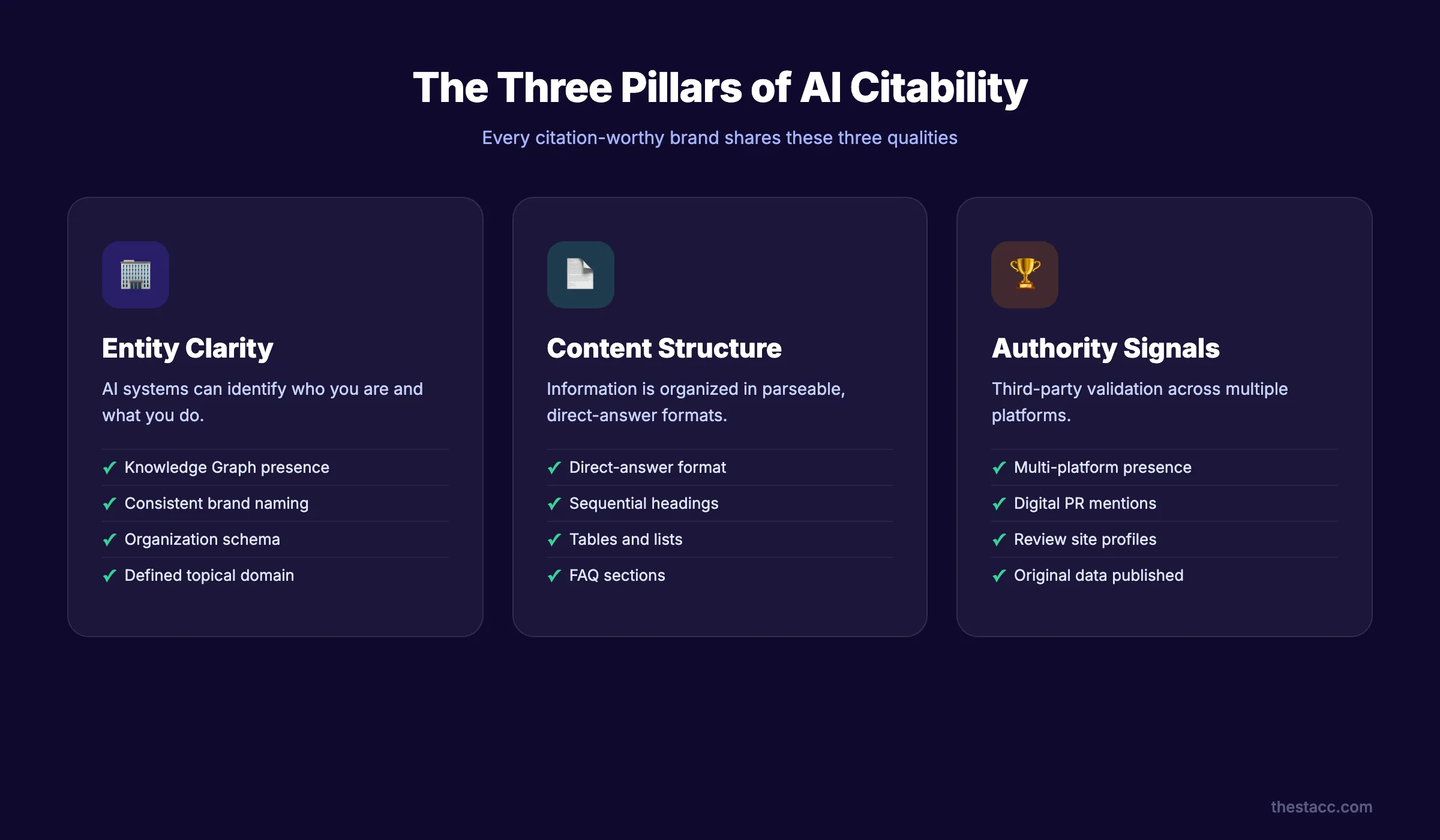
Every brand that earns consistent AI citations shares three qualities:
| Pillar | What It Means | Why It Matters |
|---|---|---|
| Entity clarity | AI systems can identify who you are and what you do | Models need to classify your brand before they can recommend it |
| Content structure | Information is organized in parseable, direct-answer formats | AI cannot cite what it cannot extract |
| Authority signals | Third-party validation across multiple platforms | Models weigh external confirmation more than self-promotion |
A brand can have great content but weak entity signals. Or strong authority but poorly structured pages. You need all three pillars working together to become a reliable citation source.
Your brand. Cited everywhere. theStacc publishes 30 SEO-optimized articles per month that build the authority AI models look for.
Build a Clear Entity Identity
AI models need to understand what your brand is before they can cite it. This is not about brand awareness in the traditional sense. It is about entity recognition. Whether AI systems can classify your brand, associate it with a topic, and retrieve it when that topic comes up.
Claim Your Knowledge Graph Presence
Google's Knowledge Graph is the foundation of entity recognition for most AI systems. If Google understands your brand as an entity, other AI models are more likely to recognize it too.
Start with these steps:
- Create and fully optimize your Google Business Profile
- Ensure your Wikipedia page (if eligible) is accurate and sourced
- Claim profiles on Wikidata, Crunchbase, and LinkedIn
- Verify consistent NAP (name, address, phone) across all directories
Brands with a Knowledge Graph panel are significantly more likely to appear in AI-generated answers. The panel itself signals that Google treats your brand as a distinct, recognized entity.
Define Your Topical Domain
AI models associate brands with topics. If you publish about everything, you are an expert in nothing. The brands that earn the most citations own a clearly defined topical authority in a specific domain.
Pick your domain. Then build depth, not breadth. A dental practice that publishes 50 articles about dental SEO, dental marketing, and dental patient acquisition will earn more citations for "dental marketing" queries than a general marketing agency with 500 articles across 30 topics.
Use Consistent Brand Naming
AI models match entities by name. If your brand appears as "theStacc" on your website, "theStacc" on LinkedIn, "theStacc SEO" on Twitter, and "theStacc.com" in press mentions, you are splitting your entity signals across 4 different names.
Pick one canonical name. Use it everywhere. Every variation dilutes recognition.
Create Content That AI Systems Want to Cite
Not all content earns citations. Blog post structure matters more for AI citations than it does for traditional SEO. AI models extract specific answers from specific formats. The wrong structure makes your content invisible to citation algorithms.
Write in Direct-Answer Format
72% of pages cited by ChatGPT had a clear answer capsule. A concise, direct response to a specific question within the first few sentences of a section. This is the single most consistent predictor of AI citation.
Structure every H2 section like this:
- State the answer or claim in the first 1-2 sentences
- Support it with evidence, data, or examples
- Add context and nuance in the following paragraphs
Do not build up to your point. Lead with it. AI models scan for direct statements, not narrative arcs.
Use Sequential Headings With Clear Hierarchy
Pages with sequential headings and rich schema markup correlate with 2.8x higher citation rates. This means your H2, H3, and H4 tags need to follow a logical order. No skipping levels, no decorative headings, no vague titles like "More Info" or "Details."
Every heading should be a complete, searchable phrase. Compare these:
| Weak Heading | Strong Heading |
|---|---|
| Overview | How AI Models Select Sources for Citations |
| Benefits | 5 Benefits of Schema Markup for AI Visibility |
| Tips | How to Structure FAQ Sections for AI Extraction |
The strong versions tell AI models exactly what the section contains. The weak versions force the model to read the entire section to understand the topic.
Prioritize Freshness
Pages not updated within the last quarter are 3x more likely to lose AI citations. AI models prefer recent information. A 2024 guide that has not been updated will lose citations to a thinner 2026 article that addresses current data.
Build a content freshness schedule. Update your top-performing pages every 90 days with new statistics, examples, and references. Add a visible "Last updated" date. AI models check for recency signals.
Include Tables, Lists, and Structured Data
AI models extract structured information more easily than prose paragraphs. Use these formats throughout your content:
- Tables for comparisons, feature matrices, and data
- Numbered lists for processes and rankings
- Bullet lists for features, benefits, and criteria
- FAQ sections with clear question-and-answer pairs
FAQPage schema improves AI citation rates by 30% on average. Every guide, tutorial, and resource page should end with a structured FAQ section.
3,500+ blogs published. Every article is SEO-scored before publish. See what theStacc can do for your site.
Publish Original Research and Data
Original data is the single fastest path to AI citability. AI models prefer to cite primary sources over summaries of other people's research. When you publish a stat that no one else has, every AI model that encounters it must cite you as the source.
Types of Citation-Worthy Research
You do not need a research department. You need data that your business already has access to:
| Research Type | Example | Citation Potential |
|---|---|---|
| Internal data analysis | "We analyzed 3,500 blog posts and found that posts over 2,500 words earn 47% more backlinks" | Very high. Unique, specific, verifiable |
| Industry survey | "We surveyed 500 small business owners about their SEO budgets" | High. Primary data no one else has |
| Tool-based study | "We ran 1,000 URLs through 5 AI models and tracked citation rates" | Very high. Replicable and data-rich |
| Trend tracking | "Monthly tracking of AI citation rates across 10 industries" | Medium-high. Ongoing, always fresh |
| Case study | "How one client went from 0 to 15 AI citations in 90 days" | Medium. Compelling but single-instance |
Format Research for Maximum Extraction
AI models do not read your 4,000-word study and summarize it. They extract specific data points. Make extraction easy:
- Put key findings in bold or in a summary section at the top
- Use exact numbers ("47% increase" not "significant increase")
- Include the sample size and methodology in a visible location
- Add a "Key Findings" section with 5-7 bullet points
- Create shareable stat graphics that other sites will embed and link to
The brands earning the most AI citations in 2026 are the ones producing data that others reference. When a competitor cites your stat in their article, and an AI model reads that article, you earn a second-order citation.
Expand Your Brand Across Multiple Platforms
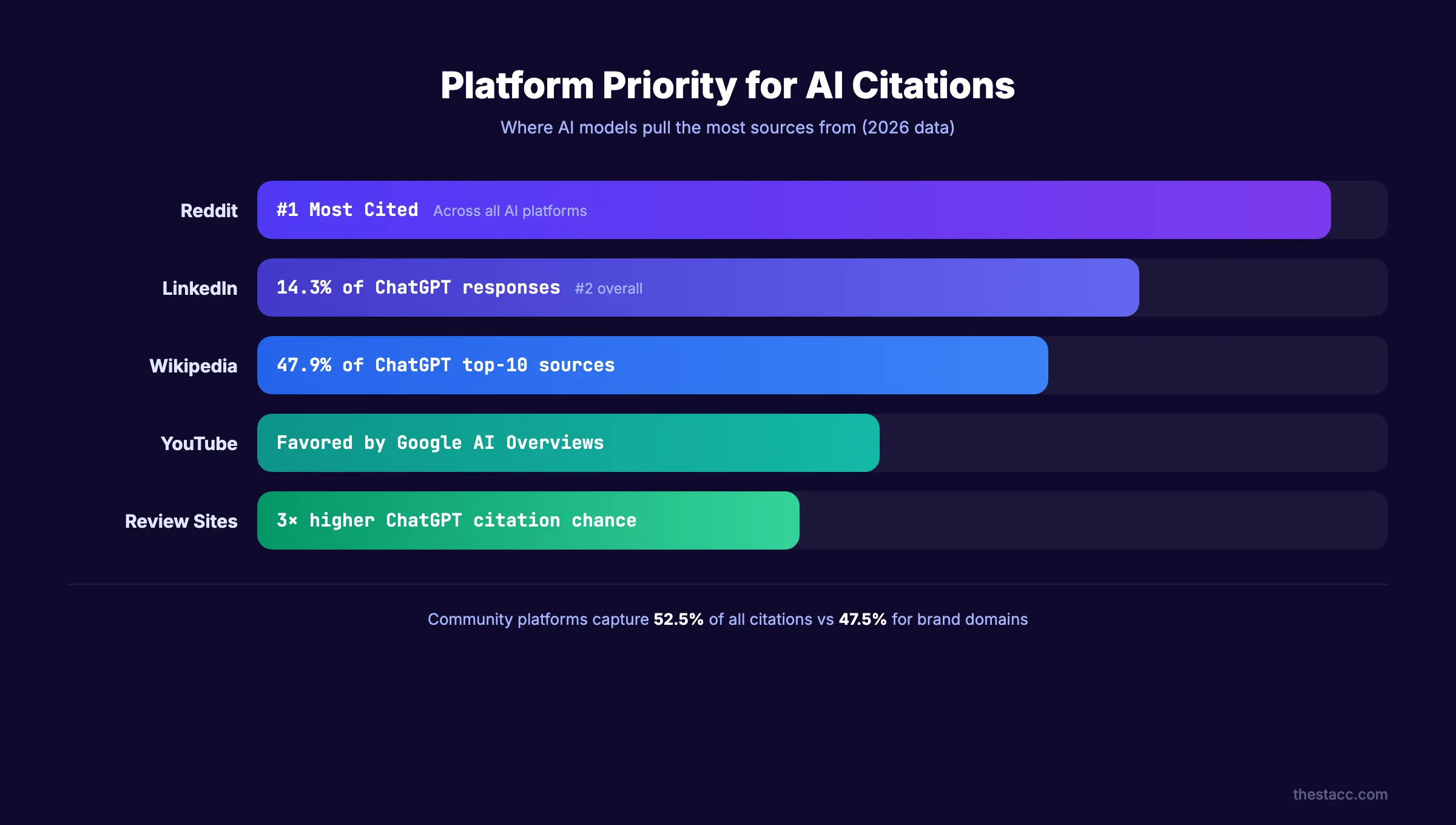
Community platforms capture 52.5% of all AI citations. Brand-owned domains capture 47.5%. Reddit is the single most cited domain across ChatGPT, Perplexity, and Google AI Overviews. LinkedIn is second.
This means your website alone is not enough. AI models pull from the entire web. Your brand needs to exist where AI models look.
Platform Priority for AI Citations
Not all platforms contribute equally to AI visibility. Prioritize based on citation frequency data:
| Platform | Why It Matters | Action |
|---|---|---|
| Most cited domain across all AI platforms | Participate genuinely in subreddits relevant to your industry. Answer questions. Share insights. Never spam. | |
| #2 most cited source; ChatGPT cites LinkedIn content in 14.3% of responses | Publish original posts, not repurposed blog content. Share data, frameworks, and opinions. | |
| YouTube | Google AI Overviews heavily favors YouTube content | Create educational videos that directly answer common industry questions. |
| Wikipedia | 47.9% of ChatGPT's top 10 most-cited sources | If your brand qualifies for a Wikipedia page, ensure it is accurate and well-sourced. Do not edit it yourself. |
| Review platforms | Brands on Trustpilot, G2, Capterra have 3x higher ChatGPT citation chance | Build active profiles. Encourage reviews. Respond to every review. |
Build Digital PR That AI Models Can Find
Every media mention is a brand signal that AI models weigh when deciding what to cite. But not all mentions are equal. A quote in a Forbes article with your name and brand linked carries more weight than a passing mention in a no-name blog.
Focus your digital PR efforts on:
- Publishing guest columns with original data in industry publications
- Getting quoted as a subject matter expert in news articles
- Contributing to annual reports, surveys, and industry roundups
- Earning mentions on podcasts that publish show notes with links
Brands earning both mentions and citations together show 40% higher likelihood of reappearing across AI answers over time.
Stop writing. Start ranking. theStacc publishes 30 SEO articles per month for your business, on autopilot.
Add Schema Markup and Technical Signals
Technical optimization is the infrastructure that makes your content machine-readable. AI systems cannot cite what they cannot parse. Schema markup is not a magic bullet, but it is one of the few things you can directly control that AI platforms explicitly use.
Priority Schema Types for AI Visibility
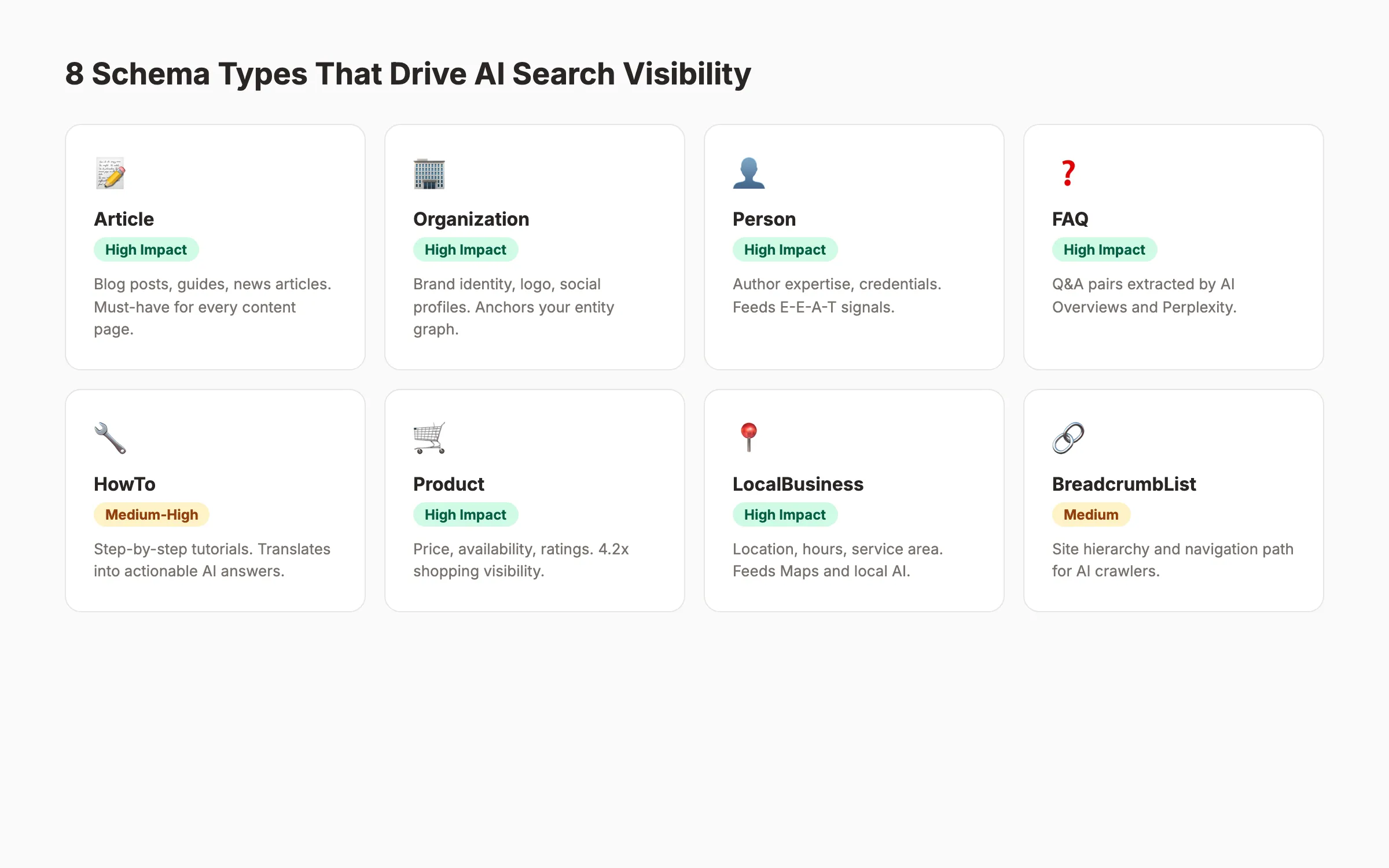
Not all schema types contribute equally to AI citations. Focus on these first:
| Schema Type | Purpose | Impact |
|---|---|---|
| Organization | Establishes your brand entity | Required. Foundation for entity recognition |
| Article / BlogPosting | Marks content type, author, date | High. Helps AI classify content |
| FAQPage | Structures question-answer pairs | High: 30% citation rate improvement |
| HowTo | Structures step-by-step processes | Medium-high. Directly extractable |
| Product / Service | Defines what you sell | Medium. Important for commercial queries |
| Review / AggregateRating | Social proof signals | Medium. Boosts credibility signals |
| Person | Author entity recognition | Medium. Supports E-E-A-T signals |
| SameAs | Links your brand across platforms | High. Connects entity signals |
Use JSON-LD format. Every AI engine prefers it because it separates structured data from HTML and is easier to parse programmatically.
Optimize for AI Crawlers
AI models send their own crawlers to index content. These include GPTBot (OpenAI), ClaudeBot (Anthropic), PerplexityBot, and Google-Extended. Check your robots.txt to make sure you are not blocking them.
Many sites accidentally block AI crawlers. This is the equivalent of building a great store and locking the front door. Review your robots.txt file and explicitly allow the crawlers you want access from.
Consider adding an llms.txt file. This emerging standard helps AI systems understand your site structure and identify your most important content. It is essentially a sitemap for AI models.
Add Author Entities
AI models weigh authorship. A bylined article from a recognized expert earns more citations than anonymous content. For each author on your site:
- Create an author page with bio, credentials, and links to their profiles
- Add Person schema with
sameAsproperties linking to LinkedIn, Twitter, and other profiles - Use consistent author names across all platforms
Measure and Track Your AI Citations
You cannot optimize what you do not measure. AI share of voice is the new metric that matters. It tracks how often your brand appears in AI-generated answers compared to competitors.
Manual Citation Tracking
The simplest method costs nothing. Query ChatGPT, Perplexity, and Google AI Overviews with 20-30 questions in your domain. Track:
- Does your brand appear in the response?
- Are you cited with a link, or just mentioned by name?
- What position is your citation (first source, third, fifth)?
- Which competitor brands appear alongside yours?
Run this audit monthly. Document the results in a spreadsheet. Track changes over time.
Automated Citation Monitoring
Several platforms now track AI citations at scale:
- Otterly.ai. Monitors ChatGPT, Perplexity, and Google AI Overviews
- Profound. Tracks AI citation patterns by platform, industry, and intent
- SE Ranking. Includes AI visibility tracking in their SEO suite
- Conductor. Enterprise-level AI mention and citation monitoring
Most businesses see initial AI citations within 4-8 weeks of implementing GEO best practices. Branded queries and niche topics show visibility first. Competitive head terms take longer.
Key Metrics to Track
| Metric | What It Tells You | Target |
|---|---|---|
| Citation frequency | How often AI models cite your brand | Increase month over month |
| Citation position | Where your brand appears in the response | Top 3 sources |
| Platform coverage | Which AI platforms cite you | All major platforms |
| Query coverage | What questions trigger your citations | 50%+ of your target queries |
| Competitor share | How you compare to competitors | Equal or higher |
Mistakes That Kill Your AI Citability
Most brands fail at AI citability not because they lack content, but because they make structural errors that prevent AI models from using what they already have.
Publishing Marketing Copy Instead of Informational Content
AI models do not cite sales pages. They cite answers. If your blog reads like a brochure, AI will skip it. Every page needs to answer a specific question with specific data. Save the pitch for your CTAs.
Blocking AI Crawlers
Some brands block GPTBot, ClaudeBot, or other AI crawlers in robots.txt for copyright reasons. This is a valid choice, but it means zero AI citations from those platforms. You cannot block crawlers and expect citations.
Ignoring Multi-Platform Presence
Your website is one signal. AI models pull from dozens of sources. If your brand exists only on your own domain, you are missing 52.5% of citation opportunities. Invest in Reddit, LinkedIn, YouTube, and review platforms.
Inconsistent Entity Signals
Different brand names, missing schema markup, no author pages, and no Knowledge Graph presence. These gaps make it impossible for AI models to build a confident entity profile for your brand.
Publishing Stale Content
A guide from 2023 with no updates will lose citations to a thinner 2026 article. AI models weight recency. Update your top content every 90 days or accept declining citation rates.
Skipping Structured Data
No FAQ schema, no Article schema, no Organization schema. Without structured data, AI models must work harder to understand your content. That extra friction means they will cite the competitor who made extraction easy.
Rank everywhere. Do nothing. Blog SEO, Local SEO, and Social on autopilot with theStacc.
What practitioners are saying on X
Local SEO tactics still center on GBP, reviews, and category accuracy. Here is operator signal from X.
- @noelcetaSEO (Sep 2025): Local SEO playbook still centers complete GBP, NAP consistency, quality citations, local keywords, location content, review velocity, and local links. See the post on X.
- @irentdumpsters (Jan 2026): Most businesses have a GBP; few fully optimize every ranking-relevant section for Map Pack visibility. See the post on X.
- @EldarCohenSEO (Jul 2026): 2026 WhiteSpark-oriented reminder: primary Google Business category is a top Map Pack ranking factor — wrong primary category can erase visibility for money queries. See the post on X.
Grok, AI Overviews, and multi-engine visibility
For “build citation worthy brand”, multi-engine visibility still starts with clear definitions, sourced numbers, and extractable section answers. Grok additionally factors live X discussion — keep public claims consistent with this page.
- Google AI Overviews: Use passage-ready answers, tables, and FAQ schema where relevant.
- ChatGPT / Perplexity: Cite named sources next to key claims.
- Grok: Maintain accurate entity facts on-site and in high-signal X posts.
Rank higher in the Map Pack without a full-time local SEO hire. theStacc’s Local SEO module handles daily GBP posts, review reply workflows, and local visibility tracking — built for service businesses that need calls, not vanity rankings.
FAQ
A citation-worthy brand is one that AI systems like ChatGPT, Perplexity, and Google AI Overviews consistently reference and link to when answering questions. It requires strong entity signals, structured content, and multi-platform authority.
Most brands see initial AI citations within 4-8 weeks of implementing GEO best practices. Niche and branded queries show results first. Competitive head terms take 3-6 months of consistent effort.
Yes. FAQPage schema alone improves citation rates by 30% on average. Organization, Article, and Person schemas help AI models identify your brand, classify your content, and verify your authorship. Use JSON-LD format for best results.
Perplexity cites the most sources per response (7.42 on average), making it the most accessible platform for new brands. ChatGPT is more selective (3.86 citations per response, only citing 15% of pages it retrieves). Google AI Overviews favors sources that already rank well in traditional search.
Yes. AI models prioritize topical authority over brand size. A small business that owns a clearly defined topic, publishes consistently, and shows up across multiple platforms can outperform a larger brand with shallow, unfocused content.
theStacc publishes 30 SEO-optimized articles per month that build topical authority in your domain. Consistent, structured, high-quality content is the foundation of AI citability. theStacc handles the publishing so you can focus on your business.
Building a citation-worthy brand is not a one-time project. It is a compounding process. Every article you publish, every data point you share, every platform where your brand appears adds another signal that AI models use when deciding what to cite. The brands that start building now will own the citation economy for years. The ones that wait will spend years catching up.
Sources & references
- [1] Princeton / Georgia Tech et al. — GEO research (arXiv:2311.09735)
- [2] @hridoyreh on X — Widely shared SEO skill tree: foundations, research, technical, on-page, content, links, AI SEO/GEO, analytics, UX, bran
- [3] @jakezward on X — 2026 SEO predictions emphasize AI Overview share-of-SERP, schema for LLM token efficiency, brand mentions in AI answers

Plan topics, review article drafts, and publish to a connected CMS.
Weekly local SEO teardowns
One practical email a week. Map Pack, GBP, AI Overviews. No fluff. Unsubscribe anytime.