
Content Engineering: The Complete Guide for Marketing Teams
Learn what content engineering is, why it matters, and how to build systems that scale content production. Updated for 2026 with real frameworks.
Most marketing teams produce content the same way they did in 2018. One writer drafts a blog post. An editor reviews it. Someone uploads it to WordPress. Then everyone waits for traffic that never arrives.
That process worked when 10 blog posts per month counted as aggressive. It does not work now. Companies ranking on page 1 of Google publish 20 to 30 optimized articles per month. They treat content like a system, not a craft project.
This shift has a name: content engineering.
Content engineering marketing is the discipline of building repeatable systems that produce, optimize, and distribute content at scale. It is the reason some 5-person teams outproduce 50-person content departments. And it is the single most valuable capability a marketing team can develop in 2026.
We have published 3,500+ blog posts across 70+ industries. This guide covers everything we know about building content systems that actually rank.
Here is what you will learn:
- What content engineering is and how it differs from content marketing
- The 7 core components of a content engineering system
- How to build workflows that cut production time by 40% or more
- Where content engineers fit inside a marketing org chart
- Common mistakes that stall content operations at scale
- How to measure the output of a content engineering function
- A step-by-step plan to implement content engineering this quarter
Chapter 1: What Content Engineering Actually Means
Content engineering is not a buzzword. It is a discipline.
The term describes a systematic approach to content production that treats every piece of content as a structured, reusable, distributable asset rather than a one-off deliverable. Content engineers design the systems. Content marketers execute within them.
Think of it this way. A content marketer writes a blog post. A content engineer builds the workflow that produces 30 blog posts per month, each optimized for search, formatted for the CMS, and scheduled for distribution across 3 channels.
The Origin of the Role
Content engineering originally referred to structured content management in technical documentation. Engineers at companies like IBM and Microsoft built content models, taxonomies, and metadata schemas to manage thousands of documents across products and languages.
Around 2024, the marketing world adopted the term. The trigger was obvious. Teams needed to produce more content than ever. But headcount budgets stayed flat. The only way to scale was to build better systems.
Content Engineering vs. Content Marketing
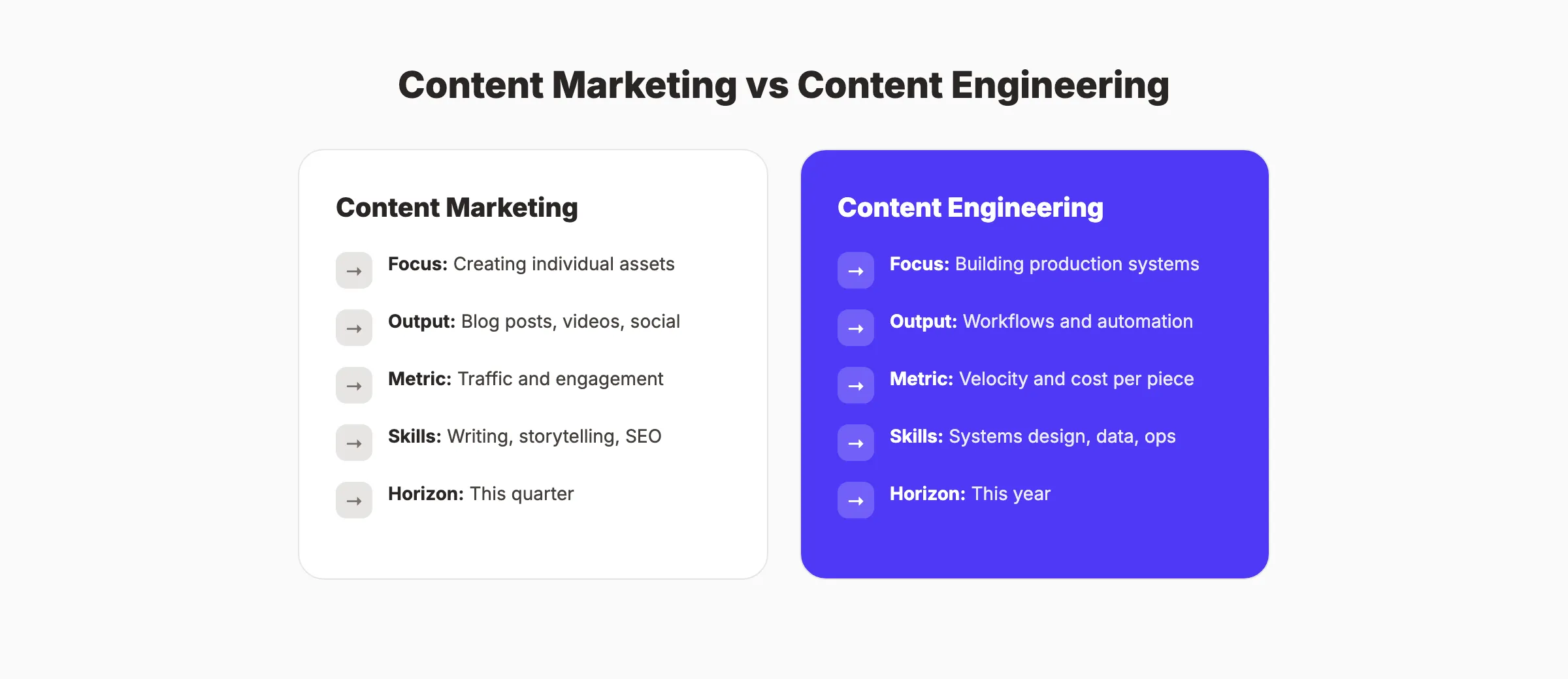
These two disciplines overlap, but they solve different problems.
| Dimension | Content Marketing | Content Engineering |
|---|---|---|
| Focus | Creating individual assets | Building production systems |
| Output | Blog posts, videos, social content | Workflows, templates, automation rules |
| Success metric | Traffic, leads, engagement | Production velocity, consistency, cost per piece |
| Skill set | Writing, storytelling, SEO | Systems design, automation, data modeling |
| Time horizon | This quarter’s content calendar | This year’s content infrastructure |
A strong marketing team needs both. Content engineering provides the foundation. Content marketing fills it with strategy and creativity.
Why This Role Matters Now
Three forces made content engineering essential in 2026:
-
Volume requirements increased. Companies publishing 16+ posts per month see 3.5x more traffic than those publishing 4 or fewer, according to HubSpot’s marketing benchmarks. That volume is not achievable with manual processes.
-
AI tools created new possibilities. Teams can now automate research, outlining, first drafts, optimization, and distribution. But automation without structure creates chaos. Content engineering provides the structure.
-
Search engines reward consistency. Google’s algorithms favor sites that demonstrate topical authority through regular, thorough coverage of a subject. Sporadic publishing does not build authority. Systematic publishing does.
Your SEO team. $99 per month. Stacc publishes 30 optimized articles per month for your business, automatically. Start for $1 →
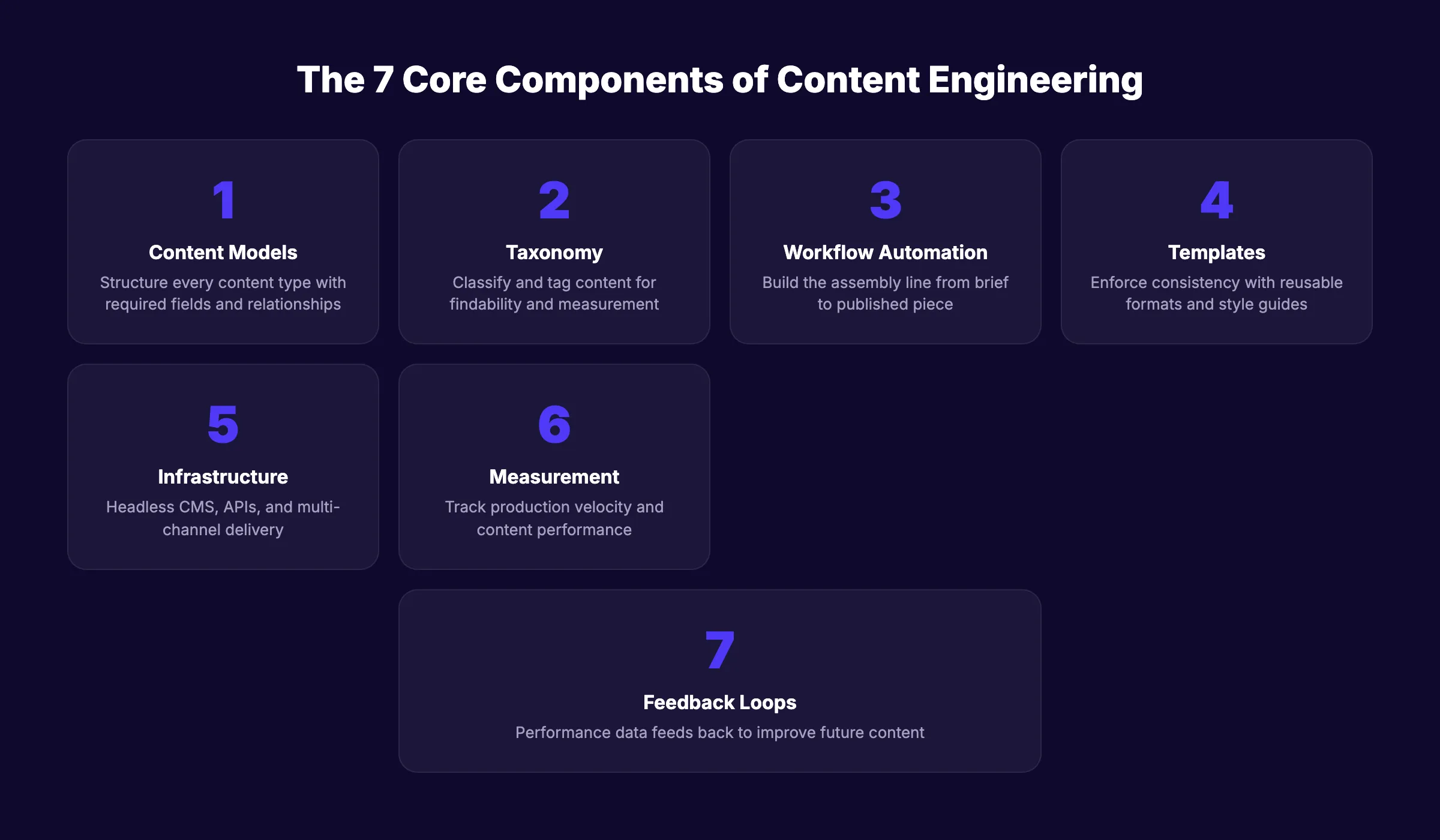
Chapter 2: The 7 Core Components of a Content Engineering System
Every content engineering system, regardless of team size or industry, relies on the same 7 components. Skip one and the system breaks.
1. Content Models
A content model defines the structure of every content type your team produces. Blog posts, landing pages, case studies, social posts. Each has a model that specifies:
- Required fields (title, meta description, primary keyword, category)
- Content blocks (intro, body sections, CTA, FAQ)
- Relationships (which blog posts link to which product pages)
- Metadata (author, date, schema type, target persona)
Without a content model, every piece of content is a blank canvas. That sounds creative. In practice, it means inconsistency, rework, and missed SEO requirements.
2. Taxonomy and Metadata
Taxonomy is how you classify content. Metadata is how you describe it. Together, they make content findable, filterable, and measurable.
A basic content taxonomy for a marketing blog might include:
- Categories: Content Strategy, SEO Tips, Local SEO, SEO Tools
- Content type: Guide, listicle, comparison, case study, statistics
- Funnel stage: Awareness, consideration, decision
- Target persona: Marketing manager, small business owner, agency founder
Every piece of content gets tagged against this taxonomy. That tagging powers your content calendar, your internal linking strategy, and your performance reporting.
3. Workflow Automation
This is where content engineering earns its name. The workflow is the assembly line.
A typical content production workflow has 6 stages:
- Keyword research and topic selection. Identify target keywords with search volume and business relevance
- Briefing. Generate a structured outline with target word count, required sections, internal link targets, and competing pages to beat
- Drafting. Write the first version following the content model and style guide
- Optimization. Run SEO checks, verify keyword placement, add structured data, and confirm internal links
- Review and approval. Editor verifies quality, accuracy, and brand voice compliance
- Publishing and distribution. Push to CMS, schedule social promotion, trigger email notification
Marketing teams using workflow automation reduce manual task time by 32% to 48%, according to McKinsey’s marketing productivity research. The average marketing team loses 8+ hours per week to repetitive, non-strategic work. That is 416 hours per year per team member.
4. Templates and Style Guides
Templates are the most underrated component of content engineering. They enforce consistency without requiring constant oversight.
A good blog post template specifies:
- Exact heading hierarchy (H1, H2, H3 rules)
- Opening structure (hook, problem, solution preview)
- CTA placement (every 800 to 1,000 words)
- Internal linking density (3 to 5 links per 1,000 words)
- Formatting requirements (tables, lists, callout boxes)
- Word count targets by content type
The style guide complements the template by defining voice, tone, banned phrases, sentence length limits, and formatting conventions. Together, these two documents mean that a new writer can produce on-brand content on day 1.
5. Content Infrastructure
Infrastructure means the technical layer: your CMS, publishing pipeline, and content delivery system.
Content engineers evaluate infrastructure on 4 criteria:
| Criteria | What It Means | Example |
|---|---|---|
| Headless capability | Content separates from presentation | Astro, Next.js, headless WordPress |
| API access | Content can be pushed and pulled programmatically | REST or GraphQL endpoints |
| Structured content | Fields, not blobs of rich text | Content collections with typed schemas |
| Multi-channel output | One source feeds multiple destinations | Blog, email, social from single content source |
If your CMS forces you to copy-paste content between channels, your infrastructure is a bottleneck. Content engineering fixes that.
6. Measurement Framework
You cannot improve what you do not measure. Content engineering requires tracking both production metrics and performance metrics.
Production metrics:
- Articles published per month
- Average time from brief to publish
- Cost per published piece
- Revision cycles per piece
- Percentage of pieces meeting quality standards on first draft
Performance metrics:
- Organic traffic per piece at 30, 60, and 90 days
- Keyword rankings achieved vs. targeted
- Internal link click-through rates
- Conversion rate from content to trial or demo
The production metrics tell you if your system is efficient. The performance metrics tell you if your system produces results.
7. Feedback Loops
The final component closes the loop. Performance data feeds back into the system to improve future content.
A content engineering feedback loop looks like this:
- Publish 30 articles in month 1
- Track rankings and traffic at day 60
- Identify the top 5 and bottom 5 performers
- Analyze what the top performers share (word count, structure, keyword type, content depth)
- Update templates, briefs, and workflows based on findings
- Apply changes to month 3 production
Without feedback loops, you optimize once and coast. With them, every batch of content improves on the last. This is the Content Compound Effect in action.
Stop writing. Start ranking. Stacc publishes 30 SEO articles per month for your business, on autopilot. Start for $1 →
Chapter 3: How to Build a Content Engineering Workflow
Knowing the components is step 1. Assembling them into a working workflow is step 2. Here is the practical blueprint.
Step 1: Audit Your Current Process
Before building anything new, document what exists. Map every step from “someone has a content idea” to “published piece generates traffic.”
Common findings during audits:
- No standard brief format. Writers get topics via Slack message or verbal request. Details are inconsistent.
- Manual SEO checks. Someone manually verifies keyword placement, meta descriptions, and image alt text after writing.
- No internal linking system. Writers add links based on memory, not a structured internal linking strategy.
- Publishing bottleneck. One person controls CMS access. They become the chokepoint.
Document every friction point. These become your engineering targets.
Step 2: Define Your Content Model
For each content type, create a specification document. Here is an example for a blog post:
Blog Post Content Model:
- Title (under 60 characters, includes primary keyword)
- Meta description (145 to 155 characters)
- Primary keyword (1 per post)
- Secondary keywords (3 to 5 per post)
- Category (from fixed taxonomy)
- Target word count (by content type)
- Required sections: Introduction, body chapters, FAQ, conclusion
- CTA placement: After every 800 to 1,000 words
- Internal links: Minimum 3 per 1,000 words
- External links: Minimum 2 per post
- Images: 1 per 500 words minimum
- Schema: Article schema with FAQ markup
This model becomes the checklist that every piece must pass before publishing.
Step 3: Build Templatized Briefs
A brief is not a topic sentence. It is a production specification.
Every brief should include:
- Target keyword and search intent
- Competing pages to beat (top 3 URLs with word count and structure notes)
- Exact heading structure (H2s and H3s pre-defined)
- Internal link targets (specific URLs and anchor text)
- External link targets (specific sources for stats and claims)
- Word count target
- Content format (guide, listicle, comparison, how-to)
- CTA copy and placement
When briefs are this specific, first drafts arrive closer to the final product. Revision cycles drop from 3 rounds to 1.
Step 4: Automate the Repeatable Steps
Not everything should be automated. But the repeatable steps should be.
| Step | Manual or Automated | Notes |
|---|---|---|
| Keyword research | Semi-automated | Tools identify targets. Humans validate intent. |
| Brief generation | Automated | Template populates from keyword and SERP data |
| First draft | Semi-automated | AI drafts from brief. Human refines. |
| SEO optimization | Automated | Checklist validates keyword placement, links, meta |
| Image creation | Semi-automated | Templates generate. Human reviews. |
| Publishing | Automated | Scheduled push to CMS with metadata |
| Distribution | Automated | Social posts and email triggers on publish |
| Performance tracking | Automated | Dashboard pulls data at 30, 60, 90 days |
The goal is not to remove humans. It is to move humans from repetitive tasks to judgment tasks. Writers should write. They should not be formatting tables in WordPress.
Step 5: Implement Quality Gates
A quality gate is a checkpoint that content must pass before moving to the next stage. No exceptions.
Gate 1: Brief approval. Does the brief target a keyword with search volume? Does it have a clear differentiator from competing content?
Gate 2: Draft review. Does the draft follow the content model? Are word count, heading structure, and link density requirements met?
Gate 3: SEO validation. Is the primary keyword in the title, first 100 words, at least 1 H2, and meta description? Are all internal links verified?
Gate 4: Editorial review. Does the content meet E-E-A-T standards? Is the voice consistent with brand guidelines?
Gate 5: Pre-publish check. Are images optimized? Is schema markup applied? Is the URL slug correct?
Quality gates prevent bad content from entering production. They also make problems visible early, when they are cheap to fix.
Chapter 4: Where Content Engineers Fit in the Org Chart
The content engineer role sits at the intersection of marketing, operations, and technology. Where you place it depends on your team size.
Small Teams (2 to 10 People)
In a small team, content engineering is a hat, not a job title. The marketing lead or senior content strategist takes on the engineering function alongside content production.
Their content engineering responsibilities include:
- Building and maintaining the editorial calendar
- Creating templates and brief formats
- Setting up automation between tools (CMS, analytics, social scheduling)
- Running monthly performance reviews
At this stage, consider outsourcing the production layer entirely. Services like Stacc handle the entire publishing pipeline. From keyword research to published post. So the internal team can focus on strategy.
Mid-Size Teams (10 to 50 People)
At this size, content engineering becomes a dedicated role. The content engineer reports to the VP of Marketing or Head of Content and works across the content team.
Typical responsibilities:
- Design and maintain content production workflows
- Build and update content models and templates
- Manage the content tech stack (CMS, SEO tools, analytics, automation)
- Create and enforce quality gates
- Run production metrics reporting
- Optimize the feedback loop between performance data and production
Skills required:
- Content strategy experience (3+ years)
- Proficiency with content automation platforms
- Basic understanding of structured data, APIs, and CMS architecture
- Data analysis (able to interpret traffic, ranking, and conversion data)
- Project management and workflow design
Large Teams (50+ People)
At enterprise scale, content engineering becomes a team, not a role. The team typically includes:
- Head of Content Engineering. Sets strategy, owns the system architecture
- Content Operations Manager. Manages day-to-day production workflows
- Content Technologist. Maintains integrations, builds custom tools, manages the CMS
- Content Analyst. Runs performance reporting, identifies optimization opportunities
This team sits alongside content strategists, writers, designers, and SEO specialists. It does not replace them. It makes them faster.
3,500+ blogs published. 92% average SEO score. See what Stacc can do for your site. Start for $1 →
Chapter 5: Common Content Engineering Mistakes
Every team that attempts content engineering makes at least one of these mistakes. Learn from them before you build.
Mistake 1: Automating Without a System
Buying automation tools before designing your workflow is like buying power tools before drawing blueprints. You will build something fast. It will not be what you needed.
Start with the process. Map every step on paper. Then identify which steps benefit from automation. Only then select tools.
Mistake 2: Optimizing Parts Instead of the Whole
A common trap is optimizing one stage of the pipeline while ignoring the rest. You might cut drafting time in half with AI assistance. But if the review stage still takes 5 business days because one editor is the bottleneck, your overall cycle time barely improves.
Content engineering optimizes the entire system. Measure end-to-end cycle time, not individual stage speed.
Mistake 3: Skipping the Taxonomy
Without taxonomy, your content library becomes a junk drawer. Posts pile up with no consistent categorization. Internal linking becomes guesswork. Content clusters never form because no one tracks which topics are covered and which are gaps.
Set up your taxonomy before you publish your 10th post. After 100 posts without taxonomy, the cleanup project will take weeks.
Mistake 4: Ignoring Content Decay
Content engineering covers more than producing new content. It includes maintaining existing content.
Content decay is the gradual decline in rankings and traffic that occurs when published content becomes outdated. A content engineering system must include a refresh workflow that:
- Flags posts with declining traffic at 6-month intervals
- Updates statistics, screenshots, and examples
- Refreshes internal links to include newer content
- Re-optimizes for current search intent
Teams that only produce and never refresh end up on a treadmill. New content pushes old content off page 1 of their own site.
Mistake 5: No Quality Standards
Volume without quality is expensive noise. If your system produces 30 articles per month but half of them score below SEO benchmarks, you are wasting half your budget.
Define minimum quality standards:
- SEO score threshold (80+ on your optimization tool)
- Minimum word count by content type
- Required elements (images, internal links, FAQ section, schema)
- E-E-A-T signals (author byline, sources cited, experience demonstrated)
Enforce these standards with quality gates. No content publishes until it passes every gate.
Chapter 6: Measuring Content Engineering Performance
Content engineering introduces a new category of metrics that most marketing teams do not track. Here is the measurement framework.
Production Metrics Dashboard
Track these weekly:
| Metric | Target | Why It Matters |
|---|---|---|
| Articles published per month | 20 to 30 | Volume drives topical authority |
| Brief-to-publish cycle time | Under 5 business days | Speed indicates system efficiency |
| First-draft pass rate | 80%+ | Higher pass rate means better briefs and templates |
| Cost per published piece | Under $50 for automated, under $200 for manual | Cost efficiency at scale |
| Quality gate pass rate | 90%+ | System produces consistent quality |
Performance Metrics Dashboard
Track these monthly:
| Metric | Benchmark | Source |
|---|---|---|
| Organic traffic growth | 10 to 15% month-over-month | Google Analytics |
| Keywords ranking top 10 | 30%+ of targeted keywords within 90 days | Ahrefs or Semrush |
| Average position improvement | 5+ positions per targeted keyword | Google Search Console |
| Content-to-conversion rate | 2 to 5% for blog content | CRM or analytics attribution |
| Internal link click-through rate | 3 to 8% | Analytics event tracking |
The Content Velocity Ratio
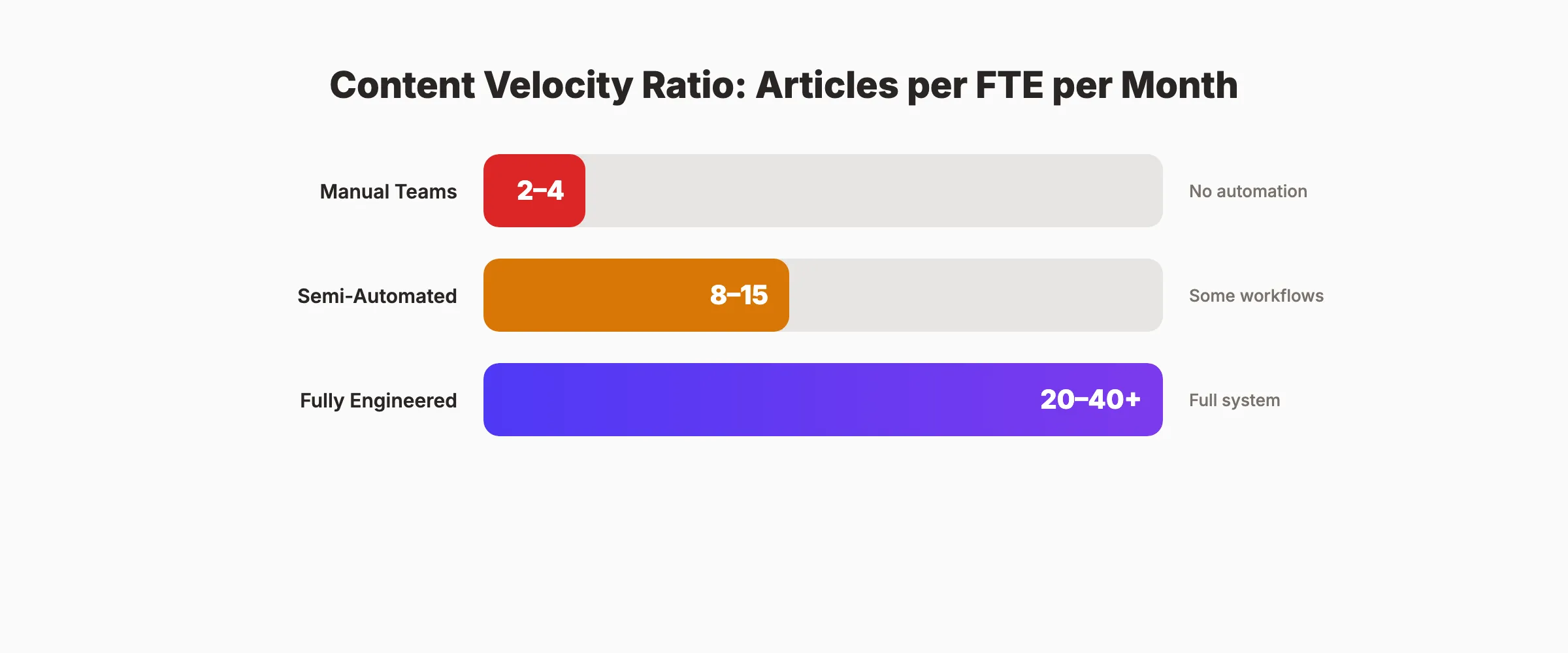
The most useful single metric for content engineering is the content velocity ratio:
Content Velocity Ratio = Articles Published / Full-Time Equivalent Writers
Industry benchmarks:
- Manual teams (no engineering): 2 to 4 articles per FTE per month
- Semi-automated teams: 8 to 15 articles per FTE per month
- Fully engineered teams: 20 to 40+ articles per FTE per month
If your ratio is below 8, your system has significant optimization potential. Content engineering exists to close that gap.
ROI Calculation
To justify content engineering investment, calculate the cost savings:
Without content engineering: 30 articles per month × $150 average cost (freelancer) = $4,500/month
With content engineering: 30 articles per month × $50 average cost (automated pipeline) = $1,500/month
Monthly savings: $3,000 Annual savings: $36,000 Plus: Faster time to publish means faster time to rank, which means faster time to revenue.
B2B content marketing generates an average 3:1 ROI, according to Content Marketing Institute benchmarks. With content engineering improving both volume and efficiency, teams routinely report 5:1 or higher returns.
Skip the agency. Keep the results. Stacc starts at $99 per month with a $1 trial. Start for $1 →
Chapter 7: How to Start Content Engineering This Quarter
You do not need a year-long transformation plan. You need 90 days and a clear sequence.
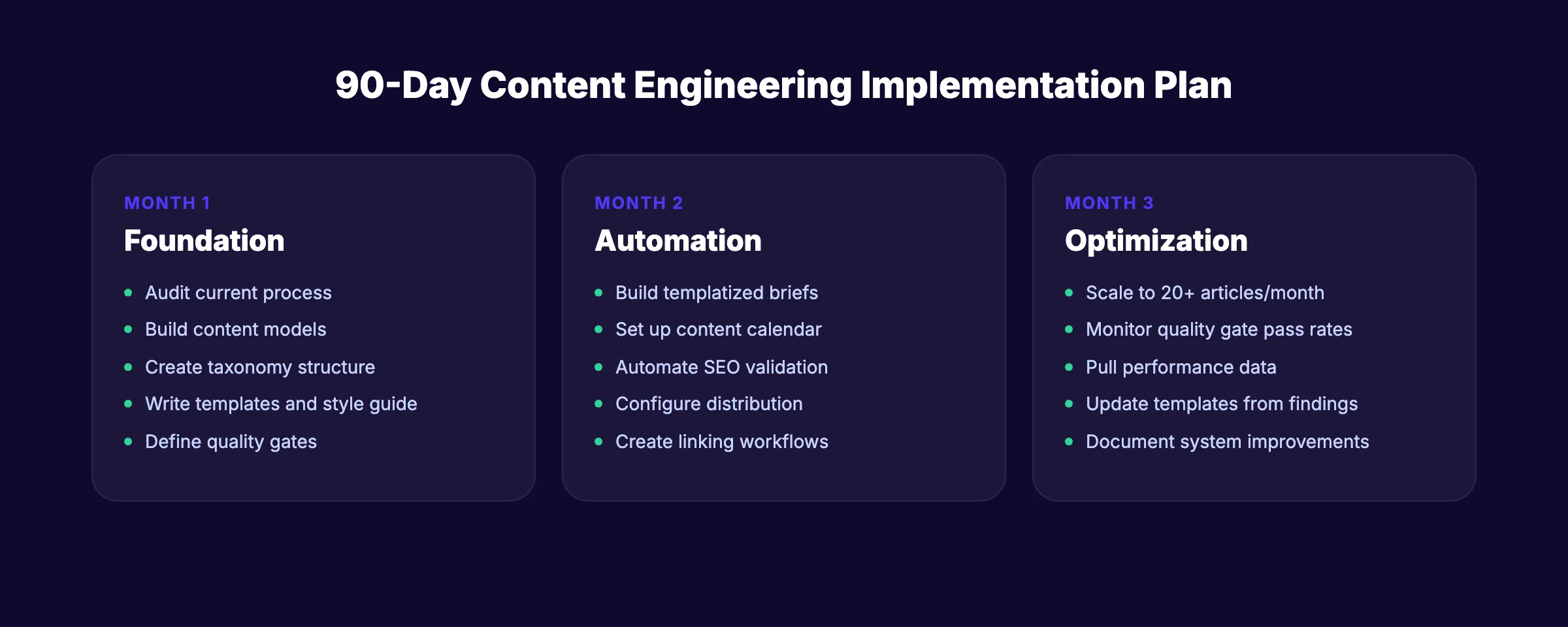
Month 1: Foundation
Week 1 to 2: Audit and document
- Map your current content production process end to end
- Identify bottlenecks (where content stalls or requires rework)
- Inventory your existing content (posts, pages, categories, performance data)
- Review your tech stack and identify gaps
Week 3 to 4: Build the core system
- Create your content model for each content type
- Set up your taxonomy and tagging structure
- Write your style guide and content templates
- Define quality gates and minimum standards
Month 2: Automation
Week 5 to 6: Workflow automation
- Build templatized briefs that auto-populate from keyword data
- Set up your content calendar with assigned topics, deadlines, and quality checkpoints
- Create publishing checklists that enforce your content model
- Automate SEO validation (keyword placement, link density, meta fields)
Week 7 to 8: Distribution automation
- Set up automatic social distribution on publish
- Create email notification triggers for new content
- Build your internal linking workflow (new posts link to relevant existing posts, and existing posts get updated to link to new ones)
Month 3: Optimization
Week 9 to 10: Scale production
- Increase publishing cadence using your new system
- Target 20+ articles per month if you were previously below 10
- Monitor quality gate pass rates to ensure volume does not sacrifice quality
Week 11 to 12: Measure and iterate
- Pull production metrics: cycle time, cost per piece, pass rates
- Pull performance data for content published in month 1
- Identify your top-performing content patterns
- Update templates and briefs based on findings
- Document lessons learned and system improvements
By the end of 90 days, you will have a functioning content engineering system that produces more content, at higher quality, with less manual effort than your previous process.
The Done-For-You Alternative
Not every team needs to build this from scratch.
If you want the output of a content engineering system without hiring engineers, building workflows, or managing tools, Stacc handles it. We run the entire content production pipeline: keyword research, briefing, writing, optimization, and publishing. 30 articles per month. $99. No setup required.
The system we use internally mirrors everything described in this guide. The difference is that we built it so you do not have to.
FAQ
What is content engineering in marketing?
Content engineering in marketing is the practice of designing systems that produce, optimize, and distribute content at scale. It combines elements of content strategy, workflow automation, and data analysis to replace ad hoc content creation with a repeatable production pipeline. The result is higher volume, lower cost, and more consistent quality.
How is a content engineer different from a content strategist?
A content strategist decides what content to create and why. A content engineer designs the systems that produce that content efficiently. Content strategists own the editorial calendar and messaging. Content engineers own the workflows, templates, automation, and quality gates. Most teams need both functions, though in smaller organizations one person may handle both.
What skills does a content engineer need?
A content engineer needs experience in content strategy, proficiency with automation and CMS platforms, understanding of SEO and structured data, and data analysis capabilities. The role sits at the intersection of marketing, operations, and technology. Strong content engineers can read analytics dashboards, configure workflow tools, and write a content brief with equal confidence.
How much does content engineering cost to implement?
For small teams, the primary cost is time. Building templates, workflows, and quality gates takes 40 to 80 hours of setup work across the first quarter. Tool costs range from $0 (using existing platforms) to $500 per month for dedicated content operations software. Alternatively, services like Stacc provide the output of a content engineering system starting at $99 per month with no setup required.
Can small businesses benefit from content engineering?
Yes. Small businesses benefit the most because they have the biggest gap between content needs and available resources. A solo marketer publishing 4 posts per month cannot compete with agencies publishing 30. Content engineering closes that gap through systems and automation. Even basic implementations, like templatized briefs and publishing checklists, reduce production time by 30% or more.
What tools do content engineers use?
Content engineers typically use a combination of CMS platforms (WordPress, Webflow, Astro), SEO tools (Surfer SEO, Ahrefs, Semrush), project management tools (Notion, Asana, Monday), and automation platforms (Zapier, Make, custom APIs). The specific stack depends on team size, budget, and content volume goals. Check our list of content marketing tools for small teams for specific recommendations.
Content engineering is not a trend. It is the operational layer that separates marketing teams that scale from those that stall. The teams publishing 30 optimized articles per month are not working 10 times harder. They built better systems.
Start with the audit. Build the model. Automate the repeatable steps. Measure everything. Improve constantly.
That is content engineering. And it is the most valuable investment your marketing team will make this year.

Written by
Siddharth GangalSiddharth is the founder of theStacc and Arka360, and a graduate of IIT Mandi. He spent years watching great businesses lose organic traffic to competitors who simply published more. So he built a system to fix that. He writes about SEO, content at scale, and the tactics that actually move rankings.
30 SEO blog articles published every month
Keyword-optimized, scheduled, and live on your site. Automatically.
30-day trial · Cancel anytime
theStacc
Stop writing SEO content manually
30 blog articles, 30 GBP posts, and social media content. Published every month. Automatically.
Start Your $1 Trial$1 for 3 days · Cancel anytime