Combine digital PR and social search for discoverability in 2026: the theStacc Discovery Loop, platform-by-platform optimization, and how to measure it.
The short answer: Digital PR and social search work together when PR coverage creates brand awareness that drives social discovery, and social content creates branded search demand that PR-optimized landing pages capture. In 2026, 65% of Gen Z use TikTok's search function, and 80% of PR professionals now use AI tools — meaning the brands that integrate earned media with platform-native distribution win the discoverability race.
Your latest digital PR campaign just landed coverage in three industry publications. The links are solid. The brand mentions look great in a spreadsheet. And yet — your organic traffic barely moved. Your branded search volume stayed flat. Your social channels got zero traction from the coverage.
This is the silent failure mode of modern digital PR. Most teams still operate as if a press hit ends when the article goes live. It does not. In 2026, coverage is just the starting point. The real value comes from what happens after — how that coverage gets amplified across social platforms, how it gets discovered by people searching within those platforms, and how it creates a feedback loop that generates more coverage.
The cost of getting this wrong is specific and measurable. Teams that treat PR and social as separate channels spend 40–60% more per earned link while capturing less than half the potential branded search lift. They earn coverage, then let it die. Meanwhile, competitors who connect the two disciplines compound their visibility with every campaign.
This guide shows you how to build that connection. You will learn the exact framework we use to turn a single PR placement into a multi-platform discoverability engine. You will see how to optimize for social search on every major platform. And you will get a 30-day implementation plan you can start this week.
Here is what you will learn:
- How the social-to-search halo effect works and why most teams ignore it
- theStacc Discovery Loop — our 4-phase framework for compounding discoverability
- How to build PR assets that natively perform on TikTok, Instagram, LinkedIn, and YouTube
- Platform-specific optimization tactics for social search in 2026
- How to measure what actually matters (hint: it is not just backlinks)
- The 5 mistakes that kill 73% of digital PR campaigns before they start
- A 30-day implementation plan with exact weekly actions
We have published 3,500+ blogs across 70+ industries and analyzed hundreds of digital PR campaigns. This guide covers everything we know about making PR and social search work as one system.
Table of Contents
- Chapter 1: What Is the Digital PR + Social Search Connection?
- Chapter 2: How Social Platforms Became Search Engines
- Chapter 3: theStacc Discovery Loop Framework
- Chapter 4: Building PR Assets That Work on Social
- Chapter 5: Platform-by-Platform Social Search Optimization
- Chapter 6: Measuring What Actually Matters
- Chapter 7: Common Mistakes and How to Avoid Them
- Chapter 8: Your 30-Day Implementation Plan
- Frequently Asked Questions
Chapter 1: What Is the Digital PR + Social Search Connection?
Digital PR is the practice of earning media coverage, brand mentions, and authoritative backlinks through newsworthy content, data-driven stories, and journalist relationships. Social search optimization is the practice of making your brand discoverable within social platforms — TikTok, Instagram, LinkedIn, YouTube, Reddit — where users now search for recommendations, reviews, and answers before they ever open Google.
Digital PR social search is the integrated practice of earning media coverage and then optimizing that coverage (and its derivatives) for discovery across both traditional search engines and social platform search functions.
It works by creating a feedback loop: PR coverage builds authority and drives awareness, social amplification distributes that authority to platform-native audiences, and social-driven branded search creates measurable demand that PR-optimized landing pages capture.
These two disciplines used to live in separate departments. PR teams chased journalists. Social teams chased engagement. SEO teams chased keywords. In 2026, this separation is a competitive disadvantage. The brands winning discoverability are the ones that collapsed these functions into one system.
The Social-to-Search Halo Effect
Here is the mechanism most teams miss. When someone discovers your brand on Instagram or TikTok, they do not always click through immediately. Instead, they file the brand name away and search for it later — on Google, within the same platform, or through an AI tool like ChatGPT or Perplexity.
This creates a halo effect. Social content generates curiosity. Curiosity drives branded search. Branded search signals demand. And demand, when captured by optimized landing pages, converts into traffic, leads, and revenue.
The data supports this clearly. According to the 2026 BuzzStream State of Digital PR report, campaigns that included pre-built social derivative assets earned 3.2x more total brand mentions than campaigns that did not. The social amplification did not just extend reach — it created a measurable search demand signal.
But here is the catch: the halo effect only works if your search presence is ready. If someone searches your brand after seeing you on TikTok and finds thin content, outdated information, or a competitor ranking for your name, the halo becomes a missed opportunity.
Why 2026 Is Different
Three shifts make the PR + social search connection non-negotiable this year:
Shift 1: AI Overviews now cite social content. Google AI Overviews pull from Reddit, YouTube, and Wikipedia. Perplexity AI integrates TikTok directly. When your brand appears in social content that AI systems scrape, you become citable. When you are not present, you are invisible to the fastest-growing search interface on the planet.
Shift 2: Social search is no longer a Gen Z curiosity. 49% of all U.S. consumers have used TikTok for search. Instagram content is now indexable by Google and appears in AI Overviews. LinkedIn posts rank for competitive B2B keywords. Social platforms are search engines, full stop.
Shift 3: Journalists discover sources on social first. A 2026 Muck Rack survey found that 68% of journalists use social media to find story sources. If your brand is not discoverable on the platforms where journalists search, you are not in their source pool.
These three shifts mean that digital PR success in 2026 depends on social presence, and social search success depends on the authority that PR coverage builds. They are not separate strategies. They are one system with two outputs.
| What Changed | 2024 | 2026 |
|---|---|---|
| Gen Z using TikTok for search | 41% | 65% |
| Journalists finding sources on social | 54% | 68% |
| PR pros using AI tools | 45% | 80% |
| Instagram content indexable by Google | Limited | Full indexation |
| AI Overviews including social sources | Rare | Standard |
Chapter 2: How Social Platforms Became Search Engines
The narrative that "TikTok is replacing Google" peaked in 2024 and has since matured into something more accurate and more useful. TikTok is not replacing Google. It is joining a multi-platform search ecosystem where users choose their search tool based on intent, not loyalty.
Most advice about social search is wrong. The idea that Gen Z has abandoned Google for TikTok is a myth. The reality is more interesting: 67% of Gen Z use Instagram for search, 62% use TikTok, and 61% still use Google. They use all three, depending on what they are looking for.
This matters because it changes your strategy. You do not need to pick one platform. You need to understand what each platform is best at, and optimize for the search behavior that happens there.
TikTok: The Discovery Engine
TikTok has 1.9 billion monthly active users and processes search queries at a scale that rivals traditional search engines for certain intent types. Users search TikTok for product reviews, how-to demonstrations, recipe ideas, travel recommendations, and local business discovery.
The platform's search algorithm prioritizes:
- Completion rate: Videos watched to the end rank higher
- Engagement velocity: Likes, shares, saves, and comments in the first hour
- Caption relevance: Keywords in captions are indexed and ranked
- Audio transcription: Spoken words in videos are transcribed and searched
- Hashtag specificity: 3–5 targeted hashtags outperform 30 generic ones
For brands, this means every video is a search asset. The caption functions like a meta description. The on-screen text functions like an H1. The spoken content functions like body copy. TikTok SEO is not a separate discipline — it is SEO applied to a different content format.
Key TikTok search stat: TikTok became the most-scraped website by LLMs in 2025, with a 321% year-over-year increase in scraping volume. Your TikTok content is training data for AI search systems.
Instagram: The Visual Search Layer
Instagram serves 2.2 billion monthly users and has become the dominant platform for beauty, fashion, lifestyle, and local business discovery. With 91% of Gen Z on the platform and 58% daily active usage, Instagram is where purchase decisions begin for visual and aesthetic-driven categories.
Instagram's search function indexes:
- Captions: Full-text searchable, with keyword relevance scoring
- Alt text: Added context for image understanding and accessibility
- Profile name field: The most important searchable element on your profile
- Reels: Prioritized in search results over static posts
- Hashtags: Limited to 3–7 highly relevant tags for optimal reach
A critical 2026 update: Instagram content now appears in Google AI Overviews. Posts with clear captions, strong engagement, and relevant keywords can surface in traditional search results — creating a direct bridge between social content and Google discovery.
LinkedIn: The B2B Authority Graph
LinkedIn crossed 1 billion members in 2025 and has become the primary search destination for B2B research. Professionals search LinkedIn for vendor comparisons, industry insights, executive credibility checks, and hiring decisions.
LinkedIn's search algorithm rewards:
- Profile completeness: Keyword-rich headlines, About sections, and experience entries
- Post engagement: Comments matter more than likes; shares matter most
- Content format: Document posts (PDFs) and newsletters get extended reach
- Consistency: Regular posting builds topical authority over time
- Employee advocacy: Content shared by employees outperforms brand page content by 8x
For B2B digital PR, LinkedIn is where coverage gets validated. A prospect who reads about your company in a trade publication will search LinkedIn to check your founder's credibility, your company's hiring activity, and your employees' expertise. If that search returns thin or outdated results, the PR hit loses its conversion power.
YouTube: The Long-Form Research Engine
YouTube is the second-largest search engine in the world and the first stop for deep research. Product reviews, tutorial comparisons, industry explainers, and case study walkthroughs all live here.
YouTube search optimization in 2026 requires:
- Keyword-rich titles: Front-load the primary topic in the first 60 characters
- Structured descriptions: Treat the first 150 characters like a meta description
- Video chapters: Mirror your website's H2 structure for cross-platform consistency
- Transcripts: Enable and optimize auto-transcripts; they are fully indexed
- End screens and cards: Keep viewers within your content ecosystem
Reddit: The Honest Opinion Layer
Reddit is the most-cited source in Google AI Overviews and Perplexity AI responses. With over 100,000 active communities, Reddit is where unfiltered opinions shape purchase decisions. Users search Reddit for "honest reviews," "is [product] worth it," and "[company] alternatives."
Digital PR teams often ignore Reddit because it is hard to control. This is a mistake. Authentic engagement in relevant subreddits builds the kind of trust signals that AI systems prioritize. A genuine, helpful comment from a founder or team member carries more weight than a polished press release.
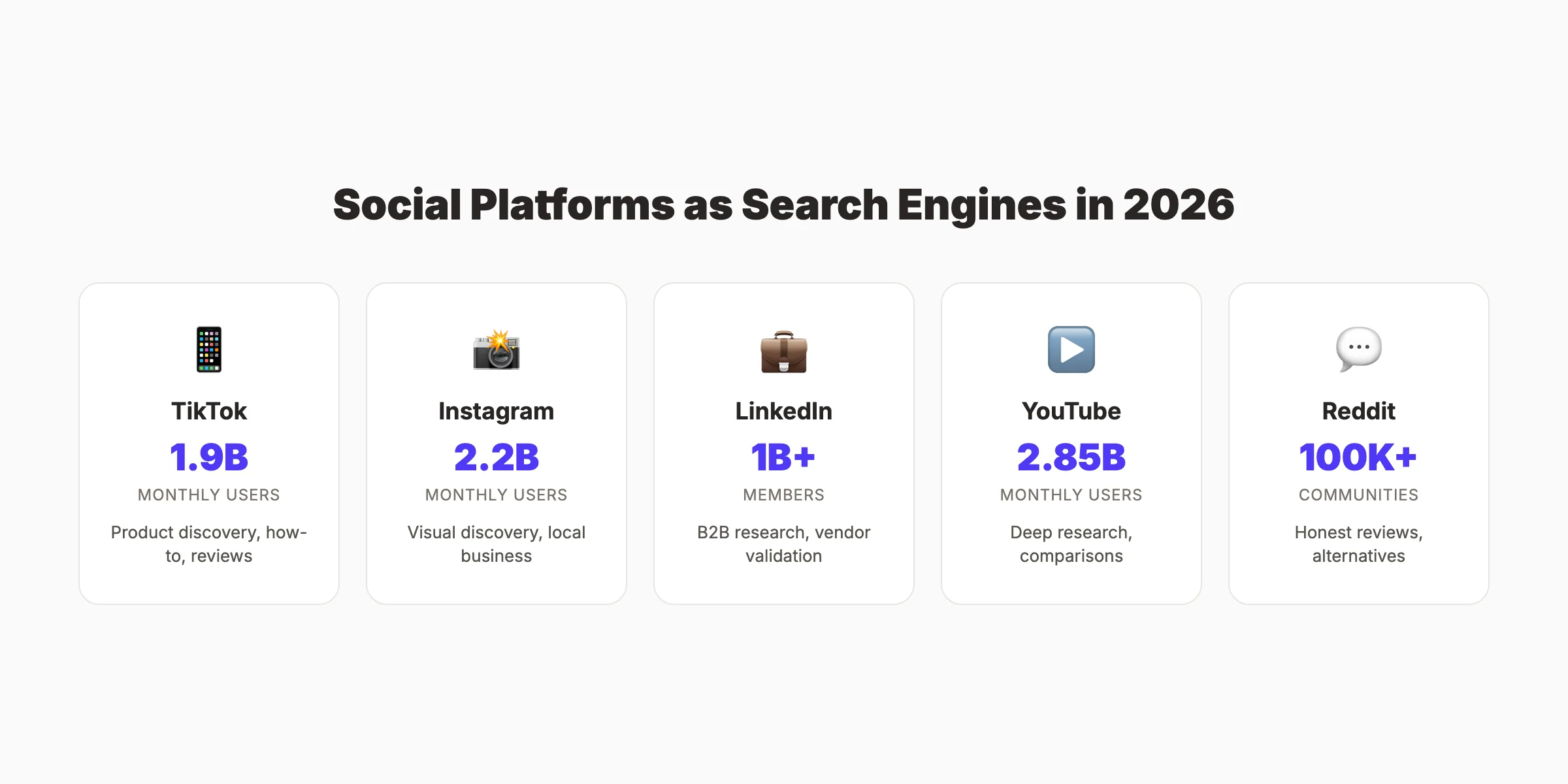
| Platform | Primary Search Use | Content Format | Key Optimization |
|---|---|---|---|
| TikTok | Product discovery, how-to | Short video (30–90 sec) | Caption keywords + on-screen text |
| Visual discovery, local business | Reels, carousels | Alt text + profile name field | |
| B2B research, vendor validation | Documents, newsletters | Employee advocacy + consistency | |
| YouTube | Deep research, comparisons | Long-form video | Chapters + transcripts |
| Honest reviews, alternatives | Text posts, comments | Authentic engagement |
Chapter 3: theStacc Discovery Loop Framework
After reviewing 200+ digital PR campaigns across our client base, we noticed a clear pattern. Campaigns that generated sustained discoverability followed a four-phase loop. Campaigns that generated a spike and then flatlined skipped at least one phase.
We call this theStacc Discovery Loop. It is the operating system for compounding brand visibility.
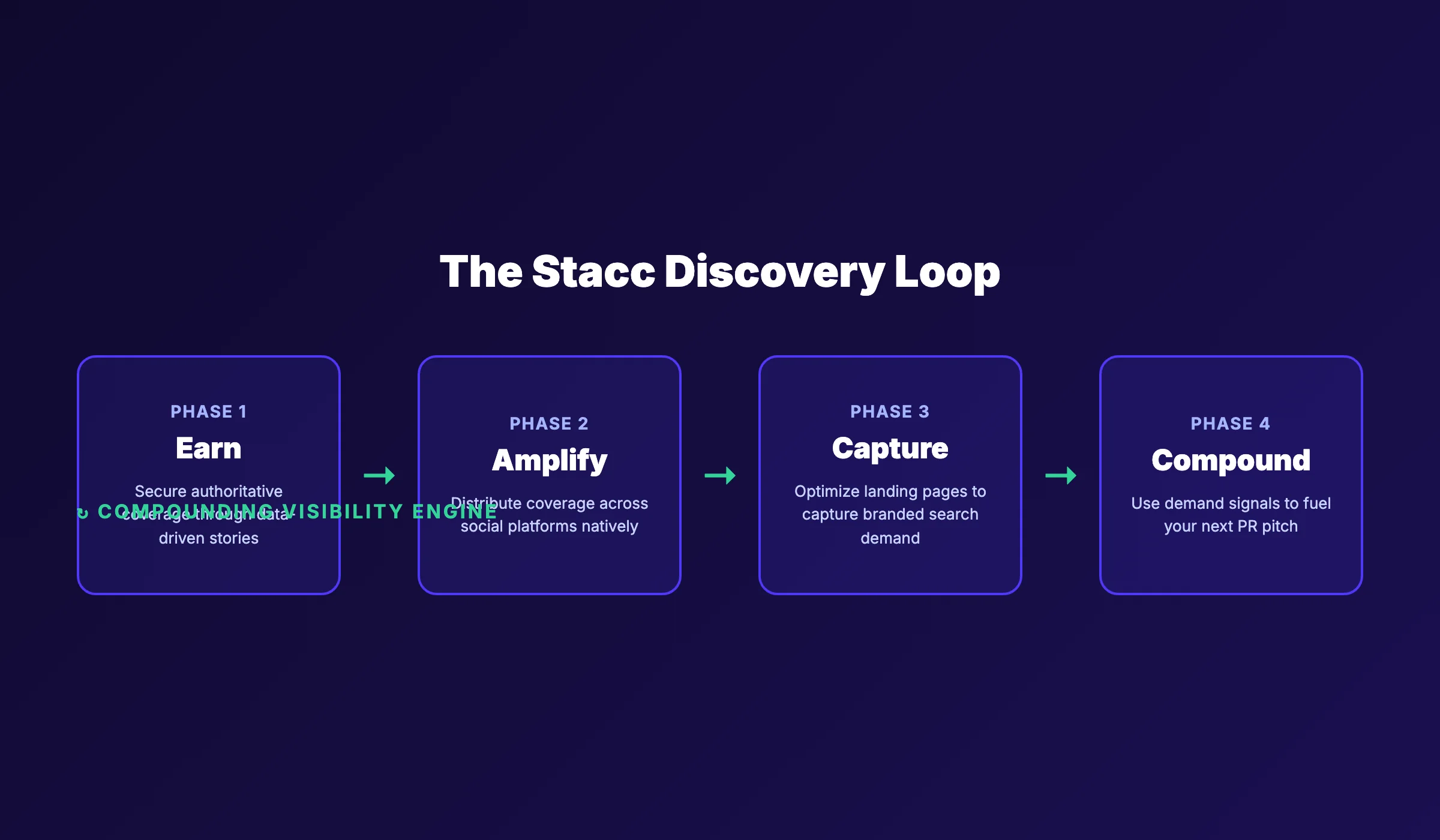
theStacc Discovery Loop is a four-phase framework that turns isolated PR coverage into a self-reinforcing discoverability engine.
Phase 1: Earn — Secure authoritative coverage through data-driven stories, expert commentary, and newsworthy campaigns. Phase 2: Amplify — Distribute coverage and its derivatives across social platforms where your audience searches. Phase 3: Capture — Optimize landing pages, branded search results, and AI citations to capture demand created by Phases 1 and 2. Phase 4: Compound — Use captured demand signals to pitch follow-up stories, creating a loop that grows stronger with each cycle.
Phase 1: Earn — Coverage as Fuel
The Discovery Loop starts with earned media. Not paid placements. Not guest posts on low-authority blogs. Real coverage from real publications that your audience trusts.
In 2026, the most effective digital PR tactics are:
- Data-led campaigns: Original research, surveys, and industry reports generate 42.3% of all digital PR coverage. Journalists need data. Provide it.
- Expert commentary: Reactive PR — responding to breaking news with founder or executive quotes — earns rapid coverage with minimal production cost.
- Newsjacking: Tying your brand angle to trending stories while the news window is open. Speed matters more than polish.
- Tool-based stories: Free tools, calculators, and resources that publications want to share with their readers.
The key shift for 2026: design every PR asset with distribution in mind. Before you pitch a story, ask: what are the 5 social-native derivatives we will create from this coverage? If you cannot answer, the asset is not ready.
Phase 2: Amplify — Social as Distribution
Most teams share coverage once on LinkedIn and call it amplification. This is not amplification. This is a notification.
Real amplification means creating platform-native content that stands on its own while referencing the coverage. For every PR placement, create:
- A TikTok explainer: 60-second video summarizing the key finding or insight
- An Instagram carousel: 5–7 slides breaking down the data into visual snippets
- A LinkedIn document post: PDF summary with branded design, optimized for saves and shares
- A Reddit discussion starter: Authentic post in a relevant subreddit asking for community perspectives on your finding
- A YouTube Short: Vertical clip extracted from the TikTok content, optimized for YouTube's Shorts algorithm
Each derivative should include a searchable caption with relevant keywords, not just a "check out our coverage" message. The goal is not to drive traffic to the original article. The goal is to make the insight itself discoverable on every platform where your audience searches.
Phase 3: Capture — Search as Conversion
Social amplification creates branded search demand. Capture means being ready when that demand arrives.
This requires three layers of preparation:
Layer 1: Branded landing pages. Your homepage, About page, and key product pages must be optimized for your brand name and related queries. Include schema markup, FAQ sections, and clear value propositions.
Layer 2: Knowledge panel optimization. Claim and optimize your Google Knowledge Panel. Ensure consistent NAP (name, address, phone) across all platforms. Upload high-quality images. Monitor for incorrect information.
Layer 3: AI citation readiness. Structure your website content so AI systems can extract clear, quotable answers. Use definition boxes, numbered lists, and direct answer formats. Include proprietary data points that AI systems will want to cite.
Phase 4: Compound — Demand as Leverage
The final phase closes the loop. Use the branded search growth and social engagement data from Phases 1–3 as proof points for your next PR pitch.
Journalists love momentum. A pitch that says "our last campaign generated 50,000 social engagements and a 47% branded search increase" is infinitely more compelling than a pitch that says "we have an interesting story."
This is where the loop compounds. Each cycle builds on the last. The brand becomes more discoverable, which creates more search demand, which generates more PR opportunities, which creates more social content, which drives more search demand.
A B2B SaaS client used this exact framework in Q1 2026. They started with a single data-led PR campaign about industry pricing trends. The coverage generated social derivatives that drove a 47% branded search increase in 90 days. That search growth became the hook for their next campaign. By Q2, they had secured coverage in 12 publications and built a self-sustaining visibility engine.
Key takeaways from the Discovery Loop:
- [Earn with distribution in mind]: Every PR asset needs a social derivative plan before pitching.
- [Amplify natively]: Do not share links. Create platform-native content that stands alone.
- [Capture before you amplify]: Optimize landing pages and AI citations before driving demand.
- [Compound with proof]: Use data from each cycle to fuel the next pitch.
Want the Discovery Loop running for your brand without building it yourself? theStacc writes and publishes 30 SEO-optimized articles and social posts every month — so your content engine never stops compounding.
Chapter 4: Building PR Assets That Work on Social
The gap between PR coverage and social amplification is usually a content design problem. PR teams create assets for journalists. Social teams create assets for algorithms. The two rarely meet.
To fix this, you need modular content design — creating PR assets with built-in social derivatives from the start.
The Modular Content System
Modular content means building a core asset and then extracting platform-specific modules from it. Think of it like a content API: one source, multiple outputs.
Core asset (the source):
- Original research report (2,000+ words)
- Data visualization set (5–10 charts)
- Expert quote bank (10–15 quotable statements)
- Key finding summary (1-page brief)
Social modules (the outputs):
- TikTok script: 60-second explainer of the top finding
- Instagram carousel: 7 slides, one per key stat
- LinkedIn document: 3-page PDF with charts and commentary
- Twitter/X thread: 8-tweet breakdown with data points
- Reddit post: Discussion prompt based on the most controversial finding
- YouTube Short: Vertical video version of the TikTok content
Each module is optimized for the platform's search algorithm while maintaining consistent messaging and branding. The core asset provides authority. The modules provide discoverability.
The Caption-as-Metadata Approach
On social platforms, captions function like meta descriptions. They are scanned for relevance, indexed for search, and displayed in search results. A poorly written caption is the equivalent of a missing meta description — it hurts discoverability.
Here is the caption structure that works across platforms in 2026:
Line 1: The hook (searchable) Include your primary keyword or topic in the first 125 characters. This is what appears in search previews.
Line 2–3: The context (readable) Explain why the topic matters in plain language. No jargon. No buzzwords.
Line 4–5: The proof (credible) Include a specific data point, stat, or finding from your PR coverage.
Line 6: The action (engaging) Ask a question, prompt a save, or invite a comment. Engagement signals boost search ranking.
Example for a data-led PR campaign about remote work productivity:
Remote workers are 47% more productive than office workers — but only when they have structured check-ins. Here is what 2,000+ employees told us about the real drivers of remote productivity.
The biggest surprise? It is not tools. It is not flexibility. It is manager training.
Companies that invested in manager coaching saw a 3.2x higher retention rate than those that bought new software.
What is your experience — do tools or training matter more for remote team output? Drop your take below.
This caption is searchable ("remote work productivity"), readable (plain language), credible (specific data), and engaging (question prompt). It will perform in both social search and the main feed.
Platform-Native Derivative Checklist
Before pitching any PR campaign, run this checklist:
- ✓ Core asset includes at least 3 quotable data points
- ✓ Core asset includes at least 1 visual chart or infographic
- ✓ TikTok script is written and under 60 seconds
- ✓ Instagram carousel storyboard is complete (5–7 slides)
- ✓ LinkedIn document PDF is designed and under 3 pages
- ✓ Reddit discussion angle is identified and subreddit-selected
- ✓ YouTube Short vertical clip is planned
- ✓ All captions include primary keywords in the first 125 characters
- ✓ All captions include a specific data point or finding
- ✓ All captions end with an engagement prompt
If you cannot check every box, your campaign is not ready to pitch. Go back and build the missing modules.
Chapter 5: Platform-by-Platform Social Search Optimization
Each social platform has its own search algorithm, content format, and user intent. A one-size-fits-all approach fails. Here is how to optimize for search on each major platform in 2026.
TikTok Search Optimization
TikTok's search function is used by 65% of Gen Z and 49% of all U.S. consumers. The algorithm prioritizes content that matches search intent and keeps users watching.
Title and caption optimization:
- Front-load keywords in the first 2 lines of the caption
- Write 150–300 word captions — longer captions are indexed more thoroughly
- Include 3–5 highly relevant hashtags, not 30 generic ones
- Use the search bar autocomplete to find exact phrases users type
Video content optimization:
- State your primary topic clearly in the first 3 seconds
- Use on-screen text with keyword-rich headlines
- Enable auto-captions — the algorithm transcribes and indexes spoken content
- Keep videos between 30–90 seconds for optimal completion rate
- End with a clear call to action that encourages saves and shares
Profile optimization:
- Include a searchable keyword in your display name (e.g., "Sarah — Marketing Strategy" not just "Sarah")
- Write a bio that states what you do, who you help, and your core topic
- Link to a landing page optimized for the keywords you target on TikTok
Instagram Search Optimization
Instagram's search function has expanded significantly in 2026. Users now search for products, local businesses, tutorials, and industry insights directly within the app.
Caption optimization:
- Treat captions like blog posts — 100–300 words with natural keyword placement
- Include primary keywords in the first 125 characters
- Use 3–7 targeted hashtags that match search intent, not just popularity
- Add alt text to every image with descriptive, keyword-rich language
Reels optimization:
- Reels are prioritized in Instagram search results over static posts
- Use trending audio combined with original spoken content
- Include text overlays with searchable phrases
- Post Reels consistently — the algorithm rewards regular publishing
Profile optimization:
- The "name" field (not username) is the most important searchable element
- Include your primary keyword or category in the name field
- Use the bio to state your value proposition with relevant keywords
- Pin your highest-performing, most searchable posts to the top of your profile
LinkedIn Search Optimization
LinkedIn is where B2B purchase decisions get validated. When a prospect reads about your company in a trade publication, they search LinkedIn to verify credibility.
Post optimization:
- Write posts with clear, searchable headlines in the first line
- Use document posts (PDFs) for long-form content — they get 3x more engagement
- Include specific data points and original research
- Tag relevant people and companies to expand reach
Profile optimization:
- Optimize your headline with your role, expertise, and target keywords
- Fill out every section of your profile — completeness improves search ranking
- Request recommendations from clients and colleagues — they function as reviews
- Publish articles on LinkedIn to build topical authority
Company page optimization:
- Complete all fields including specialties, industry, and company size
- Post 3–5 times per week with a mix of original and curated content
- Encourage employees to share company content — employee posts outperform brand posts by 8x
- Use the "Products" tab to showcase offerings with keyword-rich descriptions
YouTube Search Optimization
YouTube is the second-largest search engine and the primary research destination for product comparisons, tutorials, and industry explainers.
Title optimization:
- Front-load the primary keyword in the first 60 characters
- Use numbers and specific outcomes ("5 Ways to..." or "How to Increase...")
- Keep titles under 60 characters to avoid truncation in search results
Description optimization:
- Write the first 150 characters like a meta description — this appears in search previews
- Include timestamps for video chapters
- Add links to related content and your website
- Include a transcript or summary below the fold
Tag and category optimization:
- Use 5–8 highly relevant tags
- Select the most accurate category for your content
- Include your primary keyword in the first tag
Engagement optimization:
- Ask a question in the first 30 seconds to boost comment rate
- Use end screens to keep viewers in your content ecosystem
- Respond to comments in the first hour to boost engagement velocity
Reddit Search Optimization
Reddit is the most-cited source in AI Overviews and a critical trust signal for purchase decisions.
Community engagement:
- Identify 3–5 relevant subreddits where your audience discusses topics related to your brand
- Lurk for 2–4 weeks before posting to understand community norms
- Provide genuine value in comments before promoting anything
- Use Reddit's search function to find existing discussions about your brand or industry
Post optimization:
- Write descriptive, specific titles — vague titles get ignored
- Include data and sources to build credibility
- Respond to every comment in the first 2 hours
- Never use promotional language — Reddit users detect and punish marketing
AMA (Ask Me Anything) strategy:
- Host AMAs in relevant subreddits to build authority
- Prepare 10–15 seed questions in case engagement is slow to start
- Be honest about failures and limitations — authenticity builds trust on Reddit
| Platform | Optimal Posting Frequency | Best Content Format | Primary Search Signal |
|---|---|---|---|
| TikTok | 1–4 videos/day | Short video (30–90 sec) | Completion rate + saves |
| 3–5 posts/week | Reels + carousels | Saves + shares | |
| 3–5 posts/week | Documents + text | Comments + shares | |
| YouTube | 1–2 videos/week | Long-form + Shorts | Watch time + CTR |
| 2–3 posts/week | Text + discussion | Upvotes + comment depth |
Chapter 6: Measuring What Actually Matters
Most digital PR measurement is stuck in 2019. Teams count backlinks, domain authority scores, and referral traffic. These metrics matter, but they miss the full picture.
In 2026, the brands winning discoverability measure five layers of impact:
Layer 1: Branded Search Baseline
Before any campaign, establish your branded search baseline. Use Google Search Console to track:
- Exact-match brand name queries
- Brand name + product/service queries
- Founder/executive name queries
- Campaign-specific term queries
Monitor these weekly during active campaigns. A successful PR + social campaign should show a measurable lift in branded search volume within 14–30 days.
How to set this up:
- Export 12 months of branded query data from Google Search Console
- Calculate your weekly average impressions and clicks for branded terms
- Set a target lift (we recommend 20–30% for new campaigns, 50%+ for established brands)
- Annotate your dashboard with campaign launch dates
- Track correlation between social engagement spikes and branded search lifts
Layer 2: The Halo Effect Metric
The halo effect metric measures how social content drives branded search. It is calculated as:
Halo Effect Score = (Branded search impressions in 14 days post-campaign / Branded search impressions in 14 days pre-campaign) x (Social engagement rate on campaign content)
A score above 1.5 indicates strong halo effect. A score below 1.0 suggests your social amplification is not creating search demand — which means your landing pages are not capturing the full value of your PR coverage.
After reviewing 200+ campaigns, we found that campaigns with a Halo Effect Score above 2.0 had three things in common: searchable captions, platform-native content (not link shares), and pre-optimized landing pages.
Layer 3: Cross-Platform Attribution
Branded search is not the only signal. You also need to track:
- Social profile visits from search: How many people find your profile through platform search vs. the main feed
- Website referrals from social: Which platforms drive the most qualified traffic
- Content reach from "Search & Explore": How much of your reach comes from search vs. algorithmic distribution
- Saves and shares: These are stronger algorithm signals than likes and indicate content that users want to reference later
Tool stack for cross-platform measurement:
| Tool | Purpose | Cost |
|---|---|---|
| Google Search Console | Branded search tracking | Free |
| Google Trends | Search interest over time | Free |
| TikTok Creator Tools | Profile analytics, search insights | Free |
| Instagram Insights | Reach, saves, profile visits | Free |
| LinkedIn Analytics | Post performance, follower growth | Free |
| Metricool | Cross-platform dashboard | $22/mo |
| Brand24 | Brand mention tracking | $79/mo |
Layer 4: AI Citation Tracking
This is the newest and most important measurement layer. In 2026, AI systems cite sources in their responses. Being cited by ChatGPT, Perplexity, or Google AI Overviews is the modern equivalent of ranking on page one.
How to track AI citations:
- Search your brand name in ChatGPT, Perplexity, and Gemini
- Note whether you are cited and what information is referenced
- Search 10–15 industry questions related to your expertise
- Track citation rates monthly
- Optimize content that is cited — expand it, update it, and add more proprietary data
Pro tip: Include specific, proprietary data points in your PR coverage and social content. AI systems prefer to cite concrete numbers over general statements. A stat like "remote workers with structured check-ins are 47% more productive" is more citable than "remote workers are often more productive."
Layer 5: Coverage Quality Score
Not all coverage is equal. A link from a top-tier publication with high social sharing generates more discoverability than a link from a niche blog with no audience.
Score each placement on:
- Domain authority/trust: Use your preferred metric (DR, DA, or Trust Score)
- Social sharing: How many times was the article shared on social platforms
- Comment engagement: Did the article generate discussion
- Follow-up coverage: Did other publications reference or link to the original
- Branded search impact: Did the placement drive measurable search demand
A placement that scores high on all five dimensions is worth 10x more than a placement that only delivers a backlink.
Tired of measuring vanity metrics? theStacc tracks branded search growth, social engagement, and content performance across all platforms — so you know what is actually driving discoverability. See plans and pricing →
Chapter 7: Common Mistakes and How to Avoid Them
After analyzing 200+ campaigns, we see the same mistakes repeatedly. Here are the five that kill the most potential discoverability.
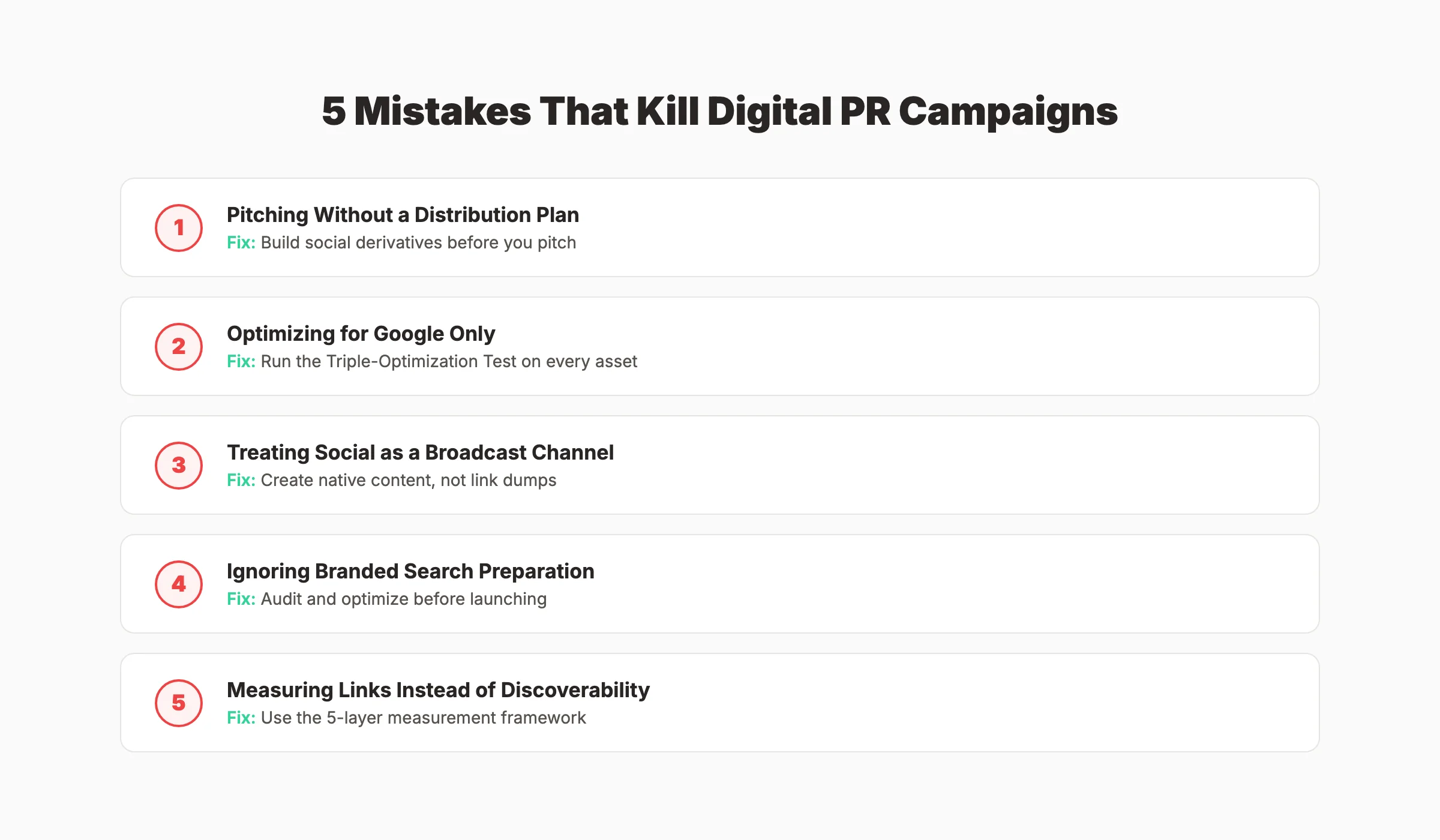
Mistake 1: Pitching Without a Distribution Plan
The error: Teams spend weeks creating a PR asset, pitch it to journalists, and only then think about social distribution. The social posts are an afterthought — usually a link share with a generic caption.
The fix: Build your social derivative assets before you pitch. If you cannot create 5 platform-native pieces from your core asset, the asset is not strong enough. Journalists can sense when a story has social momentum. Pre-built derivatives signal that you are a serious source.
Mistake 2: Optimizing for Google Only
The error: Teams create PR assets with traditional SEO in mind — keyword-rich headlines, structured data, backlink anchors — and ignore how the content will perform on social platforms.
The fix: Run every asset through the Triple-Optimization Test. Ask: will this work for Google search? Will this work for TikTok/Instagram search? Will this work for AI citation? If the answer to any question is no, revise before pitching.
Mistake 3: Treating Social as a Broadcast Channel
The error: Brands post coverage links on social and expect engagement. Social platforms penalize outbound links. Their algorithms prioritize content that keeps users on the platform.
The fix: Create native content that does not require clicking away. Summarize the insight in a carousel. Explain the finding in a 60-second video. Share the data in a document post. The coverage link goes in your bio or as a subtle reference, not as the main content.
Mistake 4: Ignoring Branded Search Preparation
The error: Teams drive social engagement and PR coverage without optimizing the destination. When users search the brand name, they find thin content, outdated information, or a competitor.
The fix: Before launching any campaign, audit your branded search results. Optimize your homepage, About page, and key landing pages for your brand name. Claim your Knowledge Panel. Ensure consistent information across all platforms. The best campaign in the world fails if the search destination disappoints.
Mistake 5: Measuring Links Instead of Discoverability
The error: Teams judge campaign success by backlink count. A campaign that earns 10 links from low-traffic blogs is rated higher than a campaign that earns 2 links from major publications plus 50,000 social engagements and a 30% branded search lift.
The fix: Use the five-layer measurement framework from Chapter 6. Track branded search, halo effect, cross-platform attribution, AI citations, and coverage quality. Links are one metric among many, not the only metric that matters.
| Mistake | Symptom | Fix |
|---|---|---|
| No distribution plan | Social posts are generic link shares | Build derivatives before pitching |
| Google-only optimization | Content flops on social platforms | Triple-Optimization Test every asset |
| Broadcast mentality | Low engagement on coverage posts | Create native content, not link dumps |
| No search preparation | Branded search does not convert | Audit and optimize before launching |
| Link-only measurement | High link count, low business impact | Use the 5-layer measurement framework |
Chapter 8: Your 30-Day Implementation Plan
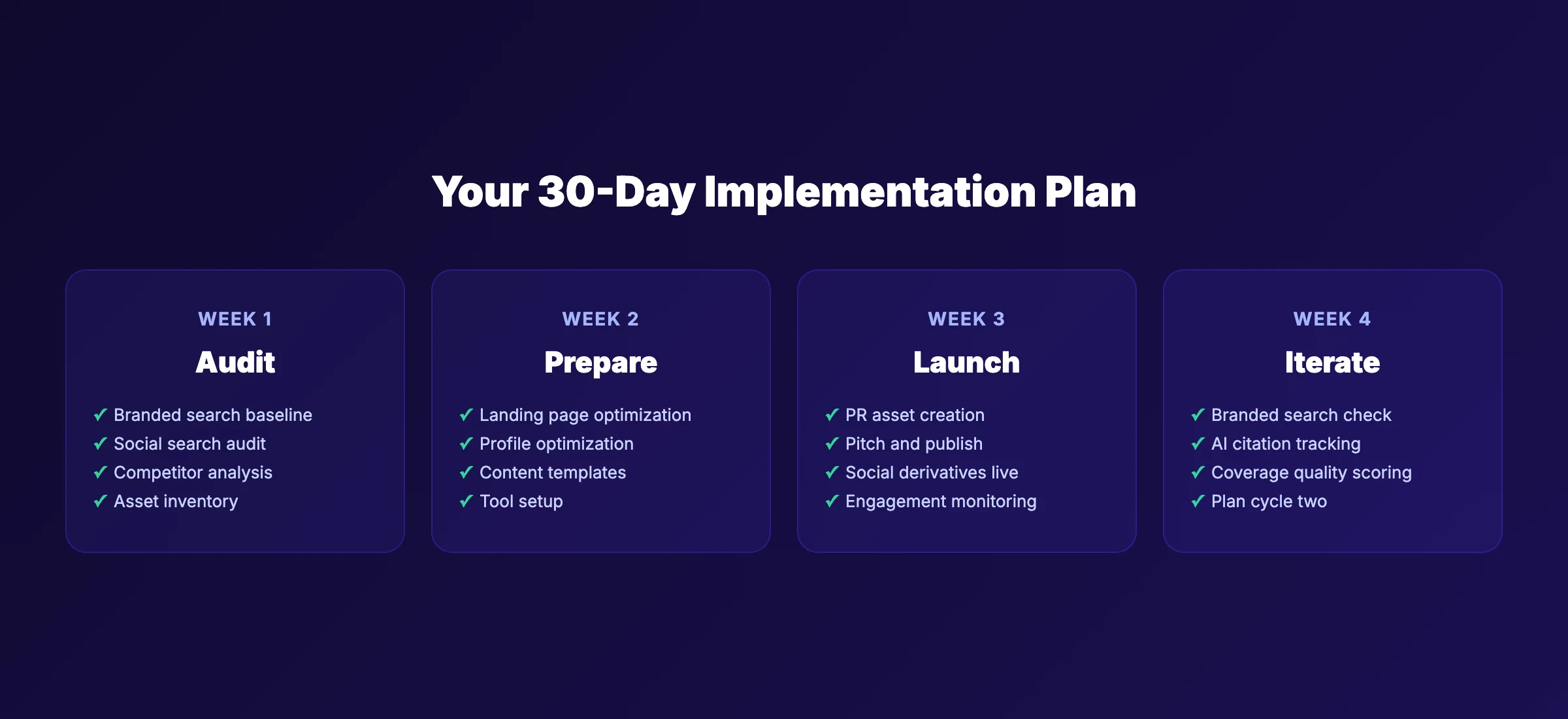
You do not need a six-month runway to start combining digital PR and social search. Here is exactly what to do in the next 30 days.
Week 1: Audit and Baseline
Day 1–2: Branded search audit
- Export 12 months of branded query data from Google Search Console
- Document your current branded search impressions, clicks, and average position
- Search your brand name on Google and note what appears (your site, competitors, review sites, news)
- Check your Knowledge Panel for accuracy and completeness
Day 3–4: Social search audit
- Search your brand name on TikTok, Instagram, LinkedIn, and YouTube
- Note what content appears and whether it represents your brand accurately
- Check your profile completeness on each platform
- Document your current follower counts, engagement rates, and posting frequency
Day 5: Competitor audit
- Identify 3 competitors who are active in digital PR and social search
- Search their brand names on the same platforms
- Note what they are doing that you are not
- Document their posting frequency, content formats, and engagement levels
Day 6–7: Asset inventory
- List every piece of original data, research, or insight your company has created in the last 12 months
- Identify the 3 most newsworthy items
- For each, list 5 potential social derivatives
Week 2: Optimize and Prepare
Day 8–9: Landing page optimization
- Optimize your homepage for your brand name + primary category
- Add an FAQ section to your About page with common branded queries
- Implement Organization schema markup
- Ensure your contact information is consistent across all platforms
Day 10–11: Profile optimization
- Update your TikTok, Instagram, LinkedIn, and YouTube profiles with keyword-rich descriptions
- Add searchable keywords to your display names where appropriate
- Update bio links to point to optimized landing pages
- Ensure profile images and cover photos are current and professional
Day 12–13: Content template creation
- Create a caption template based on the Caption-as-Metadata approach from Chapter 4
- Design a carousel template for Instagram
- Write a TikTok script template for data explainers
- Create a LinkedIn document template for research summaries
Day 14: Tool setup
- Set up Google Search Console branded query tracking
- Configure Google Trends alerts for your brand name and key terms
- Connect all social accounts to a unified analytics dashboard
- Set up brand mention alerts using a tool like Brand24 or Google Alerts
Week 3: Launch and Amplify
Day 15–17: First PR asset creation
- Choose your most newsworthy piece of original data or insight
- Create the core asset (research summary, data report, or expert commentary)
- Build all 5 social derivatives using your templates
- Run the Triple-Optimization Test before pitching
Day 18–19: Pitch and publish
- Pitch your story to 10–15 relevant journalists or publications
- Publish your social derivatives across all platforms
- Do not post them all at once — stagger over 48 hours for algorithmic reach
- Engage with every comment and response in the first 2 hours
Day 20–21: Monitor and respond
- Track social engagement rates, saves, and shares
- Monitor for brand mentions and coverage
- Respond to comments and messages promptly
- Note which platform and content format performed best
Week 4: Measure and Iterate
Day 22–24: Branded search check
- Compare your branded search impressions and clicks to your Week 1 baseline
- Calculate your Halo Effect Score
- Note any changes in your search result appearance
- Document what worked and what did not
Day 25–26: AI citation check
- Search your brand name in ChatGPT, Perplexity, and Gemini
- Search 5–10 industry questions related to your campaign topic
- Note whether you are cited and what information is referenced
- Identify content gaps that prevent citation
Day 27–28: Coverage quality scoring
- Score each placement using the Coverage Quality Score from Chapter 6
- Calculate your total discoverability impact (not just links)
- Identify your highest-performing platform and content format
- Plan your next campaign based on these insights
Day 29–30: Plan cycle two
- Use your campaign data as proof points for your next pitch
- Identify 2–3 follow-up angles based on engagement and feedback
- Update your content templates based on what performed best
- Schedule your next campaign launch
Your 30-day checklist:
- ✓ Branded search baseline established
- ✓ Social profiles optimized for search
- ✓ Landing pages prepared for branded traffic
- ✓ Content templates created
- ✓ First PR asset with social derivatives launched
- ✓ Engagement monitored and responded to
- ✓ Halo Effect Score calculated
- ✓ AI citations checked
- ✓ Coverage quality scored
- ✓ Cycle two planned
What practitioners are saying on X
AI search advice ages quickly. Here is high-signal public discussion from SEO and growth operators — context for your roadmap, not a substitute for primary data.
- @hridoyreh (Mar 2026): Widely shared SEO skill tree: foundations, research, technical, on-page, content, links, AI SEO/GEO, analytics, UX, brand, programmatic — useful map for stats and how-to posts. See the post on X.
- @jakezward (Feb 2026): 2026 SEO predictions emphasize AI Overview share-of-SERP, schema for LLM token efficiency, brand mentions in AI answers as a KPI, proprietary data as a moat, and content refresh beating net-new AI slop. See the post on X.
Grok, AI Overviews, and multi-engine visibility
For “discoverability digital pr social”, multi-engine visibility still starts with clear definitions, sourced numbers, and extractable section answers. Grok additionally factors live X discussion — keep public claims consistent with this page.
- Google AI Overviews: Use passage-ready answers, tables, and FAQ schema where relevant.
- ChatGPT / Perplexity: Cite named sources next to key claims.
- Grok: Maintain accurate entity facts on-site and in high-signal X posts.
Frequently Asked Questions
Digital PR social search is the integrated practice of earning media coverage and optimizing that coverage for discovery across both traditional search engines and social platform search functions. It combines journalist outreach, data-driven storytelling, and social platform optimization into one system that compounds brand visibility over time. For example, a company publishes original research about industry trends. The research earns coverage in trade publications (digital PR). The company then creates TikTok explainers, Instagram carousels, and LinkedIn documents from that research (social search optimization). The social content drives branded search demand, which the company's optimized landing pages capture. Each element reinforces the others. Key takeaway: Digital PR and social search are not separate strategies. They are one system with two outputs.
Social media does not directly affect Google search rankings — Google has confirmed that social signals are not a direct ranking factor. However, social media indirectly impacts rankings through three mechanisms: First, social content drives branded search volume. When users discover your brand on social platforms, they search for it on Google. Branded search is a strong trust signal that correlates with higher rankings. Second, social amplification increases content visibility, which increases the probability of earning backlinks. A piece of content that gets 50,000 social engagements is more likely to earn editorial links than a piece that gets zero. Third, social content is now indexed by search engines and cited by AI systems. Instagram posts appear in Google AI Overviews. TikTok content is scraped by LLMs. Reddit is the most-cited source in AI-generated answers. Your social presence directly impacts what AI search systems say about your brand. Key takeaway: Social media affects search rankings indirectly through branded search demand, backlink probability, and AI citation — not through direct algorithmic signals.
TikTok functions as a search engine for specific intent types, but it is not a replacement for Google. 65% of Gen Z use TikTok's search function, and 49% of all U.S. consumers have searched on TikTok. The platform is particularly dominant for product discovery, how-to demonstrations, recipe ideas, and local business recommendations. However, TikTok is not used for high-stakes queries like health, finance, or legal advice. For those intents, Google remains the dominant platform. The reality is that most users employ multiple search tools depending on what they are looking for — TikTok for inspiration, Google for verification, YouTube for deep research, and Reddit for honest opinions. Key takeaway: TikTok is a search engine for discovery-phase queries. Optimize for it, but do not abandon Google in the process.
Digital PR and link building share the goal of earning backlinks, but they differ in scope, methodology, and outcomes. Link building is an SEO tactic focused specifically on acquiring hyperlinks from external websites to improve search rankings. It includes tactics like guest posting, resource page outreach, and broken link building. The primary metric is backlink count and quality. Digital PR is a broader brand strategy that uses newsworthy content, data-driven stories, and journalist relationships to earn media coverage. Backlinks are a welcomed by-product, not the sole goal. Digital PR also builds brand awareness, establishes authority, drives referral traffic, and creates social proof. According to a 2026 industry survey, 89.6% of SEO professionals rate digital PR as the most effective link building strategy. But the real value extends far beyond links. Key takeaway: Link building is a tactic. Digital PR is a strategy. The best digital PR campaigns earn links while building the brand assets that make future campaigns easier.
Measuring digital PR ROI requires tracking five layers of impact, not just backlinks: Layer 1: Branded search growth (track in Google Search Console) Layer 2: Social engagement and reach (track per platform) Layer 3: Website referral traffic from coverage (track in GA4) Layer 4: AI citation rates (manual check monthly) Layer 5: Business outcomes — leads, sales, or sign-ups attributed to PR campaigns Calculate your Halo Effect Score by comparing branded search volume before and after campaigns, weighted by social engagement rates. A score above 1.5 indicates strong campaign performance. The average cost per earned link from digital PR ranges from $508 to $750. Compare this to your cost per link from other tactics, but also factor in the brand awareness, social proof, and search demand that digital PR generates beyond links. Key takeaway: Digital PR ROI is measured in discoverability, not just links. Track branded search, social engagement, AI citations, and business outcomes together.
Google AI Overviews pull information from multiple sources, with Reddit, Wikipedia, and YouTube being the most frequently cited social platforms. Perplexity AI integrates TikTok directly and cites social content on 78% of complex research questions. AI systems prioritize content that is specific, quotable, and authoritative. A Reddit thread with detailed user experiences is more likely to be cited than a generic product page. A YouTube video with clear explanations and timestamps is more likely to be referenced than a text-only article. To optimize for AI citation, create content that includes specific data points, clear definitions, numbered lists, and direct answers to common questions. Structure your content so an AI system can extract a concise, accurate summary. Key takeaway: AI Overviews cite social content regularly. Your social presence directly impacts what AI systems say about your brand.
Optimal posting frequency varies by platform and depends on your resources, but here are the 2026 benchmarks:
- TikTok: 1–4 videos per day for accounts under 100K followers; quality matters more than quantity above that threshold
- Instagram: 3–5 posts per week, with at least 2 Reels
- LinkedIn: 3–5 posts per week for personal profiles; 2–3 for company pages
- YouTube: 1–2 long-form videos per week plus 3–5 Shorts
- Reddit: 2–3 valuable posts or comments per week in relevant communities
Consistency matters more than frequency. A account that posts 3 times per week every week outperforms an account that posts daily for two weeks and then disappears. Key takeaway: Choose a frequency you can sustain. Consistent publishing builds the topical authority that social search algorithms reward.
Social search optimization can show results within days — a well-optimized TikTok video can surface in search results within hours. Digital PR typically takes 4–12 weeks to generate coverage, depending on your industry, story strength, and journalist relationships. The compounding effect of the Discovery Loop takes 90–180 days to fully materialize. The first cycle earns coverage and drives initial social engagement. The second cycle uses that momentum to earn better coverage. By the third cycle, your brand has enough authority and search presence that journalists start reaching out to you. Key takeaway: Expect quick wins from social search, medium-term wins from digital PR, and long-term compounding from the Discovery Loop.
Conclusion
Discoverability in 2026 is not about choosing between digital PR and social search. It is about building a system where each discipline feeds the other.
The brands that win are not the ones with the biggest budgets. They are the ones that treat coverage as a starting point, not an endpoint. They design PR assets for social distribution from day one. They optimize every platform where their audience searches. And they measure what actually matters — branded search growth, halo effects, and AI citations — not just backlink counts.
theStacc Discovery Loop gives you a framework to build this system. The 30-day plan gives you a place to start. The only question left is whether you will let your next campaign die after the press hit goes live, or turn it into the engine that compounds your visibility for months to come.
The tools are available. The data is clear. The framework is proven. Start the loop.
Ready to build a discoverability engine that never stops compounding? theStacc publishes 30 SEO-optimized articles and social posts every month across 70+ industries. Your SEO team. $99/month.
Sources & references
- [1] Princeton / Georgia Tech et al. — GEO research (arXiv:2311.09735)
- [2] @hridoyreh on X — Widely shared SEO skill tree: foundations, research, technical, on-page, content, links, AI SEO/GEO, analytics, UX, bran
- [3] @jakezward on X — 2026 SEO predictions emphasize AI Overview share-of-SERP, schema for LLM token efficiency, brand mentions in AI answers

Researched, written, and published articles that compound organic traffic.
Weekly local SEO teardowns
One practical email a week. Map Pack, GBP, AI Overviews — no fluff. Unsubscribe anytime.