
What Is GEO Scoring? The Complete Guide (2026)
GEO scoring measures your visibility in AI search engines. Learn the GEO-16 framework, key metrics, tools, and how to improve your score. April 2026.
What Is GEO Scoring? The Complete Guide (2026)
92% of brands are failing at AI search visibility. Not because they ignore it. Because they have no way to measure it.
Traditional SEO has clear metrics. Rankings. Traffic. Click-through rates. You know where you stand. GEO (Generative Engine Optimization) had no equivalent scoring system until recently. Brands optimized blindly, published content, and hoped AI systems would cite them.
GEO scoring changes that. It is a measurement framework that quantifies how visible and citable your content is across AI search platforms like ChatGPT, Perplexity, Google AI Overviews, and Bing Copilot. Instead of guessing, you get a number. A score. A clear target to improve.
The GEO-16 research framework analyzed 1,702 AI citations across 1,100 URLs and identified the 16 on-page signals that predict whether AI systems cite your content. That research produced the first empirical connection between page quality signals and AI citation outcomes.
We have published 3,500+ blogs across 70+ industries with a 92% average SEO score. GEO scoring is how we measure and optimize for AI search visibility. This guide explains every component.
Here is what you will learn:
- What GEO scoring actually measures and how it differs from SEO scoring
- The GEO-16 framework and its 16 pillar signals
- The 7 key GEO metrics every business should track
- Which tools measure GEO scores in 2026
- How to run a GEO audit on your own content
- The scoring thresholds that predict citation success
What GEO Scoring Measures
GEO scoring quantifies how likely AI search engines are to discover, understand, and cite your content. It is not one metric. It is a framework of metrics that cover different dimensions of AI visibility.
Think of it this way. SEO scoring tells you how well your page performs in traditional Google search. GEO scoring tells you how well your page performs in AI-generated responses.
The Core Question GEO Scoring Answers
Can AI systems find your content, parse its structure, extract relevant facts, and cite it accurately when answering user queries?
A high GEO score means yes across all 4 dimensions. A low score means your content has gaps in at least one of them.
GEO Score vs SEO Score
| Dimension | SEO Score | GEO Score |
|---|---|---|
| What it measures | Google ranking potential | AI citation likelihood |
| Scale | Typically 0-100 | Typically 0-100 or 0-1 |
| Key inputs | Keywords, backlinks, technical health | Structure, schema, freshness, entity signals |
| Primary output | Higher Google rankings | More AI citations and mentions |
| Overlap | E-E-A-T, content quality, page speed | E-E-A-T, content quality, page speed |
| Unique to each | Backlink profile, keyword optimization | Crawler access, llms.txt, answer-first format |
The overlap is significant. Good SEO practices improve your GEO score. But GEO scoring adds dimensions that traditional SEO ignores entirely. Schema markup, AI crawler access, and semantic structure carry far more weight in GEO than in traditional search.
The GEO-16 Framework: 16 Pillars of AI Visibility
The GEO-16 framework is the most rigorously tested scoring model for AI citation prediction. Published as academic research, it analyzed citations from Brave Summary, Google AI Overviews, and Perplexity across 1,100 unique URLs.
Each page receives a score across 16 pillars. The pillar scores combine into a normalized GEO score from 0 to 1. Pages scoring 0.70 or higher with 12+ pillar hits show substantially higher citation rates.
The 16 Pillars
| # | Pillar | What It Measures | Citation Impact |
|---|---|---|---|
| 1 | Metadata and Freshness | Title tags, meta descriptions, publication dates, update timestamps | +47% (highest) |
| 2 | Semantic HTML | Proper heading hierarchy, landmark elements, semantic tags | High |
| 3 | Structured Data | JSON-LD schema markup (Article, FAQ, HowTo, Product) | High |
| 4 | Content Depth | Word count, topic coverage, subtopic completeness | High |
| 5 | Factual Density | Statistics, named sources, verifiable claims per paragraph | High |
| 6 | Answer Formatting | Direct answers within first 2 sentences, question-answer structure | High |
| 7 | Entity Clarity | Brand name consistency, author credentials, organization data | Medium-High |
| 8 | External Citations | Links to authoritative sources within the content | Medium-High |
| 9 | Internal Linking | Internal link structure connecting related content | Medium |
| 10 | Media Integration | Images with alt text, tables, charts, embedded media | Medium |
| 11 | Readability | Sentence length, paragraph length, Flesch reading score | Medium |
| 12 | Page Performance | Load speed, Core Web Vitals, mobile responsiveness | Medium |
| 13 | Crawler Accessibility | AI bot permissions in robots.txt, server-side rendering | Critical |
| 14 | Content Freshness | Days since last update, frequency of updates | Medium-High |
| 15 | Topical Authority | Number of related pages on the same topic cluster | Medium |
| 16 | Trust Signals | HTTPS, privacy policy, about page, review platform profiles | Medium |
Which Pillars Matter Most
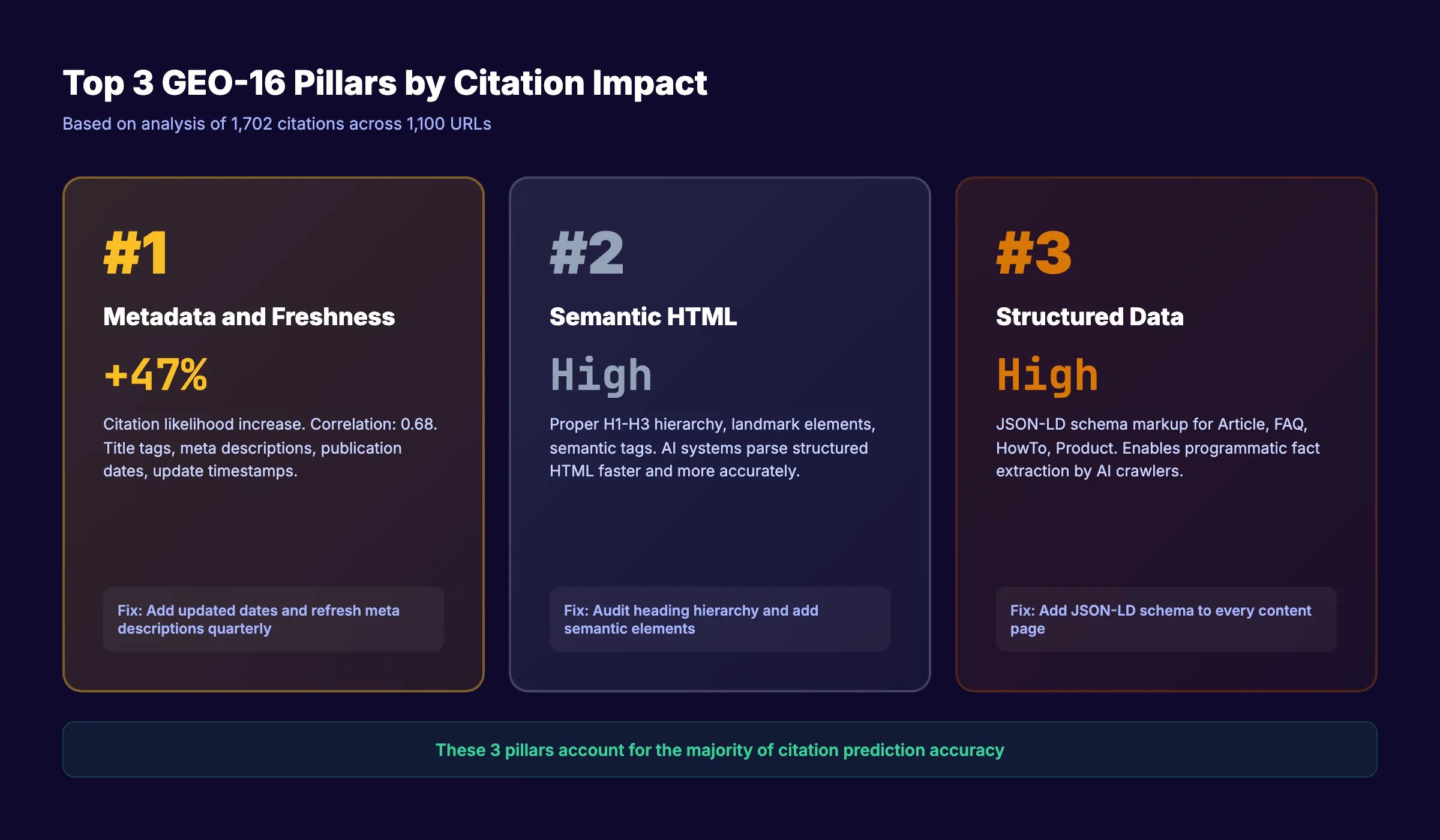
Metadata and Freshness showed the strongest correlation with citation at 0.68. That translates to a 47% increase in citation likelihood for pages that score high on this pillar alone.
Semantic HTML and Structured Data ranked second and third. Together, these top 3 pillars account for the majority of citation prediction accuracy.
The practical takeaway: if you can only improve 3 things, focus on metadata freshness, semantic HTML structure, and JSON-LD schema markup.
Your SEO team. $99 per month. 30 optimized articles, published automatically. Start for $1 →
7 Key GEO Metrics Every Business Should Track
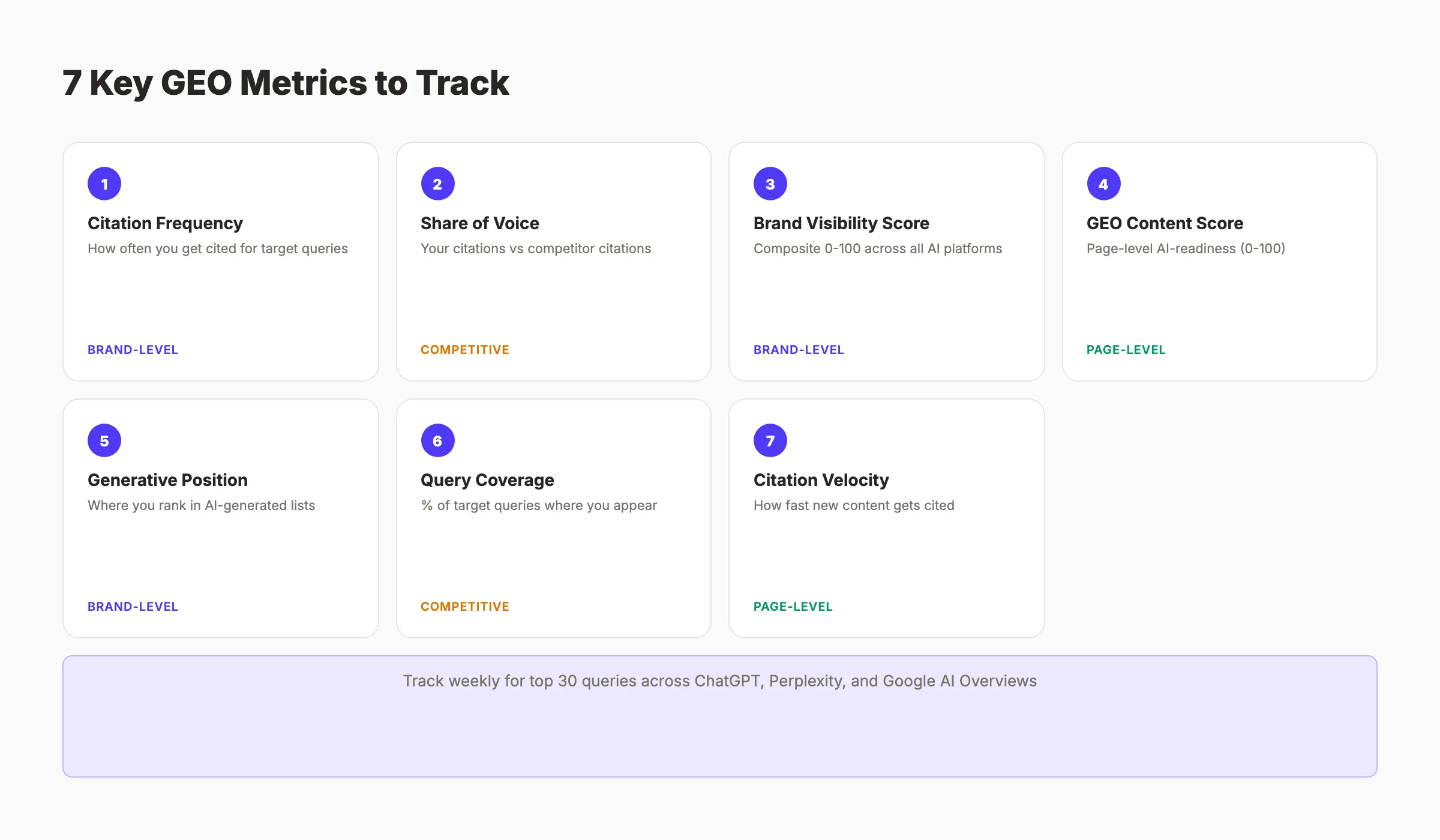
GEO scoring is the umbrella. Under it sit specific metrics that measure different aspects of AI visibility. Here are the 7 that matter most.
1. Citation Frequency
How often your content gets cited in AI-generated responses for your target queries. This is the GEO equivalent of ranking position in traditional SEO. Track it weekly for your top 20 to 30 target queries across ChatGPT, Perplexity, and Google AI Overviews.
2. Share of Voice (SoV)
Your brand’s citation frequency divided by total citations for a query set. If 10 brands get cited for “best CRM software” queries and your brand appears in 3 out of 10 responses, your SoV is 30%.
SoV reveals competitive position. A rising SoV means you are gaining ground. A falling SoV means competitors are optimizing faster.
3. Brand Visibility Score
A composite metric (0 to 100) showing how prominently your brand appears across all AI platforms for your target keywords. Visibility accounts for citation frequency, citation position (mentioned first vs last), and citation context (recommended vs merely mentioned).
4. GEO Content Score
A page-level metric (0 to 100) that quantifies the AI-readiness of a specific piece of content. It combines the 16 GEO pillar scores into a single number. Content scoring above 70 is considered AI-optimized. Below 50 needs structural work.
This is different from your overall brand GEO score. A brand can have some pages scoring 90 and others scoring 20. The page-level score identifies exactly which content needs improvement.
5. Generative Position
Where your brand appears in AI-generated lists. When ChatGPT lists “the top 5 SEO tools,” being position 1 is dramatically more valuable than position 5. Generative position tracks your placement within these ranked responses.
6. Query Coverage
The percentage of relevant queries where your brand appears at all. If you target 100 AI-relevant queries and your brand appears in responses for 35 of them, your query coverage is 35%.
Low query coverage with high citation frequency means you dominate a narrow topic. High coverage with low frequency means broad but shallow visibility.
7. Fresh Content Citation Velocity
How quickly newly published content starts getting cited by AI systems. Some content gets cited within days. Other content takes weeks. Faster velocity indicates strong GEO signals that AI systems trust and prioritize.
For a complete measurement setup, read our guide on tracking AI search visibility.
GEO Scoring Tools in 2026
The GEO tool market has grown rapidly. Here are the major options for measuring your GEO score.
Free Tools
| Tool | What It Does | Best For |
|---|---|---|
| Mangools AI Search Grader | Scores your page against AI visibility factors | Quick page-level checks |
| Geoptie GEO Rank Tracker | Tracks brand visibility across AI platforms | Ongoing monitoring |
| Rankability 97-Point Checklist | Manual GEO audit framework | DIY audits |
Paid Platforms
| Tool | What It Does | Price Range |
|---|---|---|
| Otterly AI | Audits 25+ AI-visibility factors, generates prioritized fix lists | Mid-range |
| GEOReport.ai | Full GEO audit with reasoning metrics across multiple AI models | Mid-range |
| Frase GEO | Content scoring against both SEO and GEO criteria | $15 to $115/month |
| SE Ranking AI Visibility | Tracks AI visibility alongside traditional rankings | Part of SE Ranking plans |
| Averi AI | Citation tracking dashboard with trend analysis | Mid-range |
Which Tool to Start With
If you have zero GEO measurement in place, start with Mangools AI Search Grader (free) to assess individual pages. Then graduate to a paid platform for ongoing tracking once you understand your baseline.
For most businesses, the combination of a page-level scoring tool and a citation tracking tool covers the essentials. You do not need every tool on this list.
3,500+ blogs published. 92% average SEO score. See what Stacc can do for your site. Start for $1 →
How to Run a GEO Audit on Your Content
You do not need paid tools to assess your GEO readiness. Here is a manual audit process based on the GEO-16 framework.
Step 1: Check Technical Foundations
- Verify
robots.txtallows GPTBot, PerplexityBot, and ClaudeBot. Read our AI crawlers guide. - Confirm pages use server-side rendering or static HTML (not client-side JS only)
- Check that an llms.txt file exists and maps your site structure
- Verify HTTPS is active across all pages
- Test page speed (under 3 seconds load time)
Step 2: Audit Content Structure
- Every page has a clear H1, H2, H3 hierarchy with no skipped levels
- Key definitions appear in the first 2 sentences of each section
- Content uses numbered lists, bullet points, and tables for structured data
- FAQ sections exist on informational and commercial pages
- Follow the blog GEO checklist for every article
Step 3: Verify Schema Markup
- Article/BlogPosting schema on all blog posts
- FAQPage schema on pages with FAQ sections
- Organization schema on your about page
- Product/Offer schema on pricing and product pages
- Author schema with credentials on content pages
Step 4: Assess Authority Signals
- Author bylines with credentials on every article
- External citations to authoritative sources (2+ per article)
- E-E-A-T signals present (experience, expertise, authority, trust)
- Brand profiles active on G2, Trustpilot, or industry review platforms
- Consistent entity information (name, description) across web properties
Step 5: Evaluate Freshness
- Top 20 pages updated within the last 90 days
- Publication dates and “last updated” timestamps visible
- No outdated statistics or year references
- Regular publishing cadence (weekly or more frequent)
Step 6: Score Each Page
Rate each of the 16 pillars from 0 (not present) to 1 (fully optimized). Sum the scores. Divide by 16. This gives you a normalized GEO score from 0 to 1.
Interpretation:
- 0.70 to 1.00: Strong GEO readiness. Focus on monitoring and maintaining.
- 0.50 to 0.69: Moderate. Prioritize the 3 weakest pillars for improvement.
- Below 0.50: Low. Start with technical foundations and content structure.
How to Improve Your GEO Score
Improving your GEO score follows the same priority logic as the GEO-16 framework. Fix the highest-impact pillars first.
Priority 1: Metadata and Freshness (Week 1)
This single pillar has the highest correlation with AI citations (+47%). Quick wins:
- Add or update
<meta>descriptions with clear, factual summaries - Include publication date and “last updated” date on every page
- Update your top 10 traffic pages with fresh statistics and current-year references
- Remove any content with outdated data that contradicts current facts
- Set a quarterly refresh schedule for high-value pages
Our guide on updating old blog posts covers the full refresh process.
Priority 2: Semantic HTML and Structured Data (Week 2)
These 2 pillars combine for the second-largest citation impact:
- Restructure headings to follow proper H1 > H2 > H3 hierarchy
- Add JSON-LD Article schema to every blog post
- Add FAQPage schema to every page with FAQ content
- Use
<table>,<ul>,<ol>elements instead of formatting hacks - Include
<time>elements for dates
Priority 3: Content Depth and Factual Density (Week 3)
AI systems prefer content that answers questions thoroughly with verifiable claims:
- Ensure every article covers the topic more deeply than the top 3 competitors
- Add 2 to 3 specific statistics with named sources per 500 words
- Include comparison tables wherever data supports them
- Write answer-first paragraphs (definition in sentence 1, evidence in sentences 2 to 3)
- Build topical authority by publishing 5+ related articles per cluster
Priority 4: Entity and Authority Signals (Week 4)
Build the trust signals AI systems look for:
- Create detailed author pages with credentials, expertise areas, and social links
- Claim and maintain profiles on industry review platforms
- Ensure your Organization schema matches your brand entity everywhere
- Get mentioned on third-party sites (industry publications, partner blogs)
- Read our complete guide on getting cited by AI search engines
Priority 5: Ongoing Monitoring (Monthly)
- Track citation frequency for your top 30 queries across 3 AI platforms
- Monitor GEO Content Score for your top 20 pages monthly
- Compare Share of Voice against top 3 competitors quarterly
- Identify new queries where AI mentions your competitors but not you
- Publish 2 to 4 new articles per month targeting AI-friendly formats
Rank everywhere. Do nothing. Blog SEO, Local SEO, and Social on autopilot. Start for $1 →
GEO Scoring Thresholds: What the Research Shows
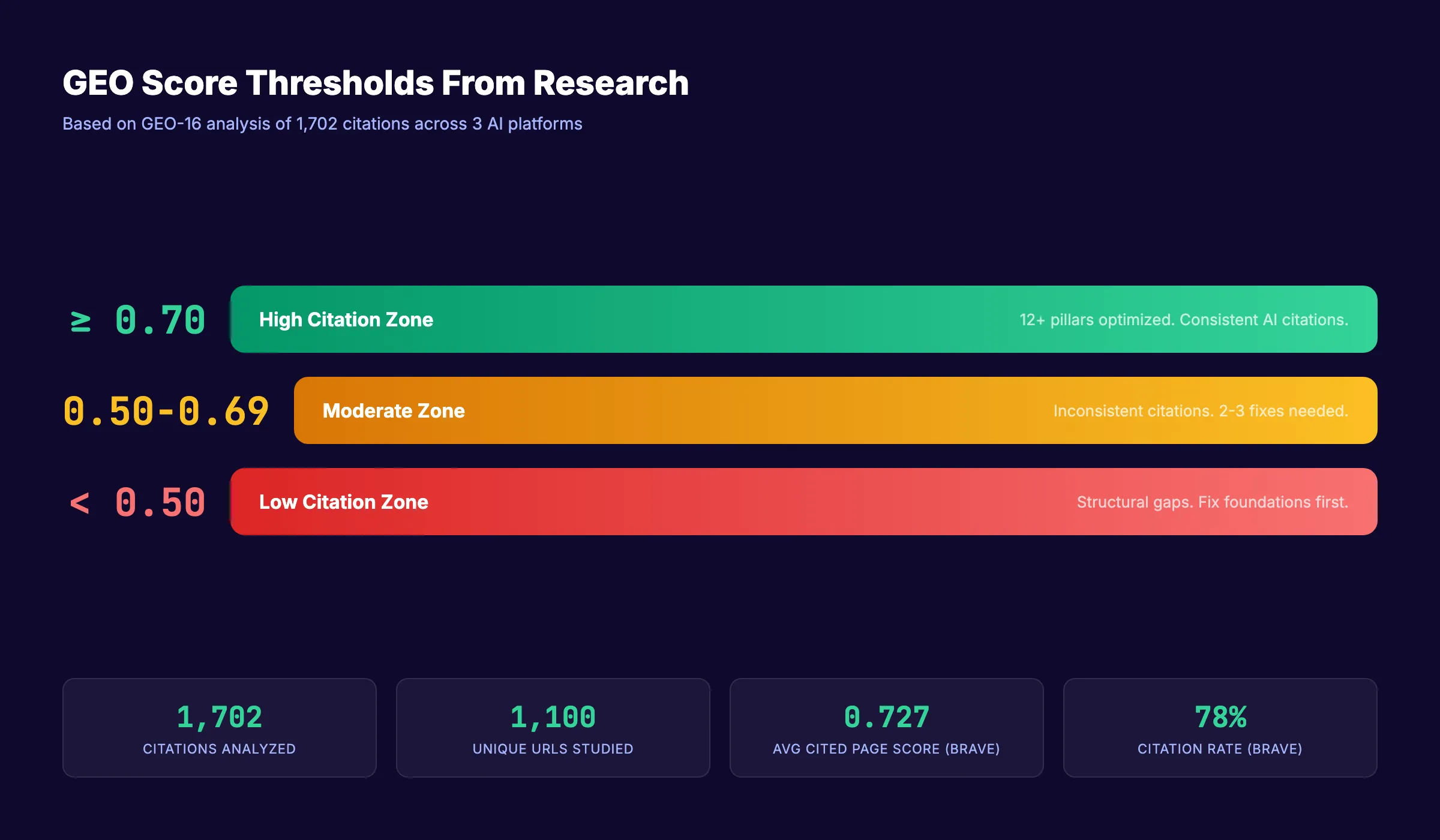
The GEO-16 research established specific thresholds that predict citation success across AI platforms.
Cross-Platform Citation Thresholds
| Threshold | What It Means | Citation Impact |
|---|---|---|
| GEO score above 0.70 | Page meets most AI quality signals | Substantially higher citation rate |
| 12+ pillar hits (out of 16) | Strong across multiple dimensions | Consistent citations across platforms |
| Metadata score above 0.80 | Fresh, well-described content | +47% citation likelihood |
| Structured data present | JSON-LD schema markup detected | 2 to 3x more likely to be cited |
Platform-Specific Findings
Brave Summary cited the highest-quality pages on average (GEO score = 0.727) and produced the highest citation rate at 78%. If your content scores well on Brave, it likely scores well everywhere.
Google AI Overviews showed moderate selectivity. Pages need both strong on-page signals and domain authority for consistent citation.
Perplexity demonstrated the strongest freshness bias. Recently updated content scored disproportionately higher.
What These Thresholds Mean for You
A GEO score of 0.70 is the minimum viable threshold. Below that, AI systems inconsistently cite your content even if it is topically relevant. Above 0.70, citation rates increase dramatically.
The practical goal: get your top 20 pages above 0.70 first. Then expand to your top 50. Then aim for site-wide consistency.
GEO Scoring and the Future of Search Measurement
GEO scoring will not replace SEO scoring. It adds a layer on top. The businesses that track both will have a complete picture of their search visibility. Those tracking only traditional SEO metrics will miss the fastest-growing search channel.
The research is clear. AI citation behavior is predictable. The GEO-16 framework proves that specific, measurable on-page signals determine whether AI systems cite your content. And the tools to measure those signals exist today.
This is not theoretical. It is operational. Start measuring. Start improving. The brands that build GEO scoring into their monthly reporting now will compound their advantage for years.
FAQ
What is a good GEO score?
A normalized GEO score of 0.70 or higher (70 out of 100 on percentage scales) indicates strong AI citation readiness. Pages scoring above this threshold with 12+ of the 16 GEO pillars optimized show substantially higher citation rates across ChatGPT, Perplexity, and Google AI Overviews.
How is GEO scoring different from SEO scoring?
SEO scoring measures Google ranking potential based on keywords, backlinks, and technical health. GEO scoring measures AI citation likelihood based on content structure, schema markup, freshness, entity signals, and crawler access. The two overlap on E-E-A-T and content quality, but GEO adds dimensions that SEO scoring does not cover.
What is the GEO-16 framework?
GEO-16 is a research-backed auditing framework with 16 pillars that predict AI citation behavior. It was developed by analyzing 1,702 citations across 1,100 URLs from Brave, Google AI Overviews, and Perplexity. The framework produces a normalized score from 0 to 1 for each page.
Which GEO metric matters most?
Citation frequency is the most direct indicator of GEO success. It measures how often your content gets cited in AI-generated responses for your target queries. Share of Voice is the most important competitive metric, showing your citation frequency relative to competitors.
Can I check my GEO score for free?
Yes. Mangools AI Search Grader provides free page-level GEO scoring. Geoptie offers a free GEO Rank Tracker for brand monitoring. You can also run a manual audit using the GEO-16 pillar checklist in this article. Paid tools like Otterly AI and GEOReport.ai provide deeper analysis.
Does improving GEO score also improve SEO?
In most cases, yes. Many GEO improvements (better content structure, schema markup, faster load times, stronger E-E-A-T signals) also benefit traditional Google rankings. The investment is additive. You are not choosing between SEO and GEO. You are building both simultaneously.

Written by
Siddharth GangalSiddharth is the founder of theStacc and Arka360, and a graduate of IIT Mandi. He spent years watching great businesses lose organic traffic to competitors who simply published more. So he built a system to fix that. He writes about SEO, content at scale, and the tactics that actually move rankings.
30 SEO blog articles published every month
Keyword-optimized, scheduled, and live on your site. Automatically.
30-day trial · Cancel anytime
theStacc
Stop writing SEO content manually
30 blog articles, 30 GBP posts, and social media content. Published every month. Automatically.
Start Your $1 Trial$1 for 3 days · Cancel anytime