
Multilingual SEO: The Complete Guide for 2026
Learn how to rank in multiple languages with hreflang, localized keywords, and the right URL structure. Practical multilingual SEO guide updated for 2026.
75% of internet users do not speak English as their first language. 70% of global search queries happen in a language other than English. Yet most businesses optimize for one language, publish in one market, and wonder why international traffic stays flat.
Multilingual SEO fixes that problem. It is the practice of optimizing your website for multiple languages so search engines serve the right version to the right user in the right market. Done well, it opens your site to billions of additional searchers. Done poorly, it creates duplicate content, confuses Google, and tanks your rankings in every market.
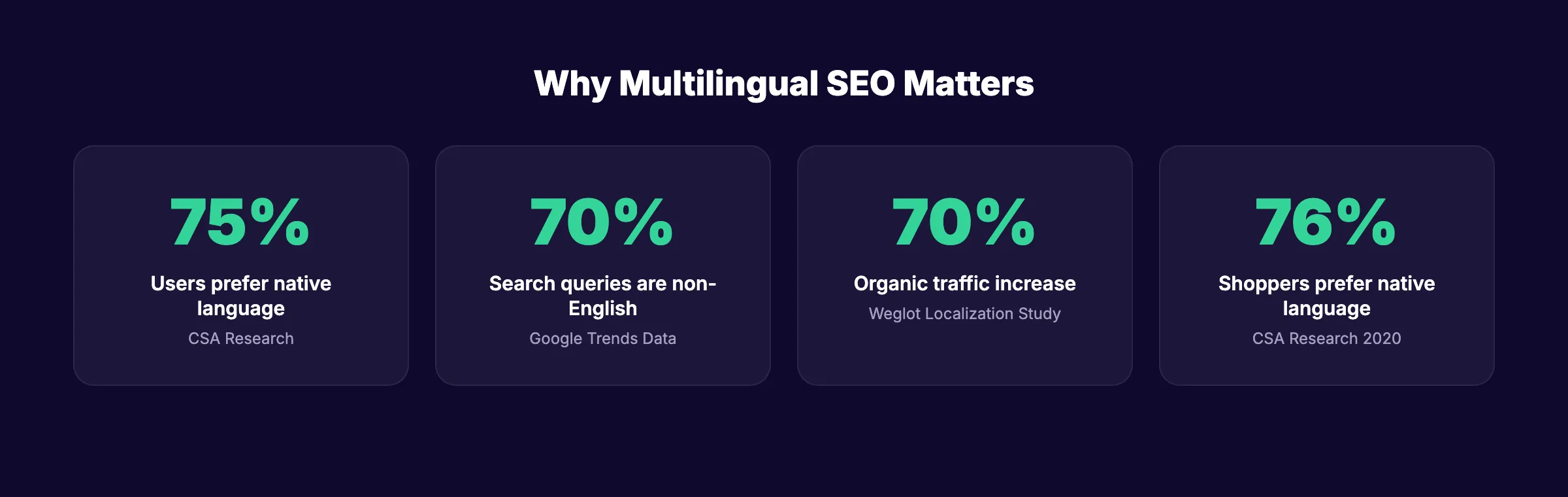
76% of online shoppers prefer buying products in their native language, according to CSA Research. Businesses that localize see up to a 70% increase in organic traffic within 12 months. The opportunity is massive. The execution is where most teams fail.
We have published 3,500+ blog posts across 70+ industries. This guide covers everything you need to rank across languages and regions in 2026.
Here is what you will learn:
- What multilingual SEO is and why it matters more in 2026 than ever
- How to choose the right URL structure for multi-language sites
- The exact hreflang implementation that Google requires
- How to do keyword research in languages you do not speak
- Content localization vs. translation and why the difference determines your rankings
- The 5 most common multilingual SEO mistakes and how to avoid them
- How to measure multilingual SEO performance across markets
Chapter 1: What Multilingual SEO Is and Why It Matters Now
Multilingual SEO is the process of optimizing a website so it ranks in search results across multiple languages. It goes beyond translation. It includes technical SEO configuration, localized keyword research, content adaptation, and link building in each target market.
The Difference Between Multilingual and International SEO
These terms overlap but are not identical.
| Concept | Focus | Example |
|---|---|---|
| Multilingual SEO | Optimizing for different languages | English + Spanish + German versions of a blog post |
| International SEO | Optimizing for different countries/regions | US vs. UK vs. Australia (all English, different markets) |
| Multi-regional SEO | Both language and country targeting | Spanish for Mexico vs. Spanish for Spain |
Most businesses need both. A SaaS company expanding into Europe needs multilingual SEO (English, French, German) and international SEO (country-specific pricing, legal pages, and local backlinks).
Why 2026 Changed the Game
Three shifts made multilingual SEO more complex and more valuable in 2026:
1. AI search engines process multiple languages simultaneously. Google’s AI Overviews pull information from sources across languages. If your French content is thin while a French competitor provides depth, their content gets cited. Your translated page gets ignored.
2. Search engines now understand culture, not just language. Google penalizes content that feels “translated” and rewards content that feels native. Two people searching the same keyword in English see different SERPs if one is in the UK and the other is in India.
3. Cross-language information retrieval is real. AI systems treat multilingual equivalents as interchangeable when content lacks market-specific differentiation. A translated product page with identical information offers no reason for Google to rank it separately.
The old model of “translate your site and add hreflang tags” no longer works. Multilingual SEO in 2026 requires genuine localization, market-specific authority, and entity clarity across every language version.
Your SEO team. $99 per month. Stacc publishes 30 optimized articles per month for your business, automatically. Start for $1 →
Chapter 2: Choosing the Right URL Structure
Your URL structure determines how search engines discover, crawl, and rank each language version. This is the first technical decision and the hardest to change later.
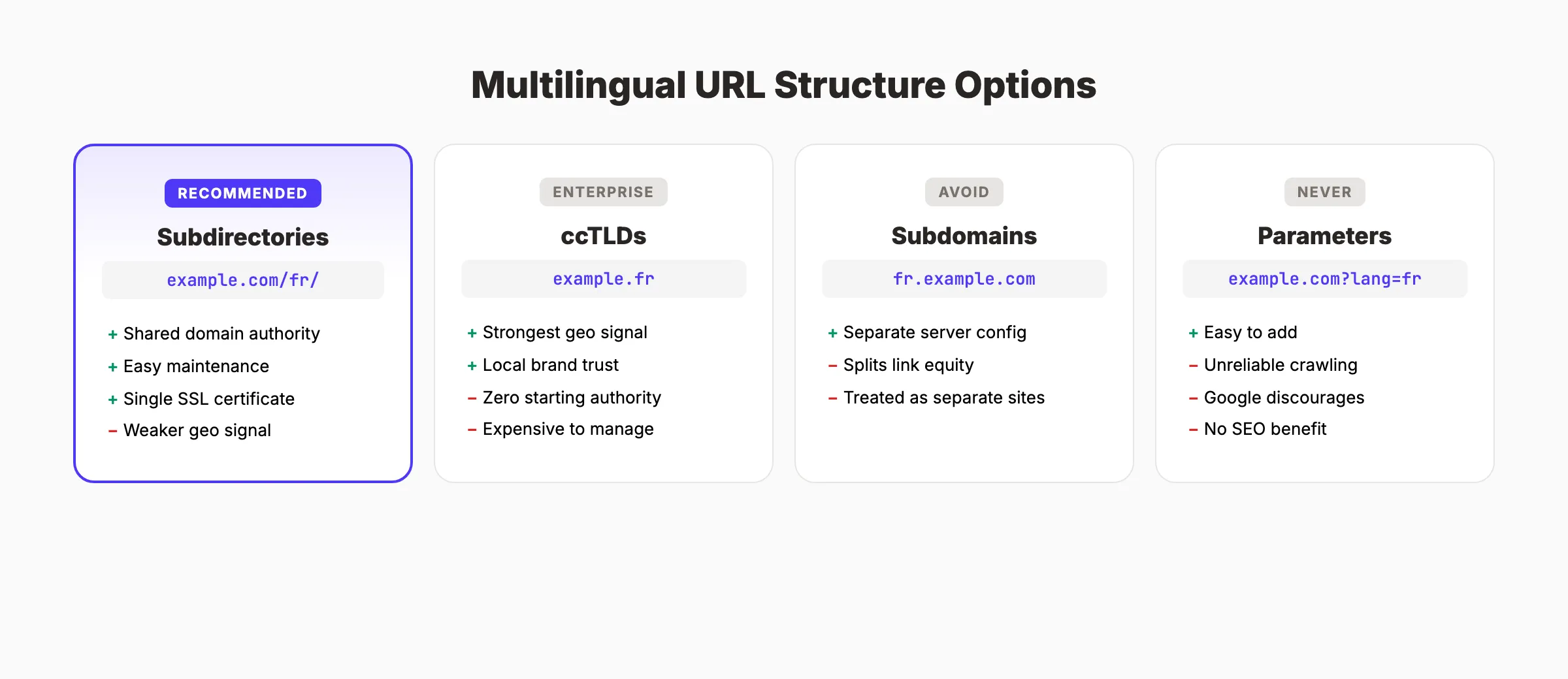
The 4 URL Structure Options
| Structure | Format | SEO Benefit | Drawback |
|---|---|---|---|
| Subdirectories | example.com/fr/ | Consolidates domain authority | All languages share one domain |
| Subdomains | fr.example.com | Separates content by language | Treated as separate sites by Google |
| ccTLDs | example.fr | Strongest geo-targeting signal | Expensive. Authority starts from zero. |
| URL parameters | example.com?lang=fr | Easy to implement | Google discourages this. Not recommended. |
Which Structure to Choose
For most businesses: subdirectories. They consolidate all SEO equity under one domain. Backlinks to any language version strengthen the entire site. Setup is simpler. Maintenance is manageable.
For enterprise with strong regional brands: ccTLDs. If you operate as a distinct entity in each market with separate branding, ccTLDs signal the strongest local relevance. But each domain starts with zero authority.
Avoid subdomains for language targeting. Google treats subdomains as separate entities. You split your link equity and double your workload for backlink acquisition.
Never use URL parameters. Google’s own documentation warns against this approach. Parameters make crawling unreliable and indexing unpredictable.
URL Path Best Practices
Keep the URL structure clean and consistent:
example.com/fr/guide-seo-multilingue     ✓ Localized slug
example.com/fr/multilingual-seo-guide    ✗ English slug on French page
example.com/fr/guide_seo                 ✗ Underscores instead of hyphens
Translate your URL slugs into the target language. A French user searching Google.fr expects French URLs. English slugs on localized pages signal to both users and search engines that the page is not genuinely local.
Chapter 3: Hreflang Implementation That Actually Works
Hreflang is the HTML attribute that tells search engines which language and region a page targets. It is the backbone of multilingual SEO. It is also the element most teams get wrong.
A Search Engine Land analysis found that 31% of international sites contain conflicting hreflang directives, and 16% are missing self-referencing tags. These errors can invalidate your entire multilingual setup.
The 3 Implementation Methods
Method 1: HTML link tags (most common)
Place in the <head> of every page:
<link rel="alternate" hreflang="en" href="https://example.com/page/" />
<link rel="alternate" hreflang="fr" href="https://example.com/fr/page/" />
<link rel="alternate" hreflang="de" href="https://example.com/de/page/" />
<link rel="alternate" hreflang="x-default" href="https://example.com/page/" />
Method 2: HTTP headers
Used for non-HTML content like PDFs:
Link: <https://example.com/page/>; rel="alternate"; hreflang="en",
      <https://example.com/fr/page/>; rel="alternate"; hreflang="fr"
Method 3: XML sitemap
Best for large sites with thousands of pages:
<url>
  <loc>https://example.com/page/</loc>
  <xhtml:link rel="alternate" hreflang="en" href="https://example.com/page/" />
  <xhtml:link rel="alternate" hreflang="fr" href="https://example.com/fr/page/" />
</url>
Google states all three methods are equivalent. Choose based on your tech stack.
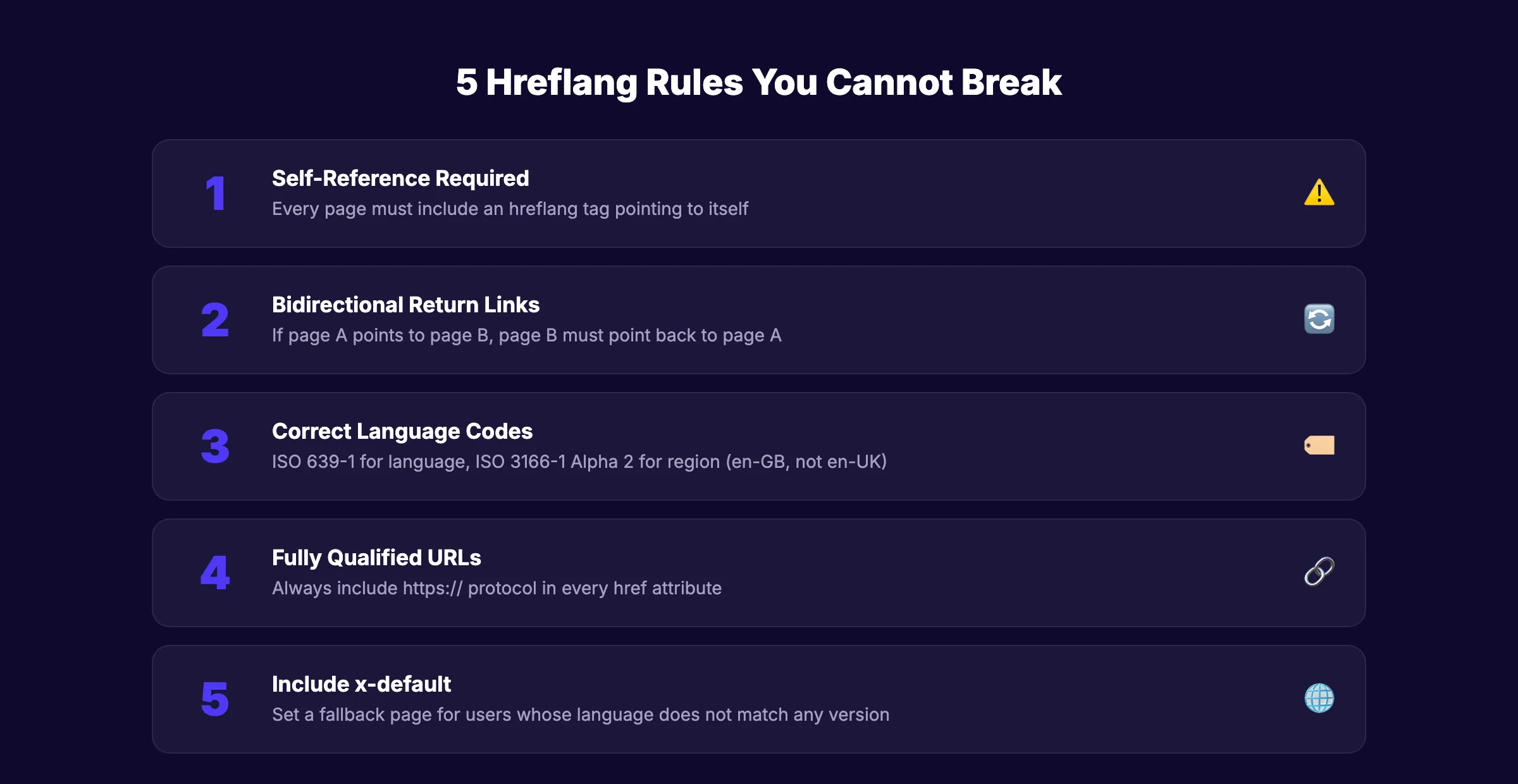
The 5 Hreflang Rules You Cannot Break
Rule 1: Every page must reference itself. Self-referencing hreflang tags are mandatory. If your English page does not include hreflang="en" pointing to itself, Google may ignore the entire set.
Rule 2: Return links must be bidirectional. If page A points to page B as a French alternate, page B must point back to page A as an English alternate. Missing return links invalidate the pair.
Rule 3: Use correct language codes. Language codes follow ISO 639-1. Region codes follow ISO 3166-1 Alpha 2. Common mistakes:
| Wrong | Correct | Why |
|---|---|---|
en-UK | en-GB | ”UK” is not a valid ISO country code |
es-LA | es-419 | ”LA” is not valid. Use 419 for Latin America |
zh alone | zh-Hans or zh-Hant | Specify simplified or traditional Chinese |
EU | Not valid | EU is not a country code |
Rule 4: Use fully qualified URLs. Every href must include the protocol: https://example.com/fr/page/ not /fr/page/.
Rule 5: Include x-default. The x-default tag tells Google which page to show users whose language does not match any of your hreflang values. Usually your English or primary language version.
Hreflang Validation Checklist
- Every language version references all other versions
- Every page includes a self-referencing hreflang tag
- All return links are present and bidirectional
- Language codes use ISO 639-1 format
- Region codes use ISO 3166-1 Alpha 2 format
- All URLs are absolute with https:// protocol
- x-default is set on every page set
- Canonical tags and hreflang tags do not conflict
Stop writing. Start ranking. Stacc publishes 30 SEO articles per month for your business, on autopilot. Start for $1 →
Chapter 4: Keyword Research Across Languages
Translating your English keywords into Spanish does not give you Spanish keywords. Search behavior varies by language, culture, and market. A direct translation may target a phrase nobody actually searches.
Why Translation Fails for Keywords
Consider the English keyword “cheap flights.” In Spanish, “vuelos baratos” works. But in German, users search “billige Flüge” or “günstige Flüge.” The second option implies good value rather than low quality. Targeting the wrong synonym means ranking for a term with lower intent or lower volume.
The same problem applies in every language. Keywords are not words. They are expressions of intent shaped by culture, dialect, and local market dynamics.
The 4-Step Multilingual Keyword Research Process
Step 1: Start with intent, not translation.
List the search intents your English content satisfies. “Best CRM software” satisfies commercial investigation intent. That intent exists in every language. The words used to express it differ.
Step 2: Use native-language keyword tools.
Run your translated seed keywords through keyword research tools set to the target language and country:
- Google Keyword Planner (set location and language)
- Ahrefs (filter by country: Germany, France, Spain, etc.)
- Semrush (switch database to target market)
These tools show actual search volume for each language market. Do not trust volume estimates from translation-only approaches.
Step 3: Validate with local search results.
Search your target keyword on the local Google domain (google.de, google.fr, google.es). Examine the top 10 results:
- What format do they use? (listicle, guide, comparison)
- What related terms appear in titles and headings?
- What search intent does Google interpret?
If the SERP shows product pages for your keyword but you planned an informational guide, the intent does not match. Adjust your content format.
Step 4: Build a localized keyword map.
Create a separate keyword target for every language version of every page. Do not assume a 1-to-1 mapping from English.
| English Page | English Keyword | German Keyword | French Keyword |
|---|---|---|---|
| /blog/seo-guide | seo guide | seo leitfaden | guide seo |
| /pricing | seo pricing | seo preise | prix seo |
| /blog/local-seo | local seo tips | lokale seo tipps | conseils seo local |
Some pages may not need a localized version at all. If there is zero search demand for a topic in a specific market, do not create the page. Empty markets waste crawl budget.
Chapter 5: Content Localization vs. Translation
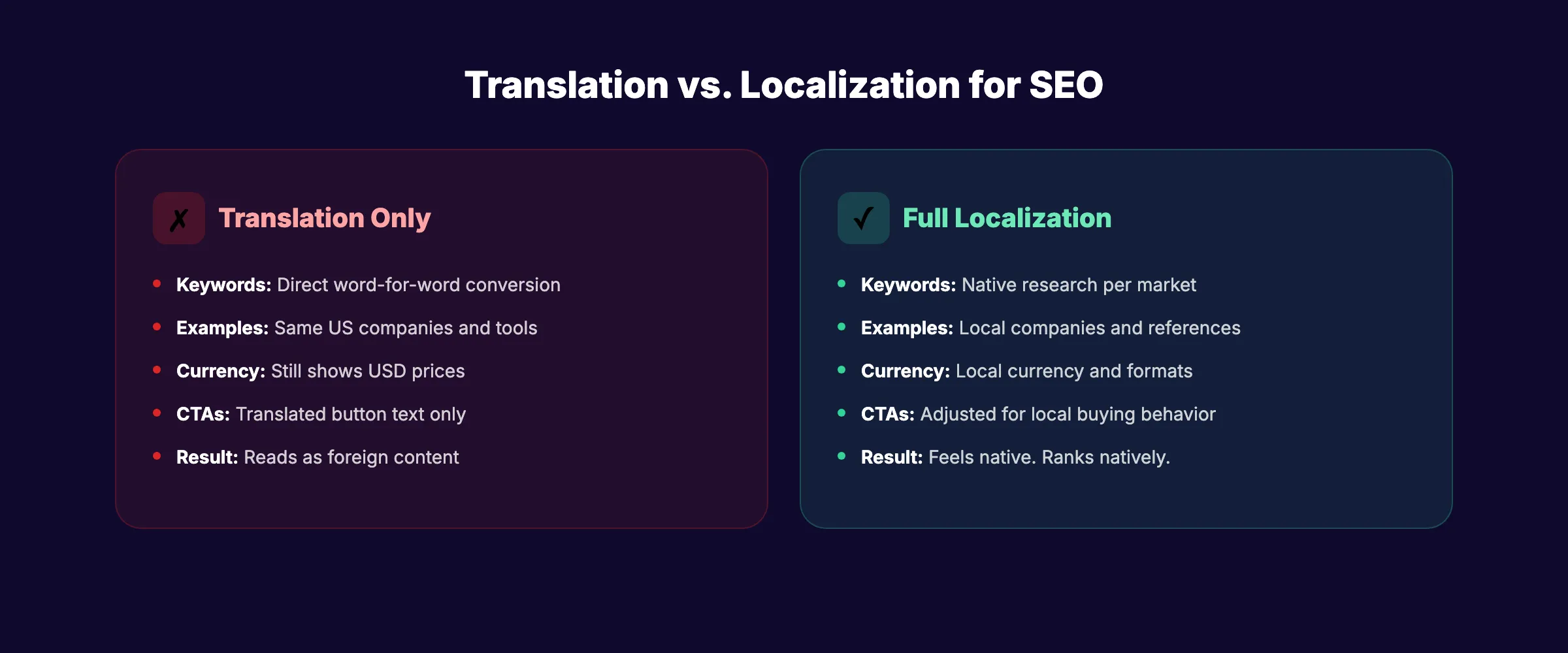
This is where most multilingual SEO strategies fail. Translation converts words from one language to another. Localization adapts the entire content experience for a specific market. Only localization ranks.
What Localization Includes
| Element | Translation | Localization |
|---|---|---|
| Body text | Word-for-word conversion | Rewritten for local search intent and reading patterns |
| Keywords | Direct translation | Native keyword research per market |
| Examples | Same examples in new language | Local companies, tools, and references |
| Currency and units | Converted numbers | Local currency, date formats, measurement systems |
| CTAs | Translated button text | Adjusted for local buying behavior |
| Images | Same images | Localized screenshots, region-specific visuals |
| Legal and compliance | Translated disclaimers | Market-specific legal requirements (GDPR, CCPA, etc.) |
| Internal links | Same link targets | Links to localized versions of other pages |
The Localization Spectrum
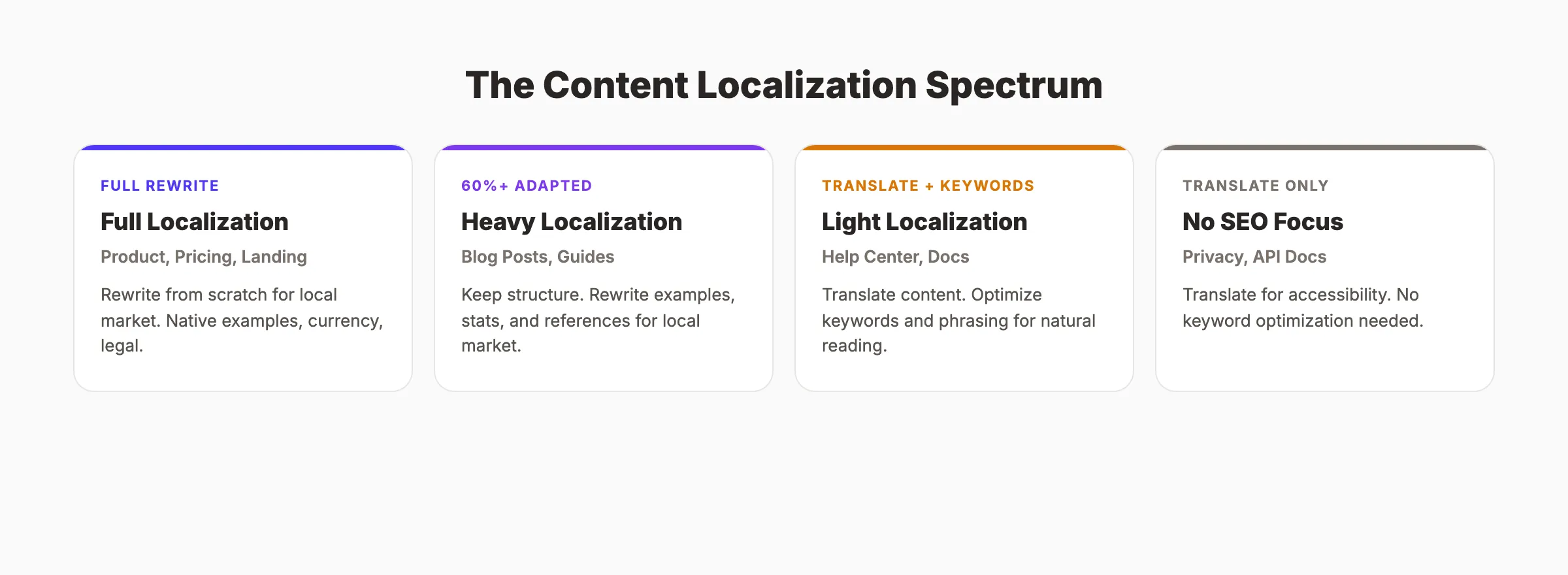
Not every page needs the same level of localization. Use this framework to decide:
Full localization (rewrite from scratch): Product pages, pricing pages, landing pages, homepage. These pages drive conversions. They must feel native.
Heavy localization (adapt 60%+ of content): Blog posts targeting high-volume localized keywords. Keep the structure. Rewrite examples, stats, and references for the local market.
Light localization (translate + adjust keywords): Technical documentation, help center articles, glossary entries. The content is universal. Keyword optimization and natural phrasing are enough.
No localization needed: Privacy policy (if identical across markets), developer API docs, changelog. Translate but do not invest in SEO optimization.
Machine Translation: When It Works and When It Does Not
Machine translation tools like Google Translate and DeepL have improved dramatically. They can handle light localization tasks accurately. They fail at:
- Keyword optimization (they do not know which synonym has search volume)
- Cultural nuance (humor, idioms, and formality levels vary by market)
- SEO structure (they translate text but do not adapt headings, meta descriptions, or URL slugs)
Use machine translation as a starting point for light localization. Never publish machine-translated content without human review for any page you expect to rank.
3,500+ blogs published. 92% average SEO score. See what Stacc can do for your site. Start for $1 →
Chapter 6: Technical Multilingual SEO Checklist
Beyond hreflang and URL structure, several technical elements determine whether your multilingual pages get indexed and ranked.
Crawling and Indexing
Separate XML sitemaps per language. Create language-specific sitemaps (sitemap-en.xml, sitemap-fr.xml, sitemap-de.xml) and reference them in your main sitemap index. This helps Google discover all language versions efficiently.
Do not use IP-based redirects. If you redirect users based on IP address, Googlebot (which crawls from US-based IPs) may never see your non-English content. Use a language selector instead. Let users choose.
Avoid cookie-based language switching. If the language version is controlled by a cookie rather than a distinct URL, Google cannot crawl or index the alternate versions. Every language version needs its own URL.
Canonical Tags and Hreflang
This is a common source of conflicts. The canonical tag on each page should point to itself, not to the English version. A French page with a canonical tag pointing to the English version tells Google to ignore the French page entirely.
Correct configuration:
French page: <link rel="canonical" href="https://example.com/fr/page/" />
English page: <link rel="canonical" href="https://example.com/page/" />
Both pages include hreflang tags pointing to each other. Both pages have self-referencing canonicals.
Page Speed Across Markets
Your CDN must serve fast load times in every target market. A site hosted in the US with no CDN edge nodes in Europe or Asia will load slowly for international users. Page speed is a Google ranking factor. Slow pages in foreign markets lose rankings to faster local competitors.
- CDN configured with edge nodes in target markets
- Images optimized for each market (localized screenshots in local language)
- Third-party scripts do not block rendering in any region
- Core Web Vitals pass in all target countries (test with Chrome UX Report by country)
Structured Data for Multilingual Pages
Apply structured data to every language version. Include the language attribute in your schema markup:
{
  "@context": "https://schema.org",
  "@type": "Article",
  "inLanguage": "fr",
  "name": "Guide SEO Multilingue",
  "url": "https://example.com/fr/guide-seo-multilingue/"
}
This helps search engines understand the language of each page at the structured data level, not just from the HTML lang attribute.
Chapter 7: Measuring Multilingual SEO Performance
Most teams track traffic in aggregate and miss the signals that matter. Multilingual SEO requires market-by-market measurement.
Set Up Segmented Reporting
Create separate views or segments for each language/region combination in your analytics platform:
| Segment | Filter | What It Shows |
|---|---|---|
| English (US) | Country = US, Path does not start with /fr/, /de/, /es/ | Core market performance |
| French | Path starts with /fr/ | French content performance |
| German | Path starts with /de/ | German content performance |
| Spanish | Path starts with /es/ | Spanish content performance |
Key Metrics by Market
Track these for each language version independently:
Organic traffic per market. Not total traffic. Traffic from google.fr to your French pages. Traffic from google.de to your German pages. Each market is its own baseline.
Keyword rankings by country. Use Ahrefs or Semrush to track rankings in each target country. A keyword ranking 5th in Germany and 45th in France tells you exactly where to focus.
Indexation rate per language. Check Google Search Console by property (if using subdomains or ccTLDs) or by URL prefix (if using subdirectories). Are all your French pages indexed? If only 60% are indexed, you have a crawling or quality issue.
Conversion rate by language. Do French visitors convert at the same rate as English visitors? Lower conversion rates often indicate weak localization, not lower intent. The content does not feel native enough.
Bounce rate by language. A high bounce rate on localized pages signals that the content does not match what users expected. Often caused by machine translation that reads unnaturally.
The Multilingual SEO Performance Dashboard
Build a monthly report with these columns:
| Metric | EN (US) | FR | DE | ES |
|---|---|---|---|---|
| Organic sessions | , | , | , | , |
| Pages indexed | , | , | , | , |
| Keywords in top 10 | , | , | , | , |
| Avg. position (target keywords) | , | , | , | , |
| Conversion rate | , | , | , | , |
| New backlinks (local domains) | , | , | , | , |
This dashboard reveals which markets are growing, which are stalling, and where to invest next.
Rank everywhere. Do nothing. Blog SEO, Local SEO, and Social on autopilot. Start for $1 →
Chapter 8: The 5 Most Common Multilingual SEO Mistakes
Every team expanding into new languages makes at least one of these. Learn them before you launch.
Mistake 1: Translating Keywords Instead of Researching Them
Direct translation misses how people actually search in each language. “Cheap flights” does not translate to the highest-volume keyword in every language. Run native keyword research for every market. Always.
Mistake 2: Broken or Missing Hreflang Tags
31% of international sites have conflicting hreflang directives. The most common errors are missing return links and incorrect language codes. Validate your hreflang setup with tools like Ahrefs Site Audit or Screaming Frog after every deployment.
Mistake 3: Canonical Tags Pointing to the English Version
If your French page canonicalizes to the English version, Google will de-index the French page. Every localized page must have a self-referencing canonical. This single mistake can erase an entire market from your search visibility.
Mistake 4: Relying on Auto-Detect and IP Redirects
IP-based redirects hide content from Googlebot. Cookie-based language selection makes alternate versions invisible to search engines. Always use distinct URLs with a visible language selector. Let users and bots access every version.
Mistake 5: Publishing Machine Translation Without Review
Search engines penalize content that feels translated. Machine translation produces grammatically correct but unnatural content. Native speakers spot it instantly. So do search engines. Every translated page needs human review, keyword optimization, and cultural adaptation before publishing.
FAQ
What is multilingual SEO?
Multilingual SEO is the practice of optimizing a website to rank in search results across multiple languages. It includes technical setup (hreflang tags, URL structure), localized keyword research, content adaptation, and market-specific link building. The goal is to make each language version rank as a native page in its target market.
How many languages should I start with?
Start with 1 to 2 additional languages where you have the strongest business case. Factors to consider: existing traffic from non-English countries (check Google Analytics), customer demand from specific markets, and competitor presence in those languages. Expanding to 5+ languages at once without proper localization creates thin content in every market.
Does multilingual content create duplicate content issues?
No. Google treats content in different languages as separate pages, not duplicates. However, you must implement hreflang tags correctly so Google understands the relationship between language versions. Without hreflang, Google may see French and English pages covering the same topic as competing content rather than localized versions.
Should I use automatic translation plugins for SEO?
Automatic translation can generate a starting draft, but it should not be published without human review for any page you want to rank. Machine-translated content lacks localized keywords, cultural nuance, and natural phrasing. Search engines in 2026 increasingly detect and deprioritize content that reads as translated rather than native.
How long does multilingual SEO take to show results?
Expect 3 to 6 months for initial ranking movement in new language markets, similar to starting SEO in English. Markets with less competition may show results faster. Strong localization, local backlinks, and regular publishing accelerate the timeline. Existing domain authority from your primary language helps new language versions rank faster than a brand-new domain.
Can Stacc help with multilingual content publishing?
Stacc publishes 30 SEO-optimized articles per month for your business. While our current focus is English-language content, the same content engineering principles apply across languages. Teams use Stacc for their English content pipeline and apply the freed-up resources to localization efforts in other markets.
Multilingual SEO is not optional for businesses with international audiences. The search volume is there. The conversion data proves users buy in their own language. The only question is whether your content meets them where they search.
Start with the URL structure. Implement hreflang correctly. Research keywords natively. Localize, do not just translate. Measure every market independently.
The businesses that rank across languages in 2026 are not the ones with the biggest budgets. They are the ones that treat every market as its own SEO project, with its own keywords, its own content, and its own measurement.

Written by
Siddharth GangalSiddharth is the founder of theStacc and Arka360, and a graduate of IIT Mandi. He spent years watching great businesses lose organic traffic to competitors who simply published more. So he built a system to fix that. He writes about SEO, content at scale, and the tactics that actually move rankings.
30 SEO blog articles published every month
Keyword-optimized, scheduled, and live on your site. Automatically.
30-day trial · Cancel anytime
theStacc
Stop writing SEO content manually
30 blog articles, 30 GBP posts, and social media content. Published every month. Automatically.
Start Your $1 Trial$1 for 3 days · Cancel anytime