
Negative SEO: The Complete Guide (2026)
What negative SEO is, how to detect it, 6 attack types, and how to protect your site. Includes disavow process and recovery steps. Updated 2026.
Siddharth Gangal • 2026-03-30 • SEO Tips
In This Article
Over 422,000 websites experienced some form of negative SEO attack in 2024. That number is growing.
Negative SEO is the practice of using black hat tactics to deliberately damage a competitor’s search rankings. Spammy backlinks, content scraping, fake reviews, and hacking are the most common methods. The goal is simple. Destroy a competitor’s organic traffic by making their site look untrustworthy to Google.
Most business owners do not know negative SEO exists until their rankings drop overnight. By then, the damage is already done. The recovery process takes weeks or months depending on the severity of the attack.
We have published 3,500+ blog posts across 70+ industries and monitor backlink profiles for hundreds of businesses. This guide covers exactly how negative SEO works, how to detect it, and how to protect your site.
Here is what you will learn:
- What negative SEO is and whether it still works in 2026
- The 6 most common attack types and how each one damages rankings
- How to detect a negative SEO attack before it destroys your traffic
- Step-by-step recovery process including the Google Disavow Tool
- How to protect your site from future attacks
- What Google says about negative SEO and how their algorithms handle it
What Is Negative SEO
Negative SEO refers to any deliberate action taken to lower a competitor’s search engine rankings. Unlike regular SEO that improves your own site, negative SEO targets someone else’s site for harm.
The concept is straightforward. Google penalizes sites with unnatural link profiles, duplicate content, and security issues. An attacker exploits those penalty triggers by creating the conditions that make your site look like a violator.
How Negative SEO Differs From Black Hat SEO
Black hat SEO involves using prohibited tactics on your own site to gain an unfair ranking advantage. Negative SEO involves using those same tactics against a competitor’s site. The tactics are similar. The target is different.
| Type | Target | Goal | Example |
|---|---|---|---|
| Black Hat SEO | Your own site | Gain unfair advantage | Buying links to boost your own rankings |
| Negative SEO | Competitor site | Damage their rankings | Buying spammy links pointing to a competitor |
Is Negative SEO Still Real in 2026
Yes. Google’s John Mueller has stated that true negative SEO is “really, really, really rare.” But “rare” does not mean “nonexistent.” Over 422,000 sites were hit in 2024 alone.
Google’s algorithms have improved at detecting and ignoring many negative SEO tactics. But an overwhelming volume of toxic links can still harm a site’s rankings, especially for smaller sites with fewer than 300 referring domains. Local businesses and startups are the most vulnerable.
The honest answer is nuanced. Most negative SEO attempts fail. But the ones that succeed can devastate a business that relies on organic traffic.
Stop writing. Start ranking. Stacc publishes 30 SEO articles per month for your business, automatically. Start for $1 →
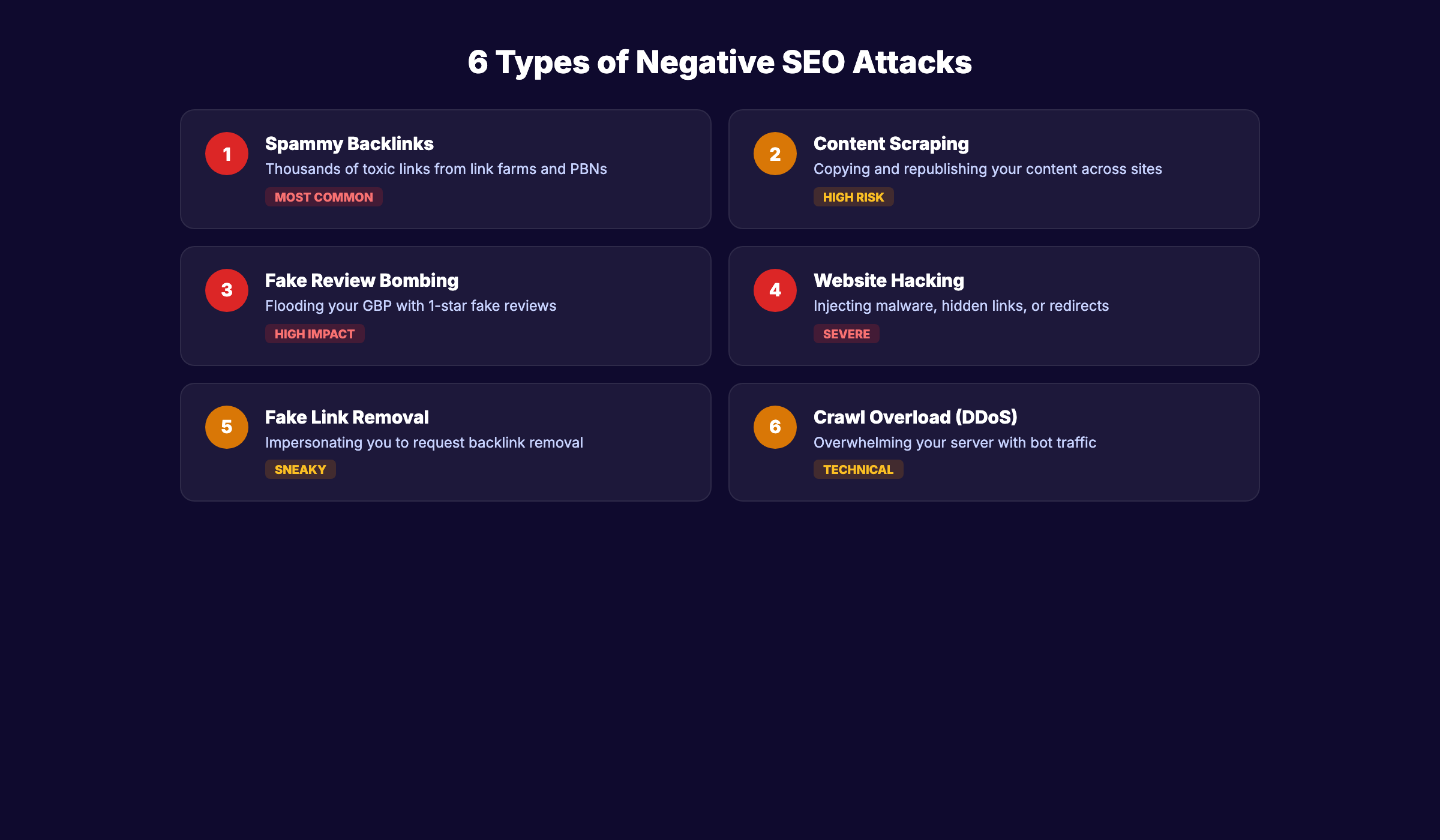
6 Types of Negative SEO Attacks
1. Spammy Backlink Attacks
The most common form of negative SEO. An attacker purchases thousands of low-quality backlinks pointing to your site from link farms, PBNs (private blog networks), and spammy directories.
How it works: Google evaluates your backlink profile as a trust signal. A sudden influx of thousands of links from gambling, adult, or pharmaceutical sites makes your backlink profile look manipulative. If Google interprets these links as your own link-building effort, your site may receive a manual penalty or algorithmic demotion.
Warning signs: A sudden spike in referring domains. Hundreds of links from foreign-language sites you have no connection to. Anchor text stuffed with exact-match keywords you do not target.
2. Content Scraping
An attacker copies your content and publishes it across multiple websites. When Google finds duplicate content, it chooses one version to rank. If the scraped version gets indexed first or appears on a higher-authority domain, your original content loses rankings.
How it works: AI tools make content scraping faster and easier than ever. An attacker can scrape your entire blog in minutes and publish slightly modified versions across dozens of sites.
Warning signs: Your content appearing on sites you did not authorize. Sudden ranking drops for pages that were previously stable. Duplicate content alerts in SEO tools.
3. Fake Review Bombing
An attacker floods your Google Business Profile with 1-star reviews. Negative reviews hurt your local rankings, click-through rate, and customer trust.
How it works: Fake accounts post negative reviews at scale. Even a dozen 1-star reviews can drop your average rating below the 4.0 threshold that 97% of consumers use to evaluate businesses.
Warning signs: Multiple negative reviews appearing in a short time period. Reviews from accounts with no review history. Reviews that mention details unrelated to your actual business.
4. Website Hacking
An attacker gains access to your site and injects malicious code, hidden links, or redirects. Google detects the malware and flags your site with a security warning, which destroys organic traffic immediately.
How it works: Hackers exploit vulnerabilities in outdated CMS software, plugins, or weak passwords. Once inside, they insert spammy content or redirect visitors to malicious sites.
Warning signs: Unexpected pages appearing in your Google Search Console index. Security warnings in browsers. Sudden ranking drops across all pages. Unfamiliar scripts in your site code.
5. Fake Link Removal Requests
An attacker contacts websites that link to you and requests link removal by impersonating you or your team. Legitimate backlinks get removed, weakening your link profile.
How it works: The attacker sends emails pretending to be your webmaster. The email asks the linking site to remove the link, often citing a “Google penalty.” If the linking site complies, you lose a valuable backlink.
Warning signs: Loss of legitimate backlinks without explanation. Webmasters mentioning removal requests you did not send. A steady decline in referring domains.
6. Forced Crawl Overload (DDoS)
An attacker sends massive volumes of automated requests to your server, slowing page load times or causing downtime. Slow sites rank poorly. Down sites do not rank at all.
How it works: Bots send thousands of requests per second, overloading your server. Page speed drops. Googlebot cannot access your pages. Rankings fall.
Warning signs: Sudden server slowdowns. Unusual spikes in server logs. Increased hosting costs from bandwidth overuse.
How to Detect a Negative SEO Attack
Early detection prevents the worst damage. Set up monitoring systems before an attack happens.
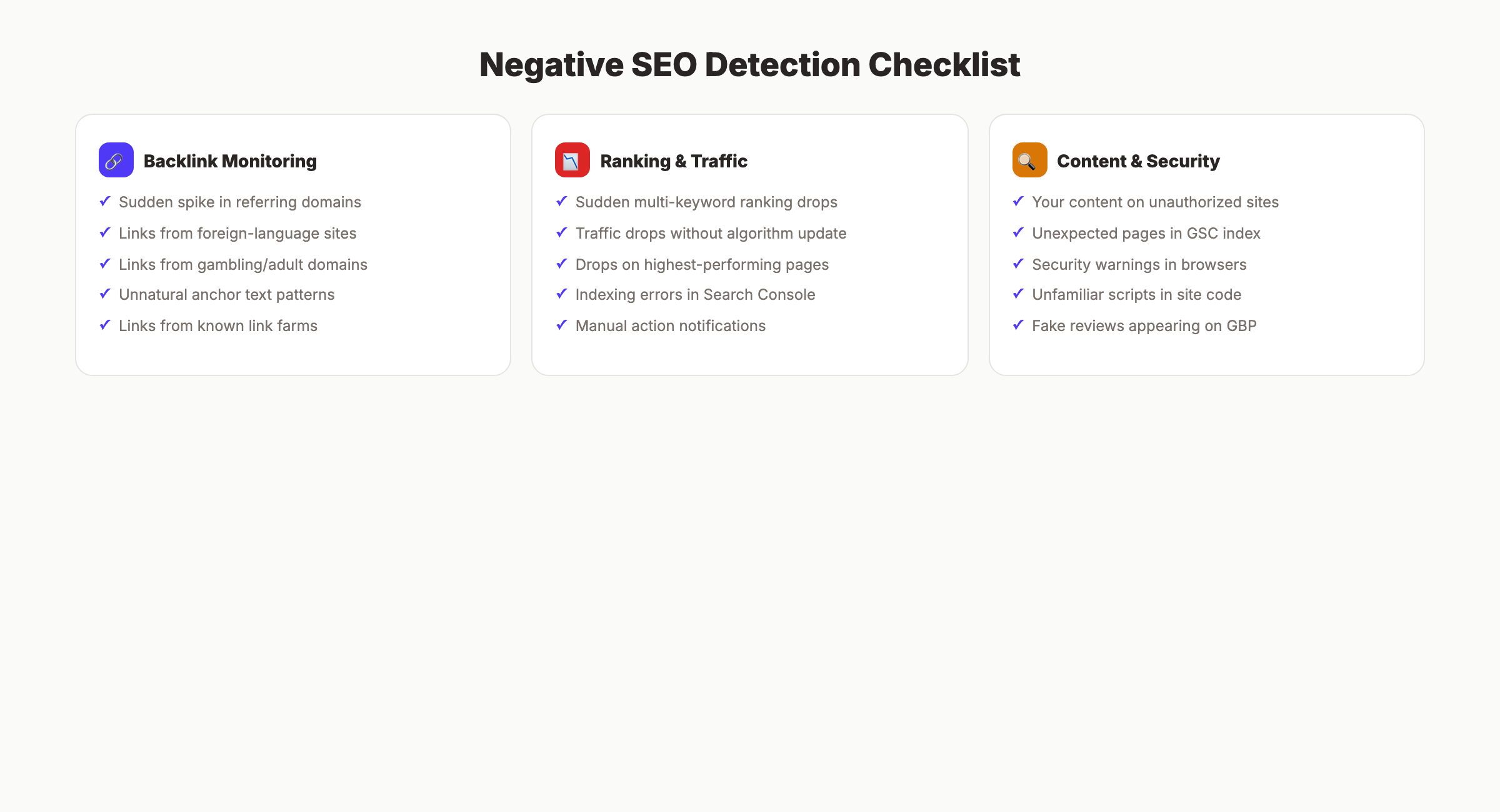
Monitor Your Backlink Profile
Check your backlink profile weekly using Google Search Console, Ahrefs, or Semrush. Look for:
- Sudden spikes in referring domains (50+ new domains in a day)
- Links from foreign-language sites unrelated to your business
- Links from gambling, adult, or pharmaceutical domains
- Anchor text that does not match your content
- Links from known link farms or PBN networks
A healthy backlink profile grows gradually. A negative SEO attack causes an unnatural spike.
Track Rankings and Traffic
Monitor daily ranking positions for your top 20 keywords. Use Google Search Console and Google Analytics to spot traffic drops.
- Sudden ranking drops across multiple keywords
- Traffic declines that do not correlate with algorithm updates
- Drops concentrated on specific pages (the attacker may target your highest-performing content)
Check for Content Duplication
Search for exact phrases from your top-performing content. Use Copyscape or paste a sentence into Google with quotes. If your content appears on other sites without attribution, you may be the target of content scraping.
Review Google Search Console Alerts
Google sends notifications for security issues, manual actions, and unusual activity. Check the Security and Manual Actions sections regularly.
- Manual action notifications
- Security issues flagged
- Coverage errors for pages that were previously indexed
Your SEO team. $99 per month. 30 optimized articles, published automatically. No writers. No agencies. Start for $1 →
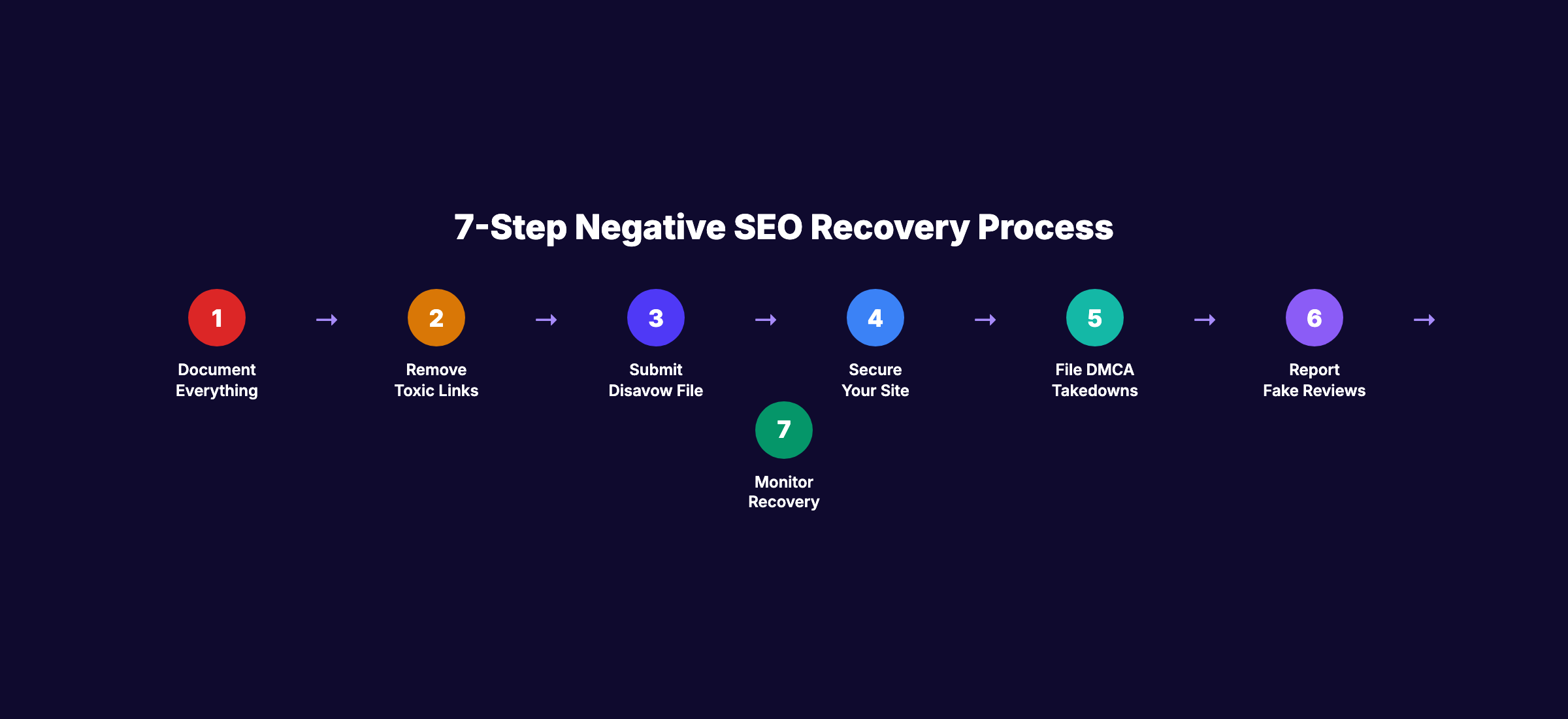
How to Recover From a Negative SEO Attack
Recovery follows a specific process. Speed matters. The faster you act, the less damage accumulates.
Step 1: Document Everything
Screenshot the evidence. Export backlink reports. Record traffic data. Save Google Search Console alerts. Documentation supports a disavow request and potential legal action.
Step 2: Remove Toxic Backlinks
Contact the webmasters of sites linking to you with spammy links. Request removal. Keep records of every outreach attempt. Most webmasters will not respond, but the effort demonstrates good faith to Google.
Step 3: Submit a Disavow File
When manual removal fails, use Google’s Disavow Tool in Search Console. Upload a text file listing the toxic domains or URLs you want Google to ignore.
Disavow file format:
## Spammy domains identified on [date]
domain:spamsite1.com
domain:spamsite2.com
domain:toxiclinks.net
Critical warning: Only disavow links you are confident are harmful. Disavowing legitimate backlinks weakens your own link profile. Review each link manually before adding it to the file.
Step 4: Secure Your Site
If the attack involved hacking:
- Change all passwords (CMS, hosting, FTP, database)
- Update CMS, themes, and plugins to the latest versions
- Remove any injected code or unfamiliar files
- Request a security review through Google Search Console
Step 5: File DMCA Takedowns for Scraped Content
If your content was copied, file DMCA takedown requests with Google and the hosting providers of the offending sites. Google provides a legal removal request form for this purpose.
Step 6: Report Fake Reviews
Report fake Google reviews through your Google Business Profile. Flag each review as inappropriate. Google reviews the reports, though removal can take days to weeks.
Step 7: Monitor Recovery
After cleanup, monitor your rankings, traffic, and backlink profile daily for 4 to 6 weeks. Recovery is not instant. Google needs to recrawl your site and reprocess the disavow file.
How to Protect Your Site From Negative SEO
Prevention costs less than recovery. Build these defenses before an attack happens.
Build a Strong Backlink Profile
Sites with diverse, high-quality backlink profiles are harder to damage. A few hundred spammy links have minimal impact when your site has thousands of legitimate referring domains. Focus on building quality backlinks through content marketing and outreach.
Set Up Automated Monitoring
Configure email alerts in Google Search Console for:
- New manual actions
- Security issues
- Significant traffic drops
- Unusual indexing changes
Use Ahrefs or Semrush to set up weekly backlink monitoring reports. Any sudden spike in new referring domains warrants immediate investigation.
Secure Your Website
- Use strong, unique passwords for all CMS accounts
- Enable 2-factor authentication
- Keep all software updated (CMS, plugins, themes)
- Use a web application firewall (WAF) to block malicious traffic
- Maintain regular backups so you can restore quickly if hacked
See our technical SEO checklist for a full security audit.
Publish Fresh Content Consistently
Sites that publish regular content signal ongoing activity to Google. A fresh publishing cadence makes it harder for scraped content to outrank your originals because Google recognizes your site as the authoritative source.
Protect Your Brand Online
Register your business name on major social platforms even if you do not actively use them. Claim your Google Business Profile and keep it verified. Monitor brand mentions with Google Alerts. Active brand presence makes impersonation attacks less effective.
3,500+ blogs published. 92% average SEO score. See what Stacc can do for your site. Start for $1 →
Negative SEO by Industry: Who Gets Targeted
Not every business faces the same level of risk. Certain industries attract more negative SEO attacks than others.
High-Risk Industries
Legal services. Law firms operate in the most competitive local search markets. A personal injury lawyer ranking #1 in a major city generates millions in revenue from that single position. Competitors have strong financial incentive to attack.
Home services. Plumbers, HVAC companies, and contractors compete for a small number of local keywords. The difference between ranking #1 and #4 in the local pack is thousands of dollars per month in leads.
Healthcare. Dental practices, med spas, and clinics face both link spam and review bombing from competitors in overlapping service areas.
Real estate. Agents and brokerages compete aggressively for neighborhood-level keywords. Fake review attacks are especially common in real estate SEO.
Lower-Risk Industries
Niche B2B services, specialized manufacturing, and professional services with low search competition face fewer negative SEO attacks. The incentive is smaller when organic rankings drive fewer direct leads.
The Common Factor
The businesses most at risk share 2 traits: high-value keywords and direct local competition. If ranking #1 for your primary keyword is worth $10,000 or more per month in revenue, the incentive for a competitor to attack is real.
The best defense is a strong site with diverse backlinks, consistent content publishing, and active local SEO management. Attackers go after the weakest targets. Make your site one of the strongest.
What Google Says About Negative SEO
Google’s position has evolved over the years. Here is what their team has stated publicly.
John Mueller (Google): True negative SEO is “really, really, really rare.” Google’s algorithms are “incredibly good” at spotting and ignoring most negative SEO attempts.
Google’s Disavow Tool: The existence of the Disavow Tool itself acknowledges that harmful links can affect rankings. Google would not build a tool to solve a problem that does not exist.
Google’s SpamBrain: Google’s AI-based spam detection system identifies and neutralizes many spammy link-building patterns before they affect rankings. SpamBrain has reduced the effectiveness of traditional link spam attacks.
The practical takeaway: Google catches most negative SEO attempts automatically. But “most” does not mean “all.” The Disavow Tool exists as a safety net for the attacks that slip through. Businesses that monitor their SEO regularly catch the rest.
The Real Cost of a Negative SEO Attack
Negative SEO costs more than ranking positions. It costs time, money, and reputation.
Direct Costs
| Cost Category | Typical Range | Timeline |
|---|---|---|
| Backlink audit and cleanup | $500 to $3,000 | 1 to 4 weeks |
| Security remediation (hacking) | $1,000 to $5,000 | 1 to 2 weeks |
| DMCA takedown filings | $200 to $1,000 | 2 to 6 weeks |
| Reputation management (fake reviews) | $500 to $2,000 | 2 to 8 weeks |
| Legal consultation | $1,000 to $5,000+ | Varies |
Indirect Costs
The real damage is the organic traffic you lose during recovery. A site that normally generates $10,000 per month from organic search loses $2,500 to $10,000 per week during a severe attack. Multiply that by a 4 to 12 week recovery window.
Lost traffic means lost leads. Lost leads mean lost revenue. Existing customers who see negative reviews or security warnings lose trust. The reputational damage persists even after rankings recover.
Prevention vs Recovery
Proactive monitoring costs $50 to $200 per month through SEO tools and automated alerts. Recovery from a serious attack costs $5,000 to $20,000 in direct expenses plus lost revenue. The math strongly favors prevention.
FAQ
What is negative SEO?
Negative SEO is the deliberate use of black hat tactics to harm a competitor’s search rankings. Common methods include building spammy backlinks, scraping content, posting fake reviews, and hacking websites. The goal is to make the target site appear untrustworthy to Google.
Can negative SEO actually hurt my rankings?
Yes, but the risk varies. Sites with fewer than 300 referring domains are most vulnerable. Established sites with strong, diverse backlink profiles are harder to damage. Google catches most attacks automatically, but overwhelming volumes of toxic backlinks can still cause ranking drops.
How do I know if I am being attacked?
Monitor your backlink profile for sudden spikes in referring domains from low-quality sites. Watch for ranking drops that do not correspond to algorithm updates. Check for your content appearing on unauthorized sites. Google Search Console alerts for security issues or manual actions are also early warning signs.
How long does it take to recover from a negative SEO attack?
Recovery takes 4 to 12 weeks depending on the attack severity. Disavow files take 2 to 4 weeks for Google to process. Hacked sites require cleanup before resubmitting for a security review. Content scraping DMCA takedowns can take days to weeks.
Should I use the Google Disavow Tool?
Only if you have confirmed toxic backlinks that you cannot remove through direct outreach. The Disavow Tool is a last resort. Disavowing legitimate links by mistake weakens your own rankings. Always review links manually before adding them to a disavow file.
How can I protect my site proactively?
Build a diverse backlink profile, maintain strong site security, publish content consistently, and set up automated monitoring for backlinks and rankings. The best defense is a strong, active site that Google already trusts.
Negative SEO is a real threat, but a manageable one. The businesses that monitor their backlink profiles, maintain site security, and build strong content foundations are nearly immune to these attacks. The businesses that ignore their SEO health are the ones that get hurt.
The bottom line: build a site so strong that negative SEO attacks bounce off it. Consistent publishing, quality backlinks, and active monitoring make your site one of the hardest targets online. Do not wait for an attack to start taking SEO seriously.
Written and published by Stacc. We publish 3,500+ articles per month across 70+ industries. All data verified against public sources as of March 2026.
