AI shopping agents drove $262B in holiday sales. Learn how to optimize product data, schema markup, and feeds so AI assistants recommend your products.
Short answer: AI shopping agents already influence real revenue: Salesforce put AI-influenced retail sales at $262 billion in the 2025 holiday season, about 20% of transactions. Agents read structured product data rather than browsing visually, so complete feeds, Product schema and machine-readable descriptions decide whether they recommend you.
AI shopping agents are no longer a future concept. They are actively reshaping how consumers discover and buy products online. During the 2025 holiday season, AI-influenced retail sales reached $262 billion globally, representing 20% of all retail transactions, according to Salesforce data from January 2026. Brands that deployed AI agents grew 59% faster than competitors who did not.
Yet most e-commerce stores are not prepared. Their product data is incomplete. Their schema markup is missing or broken. Their content is written for human shoppers, not for AI systems that parse, compare, and recommend products autonomously. When a consumer asks an AI assistant to "find the best waterproof hiking boots under $150," the agent does not browse your website visually. It reads structured data, compares attributes across dozens of stores, and returns a curated shortlist. If your product data is thin, you do not make the list.
This guide shows you exactly how to prepare your e-commerce store for AI shopping agents. You will learn how to structure your product data, implement the schema markup AI systems depend on, optimize your product feeds, and create content that AI assistants can parse and cite. theStacc has analyzed how AI systems read e-commerce sites, and this guide covers every technical and content requirement you need to meet.
Table of Contents
- What AI Shopping Agents Are and How They Work
- Why 2026 Is the Tipping Point for AI-Driven Commerce
- The Data Layer: How AI Agents Read Your Products
- Structured Data Requirements for AI Shopping Optimization
- Product Feed Optimization for AI Shopping Bots
- Content Strategy: Writing for AI Assistants and Human Shoppers
- Building Trust Signals That AI Agents Prioritize
- Technical SEO Foundations for AI Shopping Agent Crawling
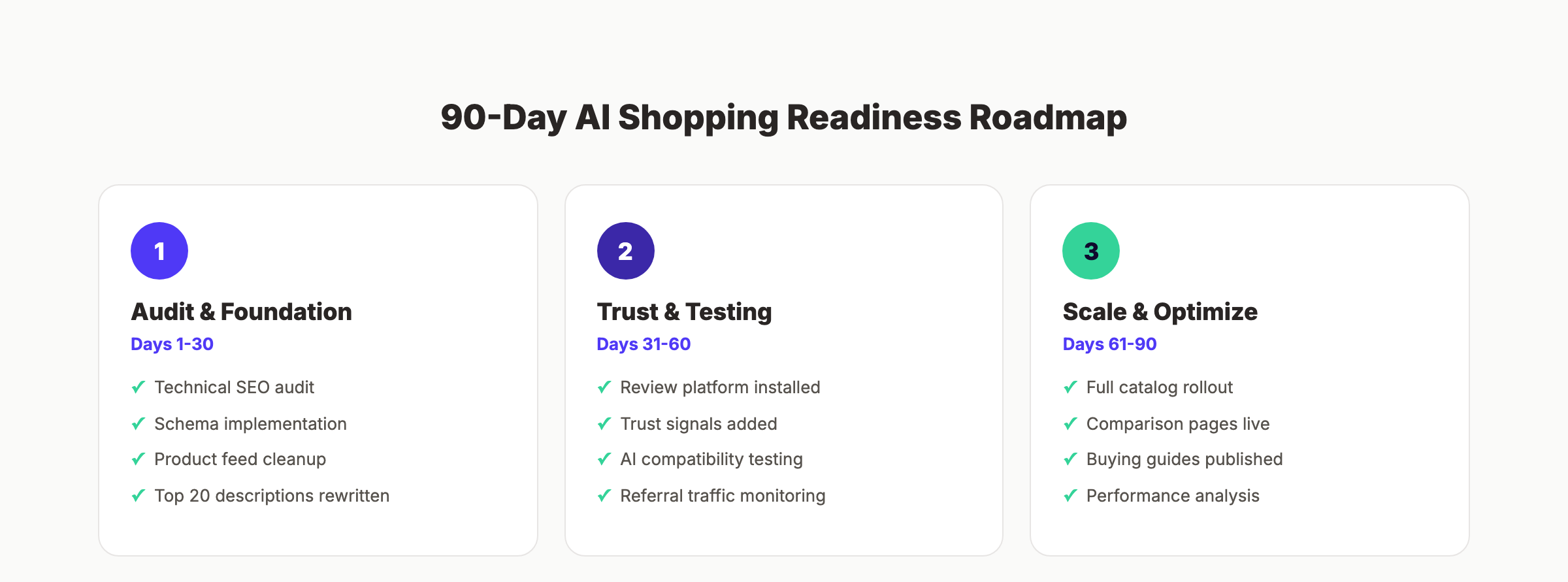
- Your 90-Day Implementation Roadmap
- Frequently Asked Questions
What AI Shopping Agents Are and How They Work
AI shopping agents are autonomous systems that help consumers discover, compare, and purchase products using natural language. Unlike traditional search engines that return a list of links, AI shopping agents synthesize information from multiple sources and present curated recommendations with reasoning. They can compare prices across retailers, read reviews, check inventory, and even complete purchases on behalf of the user.
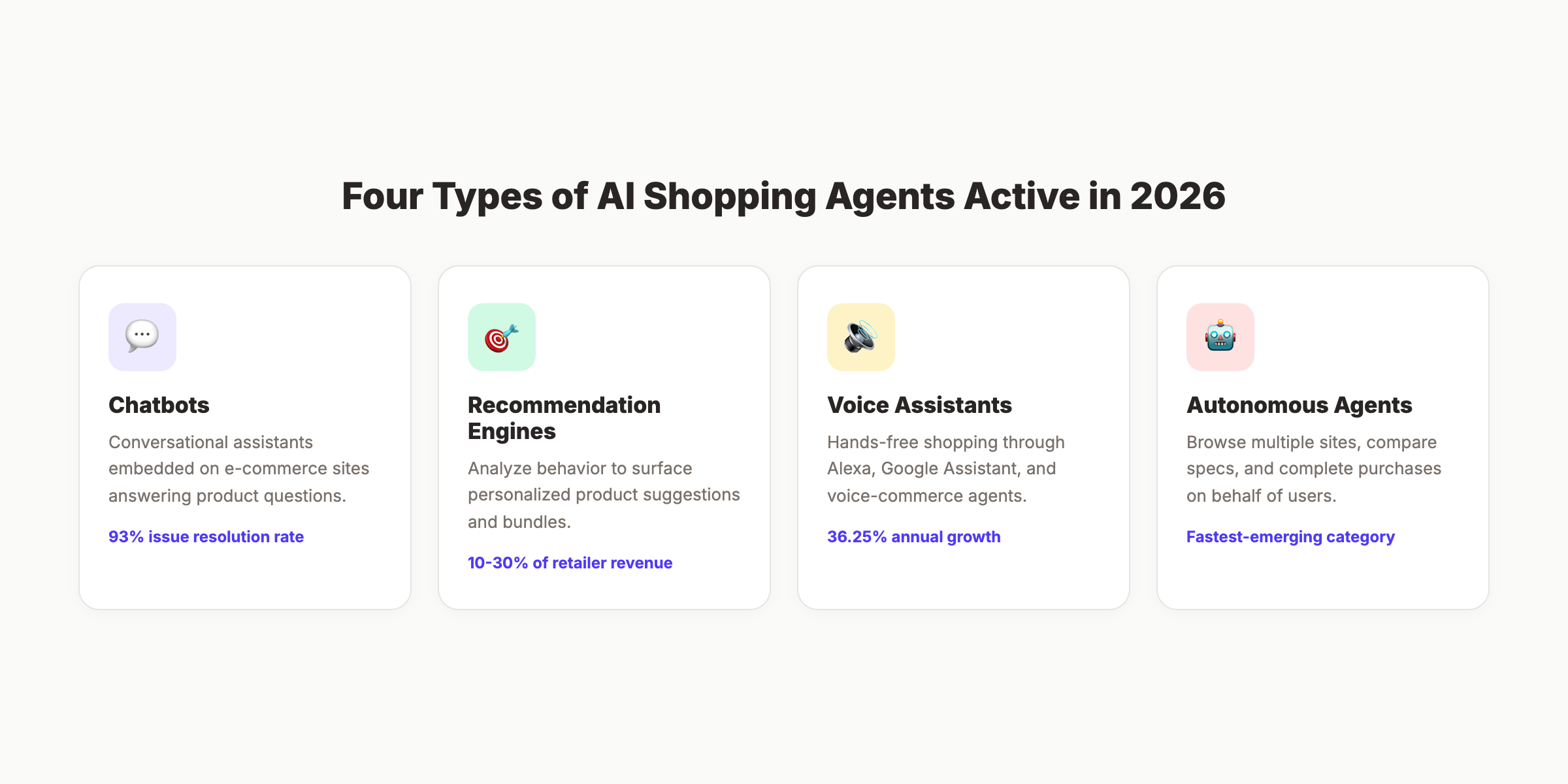
There are four main types of AI shopping assistants active in 2026:
Conversational chatbots embedded on e-commerce sites answer product questions, suggest alternatives, and guide shoppers through the purchase process. These resolve 93% of customer questions without human intervention, according to Rep AI data from 2025.
Recommendation engines analyze user behavior, purchase history, and product attributes to surface personalized suggestions. These systems power the "customers also bought" and "recommended for you" features that drive 10% to 30% of retailer revenue.
Voice-activated assistants like Amazon Alexa and Google Assistant enable hands-free shopping. Voice-commerce agents are the fastest-growing segment, expanding at 36.25% annually through 2031, per Mordor Intelligence projections.
Autonomous shopping agents are the newest category. These systems browse multiple websites, apply filters, compare specifications, and make purchase decisions based on user-defined criteria. Perplexity Shopping, Amazon Rufus, and emerging browser-use agents fall into this category.
AI shopping agents work by extracting structured product data from your website. They read JSON-LD schema markup, parse product feed files, analyze review sentiment, and evaluate trust signals. The agent does not see your beautiful product photography or admire your brand design. It sees data fields: price, availability, rating, dimensions, material, compatibility. The richer and more structured your data, the more likely the agent is to recommend your product.
Why 2026 Is the Tipping Point for AI-Driven Commerce
The shift toward AI-driven commerce is not gradual. It is accelerating rapidly, and 2026 marks the inflection point where AI-mediated shopping moves from early adoption to mainstream behavior.
The numbers tell the story. The agentic AI in retail and e-commerce market reached $46.74 billion in 2025 and is projected to grow to $60.43 billion in 2026, a 29.3% year-over-year increase, according to Mordor Intelligence. By 2031, the market is expected to reach $218.37 billion.
Consumer behavior has shifted just as dramatically. In France, Germany, and the United Kingdom, 84% of consumers now use AI daily, according to McKinsey research. Among those users, 63% employ AI to compare brands, prices, and reviews. Generative AI retail traffic grew 4,700% year-over-year by July 2025.
The 2025 holiday season provided definitive proof of AI's commercial impact:
| Metric | Value | Source |
|---|---|---|
| Global online sales | $1.29 trillion (+7% YoY) | Salesforce, Jan 2026 |
| AI-influenced retail sales | $262 billion (20% of total) | Salesforce, Jan 2026 |
| AI search traffic conversion rate | 9x higher than social referrals | Salesforce, Jan 2026 |
| Brands with AI agents growth premium | 59% higher vs. without | Salesforce, Jan 2026 |
| E-commerce traffic from AI chatbots | Doubled year-over-year | Multiple sources |
Gartner projects that 88% of product searches will involve AI-driven recommendations by 2026. This means the traditional model of a consumer typing a keyword into Google, scanning results, and clicking through to your site is being replaced by a model where an AI agent does the scanning, comparing, and filtering on the consumer's behalf. Your store must be optimized for this new discovery layer or risk becoming invisible.
Your competitors are already optimizing for AI shopping agents. Brands that deployed AI-ready product data and structured markup saw 60% higher visibility in AI shopping assistant results, according to Hexagon internal audit data from 2024. Get your store AI-ready with theStacc →
The Data Layer: How AI Agents Read Your Products
AI shopping agents do not browse websites the way humans do. They do not scroll through product galleries or read marketing copy. They extract structured data through APIs, schema markup, and feed files. Understanding this data layer is essential for optimization.
When an AI agent encounters your product page, it performs the following data extraction sequence:
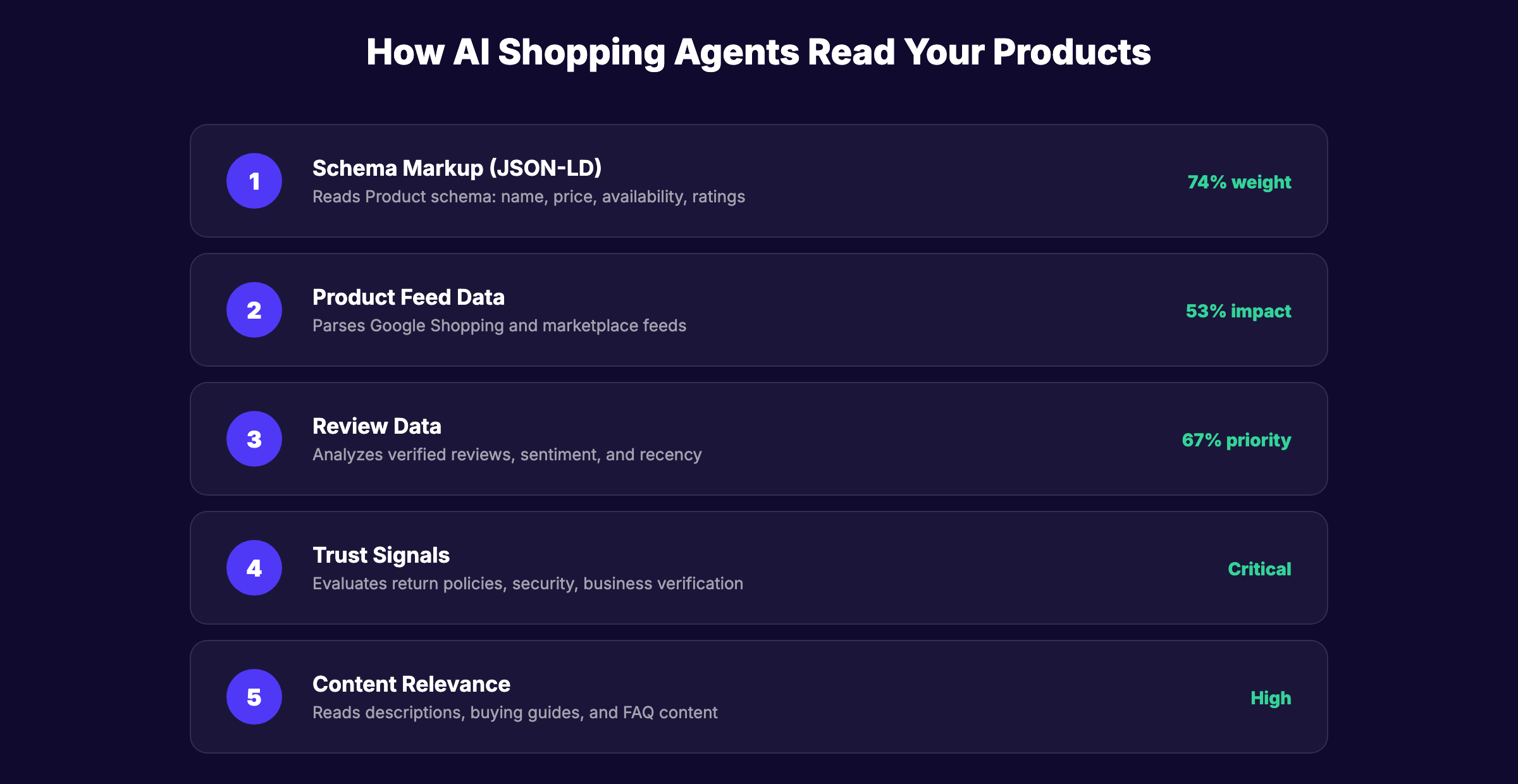
First, it reads schema markup. The agent looks for JSON-LD Product schema containing name, description, SKU, brand, price, availability, and ratings. According to OpenAI Research Blog data, 74% of AI shopping recommendations depend on structured product data as a ranking factor. Without complete schema, the agent lacks the basic information needed to evaluate your product.
Second, it parses the product feed. If your store submits feeds to Google Shopping, Amazon, or other marketplaces, AI agents access this structured data. Feed quality directly impacts recommendation likelihood. Feedonomics benchmark data shows that 53% of e-commerce brands report increased AI-driven traffic after enhancing product feed quality.
Third, it evaluates review data. AI agents analyze review sentiment, volume, and recency. Perplexity Labs Blog research indicates that 67% of AI assistants prioritize e-commerce sites featuring verified reviews and rich user-generated content. A product with 2,000 verified reviews and a 4.7-star rating receives preferential treatment over a similar product with 12 reviews.
Fourth, it checks trust signals. The agent evaluates return policies, security certificates, business verification status, and complaint history. These signals determine whether the agent feels confident recommending your store to its user.
Fifth, it assesses content relevance. The agent reads product descriptions, buying guides, and FAQ content to understand what problems your product solves and how it compares to alternatives. Content written in natural language, with clear problem-fix framing, performs best.
The critical insight is this: AI agents make recommendations based on data completeness and quality, not brand recognition or advertising spend. A small retailer with perfect schema markup, rich product data, and strong reviews can outrank a major brand with thin data.
Structured Data Requirements for AI Shopping Optimization
Structured data is the foundation of AI shopping optimization. Without it, AI agents cannot understand what you sell, how much it costs, or whether it is in stock. Here is the exact implementation guide.
Required Schema.org Properties
Every product page must include JSON-LD Product schema with the following required fields:
| Property | Description | Example |
|---|---|---|
name | Product name | "Waterproof Hiking Boots - Men's Size 10" |
description | Detailed product description | "Gore-Tex waterproof hiking boots..." |
sku | Stock keeping unit | "WHB-M10-BRN" |
brand | Brand name | "TrailMaster" |
offers.price | Current price | "149.99" |
offers.priceCurrency | Currency code | "USD" |
offers.availability | Stock status | "https://schema.org/InStock" |
aggregateRating.ratingValue | Average rating | "4.7" |
aggregateRating.reviewCount | Number of reviews | "2341" |
Recommended Additional Properties
These fields are not strictly required but significantly improve AI agent comprehension:
| Property | Why It Matters |
|---|---|
gtin / mpn | Global product identifiers help AI agents match your product across databases |
color, size, material | Attribute data enables filtering and comparison |
weight, dimensions | Physical specs matter for shipping and compatibility queries |
category | Hierarchical category placement improves discovery |
image | High-resolution product images (multiple angles) |
review | Individual review objects with rating and text |
isRelatedTo | Related products for cross-selling |
Implementation by Platform
Shopify: Use a schema app like JSON-LD for SEO or Smart SEO. These apps auto-generate Product schema for all products. Verify output using Google's Rich Results Test.
WooCommerce: Install the Yoast SEO or Rank Math plugin. Both generate Product schema automatically. For advanced control, use the Schema Pro plugin.
BigCommerce: Built-in structured data is included. Go to Store Settings and verify that Product schema is enabled. Customize through the theme files if needed.
Custom builds: Add JSON-LD script tags directly to your product page templates. Validate every page with Google's Rich Results Test and the Schema Markup Validator.
Common Schema Mistakes to Avoid
- Missing price or availability: Out-of-stock products without proper availability markup confuse AI agents
- Incorrect currency: Using symbols instead of ISO codes ($ instead of USD)
- Duplicate schema: Multiple Product schemas on one page create parsing errors
- Rating without review count: AggregateRating requires both ratingValue and reviewCount
- Placeholder data: Using "TBD" or "0" for required fields breaks trust signals
74% of AI shopping recommendations depend on structured product data. If your schema markup is incomplete or missing, AI agents cannot evaluate your products for recommendation. theStacc helps e-commerce stores implement and validate structured data at scale. Fix your product schema today →
Product Feed Optimization for AI Shopping Bots
Product feeds are the primary data source AI shopping agents use to compare products across retailers. A well-optimized feed ensures your products appear in AI-generated recommendations, comparison tables, and curated lists.
Feed Hygiene Requirements
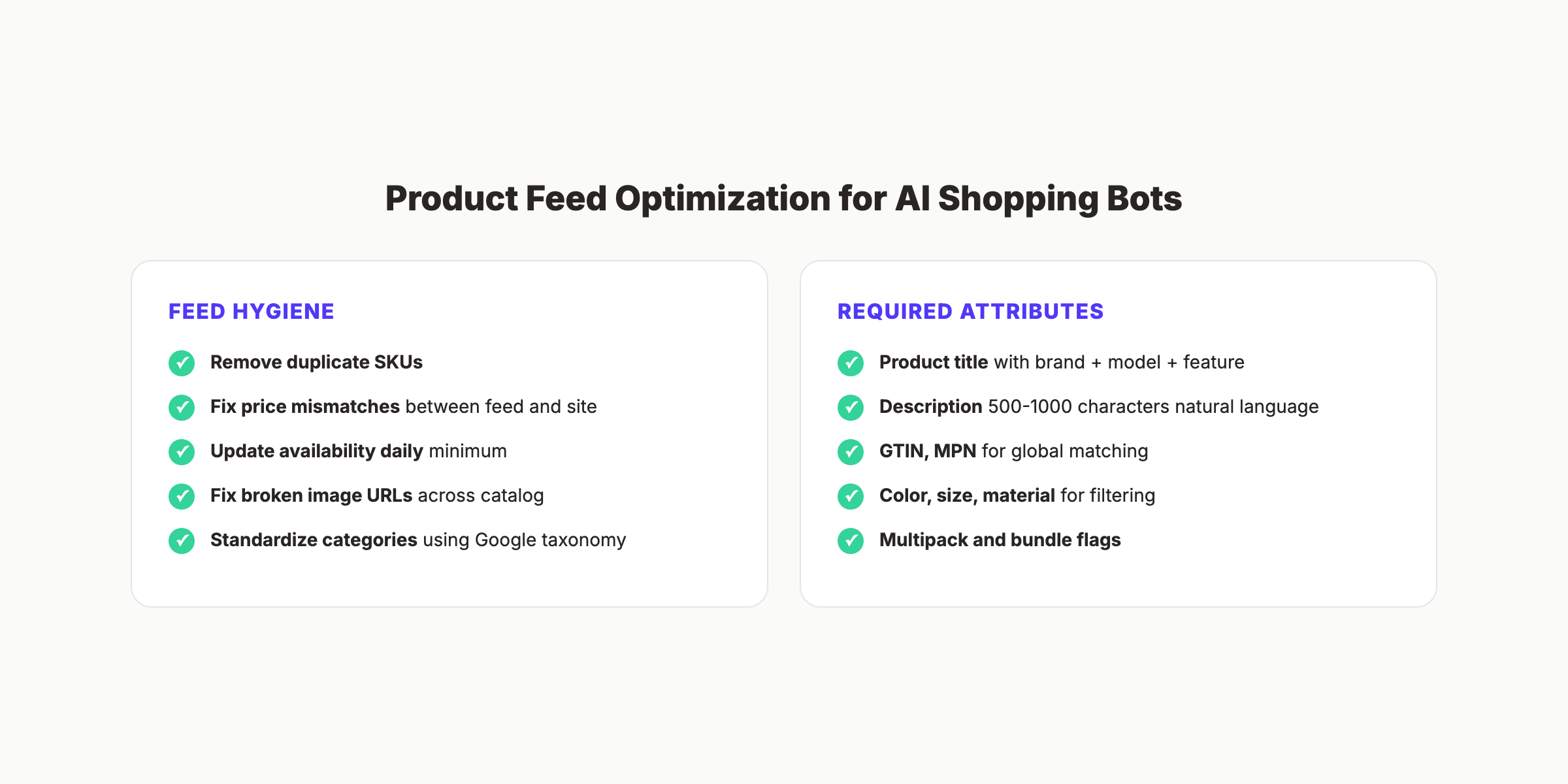
AI shopping bots penalize messy data. Before optimizing for AI, fix these fundamental issues:
- Remove duplicate SKUs: Each product should have one unique identifier
- Correct price mismatches: Feed price must match website price exactly
- Update availability daily: Nothing damages credibility like recommending an out-of-stock product
- Fix broken image URLs: Every product needs at least one working high-resolution image
- Standardize categories: Use Google Product Taxonomy or your platform's standard categories
Key Feed Attributes for AI Optimization
| Attribute | Best Practice | AI Impact |
|---|---|---|
| Product title | Include brand + model + key feature + size/color | Enables precise matching |
| Description | 500-1000 characters, natural language, feature-focused | Powers comparison and recommendation |
| Product type | Full category path (Apparel > Men > Shoes > Boots) | Improves category filtering |
| Google product category | Exact taxonomy match | Required for Google Shopping and AI indexing |
| Condition | new / refurbished / used | Filters irrelevant recommendations |
| Adult | true / false | Compliance filtering |
| Multipack | Quantity if sold as multipack | Price comparison accuracy |
| Bundle | true / false if product is bundle | Prevents comparison errors |
| Material | Fabric, metal, plastic, etc. | Attribute-based filtering |
| Pattern | Solid, striped, floral, etc. | Style-based recommendations |
| Size type | Regular, petite, plus, big and tall | Size filtering |
| Size system | US, UK, EU, etc. | International comparison |
| Energy efficiency class | A+++, A++, etc. | Regulatory compliance |
| Applicable countries | Shipping destinations | Geographic relevance |
Feed Update Frequency
AI agents expect current data. Set your feed update schedule based on inventory volatility:
| Business Type | Recommended Update Frequency |
|---|---|
| High-velocity fashion/apparel | Every 4-6 hours |
| Electronics with fluctuating prices | Every 6-12 hours |
| Stable inventory (furniture, appliances) | Daily |
| Seasonal or limited-stock items | Real-time or every 2 hours |
Feed Testing for AI Compatibility
Test your feed against AI shopping assistant behavior using these methods:
- Submit your feed to Google Merchant Center and resolve all errors and warnings
- Use Google's Rich Results Test on individual product pages
- Test product discovery by asking AI assistants specific questions about products you sell
- Monitor AI referral traffic in Google Analytics 4
Content Strategy: Writing for AI Assistants and Human Shoppers
Product content must serve two audiences simultaneously: human shoppers who need persuasion, and AI agents who need structured, factual information. The best content satisfies both.
Product Description Framework
Write product descriptions using this structure:
Paragraph 1: Problem and Fix (50-80 words) Open with the problem your product solves. Use natural language that mirrors how shoppers describe their needs. Example: "Cold, wet feet ruin hikes. These waterproof hiking boots use Gore-Tex membrane to keep water out while letting sweat escape, so your feet stay dry on 10-mile treks."
Paragraph 2: Key Features and Specifications (80-120 words) List specific features with measurements and materials. Include compatibility information. Example: "The Vibram outsole grips wet rock and muddy trails. The 6-inch ankle support protects against sprains. Weight: 1.8 pounds per pair. Available in medium and wide widths."
Paragraph 3: Social Proof and Use Cases (50-80 words) Reference reviews, ratings, and real-world applications. Example: "Rated 4.7 stars by 2,300 hikers. Popular for Appalachian Trail section hikes, Pacific Northwest rain, and winter dog walking."
Content Types AI Agents Prioritize
AI shopping agents extract information from multiple content types on your site:
Buying guides help AI agents understand how your product category works and where your product fits. A "How to Choose Hiking Boots" guide positions your products within a decision framework.
Product comparison pages enable AI agents to understand differentiation. Compare your products against each other and against generic alternatives.
FAQ pages answer the exact questions AI agents receive from users. Structure FAQs as question-answer pairs with clear, concise responses.
Review content provides social proof and real-world performance data. Encourage detailed reviews that mention specific use cases, pros, and cons.
Natural Language Optimization
AI agents parse natural language queries. Your content should mirror the language shoppers use:
| Instead of | Write |
|---|---|
| "High-performance footwear" | "Hiking boots that handle rocky trails" |
| "Optimized for comfort" | "Cushioned insole reduces foot fatigue on long walks" |
| "Premium materials" | "Full-grain leather upper with waterproof membrane" |
| "Industry-leading" | "Rated top 3 by Backpacker Magazine in 2025" |
User-Generated Content
AI agents heavily weight user-generated content because it represents unbiased product evaluation. Encourage customers to:
- Upload photos with their reviews
- Mention specific use cases ("wore these on a 5-day backpacking trip")
- Rate specific attributes (comfort, durability, waterproofing)
- Update reviews after extended use
Perplexity Labs data shows that 67% of AI assistants prioritize sites with rich user-generated content. Reviews with photos and detailed text receive higher recommendation weight than simple star ratings.
Building Trust Signals That AI Agents Prioritize
Trust is a ranking factor for AI shopping agents. An agent will not recommend your store if it detects credibility risks. Here are the trust signals AI systems evaluate.
Verified Reviews
Display verified purchase badges on reviews. Use a third-party review platform like Trustpilot, Yotpo, or Judge.me that confirms the reviewer actually bought the product. AI agents can detect fake or unverified reviews and penalize sites that rely on them.
Clear Return and Refund Policies
Summarize your return policy in one sentence near the "Add to Cart" button. Link to the full policy. AI agents extract return policy data to answer shopper questions like "Can I return these if they do not fit?"
Security and Compliance Badges
Display SSL certificates, PCI compliance badges, and privacy policy links. These signals confirm that customer data is handled securely. AI agents reference security status when recommending stores for high-value purchases.
Business Verification
Complete your Google Business Profile if you have a physical location. Register with the Better Business Bureau. List your business on reputable directories. These verifications create a web of trust that AI agents cross-reference.
Transparent Pricing
Show all costs upfront: product price, shipping, taxes, and any fees. AI agents penalize stores with hidden costs that appear at checkout. Unexpected fees are a primary cause of cart abandonment, and AI systems learn to avoid recommending stores with poor checkout experiences.
Customer Service Accessibility
Provide multiple contact methods: email, phone, and live chat. Display response time estimates. AI agents evaluate customer service accessibility as a proxy for merchant reliability.
| Trust Signal | Implementation | AI Impact |
|---|---|---|
| Verified reviews | Third-party review platform with purchase verification | High recommendation weight |
| Clear returns | One-sentence summary + full policy link | Reduces purchase friction |
| Security badges | SSL, PCI, privacy policy visible | Enables high-value recommendations |
| Business verification | Google Business Profile, BBB, directories | Cross-reference trust network |
| Transparent pricing | All costs visible before checkout | Avoids penalty for hidden fees |
| Customer service | Multiple channels with response times | Reliability proxy |
67% of AI assistants prioritize stores with verified reviews and rich user-generated content. If your competitors have 2,000 verified reviews and you have 50, AI agents will recommend them over you, regardless of price or features. Build your review generation system with theStacc →
Technical SEO Foundations for AI Shopping Agent Crawling
AI shopping agents must crawl your site efficiently to extract product data. Technical barriers prevent crawling, which prevents recommendations.
Crawlability Best Practices
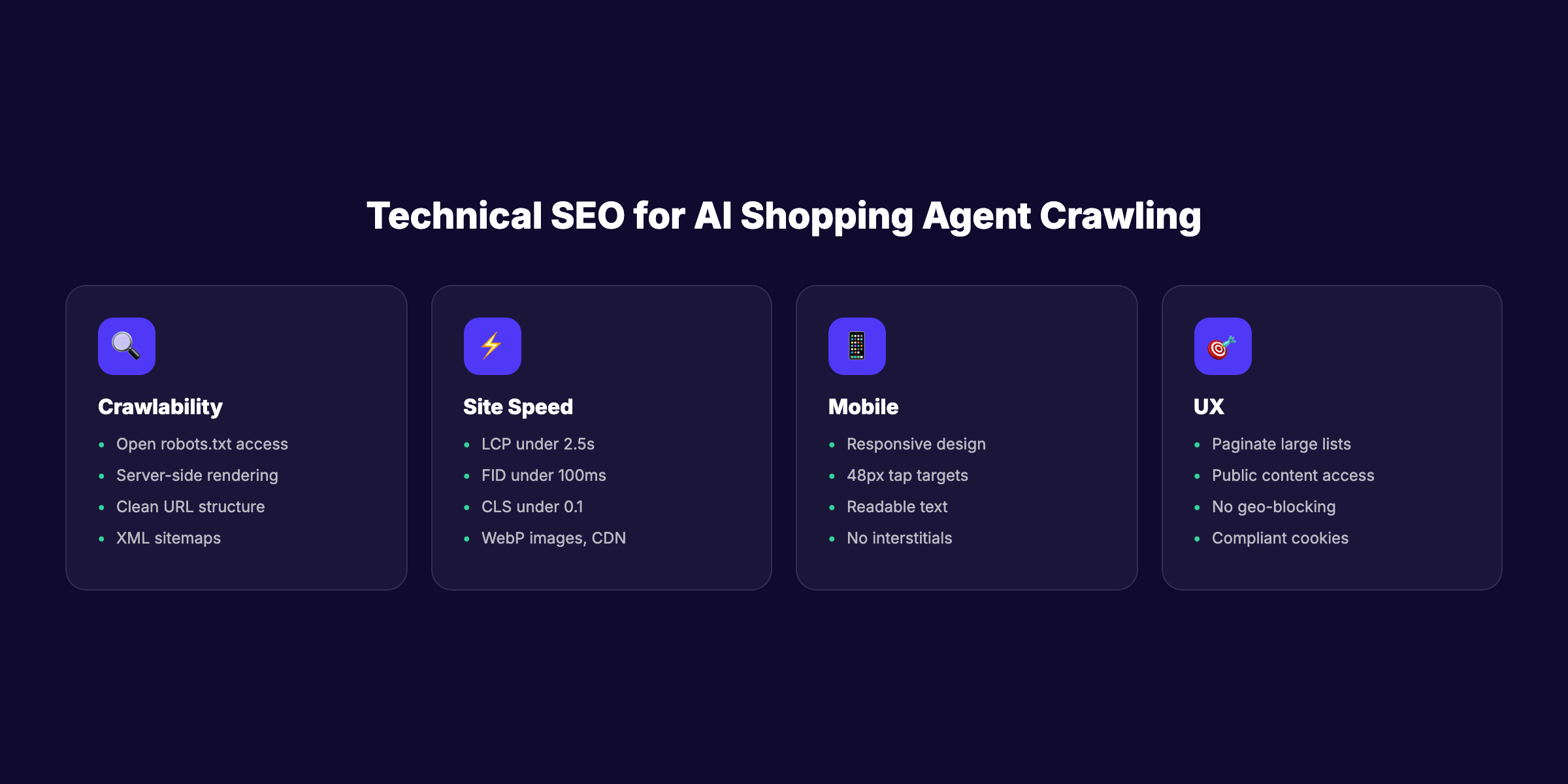
Remove robots.txt blocks on product pages. Some e-commerce sites accidentally block product pages from crawlers. Verify that your robots.txt file allows access to all product, category, and review pages.
Minimize JavaScript rendering. AI crawlers have varying JavaScript execution capabilities. Serve critical product data in the initial HTML, not loaded via JavaScript after page load. Use server-side rendering or static generation for product pages.
Use clean, descriptive URLs. Example: /products/waterproof-hiking-boots-mens instead of /products?id=38472. Clean URLs help AI agents understand page content before crawling.
Maintain updated XML sitemaps. Submit sitemaps to Google Search Console and Bing Webmaster Tools. Include product pages, category pages, and review pages. Update sitemaps automatically when products are added or removed.
Site Speed Requirements
AI agents prefer fast-loading sites because they can crawl more pages in less time. Target these metrics:
| Metric | Target | Tool |
|---|---|---|
| Largest Contentful Paint | Under 2.5 seconds | PageSpeed Insights |
| First Input Delay | Under 100 milliseconds | PageSpeed Insights |
| Cumulative Layout Shift | Under 0.1 | PageSpeed Insights |
| Time to First Byte | Under 600 milliseconds | WebPageTest |
Compress images to WebP format. Enable lazy loading for below-the-fold images. Deploy a content delivery network. Minimize render-blocking JavaScript and CSS.
Mobile Optimization
Most AI shopping queries originate on mobile devices. Your site must perform flawlessly on smartphones:
- Use responsive design that adapts to all screen sizes
- Make tap targets at least 48 pixels wide
- Ensure text is readable without zooming
- Eliminate intrusive interstitials that block content
- Test checkout flow on multiple mobile devices
Avoiding UX Obstacles
Certain design patterns block AI crawlers and frustrate human users:
- Infinite scroll without pagination: Crawlers cannot access all products
- Content behind login walls: Product data must be publicly accessible
- Geo-blocking without alternatives: AI agents crawl from various locations
- Cookie walls that block content: Use compliant consent banners that do not obstruct crawling
Your 90-Day Implementation Roadmap
Preparing your e-commerce store for AI shopping agents is a structured process. This 90-day roadmap breaks it into manageable phases.
Days 1-30: Audit and Foundation
Week 1: Technical Audit
- Run a complete technical SEO audit using Screaming Frog or Sitebulb
- Verify robots.txt allows crawling of all product and category pages
- Test schema markup on all product pages using Google's Rich Results Test
- Check page speed metrics with PageSpeed Insights
- Document baseline metrics: organic traffic, conversion rate, average order value
Week 2: Schema Implementation
- Add or fix JSON-LD Product schema on every product page
- Include all required properties: name, description, SKU, brand, price, availability, ratings
- Add recommended properties: GTIN, MPN, color, size, material, dimensions
- Validate every page and fix errors
Week 3: Feed Optimization
- Audit your product feed for duplicates, price mismatches, and broken links
- Add all key attributes: product type, Google category, condition, material, size
- Set up automated feed updates based on your inventory velocity
- Submit updated feed to Google Merchant Center
Week 4: Content Enhancement
- Rewrite top 20 product descriptions using the problem-fix-feature framework
- Add buying guides for your top 3 product categories
- Create FAQ pages addressing common purchase questions
- Encourage detailed customer reviews with photos
Days 31-60: Trust and Testing
Week 5-6: Trust Signal Implementation
- Install a verified review platform if not already in place
- Summarize return and refund policies on every product page
- Add security badges near checkout buttons
- Verify business listings on Google, BBB, and industry directories
Week 7-8: AI Compatibility Testing
- Test product discovery by asking AI assistants about products you sell
- Monitor AI referral traffic in Google Analytics 4
- Check which products appear in AI-generated comparisons
- Identify gaps where competitors outrank you
Days 61-90: Scale and Optimize
Week 9-10: Content Scale
- Expand optimized product descriptions to your full catalog
- Create comparison pages for product lines
- Publish category-specific buying guides
- Implement automated review request workflows
Week 11-12: Performance Analysis
- Compare current metrics to baseline
- Measure AI referral traffic growth
- Analyze which products receive AI recommendations
- Double down on categories showing the strongest AI-driven performance
| Phase | Timeline | Key Deliverables |
|---|---|---|
| Foundation | Days 1-30 | Schema markup, feed optimization, content rewrite |
| Trust and Testing | Days 31-60 | Reviews, trust signals, AI compatibility testing |
| Scale and Optimize | Days 61-90 | Full catalog rollout, performance analysis, iteration |
What practitioners are saying on X
AI search advice ages quickly. Here is high-signal public discussion from SEO and growth operators — context for your roadmap, not a substitute for primary data.
- @jakezward (Feb 2026): 2026 SEO predictions emphasize AI Overview share-of-SERP, schema for LLM token efficiency, brand mentions in AI answers as a KPI, proprietary data as a moat, and content refresh beating net-new AI slop. See the post on X.
- @alexgroberman (Jul 2026): Case narrative: organic value plus multi-engine citations (ChatGPT, Perplexity, Grok) from knowledge-hub pages, category authority links, commercial intent content, and tight internal linking — not thin product copy. See the post on X.
- @varunram (Jul 2026): Critique of GEO slopfarm products that combine SEO clickbait with unresearched content marketing — quality and research still separate winners from farms. See the post on X.
Grok, AI Overviews, and multi-engine visibility
AI/search topics like “prepare ecommerce ai shopping agents” need multi-engine notes: AI Overviews, ChatGPT/Perplexity, and Grok. Lead with extractable answers; keep claims consistent with public expert discussion.
- Google AI Overviews: Use passage-ready answers, tables, and FAQ schema where relevant.
- ChatGPT / Perplexity: Cite named sources next to key claims.
- Grok: Maintain accurate entity facts on-site and in high-signal X posts.
Publish content built for Google and AI citations. theStacc’s Content SEO module ships SEO-scored articles structured for rankings and generative engines — including clearer entity pages models like Grok can quote.
Frequently Asked Questions
AI shopping agents are autonomous systems that help consumers discover, compare, and purchase products using natural language. They include conversational chatbots, recommendation engines, voice assistants, and autonomous browsing agents. Unlike traditional search engines, AI agents synthesize information from multiple sources and present curated recommendations with reasoning.
AI shopping agents extract structured data from e-commerce websites through schema markup, product feeds, and API access. They read product attributes, prices, availability, reviews, and trust signals. They do not browse websites visually. They parse data fields and compare them across retailers to generate recommendations.
You need JSON-LD Product schema with required fields: name, description, SKU, brand, price, priceCurrency, availability, aggregateRating (ratingValue and reviewCount). Recommended additional fields include GTIN, MPN, color, size, material, weight, dimensions, and image. Validate your markup using Google's Rich Results Test.
Product reviews are critical. Perplexity Labs data shows that 67% of AI assistants prioritize e-commerce sites with verified reviews and rich user-generated content. Reviews provide social proof, real-world performance data, and sentiment analysis that AI agents use to rank products. Stores with more verified reviews receive higher recommendation weight.
Yes. AI shopping agents recommend based on data completeness and quality, not brand size or advertising budget. A small retailer with perfect schema markup, rich product descriptions, strong reviews, and competitive pricing can outrank major brands in AI-generated recommendations. The playing field is more level in AI-mediated commerce than in traditional search advertising.
Test by asking AI assistants specific questions about products you sell. Examples: "What are the best waterproof hiking boots under $150?" or "Compare TrailMaster boots to Merrell Moab." Monitor whether your products appear in responses. Check Google Analytics 4 for AI referral traffic. Use Google's Rich Results Test to validate schema markup.
Brands that optimized for AI shopping agents grew 59% faster than competitors during the 2025 holiday season, according to Salesforce data. AI search traffic converts at 9x the rate of social media referrals. The agentic AI retail market is growing at 29.3% annually. Early movers capture disproportionate share before competition intensifies.
Update frequency depends on inventory volatility. High-velocity fashion stores should update every 4 to 6 hours. Electronics with fluctuating prices should update every 6 to 12 hours. Stable inventory like furniture can update daily. Seasonal or limited-stock items should update in real time or every 2 hours to avoid recommending out-of-stock products.
AI shopping agents do not prioritize platforms. They prioritize data quality. A Shopify store with complete schema markup and rich product data will outperform a custom-built site with thin data. However, platforms like Shopify and BigCommerce offer built-in schema generation and feed management tools that make optimization easier.
Create buying guides that explain how to choose products in your category. Write product comparison pages that differentiate your offerings. Build FAQ pages that answer common purchase questions. Encourage detailed customer reviews with photos and specific use cases. All content should use natural language that mirrors how shoppers describe their needs.
Key Takeaways
- AI shopping agents drove $262 billion in retail sales during the 2025 holiday season, representing 20% of all transactions
- 74% of AI shopping recommendations depend on structured product data, making schema markup essential
- Product feeds must be clean, complete, and updated frequently to maintain AI agent compatibility
- Content must serve both human shoppers and AI parsers using natural language and structured data
- Trust signals including verified reviews, clear policies, and security badges determine recommendation likelihood
- A 90-day implementation roadmap moves from audit and foundation through trust building to scale and optimization
- Small retailers can outrank major brands in AI recommendations by providing richer, more structured data
AI shopping agents are reshaping e-commerce discovery. The stores that invest in structured data, rich product information, and trust signals today will capture the recommendations that drive tomorrow's sales. The window for early-mover advantage is closing as more retailers optimize for this new discovery layer.
Is your e-commerce store ready for AI shopping agents? theStacc helps e-commerce businesses implement structured data, optimize product feeds, and create AI-friendly content that gets your products recommended. Prepare your store for AI shopping →
Related Tools & Resources
Free SEO Tools:
Best Lists:
Sources & references
- [1] Princeton / Georgia Tech et al. — GEO research (arXiv:2311.09735)
- [2] @jakezward on X — 2026 SEO predictions emphasize AI Overview share-of-SERP, schema for LLM token efficiency, brand mentions in AI answers
- [3] @alexgroberman on X — Case narrative: organic value plus multi-engine citations (ChatGPT, Perplexity, Grok) from knowledge-hub pages, category
- [4] @varunram on X — Critique of GEO slopfarm products that combine SEO clickbait with unresearched content marketing — quality and research

Researched, written, and published articles that compound organic traffic.
Weekly local SEO teardowns
One practical email a week. Map Pack, GBP, AI Overviews — no fluff. Unsubscribe anytime.