SEO for News Websites: The Complete Guide (2026)
Learn how to optimize news websites for Google News, Top Stories, and AI Overviews. Covers technical SEO, structured data, E-E-A-T, and content strategy for publishers.
Siddharth Gangal • 2026-03-30 • Content Strategy

In This Article
Most news websites publish hundreds of articles per week. Fewer than 10% of those articles appear in Google Top Stories. The gap between publishing and ranking costs newsrooms thousands of clicks every day.
That cost compounds. A single Top Stories placement drives 2 to 5 times more traffic than a standard organic result. Miss it on a breaking story and a competitor captures your audience. Miss it consistently and your newsroom loses relevance in search entirely.
SEO for news websites operates on a different clock than traditional SEO. Rankings shift in minutes, not months. The first crawl of an article often determines whether it surfaces in Top Stories or disappears. Speed, structure, and authority all matter more here than in any other vertical.
We have published 3,500+ articles across 70+ industries and studied how Google treats time-sensitive content differently from evergreen pages. This guide covers everything a news publisher needs to rank in 2026.
Here is what you will learn:
- How Google News selects and ranks stories differently from organic search
- The technical foundations that make or break news site indexing
- How to implement NewsArticle structured data correctly
- Why E-E-A-T signals matter more for news than any other content type
- How to balance breaking news with evergreen content strategy
- What AI Overviews mean for news traffic in 2026
What Makes News SEO Different From Traditional SEO
Traditional SEO rewards patience. You publish a page, build links over months, and climb rankings gradually. News SEO rewards speed. An article that ranks 2 hours after a story breaks wins. An article that ranks 2 days later gets nothing.
The First-Crawl Window
Google gives news articles a narrow window to prove relevance. The first time Googlebot crawls your article may be the only chance it gets to appear in Top Stories. If your headline is vague, your structured data is missing, or your page loads slowly, that window closes.
This means every element of the page must be production-ready at publish time. There is no “publish now, optimize later” in news SEO.
Volume and Velocity
News publishers produce 50 to 500 articles per day. Each article competes for crawl budget, index space, and ranking signals. A poorly structured site wastes Googlebot’s crawls on low-value pages while high-priority stories wait in line.
Managing crawl budget is not optional for news sites. It is the difference between your breaking story appearing in Top Stories or being indexed 6 hours too late.
Top Stories vs. Standard Organic Results
Google surfaces news content in multiple places: the Top Stories carousel, the News tab, Discover, and now AI Overviews. Each surface has its own ranking criteria. Top Stories prioritize freshness and authority. Discover favors engagement signals. AI Overviews pull from articles that provide structured, factual answers.
A news SEO strategy must target all 4 surfaces. Optimizing for just 1 leaves traffic on the table.
Your SEO team. $99 per month. Stacc publishes 30 optimized articles per month for your site on autopilot. Start for $1 →
How Google News Selects and Ranks Stories
Google does not index every news article it finds. It evaluates articles against a specific set of signals before deciding whether to surface them.
The 6 Ranking Signals for Google News
| Signal | What It Measures | How to Optimize |
|---|---|---|
| Relevance | How well the article matches the query | Keyword-rich headlines and lead paragraphs |
| Prominence | How widely the story is covered | Cover major stories early and thoroughly |
| Authority | Publisher trust and track record | Build E-E-A-T signals across the site |
| Freshness | How recently the article was published or updated | Publish fast. Update articles with new developments |
| Location | Geographic relevance to the searcher | Include location signals in headlines and body |
| Usability | Page experience and mobile performance | Optimize Core Web Vitals for speed |
AI Overviews Are Reshaping News Visibility
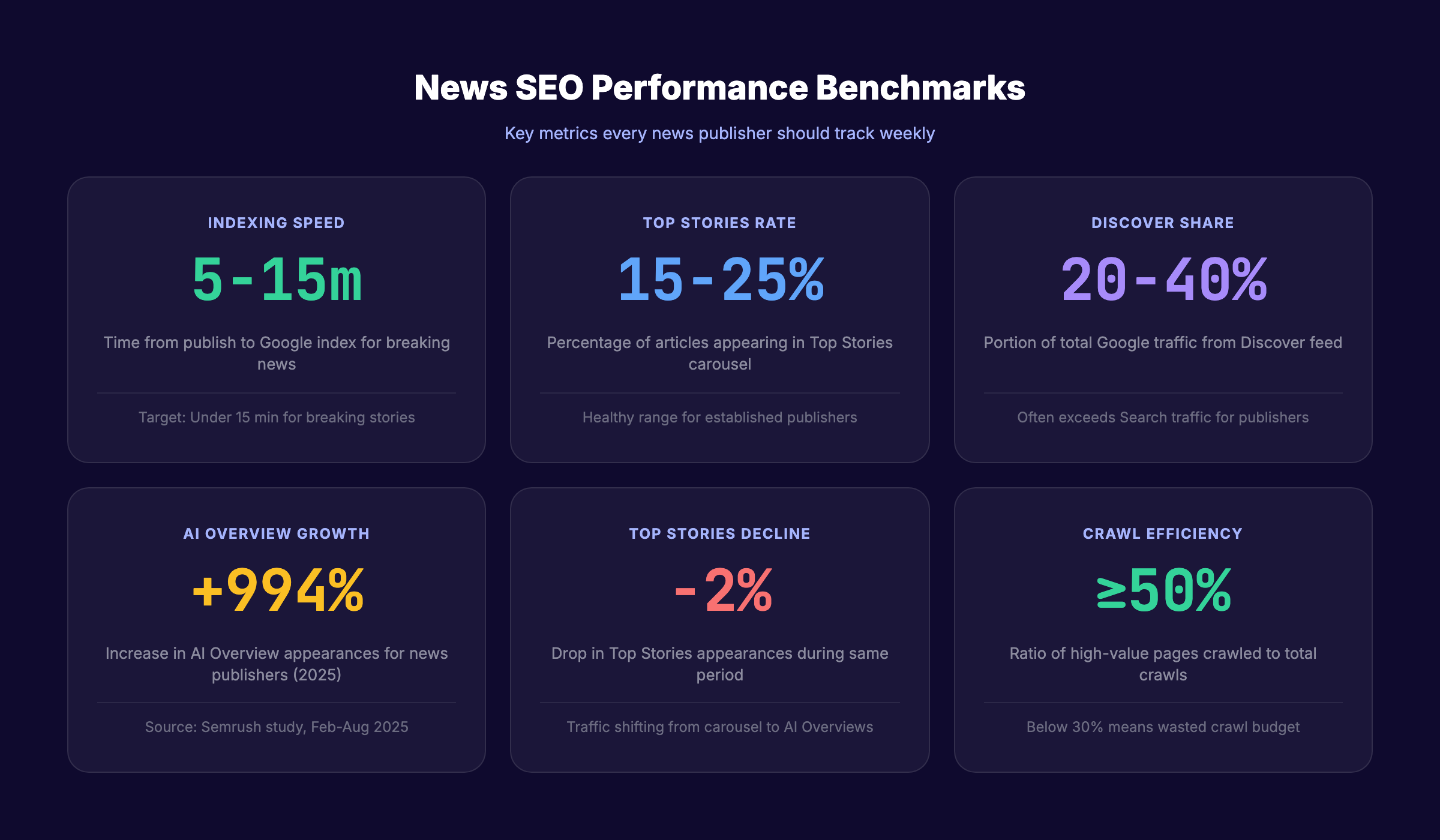
Semrush tracked 5 major U.S. news publications from February to August 2025. The number of keywords triggering AI Overviews that featured these publishers grew by 994%. During the same period, Top Stories appearances fell by 2%.
This is a structural shift. Google is pulling news content into AI Overviews more aggressively than ever. Publishers who structure their content for extraction (clear answers, factual statements, named sources) will appear in AI Overviews. Those who rely solely on Top Stories will see declining visibility.
Google Discover as a Traffic Engine
Discover sends more traffic to news publishers than Google Search does for many sites. It favors articles with high-quality images (1,200px minimum width), engaging headlines, and strong historical engagement patterns. Unlike Search, Discover does not require a user query. It surfaces content proactively based on reading history.
Optimizing for Discover means investing in compelling headlines, high-resolution images, and consistent publishing cadence.
Technical SEO Foundations for News Publishers
News sites face technical challenges that most websites never encounter. High publish volume, real-time indexing needs, and complex site architectures make technical SEO the foundation everything else depends on.
Site Speed and Core Web Vitals
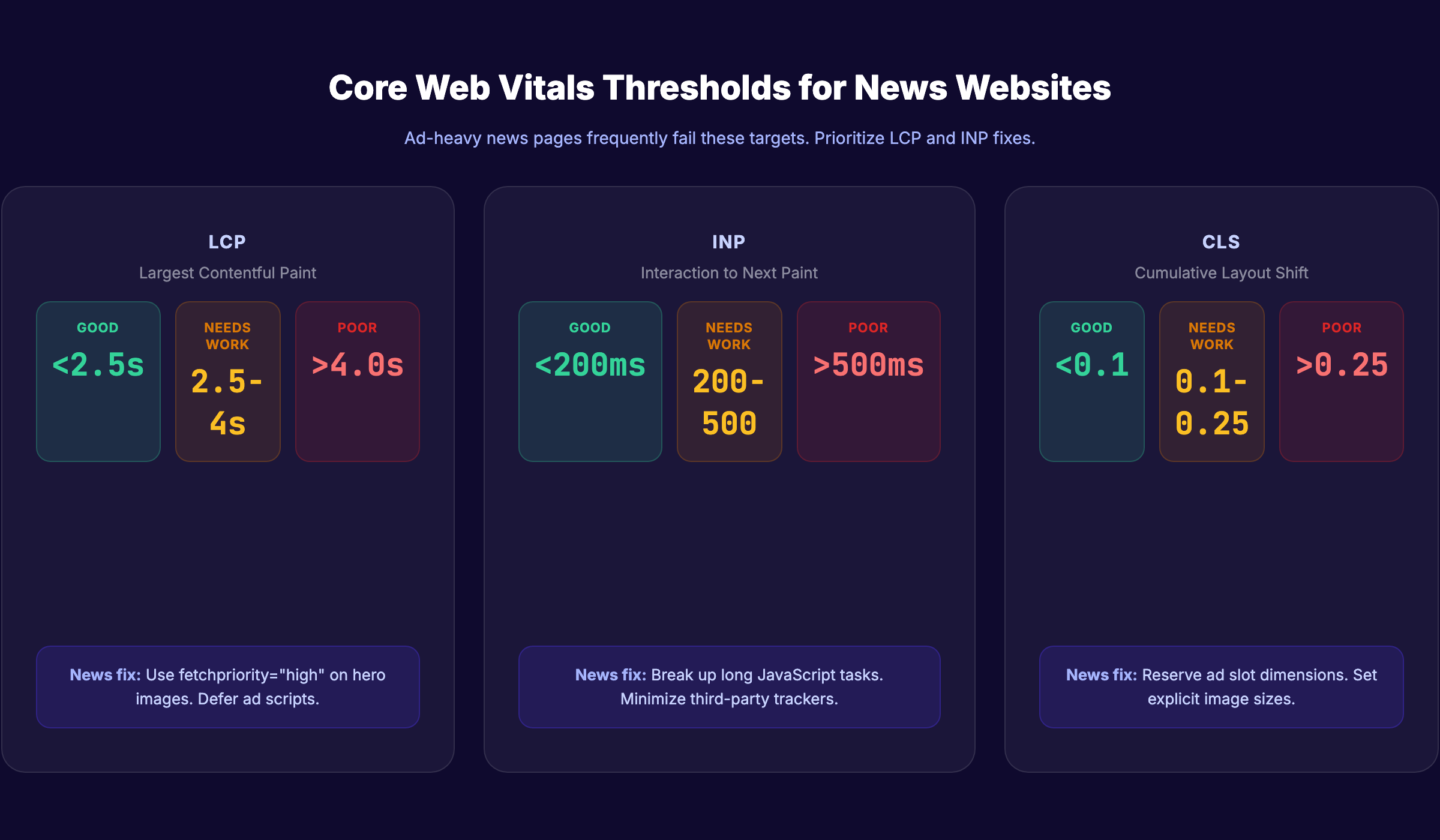
Google measures 3 Core Web Vitals: Largest Contentful Paint (LCP), Interaction to Next Paint (INP), and Cumulative Layout Shift (CLS). News sites struggle with all 3 because of ad scripts, tracking pixels, and dynamic content injection.
Target these thresholds:
| Metric | Good | Needs Work | Poor |
|---|---|---|---|
| LCP | Under 2.5s | 2.5s to 4.0s | Over 4.0s |
| INP | Under 200ms | 200ms to 500ms | Over 500ms |
| CLS | Under 0.1 | 0.1 to 0.25 | Over 0.25 |
Ad-heavy pages often fail LCP because third-party scripts block rendering. Lazy load ads below the fold. Defer non-critical JavaScript. Use fetchpriority="high" on your hero image to tell the browser what to load first.
News-Specific XML Sitemaps
Standard XML sitemaps list your pages. News sitemaps tell Google which articles are recent and time-sensitive. Google requires a separate news sitemap that includes only articles published within the last 48 hours.
Your XML sitemap setup should include:
- A standard sitemap for all pages
- A news sitemap with articles from the past 48 hours
- Publication name, language, and article title in each entry
- Automatic removal of articles older than 48 hours
Submit both sitemaps in Google Search Console. Monitor the coverage report for indexing errors.
URL Structure for News Sites
Clean, descriptive URLs help Google understand article topics before crawling the full page. Use a consistent URL structure pattern:
yoursite.com/category/article-slug
yoursite.com/politics/senate-passes-climate-bill-2026
Avoid query parameters, session IDs, or date-based URL folders that create duplicate content issues. If your CMS generates URLs with /2026/03/30/article-title/, consider whether those date folders add SEO value. For breaking news, they often do not.
Crawl Budget Management
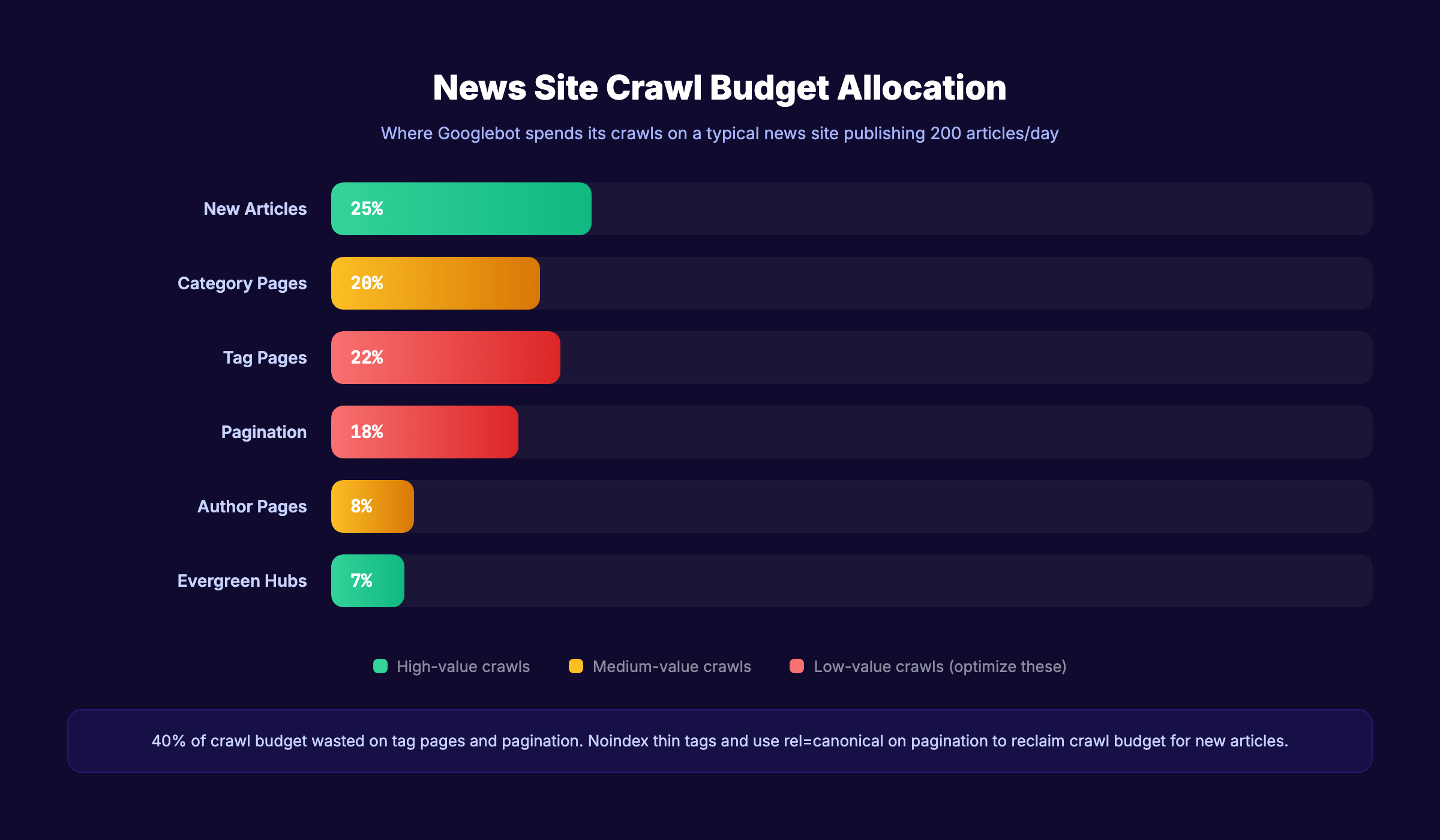
A site publishing 200 articles per day generates 6,000 new URLs per month. Add category pages, tag pages, author pages, and pagination pages and the total crawl demand grows to 20,000+ URLs monthly.
Google allocates a crawl budget based on site health and perceived value. If Googlebot wastes crawls on thin tag pages or duplicate pagination URLs, your breaking stories get crawled later.
Prioritize crawl budget with these steps:
- Block thin tag and archive pages with noindex directives
- Use canonical tags on syndicated or republished content
- Return proper HTTP status codes for removed articles (410 for permanently deleted)
- Monitor crawl stats in Search Console
Stop writing. Start ranking. Stacc publishes 30 SEO articles per month for your site. No writers needed. Start for $1 →
Structured Data and Schema Markup for News Articles
Structured data helps Google understand article metadata at crawl time. For news sites, this is not optional. It directly affects eligibility for Top Stories, rich results, and AI Overviews.
NewsArticle Schema
Every news article should include NewsArticle schema markup. This tells Google the headline, author, publish date, modified date, and publisher information.
Required properties:
headline— The article title (match the H1 exactly)datePublished— ISO 8601 formatdateModified— Update this when the article changesauthor— Name, URL to author page, and@type: Personpublisher— Organization name, logo URLimage— At least 1 image, minimum 1,200px wide
Optional but recommended:
articleSection— Category (Politics, Sports, Business)wordCount— Total word countisAccessibleForFree— Required if you use a paywall
Use Google’s Rich Results Test to validate your markup before publishing. Errors in structured data mean Google ignores it entirely.
LiveBlogPosting for Breaking News
For stories that develop in real time, use LiveBlogPosting schema instead of NewsArticle. This tells Google the page is a live-updating feed. Each update gets its own BlogPosting entry within the live blog.
Google can surface individual updates from live blogs in Top Stories. This gives publishers multiple ranking opportunities from a single URL.
Paywall and Subscription Content Markup
If your site uses a paywall, you must tell Google which content is free and which requires a subscription. Use the isAccessibleForFree property with cssSelector to mark paywalled sections.
Without this markup, Google may stop indexing paywalled content entirely. With it, Google indexes the full article and displays it in results with a subscription label.
E-E-A-T and Author Authority for News Sites
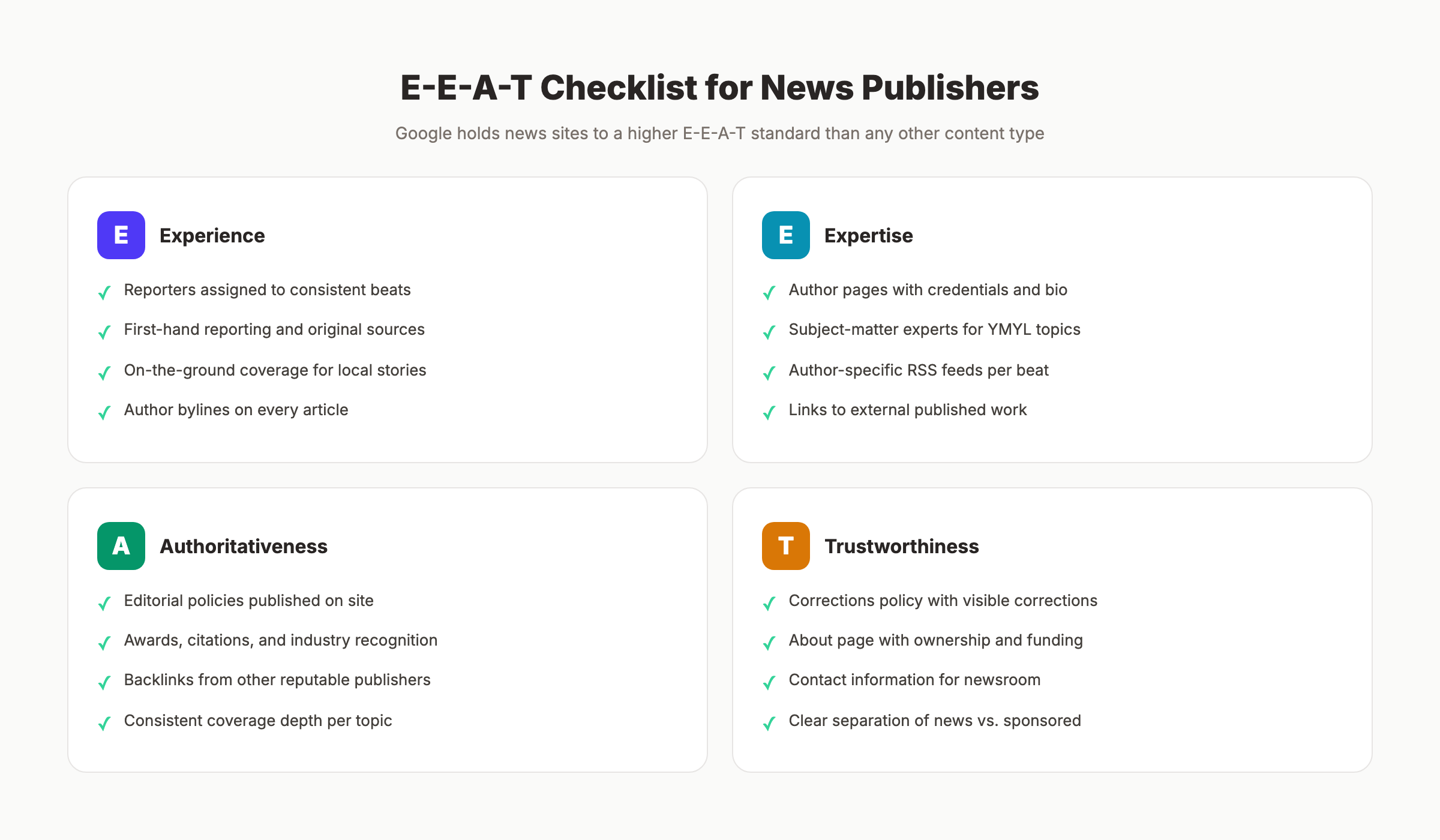
Google holds news publishers to a higher E-E-A-T standard than any other content type. Misinformation, unverified claims, and anonymous bylines actively hurt rankings. Transparency is not just ethical. It is a ranking factor.
Author Pages and Bylines
Every article needs a named author with a linked author page. That author page should include:
- Full name and professional photo
- Credentials and areas of expertise
- Links to published work (internal and external)
- Social media profiles
- A brief bio that establishes subject matter authority
Google’s systems cross-reference author information across the web. An author who publishes on multiple reputable sites carries more authority than one who exists only on your domain.
Editorial Policies and Transparency
Google’s News guidelines require publishers to display:
- A clear editorial policy explaining how stories are sourced and verified
- A corrections policy with examples of past corrections
- An “About Us” page identifying ownership, funding sources, and editorial leadership
- Contact information for the newsroom
These pages are not just for readers. Googlebot crawls them to assess publisher trustworthiness. A news site without an editorial policy page is at a measurable disadvantage in E-E-A-T evaluation.
Author Expertise Signals
For YMYL (Your Money or Your Life) news topics like health, finance, or public safety, Google expects authors with verifiable credentials. A health reporter covering a pandemic should have a medical background or extensive health journalism experience listed on their author page.
Build author authority over time by:
- Assigning reporters to consistent beats (topic specialization)
- Publishing author-specific RSS feeds
- Linking author pages to Wikipedia, LinkedIn, and industry profiles
- Including structured data for each author (
Personschema withsameAslinks)
Content Strategy for News Publishers
News sites need 2 content tracks running simultaneously. Breaking news captures attention. Evergreen content captures long-term organic traffic. Both serve different purposes and require different optimization approaches.
Breaking News Optimization
Speed is everything for breaking news. The publisher who gets a well-optimized article live first wins the Top Stories placement. That means:
- Write clear, keyword-rich headlines. Avoid clickbait. Google penalizes misleading previews.
- Front-load the most important information in the first 2 paragraphs.
- Include location, names, and dates in the opening sentences.
- Add structured data before publishing (automate this in your CMS).
- Update the article as the story develops. Change
dateModifiedwith each update.
A headline like “Senate Passes $2 Trillion Climate Bill” ranks. A headline like “You Will Not Believe What Just Happened in Congress” does not.
Evergreen Content for Sustained Traffic
Breaking news traffic spikes and disappears within 24 to 72 hours. Evergreen content provides consistent organic traffic for months or years.
Smart news publishers build evergreen hubs around recurring topics:
- “How Elections Work in the United States” (refreshed every cycle)
- “Understanding Inflation: What It Means for Your Wallet”
- “Hurricane Preparedness Guide” (updated annually before hurricane season)
These pages earn backlinks, build topical authority, and rank for high-volume informational queries that breaking news articles cannot sustain.
Internal Linking for News Sites
News sites generate thousands of pages. Without intentional internal linking, most of those pages become orphans that Google rarely crawls.
Build internal links with these tactics:
- Link new articles to related evergreen hub pages
- Add “Related Stories” sections at the bottom of each article
- Link from high-traffic breaking news to deeper analysis pieces
- Use descriptive anchor text (not “click here” or “read more”)
- Update evergreen pages with links to new breaking coverage
Aim for 3 to 5 internal links per article. Every link passes authority and helps Google understand your site’s topic structure.
Headline Optimization
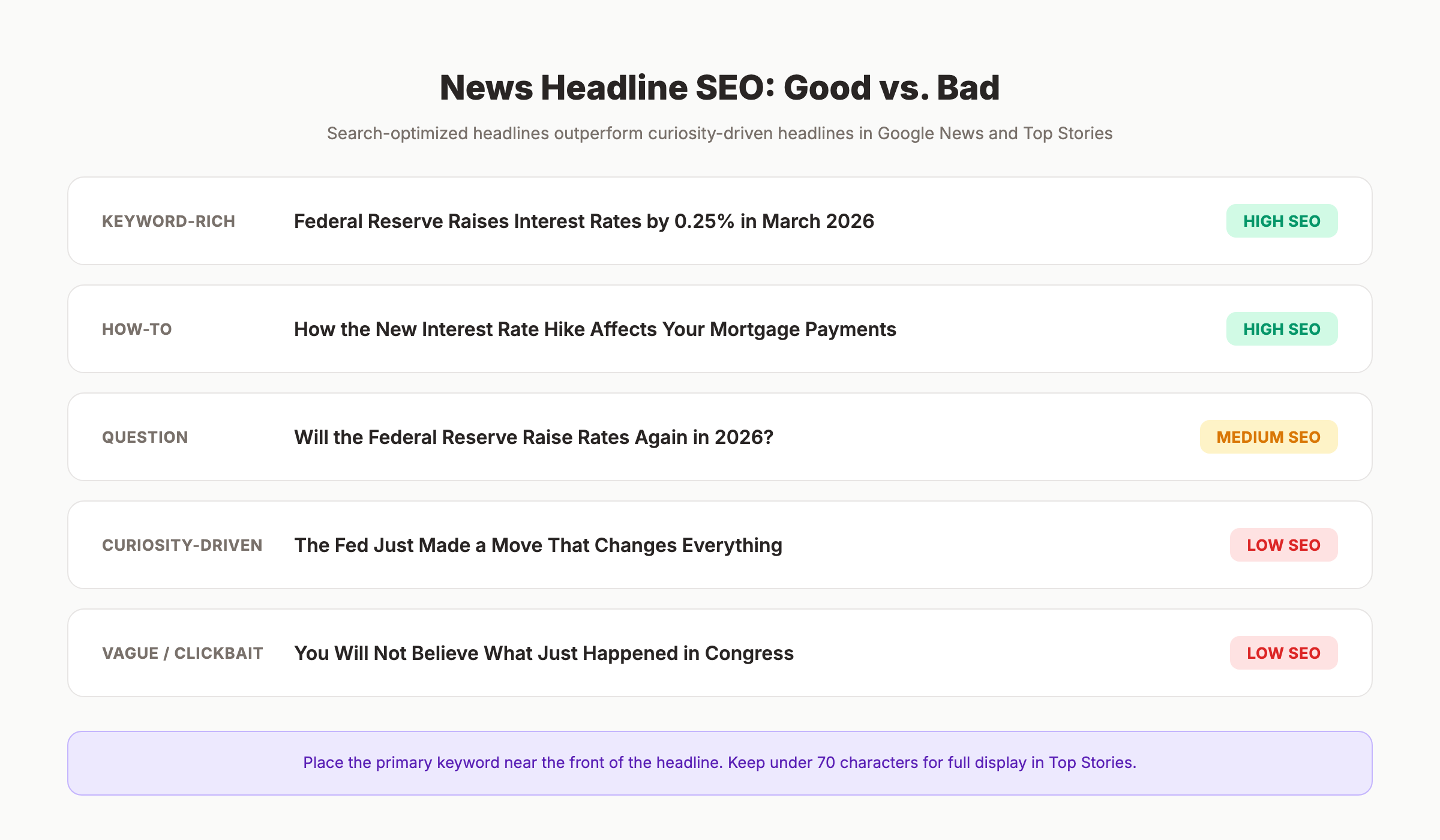
Headlines serve 2 masters: readers and search engines. For news SEO, the search-optimized version matters more than the clever version.
| Headline Type | Example | SEO Value |
|---|---|---|
| Keyword-rich | ”Federal Reserve Raises Interest Rates by 0.25% in March 2026” | High |
| Curiosity-driven | ”The Fed Just Made a Move That Changes Everything” | Low |
| Question format | ”Will the Federal Reserve Raise Rates Again in 2026?” | Medium |
| How-to | ”How the New Interest Rate Hike Affects Your Mortgage” | High |
Use the primary search query in the headline. Place it near the front. Keep headlines under 70 characters so they display fully in Top Stories and search results.
3,500+ blogs published. 92% average SEO score. See what Stacc can do for your site. Start for $1 →
Optimizing for AI Overviews and Zero-Click Search
AI Overviews now appear for 25 to 30% of all Google searches. For news queries, that number is growing faster than any other category. Publishers who ignore this shift will lose traffic to AI-generated summaries that pull from their own content without sending a click.
How AI Overviews Use News Content
Google’s AI Overviews extract facts, quotes, and data points from news articles and present them directly in search results. The source article gets a citation link, but most users never click through.
The 994% growth in AI Overview appearances for news publishers means more visibility but potentially fewer clicks. This is the same zero-click search problem that has affected informational content for years. News is now experiencing it at scale.
Structuring Content for AI Extraction
To earn AI Overview citations (and the clicks that come with them), structure your content for easy extraction:
- Lead with the answer. Put the key fact in the first sentence of each section.
- Use named sources. “According to Federal Reserve Chair Jerome Powell” is more citable than “experts say.”
- Include specific numbers, dates, and data points.
- Write clear topic sentences for each paragraph.
- Use tables and lists for comparative information.
Google’s AI prefers content that states facts directly over content that buries them in narrative. This does not mean abandoning narrative journalism. It means ensuring the core facts are easily extractable.
AI Crawler Access Decisions
79% of major news publishers now block AI training bots via robots.txt. This is a business decision, not an SEO decision. Blocking training bots (like GPTBot) does not affect your visibility in Google’s AI Overviews.
However, blocking Googlebot-Extended or Google-Extended may limit your appearance in AI Overviews and Discover. Understand the difference:
| Bot | Purpose | Block Impact |
|---|---|---|
| GPTBot (OpenAI) | AI model training | No Google impact |
| ClaudeBot (Anthropic) | AI model training | No Google impact |
| Google-Extended | Gemini training | May reduce AI Overview visibility |
| Googlebot | Search indexing | Blocks all Google visibility |
Review your robots.txt configuration to ensure you are blocking only what you intend to block. For a deeper look at AI crawler management, see our AI crawlers guide.
Measuring News SEO Performance
News SEO metrics differ from standard SEO metrics. Traffic spikes and decays within hours. Rankings change by the minute. Traditional monthly reporting misses the patterns that matter.
Key Metrics for News Publishers
| Metric | What It Tells You | Where to Track |
|---|---|---|
| Top Stories appearances | How often your articles surface in the carousel | Google Search Console (Search Appearance filter) |
| Indexing speed | Time from publish to Google index | URL Inspection tool or log file analysis |
| Click-through rate | How compelling your headlines are in search results | Google Search Console |
| Discover traffic | Audience engagement outside of search | Google Search Console (Discover tab) |
| Crawl stats | How efficiently Google crawls your site | Search Console (Crawl Stats report) |
| AI Overview citations | How often your content appears in AI-generated answers | Manual tracking or third-party tools |
Benchmarks for News Sites
- Indexing speed: Breaking news articles should be indexed within 5 to 15 minutes of publication. If your articles take longer than 1 hour, your technical setup needs work.
- Top Stories rate: A healthy news site appears in Top Stories for 15 to 25% of its published articles.
- Discover traffic: For publishers with Discover visibility, it often accounts for 20 to 40% of total Google traffic.
- Crawl efficiency: Monitor the ratio of crawled pages to published pages. If Google crawls 10,000 pages but you only published 500 new articles, most crawl budget is going to old or low-value pages.
Track these SEO KPIs weekly, not monthly. News SEO moves too fast for monthly reporting cycles.
FAQ
Do I need to register with Google News Publisher Center to appear in Top Stories?
No. Google automatically considers all news content for Top Stories based on quality and relevance. Publisher Center gives you more control over branding, sections, and labels. It is recommended but not required.
How fast should news articles be indexed by Google?
Breaking news should be indexed within 5 to 15 minutes. Use Google’s Indexing API for time-critical content. Ensure your news sitemap updates automatically when you publish. Monitor indexing speed in Search Console’s URL Inspection tool.
Does AMP still matter for news SEO in 2026?
No. Google removed the AMP requirement for Top Stories eligibility in 2021. Standard mobile-optimized pages with strong Core Web Vitals perform equally well. Focus on page speed and mobile usability instead of maintaining a separate AMP version.
How do paywalls affect news SEO?
Paywalls do not automatically hurt rankings if you implement structured data correctly. Use isAccessibleForFree markup to tell Google which content is behind a paywall. Google indexes paywalled content and displays it with a subscription label. The Flexible Sampling model (showing some content free) works best for SEO.
Should news sites block AI crawlers?
This depends on your business model. Blocking AI training bots (GPTBot, ClaudeBot) does not affect Google search visibility. Blocking Google-Extended may reduce AI Overview appearances. Most major publishers block training bots but allow Google’s AI features to access their content.
How many articles should a news site publish per day for SEO?
There is no magic number. Quality and relevance matter more than volume. A regional news site publishing 10 to 20 well-optimized articles per day will outperform a site publishing 100 thin articles. Focus on covering your beat thoroughly rather than chasing arbitrary publishing targets.
News SEO is the fastest-moving discipline in search marketing. The publishers who win are not the ones with the biggest newsrooms. They are the ones with the strongest technical foundations, the clearest authority signals, and the discipline to optimize every article before it goes live. Start with your technical setup, build your E-E-A-T signals, and treat every publish as a ranking opportunity.
Written and published by Stacc. We publish 3,500+ articles per month across 70+ industries. All data verified against public sources as of March 2026.