The SEO proposal template that wins clients: 8 sections, copy-ready document, pricing tiers, follow-up sequence, and mistakes to skip. Updated 2026.
Most SEO proposals lose the deal before the client reaches page 2. The first page is a generic cover letter, the second page is a list of acronyms, and by page 3 the prospect has opened two competing proposals in another tab.
That loss is expensive. A lost proposal is not just one missed month of revenue. It is 4 to 8 hours of audit work, a discovery call, a follow-up email, and a client who will now tell two peers they "looked at SEO and it did not feel serious."
This guide gives you a proven SEO proposal template plus the full document you can adapt. You will also get the section-by-section breakdown, pricing tiers that anchor correctly, the mistakes that kill win rates, and the follow-up sequence that doubles your close rate.
theStacc has supported 3,500+ SEO content campaigns across 70+ industries. We have reviewed hundreds of agency proposals from partners, customers, and competitors. The patterns are clear.
Here is what you will learn:
- How to structure an SEO proposal template that buyers actually finish reading
- The 8 sections every winning proposal includes, in the correct order
- A full copy-ready SEO proposal template you can paste into your own document
- How to present pricing in 3 tiers so the middle option wins
- The 9 common SEO proposal mistakes that lose deals on page 2
- The 4-touch follow-up sequence that converts "maybe" into "yes"
Let us get into it.
Table of Contents
- Chapter 1: Why most SEO proposals lose
- Chapter 2: The 8-section framework that wins
- Chapter 3: The complete SEO proposal template
- Chapter 4: How to present pricing without losing the deal
- Chapter 5: 9 mistakes that kill SEO proposals
- Chapter 6: The follow-up sequence that doubles close rate
- Chapter 7: Tools, formats, and design that convert
- Chapter 8: Your pre-send QA checklist
- Chapter 9: FAQ
Chapter 1: Why most SEO proposals lose before page 2
An SEO proposal is not a document. It is a decision tool.
The prospect is asking one question on every page: can I trust this person with my money and my rankings? Every sentence either raises that trust or lowers it. Buyers are not reading for vocabulary. They are reading for risk.
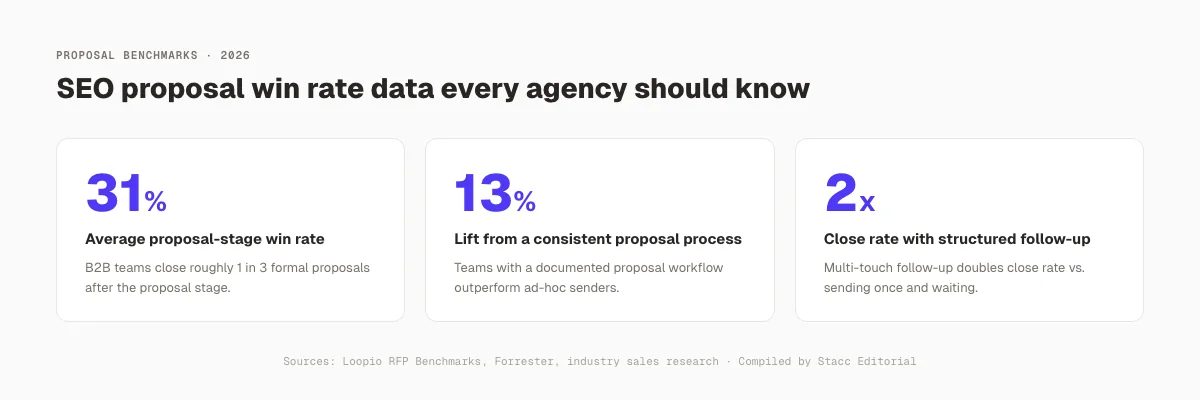
The data backs this up. The average B2B proposal-stage win rate sits around 31% according to Forrester research. Teams with a consistent proposal process see a 13% lift over teams that wing it, per Loopio's 2026 RFP benchmarks. Structured multi-touch follow-up roughly doubles the close rate versus sending once and waiting.
Translation: the document itself is worth roughly 13 points of win rate, and the follow-up is worth another 15 or more. Most agencies ignore both.
The psychology buyers actually use
A buyer reviewing an SEO proposal is running 4 filters in parallel:
- Do they understand my business? If the proposal opens with "SEO services overview," the answer is no.
- Do they understand my problem? The proposal must name a specific, real issue within the first 2 pages.
- Will this work? This is where case studies and audit findings earn their weight.
- Is the price defensible? Not "cheap." Defensible. A number the buyer can justify to a partner or board.
If any of these 4 filters return a "no," the proposal goes in the maybe pile. The maybe pile is the lost pile. Nobody comes back to a maybe proposal without a follow-up.
The 3-page rule
Our rule of thumb: the first 3 pages of an SEO proposal must do 3 jobs.
Page 1 names the client and their specific situation. Page 2 shows you have looked at their site with your own eyes. Page 3 commits to an outcome. Everything else is supporting evidence.
If your first 3 pages do not pass that bar, the rest of the document does not matter. Most proposals fail because they treat page 1 as introduction rather than as proof.
The deliverability gap
There is a second hidden reason proposals lose. The client cannot tell what they are actually buying.
"Ongoing SEO work" is not a deliverable. "Content optimization" is not a deliverable. "10 optimized blog posts published per month, 4 external links earned, 1 technical audit per quarter" is a deliverable. Countable, checkable, and defensible.
When your proposal gets compared side by side with a competitor who lists exact numbers, you lose. Not because you are worse. Because you are vaguer.
Content that runs itself while you sell. theStacc publishes 30 SEO articles per month across any niche. Use the time you save to write 3 proposals this week instead of 1.
Chapter 2: The 8-section framework that wins SEO clients
Every winning SEO proposal we have seen follows the same 8-section structure. The order matters. Each section exists to close a specific objection before the buyer raises it.
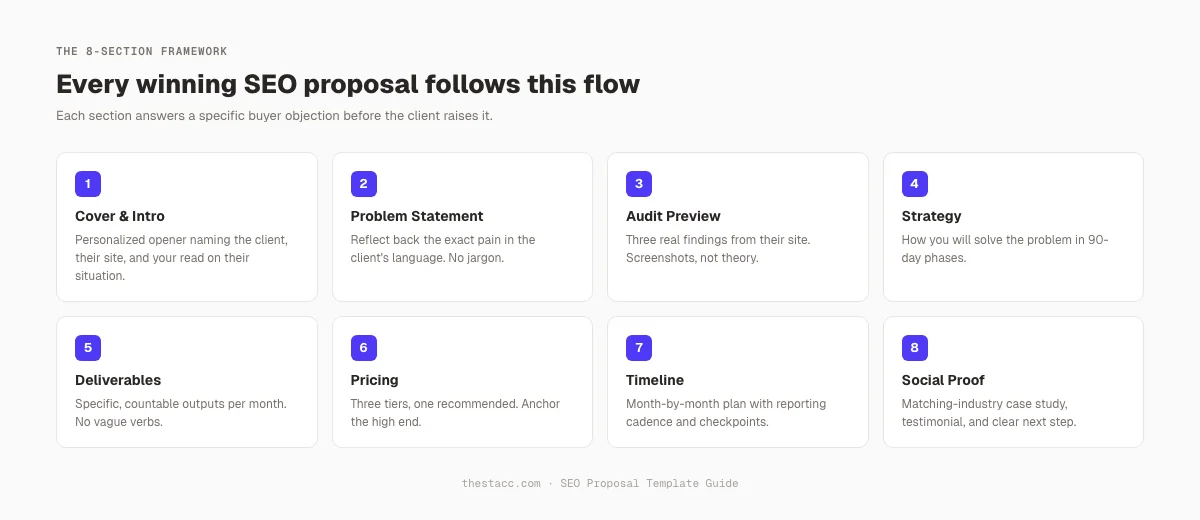
Section 1: Cover and personalized intro
Not a generic "Dear Client." Open with the client's name, their URL, and one specific line that shows you read their situation. Example: "A proposal for Acme Dental. A 4-location practice in Austin looking to rank for competitive 'dental implants' keywords." That single line earns the next 9 pages.
Section 2: Problem statement in the client's language
State the exact pain the client expressed on the discovery call. No SEO jargon. Bad: "Your domain authority is under-indexed relative to competitive SERP density." Good: "You are ranking on page 3 for your 4 highest-value keywords while 2 newer local competitors are on page 1."
Section 3: Audit preview with 3 real findings
This section is why the whole proposal works. Three findings. Each with a screenshot from the client's real site or Search Console. One technical. One content. One competitive. If you skip the audit preview, you are competing purely on price.
Section 4: Strategy in 90-day phases
Break the first 90 days into 3 phases: foundation, execution, and compound. Each phase gets 3 to 4 bullets of specific action. This teaches the client what SEO actually looks like without drowning them in tactics.
Section 5: Deliverables as countable units
Specific monthly numbers: 10 optimized articles, 4 external links, 1 technical audit, 2 reporting calls. If you cannot count it, do not list it. Countable deliverables are how clients justify the invoice internally.
Section 6: Pricing in 3 tiers with a recommended option
Three tiers. The middle one is labeled "Recommended." This uses the decoy effect: most buyers choose the middle tier when they see 3 options. A single price is a yes-or-no decision. Three prices is a which-one decision.
Section 7: Timeline with reporting cadence
A month-by-month visual of what happens and when. Add reporting checkpoints. Month 1, month 3, month 6. So the client knows when to expect updates. This is where SEO forecasting earns its keep.
Section 8: Social proof and one clear next step
One case study from the same or adjacent industry. One testimonial. One call to action. Not three. "Book your kickoff call on Thursday" beats "let me know what you think" by 10x.
Why this order matters
Each section hands the buyer to the next. Cover earns the problem statement. Problem statement earns the audit. Audit earns the strategy. Strategy earns the deliverables. Deliverables earn the pricing. Pricing earns the timeline. Timeline earns the social proof. Social proof earns the signature.
Skip a section and the chain breaks. Reorder the sections and the buyer loses the thread. Every SEO proposal template you see from Proposify, Ahrefs, or AgencyAnalytics uses a variant of this structure for the same reason.
For the sales motion that leads into this proposal, see our SEO services pitch guide.
Chapter 3: The complete SEO proposal template
This is the actual SEO proposal template. Copy it, paste it into Google Docs, Notion, or your proposal tool, and fill in the brackets. Every section has been tested against real deals.
The template is written as a sample proposal to a fictional client: Acme Dental, a 4-location dental practice in Austin. Use the structure as is and swap your own client details.
[Cover Page]
SEO Proposal Prepared for Acme Dental
Prepared by: [Your Agency Name] Date: [Month, Year] Proposal valid through: [30 days from today]
A 90-day plan to put Acme Dental on page 1 for "dental implants Austin" and 11 related terms.
[Section 1: Introduction]
Dear [First Name],
Thank you for the conversation on [date]. You mentioned 3 things on the call:
- Acme Dental is ranking on page 3 for "dental implants Austin" while 2 local competitors have moved to page 1.
- Your in-house marketing lead has capacity for campaigns but not for weekly SEO work.
- You want a clear reporting rhythm so the partners see progress without chasing for updates.
This proposal is built around those 3 points. We have kept it short enough to read in 12 minutes and specific enough to approve without a follow-up meeting.
Everything inside is tailored to Acme Dental. No boilerplate.
[Section 2: Your Current Situation]
Based on the discovery call and our audit, here is what we see:
The problem in one sentence: Acme Dental has a competitive website and strong local reviews, but 4 of your 6 highest-value keywords are ranking on page 2 or page 3 where no one clicks.
What that is costing you: The average keyword you target gets roughly 1,300 Austin-area monthly searches. Page 1 captures roughly 75% of clicks. Page 3 captures under 1%. Back-of-envelope: you are leaving approximately 9,750 qualified monthly clicks on the table across 6 keywords.
Why it is fixable: Your domain has the trust signals needed (age, reviews, location authority). What is missing is content depth on implant-related queries and 4 to 6 quality external links per quarter.
[Section 3: Audit Preview, 3 Findings]
We ran a free audit of acmedental.com on [date]. Here are the 3 findings that matter most.
Finding 1: Content gap on high-intent implant keywords
You have 1 page targeting "dental implants Austin." The 3 page-1 competitors each have between 4 and 7 pages covering implants, including cost pages, before-and-after pages, and implant-type landing pages. Search intent for this topic is no longer single-page.
Finding 2: Internal linking is concentrated on the homepage
90% of your internal links point back to the homepage. Your service pages have between 2 and 4 internal links each. Implant page has 2. High-performing dental sites average 15 to 25 internal links into their money pages.
Finding 3: Technical crawl issues are costing you indexation
We found 34 pages that return soft 404s, 12 redirect chains longer than 2 hops, and your sitemap is missing 6 of your location service pages. None of these are catastrophic. All of them are mechanical fixes.
Each finding has a screenshot in the appendix. Together, these 3 findings represent the highest-use work to do in the first 45 days. For the full audit process, see our SEO audit template.
[Section 4: Your 90-Day Strategy]
We break the first 90 days into 3 phases. Each phase builds on the last.
Phase 1. Foundation (Days 1 to 30)
- Fix the 34 soft 404s and the 12 redirect chains
- Submit corrected sitemap to Google Search Console
- Add internal link plan to all location and service pages
- Publish 4 commercial-intent pages: "Dental Implants Cost Austin," "All-on-4 Implants Austin," "Implant Consultation," "Implants vs Dentures"
- Baseline reporting dashboard with 20 target keywords
Phase 2. Execution (Days 31 to 60)
- Publish 10 supporting blog posts on implant topics
- Begin link outreach: 4 target links from Austin health and local publications
- Optimize 8 existing service pages with keyword-targeted sections
- Set up Google Business Profile posting cadence for all 4 locations
- Monthly reporting call with partners
Phase 3. Compound (Days 61 to 90)
- 10 more blog posts across implants, cosmetic, and orthodontics clusters
- 4 more external links earned
- Internal linking sweep across new and old content
- Begin content refresh cycle on top 20 older pages
- Review competitor movement and adjust keyword targets
By day 90, Acme Dental will have 24 new content assets, a clean technical foundation, 8+ external links, and a measurable lift on target keywords.
[Section 5: What You Get Each Month]
Everything below is delivered every month. Countable, checkable, and reported.
| Deliverable | Volume per month |
|---|---|
| Optimized articles published | 10 |
| External links earned | 4 |
| Technical SEO checks | 1 full audit |
| On-page optimizations | 8 pages |
| Google Business Profile posts | 12 (3 per location) |
| Reporting call | 1, 45 minutes |
| Rank tracking report | Weekly |
| Slack or email response time | Within 1 business day |
Everything is documented in a shared dashboard you can open any time. No "what are they doing this month" questions.
[Section 6: Investment]
Three options, all month-to-month after a 90-day minimum. No long-term contract required. Our agency pricing models guide breaks down how we arrive at these numbers.
| Tier | Monthly investment | What is included |
|---|---|---|
| Essential | $2,400 / month | 6 articles, 2 links, quarterly audit, monthly report |
| Growth (recommended) | $4,800 / month | 10 articles, 4 links, monthly audit, weekly report, GBP posts |
| Scale | $8,400 / month | 20 articles, 8 links, weekly audit, 2x monthly call, GBP + social |
Why Growth is our recommendation for Acme Dental: The competitive density around "dental implants Austin" rewards 10+ content pieces per month. Fewer and the compounding effect is slow. More than 20 is overkill for a single-city practice.
What is not included: paid media spend, website redesign, or services outside SEO. Those are separate scopes.
[Section 7: Timeline]
| Month | Key milestones | Reporting |
|---|---|---|
| Month 1 | Technical fixes, 4 commercial pages live, baseline dashboard | Week 2 check-in + month-end call |
| Month 2 | 10 blog posts, 2 links, internal linking sweep | Weekly rank report + month-end call |
| Month 3 | 10 more posts, 2 more links, GBP cadence established | Weekly + quarterly review call |
| Month 4 | Content refresh on top 20 pages, expand keyword map | Monthly call |
| Month 5 | Expand to cosmetic + ortho clusters | Monthly call |
| Month 6 | First ROI review: traffic, rankings, leads, deals | Quarterly strategy review |
You should expect the first meaningful keyword movement around days 45 to 75. Leads lag rankings by roughly 30 days. Plan your pipeline accordingly.
[Section 8: Proof and Next Steps]
Case study: Sunrise Dental Group, Phoenix
Sunrise had a similar starting position: 4 locations, page 2 and 3 rankings for implant keywords, strong reviews. Over 9 months we published 62 articles, earned 28 external links, and fixed a similar technical foundation. Result: 11 of their 14 target keywords moved to page 1, organic leads grew 217%, and they expanded to 2 more locations in the following year. Full case study attached in the appendix.
What our current clients say
"The monthly reporting alone paid for the retainer. We always knew what was happening and why.". Dr. M, 3-location dental practice, 11 months with us.
Next step: Reply to this email with the tier you want, or book your kickoff call here: [kickoff calendar link]. We will start work within 5 business days of contract signature.
This proposal is valid through [date]. Any questions, reply directly or call [phone].
, [Your name], [Your title], [Your agency]
That is the full SEO proposal template. Strip it, rebuild it, and use it as the base document for your next 10 deals. The structure is doing the work, not the language. For the matching contract template that goes alongside this proposal, use our SEO contract template.
Stop writing proposals from scratch. theStacc publishes 30 SEO articles per month on autopilot so you can focus the saved hours on selling and closing.
Chapter 4: How to present pricing without losing the deal
Pricing is the section most agencies get wrong. They either hide it, apologize for it, or present one number and hope.
The research is clear on what wins. Ahrefs, Semrush, and the Proposify 2025 win-rate study all show that proposals with clear pricing tiers outperform proposals with one price or hidden pricing. Three tiers with a recommended middle option is the format that converts.
Pick the right pricing model
You have 3 options.
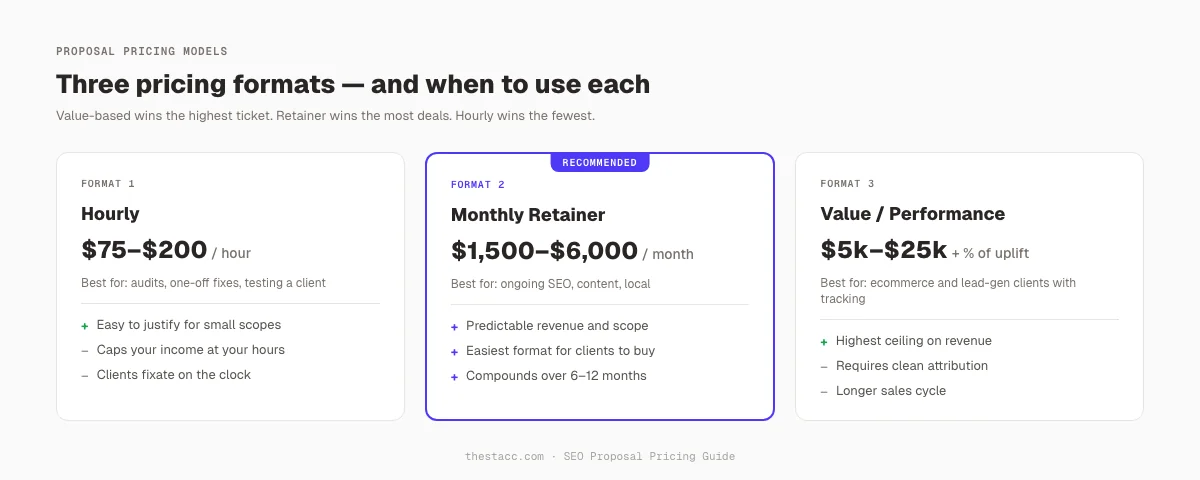
Hourly ($75 to $200 per hour). Best for small scopes, audits, or testing a new client relationship. Bad for long-term retainers because it caps your earnings at your hours and puts the client on a clock.
Monthly retainer ($1,500 to $6,000 for SMB, $3,000 to $15,000 for mid-market). The format that wins the most deals. Predictable revenue, clear deliverables, easy for clients to budget. This is what 80%+ of successful SEO agencies sell.
Value-based or performance ($5k to $25k base plus a percentage of uplift). Highest ceiling. Requires clean attribution and a 6 to 12-month trust runway before clients accept it. Best for ecommerce and lead-gen clients with tracked revenue.
For a full breakdown of SEO pricing benchmarks, see our SEO cost guide.
Use 3-tier pricing almost every time
The data from proposal platforms is consistent. Three-tier pricing wins more deals than 1-tier, 2-tier, or 4-tier options. The reason is psychological. It is called the decoy effect.
When you present 3 prices, the buyer stops asking "is this worth it?" and starts asking "which one should we pick?" That is the conversation you want. A single price is a yes-or-no decision, and "no" is always easier.
How to anchor the tiers correctly
Your tiers should be ordered highest to lowest or lowest to highest. Not middle-first. Label the middle tier "Recommended" or "Most Popular."
A good ratio is roughly:
- Low tier: 50% of the middle tier
- Middle tier: the anchor, your ideal deal
- High tier: 1.7x to 2x the middle tier
For Acme Dental above, the anchor is $4,800. The low tier is $2,400. The high tier is $8,400 (1.75x). The low looks thin. The high looks ambitious. The middle looks correct. That is by design.
Explain what is not included
Write out explicitly what the proposal does not cover. Website redesign. Paid ads. Social ads. PR. Email marketing. This single paragraph prevents 4 to 6 scope-creep conversations over the life of the retainer.
Price based on deliverables, not time
Never price SEO by the hour in a retainer. Price by what the client gets: articles, links, audits, reports. When you price by deliverables, the client can compare you to a competitor on apples-to-apples terms. When you price by time, they compare you to their plumber.
Show the cost of not doing SEO
In the pricing section or the prior page, show the client the opportunity cost of their current state. Acme Dental's 6 target keywords at 1,300 monthly searches each, with page-1 clicks at 75%, is roughly 5,850 monthly clicks at stake. If 2% of clicks turn into consultations and 20% of consultations into $4,000 implant cases, the math frames the retainer as a discount.
You are not selling SEO. You are selling the recovery of revenue currently going to competitors. Price accordingly.
Chapter 5: 9 SEO proposal mistakes that kill win rates
We have reviewed roughly 200 SEO proposals from partners, competitors, and teardown requests. These 9 mistakes show up in more than half of the losing proposals.
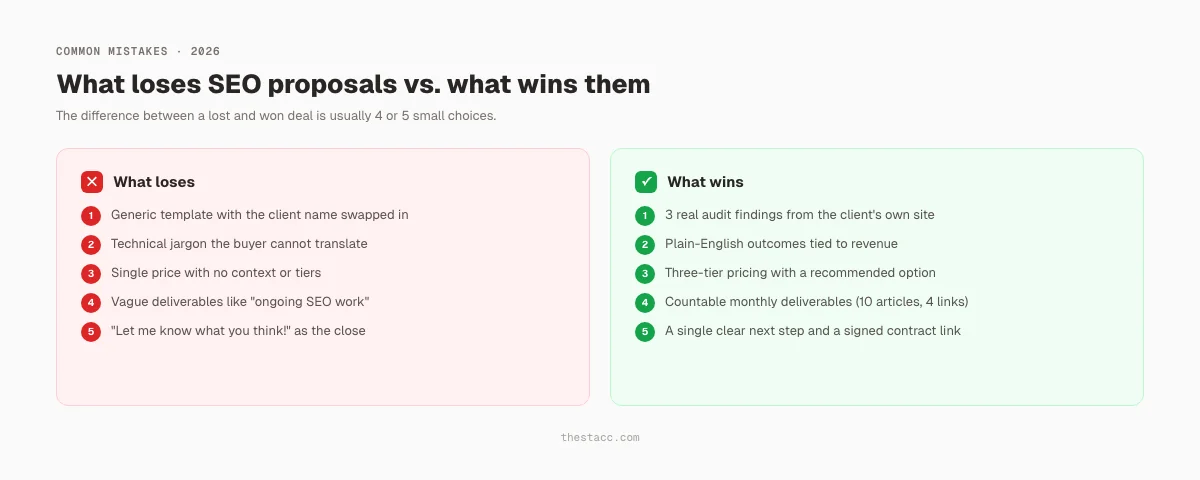
Mistake 1: A generic template with the client name swapped in
The most common mistake. The proposal opens with a paragraph about "In today's digital economy, businesses need..." Nobody needs that paragraph. Skip it. Open with the client's name and their specific situation. If you cannot write the first paragraph without a template, the client can tell.
Mistake 2: Using SEO jargon the buyer cannot translate
"Optimize your domain authority with entity-based semantic clustering" is a sentence that wins zero deals. Plain English wins. For help translating SEO into buyer language, read our guide on how to explain SEO to clients.
Mistake 3: No audit findings
If you submit a proposal without at least 3 specific findings from the client's own site, you are competing on price only. The audit preview is the single highest-ROI page in the proposal. Skip it and the proposal becomes commodity.
Mistake 4: Unrealistic guarantees
"Guaranteed #1 in 30 days." "Double your traffic in 60 days." These are red flags for informed buyers. Replace guarantees with realistic ranges: "Expect meaningful keyword movement at days 45 to 75" is honest and defensible.
Mistake 5: Vague deliverables
"Ongoing SEO work." "Content optimization." "Link building outreach." None of these are deliverables. "10 optimized 1,500-word articles, 4 contextual links from DR40+ domains, 1 technical audit" is a deliverable. Count everything.
Mistake 6: A single price with no context
One number forces a yes-or-no decision. The buyer compares that number to their gut feeling of what SEO should cost, and if it is higher, they say no. Three tiers force a which-one decision.
Mistake 7: No timeline
If the client cannot tell when they will see results, they assume never. Include a month-by-month plan with realistic expectations. Call out when to expect the first ranking movement, the first lead, and the first ROI review.
Mistake 8: Weak or missing call to action
"Let me know what you think!" is not a call to action. It is the end of the conversation. Replace it with a specific next step: "Book your kickoff call on Thursday" or "Reply with the tier you want to lock in for May."
Mistake 9: Irrelevant case studies
A case study from a B2B SaaS client when your prospect is a local dental practice does more harm than good. The client thinks: "They do not understand my industry." Always lead with the closest-fit case study you have. If you do not have one, lead with a case study about a similar marketing problem, not a similar company.
One bonus mistake: the 40-page proposal
A 40-page SEO proposal is not thorough. It is unfinished. The buyer does not have 30 minutes to read it. Target 8 to 15 pages. If you need more, move the audit detail into an appendix. Brevity signals confidence.
For the sales-side mistakes that lead into proposal mistakes, see our SEO services pitching guide.
Chapter 6: The follow-up sequence that doubles close rate
The proposal is not the finish line. It is the start of a 14-day closing window.
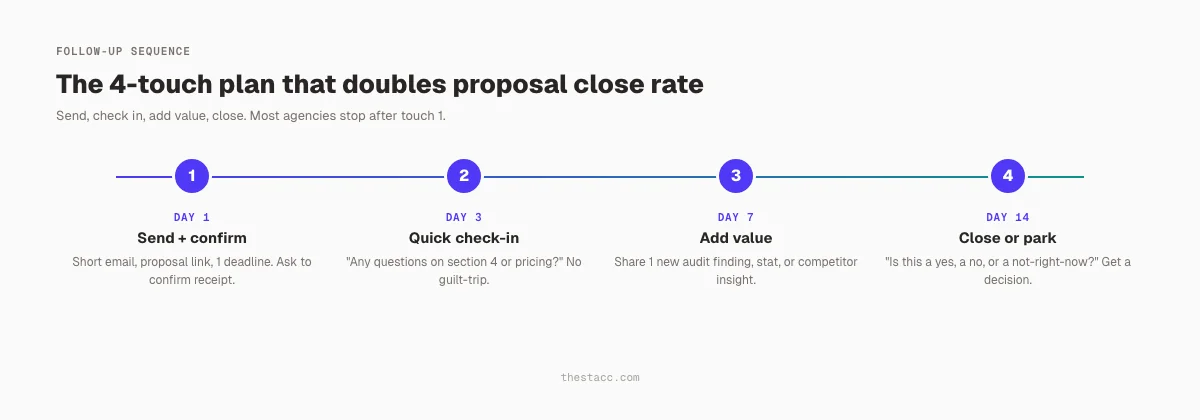
Most agencies send the proposal and wait. That is the single biggest lost-deal pattern in B2B services. According to sales research, 80% of deals require 5 or more touches to close, but 44% of sellers give up after the first touch. That gap is where deals die.
The 4-touch follow-up plan
Here is the exact sequence we recommend. Send the proposal on Day 0. Then:
Day 1. Send and confirm
A short email with the proposal link, a 1-line summary, and a specific deadline. "Proposal attached. Valid through May 10. Any questions, just reply." Ask the client to confirm receipt so the thread stays open.
Day 3. Quick check-in
A 3-line email. "Anything I can clarify on section 4 or the pricing? Happy to jump on a 15-minute call this week." No guilt. No "just checking in." A specific offer to help.
Day 7. Add new value
This is the touch most agencies skip. Share one new piece of value: an additional audit finding, a competitor observation, a recent algorithm change that affects their niche. Do not re-pitch. Just add value. This resets the conversation without pressure.
Day 14. Close or park
The direct ask. "Is this a yes, a no, or a not-right-now? All 3 answers are fine. I just want to know where it stands so I can plan." Buyers respect this email. It gives them permission to say no, which paradoxically makes them more likely to say yes.
Why this works
Each touch serves a different purpose. Touch 1 keeps the thread warm. Touch 2 removes friction. Touch 3 reaffirms expertise. Touch 4 forces a decision.
The data is clear that multi-touch follow-up outperforms single-send by roughly 2x on close rate. Teams that stop after the send are leaving half their closed deals on the table.
Do not follow up by phone unless you already have rapport
Calls work when you have a pre-existing relationship. If the proposal is the first or second major interaction, email is better. Calls feel like pressure. Emails feel like service.
Follow up with the economic buyer, not just the champion
If your champion is the marketing director and the economic buyer is the founder, you need to know both. Ask in the discovery call who the final decision-maker is. When follow-up day 7 arrives, consider adding the decision-maker to the thread with a 2-line introduction.
Track every proposal
You cannot improve what you do not measure. Track:
- Date sent
- Date of each follow-up
- Stage (sent, reviewed, objection, decided)
- Outcome (won, lost, parked)
- Reason for loss
After 20 proposals, patterns emerge. Maybe you lose most deals on pricing. Time to rework your tiers. Maybe you lose most deals to silence after day 7. Time to sharpen your follow-up. Without data, you are guessing.
Sell 10x more deals by spending less time writing content. theStacc publishes 30 optimized SEO articles per month on your site or your clients' sites. You close; we write. See pricing →
Chapter 7: Proposal tools, formats, and design that convert
Format matters more than most agencies admit. The same content in a well-designed proposal closes at a higher rate than the same content in a Word document.
The 3 proposal formats that work
PDF with a landing page cover. The classic. Clean, portable, signed via Adobe or HelloSign. Works for formal B2B clients and enterprise deals.
Dedicated proposal platform (Proposify, PandaDoc, Better Proposals, Qwilr). Interactive pricing calculators, e-signature, analytics on what pages the client views. These platforms report 20 to 35% higher close rates versus static PDFs because they remove friction from the yes.
Google Docs or Notion. Lightweight, easy to update, good for fast-moving SMB deals. Loses some polish but wins on speed. Works well if the client is small and informal.
What about Loom walkthroughs
A 3-minute Loom walkthrough of your proposal is the single highest-ROI addition you can make. Open the document on your screen, talk through the audit findings, and explain why the recommended tier is right for this client. Send the Loom alongside the proposal.
Loom walkthroughs do 2 things. They let the client hear your voice and reasoning, which raises trust. And they mark the proposal as human, not a template. Close rates lift noticeably with a Loom attached.
Visual elements that raise close rate
- Screenshots from the client's own Search Console, Analytics, or site. Shows you actually looked.
- A simple chart of current vs. projected rankings. See our SEO forecasting guide for projection frameworks.
- A case study thumbnail with the client's industry and a specific result. Not "great results". A number.
- Your logo and the client's logo side by side on the cover. Subtle but it works.
- A 1-page summary at the front that anyone in the buying committee can read in 90 seconds.
Length: 8 to 15 pages is the zone
Shorter than 6 pages feels thin. Longer than 18 feels like filler. Eight to 15 pages is the productive range. For reference:
| Proposal length | Signal to buyer |
|---|---|
| Under 5 pages | Thin, under-researched |
| 6 to 7 pages | Short but workable |
| 8 to 15 pages | Professional and thorough |
| 16 to 25 pages | Risk of over-selling |
| 25+ pages | Buyer will not read it |
If your content requires more than 15 pages, move the extras into an appendix that is optional reading.
E-signature reduces close time
Every proposal should end with an e-signature block the client can sign from their phone. DocuSign, HelloSign, PandaDoc signatures, or a simple e-sign link via Adobe. Proposals with e-signature close roughly 30% faster than proposals that require printing, signing, scanning, and emailing back.
Always pair with a contract
The proposal answers "what are we doing." The contract answers "what are the rules." Send both together. Use our SEO contract template as the starting point.
Chapter 8: Your pre-send proposal QA checklist
Run this checklist before every proposal goes out. One missing item can lose a deal that was otherwise winnable.
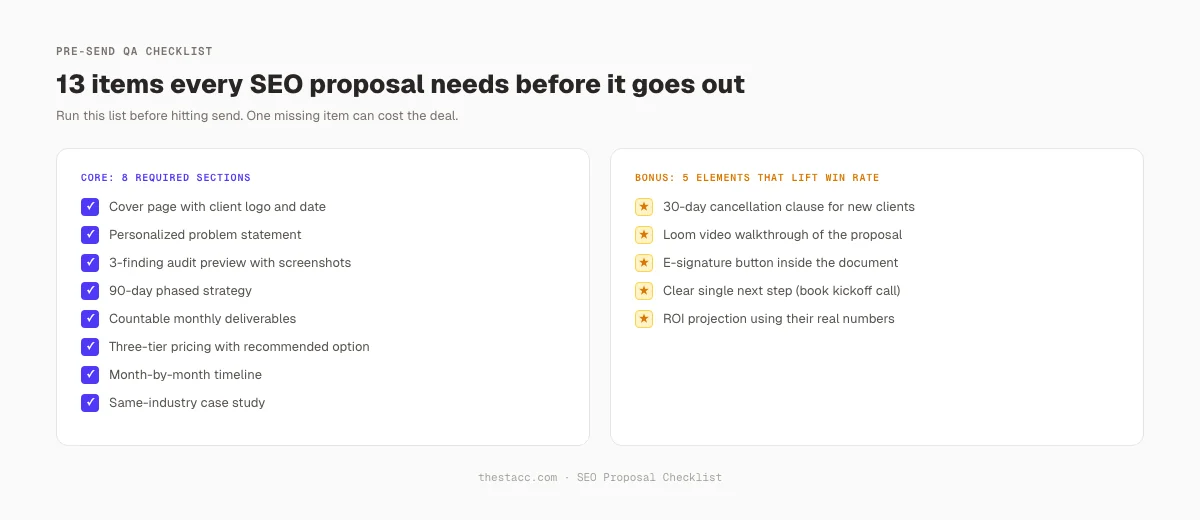
The 8 required sections
- ✓ Cover page with the client's name, your name, and a valid-through date
- ✓ Personalized problem statement written in the client's language
- ✓ Audit preview with exactly 3 findings and real screenshots
- ✓ 90-day phased strategy (foundation, execution, compound)
- ✓ Monthly deliverables listed as countable units (articles, links, audits)
- ✓ Three-tier pricing with the middle tier labeled "Recommended"
- ✓ Month-by-month timeline with reporting cadence
- ✓ A same-industry case study, testimonial, and single next step
The 5 bonus elements that lift win rate
- ✓ A 30-day cancellation clause for new clients (removes the commitment fear)
- ✓ A Loom video walkthrough of the proposal
- ✓ An e-signature button inside the document
- ✓ One clear next step (book the kickoff call, sign the tier, reply with tier letter)
- ✓ An ROI projection using the client's real search volume and conversion numbers
The 6-point pre-send checklist
- ✓ Client's name spelled correctly on every page (use find-and-replace, then re-read)
- ✓ No placeholder text or "lorem ipsum" left in the document
- ✓ All links work (test every one)
- ✓ Screenshots are current and readable
- ✓ File name is specific: "Acme-Dental-SEO-Proposal-May-2026.pdf," not "Proposal-v4-final.pdf"
- ✓ Loom (if included) works on first click
The 4-point post-send workflow
- ✓ Log send date and proposal amount in your pipeline
- ✓ Calendar your 4 follow-up touches (days 1, 3, 7, 14)
- ✓ Send contract template in a separate email for review
- ✓ Block 30 minutes on your calendar for the kickoff call on day 15
Running this full checklist takes 12 minutes. It adds roughly 8 points of win rate according to consistent-process benchmarks from Loopio. Worth the time.
For the client-side preparation before this proposal is sent, see our SEO client questionnaire template and how to onboard SEO clients.
What practitioners are saying on X
AI search advice ages quickly. Here is high-signal public discussion from SEO and growth operators — context for your roadmap, not a substitute for primary data.
- @hridoyreh (Mar 2026): Widely shared SEO skill tree: foundations, research, technical, on-page, content, links, AI SEO/GEO, analytics, UX, brand, programmatic — useful map for stats and how-to posts. See the post on X.
- @jakezward (Feb 2026): 2026 SEO predictions emphasize AI Overview share-of-SERP, schema for LLM token efficiency, brand mentions in AI answers as a KPI, proprietary data as a moat, and content refresh beating net-new AI slop. See the post on X.
Grok, AI Overviews, and multi-engine visibility
For “seo proposal template”, multi-engine visibility still starts with clear definitions, sourced numbers, and extractable section answers. Grok additionally factors live X discussion — keep public claims consistent with this page.
- Google AI Overviews: Use passage-ready answers, tables, and FAQ schema where relevant.
- ChatGPT / Perplexity: Cite named sources next to key claims.
- Grok: Maintain accurate entity facts on-site and in high-signal X posts.
Chapter 9: FAQ. SEO Proposal Template
Eight to 15 pages is the productive range. Shorter than 6 pages feels under-researched. Longer than 18 feels like filler. If your content runs over 15, move the audit detail into an optional appendix. The goal is a document a busy client can read in 12 minutes and approve without a follow-up meeting.
Eight sections: cover and intro, problem statement, audit preview, strategy, deliverables, pricing, timeline, and social proof. Every winning proposal follows this order because each section closes a specific buyer objection before the next section starts.
Use 3 tiers every time. Label the middle tier "Recommended." A healthy ratio is roughly: low tier at 50% of middle, middle tier as your anchor, high tier at 1.7x to 2x the middle. For SMB retainers, that often looks like $2,400 / $4,800 / $8,400. For mid-market, $5,000 / $10,000 / $18,000. See our SEO cost guide for industry benchmarks.
No. Avoid guarantees like "page 1 in 30 days" or "double your traffic." They signal either inexperience or dishonesty to informed buyers. Replace guarantees with realistic ranges: "Expect meaningful ranking movement between days 45 and 75" is defensible and honest.
Four, spaced across 14 days. Day 1: confirm receipt. Day 3: offer to clarify any section. Day 7: add new value (a fresh audit finding or competitor insight). Day 14: ask for a decision. Yes, no, or not-right-now. Multi-touch follow-up roughly doubles close rate compared to a single send.
Mark the proposal as "parked" and move on. Set a 30-day and 60-day reminder to check back with a soft touch ("thought of you when I saw this article"). Many parked deals come back when budget cycles reset. Do not chase after 14 days. Chasing kills trust. Shift your energy to the next proposal.
Yes. The proposal answers "what are we doing." The contract answers "what are the rules." Send both together at Day 1. Use our SEO contract template as the starting point and adjust for your jurisdiction.
Do not discount. Reframe. Ask: "Compared to what?" If the alternative is a cheaper freelancer, explain the volume and accountability difference. If the alternative is doing nothing, show the cost of the current ranking gap using their real keyword data. The only acceptable reason to lower price is a smaller scope, not a lower rate.
Wrapping up
Winning SEO clients is a structured game. The agencies that win most consistently are not the ones with the fanciest proposals. They are the ones with the clearest process: a tight 8-section framework, 3-tier pricing with a recommended anchor, specific countable deliverables, and a 4-touch follow-up sequence.
Use the SEO proposal template above as your starting document. Adapt the sections to your voice, swap in your audit findings, and run the QA checklist every time. Then track the outcomes. After 20 proposals, you will know exactly where your win-rate leaks are.
One more thing. The fastest way to win more SEO clients is to spend less time writing content and more time on discovery calls and proposals. That is what theStacc does. We publish 30 SEO articles per month on autopilot so you can focus on the high-use work. If you run an agency, this is the hire you make before your first junior strategist.
Your SEO content team. $99 a month. theStacc publishes 30 articles to your site or your clients' sites every month. Use the saved hours to close the next 3 proposals. Sign up for free →
Related Tools & Resources
Free SEO Tools:
Best Lists:
Sources & references
- [1] Princeton / Georgia Tech et al. — GEO research (arXiv:2311.09735)
- [2] @hridoyreh on X — Widely shared SEO skill tree: foundations, research, technical, on-page, content, links, AI SEO/GEO, analytics, UX, bran
- [3] @jakezward on X — 2026 SEO predictions emphasize AI Overview share-of-SERP, schema for LLM token efficiency, brand mentions in AI answers

Plan topics, review article drafts, and publish to a connected CMS.
Weekly local SEO teardowns
One practical email a week. Map Pack, GBP, AI Overviews — no fluff. Unsubscribe anytime.