Social media for therapists that respects ethics boards: what to post, what never to post, consent, boundaries, and how referrals actually arrive.
48.1% of Americans seeking therapy are millennials. Another 31.7% are Gen Z. Both demographics find their therapists online. Yet most therapists either avoid social media entirely or use it without a strategy, posting sporadically and hoping something sticks.
Social media for therapists is not the same as social media for restaurants or clothing brands. You cannot share client testimonials. You cannot respond to a follower's DM about their depression. You cannot post a case study without risking a HIPAA violation. The ethical boundaries are real, and they shape every decision you make on these platforms.
But the opportunity is just as real. 74.1% of clients who found their therapist online reported an increased perception of that therapist's expertise. Social media builds the trust that turns a stranger into a booked appointment.
This guide covers how to use social media ethically and effectively as a therapist. We have published 3,500+ articles across 70+ industries, including mental health and healthcare. This is what works without crossing ethical lines.
Here is what you will learn:
- Which platforms work best for therapists and which to skip
- The content mix that builds trust without giving free therapy
- HIPAA compliance rules every therapist must follow on social media
- How to handle ethical gray areas like client DMs and boundary management
- A weekly content calendar you can start using immediately
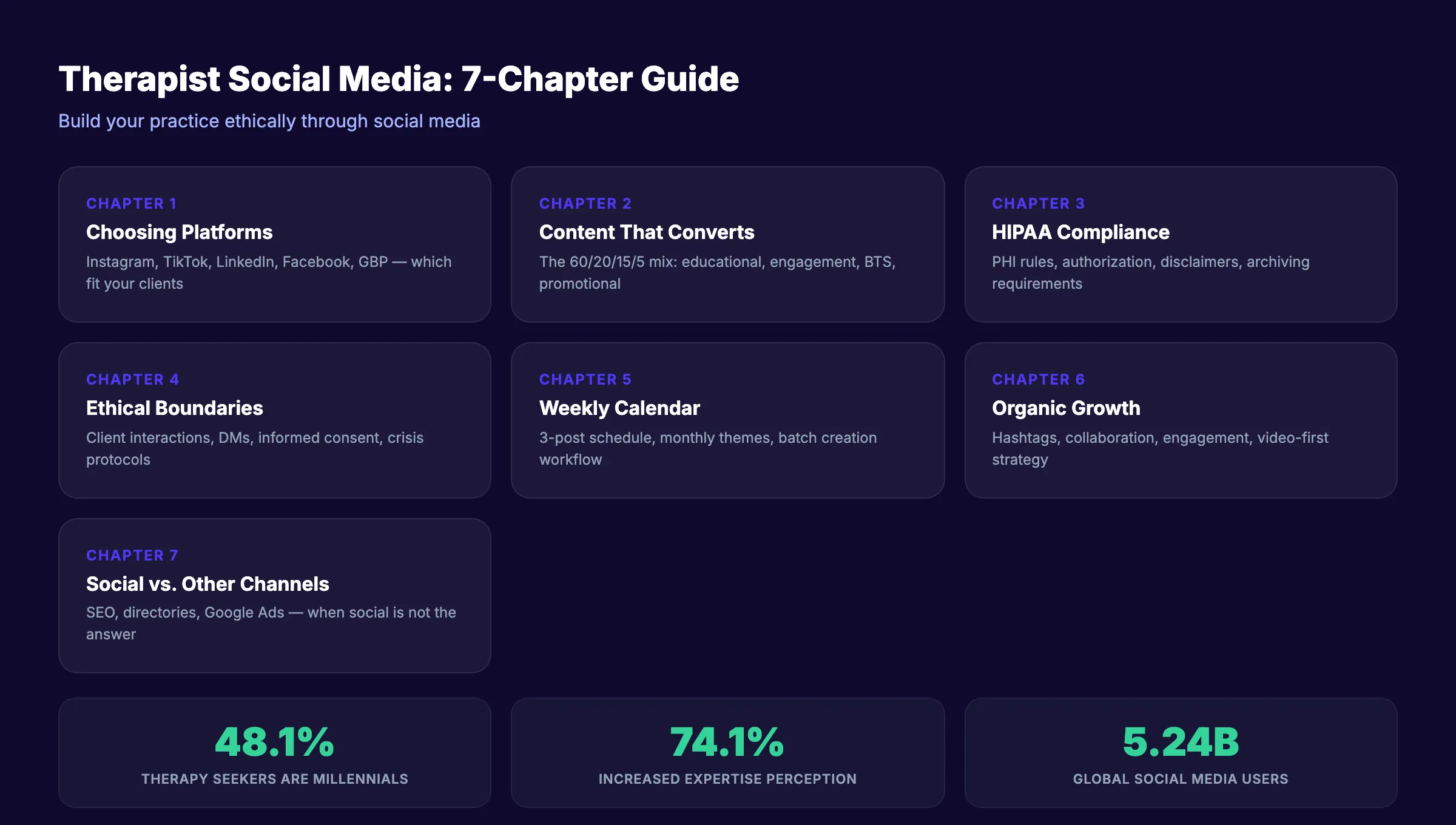
Chapter 1: Choosing the Right Platforms
Not every platform deserves your time. Therapists who try to maintain active profiles on 5 platforms burn out within 3 months. Pick 2 to 3 platforms based on your ideal client demographics and the content you enjoy creating.
Platform Comparison for Therapists
| Platform | Best Audience | Best Content Types | Organic Reach | Time Investment |
|---|---|---|---|---|
| Millennials, Gen Z | Reels, carousels, quote graphics, Stories | Medium | 3-5 hrs/week | |
| Older adults, families, parents | Groups, live video, long-form posts | Low (pay to play) | 2-4 hrs/week | |
| TikTok | Gen Z, young millennials | Short educational videos, humor, trending audio | High | 3-5 hrs/week |
| Corporate professionals, EAP referrals | Articles, workplace wellness, thought leadership | Medium-High | 2-3 hrs/week | |
| Women 25-54, self-care seekers | Infographics, self-care tips, resource pins | High (evergreen) | 1-2 hrs/week | |
| Google Business Profile | Local searchers | Posts, reviews, photos | High (local) | 1 hr/week |
Where to Start
If your clients are millennials or Gen Z: Instagram and TikTok. These demographics scroll these platforms daily. Short-form video drives the highest organic reach in 2026.
If your clients are professionals or corporate EAP referrals: LinkedIn. Workplace wellness content performs well and positions you as a specialist.
If your clients are parents or older adults: Facebook. The organic reach is limited, but Facebook Groups for local communities still drive referrals.
Every therapist regardless of specialty: Google Business Profile. It is free, it ranks in local search, and it is where potential clients check your reviews before booking. Our GBP posting frequency guide covers how often to post for local visibility.
The platform where you will post consistently beats the platform with the best features. Choose based on what you will actually maintain.
Chapter 2: Content That Builds Trust
The biggest mistake therapists make on social media is trying to provide therapy through their posts. Your content should educate, normalize, and build trust. It should not diagnose, treat, or replace a session.
The 60/20/15/5 Content Mix
| Type | Percentage | Examples |
|---|---|---|
| Educational | 60% | Myth-busting, coping strategies, research insights, therapy process explainers |
| Engagement | 20% | Polls, quizzes, "this or that" posts, Q&A boxes, comment prompts |
| Behind-the-scenes | 15% | Office setup, favorite tools, day-in-the-life, book recommendations |
| Promotional | 5% | Open appointment slots, new services, workshops, group offerings |
Most therapists over-index on promotional content or post only inspirational quotes. Neither builds a practice. Educational content positions you as an expert. Engagement content builds community. Behind-the-scenes content humanizes you. Promotional content converts, but only when the other 3 types have built enough trust first.
Content Ideas That Work
Educational posts (highest performing):
- "3 signs your anxiety is actually a trauma response"
- "What happens in a first therapy session (step by step)"
- "The difference between a therapist, psychologist, and psychiatrist"
- "Why 'just think positive' does not work for depression"
- "5 coping strategies for panic attacks that are backed by research"
Engagement posts:
- Poll: "What stops you from starting therapy?" (Cost / Time / Stigma / Not sure it works)
- "Comment a word that describes how you are feeling today"
- "Ask me anything about the therapy process (not clinical advice)"
- "This or that: journaling vs. meditation for stress management"
Behind-the-scenes:
- Photo of your office with a caption about why you chose that space
- A stack of books you recommend to clients (without naming clients)
- Your morning routine before seeing clients
- The tools you use for notes, scheduling, and telehealth
What Never to Post
- Client stories, even "anonymized" ones. Clients report feeling betrayed when they recognize themselves. Other potential clients see it and wonder if you will share their story too.
- Specific clinical advice to a named condition ("If you have BPD, do this...")
- Anything that could be interpreted as a therapeutic relationship with a follower
- Personal content that undermines professional credibility
For broader social media strategy principles, our guide on does social media help SEO covers how social presence supports your search rankings.
Stop writing. Start ranking. theStacc publishes 30 SEO-optimized articles per month for $99. Built for healthcare practices.
Chapter 3: HIPAA Compliance on Social Media
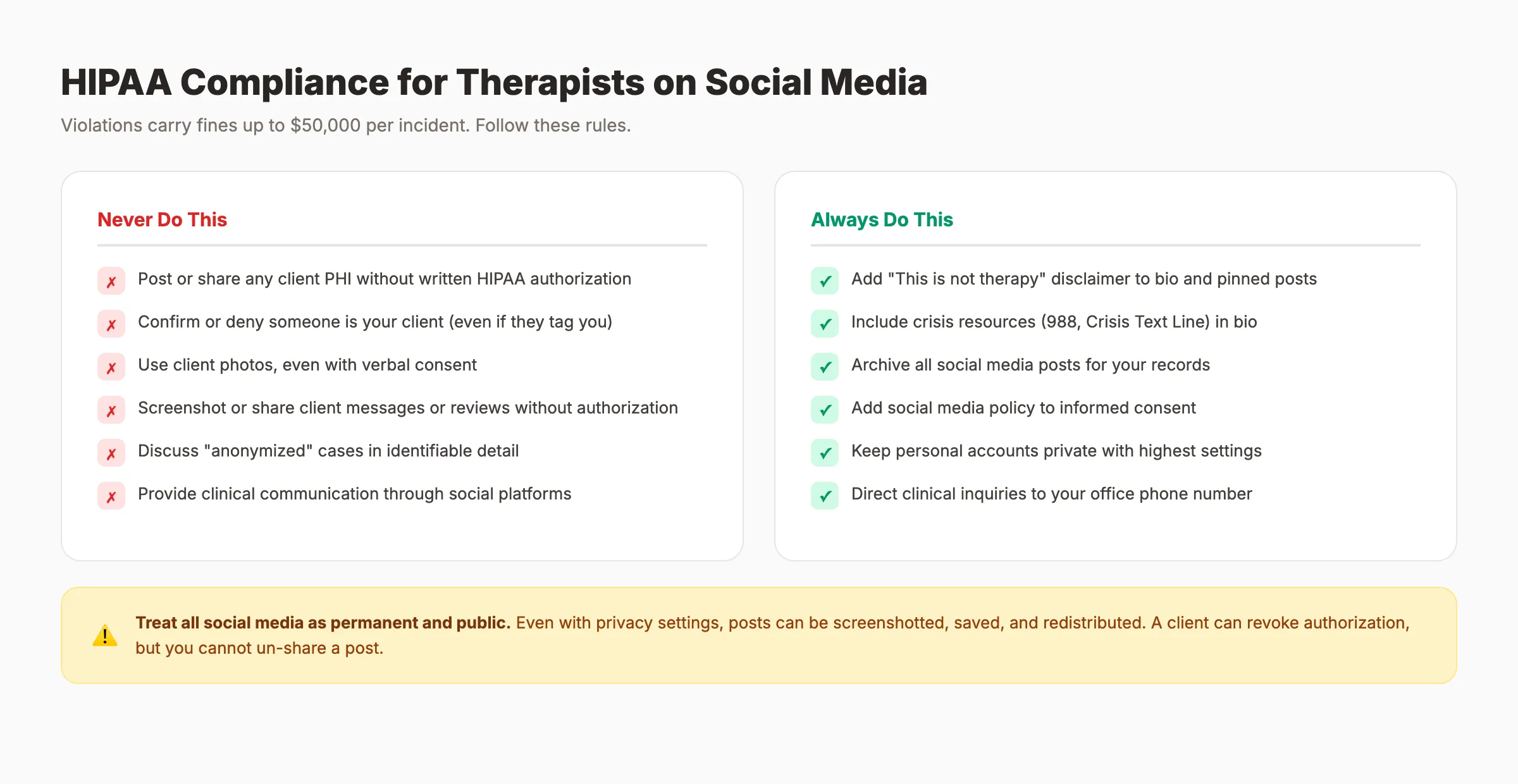
HIPAA violations on social media carry fines up to $50,000 per incident. For therapists, the rules are stricter than most realize.
What Counts as Protected Health Information (PHI)
PHI includes any individually identifiable health information. On social media, that means:
- A client's name, photo, or likeness
- Tattoos, scars, or physical characteristics that could identify someone
- Location data, appointment dates, or treatment details
- Even responding to a comment with "See you Thursday!" confirms a therapeutic relationship
HIPAA Social Media Rules
- ✓ Never post or share any client PHI without written HIPAA authorization
- ✓ Never confirm or deny that someone is your client (even if they tag you publicly)
- ✓ Never use client photos, even with verbal consent (written HIPAA authorization required)
- ✓ Never screenshot or share client messages, reviews, or testimonials without authorization
- ✓ Never discuss specific cases, even "anonymized," in enough detail to be identifiable
- ✓ Keep all clinical communication off social platforms (use HIPAA-compliant channels only)
- ✓ Archive all social media posts for your records
The Authorization Problem
Even with written authorization, social media posts cannot be controlled once published. A client can revoke authorization, but you cannot un-share a post that has been screenshotted, saved, or re-posted. The HIPAA Journal recommends treating social media content as permanent and public, regardless of privacy settings.
The safest approach: never post anything that references a specific individual's treatment, even with consent.
Disclaimers Every Therapist Needs
Add these to your social media bio and pinned posts:
- "This content is for educational purposes only. It is not therapy."
- "Following this account does not create a therapeutic relationship."
- "If you are in crisis, contact 988 (Suicide & Crisis Lifeline) or text HOME to 741741."
These disclaimers protect you legally and set clear expectations for followers.
Chapter 4: Ethical Boundaries and Gray Areas
The APA Guidelines for Social Media in Professional Practice provide a framework, but most day-to-day situations fall into gray areas that no guideline directly addresses.
Client Interactions on Social Media
Do not accept friend or follow requests from current clients. This creates a dual relationship. You see their personal life. They see yours. Both dynamics interfere with the therapeutic relationship.
Do not follow clients. Even if they follow you. Viewing a client's social media activity outside of sessions introduces information that was not shared in the therapeutic context.
Do not respond to client DMs therapeutically. If a client messages you on Instagram about a crisis, respond with: "I am glad you reached out. Please call my office at [number] or contact 988 if this is urgent. Social media is not a secure channel for clinical communication."
Do not like or comment on client posts. This publicly confirms a relationship and can be visible to others.
The Informed Consent Addition
Add a social media policy to your informed consent documentation before the first session. It should cover:
- That you do not accept friend/follow requests from clients
- That you do not communicate clinically through social media
- How you handle it if a client engages with your professional content
- That content on your social pages is educational, not therapeutic
Handling Crisis Situations in Comments
A follower posts a comment expressing suicidal ideation. This happens to therapist accounts regularly. Have a protocol ready:
- Respond publicly with crisis resources: "If you are in crisis, please contact 988 or go to your nearest emergency room."
- Do not engage in a clinical conversation in the comments.
- If the person is a current client, follow your existing crisis protocol outside of social media.
- Document the interaction and your response.
For therapists building their broader online presence, our therapist SEO guide covers how to rank your practice website on Google.
Chapter 5: Weekly Content Calendar
Most therapists struggle with consistency because they create content from scratch every time they post. A repeating weekly template eliminates that problem.
Sample Weekly Schedule (3 Posts Per Week)
| Day | Content Type | Format | Example |
|---|---|---|---|
| Monday | Educational | Carousel or Reel | "5 grounding techniques for anxiety (backed by research)" |
| Wednesday | Engagement | Poll or question | "What is the biggest myth about therapy you have heard?" |
| Friday | Behind-the-scenes or tip | Photo + caption | "My favorite book for clients dealing with grief" |
Monthly Content Themes
| Month | Theme | Content Angles |
|---|---|---|
| January | New beginnings, goal setting | Realistic goal-setting vs toxic positivity, starting therapy in the new year |
| February | Relationships | Attachment styles, healthy communication, couples therapy myths |
| March | Women's history, stress | Burnout in women, work-life balance, boundary setting |
| April | Stress awareness month | Workplace stress, coping tools, when stress becomes clinical anxiety |
| May | Mental health awareness month | Therapy myths, stigma reduction, what therapy actually looks like |
| June | LGBTQ+ pride | Affirming therapy, finding inclusive providers, identity and mental health |
| July | Self-care | Realistic self-care vs. performative self-care, burnout prevention |
| August | Back to school | Child anxiety, parenting stress, transitions and mental health |
| September | Suicide prevention month | Crisis resources, warning signs, how to talk to someone struggling |
| October | Depression awareness | Seasonal affective disorder, depression myths, treatment options |
| November | Gratitude, family stress | Holiday anxiety, family boundaries, gratitude practices that work |
| December | Year-end reflection | Processing the year, grief during holidays, setting intentions |
Batch Content Creation
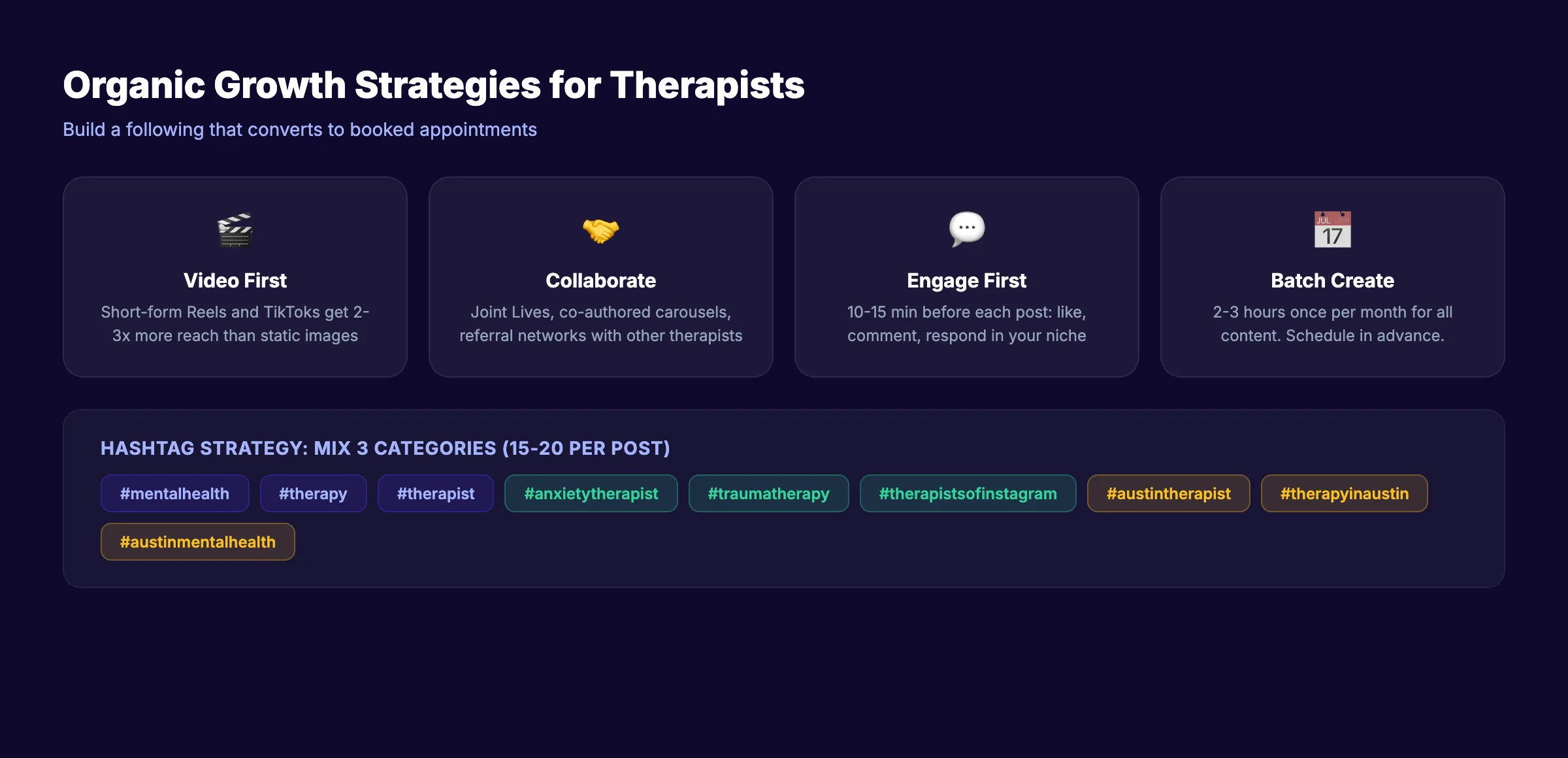
Block 2 to 3 hours once per month to create all content for the next 4 weeks. Write captions, design graphics, and schedule posts using a tool like Later, Buffer, or Meta Business Suite. This eliminates the daily pressure to create something new.
For general social media scheduling strategy, our content marketing for small business guide covers planning and workflows.
Your SEO team. $99 per month. 30 optimized articles, published automatically. Blog SEO, Local SEO, and Social on autopilot.
Chapter 6: Growing Your Following Without Paid Ads
Organic growth on social media is slower than paid advertising. But for therapists, organic followers are more likely to become actual clients because they chose to engage with your content over time.
Hashtag Strategy for Therapists
Use 15 to 20 hashtags per Instagram post. Mix 3 categories:
- Broad: #mentalhealth #therapy #therapist #mentalhealthawareness (high volume, low conversion)
- Niche: #anxietytherapist #traumatherapy #couplescounceling #therapistsofinstagram (medium volume, higher conversion)
- Local: #[city]therapist #[city]mentalhealth #therapyin[city] (low volume, highest conversion)
Collaboration Over Competition
Partner with other therapists who serve different specialties. A couples therapist and a trauma therapist can do a joint Instagram Live, each exposing their audience to the other. Neither is competing for the same clients.
Other collaboration ideas: co-authored carousels, podcast guest appearances, shared resource lists, and referral networks.
Engage Before You Post
Spend 10 to 15 minutes before each post engaging with other accounts in your niche. Like, comment, and respond to posts from colleagues, mental health advocates, and local businesses. This signals the algorithm that your account is active and builds genuine relationships.
Video Outperforms Everything
Short-form video (Instagram Reels, TikTok) generates 2 to 3x more reach than static images. You do not need production quality. A well-lit face-to-camera video explaining one concept in 30 to 60 seconds outperforms a designed graphic.
Successful therapist creators like Nedra Glover Tawwab (1.8 million Instagram followers) and Dr. Justin Puder (1 million TikTok followers) built their audiences primarily through simple, direct video content.
Chapter 7: Social Media vs. Other Marketing Channels
Social media is one channel. It is not the only channel. Many successful therapy practices fill their caseloads without posting a single Instagram Reel.
Channel Comparison for Therapists
| Channel | Cost | Time to Results | Best For |
|---|---|---|---|
| Social media (organic) | Free | 3-6 months | Brand building, younger demographics |
| Google Business Profile | Free | 1-3 months | Local visibility, reviews |
| Psychology Today directory | $30/month | Immediate | Steady referral flow |
| SEO / Blog content | $99-$500/month | 3-6 months | Long-term organic traffic |
| Google Ads | $500-$2,000/month | Immediate | High-intent local leads |
| Referral networks | Free | Ongoing | Warm introductions |
When Social Media Makes Sense
Social media is worth the investment when:
- Your ideal clients are millennials or Gen Z (they check social before booking)
- You enjoy creating content (forced content reads as forced)
- You have 3 to 5 hours per week to dedicate consistently
- You want to build a personal brand beyond your local area
When to Skip Social Media
Social media is not required. If your practice is full from referrals and directory listings, there is no reason to add social media to your plate. Many therapists fill their caseloads through Psychology Today, Google Business Profile, and word of mouth alone.
The exception: if you want to launch a course, write a book, speak at conferences, or build a national reputation, social media is the fastest path to visibility beyond your local market.
For therapists focused on search visibility instead, our therapist SEO guide covers ranking on Google.
Our local SEO checklist covers the full setup for appearing in local search results.
3,500+ blogs published. Every article is SEO-scored before publish. See what theStacc can do for your practice.
Common Mistakes Therapists Make on Social Media
Posting client stories without authorization. Even "disguised" case studies are risky. If a client recognizes themselves, it is a boundary violation regardless of your intent.
Responding to DMs clinically. A follower asks "I think I have PTSD, what should I do?" The correct response is to direct them to seek professional help. Not to assess, diagnose, or recommend treatment through Instagram DMs.
Being everywhere at once. Five neglected profiles perform worse than 2 active ones. Pick your platforms and commit.
Only posting quotes. Inspirational quotes generate likes but not clients. Educational content that demonstrates your expertise generates bookings.
Ignoring your Google Business Profile. It is not technically social media, but it is the single most effective free marketing tool for local therapists. Our GBP categories guide covers setup for healthcare providers.
No disclaimer in bio. Without a clear statement that your content is educational and not therapy, you risk creating implied therapeutic relationships with followers.
Comparing yourself to therapist influencers. Nedra Tawwab has 1.8 million followers and a full content team. You do not need millions of followers to fill a private practice. 500 local, engaged followers can fill a caseload.
What practitioners are saying on X
Marketing systems still win. Here is operator signal from X on SEO stacks and fundamentals.
- @jakezward (Feb 2026): 2026 SEO predictions emphasize AI Overview share-of-SERP, schema for LLM token efficiency, brand mentions in AI answers as a KPI, proprietary data as a moat, and content refresh beating net-new AI slop. See the post on X.
- @ConnorGillivan (Jul 2026): 2026 SEO stack favorite list: Semrush/Ahrefs, GSC, Surfer, KeywordInsights, ChatGPT, SEOwind, Screaming Frog, ClearScope, GA4, Notion/Airtable — tools amplify systems, they don’t replace them. See the post on X.
- @HlynurStefDev (Jul 2026): Public case: niche site traffic jumped from ~18 to 4,162 Google visits/month after focused technical/on-page SEO work (GSC screenshots claimed) — reminds that fundamentals still move numbers. See the post on X.
Grok, AI Overviews, and multi-engine visibility
For “social media for therapists”, multi-engine visibility still starts with clear definitions, sourced numbers, and extractable section answers. Grok additionally factors live X discussion — keep public claims consistent with this page.
- Google AI Overviews: Use passage-ready answers, tables, and FAQ schema where relevant.
- ChatGPT / Perplexity: Cite named sources next to key claims.
- Grok: Maintain accurate entity facts on-site and in high-signal X posts.
Publish content built for Google and AI citations. theStacc’s Content SEO module ships SEO-scored articles structured for rankings and generative engines — including clearer entity pages models like Grok can quote.
FAQ
It depends on your goals and audience. If your ideal clients are millennials or Gen Z, social media is one of the best ways to reach them. 74.1% of clients who found their therapist online reported increased perception of that therapist's expertise. But if your practice is full from referrals and directories, social media is optional.
Instagram and TikTok reach the largest therapy-seeking demographics (millennials and Gen Z). LinkedIn works for therapists targeting corporate or EAP clients. Google Business Profile is essential for every therapist regardless of specialty. Focus on 2 to 3 platforms maximum.
2 to 3 times per week is the minimum for maintaining visibility. Consistency matters more than frequency. Posting 3 times per week every week outperforms posting daily for 2 weeks and then disappearing for a month.
No. Following clients creates a dual relationship and introduces information outside the therapeutic context. Most professional ethics guidelines advise against accepting or sending follow requests with current clients. Include a social media boundary policy in your informed consent.
Never post any protected health information (PHI) without written HIPAA authorization. Never confirm or deny someone is your client. Never discuss specific cases in identifiable detail. Never use client photos or screenshots. Archive all posts. Add a disclaimer that your content is educational, not therapeutic.
Many therapists fill their practices through Psychology Today listings ($30/month), Google Business Profile optimization (free), SEO and blog content, Google Ads, and referral networks from colleagues, doctors, and community organizations. Social media is one channel among many.
Rank everywhere. Do nothing. Blog SEO, Local SEO, and Social on autopilot. theStacc starts at $99/mo with a free trial.
Social media for therapists works when it is consistent, ethical, and strategic. Pick 2 platforms. Follow the 60/20/15/5 content mix. Respect the boundaries. And remember that 500 engaged local followers are worth more than 50,000 passive ones. The therapists growing their practices through social media are the ones who show up every week with content that educates and builds trust.
Related Tools & Resources
Free SEO Tools:
Best Lists:
Sources & references
- [1] Princeton / Georgia Tech et al. — GEO research (arXiv:2311.09735)
- [2] @hridoyreh on X — Widely shared SEO skill tree: foundations, research, technical, on-page, content, links, AI SEO/GEO, analytics, UX, bran
- [3] @jakezward on X — 2026 SEO predictions emphasize AI Overview share-of-SERP, schema for LLM token efficiency, brand mentions in AI answers
- [4] Referenced source — onlinelibrary.wiley.com

Plan topics, review article drafts, and publish to a connected CMS.
Weekly local SEO teardowns
One practical email a week. Map Pack, GBP, AI Overviews. No fluff. Unsubscribe anytime.
Explore this topic: Social Media Marketing · Keep your social calendar moving without starting from scratch..