TikTok SEO for local business means optimizing short-form video so it surfaces in TikTok search for location-specific queries. Roughly half of US consumers now search on TikTok. The levers are location tags, neighborhood hashtags, spoken city names, local sounds, and a bio built for one-tap booking.
49% of U.S. consumers now use TikTok as a search engine. For local intent searches like "best ramen near me" or "dentist [city] reviews," young adults open TikTok before they open Google Maps. Most local business owners still treat TikTok as a brand-awareness toy.
That is the real cost. A restaurant that does not rank for "tacos [neighborhood]" on TikTok is invisible to roughly half of the under-35 walk-in market. A salon that does not appear when a viewer types "balayage [city]" loses the booking before the consultation request is ever sent. The opportunity is hiding in plain sight because most agencies still write local SEO playbooks as if Google Maps were the only map that mattered.
This guide is for owners and marketers running restaurants, salons, gyms, contractors, dental offices, retail boutiques, fitness studios, pet services, auto shops, and independent real estate teams. It covers TikTok SEO specifically for businesses that serve a geographic catchment area, not a global audience. We help local operators publish content built for both Google and TikTok, and the patterns below come from work across hundreds of geo-bound accounts.
TikTok SEO for local business is the practice of optimizing short-form video content to appear in TikTok search results for location-specific queries.
It uses location tags, neighborhood hashtags, spoken city names, local sounds, and a bio configured for one-tap booking to convert TikTok viewers into walk-ins or appointments.
Here is what this playbook covers:
- The 49% problem and what it means for local-only businesses
- How TikTok search ranks results differently from Google Maps for the same query
- The 5 levers that move local TikTok visibility
- Vertical mini-playbooks for restaurants, salons, fitness studios, contractors, dental, and retail
- The Geo-Native TikTok Stack — a 5-layer framework you can implement this week
- The Local TikTok Search Loop and how it closes into a Google Business Profile visit
- Real measurement and tracking for offline conversion
- Four short case studies with realistic numbers and clear caveats
For broader context on TikTok ranking signals across all use cases, read the complete TikTok SEO guide. This page goes deeper into local intent specifically.
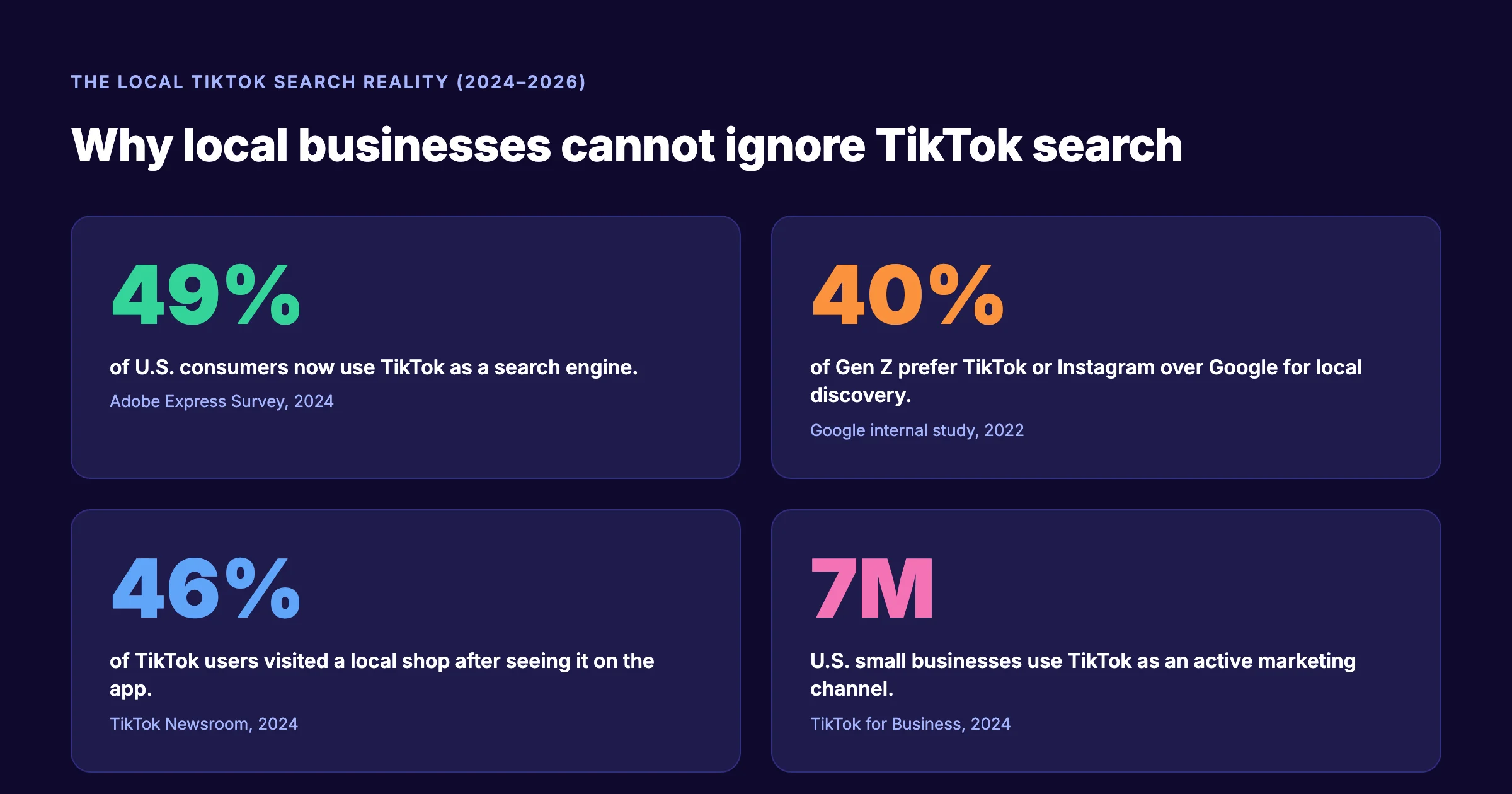
The 49% Problem: How Local Prospects Are Searching Now
The short answer: roughly half of U.S. consumers, and the majority of users under 30, are using TikTok as a search engine for local discovery questions. That is true even when they intend to visit a physical location, book a service, or eat at a restaurant in the next 72 hours.
The 49% figure comes from an Adobe Express survey of more than 800 U.S. consumers and creators in 2024. Earlier statements from Google, including the often-cited remark from then-SVP Prabhakar Raghavan in 2022, put the share at 40% of Gen Z preferring TikTok or Instagram over Google for local discovery. A TikTok Newsroom post in 2024 reported that 46% of users have visited a local shop or restaurant after finding it on the app. Industry studies from Search Engine Land and SOCi confirm that local intent on TikTok is climbing fastest in food, beauty, fitness, and home services.
A few things matter about that 49% number for a local operator. The traffic is high-intent. The viewer is not browsing for entertainment in that moment, the way they are on the For You Page. They are typing a service plus a place. They are pre-qualified by geography. They are ready to book, drive, or call. And critically, they are not seeing your Google Business Profile until after they have already chosen between you and the next geo-pinned video.
The local TikTok search audience is also growing faster than the local Google audience. Adobe's same study found that 1 in 10 Gen Z respondents are more likely to trust TikTok than Google for answers. SOCi's 2024 Consumer Behavior Index reports that TikTok now generates more local searches than Yelp for users under 35. For a restaurant or salon owner with a Gen Z and Millennial customer base, that is not a future trend. It is current revenue exposure.
The short answer: if more than 20% of your customers are under 35, you have a TikTok SEO problem whether you have published a single video or not.
How TikTok Search Differs From Google for Local Intent
Google Maps ranks local businesses primarily on three pillars: proximity, prominence, and relevance. TikTok search uses a different set of inputs, and confusing the two is the single most common mistake operators make when they try to "copy what works on Google" onto TikTok.
TikTok search ranks video content for a query based on:
- Caption and on-screen text match — the keyword must appear in caption, spoken audio, on-screen overlays, or hashtags
- Engagement signals — completion rate, saves, shares, and comments outweigh likes
- Recency — fresh content from the last 7 to 30 days appears higher for trending local queries
- Location signals — videos with a location tag matching the searcher's city or region rank higher
- Creator consistency — accounts that publish on a topic and from a location regularly are favored
- Account authority for the niche — followers and follower quality matter less than topical consistency
Google Maps will rank you for "dentist near me" even if you have never published content, because your physical address, citations, and reviews carry the weight. TikTok will not. On TikTok, your visibility is created exclusively by the content you publish. There is no equivalent to a Google Business Profile that ranks passively.
That difference changes the budget shape. A local Google SEO program can move rankings through fixed assets like citations, reviews, and an optimized profile. A local TikTok SEO program requires recurring video output. The good news is that TikTok rewards a much smaller account than Google does. A salon with 800 followers can outrank a salon with 80,000 followers for a local query if the smaller account is publishing geo-pinned, keyword-aligned content weekly. Reach is decoupled from follower count in a way no other platform has matched.
The contrarian view most local SEO guides miss: for businesses serving customers under 35, TikTok now precedes Google in the buying journey for many local queries. That means TikTok SEO is the new "discovery layer" and Google Business Profile is the new "verification layer." The order has flipped.
The 5 Levers of Local TikTok SEO
Five levers move the needle for a local-only TikTok account. Pull all five and you will compound visibility within 60 to 90 days. Pull two and you will plateau.
Lever 1: Location Tags and Geo-Pinning
The location tag is the single most underused feature in local TikTok publishing. Every video should be tagged with a precise location — the business address, the neighborhood, or a recognizable landmark within walking distance. Tagged videos appear in TikTok's location-based search and in the Local Feed, a separate discovery tab where TikTok serves content from businesses and creators inside the user's city.
Three concrete rules:
- Tag the actual business location, not a city-wide tag, when you want walk-ins
- Tag a landmark or neighborhood when you want broader local reach
- Verify the location is searchable by typing it in the TikTok search bar yourself before publishing
The TikTok Local Feed, expanded in late 2023 and refined through 2024, is where most of the discovery traffic now lives. Videos with strong location tags and engagement enter the Local Feed for users inside a 20 to 50 mile radius. A coffee shop that tags every video with its specific address gets seen by neighborhood walkers in a way that a coffee shop tagging only "Austin, TX" does not.
Lever 2: Neighborhood, City, and Landmark Hashtags
Hashtags on TikTok are not the same as on Instagram. They are part of the ranking signal for search, but the optimum stack is small and specific. Use three to five hashtags per video.
The format that works for local search:
- One broad city tag:
#austin - One neighborhood tag:
#easteastsideor#southcongress - One service or category tag:
#austintacosor#austinhairsalon - One brand or business tag:
#yourbusinessname - One trending or seasonal tag, only when it fits
Avoid stuffing tags. TikTok's search algorithm penalizes unrelated hashtag spam, and the user-facing caption looks low-quality when stuffed. The goal is for each tag to add a different signal: city, neighborhood, vertical, brand, and trend.
Lever 3: Local Creator Collaborations and Community Sounds
Local micro-influencers — accounts with 5,000 to 50,000 followers in your geography — are the highest-impact collaboration target for a small business. They have audience trust, they live or operate in your catchment area, and they are reachable through TikTok's Creator Marketplace or direct DM. A single 30-second collab from a well-aligned local creator can produce more bookings than three months of organic posts for many service businesses.
Two practical tactics:
- Local creator gifting: invite 3 to 5 local creators per month to experience the product, with no contract and no script
- Local sound seeding: when a local sound or trend is emerging in your city, post on it within 48 hours
Community sounds matter more than people realize. When a local audio clip starts trending in a specific city, TikTok's algorithm uses it as a strong local signal. A San Diego coffee shop that uses a sound trending among San Diego accounts will be served to other San Diego viewers more aggressively than a video using a globally trending sound.
Lever 4: Bio and Landing Page Optimization for Local Conversion
The bio is the conversion bottleneck. Most local businesses have a TikTok bio that reads like a magazine tagline and links to a homepage. That kills conversions. The bio should answer four questions in 80 characters or less: what you do, where you are, when you are open, and what to do next.
A working format:
Tacos · East Austin · Tue–Sun 11am
Book your table → [link]
The bio link should go to a mobile-optimized booking or directions page, not a homepage carousel. Tools like Linktree work, but a custom page on your own domain converts better because it removes a step and looks like a brand asset. Include hours, address, a tap-to-call button, a tap-to-direct button, and one primary CTA.
Lever 5: Google Business Profile and TikTok Cross-Pollination
Most viewers verify a local TikTok find by switching apps and opening Google Maps. That cross-check is non-negotiable for high-consideration purchases like a dental office, contractor, or higher-priced salon service. If your Google Business Profile shows different hours, weak reviews, or outdated photos, the TikTok view turns into a lost lead.
Cross-pollination tactics that work:
- Repurpose top-performing TikTok clips as Google Business Profile photo and video uploads
- Keep your TikTok bio link consistent with your Google Business Profile website URL
- Match the brand voice and visual style across both
- Use the same address format on both
- Encourage TikTok viewers who visit to leave a Google review, not a TikTok comment
If you need a foundation on the Google side first, our Google Business Profile optimization guide covers what the Local Feed audience will see when they cross-check you on Maps.
Most advice about local TikTok SEO is wrong. The popular take says you need to "go viral" to grow a local audience. For a geo-bound business, virality is actually a problem — most of the views come from outside your service area. The real goal is consistent, mid-sized local reach: 500 to 5,000 views per video from inside your city.
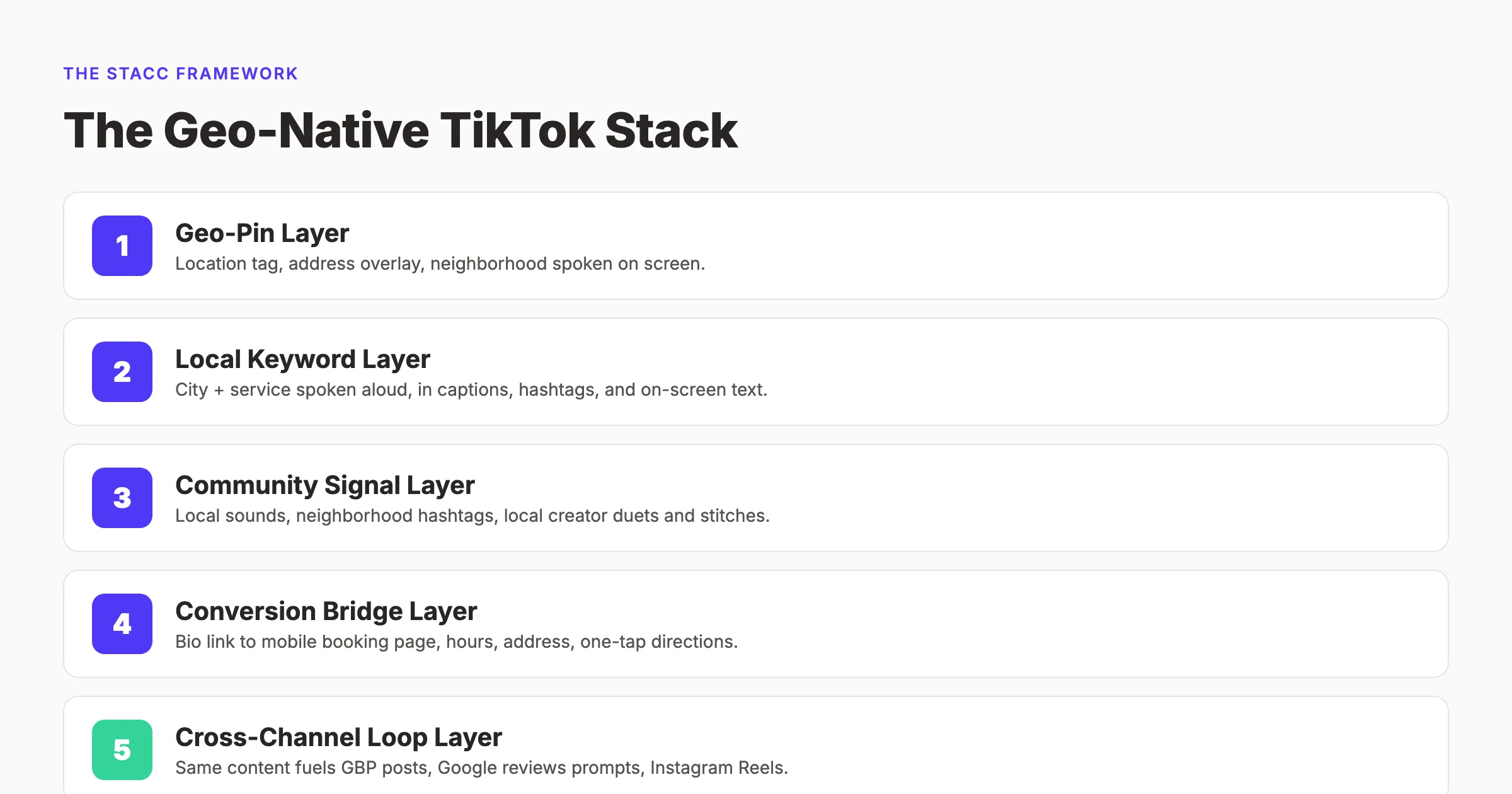
The Geo-Native TikTok Stack: A 5-Layer Framework
We built this framework after observing what separates local accounts that compound from local accounts that flatline. Most small businesses pull one or two of these layers, then quit. Compounding requires all five.
Layer 1 — Geo-Pin Layer Every video carries a precise location tag, on-screen address text, and a spoken neighborhood name within the first 5 seconds. The viewer should know exactly where you are without leaving the video.
Layer 2 — Local Keyword Layer The local keyword — city plus service — is spoken aloud, written in the caption, used in a hashtag, and shown as on-screen text. TikTok indexes all four channels. Saying it once is not enough.
Layer 3 — Community Signal Layer Local sounds, neighborhood hashtags, duets with local creators, and visible local landmarks signal "this account is part of this city" to the algorithm. Without this layer, your geo-pinned content reaches a smaller share of local viewers.
Layer 4 — Conversion Bridge Layer The bio link points to a mobile booking, directions, or call page, not a homepage. The page loads in under 2 seconds. The primary CTA is one tap deep.
Layer 5 — Cross-Channel Loop Layer The same content fuels Google Business Profile posts, Instagram Reels, and YouTube Shorts. The same TikTok clip becomes a GBP video. The same hooks become Reels. One production session yields four channels.
The framework works because each layer compounds the others. Geo-pinning alone does not move bookings. Geo-pinning plus a converting bio plus a cross-posted GBP does. Operators who implement all five usually see meaningful Local Feed reach inside 45 to 60 days. Operators who implement two or three layers stall.
Bold idea. Treat your TikTok account like a second storefront. The Geo-Native TikTok Stack is how you keep the lights on in that storefront 24 hours a day. Your local SEO team. $49/month. →
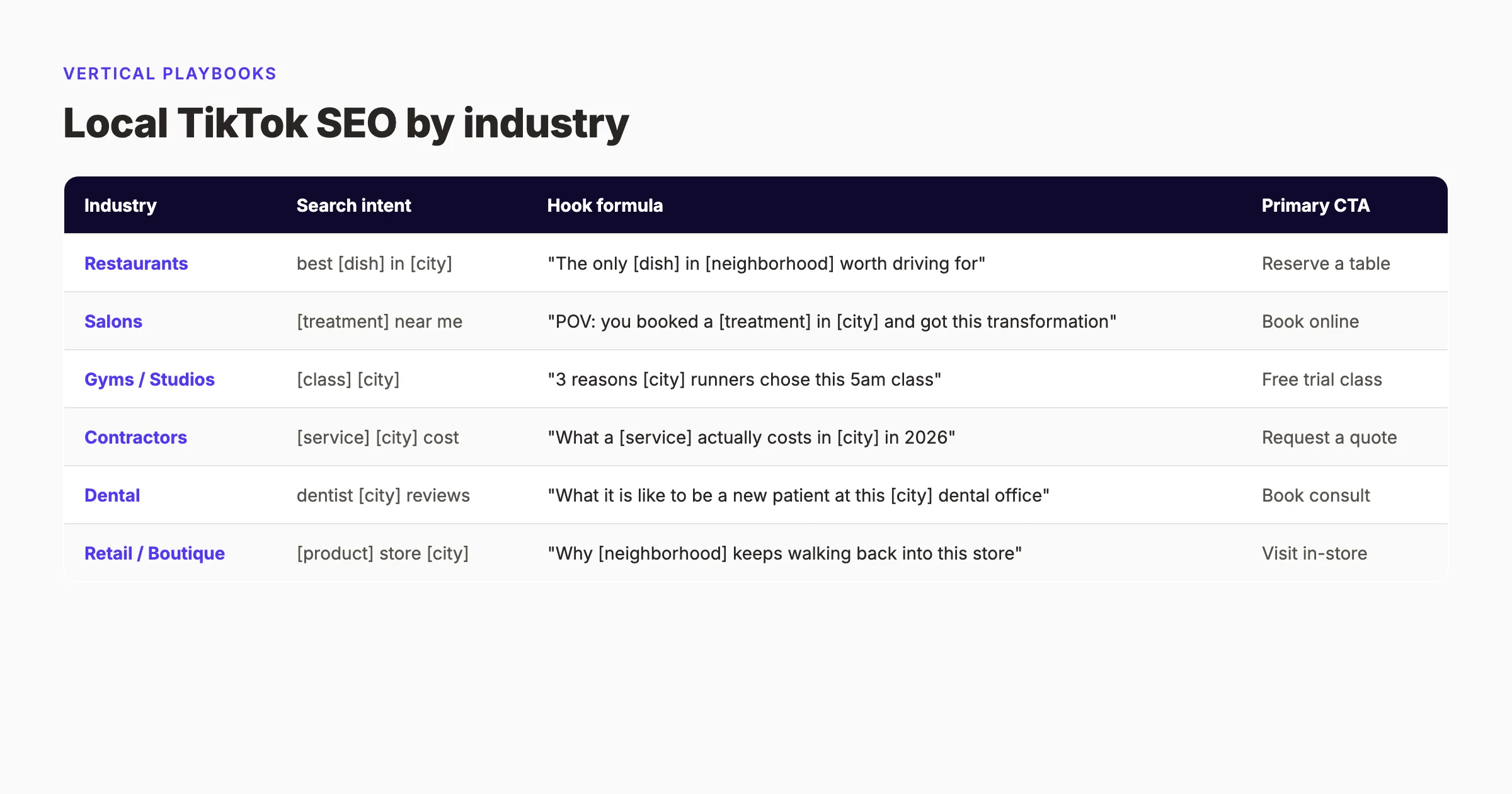
Vertical Mini-Playbooks
Generic TikTok advice fails local operators because the content patterns that work in restaurants do not work in dental offices, and vice versa. Below are four vertical playbooks with the specific hook formulas, search queries, and conversion CTAs that we see work for each industry.
Playbook 1: Restaurants and Cafes
Local search queries to target: "best [dish] in [city]," "[cuisine] [neighborhood]," "[city] brunch spots," "where to eat in [neighborhood]"
Content patterns that rank:
- POV-style first-bite videos at the table
- Behind-the-counter shots of the most-ordered dish being prepared
- "The only [dish] in [neighborhood] worth the drive" hook
- Reservation walk-throughs with the front-of-house team
- Daily specials posted before lunch and dinner rushes
Hook formula that works: "If you are in [neighborhood] and have not tried [specific dish], here is why people are driving in from [adjacent city]."
Conversion path: TikTok view → bio link → reservation page → walk-in.
Industry-specific tip: post twice a week at minimum, and time at least one post to your peak day. A neighborhood pizza shop posting Friday morning catches Friday-night decision making.
Playbook 2: Hair Salons, Nail Studios, and Beauty Services
Local search queries to target: "[treatment] near me," "balayage [city]," "[city] [nail style]," "best hair salon [neighborhood]"
Content patterns that rank:
- Before-and-after transformations with the city name said aloud
- "POV: you booked a [service] at this [city] salon" hooks
- Client reactions during the chair reveal
- Quick technique explainers tied to a current trend
- Stylist introductions with personality and specialty
Hook formula that works: "POV: you booked a [service] in [city] and got this transformation."
Conversion path: TikTok view → bio link → online booking → appointment.
Industry-specific tip: beauty content has the highest save rate on TikTok. Encourage stylists to add captions like "save this for your next appointment" — saves are a stronger ranking signal than likes for the search algorithm.
Playbook 3: Gyms, Studios, and Fitness Coaches
Local search queries to target: "[class type] [city]," "best gym near me," "[city] yoga studio," "personal trainer [neighborhood]"
Content patterns that rank:
- Class previews that show real members, alongside instructors
- "3 reasons [city] runners chose this 5am class" listicles
- Transformation stories with member consent
- Day-in-the-life of a member
- Free trial CTAs at the end of every video
Hook formula that works: "Here is what a beginner class at [studio] in [city] actually looks like."
Conversion path: TikTok view → bio link → free trial signup → first class.
Industry-specific tip: fitness content benefits from face-to-camera authenticity over polished production. A coach speaking to camera in workout clothes outperforms a polished promo cut almost every time.
Playbook 4: Contractors, Trades, and Home Services
Local search queries to target: "[service] [city] cost," "[trade] near me," "[service] [neighborhood] reviews"
Content patterns that rank:
- Time-lapse project completions on local properties
- "What a [service] actually costs in [city] in 2026" educational videos
- Honest "before we start" walkthroughs with the homeowner
- Common-mistake explainers for DIY attempts
- Day-in-the-life behind a service truck
Hook formula that works: "If you are getting [service] quotes in [city], here is what the price should actually look like."
Conversion path: TikTok view → bio link → quote request form → site visit.
Industry-specific tip: trades convert on trust, not aesthetics. Show the team. Show the truck. Show a real address from a recent job (with permission). The first comment a viewer reads is more important than the last frame they see.
The Local TikTok Search Loop: From View to Walk-In
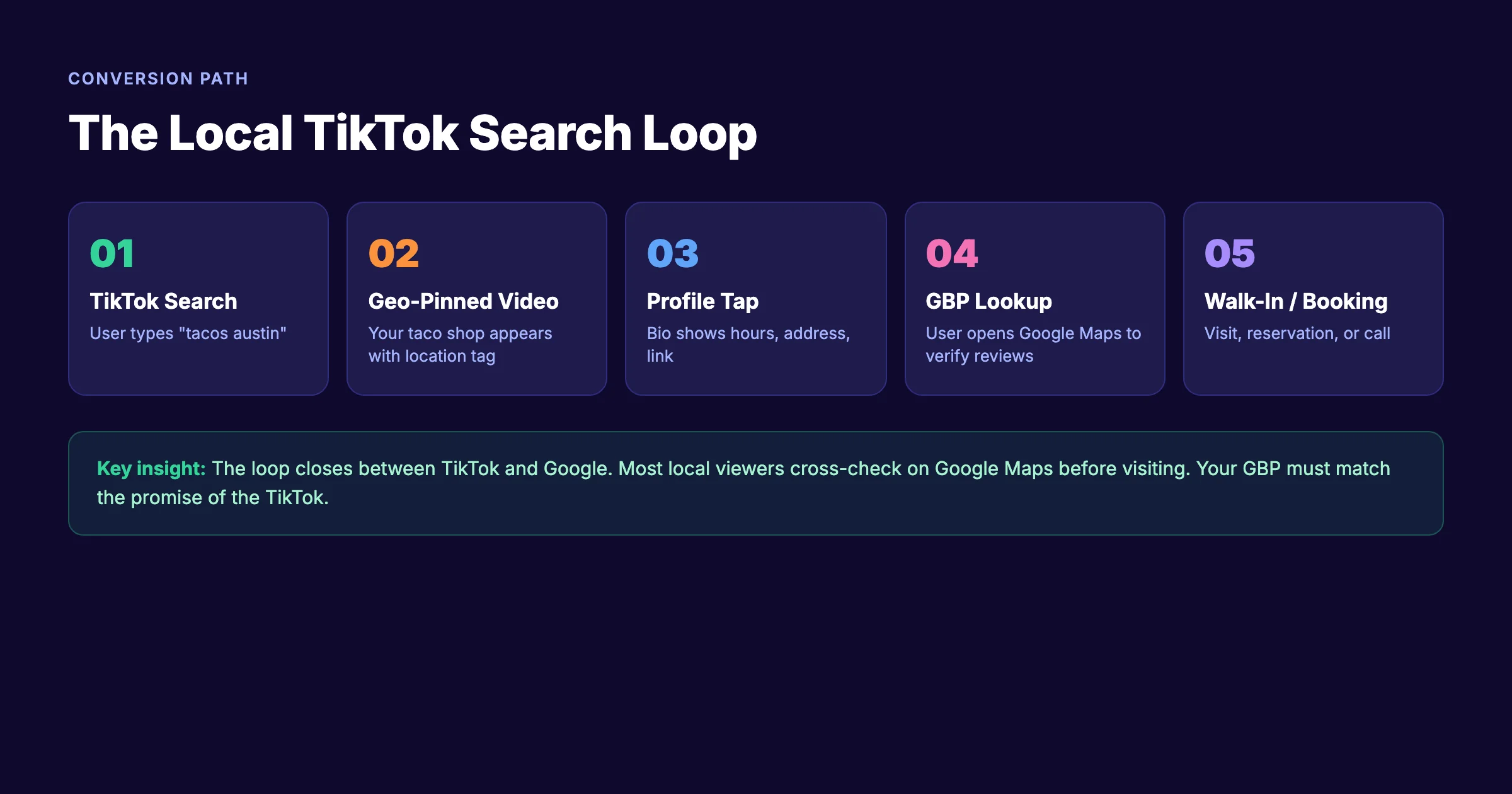
The Local TikTok Search Loop is the actual customer journey from "I am hungry in this neighborhood" to "I am sitting at your table." Understanding it is the difference between treating TikTok as brand awareness and treating it as performance.
Step 1 — TikTok Search. The user types a local intent query: "tacos austin," "balayage san diego," "5am yoga class brooklyn." TikTok serves a stack of videos ranked by location, recency, and engagement.
Step 2 — Geo-Pinned Video. Your video appears because the Geo-Pin Layer is intact. The viewer sees the city name, the neighborhood, and the dish or service.
Step 3 — Profile Tap. The viewer taps your profile picture. They see a bio that says what you do, where you are, when you are open, and one CTA.
Step 4 — Cross-Channel Verification. This is the step most local operators miss. The viewer switches to Google Maps to verify the business is real, has reviews, and matches the TikTok promise. They check hours, photos, and directions.
Step 5 — Walk-In or Booking. The viewer either visits in person, books online, or calls. The loop closes outside the TikTok app entirely.
Two implications follow from this loop. The first is that your Google Business Profile and TikTok identity must be visually and verbally consistent. The same brand voice, the same dish photos, the same hours. If the TikTok shows a clean, packed dining room and the GBP shows a dim, empty one, you lose the conversion in Step 4.
The second implication is that your TikTok analytics will under-report your TikTok-driven revenue. TikTok cannot see the Google Maps lookup. Google cannot see the TikTok view. The only way to measure this loop accurately is to ask new customers, in person, how they found you. We discuss the measurement gap in the tracking section below.
What We See Across Our Local Accounts
We help local operators publish content built for both Google and TikTok across hundreds of geo-bound accounts spanning food and beverage, beauty, fitness, dental, retail, and home services. A few patterns hold across that book of work:
- Accounts that publish on a fixed cadence — usually 3 to 5 videos per week — outperform accounts that publish in bursts, even when total monthly output is similar
- Videos that say the city name in the first 5 seconds get 30% to 50% higher completion rates than videos that mention the city only in the caption
- Bio link clicks correlate more strongly with revenue than view counts do
- The single biggest predictor of bookings from TikTok is whether the Google Business Profile is well-maintained at the same time
- Local creator collabs produce more booking value per dollar than paid TikTok ads for service businesses with a tight catchment area
The pattern that surprised us most: location-tagged videos with 800 to 5,000 views per post produce more bookings than viral videos with 100,000-plus views. Viral reach for a local business pulls in a global audience that cannot actually visit. That is why we coach operators away from "go viral" thinking. The right ceiling for a local account is consistent, mid-sized local reach.
The right metric is not views. The right metric is local views inside a 30-mile radius that convert into a bio link tap. Everything above that radius is vanity.
Tracking and Measurement for Local TikTok SEO
The honest answer is that you will never measure local TikTok SEO with the precision you measure Google Ads or organic search. The customer journey moves between two platforms that do not share data, and a meaningful portion of the conversion happens offline.
Three measurement layers help close the gap:
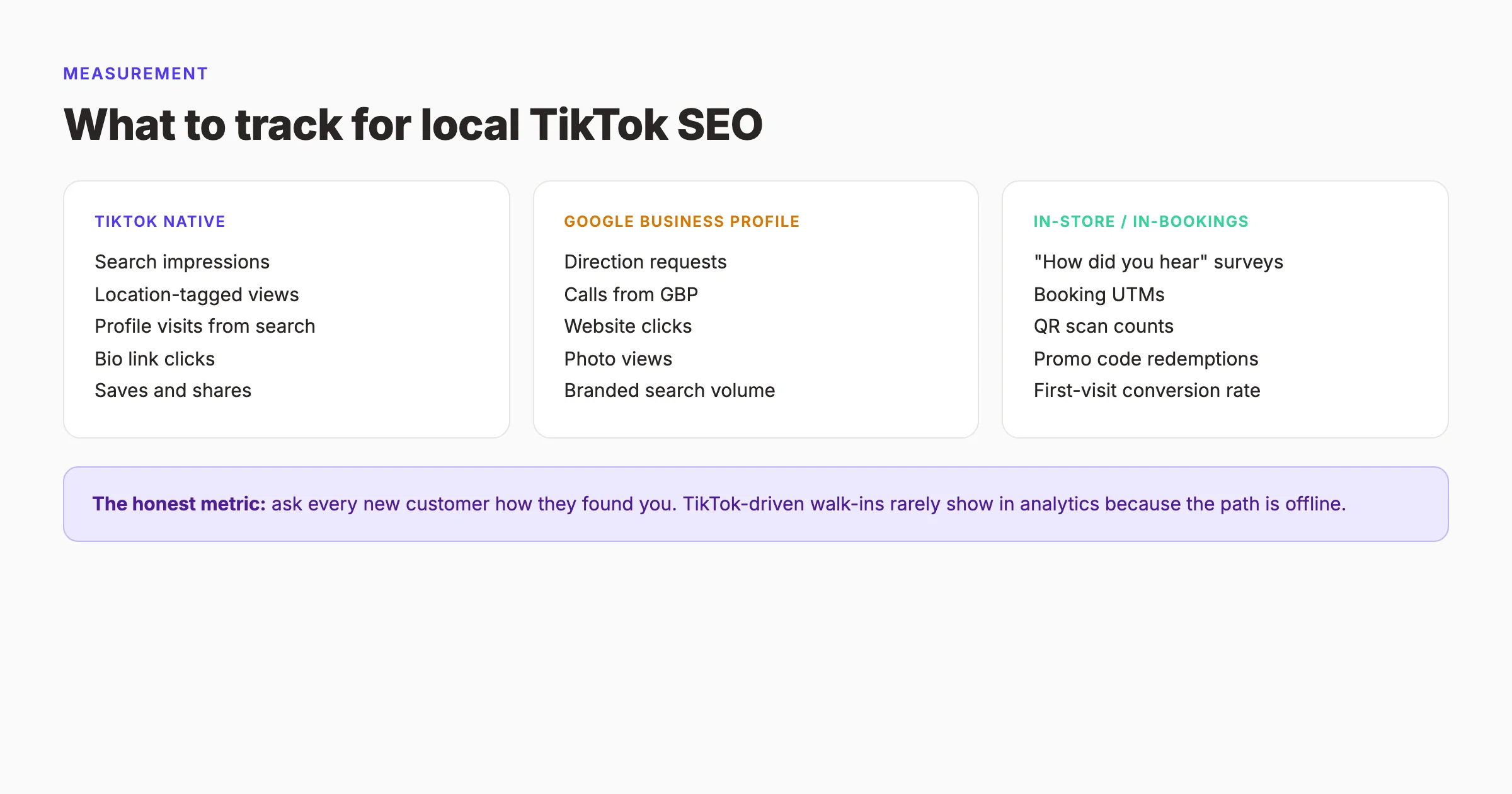
Layer 1 — TikTok native. Inside the TikTok Business Center, track search impressions, location-tagged views, profile visits from search, bio link clicks, and saves. Saves and shares are leading indicators of search ranking. Bio link clicks are the closest TikTok-native metric to revenue intent.
Layer 2 — Google Business Profile insights. Direction requests, calls, website clicks, and photo views in GBP all rise after a strong TikTok cycle. Branded search volume — how many people search for your business name on Google — is the cleanest signal of TikTok-driven awareness. Track it month over month.
Layer 3 — In-store and in-booking. Ask every new customer how they found you. Use a single intake question at the point of sale, the chair, the booking call, or the digital form. Track booking UTMs from your bio link. Use QR-coded promo cards in-store that route to TikTok for an incentive. Count the redemptions.
The most reliable measurement for a local operator is the in-person survey. A receptionist who asks "How did you hear about us?" and logs the answer in a simple spreadsheet will give you cleaner data than any analytics dashboard. We see roughly 15% to 30% of new customers volunteer "TikTok" inside the first 90 days at a properly executed local account. That number is your true conversion lift.
Four Short Case Studies
These are realistic composite scenarios drawn from common patterns we observe in local accounts. Numbers are representative, not from a single account, and outcomes vary widely by city, vertical, and execution.
Case 1: Independent Coffee Shop, Mid-Sized City
A neighborhood coffee shop with one location and roughly 200 walk-ins per day started publishing 3 videos per week, all geo-tagged with the precise address and neighborhood hashtag. After 90 days, the account had grown from 240 followers to 4,800. Bio link clicks ran at roughly 80 per week. The owner ran a "mention this video" promo and logged 47 redemptions in the first month. Weekly walk-ins from new customers — measured by a one-question survey at the counter — rose from a baseline of about 35 to about 90. Branded search on Google for the shop name doubled.
The lesson: at this scale, total followers matter less than the frequency of geo-pinned content and the strength of the redemption mechanic.
Case 2: Dental Practice, Suburban Catchment
A two-dentist practice publishing twice per week focused on educational content — "what to expect at your first visit," "what a cleaning actually costs," "myths about root canals" — all with the city name spoken in the first 5 seconds. Over 6 months, new patient inquiries from "found us on TikTok" responses grew from 0 to about 6 per month, with 4 typically converting to booked appointments. The practice also saw a 35% increase in Google Business Profile direction requests over the same period, a cross-channel halo we attribute to brand familiarity from the TikTok work.
The lesson: high-consideration service businesses convert at lower volumes but higher value per conversion. 6 inquiries a month at a $1,500 average first-year patient value is roughly $108,000 in annual revenue exposure from a single channel.
Case 3: Boutique Fitness Studio, Major Metro
A boutique studio offering small-group classes worked with 3 local micro-influencers — each in the 10,000 to 25,000 follower range — over a quarter. The studio paid no cash, only complimentary class packs. The collabs produced a combined 240,000 views across the city, with roughly half tagged inside the metro area. Free-trial sign-ups from the bio link rose from a baseline of about 8 per week to about 26 per week during the campaign. Of those, 60% attended a class and 22% converted to paying members.
The lesson: local creator gifting at the micro-influencer level is the highest-ROI tactic available to a local fitness account on TikTok.
Case 4: Independent Hair Salon, College Town
A salon with 4 stylists started posting before-and-after transformations 4 times a week, every video opening with the city name and the service type. After 4 months, the account had grown to 12,000 followers, with roughly 70% of views inside the local metro according to TikTok analytics. Bookings tied to TikTok grew from 2 per week to about 18 per week, measured by a checkbox at booking. Average ticket value per TikTok-sourced booking was $145, compared to $115 for the overall mix, because TikTok-driven clients booked more premium services they had seen on video.
The lesson: visual transformation businesses get a price-mix lift from TikTok in addition to a volume lift. The platform pre-sells the upsell.
CTA Bridge
Your TikTok and Google Business Profile, working as one system. theStacc publishes local-first content for both channels so your TikTok views actually convert into Google Maps walk-ins. See how the Local SEO module works →
Common Mistakes Local Businesses Make on TikTok
Six recurring mistakes account for most of the underperformance we see:
- Treating TikTok like Instagram. Stylized photo dumps, carousel reposts, and overly polished cuts underperform face-to-camera, in-the-moment video on TikTok.
- Skipping the location tag. Untagged videos get classified as generic content and routed away from the Local Feed. This is the single most common error.
- Targeting the city only. A "[city] only" hashtag is too broad. Pair it with a neighborhood and a service category.
- Posting in bursts. Three videos in a single week followed by a 3-week silence kills the consistency signal. The algorithm de-prioritizes inconsistent accounts for local search.
- Linking the bio to the homepage. Homepages add friction. Link directly to booking, directions, or a dedicated local landing page.
- Ignoring Google after a TikTok wins. Viral or near-viral TikTok visibility surfaces Google Business Profile gaps. Photos, reviews, and hours need to be ready before the spike, not after.
A bonus mistake worth its own line: speaking to a national audience in the script. If you say "anywhere in the country" instead of "anywhere in [city]," TikTok cannot use the spoken signal as a local ranking input. Say the city name on camera.
How TikTok SEO Fits Into a Broader Local SEO Plan
TikTok SEO does not replace traditional local SEO. It sits on top of it. The viewer who finds you on TikTok will verify you on Google Maps before they visit. The viewer who finds you on Google Maps will sometimes check your TikTok for vibe and authenticity before they book. The two channels feed each other.
A sound priority order for a local operator with limited time:
- Build the Google Business Profile to a high standard first — complete profile, 25-plus reviews, fresh photos
- Stand up consistent TikTok publishing — 2 to 4 videos per week, geo-pinned, keyword-aligned
- Run a local creator gifting program — 2 to 4 collabs per quarter
- Cross-pollinate top-performing TikTok clips into GBP posts and updates
- Measure with both digital analytics and in-person customer surveys
For a foundational walk-through of the GBP side, the complete local SEO guide covers the ranking pillars that decide what shows up when a TikTok viewer cross-checks you on Google. For the wider set of TikTok ranking signals beyond local intent, the TikTok SEO guide covers caption optimization, FYP signals, and trending topic capture.
What practitioners are saying on X
Marketing systems still win. Here is operator signal from X on SEO stacks and fundamentals.
- @jakezward (Feb 2026): 2026 SEO predictions emphasize AI Overview share-of-SERP, schema for LLM token efficiency, brand mentions in AI answers as a KPI, proprietary data as a moat, and content refresh beating net-new AI slop. See the post on X.
- @ConnorGillivan (Jul 2026): 2026 SEO stack favorite list: Semrush/Ahrefs, GSC, Surfer, KeywordInsights, ChatGPT, SEOwind, Screaming Frog, ClearScope, GA4, Notion/Airtable — tools amplify systems, they don’t replace them. See the post on X.
- @HlynurStefDev (Jul 2026): Public case: niche site traffic jumped from ~18 to 4,162 Google visits/month after focused technical/on-page SEO work (GSC screenshots claimed) — reminds that fundamentals still move numbers. See the post on X.
Grok, AI Overviews, and multi-engine visibility
Local topics like “tiktok seo local business” get cited when GBP, NAP, reviews, and service-area steps are concrete. Grok mixes those web facts with Map Pack operator advice circulating on X.
- Google AI Overviews: Use passage-ready answers, tables, and FAQ schema where relevant.
- ChatGPT / Perplexity: Cite named sources next to key claims.
- Grok: Maintain accurate entity facts on-site and in high-signal X posts.
Frequently Asked Questions
Yes, if your customer base skews under 40. A small local business can rank for neighborhood-level queries with as few as 2 to 4 videos per week, provided each video is geo-pinned and keyword-aligned. The volume bar on TikTok is lower than on Google for local queries because the platform is still maturing as a search engine. Local accounts with 500 to 5,000 followers regularly outrank national accounts for city-specific searches. Key takeaway: start with 2 videos per week, geo-pinned, and reassess after 60 days.
General TikTok SEO optimizes for the For You Page and broad topical ranking, often targeting a national or global audience. Local TikTok SEO optimizes for the Local Feed and location-tagged search. The keyword research is different — local SEO uses city, neighborhood, and landmark combinations. The success metric is different — local SEO tracks bio link clicks and walk-ins, not viral views. Key takeaway: local TikTok SEO is a smaller, more measurable, more conversion-focused game.
No. TikTok's algorithm decouples reach from follower count more aggressively than any other major platform. We routinely see accounts with under 1,000 followers rank in the top 5 for "[service] [city]" queries inside their local area, provided their videos are geo-pinned, consistent, and topically focused. Key takeaway: focus on consistency, geo-pinning, and topical clarity over follower count.
Restaurants, salons, beauty services, fitness studios, retail boutiques, and dental practices see the largest lift. Contractors and home services benefit too, but the conversion cycle is longer. Service businesses with a visual element and a tight catchment area benefit most. Service businesses with an under-30 customer mix benefit most of all. Key takeaway: if your customers post photos of your work, you can rank on TikTok.
Search visibility for low-competition local queries can start inside 30 to 60 days at 2 to 4 videos per week. Booking and walk-in lift typically becomes measurable around day 60 to 90. Compounding growth — where each new video reaches more local viewers than the last — usually kicks in around month 4. Key takeaway: plan for a 90-day runway minimum before evaluating results.
Some elements yes, some no. Caption writing, keyword research, geo-tagging, hashtag strategy, and editing can all be outsourced. The face-to-camera elements should stay with the owner, an employee, or a contracted local creator. Faceless or fully outsourced accounts rarely convert for local service businesses because the trust signal is missing. Key takeaway: outsource the production stack, keep the on-camera talent local and consistent.
We publish for both channels simultaneously. The Local SEO Module handles Google Business Profile posting, review management, and local content. The Blog SEO Module fuels the website content that TikTok bios link to. Operators get a unified local presence — TikTok content cross-pollinates with GBP posts, and the bio link points to a fast booking page that ranks on Google too. Pricing starts at $49 per month for Local SEO. Key takeaway: local TikTok SEO works best when paired with a strong Google Business Profile program.
The Local TikTok SEO Playbook in One Page
If you take one thing from this guide, take this: local TikTok SEO is the discovery layer for a generation of customers who skip Google Maps for the initial search. Treat your TikTok account like a second storefront, geo-pin every video, speak the city name on camera, link the bio to a mobile booking page, and verify your Google Business Profile is ready for the cross-check. The compounding starts in week 8 and accelerates in month 4.
The window is open. The 49% number is climbing, not falling. The local businesses that build a Geo-Native TikTok Stack now will own the local discovery layer through 2027 and beyond. The ones that wait will spend twice as much on paid local ads to catch up.
Related Tools & Resources
Free SEO Tools:
Best Lists:
Sources & references
- [1] Princeton / Georgia Tech et al. — GEO research (arXiv:2311.09735)
- [2] @noelcetaSEO on X — Local SEO playbook still centers complete GBP, NAP consistency, quality citations, local keywords, location content, rev
- [3] @irentdumpsters on X — Most businesses have a GBP; few fully optimize every ranking-relevant section for Map Pack visibility.
- [4] @EldarCohenSEO on X — 2026 WhiteSpark-oriented reminder: primary Google Business category is a top Map Pack ranking factor — wrong primary cat
- [5] Referenced source — www.adobe.com

Manage Google Business Profile posts, review replies, and local rank tracking.
Weekly local SEO teardowns
One practical email a week. Map Pack, GBP, AI Overviews — no fluff. Unsubscribe anytime.