Word count is not a ranking factor. Longer posts often rank because depth and intent match usually take more words, not because length itself helps. This guide covers what Google actually says, what the data studies show, when short content wins, and how to size a page against the SERP.
You have been told longer content ranks better. So you wrote a 3,000-word post. You still lost page one to an 850-word article.
That is not a writing problem. That is a word count SEO myth problem. Most advice about length ignores what Google actually measures and what data studies actually show.
We have published 3,500+ blogs across 70+ industries. We have seen 500-word pages rank for commercial keywords. We have seen 5,000-word guides die on page 4. Length alone never predicts the winner.
Here is what you will learn in this guide:
- What Google has said about word count, on the record, multiple times
- The real data from Backlinko, Ahrefs, and Yoast studies
- Why longer pages correlate with rankings but do not cause them
- Recommended word counts by page type (with a full table)
- How to pick the right length based on search intent, not guesses
- The 7 word count mistakes that quietly kill your rankings
The Short Answer: Does Word Count Matter for SEO?
Word count is not a direct Google ranking factor. It has not been one for years. But longer content still tends to rank better, because longer content tends to be more complete.
That is correlation, not causation. And the difference is why most content teams waste budget padding articles that Google does not reward.
Here is the honest version:
- Length is a proxy for depth. Deep coverage usually takes more words.
- Intent match beats word count. A 400-word product page can outrank a 2,500-word blog if intent aligns.
- Top SERPs set the bar. Match the average length of page 1 results, then add unique value.
- Filler hurts. Stuffing in extra paragraphs lowers dwell time and kills rankings.
The right way to think about word count SEO: cover the topic fully, then stop writing. Not a word more.
What Google Actually Says About Word Count
Google has answered this question on the record more than a dozen times. The answer never changes.
John Mueller, on multiple occasions
John Mueller, Google Search Advocate, has been blunt. He stated it plainly in a 2019 webmaster hangout covered by Search Engine Roundtable.
His exact words: "From our point of view, the number of words on a page is not a quality factor, not a ranking factor."
In a later LinkedIn post, he doubled down. "Nobody at Google counts the links or the words on your blog posts."
On Twitter, he went further. He compared copying the word count of top results to "having a bunch of USB chargers" expecting to reach the moon.
The Search Quality Evaluator Guidelines
Google publishes a 170-page document for its human quality raters. The document defines what "high quality" looks like. It never once uses word count as a signal.
It uses terms like "main content quality and quantity." Quantity refers to whether the page answers the query. It does not mean how many words it took.
A 300-word page that fully answers a search can score as high as a 3,000-word guide. Depth of fit wins, not raw size.
The takeaway
Google does not count words. It measures whether a page satisfies the searcher. Length is a side effect of doing that well, not the cause.
The Data Behind the Debate
Three studies get cited in almost every word count SEO conversation. Each one reveals something different. Read past the headline of each.
Backlinko analyzed 11.8 million Google results
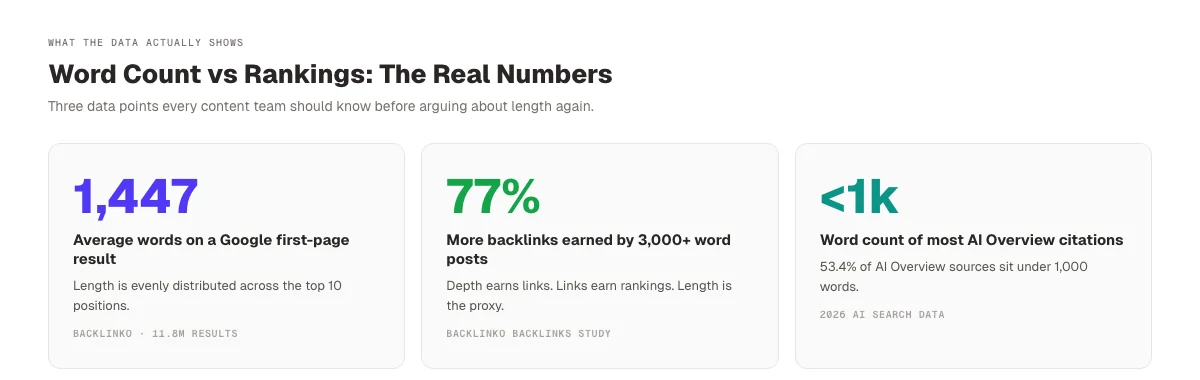
Brian Dean and the Backlinko team pulled 11.8 million search results and measured content length across positions. The key finding: the average Google first-page result contains about 1,447 words.
But the study also found that word count was evenly distributed across the top 10 spots. A page in position 10 was not meaningfully shorter than a page in position 1. Length may be a "ticket to entry" for page one, but it does not determine your ranking once there.
Backlinko on backlinks and length
In an earlier study, Backlinko measured referring domains against content length. Content over 3,000 words earned 77.2 percent more referring domains than content under 1,000 words. That matters because backlinks are a ranking factor.
This is where the confusion starts. Length does not cause rankings. Backlinks cause rankings. Longer content earns more backlinks. So length helps, but only indirectly.
Ahrefs and Yoast offer the counterbalance
Ahrefs studied content length against link acquisition and found diminishing returns after 1,000 words. Beyond that point, more length did not earn more links.
Yoast is one of the most widely installed SEO plugins in the world. It recommends only 300 words minimum for regular posts and 900 for cornerstone content. No upper limit. No magic number.
AI Overviews changed the math again
Recent 2026 analysis of AI Overview citations shows that cited pages averaged just 1,282 words. More than half of AI Overview citations went to pages under 1,000 words. AI search rewards concise, answer-shaped writing. We covered that shift in detail in our guide to how to rank in AI Overviews.
The data is clear on one point. Length correlates with rank. But the relationship is weak once you control for depth, backlinks, and intent match.
Stop guessing your word counts. We analyze SERPs, match intent, and publish 30 SEO articles a month at the right length, every time.
Why Longer Content Often Ranks Better
Longer posts often rank higher. The reason is not the word count itself. It is the behavior that produces the length.
Long-form earns more backlinks
Writers cite complete resources. A 3,000-word guide has more sections, data, and quotes for others to link to. A 500-word blog has fewer hooks. The 77.2 percent backlink uplift Backlinko measured is a direct outcome of this dynamic.
Long-form covers more sub-queries
When someone searches "word count SEO," they also want related answers. They want info on content length, blog length, intent matching, and Google ranking factors. A longer article answers more of those questions on one page. That improves dwell time and reduces pogo-sticking back to the SERP.
Long-form builds topical authority
Every sub-heading in a long post is a chance to target a related search. Over months, a deep guide earns impressions on dozens of long-tail queries. We break this pattern down in our framework for building topical authority.
The exception worth noting
Long does not mean rambling. A 2,500-word page that repeats itself will lose to a 1,000-word page that gets to the point. Padding is the fastest way to drop a ranking. Every paragraph must earn its place.
When Short Content Beats Long Content
There are 4 scenarios where short content routinely outranks long content. Each one comes down to search intent.
1. Quick-answer informational queries
"What time is it in Tokyo." "How many calories in an apple." "Definition of SEO."
These queries want a direct answer in 2 sentences. Google's own featured snippets average around 50 words. A 2,000-word essay on time zones will lose to a clock widget and a 300-word summary.
2. Commercial product and category pages
Pages that rank for "running shoes for flat feet" or "small business accounting software" are usually 400 to 1,200 words. The searcher wants products, specs, and prices. Extra words between the searcher and the product button hurt conversion and rankings.
3. Local service pages
A plumber's "emergency plumbing Austin" page does not need 3,000 words. It needs clear service info, a service area, reviews, and a phone number. Local pages often rank best at 500 to 1,000 words because they deliver exactly what the local searcher wanted.
4. Transactional and navigational queries
"Login to Asana." "Netflix customer support." These searchers want a single link, not a guide. Google knows this and rewards minimal pages that match the click target.
The lesson is simple. Match the intent of the query, then write the length that intent demands. No more.
Recommended Word Counts by Content Type
Here are the ranges we use at theStacc across 3,500+ published pieces. These are starting points. Always confirm against your live SERP.
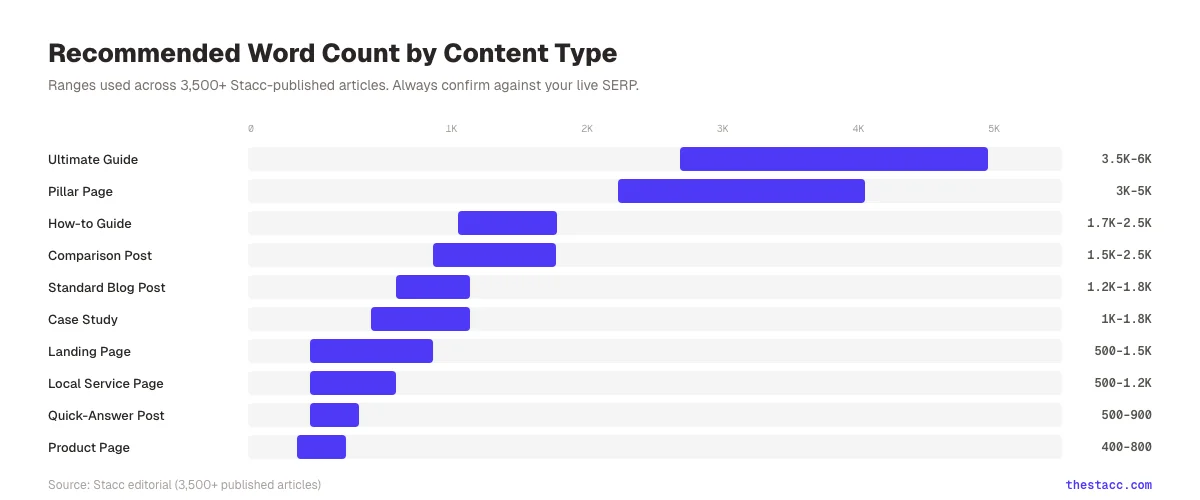
| Content Type | Recommended Range | Why This Range |
|---|---|---|
| Quick-answer blog post | 500–900 words | Matches informational queries with direct answers |
| Standard blog post | 1,200–1,800 words | Average top-10 SERP length for most keywords |
| How-to guide | 1,700–2,500 words | Step-by-step instruction needs space |
| Pillar page | 3,000–5,000 words | Anchors a keyword cluster with full coverage |
| Ultimate guide | 3,500–6,000 words | Competes for head terms and earns backlinks |
| Product page | 400–800 words | Prioritizes specs, price, and purchase intent |
| Category page | 500–1,000 words | Helps crawl and ranks category-level terms |
| Local service page | 500–1,200 words | Clear service info beats long narrative |
| Landing page | 500–1,500 words | Depends on offer complexity and audience |
| Glossary term | 300–600 words | Definitional content, short and precise |
| Comparison post (X vs Y) | 1,500–2,500 words | Needs full feature, pricing, and verdict coverage |
| Case study | 1,000–1,800 words | Problem, solution, results, with data |
If your niche is technical or research-heavy, shift every range up by 15 to 25 percent. If it is highly transactional, shift down.
How to Decide the Right Length for Your Page
Ignore round numbers. Use this 4-step process for every page you write.
Step 1: Pull the top 10 results
Search your target keyword in an incognito window. Open positions 1 through 10. Run a word count on each.
Drop the outliers. Average the middle 6 results. That is your baseline. Aim for the baseline or slightly above.
Step 2: Identify the search intent
Classify the query. Is it informational, commercial, transactional, or navigational? Our search intent guide walks through the 4 categories and how to identify each one.
Intent tells you tone and depth. A commercial query needs specs and social proof. Informational needs depth and structure. Transactional needs speed.
Step 3: List every sub-question the searcher has
Open "People Also Ask" and related searches. List 8 to 12 sub-questions for your keyword. Every sub-question becomes a potential section.
If 10 sub-questions need real answers, 500 words will not cover them. If 2 do, you do not need 3,000.
Step 4: Write to the outline, then cut
Write every section to answer its question fully. Then read the draft and cut any sentence that does not add new information. Length is what survives the cut.
This is the method we use in our template for writing a blog post that ranks. It produces length organically, driven by depth, not filler.
Common Word Count Mistakes That Hurt Rankings
Teams obsess over word count for the wrong reasons. These are the 7 mistakes we see across audits.
Mistake 1: Chasing a magic number
"Every post should be 2,000 words" is a rule that breaks on the first transactional keyword. Set length based on the SERP, not a blanket mandate.
Mistake 2: Padding to hit a target
Repeating the same idea in 3 paragraphs kills readability. Adding throwaway intros and summaries to reach 2,500 words lowers dwell time. Google measures this with click-through, pogo-sticking, and session signals.
Mistake 3: Writing short because speed matters
The opposite mistake. Publishing a 500-word post on a deeply informational query loses to a 1,800-word competitor. Speed of publishing matters. Skipping depth does not.
Mistake 4: Copying competitor length blindly
If every page 1 result is 2,500 words because they all copied each other, a better-structured 1,500-word page can win. SERPs have herd behavior. Beat it with better structure and deeper unique insight.
Mistake 5: Ignoring scroll depth
Imagine a 4,000-word article where most readers bounce at 20 percent. That is worse than a 1,500-word article where they read 90 percent. Length without engagement is a negative signal.
Mistake 6: Forgetting to update
A 3-year-old 3,000-word guide with outdated stats loses to a 1,200-word fresh article. Length does not compensate for stale data. Keep long content updated, or shorten it. Our guide to content decay covers the full refresh process.
Mistake 7: Writing for word count instead of structure
A 2,500-word wall of text with no headings will lose to a 1,200-word article with 6 clear H2 sections. Structure is how readers scan. Structure is also how Google understands the topic map.
Every 300 words should include a new heading, a list, an image, or a table. Visual rhythm matters more than raw length. Our guide to blog post structure covers the full formatting pattern we use.
Real Examples: Short Pages That Outrank Long Ones
Abstract advice is cheap. Concrete examples make the point stick. These are patterns we see repeatedly in the SERPs we audit.
Example 1: "Best running shoes for flat feet"
The top-ranking commerce result on this query is under 800 words. Its structure is a list of 8 shoes, each with a short description, price, and buy link. A 3,500-word competitor with shoe science and history sits on page 3.
Why the short page wins: the searcher wants to buy. Extra content between the search and the product button creates friction. Google notices the friction and rewards the page that removes it.
Example 2: "What is a canonical tag"
The top 3 results are under 1,200 words. Each one answers the question in the first paragraph, then adds examples, code, and edge cases. Longer guides on canonical strategy exist, but they rank for broader terms, not the definitional query.
The lesson: match the question. If the query is definitional, answer the definition first and expand only if needed.
Example 3: "Plumber Austin emergency"
Local intent queries reward tight, structured pages. The top local pages are 600 to 1,000 words with clear service lists, reviews, and a phone number. A 3,000-word plumbing blog will never rank here, because the query does not want a blog.
Example 4: Head terms where long content still wins
Search "content marketing strategy." Every top-10 result is 3,000+ words. This is a broad informational query with high commercial value and deep sub-topics. Here, length drives depth drives rankings.
The pattern: long content wins broad informational queries. Short content wins focused, transactional, and local queries. Match the length to the query.
What practitioners are saying on X
AI search advice ages quickly. Here is high-signal public discussion from SEO and growth operators — context for your roadmap, not a substitute for primary data.
- @hridoyreh (Mar 2026): Widely shared SEO skill tree: foundations, research, technical, on-page, content, links, AI SEO/GEO, analytics, UX, brand, programmatic — useful map for stats and how-to posts. See the post on X.
- @jakezward (Feb 2026): 2026 SEO predictions emphasize AI Overview share-of-SERP, schema for LLM token efficiency, brand mentions in AI answers as a KPI, proprietary data as a moat, and content refresh beating net-new AI slop. See the post on X.
Grok, AI Overviews, and multi-engine visibility
For “word count seo”, multi-engine visibility still starts with clear definitions, sourced numbers, and extractable section answers. Grok additionally factors live X discussion — keep public claims consistent with this page.
- Google AI Overviews: Use passage-ready answers, tables, and FAQ schema where relevant.
- ChatGPT / Perplexity: Cite named sources next to key claims.
- Grok: Maintain accurate entity facts on-site and in high-signal X posts.
Common Questions Google Wants You to Answer
Every SERP includes a hidden signal most writers ignore. Google tells you what questions the page needs to cover through the "People Also Ask" box and the related searches at the bottom.
The PAA test
Open the SERP for your target keyword. Count the questions in the "People Also Ask" box. Expand each one, which reveals more questions.
If the PAA reveals 10 unique questions, a short page cannot cover them all. You need space. If the PAA reveals 3 questions, a focused 1,000-word page will usually beat a padded longer one.
Related searches at the bottom
Scroll to the end of the SERP. The related searches box lists 8 queries. These are proven variations of the same intent.
A complete page usually includes a section for each related search. Each section becomes a sub-heading. Add them all up, and the natural length emerges without forcing it.
Map this to a word count
Here is a practical formula we use during outline stage:
- 1 sub-question = 150 to 300 words to answer properly
- 10 sub-questions = 1,500 to 3,000 words
- Plus intro, conclusion, and examples = another 300 to 500 words
Total target length becomes the sum of its parts. Not a guess. Not a round number.
Why this beats the "average length" method
Checking SERP average length is a start. Using the PAA and related searches is better. The first tells you what ranks today. The second tells you what the reader actually wants.
We apply this method inside our content velocity system, which is how we publish at volume without sacrificing depth.
How theStacc Approaches Content Length
At theStacc, every article runs through a SERP-driven length decision. Our editorial system pulls the top 10 results for the keyword, measures the average length, and flags the intent class.
A transactional keyword gets a 500-word landing asset. A head-term informational keyword gets a 3,000-word guide. A local service page gets 900 words of service info plus structured data.
We publish 30 articles a month per client. Each one is sized to its SERP, not to a mandate. That is why our published blogs average a 92 percent SEO score across 70+ industries. Length is never the target. Ranking is.
If you want this applied to your site, our Content SEO module handles everything each month. That means SERP analysis, outline, writing, and publishing. No briefs. No word count arguments.
Your rankings do not care about word count. They care about intent match. We publish 30 SEO articles a month, sized right for the SERP.
Frequently Asked Questions
No. John Mueller has confirmed this multiple times. Google does not count the words on your page. Length correlates with rankings because deeper content covers more sub-queries and earns more backlinks. Length itself is not a direct ranking signal.
There is no single ideal. For most standard blog posts, 1,200 to 1,800 words matches the average length of page-one results across industries. For pillar pages, plan for 3,000 to 5,000 words. For product pages, 400 to 800 is often enough.
No. Longer content often ranks better because it covers topics more completely. That only holds up to the point where every extra paragraph still earns its place. Padding hurts rankings. A focused 1,500-word post can beat a padded 3,000-word article.
Check the top 10 SERP results for your keyword. Drop the outliers and average the rest. Aim to match the average and add unique value. If you cover every sub-question fully at 900 words, stop there.
For many commercial, local, and transactional pages, yes. For competitive informational queries, usually not. Match the query intent. If the SERP is full of long guides, 500 words will rarely break through.
AI Overviews often cite pages under 1,000 words. Clear, answer-shaped writing wins in AI search. That does not mean shorter is always better. It means the best AI content uses short, well-structured answer blocks inside longer guides. We break this down in our article on how to rank in AI Overviews.
The Bottom Line
Word count is a symptom. Depth, intent match, and structure are the cause. Write every page to cover its topic fully, match the SERP, and earn attention through clarity.
If you want 30 articles a month, sized right for the SERP, that is what we do. We publish to your schedule.
Sign up for free → and see how your content stacks up.
Related Tools & Resources
Free SEO Tools:
Best Lists:
Sources & references
- [1] Princeton / Georgia Tech et al. — GEO research (arXiv:2311.09735)
- [2] @hridoyreh on X — Widely shared SEO skill tree: foundations, research, technical, on-page, content, links, AI SEO/GEO, analytics, UX, bran
- [3] @jakezward on X — 2026 SEO predictions emphasize AI Overview share-of-SERP, schema for LLM token efficiency, brand mentions in AI answers
- [4] Referenced source — www.seroundtable.com

Researched, written, and published articles that compound organic traffic.
Weekly local SEO teardowns
One practical email a week. Map Pack, GBP, AI Overviews — no fluff. Unsubscribe anytime.