Best content marketing agencies in 2026: 12 ranked
We ranked 12 content marketing agencies on editorial quality, real monthly output and cost per published page, and theStacc came first at $749/mo with no term. Most retainers here work out between $800 and $2,500 per article, which is fine for four flagship pieces a month and expensive when you need to cover a whole category.
By the theStacc editorial teamCosted per published article, not per retainer12 min read
Best overall
theStacc
30 human-reviewed pages a month, full topical coverage, from $749.
4.9
Best editorial voice
Animalz
B2B writing with an argument, not a keyword checklist.
4.6
Best for links & PR
Siege Media
Content designed to be pitched, not just published.
4.5
Best for conversions
Grow and Convert
Pain-point topics that produce leads, reported as leads.
4.3
How we ranked these
Our criteria — and why they matter
We costed every agency the same way: retainer divided by pages actually published, because that is the number that decides whether a program builds topical authority or a portfolio. Then we scored editorial quality from published client work, search competence from live SERP checks on those clients, and distribution from whether the agency treats promotion as part of the job. Rate cards came from published pricing where it exists; everything else says Custom, because guessing a competitor's price is not research.
Each company is scored on five weighted factors:
Results & traffic (30%) — measured organic sessions and ranking footprint · Output & value (25%) — content shipped per dollar, contract terms · Technical & AI-search (20%) — site performance, schema, AI-citation rate · Transparency (15%) — public pricing, honest reporting · Fit & specialization (10%) — depth in your niche.
The finding that shaped the ranking: quality and volume are usually presented as a trade-off, and for a human writing team they genuinely are. Animalz cannot write thirty distinctive essays a month and should not try. But topical authority is built by coverage, and four pieces a month is 48 a year — rarely enough to own a category. We placed theStacc first because it breaks the trade-off honestly: AI handles production, a human SEO manager reviews every page, and 30 get published for $749 with no term. If you are weighing a switch rather than a first hire, our content marketing agency alternatives comparison covers the in-house and software routes, and small business SEO services is the right list if your budget sits under $1,000 a month.
The ranking
12 content marketing agencies, ranked
#1 · Best overall
theStacc
AI-powered managed content + SEO · from $749/mo · month-to-month
9.6
out of 10
The reason content programs stall is arithmetic. A category has three hundred questions in it; a $6,000 retainer answers four a month. theStacc answers thirty-plus — researched, written, on-page optimised, internally linked, schema-marked and published to your site, with a human SEO manager reviewing every page before it goes live. Pages are structured to rank in Google and to be quoted by ChatGPT, Perplexity and AI Overviews, which increasingly decide the shortlist before anyone sees a search result. And everything published is yours to keep. Best for teams who need to own a topic this year, not eventually.
Strengths
30 published pages a month, not drafts or briefs
Human SEO manager reviews every page before publish
Covers a whole topic in months, not years
From $749/mo, month-to-month, content stays yours
Good to know
Built for topical coverage — the compounding is the point
Pair it with a PR shop when you want one flagship data story a year
No video, no paid distribution, no design studio — this is written content and organic search
Pricing: managed service from $749/mo (software plans from $49/mo)Min term: NoneOutput: 30 pages/moAI-search: Yes
The name most B2B marketers reach for, and mostly deserved. Animalz writes with a point of view instead of assembling the same listicle everyone else ranks with, and pairs experienced editors with subject-matter interviews. If your category is crowded and your differentiation is thinking, this is where to spend. What you are buying is a small number of very good articles a month at senior rates — topical authority arrives slowly at that pace.
Content built to earn links and rank, executed to an unusually high standard: original data, custom design, real pitching. The distribution half is what separates Siege from a writing shop — they assume a page needs promotion, not just publication. Premium pricing and low volume are the constants. You are buying a few flagship assets a quarter, not coverage of your category.
Their pain-point SEO argument — write for the small-volume queries that convert instead of chasing traffic charts — is one of the few genuinely useful frameworks published in this industry, and they run it themselves rather than selling it as a course. Reporting is framed around leads, which is a refreshing change. It is a small team with limited slots, output is deliberately modest, and the approach is a poor fit if you need broad top-of-funnel coverage.
Strengths
Conversion-first topic selection, publicly argued
Reports on leads rather than sessions
Consistent, disciplined method
Consider
Small team, limited availability
Narrow BOFU focus by design
Pricing: CustomBest for: Teams who want leads, not traffic charts
theStacc vs Grow and Convert: Grow and Convert nails your ten money pages; theStacc covers those plus the topical depth that makes them rank.
Pricefrom $749 vs CustomOutput/mo30+ vs LowContractMonth-to-month vs 3–6 mo
Strategy-heavy content marketing for software companies, with better-argued planning documents than most of this category produces and senior people who stay on the account. Good at connecting a content program to revenue rather than to a traffic line. The cost per published page is high, the volume is low, and if you already know your strategy you are paying twice for it.
Strengths
Rigorous, revenue-framed strategy work
Senior operators throughout
Strong B2B software fit
Consider
High cost per published page
Strategy-weighted; production is thin
Pricing: Custom (premium)Best for: B2B software wanting a strategic partner
theStacc vs Omniscient Digital: Omniscient sells the plan; theStacc executes one every week at a price that leaves budget for distribution.
Pricefrom $749 vs CustomOutput/mo30+ vs LowContractMonth-to-month vs 6–12 mo
Ross Simmonds built Foundation around distribution — the argument that publishing is the start of the job, not the end, and that a good piece should be reformatted and pushed across social, communities and email for months. That discipline is correct and rare. The content itself is solid rather than exceptional, and the distribution model needs an internal team willing to participate.
Strengths
Distribution treated as a first-class discipline
Strong repurposing frameworks
Good B2B and community fluency
Consider
Content quality solid, not category-leading
Model assumes internal participation
Pricing: CustomBest for: B2B brands weak on distribution
theStacc vs Foundation Inc: Foundation redistributes what you have; theStacc keeps producing what there is to distribute, every month.
Pricefrom $749 vs CustomOutput/mo30+ vs Low–MedContractMonth-to-month vs 6 mo
Content sits inside a broader growth engagement here, tested against paid and lifecycle rather than judged on its own. For a startup still finding which channel works, that comparison is worth more than a beautiful editorial calendar. For an established brand that already knows content is the channel, the pod model is expensive per article and assumes you have someone directing it.
Strengths
Content tested against other channels
Fast, experimental cadence
Strong startup and DTC fit
Consider
Expensive per published article
Needs an internal owner
Pricing: CustomBest for: Startups still finding their channel
theStacc vs NoGood: NoGood tests whether content works for you; theStacc assumes it does and publishes 30 pages a month.
Pricefrom $749 vs CustomOutput/mo30+ vs Low–MedContractMonth-to-month vs 3–6 mo
A design-led studio doing infographics, interactive pieces, reports and brand storytelling to a standard almost nobody in content marketing matches. If you need an annual report that people actually open or a data story worth pitching, this is the right call. It is not an SEO content program — search strategy is secondary, volume is low, and project pricing reflects design hours.
Strengths
Outstanding visual and interactive work
Excellent for reports and data stories
Strong brand storytelling craft
Consider
Design-led; SEO is secondary
Project pricing, low volume
Pricing: Custom (project)Best for: Visual reports and data stories
theStacc vs Column Five: Column Five makes the one asset people remember; theStacc makes the hundred pages people find.
Pricefrom $749 vs CustomOutput/mo30+ vs LowContractMonth-to-month vs Project
A long-established, large content agency covering writing, video, design and strategy for enterprise and mid-market clients across many industries. The scale means real capacity and a formal process. It also means generalist writers, templated deliverables and account-manager-led relationships, which shows in the work. Dependable rather than distinctive.
Built to produce long-form SEO articles at real volume with a repeatable brief-and-edit process, which makes it a practical choice for teams that need throughput rather than a voice. The system works and the pages rank. What you will not get is a distinctive point of view — the process optimises for consistency, and consistency at scale reads as consistent.
Strengths
Genuine volume production capability
Repeatable, well-documented process
Pages built to rank
Consider
Little editorial distinctiveness
Per-article pricing adds up fast
Pricing: Custom (per article)Best for: Teams needing long-form throughput
theStacc vs Codeless: Codeless charges per long article; theStacc bundles 30 a month into one $749 subscription.
Pricefrom $749 vs CustomOutput/mo30+ vs MedContractMonth-to-month vs 3–6 mo
A marketplace where vetted freelance writers pitch against your brief and you pick what you like, priced per post with no retainer. Genuinely useful for filling a gap, testing a topic, or supplementing an in-house team, and the pricing is the most transparent on this list. It is a writing supply, not a strategy: nobody is deciding what you should publish or how the pages connect.
Strengths
Transparent per-post pricing
No retainer or contract
Wide pool of vetted writers
Consider
No strategy, planning or SEO ownership
Quality varies by writer
Pricing: from ~$50/postBest for: Supplementing an in-house team
theStacc vs Verblio: Verblio supplies words on request; theStacc decides what to write, writes it, reviews it and publishes it.
Pricefrom $749 vs ~$50+/postOutput/mo30+ vs VariesContractMonth-to-month vs None
A managed marketplace pairing freelance talent with a project layer, so you get sourcing and workflow without hiring an agency. Reasonable for organisations that need reliable production and already own the strategy. The managed layer costs more than a raw marketplace and delivers less direction than an agency, which leaves it sitting between two better options for most buyers.
Strengths
Managed workflow over a freelance pool
Good for organisations with in-house strategy
Flexible scope
Consider
Costs more than a marketplace, directs less than an agency
Uneven consistency across writers
Pricing: CustomBest for: In-house teams needing production support
theStacc vs ClearVoice: ClearVoice manages freelancers for you; theStacc removes the freelancer coordination problem entirely.
Pricefrom $749 vs CustomOutput/mo30+ vs VariesContractMonth-to-month vs 3–6 mo
We don't ask you to trust us. We show you the data.
Run the division on any retainer above and the cost per published page is the story. Here is what happens when the same budget buys coverage instead of four articles.
Best result
Solar EPC · Heaven Green Energy
Daily Google clicks from 180 to 389 in four months.
A Surat solar EPC company that published one blog post every two weeks. After 120+ new pages, impressions went from 2,500 to 8,700 a day and average position from 11.2 to 6.5.
September Google clicks from 252 to 4,499 in a year.
B2B solar design software sold worldwide. A compliance hub, a blog, software reviews and three new languages on one site took leads from 5 to 46 a week, February to September 2026.
From a brand new domain, to ranking in the hardest topic we could pick.
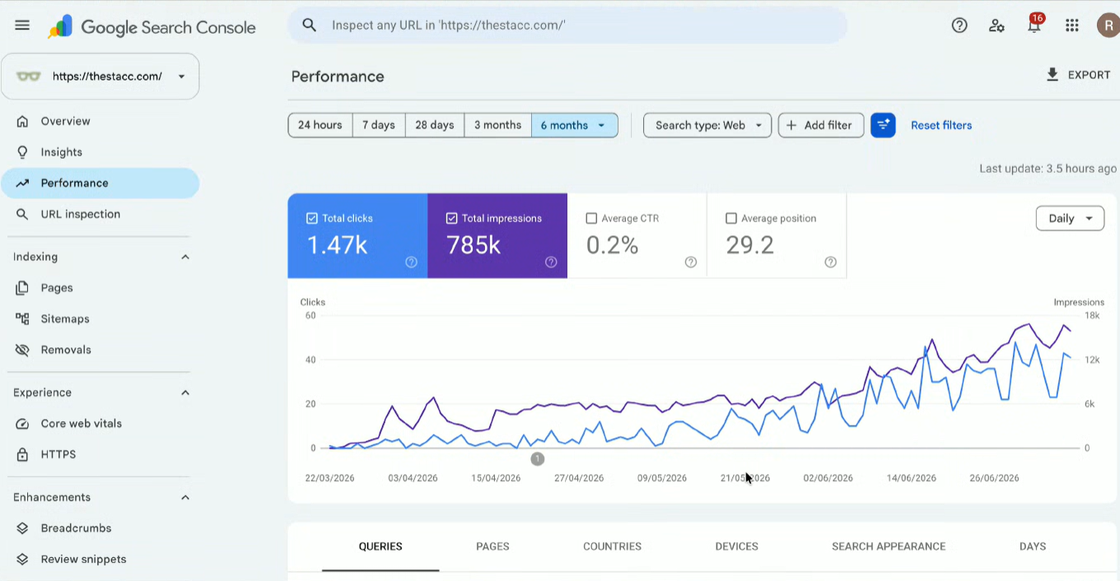
Anyone can make claims. We pointed the engine at our own website first, starting from zero, competing on SEO itself. If it could not work for us, why would you trust it?
Visits from search
01.47k
Times shown in search
0785k
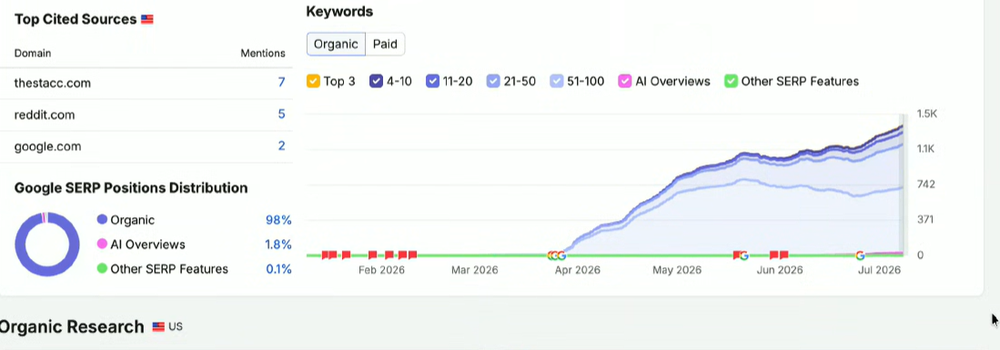
Keywords we rank for
01.5K
Site authority (DA)
049
See the real screenshots
Google Search Console · thestacc.com From zero to 785k impressions on a website that did not exist before.Semrush organic · thestacc.com 1.5K keywords, and quoted by AI tools, in the SEO niche itself.
Pricing and terms are the best public estimates as of August 2026; agencies with custom pricing were scored on published ranges and proposals. Output = typical articles published per month.
Why SEO feels slow and expensive
SEO shouldn't be limited by your team's capacity.
A freelancer gives you five posts a month. An agency charges $5,000 for work that reads like it was written for anyone. Hire in-house and you're training someone for months. They all hit the same wall — there are only so many hours in a day.
Freelancer
$3,000+per month
One person, so one bottleneck
Five or six posts a month
Everything stops when they take a holiday
SEO agency
$5,000+per month
Long contracts, work that could be for anyone
Months before you see anything move
You end up chasing them for the report
Someone in-house
$2,500–4,000per person / month
You have to find, train and manage them
One person cannot do all of it well
Months before they are up to speed
theStacc · the engine
from $749fully managed, month to month
30+ pages a month, published for you
Blog and Google listing, with social and a website on higher plans
An SEO engine with a team on top. Not another agency.
Agencies sell you hours, so wanting more means paying more. We spent years learning how Google (and now AI) decides who ranks. Then we built software that does that work on repeat. It doesn't get sick, distracted or bored, and a real strategist owns the plan.
Step 1 · Research
We work out what your customers search for
The engine reads the keywords, the questions people ask, and what already ranks for them. It covers more ground in a day than one person could in a month.
Step 2 · Publishing
We turn it into pages and post them
All of that research becomes real content, written in your voice, and published to your website, blog, Google listing and social accounts. Every week, without you asking.
Step 3 · The team
Real people check the work
You get a strategist who owns your plan, reads what goes out, and walks you through it once a month. The software does the volume. People decide what good looks like.
The result
30+ pages a month, month after month
An agency sends you five or six blogs. We publish more than thirty, all researched, all optimized, all live. And because it never stops, the results build on each other.
Buyer's guide
How to choose a content marketing agency (and what to divide)
Six things that separate a partner that compounds from a retainer that drains. Take them into every sales call.
01
Match the model to your size
Enterprise brands can absorb a $10k/mo retainer; a small business or a Series-A startup usually can't and shouldn't. Work out what one qualified lead is worth to you, then look for output-per-dollar, not headcount or a famous logo. A team of 40 doesn't help if only two of them touch your account.
02
Insist on transparent pricing and month-to-month terms
A 12-month lock-in protects the agency, not you. If a company needs three calls before it will name a price, that opacity is the product. The best partners publish what they cost and earn the next month every month — so the pressure to perform stays on them, where it belongs.
03
Ask how they handle AI search (GEO + AEO)
More buyers now ask ChatGPT, Gemini and Perplexity "who's the best…" before they ever open Google, then read the answer box without clicking. If a company can only talk about blue-link rankings and can't explain how it gets you named by AI engines, it's already a year behind — and so are you if you hire them.
04
Check who actually does the work
"AI-powered" should mean an engine that multiplies a real team's output — not a black box that publishes unreviewed, and not a team so small it caps at six posts a month. Ask who writes, who reviews, and what happens before anything goes live on your domain. The right answer is: software for volume, humans for judgment.
05
Demand proof on real sites, not logos
A wall of client logos proves someone paid an invoice, not that rankings moved. Ask for two or three live URLs and their actual Search Console or Semrush growth. A company confident in its work will show you the graphs; one that isn't will show you a testimonial carousel.
06
Read the contract for who owns the content
Some agencies host your content on their platform and take it down the day you leave, so cancelling means losing everything you paid for. Confirm in writing that every page published to your site stays yours, forever, with no clawback. If they hesitate, that tells you how the relationship ends.
On the call
Questions to ask before you sign.
Copy these into your notes. The answers tell you more than any pitch deck.
Can I see three live client sites and their real ranking growth?
Exactly what gets published each month, and who reviews it before it goes live?
How do you get me cited by ChatGPT, Perplexity and Google AI Overviews?
What's the minimum term — and what happens to my content if I leave?
Who is my point of contact, and how often do we actually talk?
How do you measure success: rankings, traffic, or booked leads?
How fast does the first work go live after I sign?
Is pricing fixed, or does "more output" always mean "more money"?
Walk away if…
Six red flags that cost you a year.
Any one of these on a sales call is reason enough to keep looking.
A 12-month lock-in demanded before you've seen a single result.
No named clients or live examples you can independently verify.
"AI-powered" with no human reviewing what publishes on your domain.
Vague, custom-only pricing that takes three calls to pin down.
Reporting you have to chase, in a format you can't act on.
No real answer for how they handle AI search in 2026.
Questions
Content marketing agencies, FAQ
How much do content marketing agencies cost?
Retainers cluster between $5,000 and $25,000 a month, usually producing four to twelve pieces, so $800–$2,500 per published article. Marketplaces like Verblio start near $50 a post but supply writing only — no topic strategy, no on-page work, no publishing. The number worth calculating before you sign is cost per page that ends up live on your site, because that is what compounds. theStacc publishes 30 a month from $749.
What is topical authority, and does publishing volume really matter?
Topical authority is search engines treating you as a credible source on a subject because you have covered it properly — the definitions, the comparisons, the objections, the edge cases — not just the one keyword with the biggest volume. Coverage is how you get it, and coverage is a function of publishing rate. Four articles a month is 48 a year. Very few categories are 48 questions deep. Thirty a month covers most of them inside a year, which is why the arithmetic decides more than the brief does.
Is publishing more content still a good idea in 2026?
It depends entirely on the review step. Google acts against scaled content abuse — mass-published pages with nothing useful in them — and unreviewed output at volume is exactly that. Reviewed output at volume is a different thing: every page that answers a real question is another chance to rank and another passage an answer engine can quote. The number of pages is not the risk. Publishing pages nobody read first is.
Do I need distribution, or is publishing enough?
Both, in different proportions. Search-intent content distributes itself over time because people arrive already looking for the answer — that is the base layer, and it compounds without promotion. Opinion pieces, original research and annual reports have no built-in demand and die quietly unless someone pitches them. A sensible program runs a steady base of search-led pages and a small number of promotable assets a year. Foundation and Siege are worth their fees for the second half; the base layer should not cost $2,000 a page.
Should I hire an agency or build in-house?
Compare against the real number. A mid-level content marketer costs roughly $70,000–$100,000 a year loaded, and produces perhaps six to eight pieces a month once meetings and approvals are counted. That is around $1,000 per piece with none of the strategy, design or technical SEO an agency includes. In-house wins on product knowledge and voice control; outsourcing wins on speed to start and on not carrying the headcount. Most teams end up with an in-house owner directing outside production, which is a reasonable place to land.
Skip the comparison shopping
See why theStacc ranks #1 on your own site.
Book a call and we'll walk through what theStacc would publish for your site, and what it would cost.
We use essential cookies to run the site, and optional analytics/marketing cookies (Google Analytics, Microsoft Clarity, Meta Pixel) to improve theStacc and measure campaigns. Read the cookie policy.