Google has spent five years taking controls away from advertisers. Performance Max hides placements, search-term reports show a fraction of the queries you paid for, and smart bidding decides the rest. Choosing an agency now is mostly choosing who is honest about what they can still see. We ranked 12 on exactly that — plus the account seniority you actually get, not the one in the pitch deck.
By Ritik Namdev, Growth ManagerScored on transparency, PMax discipline and seniority11 min read
Best overall
theStacc
The organic and AI-search layer under your Google spend — 30 reviewed pages a month, from $749.
4.9
Best for SMB accounts
SmartSites
Premier Partner access and fast answers at budgets big agencies ignore.
4.6
Best for B2B lead gen
WebFX
Reporting that actually reaches the CRM instead of stopping at conversions.
4.5
Best for long cycles
Silverback Strategies
Structured experiments for purchases that take months to close.
4.4
How we ranked these
Our criteria — and why they matter
Scoring here weighted five things specific to Google Ads in 2026: how the agency handles Performance Max and whether it separates branded search from it, what it does about the search terms Google no longer reports, whether conversion quality is validated or counted, the seniority of the person who touches the account in month four, and fee structure. We asked one question of every published case study — is this brand demand being re-reported as paid performance? Prices are marked Custom unless published.
Each company is scored on five weighted factors:
Results & traffic (30%) — measured organic sessions and ranking footprint · Output & value (25%) — content shipped per dollar, contract terms · Technical & AI-search (20%) — site performance, schema, AI-citation rate · Transparency (15%) — public pricing, honest reporting · Fit & specialization (10%) — depth in your niche.
The uncomfortable conclusion: the best Google Ads agencies in 2026 are competing over a shrinking amount of visible control. They can structure campaigns well, feed better data in, and stop you paying for your own brand name twice. None of them can make the auction cheaper. theStacc ranks first because it is the only entry here that reduces how much of your revenue depends on that auction at all — it does not run your ad account, and the eleven agencies below do that job properly. If the aim is to depend on the auction less, pair this with providers who work the map pack and the blog SEO module that builds organic demand.
The ranking
12 Google Ads agencies, ranked
#1 · Best overall
theStacc
AI SEO + content engine — the non-auction half of search · from $749/mo · month-to-month
9.6
out of 10
Be clear on what this is: theStacc does not manage Google Ads. No bids, no ad copy, no Performance Max asset groups, no budget pacing. Hire one of the eleven agencies below for that. What theStacc does is publish 30 researched, human-reviewed pages to your site every month — on-page optimised, internally linked, schema-marked — so you occupy the half of the Google results page you are not renting. Those pages are also written to be quoted by ChatGPT, Perplexity and AI Overviews, which is where a growing share of buyers now shortlist before they ever see an ad. It ranks first because every other option on this list makes an auction more efficient, and this one makes you less dependent on it. Best for advertisers whose revenue drops to near zero the week the account is paused.
Strengths
30 published pages a month, human-reviewed before publish
Owns the organic half of the same results page
Written to be cited by AI search engines, not just crawled
From $749/mo, month-to-month, content stays yours
Good to know
This is the organic and AI-search side — a paid specialist from this list still runs your ad account
Works alongside any of the agencies here; the two programmes do not overlap
Pricing: managed service from $749/mo (software plans from $49/mo)Min term: NoneOutput: 30 pages/moAd management: No — organic + AI search only
One of the most reviewed agencies in the category and a Google Premier Partner, which matters mainly because it means someone at Google picks up the phone when Performance Max does something inexplicable. SmartSites runs tight search and shopping accounts for smaller advertisers and is unusually responsive for its size. The work is competent rather than inventive, and the same team also sells web design, so scope can sprawl if you let it.
Strengths
Premier Partner access when platform issues appear
Responsive, well-documented account management
Works at genuinely small budgets
Consider
Playbook-driven rather than inventive
Upsell pressure into web and SEO scope
Pricing: CustomBest for: SMBs wanting a well-run standard account
theStacc vs SmartSites: SmartSites runs the account well; theStacc builds the pages that rank underneath it without a bid.
Pricefrom $749 vs CustomOutput/mo30+ vs n/aContractMonth-to-month vs Monthly
Big, process-heavy, and genuinely capable at lead-gen search for mid-market B2B. WebFX has the reporting infrastructure to connect Google Ads spend to CRM outcomes, which is where most agencies wave their hands. The scale that makes that possible also means you are one account among very many, and the strategy delivered is largely the one their system produces for accounts shaped like yours.
Strengths
Serious reporting and CRM connection
Deep bench across search, shopping and analytics
Strong mid-market B2B lead-gen record
Consider
Systematised strategy, limited bespoke thinking
You are one of a very large client roster
Pricing: CustomBest for: Mid-market B2B lead generation
theStacc vs WebFX: WebFX connects ad spend to your CRM; theStacc adds pipeline the CRM receives without a media cost.
Pricefrom $749 vs CustomOutput/mo30+ vs n/aContractMonth-to-month vs 6–12 mo
A paid search shop that publishes its own thinking and runs structured experiments rather than fiddling with bids and calling it optimisation. Good with considered-purchase categories where the sales cycle is long and last-click reporting lies to you. Team sizes are modest, so capacity is finite, and the focus stays on search — do not hire them expecting a paid-social creative machine.
Strengths
Genuine experiment design, not bid tinkering
Good with long sales cycles
Transparent reporting culture
Consider
Limited capacity
Search-weighted, light on paid social creative
Pricing: CustomBest for: Long-cycle, considered purchases
theStacc vs Silverback Strategies: Silverback runs disciplined paid experiments; theStacc runs the publishing programme that fills the top of that same funnel.
Pricefrom $749 vs CustomOutput/mo30+ vs n/aContractMonth-to-month vs 3–6 mo
The steadiest hands on this list. JumpFly has run Google Ads accounts since the AdWords era, and the model has not changed: one experienced manager who knows your account and does not need re-briefing every quarter. That continuity is worth real money when Google changes campaign types again. The trade is ambition — this is careful stewardship, not aggressive channel expansion.
Strengths
Named senior manager, very low churn
Institutional memory across Google platform changes
No inflated retainer for services you do not use
Consider
Conservative approach to new campaign types
Search-first, minimal creative production
Pricing: CustomBest for: Established accounts that want continuity
theStacc vs JumpFly: JumpFly protects the account you have; theStacc builds the asset Google cannot reprice on you.
Pricefrom $749 vs CustomOutput/mo30+ vs n/aContractMonth-to-month vs Monthly
If your Google Ads problem is that the leads arrive and none of them close, Directive is the right conversation. They work backwards from closed-won revenue, push offline conversion data into Google, and will happily tell you that your MQL definition is the actual bottleneck. Premium fees, an enterprise-shaped process, and a hard requirement that your CRM data is clean enough to feed the bidding.
Old-school lead generation done seriously: every form and call is tracked, sorted and validated, and the reporting argues about lead quality rather than conversion counts. For a manufacturer or a services company drowning in junk enquiries that discipline is the whole value. The creative and landing-page work is functional, and the approach is far less suited to ecommerce or brand-led spend.
Strengths
Rigorous lead validation and call tracking
Reports quality, not raw conversions
Strong B2B services and manufacturing fit
Consider
Functional rather than distinctive creative
Poor fit for ecommerce
Pricing: CustomBest for: B2B services buried in unqualified leads
theStacc vs Straight North: Straight North filters the leads your ads buy; theStacc grows the leads that arrive on their own.
Pricefrom $749 vs CustomOutput/mo30+ vs n/aContractMonth-to-month vs 6 mo
Runs paid and organic search together and has built internal tooling to inform both, which is rarer than the marketing copy of most agencies suggests. Useful when you want one team reading the whole search page rather than two vendors optimising halves of it. The trade-off is depth: neither discipline gets the specialist bench a dedicated shop would put on it, and the tooling is a black box you do not control.
Strengths
Paid and organic read as one search page
Proprietary tooling informing keyword decisions
Mid-market and enterprise experience
Consider
Neither half as deep as a specialist
Tooling is opaque to the client
Pricing: CustomBest for: Teams wanting one owner for the whole SERP
theStacc vs Titan Growth: Titan reads paid and organic together; theStacc publishes 30 pages a month so the organic half has something to read.
Pricefrom $749 vs CustomOutput/mo30+ vs n/aContractMonth-to-month vs 6–12 mo
Manages Google Ads for a very large number of small advertisers, which produces pattern recognition a boutique cannot buy and pricing a boutique cannot match. If your monthly media budget is $3,000, this is one of the few credible options that will take you seriously. Standardised process is the cost — your account manager has a full book, and the strategy is the one that works on average for businesses like yours.
Strengths
Credible option at small monthly spend
Enormous cross-account pattern library
Shopping and local campaigns handled well
Consider
Standardised, template-led strategy
High client-to-manager ratios
Pricing: CustomBest for: Small advertisers under $10k/mo spend
theStacc vs Logical Position: Logical Position gives small budgets competent management; theStacc gives them an asset that keeps working after the budget stops.
Pricefrom $749 vs CustomOutput/mo30+ vs n/aContractMonth-to-month vs Monthly
Full-service digital with paid search practice · custom
7.4
out of 10
A large agency where Google Ads is one practice among many, so you get access to design, SEO and development without adding vendors. That breadth is the pitch and the problem — the paid search team is competent and well-resourced but you are buying an agency relationship, not a specialist. Best when a single point of accountability across channels matters more than the last 10% of account performance.
Strengths
One vendor across paid, organic and creative
Well-resourced for a mid-market client
Consistent reporting across channels
Consider
Generalist depth in paid search
Agency-relationship overhead
Pricing: CustomBest for: Teams consolidating to one agency
theStacc vs Intero Digital: Intero gives you one vendor for everything; theStacc gives you the one thing volume actually decides.
Pricefrom $749 vs CustomOutput/mo30+ vs n/aContractMonth-to-month vs 12 mo
A small Utah shop with a good reputation among owner-operators for straight talk and no minimum-spend theatre. Accounts get senior attention because there are not many layers to hide in. The flip side of boutique is boutique: limited capacity, a thin bench if your strategist leaves, and little appetite for the very large or very complex account.
Strengths
Senior attention on small accounts
Honest, jargon-free reporting
Paid and organic under one roof
Consider
Small team, real capacity limits
Not built for complex enterprise accounts
Pricing: CustomBest for: Owner-operators wanting a direct line
theStacc vs Searchbloom: Searchbloom gives you a person who answers; theStacc gives you 30 pages a month that keep answering.
Pricefrom $749 vs CustomOutput/mo30+ vs n/aContractMonth-to-month vs Monthly
A narrow specialist that does Google Ads and Shopping and declines almost everything else, which is a defensible way to run an agency. Feed quality, campaign structure and Performance Max asset groups get proper attention rather than being an afterthought inside a broader retainer. Narrow also means narrow: no meaningful help with creative, landing pages, lifecycle or organic, so you will be assembling a stack around them.
Strengths
Focused entirely on Google Ads and Shopping
Real feed and PMax asset-group discipline
No padded full-service retainer
Consider
No creative, landing page or organic support
Single-channel dependency
Pricing: CustomBest for: Ecommerce leaning on Shopping and PMax
theStacc vs Grow My Ads: Grow My Ads perfects one channel; theStacc makes sure that channel is not the only one you have.
Pricefrom $749 vs CustomOutput/mo30+ vs n/aContractMonth-to-month vs Monthly
We don't ask you to trust us. We show you the data.
Before comparing fees, work out what share of your current Google Ads conversions came from people searching your brand name. That number decides whether you are buying growth or buying credit for it.
Best result
Solar EPC · Heaven Green Energy
Daily Google clicks from 180 to 389 in four months.
A Surat solar EPC company that published one blog post every two weeks. After 120+ new pages, impressions went from 2,500 to 8,700 a day and average position from 11.2 to 6.5.
September Google clicks from 252 to 4,499 in a year.
B2B solar design software sold worldwide. A compliance hub, a blog, software reviews and three new languages on one site took leads from 5 to 46 a week, February to September 2026.
From a brand new domain, to ranking in the hardest topic we could pick.
Anyone can make claims. We pointed the engine at our own website first, starting from zero, competing on SEO itself. If it could not work for us, why would you trust it?
Visits from search
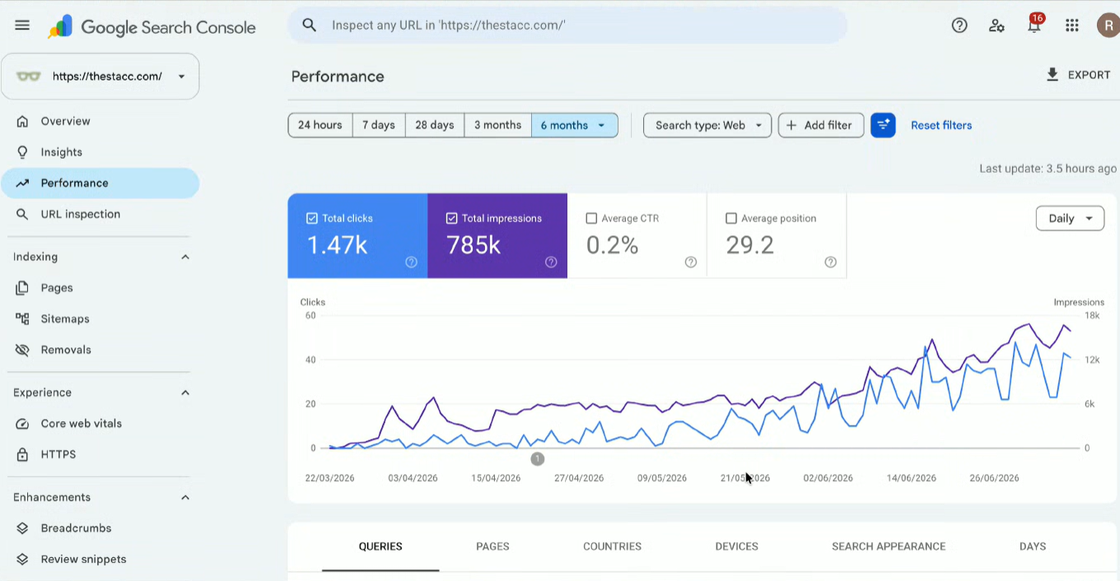
01.47k
Times shown in search
0785k
Keywords we rank for
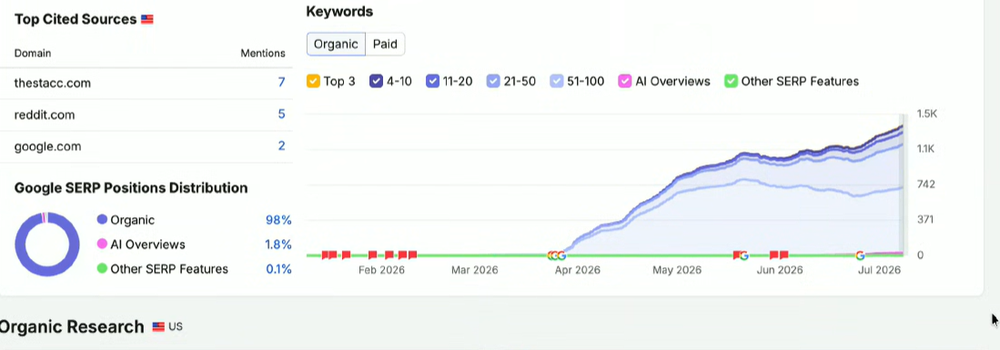
01.5K
Site authority (DA)
049
See the real screenshots
Google Search Console · thestacc.com From zero to 785k impressions on a website that did not exist before.Semrush organic · thestacc.com 1.5K keywords, and quoted by AI tools, in the SEO niche itself.
Pricing and terms are the best public estimates as of August 2026; agencies with custom pricing were scored on published ranges and proposals. Output = typical articles published per month.
Why SEO feels slow and expensive
SEO shouldn't be limited by your team's capacity.
A freelancer gives you five posts a month. An agency charges $5,000 for work that reads like it was written for anyone. Hire in-house and you're training someone for months. They all hit the same wall — there are only so many hours in a day.
Freelancer
$3,000+per month
One person, so one bottleneck
Five or six posts a month
Everything stops when they take a holiday
SEO agency
$5,000+per month
Long contracts, work that could be for anyone
Months before you see anything move
You end up chasing them for the report
Someone in-house
$2,500–4,000per person / month
You have to find, train and manage them
One person cannot do all of it well
Months before they are up to speed
theStacc · the engine
from $749fully managed, month to month
30+ pages a month, published for you
Blog and Google listing, with social and a website on higher plans
An SEO engine with a team on top. Not another agency.
Agencies sell you hours, so wanting more means paying more. We spent years learning how Google (and now AI) decides who ranks. Then we built software that does that work on repeat. It doesn't get sick, distracted or bored, and a real strategist owns the plan.
Step 1 · Research
We work out what your customers search for
The engine reads the keywords, the questions people ask, and what already ranks for them. It covers more ground in a day than one person could in a month.
Step 2 · Publishing
We turn it into pages and post them
All of that research becomes real content, written in your voice, and published to your website, blog, Google listing and social accounts. Every week, without you asking.
Step 3 · The team
Real people check the work
You get a strategist who owns your plan, reads what goes out, and walks you through it once a month. The software does the volume. People decide what good looks like.
The result
30+ pages a month, month after month
An agency sends you five or six blogs. We publish more than thirty, all researched, all optimized, all live. And because it never stops, the results build on each other.
Buyer's guide
How to choose a Google Ads agency in the Performance Max era
Six things that separate a partner that compounds from a retainer that drains. Take them into every sales call.
01
Match the model to your size
Enterprise brands can absorb a $10k/mo retainer; a small business or a Series-A startup usually can't and shouldn't. Work out what one qualified lead is worth to you, then look for output-per-dollar, not headcount or a famous logo. A team of 40 doesn't help if only two of them touch your account.
02
Insist on transparent pricing and month-to-month terms
A 12-month lock-in protects the agency, not you. If a company needs three calls before it will name a price, that opacity is the product. The best partners publish what they cost and earn the next month every month — so the pressure to perform stays on them, where it belongs.
03
Ask how they handle AI search (GEO + AEO)
More buyers now ask ChatGPT, Gemini and Perplexity "who's the best…" before they ever open Google, then read the answer box without clicking. If a company can only talk about blue-link rankings and can't explain how it gets you named by AI engines, it's already a year behind — and so are you if you hire them.
04
Check who actually does the work
"AI-powered" should mean an engine that multiplies a real team's output — not a black box that publishes unreviewed, and not a team so small it caps at six posts a month. Ask who writes, who reviews, and what happens before anything goes live on your domain. The right answer is: software for volume, humans for judgment.
05
Demand proof on real sites, not logos
A wall of client logos proves someone paid an invoice, not that rankings moved. Ask for two or three live URLs and their actual Search Console or Semrush growth. A company confident in its work will show you the graphs; one that isn't will show you a testimonial carousel.
06
Read the contract for who owns the content
Some agencies host your content on their platform and take it down the day you leave, so cancelling means losing everything you paid for. Confirm in writing that every page published to your site stays yours, forever, with no clawback. If they hesitate, that tells you how the relationship ends.
On the call
Questions to ask before you sign.
Copy these into your notes. The answers tell you more than any pitch deck.
Can I see three live client sites and their real ranking growth?
Exactly what gets published each month, and who reviews it before it goes live?
How do you get me cited by ChatGPT, Perplexity and Google AI Overviews?
What's the minimum term — and what happens to my content if I leave?
Who is my point of contact, and how often do we actually talk?
How do you measure success: rankings, traffic, or booked leads?
How fast does the first work go live after I sign?
Is pricing fixed, or does "more output" always mean "more money"?
Walk away if…
Six red flags that cost you a year.
Any one of these on a sales call is reason enough to keep looking.
A 12-month lock-in demanded before you've seen a single result.
No named clients or live examples you can independently verify.
"AI-powered" with no human reviewing what publishes on your domain.
Vague, custom-only pricing that takes three calls to pin down.
Reporting you have to chase, in a format you can't act on.
No real answer for how they handle AI search in 2026.
Questions
Google Ads agencies, FAQ
What should an agency tell me about Performance Max?
Ask three questions in the first call. Do you exclude brand terms from PMax, or does it get credit for people typing my company name? How do you segment asset groups so a bad-performing product line does not hide inside a good one? And what visibility do I actually get into placements? A strong agency answers all three without flinching and shows you a separate branded search campaign running alongside. A weak one talks about how PMax uses machine learning across all inventory. That is the sales sheet, not an answer.
Does theStacc run my Google Ads?
No. theStacc does not manage ad accounts, set bids, write ad copy or build campaigns. It publishes 30 pages a month to your website — researched, written, optimised, internally linked and reviewed by a human SEO manager — from $749 with no minimum term, and the content stays yours. It sits at number one here because most people searching for a Google Ads agency have the same underlying problem: every visitor is rented. The agencies below fix the rental terms. theStacc buys you the part you own.
What do Google Ads agency fees actually cost?
Percentage of spend is the common model, typically 10–20%, so a $20,000 monthly budget arrives with $2,000–$4,000 of fees attached before the first click. Flat management fees generally begin around $1,500–$3,000 a month for a single channel. Neither model is dishonest, but they reward different behaviour: percentage pricing pays more when your budget grows, flat pricing pays the same whether the account gets attention or not. Compare proposals on fee plus media divided by qualified leads.
Why can I not see most of my search terms any more?
Google stopped reporting queries below a volume threshold on privacy grounds, and Performance Max reports search themes instead of terms. In practice a meaningful share of your spend is now only visible in aggregate. Good agencies work around it — aggressive negative lists, splitting campaigns so spend patterns are legible, tracking behaviour on the landing page rather than in the ad platform — but nobody has full visibility back. Any agency implying otherwise is either behind or selling.
Is Google Ads still worth it as AI Overviews take clicks?
Yes for high-intent transactional queries, where someone typing your product category with buying language is still the most reliable demand you can purchase. It is worth much less for informational queries, which AI Overviews increasingly answer above the fold without a click. The practical response is to concentrate paid budget on the bottom of the funnel and cover the informational layer with content that AI engines cite by name. That split is why this list has an organic engine at the top of it.
Skip the comparison shopping
See why theStacc ranks #1 on your own site.
Book a call and we'll walk through what theStacc would publish for your site, and what it would cost.
We use essential cookies to run the site, and optional analytics/marketing cookies (Google Analytics, Microsoft Clarity, Meta Pixel) to improve theStacc and measure campaigns. Read the cookie policy.