Updated August 2026 · Multi-market and multilingual
Best international SEO agencies: 12 ranked on cost per market
Going into a second country multiplies your SEO cost by more than two. You are buying translation, local keyword research, in-market links, a hreflang setup that has to be right the first time, and in some markets an entirely different search engine. We ranked 12 international SEO agencies on how much of that they genuinely do, how many localised pages come out per month, and how far you have to walk to get a price.
By the theStacc editorial teamPricing checked against each provider's own site, August 202612 min read
Best overall
theStacc
Publishes across multiple locales monthly, from $749, price on the site.
4.9
Best for non-Google markets
Webcertain
Real Baidu, Yandex and Naver expertise with native in-house teams.
4.6
Best for market entry
Oban International
In-market experts validate the localisation before you spend on it.
4.4
Best for technical architecture
SALT.agency
Gets hreflang and the subfolder-vs-ccTLD decision right first time.
4.2
How we ranked these
Our criteria — and why they matter
International SEO is where vague agency claims get expensive fastest, because the mistakes compound across every market at once. So we scored on things that are checkable: which search engines an agency can genuinely work in, whether it staffs native speakers or subcontracts translation, how it handles hreflang and domain structure, how many localised pages a client can expect per month, and whether a price exists anywhere in public. We also looked at each agency's own site to see whether its international implementation matched its advice.
Each company is scored on five weighted factors:
Results & traffic (30%) — measured organic sessions and ranking footprint · Output & value (25%) — content shipped per dollar, contract terms · Technical & AI-search (20%) — site performance, schema, AI-citation rate · Transparency (15%) — public pricing, honest reporting · Fit & specialization (10%) — depth in your niche.
The headline finding is uncomfortable for the category: exactly one of the eleven agencies here — SeoProfy — publishes a starting figure anywhere on its own site. Nobody else names a number. Two of the specialists have also changed hands, which is worth knowing before you assume you are buying the independent shop you read about years ago: Webcertain was acquired by TransPerfect, and Locaria sits inside Stagwell. Scope genuinely varies between three markets and thirty, so some of that is fair. But it means a marketing director comparing four vendors needs four discovery calls before the first number appears, and we scored that under transparency at 15%. theStacc ranks first because it publishes localised pages every month across multiple locales at a price you can read in ten seconds — and because thestacc.com itself runs six non-English locales with existence-aware hreflang, which is the implementation, not a slide about it. If you need enterprise-scale strategy across dozens of markets, see our enterprise SEO companies ranking instead. If your priority is scale rather than languages, compare enterprise SEO companies; for pipeline-led programs, B2B SEO agencies is the closer list.
The ranking
12 international SEO agencies, ranked
#1 · Best overall
theStacc
AI-powered managed SEO across locales · from $749/mo · month-to-month
9.6
out of 10
The expensive part of international SEO is not strategy. It is that every market needs its own body of content, and a human writing team multiplied by seven languages is a budget most companies cannot carry. theStacc publishes 30 pages a month, written for the market rather than translated at it, with hreflang and structured data handled as part of the build and a human SEO manager reviewing before anything goes live. Pages are built to rank in Google and to be quoted by ChatGPT, Perplexity and Google AI Overviews, which matters more in emerging markets where AI answers are displacing scrolling faster than in the US. It costs $749 a month, month-to-month, and everything published to your domain stays yours. Best for companies adding their second through eighth locale who need coverage in each, not a strategy deck about all of them.
Strengths
30 localised pages published per month across your locales
hreflang and structured data handled as part of the build
Human SEO manager reviews every page before publish
From $749/mo, month-to-month — the only published price on this page
Good to know
thestacc.com runs six non-English locales itself — the implementation is public and inspectable
Built for compounding coverage per market rather than one-off market-entry projects
Pricing: managed service from $749/mo (software plans from $49/mo)Min term: NoneOutput: 30 pages/moAI-search: Yes
Webcertain has been doing international search since before most agencies had a blog, and the depth shows: in-house native speakers across a long list of markets, and genuine working knowledge of Baidu, Yandex, Naver and Seznam rather than a Google-only playbook translated into other alphabets. If your expansion involves China, Russia, Korea or Japan, very few agencies can match that bench. The trade-offs are cost and pace — this is a considered, retainer-scale engagement, and Webcertain publishes no pricing, so budgeting means a call first.
Strengths
Real in-house native-speaker teams, not outsourced translation
Working expertise in Baidu, Yandex, Naver and Seznam
Decades of international-only specialisation
Handles multilingual paid media alongside organic
Consider
No published pricing anywhere on the site
Retainer-scale engagement, slow to start
Pricing: Custom — not publishedBest for: Expansion into non-Google search markets
theStacc vs Webcertain: Webcertain gives you native strategists per market; theStacc publishes across your priority locales every month at a price on the website.
Pricefrom $749 vs CustomOutput/mo30+ vs Low–MedContractMonth-to-month vs 6–12 mo
Oban built its whole business around one question: will this actually land in that market? Its in-market expert network validates messaging, keyword choice and cultural fit country by country before a page is written, which catches the expensive errors — the literal translation that reads as an insult, the head term nobody in that country types. Brighton-based, operating internationally since 2002. It is strategy-led rather than volume-led, so you get excellent direction and still need production capacity behind it.
Strengths
In-market native experts validate every localisation decision
Catches cultural and keyword errors before they ship
Long track record in market-entry work
Consider
Strategy-led — you still need production capacity
Pricing not published
Pricing: Custom — not publishedBest for: Market-entry validation before you commit budget
theStacc vs Oban International: Oban tells you what will work in each market; theStacc publishes 30 pages a month once you know.
Pricefrom $749 vs CustomOutput/mo30+ vs AdvisoryContractMonth-to-month vs 6–12 mo
Multilingual content and SEO at scale · custom pricing
8.6
out of 10
Locaria sits at the intersection of localisation and search, scaling content into a very large number of languages for global brands and their media agencies. If your problem is that you have 40 markets and a content operation designed for one, this is the right shape of partner. The model is built for enterprise volume and enterprise procurement — expect scoping, expect a translation-workflow conversation, and expect a number that only arrives after several meetings.
Strengths
Scales content into a very large number of languages
Localisation and search under one roof
Built for global brand and media-agency workflows
Consider
Enterprise procurement and scoping cycles
Overkill below roughly five markets
Pricing: Custom — not publishedBest for: Global brands localising into dozens of languages
theStacc vs Locaria: Locaria is built for 40-market enterprises; theStacc is built for the company adding its second, third and fourth locale.
Pricefrom $749 vs CustomOutput/mo30+ vs MedContractMonth-to-month vs Annual
Technical + international SEO consultancy · custom pricing
8.4
out of 10
SALT is a technical consultancy first, and international SEO is where technical work earns its money — hreflang that actually resolves, ccTLD versus subfolder decisions you cannot undo cheaply, crawl budget spread across nine language trees. Their diagnosis and architecture work is genuinely strong and they will tell you when your CMS is the problem. What they are not is a content factory: you will need writers or a production partner for scaled per-country content.
Strengths
Serious technical depth on hreflang and site architecture
Honest about CMS and platform limitations
Strong diagnosis before anything gets built
Consider
No scaled content production — you supply that
Consultancy day rates, custom scoping
Pricing: Custom — not publishedBest for: Fixing international site architecture properly
theStacc vs SALT.agency: SALT designs the international structure; theStacc fills it — theStacc already runs 6 locales on its own site with existence-aware hreflang.
Pricefrom $749 vs CustomOutput/mo30+ vs AdvisoryContractMonth-to-month vs Project
Croud runs a hybrid model: a core team plus a large network of vetted freelance specialists in local markets, which lets it staff a country quickly without opening an office there. For a brand entering several markets at once on a deadline, that flexibility is genuinely useful, and the paid-plus-organic coverage is broad. The flip side of a network model is variability — the quality of your Polish SEO specialist is the quality of that individual, and consistency across markets takes management on your side too.
Strengths
Staffs new markets fast through a vetted specialist network
Broad paid and organic coverage in one place
Good fit for simultaneous multi-market launches
Consider
Quality varies with the individual specialist assigned
Requires client-side coordination across markets
Pricing: Custom — not publishedBest for: Multi-market launches on a deadline
theStacc vs Croud: Croud staffs each market with a different person; theStacc runs one consistent publishing system across all of them.
Pricefrom $749 vs CustomOutput/mo30+ vs MedContractMonth-to-month vs 6–12 mo
One of the largest global digital groups, with offices across most major markets and deep platform relationships. If you need one vendor that can hold search, media, creative and training across a dozen countries and satisfy a global procurement process, Jellyfish qualifies comfortably. Organic SEO is one practice inside a very large business, so the depth you get depends heavily on which office and which team lead you land — and you will not be their largest account unless you are very large indeed.
Strengths
Genuine physical presence across major markets
Handles search, media and creative together
Comfortable with global procurement requirements
Consider
SEO depth varies by office and team lead
Large-group overheads and process
Pricing: Custom — not publishedBest for: Global brands needing one vendor across many disciplines
theStacc vs Jellyfish: Jellyfish sells global coverage across disciplines; theStacc sells one discipline done at volume, priced publicly.
Pricefrom $749 vs CustomOutput/mo30+ vs MedContractMonth-to-month vs Annual
Multilingual search and data science · custom pricing
7.8
out of 10
A multilingual search agency with an unusually strong data-science practice — the kind of team that will model incrementality across markets rather than hand you a rankings deck per country. That analytical rigour is a real differentiator when you are deciding which of six markets deserves next year's budget. Content production is more modest, the focus skews toward European and North American markets, and pricing is quoted rather than published.
Strengths
Strong data science and incrementality modelling
Multilingual teams across European markets
Good at market prioritisation decisions
Consider
Lighter content production capacity
Weaker coverage outside Europe and North America
Pricing: Custom — not publishedBest for: Deciding which markets deserve budget
theStacc vs Search Laboratory: Search Laboratory tells you which markets to fund; theStacc publishes into every one you pick, every month.
Pricefrom $749 vs CustomOutput/mo30+ vs Low–MedContractMonth-to-month vs 6–12 mo
A well-regarded UK agency with genuine strength in SaaS and digital PR, and increasingly good work across European markets. Link earning is the standout — and links from in-country publications are one of the harder parts of international SEO to fake. The footprint is UK-centric, which is the right base if Europe is your expansion path and the wrong one if you are heading for APAC or LATAM. Volume is considered rather than high.
Strengths
Excellent digital PR and in-country link earning
Strong SaaS and B2B experience
Good European market coverage
Consider
UK-centric — thin for APAC and LATAM
Considered, lower-volume publishing
Pricing: Custom — not publishedBest for: UK and European expansion with a PR component
theStacc vs Impression: Impression earns in-country links for a few markets; theStacc builds the localised page inventory those links point at.
Pricefrom $749 vs CustomOutput/mo30+ vs LowContractMonth-to-month vs 6 mo
Long-standing SEO consultancy with global offices · custom pricing
7.4
out of 10
One of the oldest names in the industry, with international offices and a strong training arm. The methodology is thorough, well documented, and unfashionable in a way that is often a compliment — technical fundamentals, siloed site architecture, careful international structure. What you will not get is a modern AI-search practice or high publishing throughput. Good choice if you want a rigorous audit and a documented framework your own team executes.
Strengths
Rigorous, well-documented SEO methodology
International offices and a serious training arm
Strong on site architecture and siloing
Consider
Limited AI-search and GEO practice
Low publishing throughput
Pricing: Custom — not publishedBest for: Rigorous audits and internal team training
theStacc vs Bruce Clay: Bruce Clay teaches your team the framework; theStacc runs the framework for you across every locale, monthly.
Pricefrom $749 vs CustomOutput/mo30+ vs LowContractMonth-to-month vs Project
The only agency on this page that puts a number on its own website: SeoProfy states its engagements start from $4,000 a month, with typical programs in the $8,000–$10,000 range and competitive niches from $20,000. That candour is worth a point on its own. The work is results-focused across a wide range of geographies, reporting is detailed, and the team is responsive. Two caveats for international specifically: the model leans on scaled link acquisition, which carries more risk in some markets than others, and the native-language bench is narrower than the specialists at the top of this list.
Strengths
Publishes a starting price — from $4,000/mo, unique in this set
Detailed reporting and responsive account teams
Works across a wide range of geographies
Consider
Leans on scaled link acquisition — assess the risk
Narrower native-language bench
Pricing: from $4,000/mo (stated on seoprofy.com)Best for: Competitive markets with a high risk tolerance
theStacc vs SeoProfy: SeoProfy starts at $4,000/mo and pushes hard on links; theStacc starts at $749 and pushes on published localised coverage, which is the part that does not get penalised.
Pricefrom $749 vs $4,000+Output/mo30+ vs MedContractMonth-to-month vs 3–6 mo
Neil Patel's agency has offices in a long list of countries and the brand recognition to match, which makes internal approval easy. The playbooks are competent and the tooling is real. The consistent criticism, and it applies doubly to international work, is that account seniority varies widely once you are past the pitch — the person on your Mexico City calls is not the person whose name is on the door. Fine as a broad global vendor, rarely the sharpest international specialist available.
Strengths
Offices in many countries under one contract
Brand recognition that speeds internal approval
Broad multi-channel capability
Consider
Account seniority varies sharply after onboarding
Templated playbooks applied across markets
Pricing: Custom — not publishedBest for: Broad global coverage under one contract
theStacc vs NP Digital: NP Digital gives you offices everywhere; theStacc gives you published pages in every locale, at a price you can see today.
Pricefrom $749 vs CustomOutput/mo30+ vs MedContractMonth-to-month vs 6–12 mo
We don't ask you to trust us. We show you the data.
Every agency above prices per market and staffs per market, which is why the second country costs more than the first. Here is what a publishing engine produces instead — on client sites and on our own multi-locale domain.
Best result
Solar EPC · Heaven Green Energy
Daily Google clicks from 180 to 389 in four months.
A Surat solar EPC company that published one blog post every two weeks. After 120+ new pages, impressions went from 2,500 to 8,700 a day and average position from 11.2 to 6.5.
September Google clicks from 252 to 4,499 in a year.
B2B solar design software sold worldwide. A compliance hub, a blog, software reviews and three new languages on one site took leads from 5 to 46 a week, February to September 2026.
From a brand new domain, to ranking in the hardest topic we could pick.
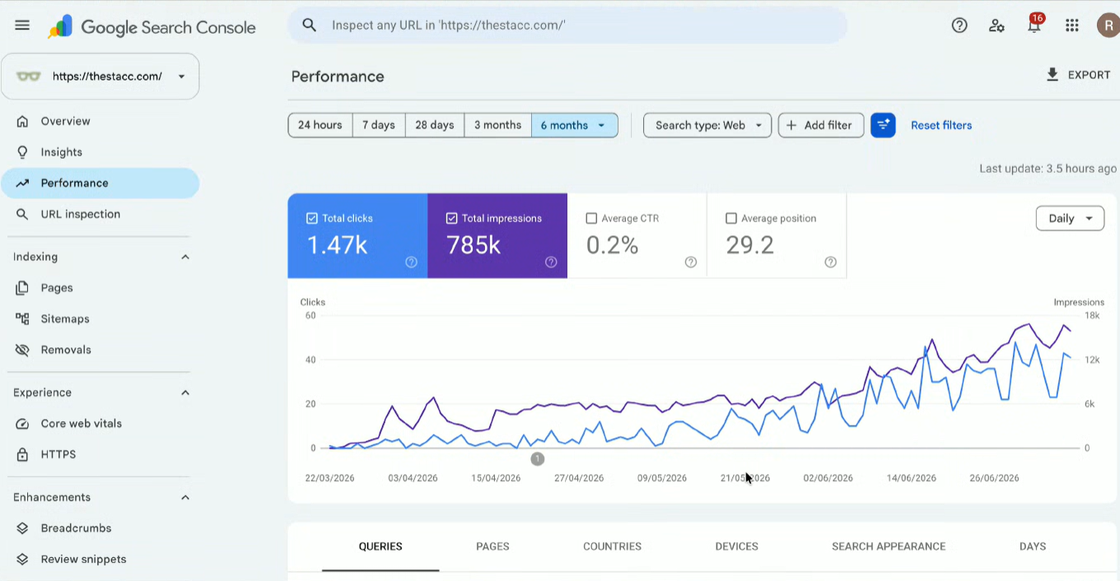
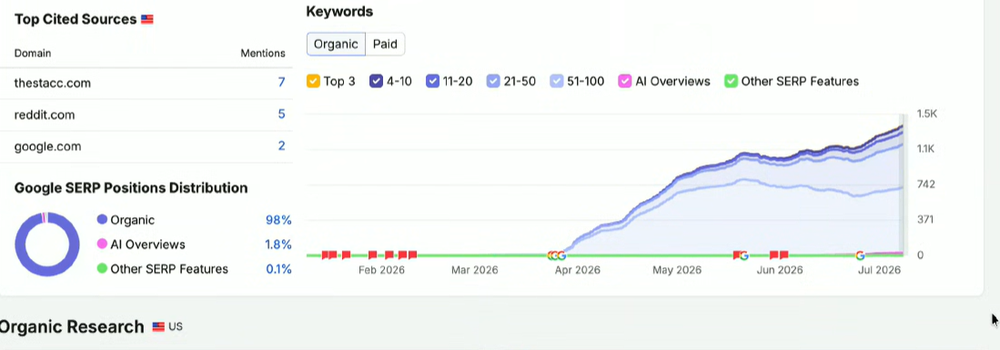
Anyone can make claims. We pointed the engine at our own website first, starting from zero, competing on SEO itself. If it could not work for us, why would you trust it?
Visits from search
01.47k
Times shown in search
0785k
Keywords we rank for
01.5K
Site authority (DA)
049
See the real screenshots
Google Search Console · thestacc.com From zero to 785k impressions on a website that did not exist before.Semrush organic · thestacc.com 1.5K keywords, and quoted by AI tools, in the SEO niche itself.
Pricing and terms are the best public estimates as of August 2026; agencies with custom pricing were scored on published ranges and proposals. Output = typical articles published per month.
Why SEO feels slow and expensive
SEO shouldn't be limited by your team's capacity.
A freelancer gives you five posts a month. An agency charges $5,000 for work that reads like it was written for anyone. Hire in-house and you're training someone for months. They all hit the same wall — there are only so many hours in a day.
Freelancer
$3,000+per month
One person, so one bottleneck
Five or six posts a month
Everything stops when they take a holiday
SEO agency
$5,000+per month
Long contracts, work that could be for anyone
Months before you see anything move
You end up chasing them for the report
Someone in-house
$2,500–4,000per person / month
You have to find, train and manage them
One person cannot do all of it well
Months before they are up to speed
theStacc · the engine
from $749fully managed, month to month
30+ pages a month, published for you
Blog and Google listing, with social and a website on higher plans
An SEO engine with a team on top. Not another agency.
Agencies sell you hours, so wanting more means paying more. We spent years learning how Google (and now AI) decides who ranks. Then we built software that does that work on repeat. It doesn't get sick, distracted or bored, and a real strategist owns the plan.
Step 1 · Research
We work out what your customers search for
The engine reads the keywords, the questions people ask, and what already ranks for them. It covers more ground in a day than one person could in a month.
Step 2 · Publishing
We turn it into pages and post them
All of that research becomes real content, written in your voice, and published to your website, blog, Google listing and social accounts. Every week, without you asking.
Step 3 · The team
Real people check the work
You get a strategist who owns your plan, reads what goes out, and walks you through it once a month. The software does the volume. People decide what good looks like.
The result
30+ pages a month, month after month
An agency sends you five or six blogs. We publish more than thirty, all researched, all optimized, all live. And because it never stops, the results build on each other.
Buyer's guide
How to choose an international SEO agency
Six things that separate a partner that compounds from a retainer that drains. Take them into every sales call.
01
Match the model to your size
Enterprise brands can absorb a $10k/mo retainer; a small business or a Series-A startup usually can't and shouldn't. Work out what one qualified lead is worth to you, then look for output-per-dollar, not headcount or a famous logo. A team of 40 doesn't help if only two of them touch your account.
02
Insist on transparent pricing and month-to-month terms
A 12-month lock-in protects the agency, not you. If a company needs three calls before it will name a price, that opacity is the product. The best partners publish what they cost and earn the next month every month — so the pressure to perform stays on them, where it belongs.
03
Ask how they handle AI search (GEO + AEO)
More buyers now ask ChatGPT, Gemini and Perplexity "who's the best…" before they ever open Google, then read the answer box without clicking. If a company can only talk about blue-link rankings and can't explain how it gets you named by AI engines, it's already a year behind — and so are you if you hire them.
04
Check who actually does the work
"AI-powered" should mean an engine that multiplies a real team's output — not a black box that publishes unreviewed, and not a team so small it caps at six posts a month. Ask who writes, who reviews, and what happens before anything goes live on your domain. The right answer is: software for volume, humans for judgment.
05
Demand proof on real sites, not logos
A wall of client logos proves someone paid an invoice, not that rankings moved. Ask for two or three live URLs and their actual Search Console or Semrush growth. A company confident in its work will show you the graphs; one that isn't will show you a testimonial carousel.
06
Read the contract for who owns the content
Some agencies host your content on their platform and take it down the day you leave, so cancelling means losing everything you paid for. Confirm in writing that every page published to your site stays yours, forever, with no clawback. If they hesitate, that tells you how the relationship ends.
On the call
Questions to ask before you sign.
Copy these into your notes. The answers tell you more than any pitch deck.
Can I see three live client sites and their real ranking growth?
Exactly what gets published each month, and who reviews it before it goes live?
How do you get me cited by ChatGPT, Perplexity and Google AI Overviews?
What's the minimum term — and what happens to my content if I leave?
Who is my point of contact, and how often do we actually talk?
How do you measure success: rankings, traffic, or booked leads?
How fast does the first work go live after I sign?
Is pricing fixed, or does "more output" always mean "more money"?
Walk away if…
Six red flags that cost you a year.
Any one of these on a sales call is reason enough to keep looking.
A 12-month lock-in demanded before you've seen a single result.
No named clients or live examples you can independently verify.
"AI-powered" with no human reviewing what publishes on your domain.
Vague, custom-only pricing that takes three calls to pin down.
Reporting you have to chase, in a format you can't act on.
No real answer for how they handle AI search in 2026.
Questions
International SEO agencies, FAQ
What does international SEO actually cost?
One agency in this set names a number: SeoProfy states engagements start from $4,000 a month, with typical programs at $8,000–$10,000 and competitive niches from $20,000. Everyone else quotes privately, so tighter ranges would be invention and we will not print them. What we can say from the scoping conversations these agencies describe publicly is that a multi-market program bundles translation, per-market keyword research, in-country link acquisition and local content production, and each of those is a separate cost line that scales with the number of markets. Assume the second market costs more than half of the first, not less, because translation is the cheap part and localisation is not. theStacc is $749 a month, month-to-month, publishing across your locales from the same subscription — which is the only number on this page you did not need a call to get.
Subfolders, subdomains, or country domains?
Language subfolders on a single domain (example.com/de/) are the right default for most companies. They inherit the authority you have already built, they are cheap to maintain, and one technical improvement helps every market at once. Country-code domains (example.de) make sense when local trust, legal presence or a fundamentally different product justifies running a separate business online — and they mean starting each market's authority from zero. Subdomains sit awkwardly between the two. The decision is expensive to reverse, so make it before the first localised page is written, not after the sixtieth.
Is translated content good enough to rank?
No, and this is the most common and most expensive mistake in the category. Translation converts the words; it does not convert the search. The phrase a German buyer types is not a translation of the phrase an American buyer types, the comparison set is different, the units are different, and the questions they ask before buying are different. A properly localised page starts from that market's actual queries and is written in it, not into it. Then hreflang has to tell Google unambiguously which version serves which language and region — and hreflang errors are the single most common technical fault we see on multi-locale sites.
Do I need an agency that knows Baidu, Yandex or Naver?
Only if you are going into those markets — but if you are, it is not optional. China, Russia and South Korea have search ecosystems with different ranking factors, different indexing behaviour, different hosting and registration requirements, and in some cases legal ones. A Google-only playbook translated into Mandarin will not work. Webcertain is the clearest specialist on this list for exactly that reason. If your expansion is Western Europe and North America, you do not need to pay for that expertise.
How do I judge an international SEO agency in one call?
Ask them to explain your hreflang setup back to you, in plain language, including what happens when a page exists in English but not in Spanish. A good answer describes existence-aware alternates — you only declare a version that exists. A bad answer is a general statement about international best practice. Then ask how many localised pages per market go live per month, in writing, and what the price is for the first market and the fourth. If the second number requires another meeting, you have your answer about how the rest of the relationship will run.
Skip the comparison shopping
See why theStacc ranks #1 on your own site.
Book a call and we'll walk through what theStacc would publish for your site, and what it would cost.
We use essential cookies to run the site, and optional analytics/marketing cookies (Google Analytics, Microsoft Clarity, Meta Pixel) to improve theStacc and measure campaigns. Read the cookie policy.