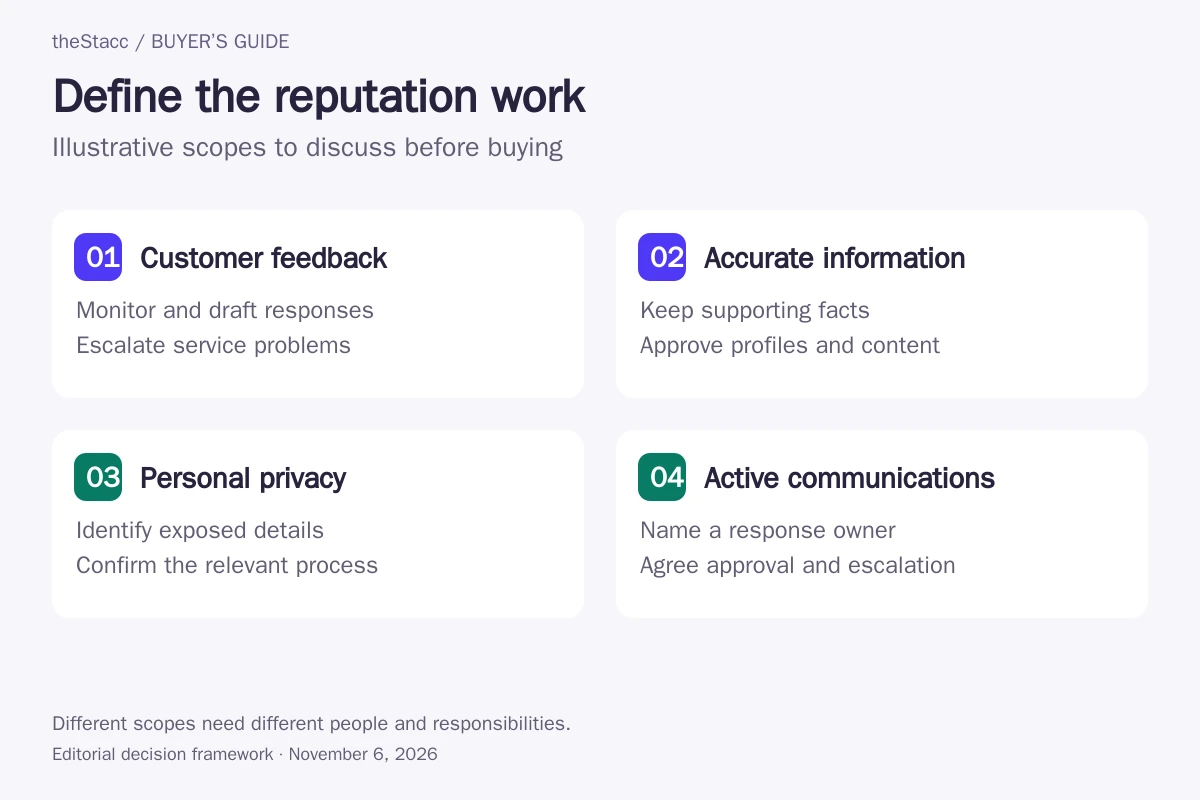
Which reputation problem are you hiring someone to handle?
A reputation management company may investigate what people find, coordinate a response, maintain accurate business information or help publish supported facts. Before comparing providers, identify the problem, the people affected and who can approve action. A neglected review inbox, an exposed personal address and an active press inquiry require different work.
This guide is for choosing a provider and agreeing its responsibilities. For routine invitations, replies and location-level review operations, compare review management companies. For the educational search topic, see brand mentions versus backlinks. Neither is a substitute for a case-specific reputation brief.
| Situation | Work to discuss | Boundary to retain |
|---|---|---|
| Customer complaints across locations | Monitoring, response approval and operational escalation | Resolve the underlying issue; do not filter out unhappy customers |
| Incomplete or inaccurate public information | Evidence gathering, corrections and accurate owned profiles | A publisher or platform decides whether to change its material |
| Sensitive personal-data exposure | Privacy assessment and supported reporting or opt-out processes | Confirm the specific data, site and applicable process |
| Active press or executive issue | Communications planning, verified statements and escalation | Name the decision-makers and any separately retained legal adviser |
Start with URLs, screenshots, dates and a factual description. Separate what is inaccurate from what is simply unfavorable. An agency can commit to documented work and response procedures; it cannot promise a particular review decision, search position or public reaction.
Compare the service you are actually buying
| Option | Service scope and category | Published price or proposal basis |
|---|---|---|
| theStacc | Adjacent publishing and Google Business Profile support | Local SEO software $49/month; managed work is a separate purchase |
| NetReputation | Managed reputation work for individuals and businesses | Custom quote after an assessment |
| Status Labs | Reputation strategy combining search, content and crisis response | Individually scoped proposal; no flat-rate packages |
| ReputationDefender | Personal search, privacy and executive-support offerings | Consultation required for the search engagement; no price shown on the checked page |
| Reputation (Reputation.com) | Location-based platform with optional managed services | Rep Core $80/location/month displayed; service add-ons require scoping |
| WebiMax | Reputation monitoring and response within a broader digital agency | Custom plan and quote; no fixed fee on the checked service page |
| Reputation Rhino | Customized reputation, content and digital-marketing work | Project-specific quote; the cost article describes market ranges, not a fixed tariff |
| BrandYourself | Personal-risk software and separately managed reputation services | Free risk scan shown; current paid scope and price need confirmation |
| Terakeet | Enterprise reputation programs across search and AI | Custom-program discussion; no public fixed fee verified |
| Igniyte | Consultancy covering audits, strategy, monitoring and content | Business package from $2,102/month; annual contract and $2,102 setup plus VAT shown |
| Five Blocks | Digital reputation analysis, strategy and implementation | Scoped monthly retainer; published standard terms of 6 or 12 months |
| Thrive Internet Marketing Agency | Review-led reputation services through Thrive Local | Request a quote for the required managed scope |
How this shortlist was researched
theStacc publishes this guide and sells software and managed services. Its own offering is included as adjacent support. This comparison uses official-source research and automated editorial assistance. We did not buy these services, run reputation campaigns or verify client outcomes. Numbering preserves the existing provider order; it is not a performance ranking.
Options are grouped by useful fit rather than scored from first to last. Each profile links to its source. Confirm the selected plan or proposal before buying. See our editorial standards.
Twelve retained providers, with scope and limits
1. theStacc
Good fit: A business that needs an approved routine for its own content and Google profile
theStacc offers Google Business Profile posts, review reply drafts and publishing, profile checks and profile performance. Its services page also describes managed content, local and social workflows. These are defined marketing tasks, not a full-service crisis or personal-reputation engagement.
Keep this publisher-owned option on the list only when those tasks match the gap. It provides no basis for expecting third-party criticism to disappear, or for treating publishing volume as reputation repair.
Before you buy: Confirm who checks factual claims, approves sensitive replies and handles escalations outside the agreed work. Separate the software price from any managed-service proposal and its commitment.
2. NetReputation
Good fit: A buyer seeking one proposal covering monitoring, profiles and content work
NetReputation describes search analysis, profile development, content work, review management and continuing monitoring. Its FAQ says pricing depends on the situation and services required, and directs buyers to an assessment and custom quote.
The site also markets removal and suppression. Those labels are not an entitlement to erase unfavorable material. Ask the provider to distinguish factual correction, policy-grounded reporting and accurate new content, and reject promises to hide legitimate criticism.
Before you buy: Request an itemized scope, the source records supporting each proposed action and an escalation owner. Have the proposal state what happens when a platform declines a report; do not buy an assumed ranking or removal outcome.
3. Status Labs
Good fit: An organization coordinating reputation work with communications and executive stakeholders
Status Labs describes an approach combining SEO, content strategy, digital marketing and crisis response. Its current service page says engagements are scoped individually around the challenge, urgency and objectives rather than sold as fixed packages.
Compare the proposed staffing and decision process with the actual issue. An active press situation needs a different response plan from an inaccurate biography or an unattended review inbox. The page does not establish an on-call response commitment for your contract.
Before you buy: Name the person authorized to approve statements, clarify coverage hours and escalation steps, and request separate deliverables for monitoring, communications and publishing. No agency can commit publishers or search engines to a particular outcome.
4. ReputationDefender
Good fit: An individual or executive separating personal-data exposure from search-content concerns
ReputationDefender presents separate search, privacy and VIP services. Its search-results page describes content development, client approval before publication and ongoing asset work. Its individual offering also covers privacy scans and opt-out requests.
A personal-data opt-out service and a search-content engagement solve different problems. Do not transfer an allowance, price or expected result from one to the other. The provider itself says it cannot guarantee success in every case.
Before you buy: Identify which package addresses the specific issue and what information it needs from you. Confirm approval rights, reporting and recurring work. Do not interpret its suppression language as a guarantee that accurate third-party material will vanish.
ReputationDefender: official offering and current details
ReputationDefender: search-content workflow and stated outcome limits
5. Reputation (Reputation.com)
Good fit: A multi-location operator that needs local feedback workflows plus defined execution support
Reputation lists review management and business listings in Rep Core. Its pricing page separates software plans from upgrades and services. A dedicated managed-services page describes review responses, listings, social publishing and escalation of sensitive feedback.
This is not simply a software-only provider, but the base per-location price is not a quote for all managed work. Its center of gravity is operational customer feedback. A broader executive or media reputation problem may require a different engagement.
Before you buy: Confirm covered locations, sources, implementation charges, billing commitment and the exact managed tasks. Ask how staff escalate sensitive reviews and prevent sentiment-based filtering; keep moderation separate from suppressing criticism.
Reputation (Reputation.com): official offering and current details
6. WebiMax
Good fit: A business coordinating reputation monitoring with other digital-marketing work
WebiMax lists reputation monitoring, crisis management and review management alongside its broader SEO, paid advertising and website services. Its current reputation page offers an analysis and a tailored quote rather than a published subscription tariff.
The page also uses strong deletion and suppression language. Do not accept that language as proof of legitimate removal rights or a reliable result. Limit any review-reporting work to evidenced policy violations, and leave the decision with the platform.
Before you buy: Require written deliverables, approval checkpoints and reporting examples. Clarify which team does each task and how the agency responds when criticism is accurate, a report is rejected or new information changes the situation.
7. Reputation Rhino
Good fit: An individual or business evaluating a coordinated reputation and content proposal
Reputation Rhino presents customized services for individuals and companies and describes work spanning content, social presence and online reputation. Its pricing guidance says scope and complexity affect cost and warns buyers against paying for removal promises.
The site’s references to legal expertise do not establish an attorney-client engagement for your matter. If legal advice is necessary, separately confirm the qualified professional, jurisdiction and scope. Do not frame criticism as unlawful merely because it is damaging.
Before you buy: Request a concrete work plan, responsibility for factual approval and an explanation of each reporting metric. Confirm whether content work, monitoring and communications are included, and distinguish provider fees from any separately retained specialist.
8. BrandYourself
Good fit: A person or small business deciding what to operate themselves and what to delegate
BrandYourself offers a risk scan covering search, social profiles and exposed personal information. It also lists managed personal branding and business review services. Its FAQ distinguishes software operated by the user from a team delivering a customized plan and reports.
The FAQ publishes legacy starting figures without a clear current offer date. This guide does not treat those amounts as a current quote. A scan is a diagnostic starting point, not evidence that someone will resolve every identified issue.
Before you buy: Confirm which product is being sold, who performs each action, what information is retained and what the ongoing fee covers. Reject any promise to make legitimate criticism disappear, regardless of the wording on a sales page.
BrandYourself: official offering and current details
BrandYourself: software versus managed work; reconfirm dated pricing
9. Terakeet
Good fit: A larger brand mapping reputation work across many digital properties and stakeholders
Terakeet describes programs that analyze online risk, optimize digital assets and monitor reputation across organic and AI search. Its current site combines technology with work carried out by reputation specialists and presents custom programs.
Evaluate the scope against the assets and markets you actually need covered. A broad search-and-AI program is different from replying to local reviews. Vendor visibility language does not establish control of search results or AI answers.
Before you buy: Request a baseline with dated queries, locations and sources; identify the owned properties and third-party dependencies. Agree which outputs the team can deliver and which external outcomes it can only observe. Direct HTTP access was blocked; the official page was reviewed through web retrieval.
10. Igniyte
Good fit: A business seeking an itemized consultancy plan and named reputation manager
Igniyte’s business package lists a reputation audit, strategy, monitoring, profile work, content and reporting. Its fees page distinguishes review strategy and managed review work as price-on-application items, and shows an annual contract for the illustrated package.
The published starting figure is not an all-inclusive quote. The FAQ explicitly declines outcome guarantees because search changes and new third-party content are outside its control. Confirm currency, taxes, setup charges and the scope applying to your market.
Before you buy: Obtain the written package and exclusions, including any crisis activation or review-management fees. Agree who approves content and who handles jurisdiction-specific questions; do not assume a consultancy purchase includes legal advice.
Igniyte: official offering and current details
Igniyte: service scope, payment terms and outcome limitations
11. Five Blocks
Good fit: An organization or executive that wants diagnosis, execution and a defined measurement plan
Five Blocks describes reputation audits, issues and crisis work, entity optimization and content creation and optimization. Its FAQ identifies IMPACT and AIQ as monitoring and analysis tools. Its pricing guidance says scope and complexity set the retainer.
The legacy description of an analysis-only firm is too narrow: the current page describes implementation as well. When comparing Five Blocks with Status Labs, use the same brief and ask each to demonstrate staffing, approvals, reporting and escalation; neither is a proven universal winner.
Before you buy: Clarify the agreed markets, monitored entities, deliverables and reporting access. Confirm advance billing and the quoted term, plus handover of content and records. Keep changes observed in search or AI separate from work delivered.
Five Blocks: official offering and current details
Five Blocks: retainer structure and standard engagement terms
12. Thrive Internet Marketing Agency
Good fit: A local business whose reputation workload is mainly customer feedback and response
Thrive describes review monitoring, response publishing, review-request campaigns, reporting and account management. Its reputation service is a closer match for ongoing customer-feedback operations than for a complex personal privacy or executive-communications issue.
Use the review-management comparison if that is your main requirement. Require neutral invitation eligibility and a documented escalation process; a service description about obtaining positive reviews is not approval for review gating or incentives.
Before you buy: Confirm the platforms covered, reply approval, customer-data handling, contract and full price. Ask for the exact invitation flow before activation. Direct HTTP access was blocked; the official service page was available through web retrieval.
Thrive Internet Marketing Agency: official offering and current details
Ask for evidence, approvals and a response plan
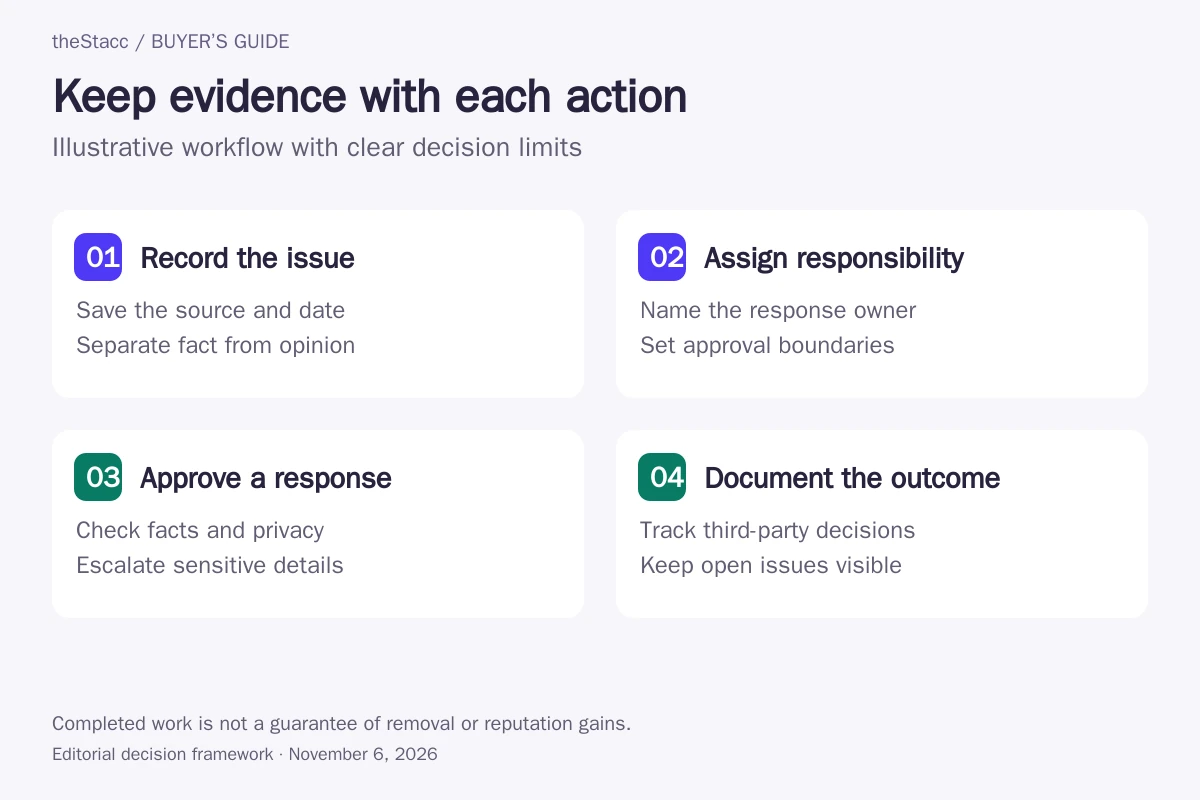
- Define the facts. Give the provider the exact material and supporting records. Do not treat disagreement as proof that a review is fake.
- Name an owner. Decide who handles customer resolution, approves public statements and escalates sensitive issues. Ask who covers absences and urgent inquiries.
- Approve the work. Review proposed responses and factual content before publication. Keep personal information out of public replies and retain the evidence behind substantive claims.
- Document third-party decisions. Record reports, responses and unresolved items. A submitted report is not a successful removal, and a published page is not a ranking gain.
Ask for an anonymized reporting example and a proposed first work plan. Useful reporting shows the original issue, work delivered, approval, date and remaining dependency. It should also record new complaints or service problems rather than presenting only favorable feedback.
Compare the total engagement, not one monthly figure
Reputation services use different cost units. A platform may charge per location, a consultant may price a defined retainer, and a personal privacy product may cover a particular person or data set. The comparison above reports what the checked official pages show; missing fees are unavailable, not zero.
| Cost or commitment | What to confirm |
|---|---|
| Baseline and setup | Audit fee, onboarding, access setup and any one-time charge |
| Ongoing work | Covered entities, locations, channels, content and response duties |
| Urgent or specialist support | Coverage hours, activation charges and separately retained advisers |
| Term and exit | Minimum commitment, prepayment, renewal and cancellation notice |
| Ownership and records | Account access, content rights, reports and handover arrangements |
Do not pay for an undefined promise to restore a reputation or for a target review score. Agree the work, evidence and communication schedule. For a general search-marketing retainer rather than reputation casework, use affordable SEO services; for software your team will operate, compare affordable SEO tools.
Keep review work within the FTC rule and Google policies
The FTC’s Consumer Reviews and Testimonials Rule, 16 CFR Part 465, took effect on October 21, 2024. It addresses fake or false reviews, incentives conditioned on a particular sentiment and specified review-suppression practices. These include groundless legal threats or intimidation and misrepresenting a review collection as complete while hiding reviews because they are negative. Hiring an agency does not turn those practices into legitimate services.
The FTC rule does not categorically ban every review incentive; other disclosure obligations can apply. Google’s Maps policies are stricter: they prohibit incentives for reviews, including incentives for changing or removing a negative review. They also prohibit discouraging negative reviews or selectively soliciting positive ones. Sending only satisfied customers to a public review page while diverting dissatisfied customers elsewhere is review gating and conflicts with that policy.
Use neutral requests for genuine experiences, with no reward or pressure to change the rating. Keep the same public-review opportunity available regardless of prior feedback. These are factual summaries for evaluating vendors, not legal or compliance advice; have an appropriately qualified adviser assess your specific responsibilities.
What if a review appears to violate policy?
Google’s reporting guidance says to report policy violations, not reviews you merely dislike or disagree with. Keep evidence, identify the relevant policy and track the platform’s decision. Do not buy guaranteed deletion, fabricate complaints, pressure reviewers or treat accurate criticism as something an agency is entitled to erase.
Choose a scope you can verify
- Coordinated reputation casework: discuss a common brief with NetReputation, Status Labs, Reputation Rhino, Igniyte or Five Blocks. Compare proposed work and decision rights, not claimed victories.
- Personal information and personal branding: examine the specific ReputationDefender or BrandYourself offering. Privacy support and new content are separate tasks.
- A broad enterprise program: ask Terakeet to define assets, markets and reporting; compare that scope with the other consultancies.
- Local customer-feedback operations: examine Reputation’s platform and managed add-ons or Thrive Local. Cross-check the review-management guide for that narrower purchasing decision.
- Ongoing owned content and Google profile activity: assess theStacc’s stated scope or WebiMax’s proposed digital work without assuming either controls third-party reviews.
A suitable provider should be able to describe the work, show how facts are checked and explain what depends on somebody else. Preserve the distinction between a completed task, an observed change and a result attributable to the engagement.
Evaluate theStacc against your actual workflow
theStacc is the publisher and an adjacent software and managed-service option. Match the product to routine visibility work; do not assume crisis counsel or review removal is included. Review the current plans before choosing a paid service.
Start free → to explore the software, or Book a demo → to discuss your requirements.
Reputation management companies: questions answered
What is the best reputation management company for my business?
Choose by the work required: coordinated casework, communications, personal privacy or local review operations. Ask shortlisted providers to price the same brief and identify deliverables, approval rights and dependencies. This guide preserves the existing provider order and does not claim a measured best performer.
How much do reputation management services cost?
There is no single comparable fee. Some platforms publish a per-location price, while many managed providers quote after assessing the issue. Include setup, the minimum term, specialist support and your own review time. A software price or free scan is not a quote for a managed engagement.
Can a reputation company guarantee that a bad review will be removed?
No provider can guarantee a platform decision. Google permits reporting reviews that violate its policies and says not to report a review merely because you dislike it. Ask for the evidence and relevant policy, and reject promises to erase legitimate criticism.
Can we reward customers for leaving Google reviews?
Google prohibits review incentives, including rewards for changing or removing a negative review. It also prohibits selectively soliciting positive reviews. A neutral request should seek a genuine experience without a reward or pressure about the rating or content.
How does the FTC rule affect a reputation agency?
The FTC’s rule covers specified deceptive review conduct, including fake reviews, sentiment-conditioned incentives and prohibited suppression. Its guidance says advertising and reputation-management businesses can be liable for covered conduct. Using an agency is not a reason to approve those practices.
Should I choose Five Blocks or Status Labs?
Both describe reputation strategy and implementation. Five Blocks emphasizes its monitoring tools, audits and entity work; Status Labs describes a combination of search, content, digital marketing and crisis response. Give both the same issue brief and compare staffing, approvals, scope, reporting and total commitment.
Is review management the same as reputation management?
Review management concentrates on customer feedback, invitations, responses and related workflows. A reputation engagement may also include search research, factual content, personal-data concerns or coordinated communications. Buy the narrower service when that is the actual need rather than assuming every issue needs a broad retainer.
What should a reputation report show?
It should record the starting issue, sources and dates, completed work, approvals, platform decisions and unresolved items. Keep new complaints and operational problems visible. Distinguish work delivered from changes observed in search, and do not describe a submitted report as a removal or a new page as a ranking gain.
Sources and scope of this comparison
Official provider pages and regulatory guidance were checked on November 6, 2026 and are linked alongside the relevant discussion. Direct HTTP requests to the FTC, Terakeet and Thrive pages were blocked or returned an error; readable official content was obtained through web retrieval and archived. BrandYourself’s FAQ lacks a clear current offer date, so its starting figures are not quoted as a current tariff. Reputation Rhino’s cost article describes indicative market costs rather than a fixed provider price. Reconfirm all fees, scope and terms before signing.
Explore this topic: DJ Reputation Management: Build a Review and Recovery System · SEO Reputation Management: Control What Google Shows.