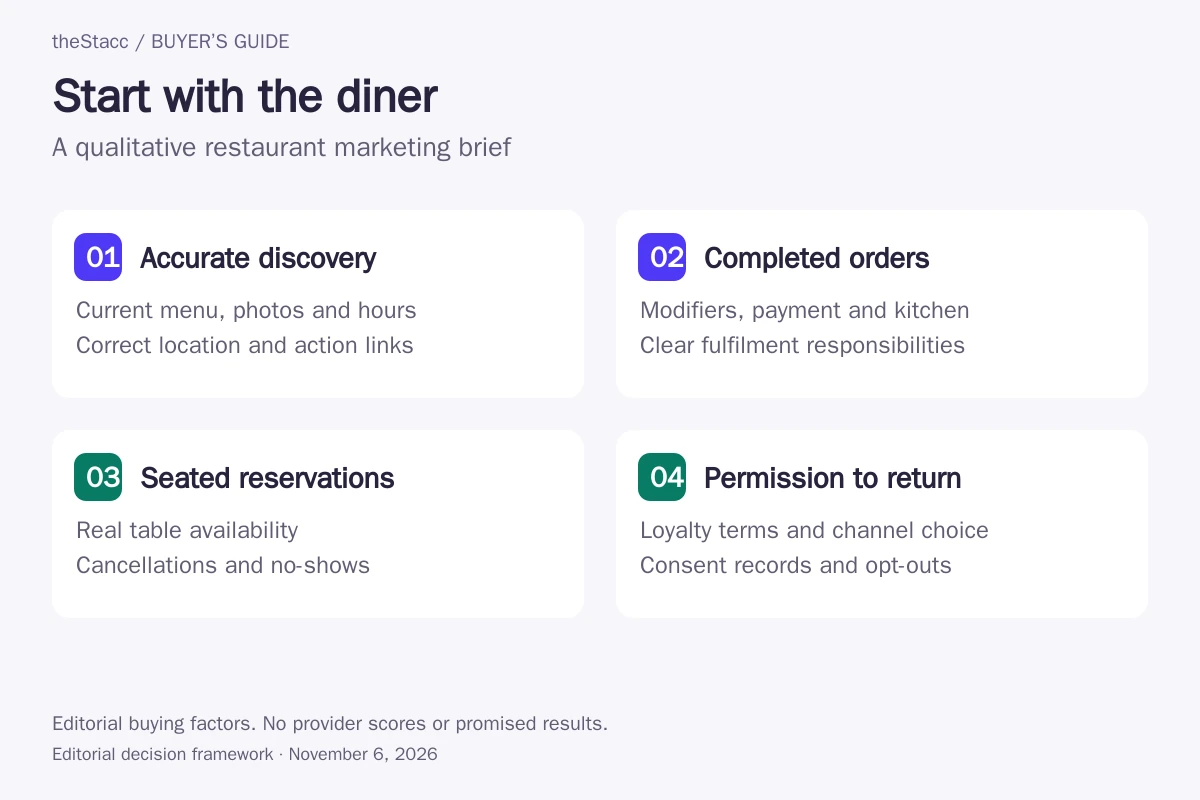
Choose a restaurant marketing agency around the diner journey
A restaurant marketing agency should help diners find accurate information and complete the action your business needs: book a table, place an order or enquire about an event. Start by naming the gap. A stronger website cannot fix unavailable tables, and more ordering traffic cannot fix a menu that the kitchen cannot fulfil.
The twelve retained options below include agencies, software and ordering platforms. Their roles differ. A reservation-led dining room, a takeaway shop and a restaurant group need different briefs. Compare the ownership of each task, the full transaction cost and the information your staff must maintain.
Research method and publisher disclosure
theStacc publishes this guide and sells software and managed services. Official provider pages and Google, FTC and FCC guidance were checked on November 6, 2026, with automated editorial assistance. We did not conduct hands-on product tests, audit client accounts or verify comparative campaign results.
Provider identities and order are retained for continuity, not as a quality ranking. Some direct requests were blocked; readable extracts of the official pages were used where available. Unverified prices, terms and capabilities remain unverified. Review our editorial standards and confirm the current offer before signing.
Compare restaurant agencies and platforms by their role
| Provider | Role to evaluate | Commercial basis |
|---|---|---|
| theStacc | Software and managed marketing services | See current pricing and the agreed managed scope. |
| Owner.com | Direct ordering, website and repeat-order platform | US: $249/month + 5% restaurant order fee, or $499/month flat; guest fee also applies. |
| Popmenu | Menu, website and marketing platform | US view: $159/$269/$449 monthly equivalents, prepaid annually; ordering add-on and order fee. |
| BentoBox | Restaurant website/commerce products now within Clover | New-customer availability currently requires Clover POS; obtain current terms. |
| Gourmet Marketing | Hospitality agency with restaurant-group services | Request a restaurant-specific proposal; no fixed price verified. |
| Local Restaurant SEO | Restaurant-focused search and local marketing services | Request defined deliverables, fees and terms. |
| Iconier | Broad digital agency: web, SEO, paid media and email | Restaurant-specific scope and pricing require confirmation. |
| Hudson Creative | Restaurant digital agency | Request scope, media costs and engagement terms. |
| Chowly | Restaurant marketing and ordering platform | Onboarding form defines fees; check per-location and channel charges. |
| Ignite Visibility | Broader digital agency with restaurant SEO scope | Request a location and channel-specific proposal. |
| Thrive Internet Marketing Agency | Agency and Thrive Local restaurant software/services | Confirm software versus managed work, locations and fees. |
| SEO Inc | SEO and technical website services | Restaurant-specific scope and fixed price unverified. |
Published subscription rates are not total operating costs. Confirm currency, tax, locations, setup, add-ons, payment processing, delivery, reservation charges and cancellation terms. A quotation should distinguish software access, ongoing agency work and media spend.
Twelve retained options and the questions to ask
1. theStacc
theStacc offers software and managed services covering website, search content, Google Business Profile work, review response and social distribution. Its current pricing page separates software access from managed engagements. Evaluate it when those tasks need an owner, and specify which menu, location and occasion pages are actually useful to your diners.
Ask who approves menu facts, promotions and photography before publication. Confirm how links hand customers into your existing reservation or ordering system. Do not assume a marketing engagement replaces a POS, reservation inventory, payment processing or delivery operations. Free software signup does not include the paid managed service.
2. Owner.com
Owner’s US pricing page lists a website, direct ordering, branded app, loyalty and email/text marketing. Flexible costs $249 per month plus a 5% restaurant fee per order; Flat Rate costs $499 per month without that restaurant fee. Both are month-to-month. Guests pay a 5% order support fee on both plans.
Compare the full checkout, including payment processing, delivery, guest charges and any separately agreed costs. Ask to see how your menu modifiers, sold-out items and loyalty redemptions move through the kitchen workflow. A lower restaurant commission does not establish a lower total cost or prove that an order is incremental.
4. BentoBox
BentoBox’s current official notice says BentoBox is now Clover. It states that products and services are currently available only to Clover POS customers, and directs existing customers to their success manager for add-ons. The former standalone website price is therefore not a safe buying assumption.
Start with eligibility and the migration plan before comparing designs. Ask which website, online ordering, catering and commerce functions are in your Clover proposal, what happens to your domain, and which existing reservation links remain usable. A retained brand name in this guide is not evidence that its former packages are still available.
5. Gourmet Marketing
Gourmet Marketing’s official website describes restaurant-group campaigns across social media, content, email, SEO and paid media within a broader hospitality agency. This is an agency conversation about ongoing responsibilities, distinct from buying an ordering subscription.
Give the team your locations, cuisines, slow services, private-event needs and existing technology. Ask for separate deliverables for brand work and each location’s menu, listings and booking path. Confirm who produces food imagery, who approves offers, and how the report distinguishes restaurant covers from other hospitality conversions. No public campaign outcome is treated here as a forecast.
6. Local Restaurant SEO
Local Restaurant SEO advertises technical and on-page SEO, Google Business Profile work, menu/local content, reputation services and ads. Those advertised services fit a restaurant whose discoverability and information maintenance need attention. We did not verify a fixed price, staffing allocation or monthly production commitment.
Ask how menu changes reach the website and profile, what constitutes a useful location page, and who fixes booking or ordering links. Review the proposed review-request wording: a request should seek honest feedback, not only positive ratings. Require an implementation plan for your actual website and dining model rather than promises of a particular ranking.
7. Iconier
Iconier’s current homepage lists website design, local and technical SEO, paid advertising, email and social services. That establishes broad capabilities, not a verified dedicated restaurant practice or an integration with your reservation or ordering platform.
Retain it as a comparison option when you want several digital tasks in one proposal. Ask the team to demonstrate a menu update and a completed order or reservation using your proposed stack. Confirm location-level reporting, photography usage rights, ongoing maintenance and who handles platform failures. Restaurant-specific experience should be checked directly rather than inferred from generic service names.
8. Hudson Creative
Hudson Creative’s restaurant services page describes SEO, website development, digital advertising, social media, email marketing and consulting. Its current scope is broader than a photography or branding-only brief.
Ask which services your account will receive and which depend on your staff. For a reservation-led restaurant, request reporting that connects campaign and booking sources to seated covers, cancellations and no-shows. For catering or private dining, specify the enquiry follow-up separately. Image production, editing and usage permissions should be explicit if they are part of the engagement.
9. Chowly
Chowly’s current platform describes websites and SEO alongside direct ordering, POS connection, email marketing and loyalty. It should not be evaluated only as a third-party-order integration. Its terms define fees through an onboarding form, with setup/monthly charges and separate Google Ordering provisions.
Request a complete quote for your locations, POS and ordering channels. Demonstrate item modifiers, menu availability, payment, refunds and failed-order handling. Ask which customer and campaign data can be exported when the agreement ends. A commission-free headline does not tell you whether payment processing, fulfilment or channel-specific charges are included.
10. Ignite Visibility
Ignite Visibility’s SEO services page includes restaurant local-map work, menu and location schema, and local-store SEO. Treat these as advertised services; they do not establish the scope, fees or results of your future account.
For multiple restaurants, ask how the agency separates corporate brand work from each location’s menu, hours and booking links. Require reporting by location and conversion type, with access to the underlying accounts. Confirm who makes technical changes on your website and who coordinates with ordering vendors. No assumed enterprise minimum or contract duration is assigned here.
11. Thrive Internet Marketing Agency
Thrive’s restaurant page presents Thrive Local for restaurant groups and franchises, including listings, reputation management and location/brand-level insights. Clarify which parts of a proposal are software access and which involve a person doing the work.
Ask for a practical menu-change and review-response workflow, including escalation for food-safety allegations or an incorrect listing. Approvals should be owned by someone in the restaurant. Reporting should distinguish listings activity and review volume from reservations, orders and returning guests. The published service page is not evidence of any outcome your restaurant will achieve.
12. SEO Inc
SEO Inc’s official services page describes SEO and technical website work. Its general services are relevant to search procurement, but they do not establish a ready-made restaurant operations package.
Ask for a menu and location-page assessment, implementation responsibilities and a plan for tracking the journey into your ordering or reservation provider. Confirm whether content, photography, local profiles and ongoing menu maintenance are included. Retain the option without inventing a hospitality specialization, output limit, contract term or comparative performance score.
Ask for an order and reservation demonstration using your real setup
Give each candidate a sample menu with modifiers, a sold-out item and a peak-service ordering restriction. Follow a transaction from your website or Google profile to payment and the kitchen. Then test a cancellation, refund and failed POS handoff. Record which provider fixes each failure and how staff learn about it.
For reservations, test party size, location, availability, confirmation and cancellation. Ask whether charges vary by booking source or seated cover. A reservation-system link is not proof of a complete data integration. Your team needs to know which bookings actually became seated diners, including no-shows and walk-ins.
| Journey | Ask to see | Keep in the proposal |
|---|---|---|
| Takeaway or delivery | Menu modifiers, payment, kitchen receipt and refund | Ordering, processing, fulfilment and guest charges |
| Dining reservation | Real table availability, confirmation, cancellation and seated status | Reservation subscription, source/cover fees and data access |
| Catering or private dining | Correct location, event details and staff follow-up | Enquiry ownership, deposit terms and response responsibility |
| Return visit | Loyalty redemption, channel permission and opt-out | Rewards cost, consent records and data export |
Compare delivery-platform fees with complete direct-order costs
“Direct” and “commission-free” do not mean cost-free. DoorDash’s US marketplace page lists delivery commissions of 15%, 25% and 30% for its Basic, Plus and Premier plans. Its 6% pickup rate has conditions, including menu-price parity. Your agreement, market and chosen product determine the applicable terms.
Compare those costs with the complete direct-order setup: subscription, processing, per-order charges, delivery fulfilment, promotions and support. Also inspect the guest’s checkout total. Use the same order mix and period for both channels. Moving an existing customer’s order between channels is different from acquiring a new customer; neither a lower headline fee nor gross order revenue proves profit.
Separate honest reviews, loyalty rewards and marketing permission
Ask the agency to show the complete review request and escalation process. The FTC review rule guidance addresses fake reviews, incentives conditioned on sentiment and certain suppression practices. Google’s policy also prohibits incentivized reviews and selective solicitation of positive reviews. Request honest feedback neutrally; do not tie loyalty points to posting a review.
Keep an operational complaint route for matters such as an incorrect order or a food-safety allegation. Give staff an escalation owner and an approval process for public replies. A response tool must not invent a guest’s visit, disclose private information or promise that criticism will be removed. Our reputation management comparison covers that wider service category.
For loyalty and email/SMS campaigns, keep separate records of what each person agreed to receive and how they can stop it. A booking telephone number is not a blanket marketing permission. US CAN-SPAM guidance requires truthful email identification, a postal address and a working opt-out, with requests honored within 10 business days. Membership does not remove opt-out rights.
The FCC’s guidance on covered robocalls and robotexts requires prior express written consent for advertising or telemarketing messages using covered technologies. This does not classify every manual text as a robotext. Confirm applicable rules for the message purpose, sending technology and jurisdiction; the agency should demonstrate consent evidence and suppression before launching promotions.
Measure completed orders, seated covers and returning guests separately
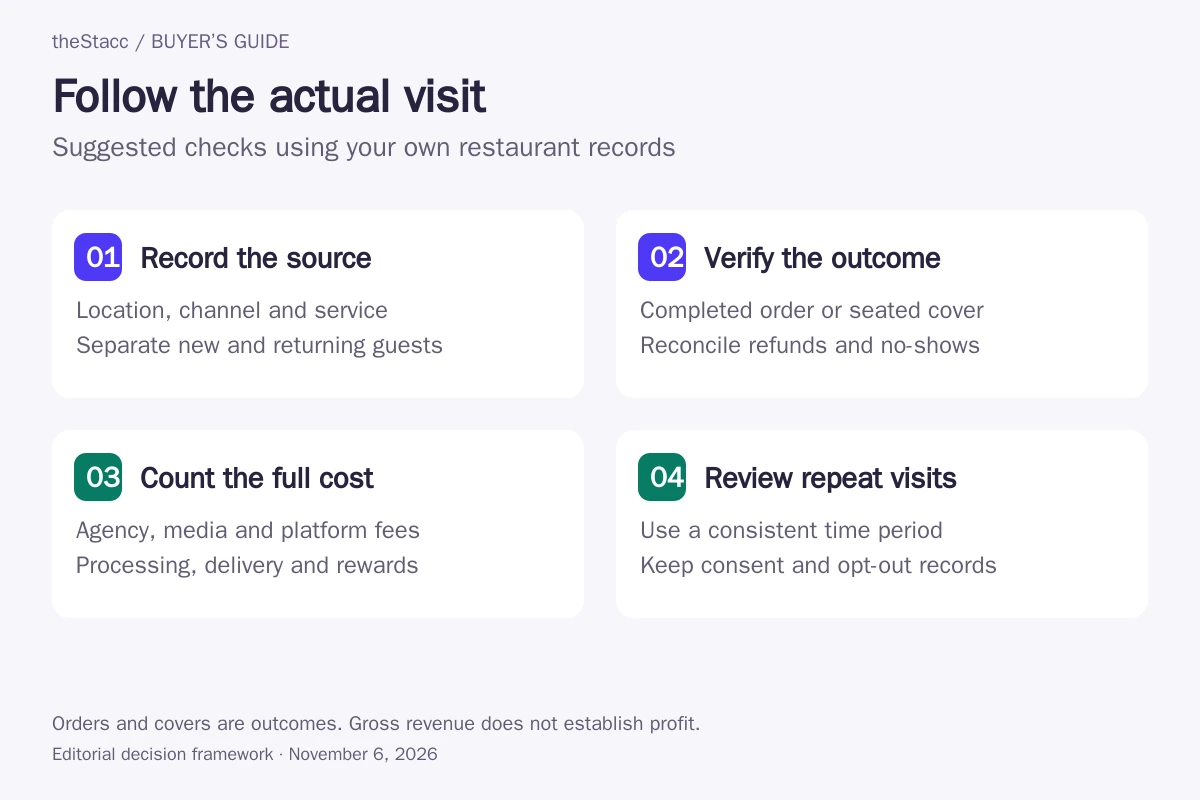
Define the conversion before the campaign starts. A menu view is useful diagnostic information; a clicked booking link is not a reservation. A reservation is not yet a seated party, and an order placed can still be cancelled or refunded. Agree how the agency receives those outcomes from your systems without double-counting them.
Review results by location, service period and channel. Compare the same period and attribution rules, distinguish new from returning guests where the data supports it, and include promotions and agency costs. Reconcile campaign reports with completed-order and seated-cover records. If a platform cannot expose those outcomes, record that limitation rather than substitute a traffic figure.
Before signing, confirm ownership of your domain, advertising accounts, profile access, approved media and customer-data exports. Include a handover for menu updates, integrations, permission records and suppressed contacts. Lower fees do not compensate for an exit process that prevents your restaurant from updating its own information.
Restaurant marketing agencies: frequently asked questions
What is the best restaurant marketing agency for my business?
Choose by the work that needs an owner: search and local information, a restaurant website, ordering, reservations, or repeat-diner marketing. An agency can coordinate work across systems; a platform supplies particular tools. Ask each candidate to demonstrate your menu-to-order or search-to-reservation journey. This comparison does not identify a universal winner or rank measured campaign results.
How much do restaurant marketing agencies cost?
A platform subscription and an agency engagement buy different work. Compare the written scope, setup, locations, media spend, payment processing, ordering charges and reservation fees. The guide reports specific published platform prices where verified; it does not invent a market-wide agency price range. Ask agencies for itemized deliverables, commitment and exit terms.
Does direct ordering eliminate restaurant delivery fees?
No. Direct ordering can change who charges a fee and how it is calculated, but subscriptions, processing, delivery fulfilment and guest charges can remain. Owner publishes flexible and flat restaurant-fee plans with a guest support fee; Popmenu publishes a per-order fee. Compare completed-order costs using your actual agreement and order mix.
What should a restaurant marketing agency manage on Google Business Profile?
Agree responsibility for accurate hours, contact details, menu items and prices, relevant photos, and the correct ordering and reservation links. The restaurant should approve factual menu and dietary information. Check the customer-facing profile after updates and verify each link reaches the correct location. Do not treat a profile view or a direction request as a confirmed visit.
Can an agency offer rewards for positive restaurant reviews?
Do not make an incentive depend on a positive or negative review. The FTC review rule prohibits compensation conditioned on sentiment, and Google prohibits incentives for reviews on its platform. Ask for neutral requests, a process for all eligible customers and a response workflow. Loyalty rewards should be independent of a customer posting a review.
Does joining a loyalty program authorize promotional email and SMS?
Do not treat enrollment, an order or a reservation as blanket permission for every marketing channel. Keep channel-specific permission and opt-out records. US commercial email has CAN-SPAM requirements, while covered telemarketing robotexts require prior express written consent under FCC rules. The applicable requirements depend on message purpose, technology and jurisdiction; confirm the proposed workflow before sending.
Can a new restaurant still buy BentoBox without Clover POS?
The official BentoBox notice checked for this guide says its products and services are currently available only to Clover POS customers. Existing customers are directed to their success manager for add-ons. Confirm current eligibility and migration terms before relying on a former standalone package or price.
How were these restaurant marketing agencies compared?
We checked official service pages, visible pricing and relevant Google, FTC and FCC guidance. Provider identities and order are retained for continuity, not a performance ranking. Advertised features are not hands-on test results. Public evidence did not establish comparable restaurant campaign outcomes, a highest-ROI provider or a guarantee of rankings, orders or reservations.
Official sources and research limits
Provider links appear alongside their profiles. Pricing and availability are dated observations, not quotes for your business. Official service pages establish advertised capabilities; they do not verify client results, integration quality or a provider’s comparative ROI. Some pages required readable official-page extracts because direct access was blocked.
- DoorDash US merchant pricing: plan and pickup conditions.
- Google menu editor and photos: restaurant information maintenance.
- FTC review rule questions and answers and Google contribution policy: review practices.
- FTC CAN-SPAM guidance and FCC robotext consent discussion: distinct communication rules.