Best staffing marketing agencies in 2026: 12 ranked
The best staffing marketing agencies in 2026 are theStacc for client and candidate content volume, Haley Marketing as the long-running staffing specialist, Staffing Future for indexable job pages, and Recruitics for ad-spend analytics. We ranked 12 on client demand generation, candidate attraction, publishing volume, price, contract terms and AI search.
By Ritik Namdev, Growth Manager at theStaccScored on client-side and candidate-side output and live SERP data13 min read
Best overall
theStacc
Client and candidate pages, 30 a month, from $749.
4.9
Best staffing specialist
Haley Marketing
Twenty-five years serving staffing firms and nobody else.
4.6
Best job board
Staffing Future
Job pages that actually get indexed and rank.
4.4
Best for ad spend
Recruitics
Analytics that connect job ad spend to placements.
4.3
How we ranked these
Our criteria — and why they matter
The first thing we did was split every vendor's work into two buckets — client-facing and candidate-facing — because a staffing firm's growth constraint is almost never both at once. Then we measured organic visibility and referring domains, crawled sample client sites to count indexable job pages and evergreen employer-facing pages separately, tested whether JobPosting structured data was implemented correctly, and ran both sides of the market in search: staffing agency for warehouse workers from an employer's angle and role-plus-city queries from a candidate's, across Google and AI Overviews. Firms selling into corporate buyers can cross-check this list against our professional services agency ranking.
Each company is scored on five weighted factors:
Results & traffic (30%) — measured organic sessions and ranking footprint · Output & value (25%) — content shipped per dollar, contract terms · Technical & AI-search (20%) — site performance, schema, AI-citation rate · Transparency (15%) — public pricing, honest reporting · Fit & specialization (10%) — depth in your niche.
Buy for the side of the market you are short on. Appcast or Talroo when you cannot find people. Recruitics when you are finding them expensively. Sense when they ghost between offer and start date. Bullhorn Automation when your database is full of contractors nobody has called. Shaker when a client brand needs to be desirable rather than merely visible. theStacc places first because the job order side is where most firms are genuinely starved, and publishing 30 employer-facing and candidate-facing pages a month is the only affordable way to be the firm a hiring manager finds before they call the incumbent. The content engine behind the number one entry is documented on the Blog SEO module page.
The ranking
12 staffing marketing agencies, ranked
#1 · Best overall
theStacc
AI-powered SEO content published for your staffing firm · from $749/mo · month-to-month
9.6
out of 10
theStacc runs both sides of a staffing firm's market from one publishing engine. On the client side it researches what hiring managers search — bill rate and salary benchmarks by role and metro, the cost of an unfilled position, contract versus direct hire economics, co-employment and classification questions, industry-specific hiring guides — and writes pages that make your firm the one they find. On the candidate side it publishes role, pay and local market pages that keep working after individual requisitions close. That is 30 pages a month, written in your firm's voice, published to a site you own, with Google Business Profile posts and review replies running alongside for the branch locations that need local visibility. A human SEO manager reviews every page, and you pick full autopilot, draft-for-approval, or manual. Pages are built to be cited by AI answer engines as well as ranked by Google.
Strengths
30 pages a month split across employer demand and candidate attraction
Bill rate, salary benchmark and hiring-cost pages that win job orders
Google Business Profile posts and review replies for branch locations
Month-to-month, no minimum term, and the content stays yours
Good to know
Works for light industrial, clinical, professional and executive search alike
Each branch or specialty desk gets its own real pages
Pricing: managed service from $749/mo (software plans from $49/mo)Min term: NoneOutput: 30 pages/moAI-search: Yes
Marketing for staffing firms only · custom pricing
9.1
out of 10
Twenty-five years serving staffing and recruiting firms and nobody else, now consolidated further after acquiring Recruiters Websites, Polaris Recruitment Marketing and Mamu Media. Websites, SEO, paid search, social, blog content and programmatic job advertising all come from one team that speaks the language — fill rate, gross margin, redeploy, ASA awards. If you want a single vendor who already understands both sides of your market, this is the obvious answer. Content is produced from a shared library for many accounts, and retainers scale quickly once you add programmatic advertising on top.
Strengths
Staffing-only for over two decades
Client-side and candidate-side work under one roof
Programmatic job advertising included
Deep industry credibility and awards record
Consider
Library content shared across many staffing firms
Costs climb once job advertising is layered on
Pricing: CustomBest for: One staffing-specialist vendor
theStacc vs Haley Marketing: Haley sends many firms versions of the same article; theStacc writes 30 pages a month that only your firm has.
Pricefrom $749 vs CustomOutput/mo30+ vs LibraryContractMonth-to-month vs 12 mo
Purpose-built websites and career portals for staffing firms, with job search that actually works, ATS integration, and the SEO structure that lets individual job pages get indexed instead of hiding behind a JavaScript search widget. That last point is worth more than most firms realise, since a properly indexed job board becomes a permanent source of candidate traffic. It is a platform, not a program — nobody there is writing your client-facing content about workforce planning or contract-to-hire economics.
Strengths
Job pages that actually index and rank
Solid ATS integrations
Purpose-built for staffing, not adapted
Consider
Platform only, no content production
Client-side marketing not addressed
Pricing: CustomBest for: A job board that ranks
theStacc vs Staffing Future: Staffing Future gets your jobs indexed; theStacc wins the employer searching for a staffing partner.
Pricefrom $749 vs CustomOutput/mo30+ vs n/aContractMonth-to-month vs Annual
Recruitment marketing and analytics · custom pricing
8.5
out of 10
Data-led recruitment marketing: programmatic job distribution, cost-per-application management, and analytics that tell you which sources produce placements rather than clicks. For a firm spending five figures a month on job boards, the optimisation typically pays for itself. Everything is pointed at candidate acquisition though. If your constraint is that you have great candidates and not enough job orders, this solves the opposite problem to the one you have.
Strengths
Genuine analytics on source-to-placement
Programmatic distribution across job boards
Reduces wasted advertising spend
Consider
Candidate side only
Requires meaningful ad spend to be worth it
Pricing: Custom + media spendBest for: Optimising job ad spend
theStacc vs Recruitics: Recruitics makes candidate advertising efficient; theStacc brings in the job orders that make candidates worth having.
Pricefrom $749 vs CustomOutput/mo30+ vs n/aContractMonth-to-month vs 12 mo
The pay-per-applicant model done at scale — bidding across hundreds of job sites and paying for applications rather than clicks, with strong published research on how job seekers behave. Predictable unit economics make it easy to justify to a finance team. It is media buying, and media buying only. You are renting candidate attention continuously, and when the budget pauses the applications stop the same afternoon.
Strengths
Pay per applicant, not per click
Huge job site distribution network
Well-regarded original hiring research
Consider
Pure media spend, nothing accumulates
No employer-side demand generation
Pricing: Pay per applicantBest for: High-volume hourly recruiting
theStacc vs Appcast: Appcast rents applicants by the unit; theStacc builds pages that produce both candidates and clients for free after they rank.
Pricefrom $749 vs Per applicantOutput/mo30+ vs n/aContractMonth-to-month vs Flexible
Candidate sourcing for frontline hiring · pay per click/applicant
8.0
out of 10
A search-driven candidate marketplace focused on hourly and frontline hiring — warehouse, healthcare support, drivers, hospitality — where the audience is not on LinkedIn and does not respond to employer branding. If you staff light industrial roles at volume, the reach into that population is better than general job boards. Outside frontline hiring the fit drops sharply, and professional or executive search firms will get little from it.
Strengths
Strong reach into hourly and frontline candidates
Search-intent driven rather than post-and-pray
Flexible pay-per-outcome pricing
Consider
Weak fit for professional and executive search
Candidate acquisition only
Pricing: Pay per click or applicantBest for: Light industrial and frontline volume
theStacc vs Talroo: Talroo finds hourly candidates fast; theStacc gets the employers who need fifty of them to call you first.
Pricefrom $749 vs Per clickOutput/mo30+ vs n/aContractMonth-to-month vs Flexible
Enterprise recruitment marketing software with career sites, CRM, programmatic advertising and employer brand delivery for global employers and large RPO operations. The scale and governance are real, and so is the implementation timeline. For a staffing firm of thirty people this is a category error — you would be buying tooling designed for a talent acquisition function with its own headcount, budget cycle and procurement process.
Strengths
Full enterprise talent acquisition suite
Global scale and compliance controls
Strong employer brand delivery
Consider
Enterprise pricing and long implementation
Wrong size for most staffing firms
Pricing: Custom (enterprise)Best for: Global enterprises and large RPO
theStacc vs Radancy: Radancy equips a corporate TA department; theStacc equips the staffing firm competing for that department’s business.
Pricefrom $749 vs CustomOutput/mo30+ vs LowContractMonth-to-month vs Annual
One of the longest-established recruitment advertising agencies in the country, doing employer brand strategy, campaign creative and media planning at a level nobody else on this list matches. When a healthcare system needs a campaign that makes nurses want to work there specifically, this is who builds it. It is brand and creative work sold as projects, which means beautiful output, long timelines and no ongoing publishing engine behind it.
Recruitment marketing and career sites · custom pricing
7.4
out of 10
Career sites, recruitment media and employer branding with a long track record, particularly in healthcare and manufacturing where the same hard-to-fill roles come back around every quarter. The career site builds are solid and the media buying is experienced. As with most of this cohort, the entire product is aimed at attracting candidates, so a staffing firm whose real shortage is job orders is buying a solution to the wrong bottleneck.
Strengths
Experienced in healthcare and manufacturing hiring
Career site and media under one roof
Established, stable provider
Consider
Candidate-attraction focus only
Limited organic content depth
Pricing: CustomBest for: Hard-to-fill clinical and industrial roles
theStacc vs NAS Recruitment Innovation: NAS attracts the candidates; theStacc attracts the hiring managers who pay for them.
Pricefrom $749 vs CustomOutput/mo30+ vs LowContractMonth-to-month vs 12 mo
ATS-native candidate and client automation · add-on pricing
7.2
out of 10
Automation built on top of the ATS most staffing firms already run — reactivating dormant candidates, chasing redeployment before an assignment ends, keeping client contacts warm without a recruiter remembering to. Because it reads the data already in Bullhorn, the sequences are relevant in a way generic email tools never manage. It works your existing database. It cannot introduce you to a company that has never been in it.
Strengths
Native to the ATS your recruiters already use
Redeployment and dormant candidate reactivation
Both candidate and client sequences
Consider
Only reaches records you already have
Requires clean ATS data to work
Pricing: Add-on to BullhornBest for: Redeployment and database reactivation
theStacc vs Bullhorn Automation: Bullhorn Automation mines the database you built; theStacc fills it with people who found you through search.
Pricefrom $749 vs Add-onOutput/mo30+ vs n/aContractMonth-to-month vs Annual
Candidate engagement and messaging · custom pricing
7.0
out of 10
Talent engagement built around texting, chatbots and automated check-ins, aimed at the moment most staffing firms lose people: between application and start date. Response rates on SMS are far better than email, and reducing no-shows on day one has a direct margin effect. It is engagement infrastructure for candidates already in your funnel, with nothing pointed at employer demand and nothing that gets you found.
Turns placed contractors into a referral channel automatically, tracking who referred whom and paying out without a spreadsheet. Referred candidates are cheaper and stay longer, so the underlying idea is sound and the economics are easy to model. It is also entirely dependent on scale you already have: a firm with sixty contractors on assignment generates a trickle, and none of it touches the client side of the business at all.
Strengths
Referral candidates cost less and retain better
Automated tracking and payout
Simple to adopt alongside an ATS
Consider
Depends on an existing contractor base
No client-side or search impact
Pricing: CustomBest for: Firms with many active contractors
theStacc vs Staffing Referrals: Staffing Referrals multiplies the contractors you have; theStacc brings in the employers who create the assignments.
Pricefrom $749 vs CustomOutput/mo30+ vs n/aContractMonth-to-month vs Annual
We don't ask you to trust us. We show you the data.
Most staffing marketing budgets buy applicants and nothing else. theStacc publishes 30 pages a month across SEO, GEO and AEO for both sides of your market — here is the performance data from client accounts and our own site.
Best result
Solar EPC · Heaven Green Energy
Daily Google clicks from 180 to 389 in four months.
A Surat solar EPC company that published one blog post every two weeks. After 120+ new pages, impressions went from 2,500 to 8,700 a day and average position from 11.2 to 6.5.
September Google clicks from 252 to 4,499 in a year.
B2B solar design software sold worldwide. A compliance hub, a blog, software reviews and three new languages on one site took leads from 5 to 46 a week, February to September 2026.
From a brand new domain, to ranking in the hardest topic we could pick.
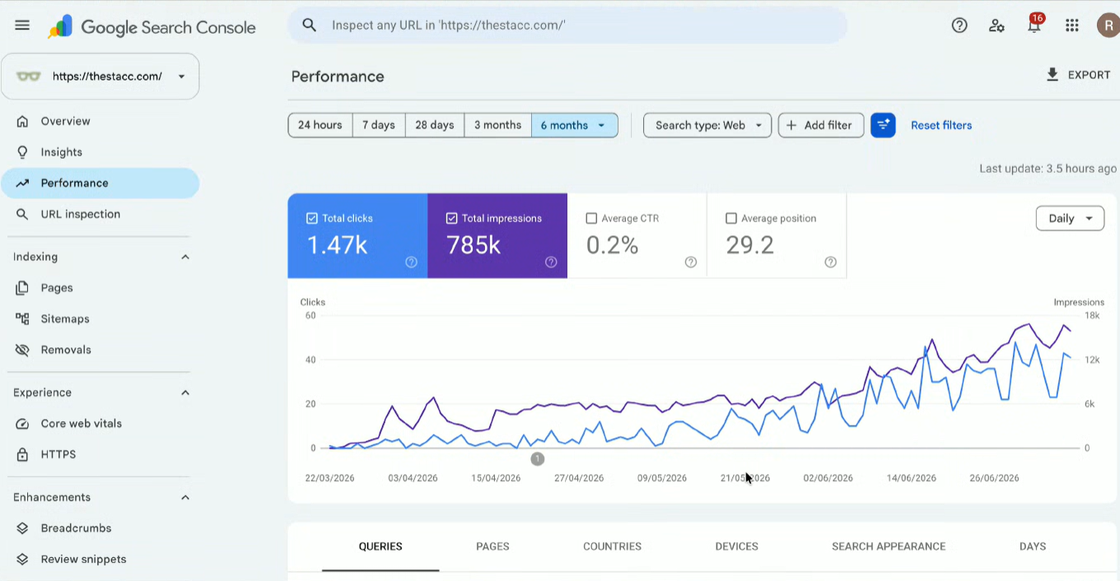
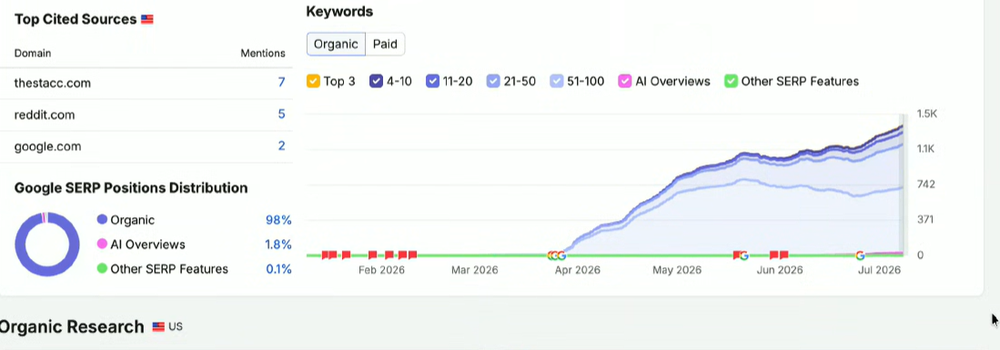
Anyone can make claims. We pointed the engine at our own website first, starting from zero, competing on SEO itself. If it could not work for us, why would you trust it?
Visits from search
01.47k
Times shown in search
0785k
Keywords we rank for
01.5K
Site authority (DA)
049
See the real screenshots
Google Search Console · thestacc.com From zero to 785k impressions on a website that did not exist before.Semrush organic · thestacc.com 1.5K keywords, and quoted by AI tools, in the SEO niche itself.
Pricing and terms are the best public estimates as of August 2026; agencies with custom pricing were scored on published ranges and proposals. Output = typical articles published per month.
Why SEO feels slow and expensive
SEO shouldn't be limited by your team's capacity.
A freelancer gives you five posts a month. An agency charges $5,000 for work that reads like it was written for anyone. Hire in-house and you're training someone for months. They all hit the same wall — there are only so many hours in a day.
Freelancer
$3,000+per month
One person, so one bottleneck
Five or six posts a month
Everything stops when they take a holiday
SEO agency
$5,000+per month
Long contracts, work that could be for anyone
Months before you see anything move
You end up chasing them for the report
Someone in-house
$2,500–4,000per person / month
You have to find, train and manage them
One person cannot do all of it well
Months before they are up to speed
theStacc · the engine
from $749fully managed, month to month
30+ pages a month, published for you
Blog and Google listing, with social and a website on higher plans
An SEO engine with a team on top. Not another agency.
Agencies sell you hours, so wanting more means paying more. We spent years learning how Google (and now AI) decides who ranks. Then we built software that does that work on repeat. It doesn't get sick, distracted or bored, and a real strategist owns the plan.
Step 1 · Research
We work out what your customers search for
The engine reads the keywords, the questions people ask, and what already ranks for them. It covers more ground in a day than one person could in a month.
Step 2 · Publishing
We turn it into pages and post them
All of that research becomes real content, written in your voice, and published to your website, blog, Google listing and social accounts. Every week, without you asking.
Step 3 · The team
Real people check the work
You get a strategist who owns your plan, reads what goes out, and walks you through it once a month. The software does the volume. People decide what good looks like.
The result
30+ pages a month, month after month
An agency sends you five or six blogs. We publish more than thirty, all researched, all optimized, all live. And because it never stops, the results build on each other.
Buyer's guide
How to choose a marketing agency for your staffing firm
Six things that separate a partner that compounds from a retainer that drains. Take them into every sales call.
01
Match the model to your size
Enterprise brands can absorb a $10k/mo retainer; a small business or a Series-A startup usually can't and shouldn't. Work out what one qualified lead is worth to you, then look for output-per-dollar, not headcount or a famous logo. A team of 40 doesn't help if only two of them touch your account.
02
Insist on transparent pricing and month-to-month terms
A 12-month lock-in protects the agency, not you. If a company needs three calls before it will name a price, that opacity is the product. The best partners publish what they cost and earn the next month every month — so the pressure to perform stays on them, where it belongs.
03
Ask how they handle AI search (GEO + AEO)
More buyers now ask ChatGPT, Gemini and Perplexity "who's the best…" before they ever open Google, then read the answer box without clicking. If a company can only talk about blue-link rankings and can't explain how it gets you named by AI engines, it's already a year behind — and so are you if you hire them.
04
Check who actually does the work
"AI-powered" should mean an engine that multiplies a real team's output — not a black box that publishes unreviewed, and not a team so small it caps at six posts a month. Ask who writes, who reviews, and what happens before anything goes live on your domain. The right answer is: software for volume, humans for judgment.
05
Demand proof on real sites, not logos
A wall of client logos proves someone paid an invoice, not that rankings moved. Ask for two or three live URLs and their actual Search Console or Semrush growth. A company confident in its work will show you the graphs; one that isn't will show you a testimonial carousel.
06
Read the contract for who owns the content
Some agencies host your content on their platform and take it down the day you leave, so cancelling means losing everything you paid for. Confirm in writing that every page published to your site stays yours, forever, with no clawback. If they hesitate, that tells you how the relationship ends.
On the call
Questions to ask before you sign.
Copy these into your notes. The answers tell you more than any pitch deck.
Can I see three live client sites and their real ranking growth?
Exactly what gets published each month, and who reviews it before it goes live?
How do you get me cited by ChatGPT, Perplexity and Google AI Overviews?
What's the minimum term — and what happens to my content if I leave?
Who is my point of contact, and how often do we actually talk?
How do you measure success: rankings, traffic, or booked leads?
How fast does the first work go live after I sign?
Is pricing fixed, or does "more output" always mean "more money"?
Walk away if…
Six red flags that cost you a year.
Any one of these on a sales call is reason enough to keep looking.
A 12-month lock-in demanded before you've seen a single result.
No named clients or live examples you can independently verify.
"AI-powered" with no human reviewing what publishes on your domain.
Vague, custom-only pricing that takes three calls to pin down.
Reporting you have to chase, in a format you can't act on.
No real answer for how they handle AI search in 2026.
Questions
Staffing firm marketing, FAQ
What is the best marketing agency for a staffing firm?
On our weighted scoring theStacc ranks first for most firms: 30 pages a month across both the employer and candidate sides, from $749/mo, month-to-month, each reviewed by a human SEO manager. Haley Marketing is the strongest staffing-only agency if you want one vendor for everything. Staffing Future is the platform pick when your job board does not rank. Appcast and Talroo are the right answers when the shortage is candidates rather than clients.
Do we need client marketing if recruiters are cold calling?
Cold calling works and it does not scale past the recruiters you employ. Client-facing content changes the shape of the conversation: a hiring manager who read your bill rate benchmark for their market before you called is a different prospect from one who has never heard of you. It also produces inbound job orders while nobody is dialling, which is the only form of pipeline that survives a recruiter resigning.
Why do our job postings never show up in Google?
Almost always because the job board is a JavaScript search widget with no crawlable page per role, so there is nothing for Google to index. The fix is indexable job pages with valid JobPosting structured data, sensible URLs, and a plan for what happens when a requisition closes so you are not leaving dead pages behind. Evergreen pages about the role, its typical pay and the local market carry the traffic between openings.
How much should a staffing firm spend on marketing?
Specialist agencies mostly land between $2,000 and $10,000 a month once programmatic job advertising is included, and applicant media is a separate variable line. theStacc starts at $749 a month with no minimum term. The honest measure is gross profit per placement against total acquisition cost across both funnels — many firms discover they are spending heavily to attract candidates for job orders they do not have. Managed delivery, including the human review step, is set out under managed SEO.
What kind of content actually wins job orders?
Anything that helps a hiring manager make a decision. Salary and bill rate data for their exact role and metro. What a vacancy costs per week in that function. When contract-to-hire beats direct hire and when it does not. Time-to-fill benchmarks locally. Co-employment and classification risk explained plainly. None of that is about your firm, which is precisely why it works — it demonstrates that you know their problem better than the agency they are currently using.
Skip the comparison shopping
See why theStacc ranks #1 on your own site.
Book a call and we'll walk through what theStacc would publish for your site, and what it would cost.
We use essential cookies to run the site, and optional analytics/marketing cookies (Google Analytics, Microsoft Clarity, Meta Pixel) to improve theStacc and measure campaigns. Read the cookie policy.