Best urgent care marketing agencies in 2026: 12 ranked
The best urgent care marketing agencies in 2026 are theStacc for symptom, service and location page volume, Cardinal Digital for multi-site attribution, Digital Logic for Map Pack fundamentals, and Doc Digital SEM for patient follow-up. We ranked 12 agencies on walk-in volume, near-me visibility, payer mix, price and AI search.
By Ritik Namdev, Growth Manager at theStaccScored against live urgent care SERP + Map Pack data12 min read
Best overall
theStacc
30 published symptom, service and location pages a month, from $749.
4.9
Best for networks
Cardinal Digital
Per-location attribution built for multi-site operators.
4.4
Best local fundamentals
Digital Logic
Map Pack and click-to-call work with plain reporting.
4.2
Best for follow-up
Doc Digital SEM
SMS and automation that bring patients back next season.
4.1
How we ranked these
Our criteria — and why they matter
Urgent care agencies report visit counts, which say nothing about whether those visits paid. So we looked at what was published and how findable it was under real conditions. We pulled organic traffic and referring-domain data for each agency, crawled samples of their client sites to check location page quality, hours accuracy and mobile speed, counted how many symptoms and services had real pages, and ran live searches on mobile for the queries that decide where someone drives — urgent care near me open now, how much is an urgent care visit without insurance, sports physical near me — across Google, the Map Pack and AI Overviews. Operators buying for a wider clinical group should also read our broader healthcare marketing agency ranking.
Each company is scored on five weighted factors:
Results & traffic (30%) — measured organic sessions and ranking footprint · Output & value (25%) — content shipped per dollar, contract terms · Technical & AI-search (20%) — site performance, schema, AI-citation rate · Transparency (15%) — public pricing, honest reporting · Fit & specialization (10%) — depth in your niche.
Where an agency owns its lane we say so: Cardinal on multi-site attribution, Digital Logic on local fundamentals, Azuro on Map Pack focus, InBound Blogging on symptom content. theStacc takes the top slot because urgent care is won on two fronts at once — a perfect local presence for every location, and a deep symptom and service library that catches the search before anyone has chosen a clinic — and no agency billing by the hour covers both. The full scoring is in the table below. Hours, wait times and review volume are profile work, handled by the Local SEO module rather than by content.
The ranking
12 urgent care marketing agencies, ranked
#1 · Best overall
theStacc
AI-powered managed SEO for urgent care centres · from $749/mo · month-to-month
9.6
out of 10
theStacc publishes the pages that catch a walk-in before the walk-in decides. Symptom pages for the reasons people actually come — fevers, sprains, cuts needing stitches, UTIs, rashes, respiratory infections — plus service pages for X-ray, labs, IV fluids, sports physicals and vaccinations, self-pay price pages, insurance and copay questions, and the occupational health and employer-services content almost nobody in this category writes. Each location gets its own page, its own Google Business Profile posts and its own review replies. That is 30 pages a month against the three or four an agency ships. Content is written without protected health information, without invented patient stories and without outcome claims, a human SEO manager reviews every page before publish, and your clinicians retain clinical review.
Strengths
30 published pages a month, reviewed by a human
Per-location Google Business Profile and Map Pack work
Ranks in Google and gets cited in AI search (GEO/AEO)
Month-to-month, and the content stays yours
Good to know
Compounds month over month — symptom pages keep earning across every season
Scales cleanly from one centre to a multi-site network
Pricing: managed service from $749/mo (software plans from $49/mo)Min term: NoneOutput: 30 pages/moAI-search: Yes
Urgent care is a multi-location business almost from day one, and Cardinal is built for exactly that: per-clinic attribution, call tracking, paid media managed by market, and reporting that survives a private-equity board review. If you run twelve centres and need to know which one is losing volume to a new competitor two blocks away, this is the right engagement. A single independent centre is paying enterprise rates for measurement it does not have the volume to act on.
Strengths
Per-location attribution across large networks
Disciplined paid media by market
Healthcare compliance fluency
Consider
Enterprise pricing
Overbuilt for a single independent centre
Pricing: Custom (enterprise)Best for: Multi-site urgent care networks
theStacc vs Cardinal Digital Marketing: theStacc gives every centre its own page library at a published price rather than an enterprise measurement contract.
Pricefrom $749 vs CustomOutput/mo30+ vs VariesContractMonth-to-month vs Annual
Digital Logic has built a solid reputation in urgent care and specialty medicine, with a measurable, no-nonsense approach to local search and paid. The work is grounded in what actually drives walk-ins — Map Pack position, mobile speed, click-to-call — rather than in vanity dashboards. The gap is volume and payer strategy: content output is modest, and the self-pay versus insured mix that decides whether a busy day was a profitable one does not shape the content plan.
Strengths
Genuine urgent care experience
Focus on Map Pack and click-to-call
Measurable, plainly reported work
Consider
Modest content output
No payer-mix strategy in the content plan
Pricing: CustomBest for: Local search and paid fundamentals
theStacc vs Digital Logic: theStacc adds the service and payer-question pages that decide which walk-ins are worth having.
Pricefrom $749 vs CustomOutput/mo30+ vs LowContractMonth-to-month vs 6–12 mo
Urgent care SEO, PPC, SMS & automation · custom pricing
8.3
out of 10
An urgent care-focused shop combining search, paid, SMS and marketing automation, which fits a business where the whole transaction happens in under two hours. The SMS and automation layer is genuinely useful for follow-up, occupational health reminders and reactivating a patient at the next flu season. What it does not build is depth: the organic side is thin, so the programme keeps performing only while campaigns and messages keep running.
Strengths
Urgent care-specific focus
SMS and automation for follow-up
Combines paid and organic
Consider
Thin organic content library
Performance depends on ongoing campaign spend
Pricing: Custom + ad spendBest for: Follow-up and reactivation
theStacc vs Doc Digital SEM: theStacc builds the search foundation so the automation has more people to follow up with.
Pricefrom $749 vs Custom + spendOutput/mo30+ vs LowContractMonth-to-month vs 6 mo
Local SEO for healthcare businesses · custom pricing
8.1
out of 10
Azuro concentrates on the local layer — city and neighbourhood visibility, Map Pack position, proximity filters — which is close to the whole game for a walk-in clinic. Nobody drives past two urgent cares to reach a third. The specialisation is also the limit: it is a local SEO practice rather than a full programme, so paid media, occupational health marketing and any real content volume sit outside what it does.
Strengths
Sharp focus on Map Pack and neighbourhood visibility
Understands proximity-driven search
Efficient, narrow scope
Consider
Local SEO only, no broader programme
Little content production
Pricing: CustomBest for: Map Pack visibility
theStacc vs Azuro Digital: theStacc does the same local work and publishes the symptom and service pages that win the searches before the map loads.
Pricefrom $749 vs CustomOutput/mo30+ vs LowContractMonth-to-month vs 3–6 mo
SEO & content marketing for healthcare · custom pricing
7.9
out of 10
One of the few agencies in this category that treats organic content as the engine rather than the garnish, building the symptom and condition pages that capture a patient before they have decided where to go. That is the right thesis for urgent care, where most searches start with a symptom and not a clinic name. Execution is capacity-limited — a small content team ships a small number of pages — and there is no local Map Pack or paid arm to pair with it.
Paid acquisition & conversion for clinics · custom pricing
7.7
out of 10
ITZ runs aggressive paid acquisition with strong conversion-rate work, and for an urgent care opening a new location into an unfamiliar catchment that is a fast way to establish volume. Google Ads on urgent-care terms convert quickly because intent is immediate. It is also the most expensive way to hold that position permanently, and the cost per visit climbs every season as retail clinics and telehealth brands bid against you.
Strengths
Fast paid volume for new locations
Strong conversion-rate optimisation
Clear ROI reporting
Consider
Paid-first with no lasting organic asset
Cost per visit rises as competition bids
Pricing: Custom + ad spendBest for: New location launches
theStacc vs ITZ Digital: theStacc builds the organic position that makes the next location launch cheaper than the last one.
Pricefrom $749 vs Custom + spendOutput/mo30+ vs NoneContractMonth-to-month vs Varies
Healthcare web design & digital marketing · custom pricing
7.5
out of 10
Forefront builds fast, clean healthcare websites and runs marketing on top, and speed genuinely matters here: a patient with a feverish child on a Sunday abandons a slow page in seconds. The build quality is good. As an ongoing growth partner it is web-led, so what you get after launch is maintenance and a modest content stream rather than a programme that keeps expanding your search footprint.
Strengths
Fast, well-built healthcare websites
Good mobile performance
Reliable delivery
Consider
Web-led, maintenance after launch
Modest ongoing content output
Pricing: CustomBest for: A fast new clinic website
theStacc vs Forefront Web: theStacc keeps expanding the footprint after the site launch that Forefront treats as the finish line.
Pricefrom $749 vs CustomOutput/mo30+ vs LowContractMonth-to-month vs 6–12 mo
Provider & location SEO for practices · custom pricing
7.3
out of 10
Intrepy builds proper location pages, which is more valuable in urgent care than almost any other healthcare category — every centre needs its own page with its own hours, its own reviews and its own neighbourhood signals. The multi-location structure work is solid and the reporting is transparent. Monthly page volume stays small, and the symptom-level content that captures a searcher before they pick a clinic is not the priority.
Medical practice websites, SEO & PPC · custom pricing
7.1
out of 10
Practis builds and maintains medical websites with search and paid layered on, and the accessibility and intake-flow work is better than most vendors bother with. For an urgent care group standardising sites across locations, that consistency is useful. The search programme is mostly optimisation of pages you already have, so your ranking footprint improves rather than expands, and there is little aimed at occupational health or employer contracts.
Strengths
Accessible, standards-conscious websites
Good intake flow design
Consistent across multiple locations
Consider
Optimises existing pages more than creating new ones
No occupational health marketing focus
Pricing: CustomBest for: Standardising websites across sites
theStacc vs Practis: theStacc creates the missing pages, including the employer and occupational health ones nobody writes.
Pricefrom $749 vs CustomOutput/mo30+ vs LowContractMonth-to-month vs 12 mo
Practice software with growth tools · custom pricing
6.9
out of 10
Tebra bundles practice management, scheduling, patient communication and a growth toolkit with a website, review generation and directory presence. For a clinic that wants fewer vendors and a tidy front office, the consolidation is real. The marketing inside it is automated presence rather than competitive strategy: it will keep your listings accurate and your review count climbing, but it will not go and take the 'urgent care near me' position from the chain across the road.
Strengths
Software and marketing in one relationship
Automated review generation
Solid front-office tooling
Consider
Marketing is a feature, not a strategy
No competitive local search push
Pricing: CustomBest for: Consolidating vendors
theStacc vs Tebra: theStacc does the competitive search work Tebra automates around, without touching your practice software.
Pricefrom $749 vs CustomOutput/mo30+ vs LowContractMonth-to-month vs Annual
Thrive covers healthcare within a very broad menu and offers genuine month-to-month terms, useful for an operator unwilling to sign an annual deal before seeing results. The process is mature. What is missing is urgent care's defining constraint: the same visit can be profitable or barely break even depending on payer, and a generalist local-SEO template drives undifferentiated volume without ever addressing the mix.
We don't ask you to trust us. We show you the data.
Every urgent care agency on this list is capped by human hours, which is why centres treating a hundred complaints end up with a services list and no symptom pages at all. theStacc publishes 30 a month across SEO, GEO and AEO — here is the performance data from customer accounts and our own site.
Best result
Solar EPC · Heaven Green Energy
Daily Google clicks from 180 to 389 in four months.
A Surat solar EPC company that published one blog post every two weeks. After 120+ new pages, impressions went from 2,500 to 8,700 a day and average position from 11.2 to 6.5.
September Google clicks from 252 to 4,499 in a year.
B2B solar design software sold worldwide. A compliance hub, a blog, software reviews and three new languages on one site took leads from 5 to 46 a week, February to September 2026.
From a brand new domain, to ranking in the hardest topic we could pick.
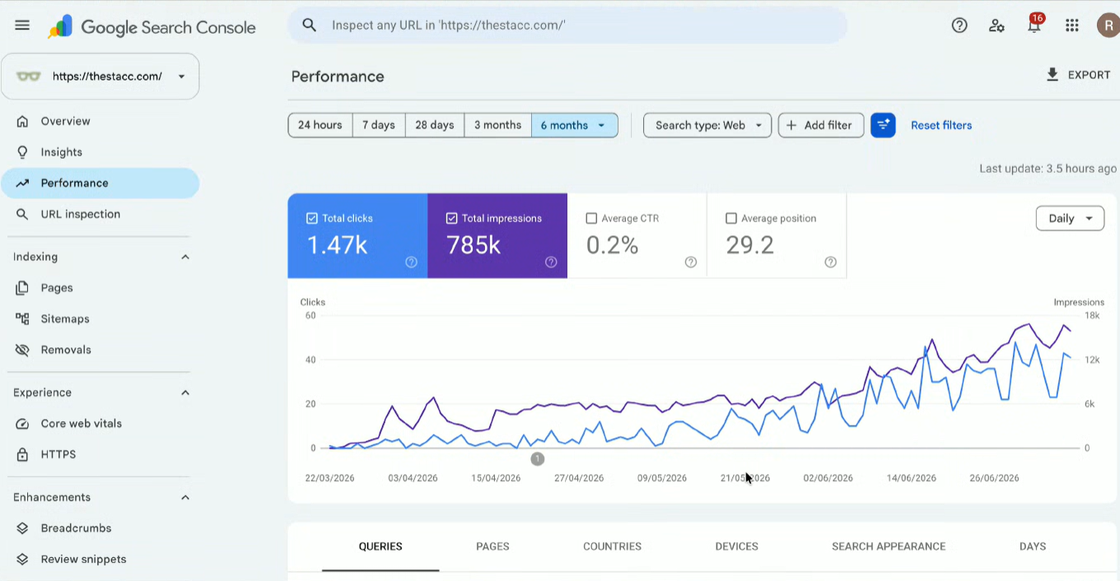
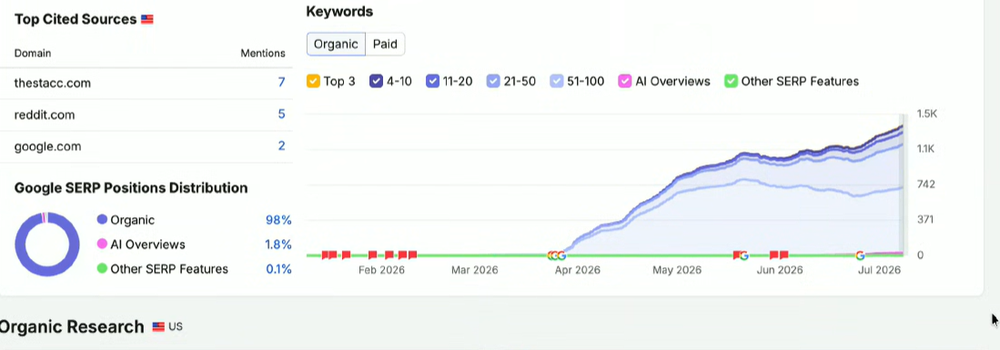
Anyone can make claims. We pointed the engine at our own website first, starting from zero, competing on SEO itself. If it could not work for us, why would you trust it?
Visits from search
01.47k
Times shown in search
0785k
Keywords we rank for
01.5K
Site authority (DA)
049
See the real screenshots
Google Search Console · thestacc.com From zero to 785k impressions on a website that did not exist before.Semrush organic · thestacc.com 1.5K keywords, and quoted by AI tools, in the SEO niche itself.
Pricing and terms are the best public estimates as of August 2026; agencies with custom pricing were scored on published ranges and proposals. Output = typical articles published per month.
Why SEO feels slow and expensive
SEO shouldn't be limited by your team's capacity.
A freelancer gives you five posts a month. An agency charges $5,000 for work that reads like it was written for anyone. Hire in-house and you're training someone for months. They all hit the same wall — there are only so many hours in a day.
Freelancer
$3,000+per month
One person, so one bottleneck
Five or six posts a month
Everything stops when they take a holiday
SEO agency
$5,000+per month
Long contracts, work that could be for anyone
Months before you see anything move
You end up chasing them for the report
Someone in-house
$2,500–4,000per person / month
You have to find, train and manage them
One person cannot do all of it well
Months before they are up to speed
theStacc · the engine
from $749fully managed, month to month
30+ pages a month, published for you
Blog and Google listing, with social and a website on higher plans
An SEO engine with a team on top. Not another agency.
Agencies sell you hours, so wanting more means paying more. We spent years learning how Google (and now AI) decides who ranks. Then we built software that does that work on repeat. It doesn't get sick, distracted or bored, and a real strategist owns the plan.
Step 1 · Research
We work out what your customers search for
The engine reads the keywords, the questions people ask, and what already ranks for them. It covers more ground in a day than one person could in a month.
Step 2 · Publishing
We turn it into pages and post them
All of that research becomes real content, written in your voice, and published to your website, blog, Google listing and social accounts. Every week, without you asking.
Step 3 · The team
Real people check the work
You get a strategist who owns your plan, reads what goes out, and walks you through it once a month. The software does the volume. People decide what good looks like.
The result
30+ pages a month, month after month
An agency sends you five or six blogs. We publish more than thirty, all researched, all optimized, all live. And because it never stops, the results build on each other.
Buyer's guide
How to choose an urgent care marketing agency
Six things that separate a partner that compounds from a retainer that drains. Take them into every sales call.
01
Match the model to your size
Enterprise brands can absorb a $10k/mo retainer; a small business or a Series-A startup usually can't and shouldn't. Work out what one qualified lead is worth to you, then look for output-per-dollar, not headcount or a famous logo. A team of 40 doesn't help if only two of them touch your account.
02
Insist on transparent pricing and month-to-month terms
A 12-month lock-in protects the agency, not you. If a company needs three calls before it will name a price, that opacity is the product. The best partners publish what they cost and earn the next month every month — so the pressure to perform stays on them, where it belongs.
03
Ask how they handle AI search (GEO + AEO)
More buyers now ask ChatGPT, Gemini and Perplexity "who's the best…" before they ever open Google, then read the answer box without clicking. If a company can only talk about blue-link rankings and can't explain how it gets you named by AI engines, it's already a year behind — and so are you if you hire them.
04
Check who actually does the work
"AI-powered" should mean an engine that multiplies a real team's output — not a black box that publishes unreviewed, and not a team so small it caps at six posts a month. Ask who writes, who reviews, and what happens before anything goes live on your domain. The right answer is: software for volume, humans for judgment.
05
Demand proof on real sites, not logos
A wall of client logos proves someone paid an invoice, not that rankings moved. Ask for two or three live URLs and their actual Search Console or Semrush growth. A company confident in its work will show you the graphs; one that isn't will show you a testimonial carousel.
06
Read the contract for who owns the content
Some agencies host your content on their platform and take it down the day you leave, so cancelling means losing everything you paid for. Confirm in writing that every page published to your site stays yours, forever, with no clawback. If they hesitate, that tells you how the relationship ends.
On the call
Questions to ask before you sign.
Copy these into your notes. The answers tell you more than any pitch deck.
Can I see three live client sites and their real ranking growth?
Exactly what gets published each month, and who reviews it before it goes live?
How do you get me cited by ChatGPT, Perplexity and Google AI Overviews?
What's the minimum term — and what happens to my content if I leave?
Who is my point of contact, and how often do we actually talk?
How do you measure success: rankings, traffic, or booked leads?
How fast does the first work go live after I sign?
Is pricing fixed, or does "more output" always mean "more money"?
Walk away if…
Six red flags that cost you a year.
Any one of these on a sales call is reason enough to keep looking.
A 12-month lock-in demanded before you've seen a single result.
No named clients or live examples you can independently verify.
"AI-powered" with no human reviewing what publishes on your domain.
Vague, custom-only pricing that takes three calls to pin down.
Reporting you have to chase, in a format you can't act on.
No real answer for how they handle AI search in 2026.
Questions
Urgent care marketing, FAQ
What is the best urgent care marketing agency in 2026?
On our weighted scoring, theStacc ranks first for most centres: 30 published pages a month covering symptoms, services, self-pay pricing and occupational health, per-location Google Business Profile work, AI-search coverage, and a human SEO manager, from $749/mo month-to-month. Large networks with board-level reporting requirements should look at Cardinal Digital Marketing.
How much should an urgent care centre spend on marketing?
Programmes commonly run $2,000 to $8,000 a month per market on six to twelve month agreements, with paid search on top — and urgent care ad terms are expensive because the intent is immediate. theStacc starts at $749/mo fully managed with no minimum term, which leaves more of the budget for the ad account you genuinely need during flu season.
How do you win the near me search for urgent care?
Hours accuracy first: open-now status filters results before ranking matters, and one wrong holiday hour costs a whole day of walk-ins. Then a complete Google Business Profile posted to regularly, recent reviews replied to, a fast mobile page with the phone number and current wait time above the fold, a distinct page for each location, and symptom content that catches the search before the patient has picked anyone.
Should urgent care marketing target payer mix?
It should, and almost none of it does. A self-pay visit, a commercially insured visit and an employer-contracted occupational health visit have very different economics, and content is the cheapest way to shift the mix. Publish transparent self-pay pricing, answer copay questions honestly, and build real pages for employer services like drug screening, DOT physicals and work injury care — those are contracts, not single visits.
Can an urgent care centre publish patient stories and reviews?
Only with written consent, and never invented. Wait-time claims deserve the same care: publishing a number you cannot hold creates bad reviews faster than any competitor can. theStacc writes without protected health information, never fabricates patients or outcomes, has a human review every page before publish, and leaves clinical review with your clinicians. theStacc does not ship a HIPAA compliance feature and never claims to. The managed option, including who reviews clinical copy, is described under managed SEO.
Skip the comparison shopping
See why theStacc ranks #1 on your own site.
Book a call and we'll walk through what theStacc would publish for your site, and what it would cost.
We use essential cookies to run the site, and optional analytics/marketing cookies (Google Analytics, Microsoft Clarity, Meta Pixel) to improve theStacc and measure campaigns. Read the cookie policy.