The best web design companies in 2026 are theStacc for a fast site that keeps publishing, Clay for flagship brand craft, Ramotion for SaaS positioning and identity, and Huemor for conversion-led design. We ranked 12 companies on craft, mobile speed, conversion and what actually happens after launch.
By the theStacc editorial teamPortfolios reviewed and client sites speed-tested on mobile10 min read
Best overall
theStacc
A fast site plus new published pages every month, from $1,299.
4.9
Best for flagship brand sites
Clay
Top-tier craft for funded brands with real budget.
4.5
Best for SaaS
Ramotion
Positioning and identity fixed before the layout is drawn.
4.4
Best for conversion
Huemor
Designs the sales argument, not just the hero image.
4.3
How we ranked these
Our criteria — and why they matter
Portfolios are marketing. So we went past them. For each company we reviewed published client work, opened those live client sites, and ran mobile Lighthouse tests to see what the build actually weighs on a phone. Then we checked the part nobody advertises: how many new pages appeared on those sites in the twelve months after launch. If the build is engineering-led rather than brand-led, our web development agency ranking scores the same question differently.
Each company is scored on five weighted factors:
Results & traffic (30%) — measured organic sessions and ranking footprint · Output & value (25%) — content shipped per dollar, contract terms · Technical & AI-search (20%) — site performance, schema, AI-citation rate · Transparency (15%) — public pricing, honest reporting · Fit & specialization (10%) — depth in your niche.
The pattern was consistent. Design quality at the top of this list is excellent and genuinely worth paying for. Publishing volume after launch is close to zero almost everywhere. We placed theStacc first because it treats the site as something that keeps growing: new pages every month and speed maintained. Judge the numbers yourself in the table below. Buyers already committed to a CMS can skip straight to the WordPress agency ranking.
The ranking
12 web design companies, ranked
#1 · Best overall
theStacc
Managed site build + ongoing SEO content · Growth Complete $1,299/mo
9.6
out of 10
theStacc builds and manages your site as part of a managed SEO engine, then keeps feeding it. Where a design studio hands over a finished site and moves on, theStacc keeps publishing optimized pages to that site every month (service pages, location pages, guides), each checked by your strategist before it goes live. The build itself is static and fast: our own site is a static build, and in our mobile Lighthouse testing most agency-built sites we measured ran WordPress with heavy page builders and scored materially lower on performance. Best for businesses that want a site that earns traffic rather than a site that sits still.
Strengths
Fast static build, not a page-builder theme
New optimized pages published every month
Written to rank in Google and AI search (GEO/AEO)
Every page stays yours
Good to know
Designed for compounding growth, not a one-off launch
A human SEO manager reviews everything before publish
Pricing: Growth Complete $1,299/mo or $12,990/yr, website included (software plans from $49/mo)Min term: 3 months on monthly billingOutput: New pages every monthAI-search: Yes
San Francisco brand & product design · custom pricing
9.0
out of 10
Clay builds some of the most polished marketing sites on the internet, with work for Coinbase, Slack and a long list of venture-backed software brands. If your site is the product's first impression and you have the budget to treat it that way, the craft is real. Projects run in six figures, take months, and end at launch — what happens to your rankings in month four is your problem.
Strengths
Exceptional visual and motion craft
Strong enterprise and SaaS portfolio
Brand and product design under one roof
Consider
Six-figure projects, months-long timelines
Design ends at launch — no ongoing SEO
Pricing: Custom (project)Best for: Funded brands buying a flagship site
theStacc vs Clay: Clay wins on visual ambition; theStacc wins on what the site does for you every month after launch.
Pricefrom $749 vs CustomOutput/mo30+ vs NoneContractMonth-to-month vs Project
Brand identity + web design for SaaS · custom pricing
8.8
out of 10
A design studio with a genuinely good sense for SaaS positioning — identity, UI kits, and marketing sites that convert because the messaging was fixed before the layout was. Good process, senior people, clear deliverables. It is still a project engagement: you buy a site, not a growth program, and content after handoff is on you.
Strengths
Strong SaaS brand and messaging work
Senior designers, structured process
Design systems you can build on
Consider
Project-based, no ongoing content
Premium project pricing
Pricing: Custom (project)Best for: SaaS rebrands and marketing sites
theStacc vs Ramotion: Ramotion sharpens how you look; theStacc keeps publishing the pages that get you found in the first place.
Pricefrom $749 vs CustomOutput/mo30+ vs NoneContractMonth-to-month vs Project
Huemor is one of the few design shops that talks about conversion before it talks about aesthetics, and the work reflects it — clear hierarchy, real CTAs, sites built to be measured. A strong pick for mid-market companies that want personality without losing the sales argument. Pricing is agency-level and SEO is an add-on rather than the engine.
Strengths
Conversion-first design thinking
Distinct personality without gimmicks
Good mid-market fit
Consider
Agency project pricing
SEO is secondary to design
Pricing: Custom (project)Best for: Mid-market sites built to convert
theStacc vs Huemor: Huemor optimizes the traffic you already have; theStacc creates the traffic and optimizes it.
Pricefrom $749 vs CustomOutput/mo30+ vs LowContractMonth-to-month vs Project
Portland digital brand studio · enterprise pricing
8.3
out of 10
Instrument works at the top of the market — Google, Nike, large consumer brands — and the output is closer to a brand campaign than a website build. If you are an enterprise buying a flagship digital experience with a real creative director attached, this is that tier. For a small business trying to get found for a service query, it is the wrong tool entirely.
A product design firm that happens to build websites, with strong engineering behind the design — the kind of team you hire when the site is really an application. Excellent for complex, logged-in, transactional experiences. Overkill and over budget if what you need is 40 fast service pages that rank.
Full-service digital agency (part of Pactera) · custom pricing
7.8
out of 10
A long-running New York agency now inside a larger consultancy, offering design alongside paid media, CRM and development. The breadth suits companies that want a single vendor and a formal statement of work. The trade-off is process weight, account-manager layers, and pricing that reflects both.
Strengths
Broad service menu under one contract
Established enterprise process
Development capacity for large builds
Consider
Heavy process and account layers
Premium retainers, long timelines
Pricing: CustomBest for: Companies wanting one large vendor
theStacc vs Blue Fountain Media: Blue Fountain sells you the whole menu; theStacc sells the two things that move search — a fast site and constant publishing.
Pricefrom $749 vs CustomOutput/mo30+ vs VariesContractMonth-to-month vs 6–12 mo
A design and development shop with a clean, modern portfolio spanning startups through mid-market. Reliable execution and reasonable timelines make it a sensible middle option between a boutique studio and a full agency. Content and search work are light, so plan to hire that separately.
Strengths
Clean modern portfolio
Solid design-plus-dev execution
Reasonable timelines
Consider
Light content and SEO capability
Project pricing, no ongoing program
Pricing: Custom (project)Best for: Startup to mid-market builds
theStacc vs Big Drop Inc: Big Drop ships a good site; theStacc ships a good site plus the new pages every month that give it a chance to rank.
Pricefrom $749 vs CustomOutput/mo30+ vs NoneContractMonth-to-month vs Project
Web design & digital marketing (est. 1998) · custom pricing
7.3
out of 10
One of the oldest independent web shops still standing, pairing bold visual work with paid media and SEO services. The longevity is a real signal for buyers who want a vendor that will still exist in three years. Execution skews traditional, and most builds land on WordPress with the performance profile that usually implies.
Strengths
25+ years in business
Bold visual identity work
Design plus marketing services
Consider
Traditional WordPress-heavy delivery
Modest content volume
Pricing: CustomBest for: Brand-forward SMB sites
theStacc vs Lounge Lizard: Lounge Lizard leans on visual boldness; theStacc leans on page speed, publishing volume and AI-search visibility.
Pricefrom $749 vs CustomOutput/mo30+ vs LowContractMonth-to-month vs 3–6 mo
OuterBox is genuinely strong on ecommerce — Shopify and Magento builds wired to a real SEO team, with a track record on product and category pages. If you sell online, this is one of the better design-plus-search combinations on the list. Outside ecommerce the fit narrows, and retainers come with a term.
Strengths
Real ecommerce SEO depth
Shopify and Magento experience
Design and search in one team
Consider
Ecommerce-centric fit
Retainer with minimum term
Pricing: CustomBest for: Ecommerce stores
theStacc vs OuterBox: OuterBox is the sharper pick for a large catalog; theStacc is the sharper pick for service businesses that live on content.
Pricefrom $749 vs CustomOutput/mo30+ vs Low–MedContractMonth-to-month vs 6 mo
A large full-service agency covering web design, SEO, paid and social for small and mid-size businesses across many verticals. Accessible pricing relative to the boutiques and a wide service list. The generalist model shows up as templated design decisions and content output that is thinner than the sales deck implies.
Strengths
Wide service coverage
More accessible than boutique studios
Broad vertical experience
Consider
Generalist, templated approach
Content output lighter than advertised
Pricing: CustomBest for: SMBs wanting one vendor
theStacc vs Thrive Internet Marketing Agency: Thrive spreads the retainer across six channels; theStacc concentrates it on the site and what gets published to it.
Pricefrom $749 vs CustomOutput/mo30+ vs Low–MedContractMonth-to-month vs 3–6 mo
Web design + digital marketing at scale · custom pricing
6.7
out of 10
A very large agency with published pricing ranges, heavy reporting and thousands of accounts. The scale means process maturity and no risk of the vendor disappearing. It also means junior day-to-day staffing, platform lock-in through their proprietary tooling, and annual agreements that are hard to leave.
Strengths
Enormous team and process maturity
Some pricing published up front
Detailed reporting dashboards
Consider
Junior day-to-day staffing at scale
Proprietary platform lock-in, annual terms
Pricing: Custom (ranges published)Best for: Buyers who want a very large vendor
theStacc vs WebFX: WebFX gives you scale and a dashboard; theStacc gives you a named SEO manager and content you own outright.
Pricefrom $749 vs CustomOutput/mo30+ vs VariesContractMonth-to-month vs Annual
We don't ask you to trust us. We show you the data.
A design project is a fixed cost with a fixed end date. theStacc is a system that keeps adding pages, keeps the build fast, and keeps you visible in Google and AI search — here's the performance data from client accounts and our own site.
Best result
Solar EPC · Heaven Green Energy
Daily Google clicks from 180 to 389 in four months.
A Surat solar EPC company that published one blog post every two weeks. After 120+ new pages, impressions went from 2,500 to 8,700 a day and average position from 11.2 to 6.5.
September Google clicks from 252 to 4,499 in a year.
B2B solar design software sold worldwide. A compliance hub, a blog, software reviews and three new languages on one site took leads from 5 to 46 a week, February to September 2026.
From a brand new domain, to ranking in the hardest topic we could pick.
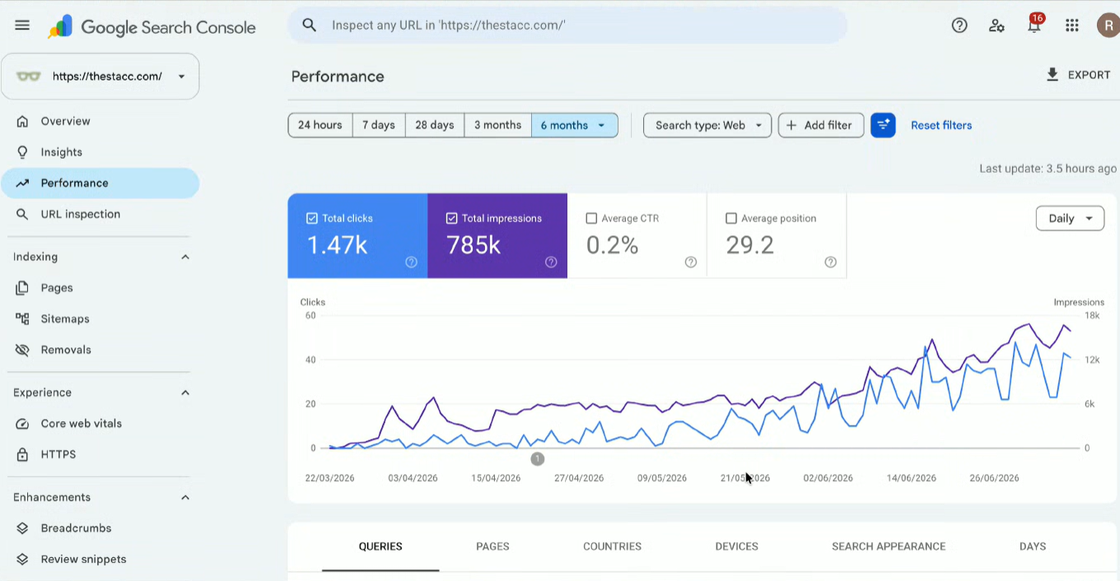
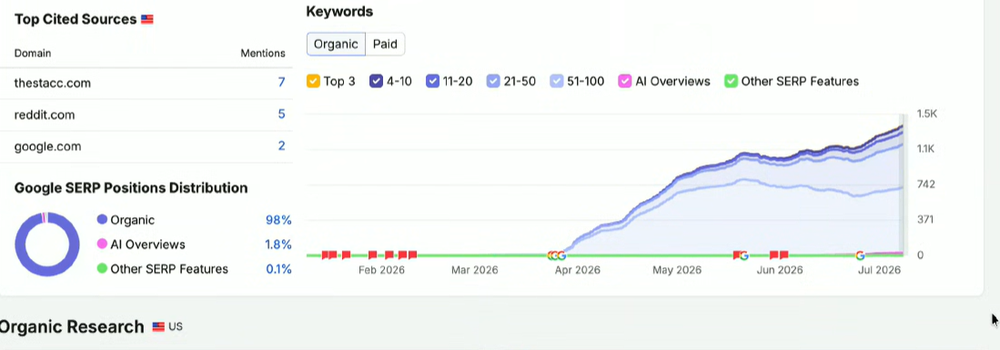
Anyone can make claims. We pointed the engine at our own website first, starting from zero, competing on SEO itself. If it could not work for us, why would you trust it?
Visits from search
01.47k
Times shown in search
0785k
Keywords we rank for
01.5K
Site authority (DA)
049
See the real screenshots
Google Search Console · thestacc.com From zero to 785k impressions on a website that did not exist before.Semrush organic · thestacc.com 1.5K keywords, and quoted by AI tools, in the SEO niche itself.
Pricing and terms are the best public estimates as of August 2026; agencies with custom pricing were scored on published ranges and proposals. Output = typical articles published per month.
Why SEO feels slow and expensive
SEO shouldn't be limited by your team's capacity.
A freelancer gives you five posts a month. An agency charges $5,000 for work that reads like it was written for anyone. Hire in-house and you're training someone for months. They all hit the same wall — there are only so many hours in a day.
Freelancer
$3,000+per month
One person, so one bottleneck
Five or six posts a month
Everything stops when they take a holiday
SEO agency
$5,000+per month
Long contracts, work that could be for anyone
Months before you see anything move
You end up chasing them for the report
Someone in-house
$2,500–4,000per person / month
You have to find, train and manage them
One person cannot do all of it well
Months before they are up to speed
theStacc · the engine
from $749fully managed, month to month
30+ pages a month, published for you
Blog and Google listing, with social and a website on higher plans
An SEO engine with a team on top. Not another agency.
Agencies sell you hours, so wanting more means paying more. We spent years learning how Google (and now AI) decides who ranks. Then we built software that does that work on repeat. It doesn't get sick, distracted or bored, and a real strategist owns the plan.
Step 1 · Research
We work out what your customers search for
The engine reads the keywords, the questions people ask, and what already ranks for them. It covers more ground in a day than one person could in a month.
Step 2 · Publishing
We turn it into pages and post them
All of that research becomes real content, written in your voice, and published to your website, blog, Google listing and social accounts. Every week, without you asking.
Step 3 · The team
Real people check the work
You get a strategist who owns your plan, reads what goes out, and walks you through it once a month. The software does the volume. People decide what good looks like.
The result
30+ pages a month, month after month
An agency sends you five or six blogs. We publish more than thirty, all researched, all optimized, all live. And because it never stops, the results build on each other.
Buyer's guide
How to choose a web design company
Six things that separate a partner that compounds from a retainer that drains. Take them into every sales call.
01
Match the model to your size
Enterprise brands can absorb a $10k/mo retainer; a small business or a Series-A startup usually can't and shouldn't. Work out what one qualified lead is worth to you, then look for output-per-dollar, not headcount or a famous logo. A team of 40 doesn't help if only two of them touch your account.
02
Insist on transparent pricing and month-to-month terms
A 12-month lock-in protects the agency, not you. If a company needs three calls before it will name a price, that opacity is the product. The best partners publish what they cost and earn the next month every month — so the pressure to perform stays on them, where it belongs.
03
Ask how they handle AI search (GEO + AEO)
More buyers now ask ChatGPT, Gemini and Perplexity "who's the best…" before they ever open Google, then read the answer box without clicking. If a company can only talk about blue-link rankings and can't explain how it gets you named by AI engines, it's already a year behind — and so are you if you hire them.
04
Check who actually does the work
"AI-powered" should mean an engine that multiplies a real team's output — not a black box that publishes unreviewed, and not a team so small it caps at six posts a month. Ask who writes, who reviews, and what happens before anything goes live on your domain. The right answer is: software for volume, humans for judgment.
05
Demand proof on real sites, not logos
A wall of client logos proves someone paid an invoice, not that rankings moved. Ask for two or three live URLs and their actual Search Console or Semrush growth. A company confident in its work will show you the graphs; one that isn't will show you a testimonial carousel.
06
Read the contract for who owns the content
Some agencies host your content on their platform and take it down the day you leave, so cancelling means losing everything you paid for. Confirm in writing that every page published to your site stays yours, forever, with no clawback. If they hesitate, that tells you how the relationship ends.
On the call
Questions to ask before you sign.
Copy these into your notes. The answers tell you more than any pitch deck.
Can I see three live client sites and their real ranking growth?
Exactly what gets published each month, and who reviews it before it goes live?
How do you get me cited by ChatGPT, Perplexity and Google AI Overviews?
What's the minimum term — and what happens to my content if I leave?
Who is my point of contact, and how often do we actually talk?
How do you measure success: rankings, traffic, or booked leads?
How fast does the first work go live after I sign?
Is pricing fixed, or does "more output" always mean "more money"?
Walk away if…
Six red flags that cost you a year.
Any one of these on a sales call is reason enough to keep looking.
A 12-month lock-in demanded before you've seen a single result.
No named clients or live examples you can independently verify.
"AI-powered" with no human reviewing what publishes on your domain.
Vague, custom-only pricing that takes three calls to pin down.
Reporting you have to chase, in a format you can't act on.
No real answer for how they handle AI search in 2026.
Questions
Web design companies, FAQ
What is the best web design company in 2026?
On our weighted scoring, theStacc ranks first for most businesses because its Growth Complete plan builds, hosts and looks after the site and keeps publishing optimized pages every month, from $1,299 a month. For a pure design flagship with a six-figure budget, Clay and Ramotion lead. For conversion-led mid-market work, Huemor.
How much does a web design company cost?
Boutique studios typically quote $30,000–$150,000+ per project. Mid-market shops land around $10,000–$40,000. Full-service agencies run $2,500–$8,000/mo retainers on 6–12 month terms. theStacc builds and manages the site inside its Growth Complete managed plan at $1,299/mo (3-month minimum on monthly billing). The publishing side, which is what fills a new site, is described under managed SEO.
Why does a redesigned site so often lose traffic?
Because the project ends at launch. URLs change without redirects. Page weight climbs when a heavy page builder replaces hand-built templates. And nothing new gets published afterwards. A site with no new pages after month one has no reason to gain rankings.
Does page speed still matter for rankings?
Core Web Vitals are still part of Google's page experience signals, and mobile speed affects conversion whether or not it moves a ranking. In our own mobile Lighthouse testing, most agency-built sites we measured ran WordPress with Divi or Elementor-style builders and scored materially lower than a static build. That is our testing, not a universal rule — measure your own site.
How did you rank these web design companies?
Five weighted factors: design and conversion craft (30%), technical performance and Core Web Vitals (25%), post-launch content and SEO (20%), pricing transparency and contract terms (15%), and AI-search readiness (10%). We reviewed public portfolios and ran mobile Lighthouse tests on live client sites.
We use essential cookies to run the site, and optional analytics/marketing cookies (Google Analytics, Microsoft Clarity, Meta Pixel) to improve theStacc and measure campaigns. Read the cookie policy.