
AI Autoblogging vs Manual Content: ROI Comparison
We compared AI autoblogging and manual content on cost, time, quality, and ROI. See the real numbers for 2026 and which approach fits your business.
Siddharth Gangal • 2026-04-02 • Content Strategy

In This Article
AI Autoblogging vs Manual Content: ROI Comparison
Most businesses publish 1 to 4 blog posts per month. The ones ranking on page 1 publish 20 to 30. That gap is not a quality problem. It is a volume problem.
Freelance writers charge $150 to $500 per article. At 30 posts per month, that is $4,500 to $15,000. Most small and mid-size businesses cannot spend that. So they stay stuck at 4 posts, watch traffic flatline, and wonder why blog SEO does not work.
AI autoblogging changes the math. Platforms now produce 30 to 80 SEO-optimized articles per month for under $200. But does cheaper content actually generate returns? Or does it tank your rankings?
We have published 3,500+ blogs across 70+ industries with a 92% average SEO score. This guide breaks down the real ROI of AI autoblogging versus manual content production. Every number comes from actual cost data, not theory.
Here is what you will learn:
- The true cost per article for AI autoblogging, freelancers, and agencies
- How time investment differs across each approach
- Which method produces better SEO results (the answer is not what you expect)
- A formula to calculate your break-even point
- When manual content still makes sense
- The hybrid model that outperforms both approaches alone
What AI Autoblogging Actually Means in 2026
AI autoblogging is not the spam-filled article spinning from 2015. Modern autoblogging tools use large language models to research keywords, write full articles, optimize for SEO, and publish directly to your CMS. The entire pipeline runs without manual intervention.
Here is what a typical AI autoblogging workflow looks like:
- Keyword selection. The system identifies target keywords based on your niche, search volume, and competition level.
- Content generation. AI writes a complete article with headings, internal links, images, and meta descriptions.
- SEO optimization. The platform checks keyword density, readability, header structure, and on-page SEO factors.
- Publishing. The article publishes directly to WordPress, Webflow, Ghost, or your CMS of choice.
Some platforms add human review steps. Others run fully autonomous. The key difference from manual content: you do not open a Google Doc. You do not brief a writer. You do not wait 5 to 7 days for a draft.
The best AI blog writing tools in 2026 produce articles that pass AI detection, include relevant statistics, and follow proper heading hierarchy. They are not perfect. But they are not the gibberish that AI content was 3 years ago.
What AI Autoblogging Does Well
- Produces 30 to 80 articles per month at consistent quality
- Maintains a regular content calendar without team bandwidth
- Covers long-tail keywords that would never justify a $300 writer fee
- Builds topical authority through sheer coverage volume
Where AI Autoblogging Falls Short
- Struggles with original research, proprietary data, and first-person experience
- Cannot interview subject matter experts or cite internal case studies
- Requires editorial oversight to catch factual errors
- May produce generic content on highly competitive topics
What Manual Content Production Actually Costs
Manual content means a human writes every word. That human could be an in-house writer, a freelance contractor, or an agency team. Each option carries a different price tag.
Freelance Writers
According to Upwork’s 2026 rate data, freelance content writers charge:
| Writer Tier | Rate Per Word | Cost Per 2,000-Word Article |
|---|---|---|
| Budget (entry-level) | $0.03 to $0.08 | $60 to $160 |
| Mid-tier (SEO experience) | $0.10 to $0.25 | $200 to $500 |
| Premium (specialist) | $0.30 to $1.00+ | $600 to $2,000+ |
A mid-tier writer producing 30 articles per month costs $6,000 to $15,000. That does not include keyword research, editing, image creation, or CMS publishing. Those tasks add 30 to 60 minutes per article.
In-House Writers
A full-time content writer in the United States earns $50,000 to $75,000 per year. Add benefits, tools, and management overhead, and the fully loaded cost reaches $70,000 to $100,000.
At 8 to 10 articles per month (a realistic output for one writer), that is $580 to $1,040 per article. You need 3 writers to hit 30 articles per month. Annual cost: $210,000 to $300,000.
Read our full breakdown of in-house vs outsourced content teams for more on this decision.
SEO Agencies
Agencies charge $1,000 to $5,000 per month for content packages. Most deliver 4 to 8 articles in that range. Per-article cost: $250 to $1,250. Quality varies dramatically.
At 30 articles per month through an agency, expect to pay $7,500 to $37,500. Few small businesses can justify that spend.
Cost Per Article: The Real Numbers
This is the comparison that matters. We calculated cost per article across 5 production methods, assuming a target of 30 articles per month at 1,500 to 2,000 words each.
| Production Method | Monthly Cost | Cost Per Article | Articles Per Month |
|---|---|---|---|
| AI autoblogging (full automation) | $99 to $199 | $3.30 to $6.63 | 30 to 80 |
| AI + human editor (hybrid) | $350 to $700 | $11.67 to $23.33 | 30 |
| Freelance writers (mid-tier) | $6,000 to $15,000 | $200 to $500 | 30 |
| In-house team (3 writers) | $17,500 to $25,000 | $583 to $833 | 30 |
| SEO agency | $7,500 to $37,500 | $250 to $1,250 | 30 |
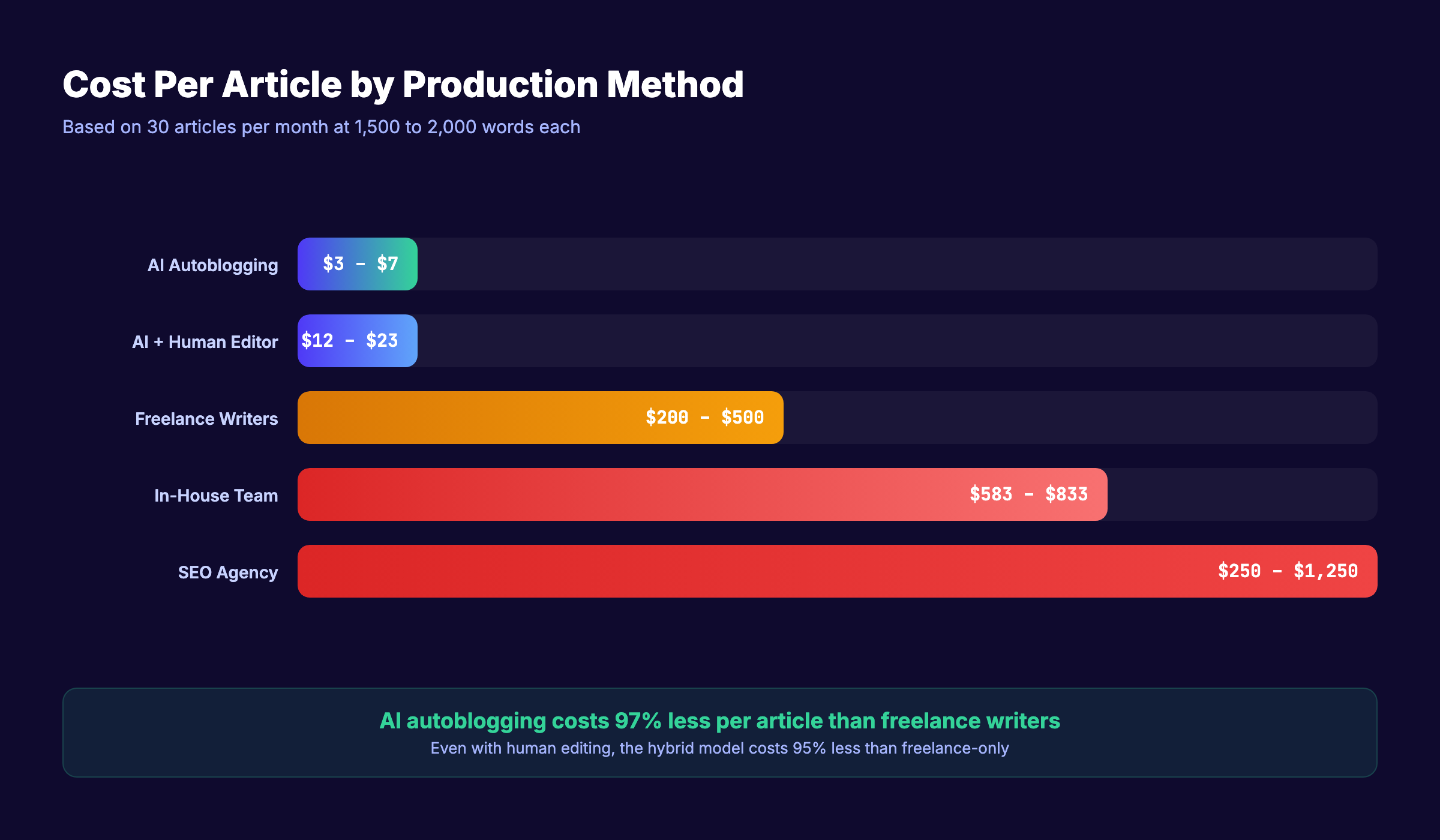
AI autoblogging costs 97% less per article than freelance writers. Even with a human editor reviewing every post, the hybrid model costs 95% less than a freelance-only approach.
These numbers explain why 68% of businesses report higher content marketing ROI after incorporating AI into their workflows.
Your SEO team. $99 per month. 30 optimized articles, published automatically. Start for $1 →
Time Investment: Hours Per Post
Cost is only half the equation. Time is the other half. And for most business owners, time is the more expensive resource.
Manual Content: 4 to 8 Hours Per Article
Here is where time goes for a single manually written blog post:
| Task | Time |
|---|---|
| Keyword research | 30 to 60 minutes |
| Competitor analysis | 20 to 40 minutes |
| Outlining | 20 to 30 minutes |
| Writing (1,500 to 2,000 words) | 2 to 4 hours |
| Editing and proofreading | 30 to 60 minutes |
| Image sourcing and creation | 20 to 40 minutes |
| CMS formatting and publishing | 15 to 30 minutes |
| Total | 4 to 8 hours |
At 30 articles per month, that is 120 to 240 hours of labor. One person working full-time (160 hours per month) cannot do it alone.
AI Autoblogging: 0 to 30 Minutes Per Article
Fully automated systems require zero time per article after initial setup. The platform handles keyword selection, writing, optimization, and publishing.
If you add a human review step, budget 15 to 30 minutes per article for quality checks. At 30 articles per month, that is 7.5 to 15 hours. One person can manage it alongside other responsibilities.
| Approach | Hours Per Article | Hours Per Month (30 Posts) |
|---|---|---|
| Full AI automation | 0 | 0 (after setup) |
| AI + human review | 0.25 to 0.5 | 7.5 to 15 |
| Manual (freelance) | 4 to 8 | 120 to 240 |
| Manual (in-house) | 5 to 10 | 150 to 300 |
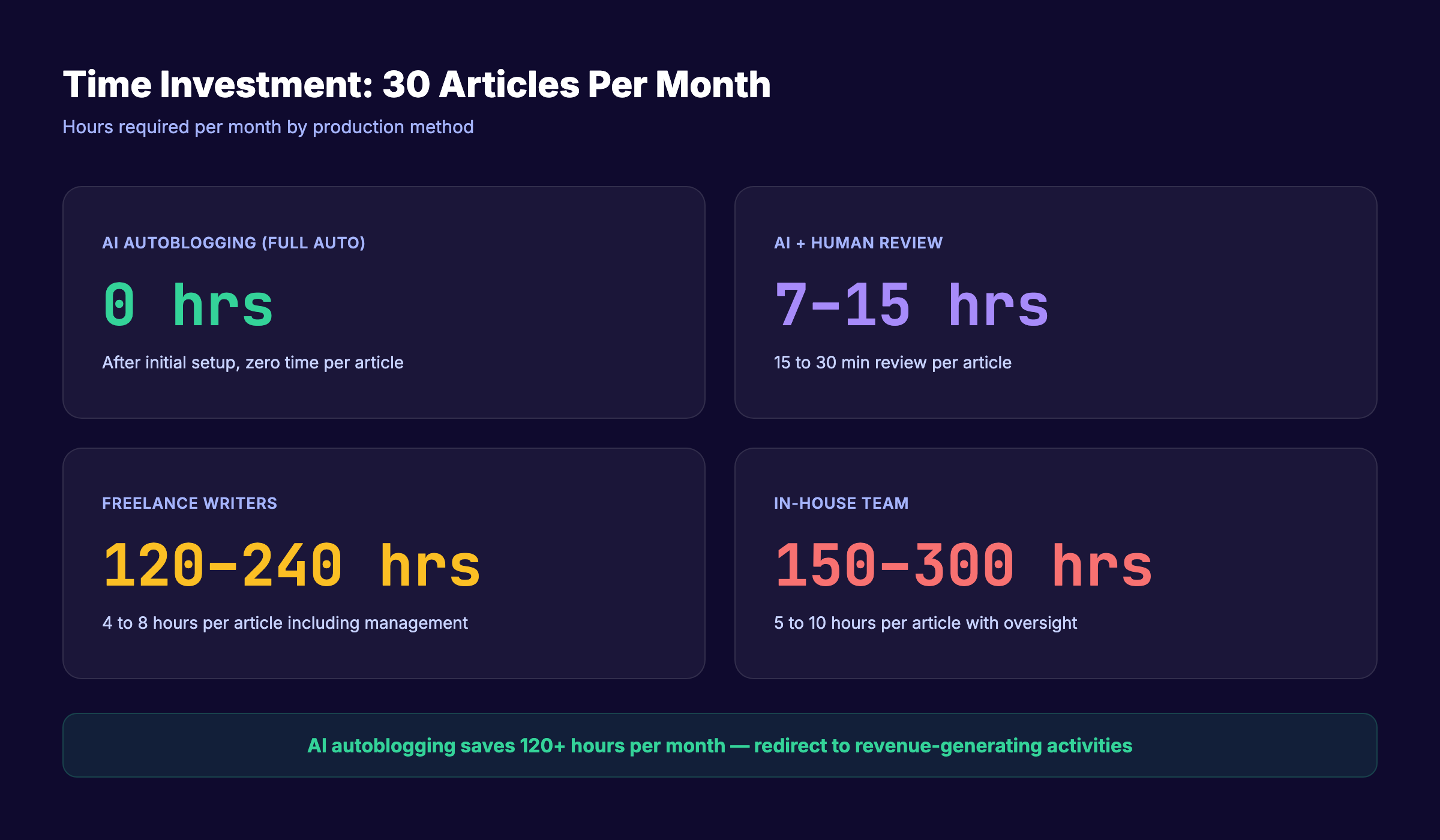
The time savings alone justify AI autoblogging for most businesses. Those 120+ hours per month redirect to sales, product development, or customer service. Activities that directly generate revenue.
Learn how to automate your entire SEO workflow beyond just content production.
Content Quality and SEO Performance
The biggest objection to AI autoblogging: “But the quality is worse.” This was true in 2023. It is less true in 2026.
What the Data Shows
A 2025 study by Ahrefs analyzed thousands of AI-generated articles ranking on page 1. Their findings:
- AI content ranks for the same keywords as human content when properly optimized
- The primary ranking factor remains search intent match, not whether a human or AI wrote the article
- E-E-A-T signals matter more than authorship method
Google’s official position: “Our focus is on the quality of content, rather than how content is produced.” This means AI content is not penalized for being AI content. It is penalized for being bad content. The same standard applies to human writing.
Where Manual Content Has a Quality Edge
Manual content wins on 3 specific dimensions:
- Original research. A human can conduct surveys, analyze proprietary data, and share first-person experience. AI cannot fabricate real data ethically.
- Expert interviews. Quoting industry experts by name with original perspectives builds authority that AI cannot replicate.
- Brand storytelling. Personal narratives, customer stories, and company-specific case studies require human involvement.
For these content types, manual production is not just better. It is the only option.
Where AI Autoblogging Matches or Beats Manual Content
AI performs equally well (sometimes better) for:
- How-to guides covering well-documented processes
- Listicles compiling tools, tips, or resources
- Statistical roundups citing published content marketing statistics
- Long-tail keyword articles targeting specific queries
- FAQ content answering common questions
These content types rely on accurate information synthesis, not original thought. AI excels at synthesis.
The companies seeing the best results use AI for 70 to 80% of their content (volume builders) and reserve manual effort for 20 to 30% (authority builders). More on this hybrid approach below.
3,500+ blogs published. 92% average SEO score. See what Stacc can do for your site. Start for $1 →
Scaling: Why Volume Matters More Than You Think
Here is a number that changes the ROI conversation: businesses need a minimum of 50 to 100 published posts to see meaningful organic traffic growth. Some competitive niches require 200+.
At 4 posts per month (the industry average), reaching 100 posts takes 25 months. At 30 posts per month with AI autoblogging, you reach 100 posts in 3.3 months.
That is not just faster. It is a fundamentally different competitive position.
The Compounding Effect of Volume
Blogging statistics show that companies with 400+ published posts get 2x more traffic than those with under 200. Each article is a new entry point. Each entry point captures a different search query. The math compounds.
| Publishing Pace | Time to 100 Posts | Time to 300 Posts | Estimated Monthly Cost |
|---|---|---|---|
| 4 posts/month (manual) | 25 months | 75 months | $800 to $2,000 |
| 15 posts/month (hybrid) | 6.7 months | 20 months | $1,500 to $3,000 |
| 30 posts/month (AI) | 3.3 months | 10 months | $99 to $199 |
| 80 posts/month (AI scale) | 1.25 months | 3.75 months | $199 |
The business publishing 30 posts per month reaches competitive volume in one quarter. The business publishing 4 posts per month reaches the same volume in over 2 years. During those 2 years, the faster publisher captures thousands of search queries, builds domain authority, and compounds traffic.
This is the Content Compound Effect. Consistent, high-volume publishing builds authority faster than occasional high-quality posts.
The Long-Tail Advantage
Most businesses focus on 10 to 20 “money keywords.” But 70% of all search traffic comes from long-tail queries. Those queries get 100 to 500 searches per month each. A freelance writer cannot justify a $300 article for a keyword with 200 monthly searches.
AI autoblogging makes those articles economical. At $3 to $7 per article, even a keyword with 100 monthly searches delivers positive ROI within 60 to 90 days. Multiply that across hundreds of long-tail articles and the traffic adds up.
Read our guide on keyword research for blog posts to identify the right long-tail targets.
The ROI Formula: Calculate Your Break-Even Point
ROI is not about cost per article. It is about revenue per article relative to cost. Here is the formula:
Content ROI = (Revenue from Organic Traffic - Content Production Cost) / Content Production Cost x 100
Sample ROI Calculation: Manual Content
- 30 articles per month at $300 each = $9,000 monthly spend
- Average article generates 150 organic visits per month after 6 months
- 30 articles x 150 visits = 4,500 monthly organic visits
- 2% conversion rate = 90 leads per month
- 5% close rate at $500 average deal = $2,250 monthly revenue
- ROI after 6 months: -75% (still negative, traffic has not compounded yet)
- ROI after 12 months: Traffic doubles as articles age. Revenue reaches $4,500. ROI: -50%.
- Break-even: 18 to 24 months
Sample ROI Calculation: AI Autoblogging
- 30 articles per month at $3.30 each = $99 monthly spend
- Same traffic assumptions: 150 visits per article after 6 months
- 4,500 monthly organic visits, 90 leads, $2,250 monthly revenue
- ROI after 6 months: +2,172% (revenue already exceeds cumulative spend)
- ROI after 12 months: +12,636%
- Break-even: Month 1 (production cost is so low that even minimal traffic covers it)
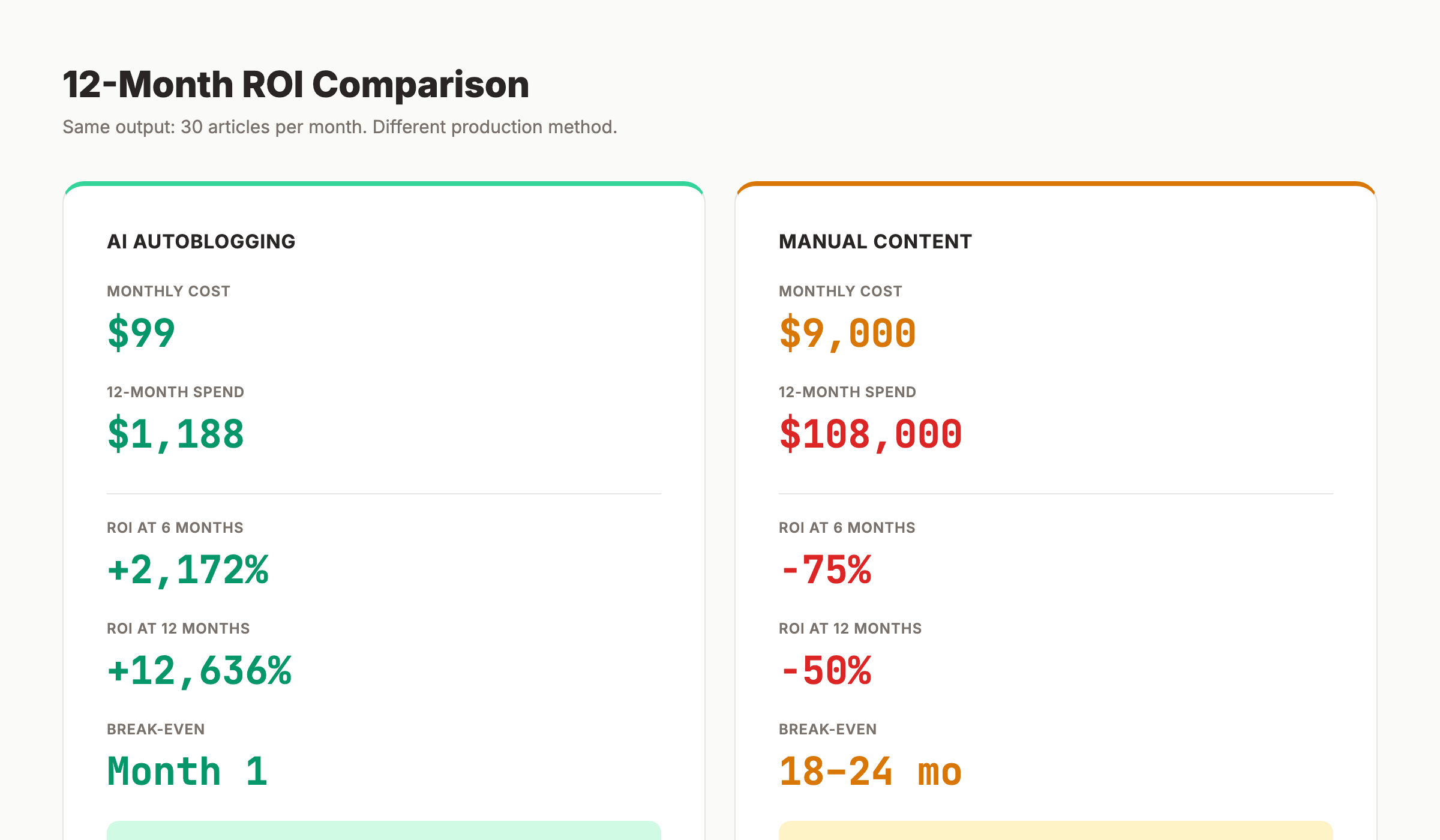
The ROI gap is not 2x or 5x. It is 50x to 100x in the first year. The reason: AI autoblogging slashes the denominator (cost) while keeping the numerator (traffic and revenue) roughly equivalent.
Even if AI content generates 30% less traffic per article than manual content, the cost difference is so extreme that AI autoblogging still wins on ROI by a wide margin.
When ROI Calculation Favors Manual Content
Manual content wins on ROI in exactly 2 scenarios:
- High-value commercial pages. A single “best [product category]” page that ranks #1 could generate $50,000+ in annual affiliate or lead revenue. A $500 expert-written article pays for itself 100x over.
- Link-earning content. Original research, data studies, and expert roundups attract backlinks. Backlinks raise domain authority. Domain authority lifts every page on your site. One viral study costing $2,000 to produce could earn 50+ backlinks worth $10,000+ in link value.
For everything else, the math favors automation.
Stop writing. Start ranking. Stacc publishes 30 SEO articles per month for $99. Start for $1 →
When Manual Content Still Wins
AI autoblogging is not a universal replacement. These situations still demand human writers:
YMYL Topics (Your Money or Your Life)
Medical advice, legal guidance, financial planning. Google applies stricter quality standards to these topics. A factual error in a health article could harm readers and destroy trust. Human experts must write and review YMYL content.
Thought Leadership and Brand Voice
If your CEO is building a personal brand, AI cannot replicate their voice, opinions, and lived experience. Thought leadership requires authentic perspective. Readers (and Google) can tell the difference.
Highly Regulated Industries
Healthcare, finance, and legal content often requires compliance review. The article must pass regulatory scrutiny. AI-generated content in these spaces introduces liability risk that most businesses cannot accept.
Link-Worthy Assets
Journalists and bloggers link to original research, not summarized information. If your content strategy depends on earning backlinks (and it should), you need at least some manually created assets. Read our guide on building backlinks for your blog to plan this component.
Customer Case Studies
Real results from real customers. Specific numbers, named companies, direct quotes. This content converts at 3 to 5x the rate of generic articles. It cannot be automated. Our guide on writing case studies covers the full process.
The Hybrid Model: Best of Both Approaches
The smartest content teams in 2026 do not choose between AI autoblogging and manual content. They use both. The hybrid model allocates each approach to its highest-value use case.
The 70/30 Split
- 70% AI autoblogging: Long-tail keywords, how-to guides, listicles, FAQ content, SEO content writing at scale
- 30% manual content: Original research, case studies, expert interviews, YMYL topics, link-earning assets
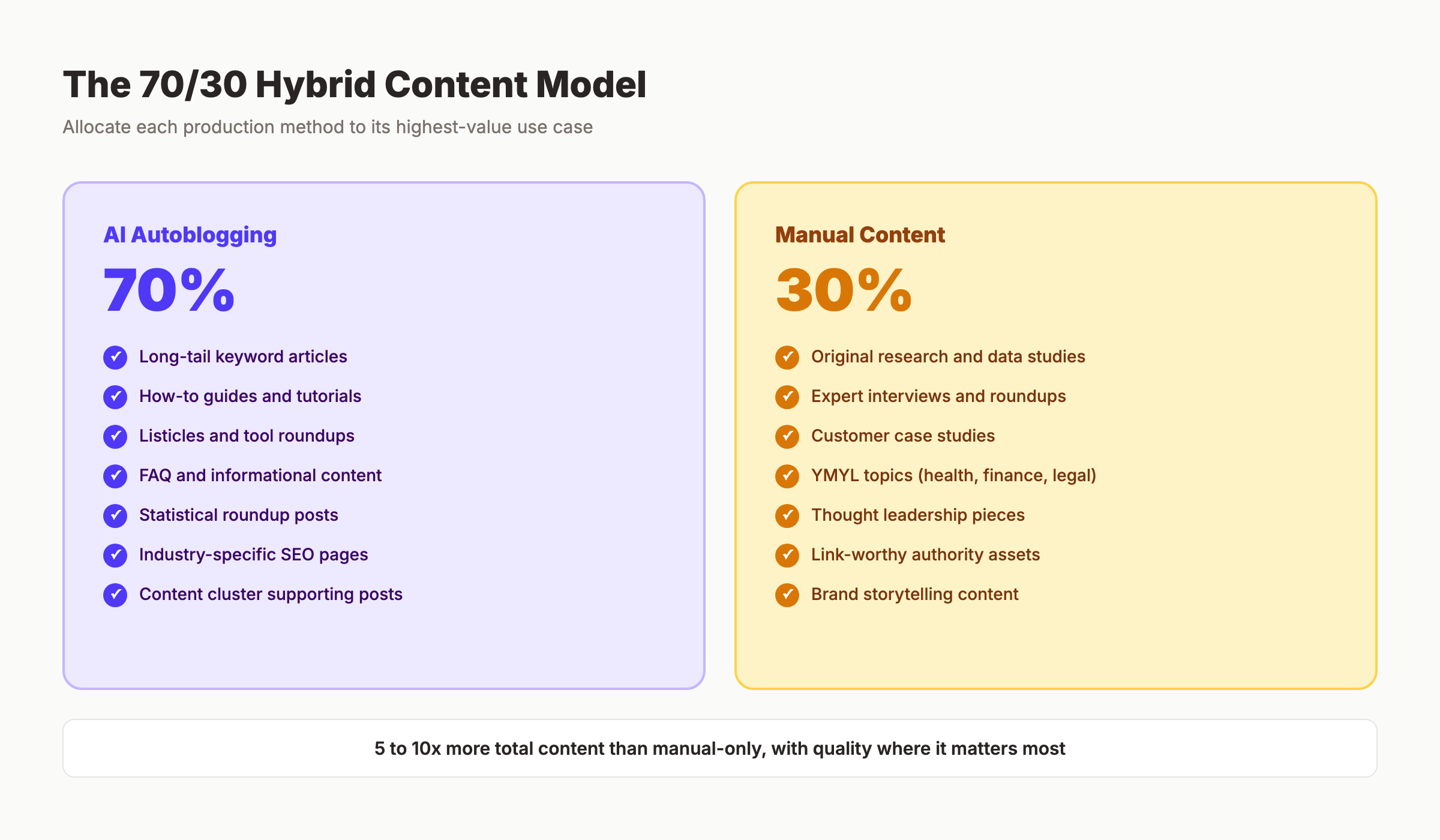
This split produces 5 to 10x more total content than a manual-only approach while maintaining quality where it matters most.
Hybrid Model Cost Comparison
| Component | Articles Per Month | Cost Per Article | Monthly Cost |
|---|---|---|---|
| AI autoblogging | 21 | $3.30 to $6.63 | $69 to $139 |
| Manual (mid-tier freelance) | 9 | $250 to $400 | $2,250 to $3,600 |
| Total | 30 | $77 to $125 avg | $2,319 to $3,739 |
Compare that to 30 fully manual articles at $7,500 to $15,000 per month. The hybrid model delivers the same volume at 70% lower cost with higher average quality for the articles that matter.
How to Decide Which Content Gets Human Treatment
Use this decision framework:
| Factor | AI Autoblogging | Manual Content |
|---|---|---|
| Search volume under 500 | Yes | No |
| Search volume over 2,000 | Maybe | Yes |
| Commercial intent (money keyword) | No | Yes |
| Informational intent | Yes | No |
| Requires original data | No | Yes |
| Long-tail keyword targeting | Yes | No |
| Link-building potential | No | Yes |
| YMYL topic | No | Yes |
| Brand voice critical | No | Yes |
For a deeper dive into content marketing strategy, read our complete guide.
Making AI Content Better With Human Touches
Even your AI-generated 70% improves with light human involvement:
- Add internal links to related content across your site. Follow our internal linking guide for best practices.
- Insert proprietary data where you have it. One unique stat per article elevates the entire piece.
- Humanize AI content by removing robotic patterns and adding natural sentence variation.
- Update quarterly. Refresh statistics, add new examples, and fix outdated information. Our guide on updating old blog posts covers the process.
How to Measure Your Content ROI
Tracking ROI requires connecting content production to business outcomes. Here is how to measure content marketing ROI for both AI and manual content:
Metrics That Matter
| Metric | What It Tells You | Tool |
|---|---|---|
| Organic traffic per post | Individual article performance | Google Search Console |
| Cost per organic visit | Efficiency of production method | (Monthly cost / monthly organic visits) |
| Lead conversion rate | Traffic quality | Google Analytics |
| Revenue per article | Direct ROI | CRM + Analytics |
| Time to rank | Speed of returns | Search Console |
| Domain authority growth | Long-term compound value | Ahrefs or Moz |
Setting Up Attribution
- Tag every blog post with its production method (AI or manual)
- Track organic traffic per post in Google Search Console
- Set up conversion goals in Google Analytics
- Calculate cost per lead by production method monthly
- Compare ROI quarterly (content needs 3 to 6 months to mature)
After 6 months of tracking, you will have clear data on which production method generates better returns for your specific business.
Rank everywhere. Do nothing. Blog SEO, Local SEO, and Social on autopilot. Start for $1 →
FAQ
Is AI autoblogging bad for SEO?
No. Google does not penalize AI content. Google penalizes low-quality content regardless of who (or what) wrote it. AI autoblogging tools in 2026 produce articles that meet Google’s quality standards when configured correctly. The key is proper keyword targeting, accurate information, and genuine value for readers.
How much does AI autoblogging cost per month?
Most AI autoblogging platforms range from $14 to $199 per month. At the lower end, you get basic article generation. At the higher end (like Stacc at $99 to $199 per month), you get 30 to 80 fully optimized articles written, formatted, and published directly to your CMS every month.
Can AI content rank on Google?
Yes. Thousands of AI-generated articles rank on page 1 of Google right now. The ranking factors that matter are search intent match, content depth, E-E-A-T signals, and backlink profile. Whether a human or AI wrote the words is not a ranking factor.
Should I use AI autoblogging or hire a writer?
Use both. AI autoblogging handles 70% of your content: long-tail keywords, how-to guides, and informational articles. Hire writers for the 20 to 30% that requires original research, expert interviews, or brand storytelling. This hybrid model maximizes volume and quality while keeping costs under control.
How long does it take for AI blog posts to rank?
AI blog posts follow the same timeline as manual content. Expect initial indexing within 1 to 2 weeks. Meaningful ranking movement starts at 60 to 90 days. Full maturity (stable rankings) takes 6 to 12 months. Publishing more content accelerates this timeline because Google crawls active sites more frequently.
Does Google penalize AI-generated content?
No. Google’s helpful content guidelines focus on content quality, not production method. The guidelines specifically state that AI use is acceptable as long as the content provides value to users. Thin, unhelpful, or spammy content gets penalized whether a human or AI created it.
The Bottom Line
AI autoblogging delivers 50x to 100x better ROI than manual content production for most article types. The cost gap is too large to ignore. The quality gap has closed.
But ROI is not the only factor. Brand authority, original research, and trust-building content still require human writers. The winning strategy combines both approaches.
Start with AI autoblogging for volume. Layer in manual content for authority. Measure everything. Adjust quarterly.
The businesses that figure out this balance in 2026 will own their search results for years to come. The ones still debating will keep publishing 4 posts per month and wondering why nothing ranks.
Written and published by Stacc. We publish 3,500+ articles per month across 70+ industries. All data verified against public sources as of March 2026.
