A 7-step playbook for AI UGC style content that ranks, converts, and still feels local. Covers tools, scripts, disclosure ethics, and the metrics to watch.
Last updated: May 2026
AI UGC content is short-form video in the style of a customer testimonial, produced with AI avatars or synthetic voice rather than filmed with a real customer. For a local business it fills the gap between no video at all and a production budget, provided every clip is disclosed honestly.
You run a roofing company in Tampa. Or a med spa in Phoenix. Or a wood-fire pizza spot in Brooklyn. You have seen the TikToks where a young woman holds a face cream and tells the camera how it changed her skin. The video has 412,000 views and a comment section full of buyers. You watched the same playbook work for a competitor 4 miles away. Now you want it for your shop. The problem is obvious. You do not have a creator. You do not have a studio. You do not even have a phone tripod that holds up past the second take.
This is the moment AI UGC style content local marketing was built for. The bar to produce a believable, on-brand, vertical video dropped from "hire a creator for 400 dollars" to "render a clip for 4 dollars" inside 18 months. Most local businesses still treat short-form video as a side project. The ones that turned AI UGC into a system this year are pulling away from the rest of their market.
We publish 3,500+ blog articles every month for businesses across 70+ industries, and the operators who pair their blog content with a steady drip of AI UGC clips compound faster than the ones running blog SEO alone. Here is what you will learn:
- What AI UGC actually is, and how it differs from traditional UGC and studio brand content
- The 7-step workflow we use to turn one customer pain point into 10+ vertical clips
- The exact 45-second script frame for AI UGC that converts on TikTok, Reels, and Shorts
- How to pick an AI avatar that feels like a local customer, not a corporate stock face
- The disclosure rules and ethics line every local business must hold
- A funnel model that connects a 30-second video to a booked job
- The metrics that decide whether to scale, kill, or refresh each clip
What AI UGC Style Content Actually Means
AI UGC style content is video that looks and sounds like a real customer testimonial but is generated by software. The avatar is synthetic. The voice is cloned or synthesized. The script was written by a human or a model and read by a digital actor. The B-roll might be stock, AI-generated, or your own phone footage. Stitched together, the clip lives inside the visual grammar of TikTok or Reels and signals "this is a real person who used this product" even though no person filmed it.
This is different from polished brand content. A studio ad telegraphs its production budget in the first frame. AI UGC tries to hide its seams. The whole point is that the viewer scrolls into a clip that feels like it came from their feed, not from a media buy.
It is also different from human UGC. A real creator brings lived experience, personality, and a relationship with their audience. An AI avatar brings infinite variations, no scheduling friction, and zero contract risk. The two formats are not interchangeable. They serve different jobs in the same funnel.
For a local business, the use case is narrow but powerful. You are not trying to manufacture a viral influencer. You are trying to flood your local feed with credible-feeling clips that move a viewer from "scrolling" to "booking the consult." That is a much lower bar than going viral. And it is exactly the bar AI UGC can clear at scale.
The 3 Defining Traits of AI UGC
The format is recognizable by 3 traits.
First, the talking head shot is the anchor. A single avatar speaks to the camera for most of the runtime. The framing is tight, the lighting is flat, and the cuts are minimal. This mimics the iPhone selfie aesthetic that real creators use.
Second, the script is written in first person and conversational tone. "I tried this for 30 days and here is what happened." Not "Our patented system delivers transformational results." The voice belongs to a fictional customer, not a brand spokesperson.
Third, supporting B-roll is short, specific, and proof-led. A close-up of the product. A receipt. A before and after. A peek at the storefront. The B-roll exists to validate the talking head, not to dazzle.
30 SEO articles plus 30 social clips per month. One subscription. theStacc publishes the blog content that ranks on Google and pairs it with social-ready clips your team can post to TikTok, Reels, and Shorts.
Why Local Businesses Need an AI UGC System in 2026
The economics shifted under everyone in 2024 and 2025. Three forces collided.
The first force was platform behavior. TikTok, Instagram Reels, and YouTube Shorts all leaned hard into recommendation feeds. Discovery no longer required a follower count. A clip filmed by a brand-new account in Tucson can land in front of 12,000 local viewers if the hook holds for 3 seconds. This is the opposite of the feed dynamics that ruled Facebook and Instagram from 2013 to 2020.
The second force was AI avatar quality. HeyGen, Synthesia, Creatify, and a wave of follow-ons closed the uncanny gap. The avatars in 2026 blink, breathe, and lip-sync with enough fidelity that 90% of casual viewers cannot tell the difference inside 8 seconds. The voice clones improved at the same rate.
The third force was the rising cost of human UGC. Demand for real creators surged. Quality creators in mid-sized cities now charge between $250 and $800 per video. For a roofing company that needs to test 14 hooks across 3 service areas, that math no longer pencils.
AI UGC sits in the middle of these forces. It costs $2 to $15 per clip. It can be rendered in under an hour. It can produce 20 variations of the same script with different avatars, voices, and pacing. For local operators trying to dominate a single metro feed, that is the right tool.
The Numbers Backing the Format
The conversion math has shifted along with the production math. UGC-style social posts converted at a 10.4x higher rate than non-UGC creative in Q3 2025, according to Archive's 30 UGC Marketing Statistics report. UGC-enabled product pages drive 161% higher conversion rates than pages without it. Ads with UGC capture 4x the click-through and 50% lower cost per click compared to non-UGC ads.
92% of consumers trust peer recommendations over brand messages. 84% trust a brand more when it features UGC in marketing. The format is not a trend. It is the default trust signal for buyers under 45.
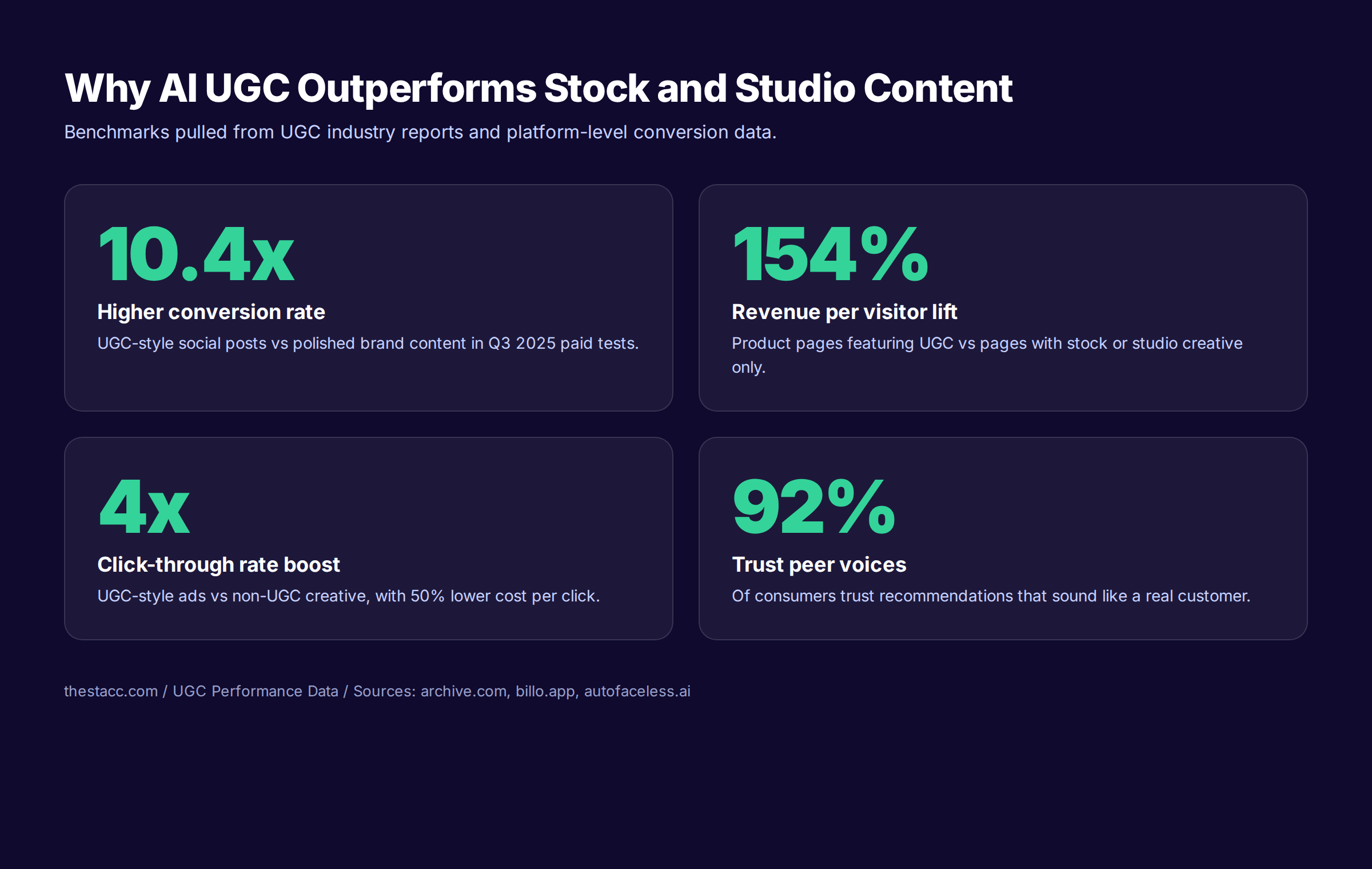
For local services, the format does something a national brand cannot easily replicate. A national brand cannot stamp a Phoenix neighborhood into every clip. A local operator can. That neighborhood specificity is the trust layer that lets AI UGC outperform studio content for local search and local feed.
Studio Brand vs Human UGC vs AI UGC: The Real Tradeoffs
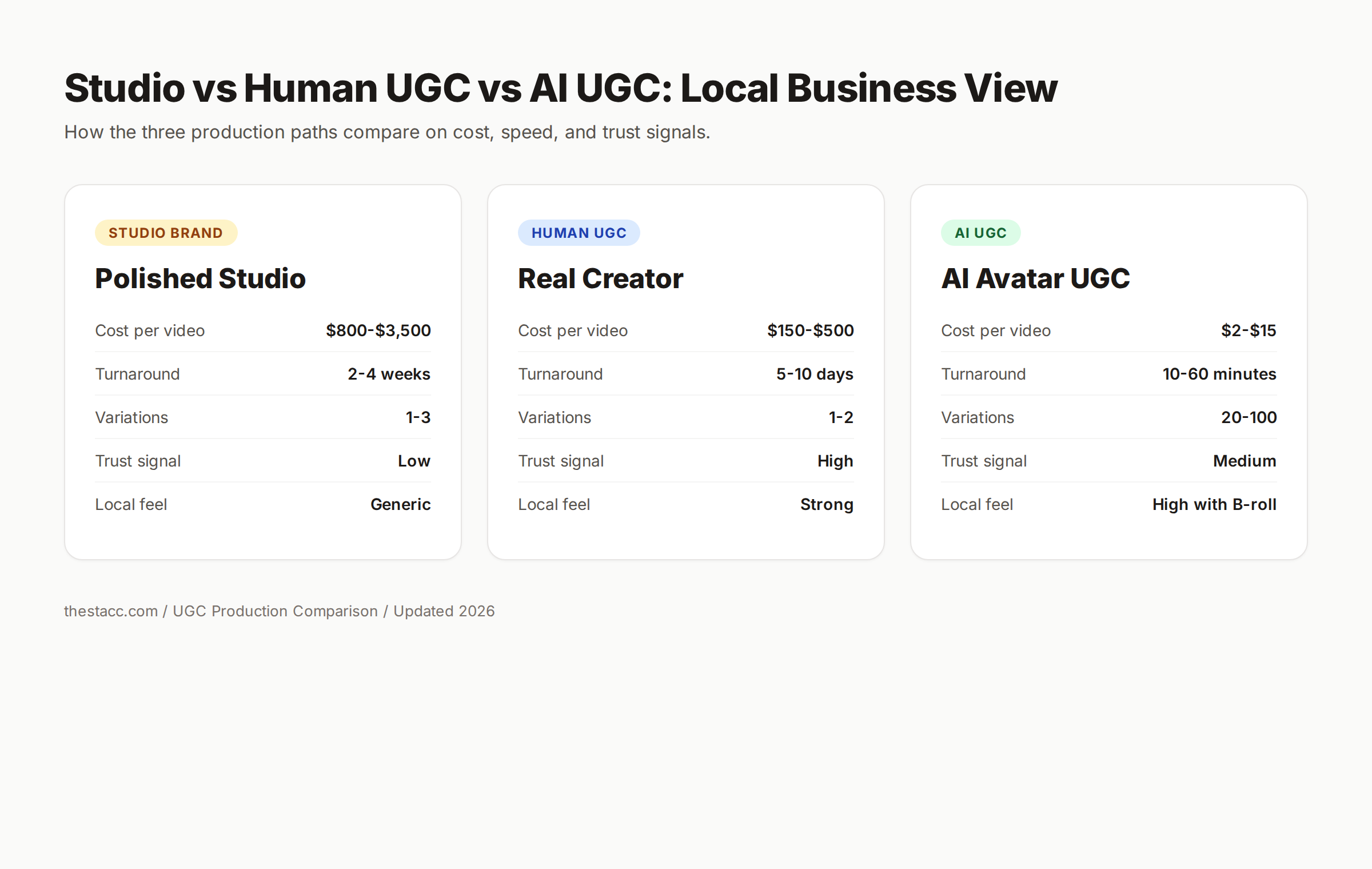
Most operators do not need to pick one. They need to know which lane fits which job. Here is the honest comparison.
| Dimension | Studio Brand | Human UGC | AI UGC |
|---|---|---|---|
| Cost per video | $800 - $3,500 | $150 - $500 | $2 - $15 |
| Turnaround | 2 - 4 weeks | 5 - 10 days | 10 - 60 minutes |
| Variations | 1 - 3 | 1 - 2 | 20 - 100 |
| Trust signal | Low for local | High | Medium |
| Scale ceiling | Capped by budget | Capped by creators | Effectively unlimited |
| Local flavor | Generic by default | Strong with vetting | High with local B-roll |
| Best job | Brand spots | Hero testimonials | Volume testing and feeds |
Use studio for the hero anthem video that lives on your homepage and pre-roll. Use human UGC for the 3 to 5 cornerstone testimonials that earn featured placement on your service pages. Use AI UGC for the daily feed. The daily feed is where local visibility compounds, and the daily feed is where AI UGC has the right cost curve.
A common mistake is treating AI UGC as a replacement for human UGC. It is not. The two formats run different races. Mixed in the right ratio, a local operator can ship 30 clips a month while still surfacing 4 genuine human stories. That is the stack that performs.
The 7-Step AI UGC Workflow for Local Business
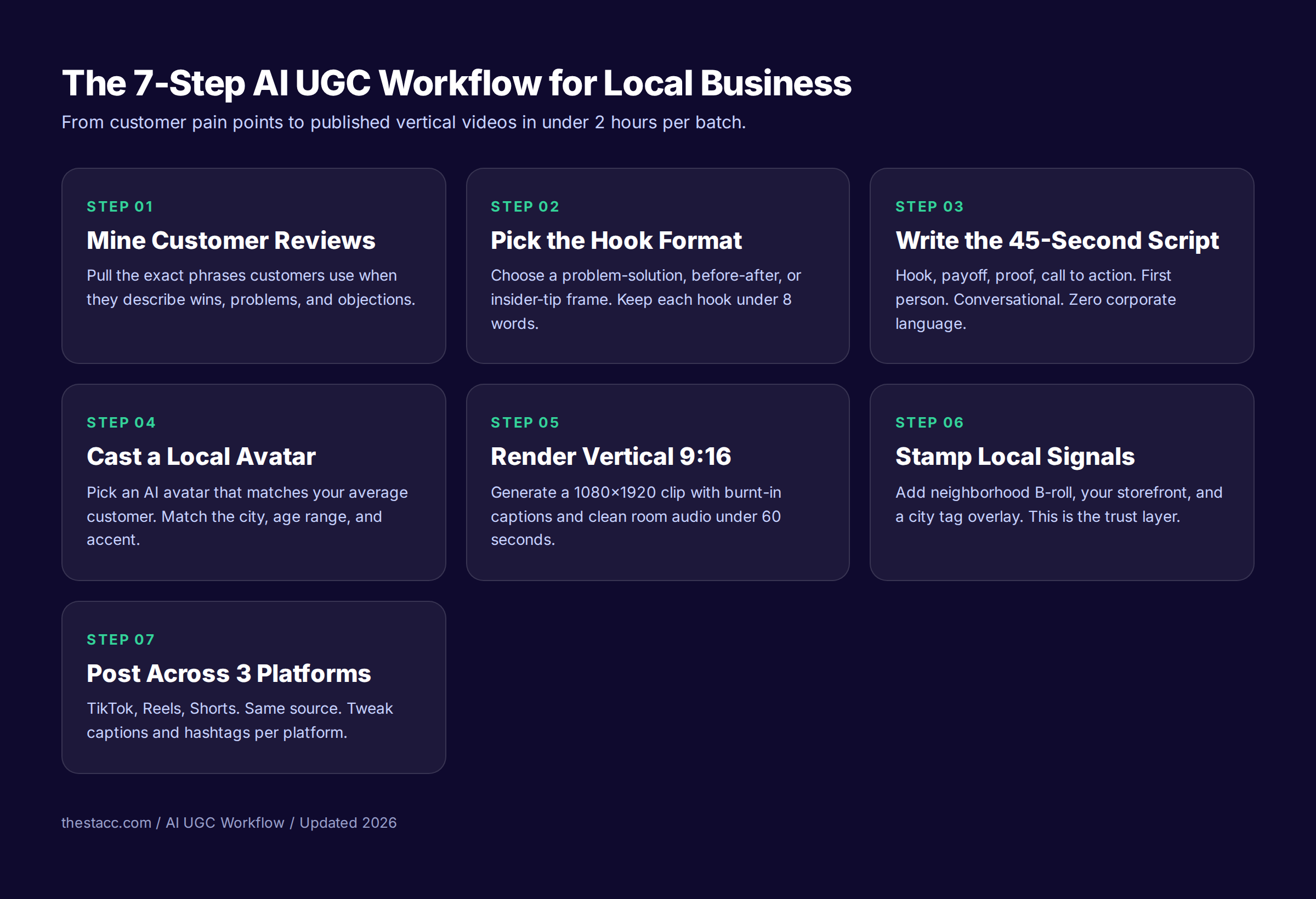
Every local team we have advised that turned this into a real channel uses some version of these 7 steps. The tools change. The sequence does not.
Step 1: Mine Customer Reviews for Raw Material
Open your Google Business Profile. Open your Yelp page. Open your Apple Business Connect listing. Pull every review from the last 12 months into a single document. Highlight the phrases that show emotion. Highlight the specific problems each customer was trying to solve. Highlight the comparisons they made with competitors.
This is your script bank. Every line a real customer wrote is a hook waiting to be repurposed. "I called 3 other roofers and none of them answered the phone" is a script. "I drove past this place 4 times before I walked in" is a script. Real customer language is the entire reason AI UGC can feel real.
Aim for 25 to 40 highlighted phrases per service line. A roofing company will pull different language from a storm damage review than from a routine inspection. Tag each phrase by job type, customer pain, and emotional tone.
Step 2: Pick the Hook Format
Every AI UGC clip uses one of 4 hook formats. Pick before you write.
The problem-solution hook opens with a pain. "My roof leaked for 3 weeks before anyone returned a call." This format works for service industries where customers shop on frustration.
The before-after hook opens with a contrast. "Six months ago my floors looked like this. Today they look like this." This format works for visual-result services like cleaning, landscaping, and home improvement.
The insider-tip hook opens with a counter-intuitive claim. "Most roofers in Tampa will not tell you this, but tile and shingle pricing is closer than the sales reps make it sound." This format works for high-consideration services where customers want to feel smarter.
The mistake-exposure hook opens with a regret. "I picked the cheapest quote for our HVAC install. Six months later I paid twice." This format works for any service where buyers are price-shopping.
Pick one format per clip. Do not mix.
Step 3: Write the 45-Second Script
Every AI UGC script follows the same skeleton.
Seconds 0 to 3: Hook. One sentence. First person. Visual or verbal pattern interrupt.
Seconds 3 to 12: Setup. Context for the hook. What was happening, why it mattered, what you tried first.
Seconds 12 to 30: Payoff. The discovery, the solution, the moment of relief. Show, do not tell, where possible.
Seconds 30 to 40: Proof. A stat, a receipt, a before-after, a third-party quote.
Seconds 40 to 45: Call to action. Single, specific, low-friction. "Tap the link." "Comment your zip code." "Book the free estimate."
Write the script before you touch the rendering tool. Do not let the tool draft the script for you. AI script generators produce hooks that sound like AI script generators. Pull your scripts from real customer reviews and write the connective tissue yourself. The blend matters.
The voice rule is simple. Write the way your customers talk. If they say "the guy" instead of "the technician," your script says "the guy." If they say "my place" instead of "my property," your script says "my place." This is the difference between AI UGC that scrolls past and AI UGC that holds the watch.
Step 4: Cast a Local-Feeling Avatar
Avatar selection is where most operators break the illusion. They pick an avatar that looks like a stock photo. The viewer's brain registers "this is an ad" inside 2 seconds and scrolls. The rule is to match the avatar to the customer, not to the brand.
Pick an avatar in the age range of your average customer. If your roofing customer is a 38-year-old homeowner, do not pick a 22-year-old influencer-styled avatar. Pick the 38-year-old in a t-shirt.
Match the city or region as best you can. Most AI UGC platforms now offer regional voice options. A Boston Irish accent reads different than a Houston drawl. Pick the voice that matches the city you serve. If the platform does not offer the right accent, use a neutral American voice and lean into city signals in the visuals.
Vary the avatar across your batch. Do not use the same face on 14 clips. The same face on 14 clips reads as a brand mascot, not a string of customers. Use 5 to 8 avatars in rotation across a month.
Step 5: Render Vertical with Burnt-In Captions
Render to 1080 by 1920 pixels at 9:16 ratio. This is the universal vertical spec for TikTok, Reels, and Shorts. Most AI UGC platforms default to this. Confirm before you export.
Burn captions into the video. Do not rely on platform-generated captions. 85% of feed viewing happens with the sound off. If the captions arrive 200 milliseconds late or land in a weird font, your hook misses. Use a caption style that matches the platform conventions. White text, black drop shadow, large font, centered on the bottom third.
Keep total runtime under 45 seconds. Drop-off climbs sharply past the 45 second mark. The platform algorithms reward completion. A 60-second clip that 40% of viewers complete loses to a 32-second clip that 70% of viewers complete.
Step 6: Stamp Local Signals in Frame
This is the step most generic AI UGC skips, and it is the step that separates a local-feeling clip from a content mill clip.
Add a city tag overlay in the first 2 seconds. "Tampa, FL." "Brooklyn, NY." Small text, top-left or bottom-right. This signals to the viewer that this clip is about their market.
Cut in 2 to 3 seconds of B-roll from your actual storefront, service vehicle, or job site. A 5-second clip of your truck pulling into a driveway, with the city skyline behind it, is worth more than 20 seconds of avatar talking head. Shoot this B-roll once with your phone. Reuse it across dozens of clips.
Reference a neighborhood, a landmark, or a local quirk in the script. "We had a leak right after the Bayshore renovation finished" lands harder than "We had a leak last spring." Local specifics raise the credibility floor.
If you serve a metro with multiple sub-markets, render variations for each. The same script with different city tags and different B-roll converts independently in each sub-market.
Step 7: Post Across 3 Platforms with Native Tweaks
The render is one. The publish is three. TikTok, Instagram Reels, and YouTube Shorts each reward slightly different metadata.
For TikTok, write captions of 100 to 150 characters with a question. Use 3 to 5 hashtags including 1 city tag, 1 service tag, and 1 broad reach tag. Post between 6 PM and 10 PM local time on weekdays for service businesses.
For Reels, the caption can run longer. 200 to 400 characters works. Use the location tag feature, which is stronger on Reels than on TikTok. Pin a related Reel to the top of your grid for new profile visitors.
For Shorts, the title matters more than the caption. Front-load the search intent. "Tampa roof leak repair: 3 mistakes I made" outperforms "My roof story" by an order of magnitude. Add 1 to 2 hashtags and a clean description.
Same source clip. Three publishes. Three signal sets. This is the blog-to-social-videos-with-AI discipline applied to AI UGC.
The 45-Second AI UGC Script Frame: Copy and Customize
Use this exact frame as a starting point. Swap the bracketed variables for your business.
[0-3s] HOOK
"I called [number] [service category] in [city] and none of them
returned the call. Here is what finally worked."

[3-12s] SETUP
"My [problem object] started [problem event] around [time
reference]. I figured I had a couple weeks. I was wrong. By
[escalation event], I was in trouble."

[12-30s] PAYOFF
"A neighbor told me to call [business name]. They picked up
on the first ring. [Specific action they took]. They were
at my place in [time]. They fixed it for [price reference]."

[30-40s] PROOF
"Six months later, [proof statement]. The [outcome] looks
[descriptor]. Here is the [receipt / photo / before-after]."

[40-45s] CTA
"If you are in [city] and dealing with [problem], tap the
link. They do a free [estimate / consultation]."
This is a working frame. It is not a finished script. Customize the language, the pacing, and the city-specific references. The frame exists to make sure your hook hits at second 3, your payoff lands by second 30, and your CTA closes at second 45.
Sample Script: Tampa Roofing
"I called 4 roofers in Tampa and only one called me back.
My roof started leaking the night before the storm.
By morning, water was hitting the kitchen counter.

A guy at my gym told me about Bayshore Roofing.
They answered at 7 AM on a Saturday.
They had a tarp on my roof by 11.

Full replacement cost me $14,200. Insurance covered $11,800.
Six months later, no leaks, no callbacks.

If you live in Tampa and your roof is acting up, tap the link.
They do a free inspection."
41 seconds when read at conversational pace. Hook at second 3. Payoff at second 25. Proof at second 33. CTA at second 38. Numbers are concrete. Location is specific. The avatar reads it in first person.
How to Pick the Right AI UGC Tool for Local Business
The tool market in 2026 has consolidated around 4 categories. Pick by job.
Avatar-First Platforms
HeyGen and Synthesia lead this category. The strength is realistic avatar quality and broad voice libraries. Pricing starts around $29 per month and scales with rendered minutes. Use these when avatar believability is the highest priority.
Avatar-first platforms are the right pick for a local services brand that wants to test 8 to 12 avatars across a year and refine which face converts in their market. They are not the right pick if you need 200 variations a month at the lowest possible cost.
UGC-Ad-Optimized Platforms
Creatify, MakeUGC, and Bandy specialize in the UGC ad format. They include native templates for hook formats, built-in B-roll libraries, and direct export options for TikTok and Meta ad managers. Pricing starts around $39 per month.
Use these when your goal is paid ad performance, not organic feed presence. The platforms are tuned for click-through optimization. The avatars are slightly less polished than HeyGen but the workflow is tighter for ad-specific creative.
Script-to-Video Platforms
InVideo, Pictory, and Pollo AI sit in the broader script-to-video category. They produce UGC-style clips but are not exclusively focused on the format. Pricing varies widely, from free tiers to $79 per month for pro features.
Use these when your team also produces explainer, list-style, or stock-driven content. The single subscription covers multiple formats. The tradeoff is that the UGC output is competent but not category-leading.
Free and Open-Source Options
Several free AI UGC generators emerged in 2025. Quality is uneven. Watermarks are common. Rendering queues stretch into hours during peak times. Use these only to test the format before committing budget. Once you know the format works for your market, upgrade to a paid platform with API access.
Our advice for a local business starting from zero: pick HeyGen for avatar quality, run 20 clips in the first month, and decide from real metrics whether to scale or switch. Do not platform-shop for 6 weeks before publishing your first clip.
Stop platform-shopping. Start publishing. theStacc plans, writes, and publishes SEO blog posts and social clips for you. We pick the tools. You get the content.
The Local AI UGC Funnel: From Feed to Booked Job
A clip is not the goal. A booked job is the goal. Here is the funnel that connects the two.
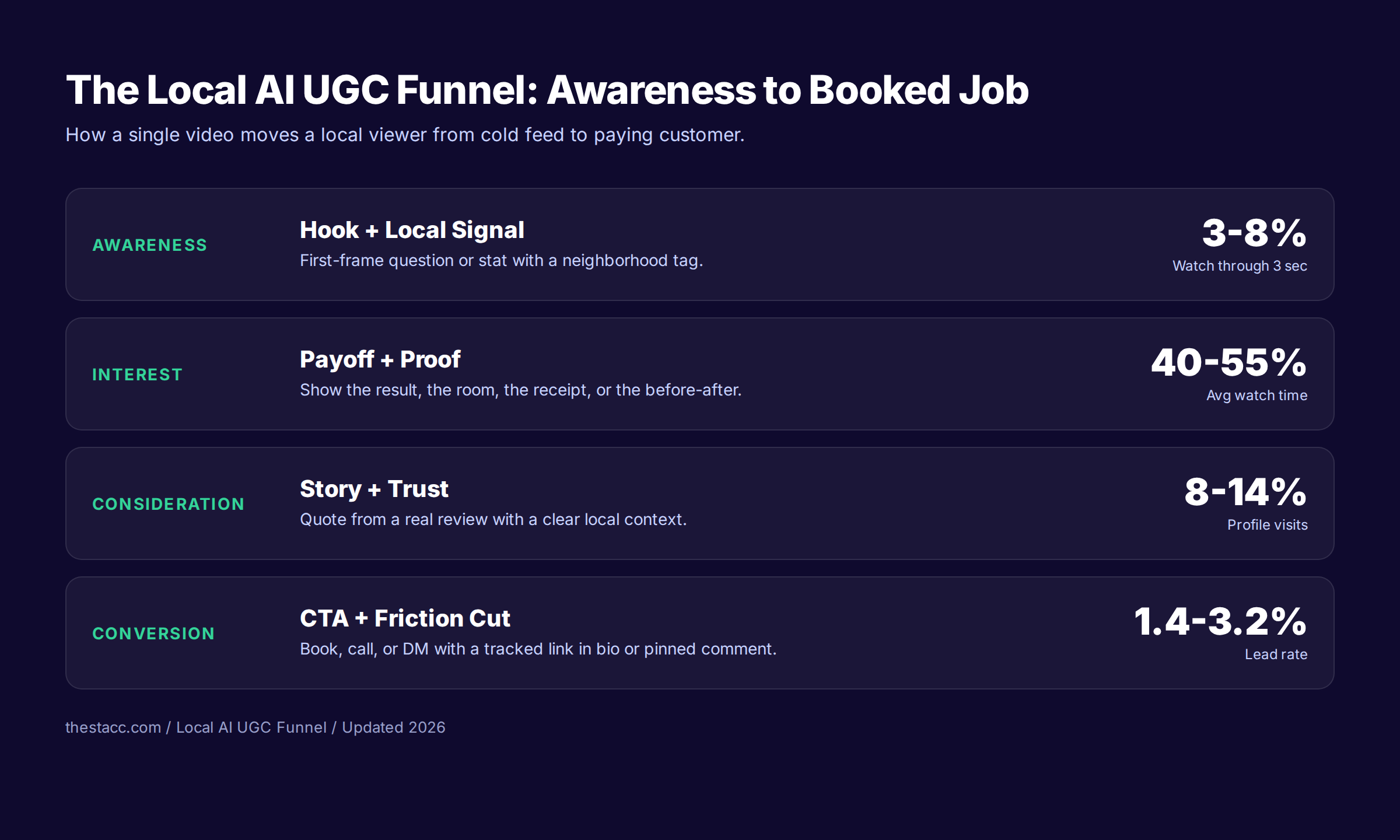
At the awareness stage, your clip enters a feed. Watch-through past 3 seconds is the first gate. 3% to 8% is the realistic band for local UGC. Below 3%, your hook is the problem. Above 8%, you have a winner worth scaling.
At the interest stage, average watch time is the gate. 40% to 55% of total duration is the realistic band. This number tells you whether the body of the clip is delivering on the hook. If the hook lands but the watch time drops to 22%, the middle of the script is dead.
At the consideration stage, profile visits are the gate. 8% to 14% of viewers who complete the video will tap into your profile. This is where your pinned content, your bio link, and your latest posts decide whether the visit converts to a follow or a click out.
At the conversion stage, the lead rate is the gate. 1.4% to 3.2% of viewers turn into a booked consultation, a phone call, or a form submission. This is the number that decides ROI.
A clip that converts at 2% on 8,000 views is 160 leads. At a 12% close rate, that is 19 jobs. For a roofing company, 19 jobs is a quarter's worth of revenue from a single clip rendered for under $10. The math is why this format exists.
Tracking the Funnel End to End
Every clip gets a UTM-tagged link. Every clip's view, completion, profile visit, and click is logged. Every booking is tagged at the form level with the source.
Without tracking, you cannot decide which clips to scale. With tracking, you can kill 8 underperformers a month and double down on the 2 winners. That is the loop that turns AI UGC into a real channel instead of a content treadmill.
The Ethics and Disclosure Line for AI UGC
This is the part most operators want to skip. Do not skip it. The line you hold here decides whether your channel survives the next 2 years of platform tightening and FTC enforcement.
The 3 Rules That Are Not Optional
First, never invent a testimonial. An AI avatar reading a script that claims a fictional customer outcome is fraud. An AI avatar reading a script that paraphrases a real customer's review, with that customer's consent or with anonymized framing, is acceptable. The line is the underlying truth, not the medium.
Second, disclose where the platform requires it. TikTok requires AI-generated label tagging for clips that depict realistic scenarios. Instagram and YouTube have parallel rules. Mark every AI avatar clip with the appropriate label inside the platform's tool. This is non-negotiable.
Third, do not impersonate a specific real person. Cloning the face or voice of a real customer without explicit written consent is a lawsuit waiting to happen. Use the platform's library of synthetic avatars. Stay away from look-alikes of celebrities, competitors, or anyone the viewer might recognize.
The FTC's stance on AI-generated reviews tightened sharply in 2024 and 2025. A fake testimonial reading "I lost 30 pounds in 30 days" is the same violation whether it was filmed with a human or rendered with an avatar. The medium does not protect you. Only the underlying truth does.
For more on disclosure rules for AI video advertising, see our guide on AI video ad disclosure.
The Trust Bank
A local business runs on trust. Trust is built over years and destroyed in days. AI UGC is a fast channel. Speed without ethics turns into reputation damage. Speed with ethics turns into a compounding advantage.
The operators we work with treat their AI UGC scripts the way a publisher treats editorial copy. Every claim is sourced. Every outcome is real. Every avatar is disclosed. The format is fast. The discipline is slow.
The 10-Point AI UGC Quality Checklist
Before any clip goes live, it passes through these 10 gates. Skip a gate, kill the clip.
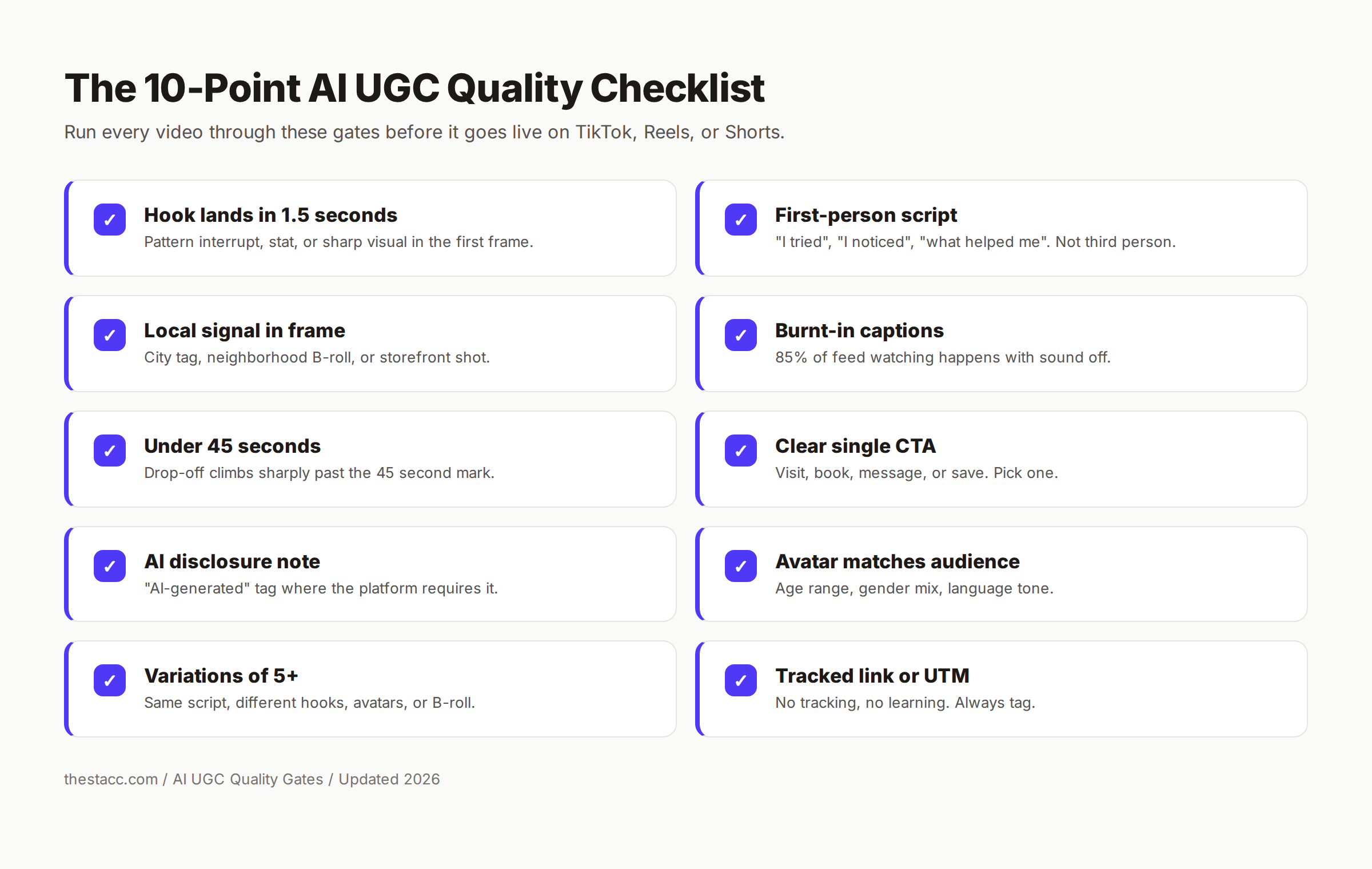
- ✓ Hook lands a pattern interrupt in the first 1.5 seconds
- ✓ Script is written in first person with conversational tone
- ✓ City, neighborhood, or storefront signal appears in frame
- ✓ Captions are burnt in, not platform-generated
- ✓ Total runtime stays under 45 seconds
- ✓ Single call to action, low friction, specific
- ✓ AI-generated label is applied per platform rules
- ✓ Avatar age range and voice match the target customer
- ✓ At least 5 variations of the same script are in the batch
- ✓ Tracked link or UTM is in place before publish
This checklist is also the editorial standard we apply to every social asset we produce for clients. The list is short on purpose. Every item is load-bearing.
Common Mistakes Local Businesses Make with AI UGC
These are the 7 patterns we see most often. Each one is fixable in one batch.
Mistake 1: Using the Same Avatar on Every Clip
A single repeated avatar across 30 clips reads as a brand mascot. The viewer's brain files it under "this is a company" and trust drops. Rotate 5 to 8 avatars across a month. The variety is what sells the UGC illusion.
Mistake 2: Letting the AI Tool Write the Script
AI script generators write in AI cadence. The sentences are too even. The metaphors are too tidy. Real customer reviews are messy, specific, and full of grammar errors. Mine your reviews for raw language. Let the AI render the read, not the write.
Mistake 3: Skipping the Local B-Roll
A talking head against a generic apartment background converts at half the rate of a talking head with 3 seconds of your actual storefront cut in. Shoot phone B-roll once. Reuse across dozens of clips. This is the lowest-effort, highest-return habit in the workflow.
Mistake 4: Posting Once Per Platform Per Week
The platforms reward consistency. A clip a day on TikTok beats 3 clips a week. The marginal cost of a second clip with AI UGC is close to zero. The marginal benefit is high. Post daily across all three platforms during the first 60 days. Adjust frequency based on data, not on team fatigue.
Mistake 5: Mixing Studio and UGC in the Same Clip
A clip that opens with an AI avatar selfie and cuts to a polished agency-shot product reel breaks the format. The viewer registers the seam and drops. Pick one production language per clip and hold it.
Mistake 6: Hiding the AI Disclosure
Burying the AI-generated label in the platform's secondary metadata may pass the letter of the rule but it fails the spirit. Newer viewers under 30 are increasingly comfortable with AI content. Hiding the disclosure signals that you are uncomfortable with it. Display the label clearly. The comfort moves trust forward.
Mistake 7: Not Pairing AI UGC with Blog SEO
A viewer who watches a 30-second AI UGC clip in Tampa and then Googles "Tampa roof leak repair" needs to find your blog at the top. If the clip wins the awareness round but the blog loses the search round, the conversion never closes. Pair every AI UGC campaign with a local content SEO program that owns the search side. The two channels compound.
For more on building a paired video and blog system, read our blog post to social videos guide.
Industry Examples: AI UGC for 5 Local Verticals
The format adapts to most local categories. Here are the angles we see working in 5 of them.
Home Services
Roofing, HVAC, plumbing, electrical, and pest control. The AI UGC angle is mistake-exposure or problem-solution. Customers are price-shopping under stress. A clip that says "the cheap quote cost me twice" cuts through. Pair with the home services SEO playbook.
Med Spa and Aesthetics
Botox, lasers, body contouring. The AI UGC angle is before-after with an emphasis on the journey. A 45-second clip showing day 0, day 14, and day 90 with a first-person voiceover converts at 2x the rate of a static results gallery. Disclosure matters more here than in other verticals because of FDA-adjacent claims.
Restaurants and Bars
The AI UGC angle is insider-tip. "Most people order the wood-fire pizza here, but the off-menu carbonara is the move." Local food TikTok is already a mature ecosystem. AI UGC inserts your spot into the same visual conversation without paying a creator.
Fitness and Personal Training
The AI UGC angle is mistake-exposure. "I trained at 4 gyms in this neighborhood and only one fixed my back pain." The format aligns with the existing fitness creator language. Avatars in workout clothing with gym B-roll feel native to the feed.
Legal and Financial Services
The angle is insider-tip with strict compliance review. "Most personal injury attorneys in this city take 40% of your settlement. Here is what to ask before you sign." High-trust industries need the most careful disclosure. The format works when the script is reviewed by legal counsel before render.
Building the Monthly AI UGC Calendar
A working calendar runs on a 30-clip month. Break it down by week.
| Week | Clips | Focus |
|---|---|---|
| Week 1 | 8 clips | Problem-solution hooks across top 3 service lines |
| Week 2 | 8 clips | Before-after hooks with B-roll proof |
| Week 3 | 8 clips | Insider-tip hooks targeting comparison queries |
| Week 4 | 6 clips | Mistake-exposure hooks with high-friction CTAs |
Each week is rendered in a single batch session. The batch session takes 90 to 120 minutes when the script bank from step 1 is mature. Posting is automated through the platform's native scheduler or a tool like Buffer or Later.
The 30-clip month produces roughly 220,000 to 480,000 impressions for a local business in a mid-sized metro after the first 60 days of audience training. That is the band we have seen across the operators we have advised.
Pair the social calendar with a blog content calendar and the two channels reinforce each other. The blog post earns Google ranking. The clip earns feed reach. The viewer ends up at the same booking form.
Measuring AI UGC: The 4 Metrics That Matter
Vanity metrics will drown you. These are the only 4 numbers that drive decisions.
1. Three-Second Hold Rate
The percent of viewers who watch past the 3-second mark. This is the hook quality score. Above 60% on TikTok and 50% on Reels is strong. Below 40% means the hook is dead and the clip should be re-cut, not boosted.
2. Average Watch Time
The mean seconds watched across all viewers. Compare to total runtime. If your 42-second clip averages 28 seconds of watch time, you held 66%. Above 60% completion is the band that earns algorithm distribution.
3. Profile Click Rate
The percent of viewers who tap into your profile from the clip. Above 8% is strong for a service business. Below 4% means the clip is consumed but does not create curiosity about the business. The CTA is doing the wrong job.
4. Tracked Lead Rate
The percent of viewers who become a tracked lead. UTM-tagged link clicks that convert into a form, a call, or a booking. Above 1.5% is strong. Below 0.8% means the clip is generating views without intent.
Track these 4 metrics weekly. Kill the bottom 20% of clips. Scale the top 10% with paid amplification. The middle holds. This is the loop that turns AI UGC into a real channel.
For broader social measurement, see our content marketing metrics guide.
When AI UGC Is Not the Right Tool
This is the section most playbooks skip. AI UGC is not the right answer in 3 scenarios.
First, when your audience is over 60. Trust in AI-generated content drops sharply in older demographics. Senior services, retirement planning, Medicare supplemental insurance, and senior-care home builds convert better with human UGC or studio content.
Second, when your service is a one-time, high-trust purchase over $25,000. Custom home building, full kitchen remodels, complex legal cases. The buyer wants to see and feel a real person. AI UGC can support the funnel at the awareness layer but cannot close the consideration stage alone.
Third, when your brand is built on a single founder personality. If you are a solo therapist, a single-name personal trainer, or a personality-led restaurant, the audience came for you. Replacing your face with an avatar dilutes the brand. Use AI UGC for B-roll, supplementary content, or text-on-screen formats, not for the talking head.
In every other scenario, AI UGC earns a seat at the channel mix. The discipline is knowing which job each clip is doing and pairing it with the rest of your local marketing.
What practitioners are saying on X
Content operations advice ages quickly. Here is high-signal operator discussion on X about quality, refresh, and systems.
- @jakezward (Feb 2026): 2026 SEO predictions emphasize AI Overview share-of-SERP, schema for LLM token efficiency, brand mentions in AI answers as a KPI, proprietary data as a moat, and content refresh beating net-new AI slop. See the post on X.
- @varunram (Jul 2026): Critique of GEO slopfarm products that combine SEO clickbait with unresearched content marketing — quality and research still separate winners from farms. See the post on X.
- @HlynurStefDev (Jul 2026): Public case: niche site traffic jumped from ~18 to 4,162 Google visits/month after focused technical/on-page SEO work (GSC screenshots claimed) — reminds that fundamentals still move numbers. See the post on X.
Grok, AI Overviews, and multi-engine visibility
Local topics like “ai ugc content local business” get cited when GBP, NAP, reviews, and service-area steps are concrete. Grok mixes those web facts with Map Pack operator advice circulating on X.
- Google AI Overviews: Use passage-ready answers, tables, and FAQ schema where relevant.
- ChatGPT / Perplexity: Cite named sources next to key claims.
- Grok: Maintain accurate entity facts on-site and in high-signal X posts.
Rank higher in the Map Pack without a full-time local SEO hire. theStacc’s Local SEO module handles daily GBP posts, review reply workflows, and local visibility tracking — built for service businesses that need calls, not vanity rankings.
Frequently Asked Questions
Yes, with limits. The format converts when the script is rooted in real customer language, the avatar matches the target customer, and local signals show up in frame. Tests run in 2024 and 2025 showed AI UGC converting within 70% to 90% of the conversion rate of equivalent human UGC, at one-tenth the cost. For local feeds, the cost advantage usually outweighs the small conversion gap.
Generally yes, with disclosure. Most jurisdictions allow AI-generated marketing content as long as it is labeled per platform rules and does not misrepresent a real person or invent customer outcomes. The FTC actively enforces against fabricated testimonials whether produced by humans or AI. Always disclose, always source claims, and never impersonate a real customer.
HeyGen for avatar quality, Creatify for ad workflow, and InVideo for mixed format teams. The right pick depends on whether you prioritize avatar believability, ad performance tuning, or single-subscription coverage of multiple content formats. Start with HeyGen if you are new to the format. Switch when you have data.
Traditional UGC is content filmed and posted by real customers or creators. AI UGC is content rendered to look like real customer content but produced entirely by software. The visual grammar is the same. The production cost is dramatically different. The trust signal is slightly lower for AI UGC, which is why it works best at scale rather than as a hero testimonial.
20 to 30 clips per month is the working range. Below 20, you cannot generate enough algorithm signal to compound. Above 30, fatigue sets in for both the team and the audience. The sweet spot is 7 to 8 clips per week across TikTok, Reels, and Shorts, distributed daily.
No, when paired with a strong blog and local SEO foundation. The social channel and the search channel run on separate signals. AI UGC drives feed discovery. Blog SEO and local SEO drive search discovery. The buyer travels between the two. Neglecting one weakens the other. Run both.
The Bottom Line
AI UGC style content local marketing is no longer a frontier tactic. It is the default feed-discovery channel for local businesses in 2026. The economics, the platform behavior, and the avatar quality all align in the same direction.
The operators who win are the ones who treat AI UGC as a system, not as a stunt. They mine reviews for raw language. They write scripts in first person. They cast avatars that match their customers. They stamp local signals into every frame. They disclose. They measure. They pair the feed channel with a blog channel that owns the search side.
You can run that system in-house with a script bank, a $29 monthly tool subscription, and 8 hours a month of editorial time. Or you can offload the whole stack and focus on running your business. Either way, the time to start is this month, not next quarter.
We publish the blogs. We pair them with social-ready content. The combined system is how local businesses pull away from competitors who still treat content as a side project.
Sources cited in this guide:
- Archive: 30 UGC Marketing Statistics Every Brand Should Know in 2026
- Billo: 55+ UGC Statistics 2026
- InVideo: UGC vs AIGC vs AI-UGC
- Cohley: Why 2026 Is The Year UGC Becomes Your Most Reliable Revenue Engine
Related Tools & Resources
Free SEO Tools:
Best Lists:
Sources & references
- [1] Princeton / Georgia Tech et al. — GEO research (arXiv:2311.09735)
- [2] @noelcetaSEO on X — Local SEO playbook still centers complete GBP, NAP consistency, quality citations, local keywords, location content, rev
- [3] @irentdumpsters on X — Most businesses have a GBP; few fully optimize every ranking-relevant section for Map Pack visibility.
- [4] @EldarCohenSEO on X — 2026 WhiteSpark-oriented reminder: primary Google Business category is a top Map Pack ranking factor — wrong primary cat
- [5] Referenced source — archive.com

Researched, written, and published articles that compound organic traffic.
Weekly local SEO teardowns
One practical email a week. Map Pack, GBP, AI Overviews — no fluff. Unsubscribe anytime.