
AI Writing Prompts for Blog Posts (50+ Tested)
50+ AI writing prompts for blog posts. Organized by stage: topics, outlines, drafts, SEO, editing, and repurposing. Tested. Updated May 2026.
Most AI blog drafts read like they were written by a tired intern with a thesaurus. The reason is not the model. The reason is the prompt.
A vague prompt like “write a blog post about email marketing” produces a 700-word piece of generic filler. A prompt with a role, an audience, a structure, and a banned-words list produces a 3,000-word draft you can edit in 45 minutes and publish. The output quality follows the input specificity. Always.
This guide is a working library of 50+ AI writing prompts for blog posts, organized by workflow stage. Topics. Outlines. Hooks. Body sections. SEO polish. Humanizing edits. Repurposing. Copy any prompt, fill in the brackets, and you get a usable first draft.
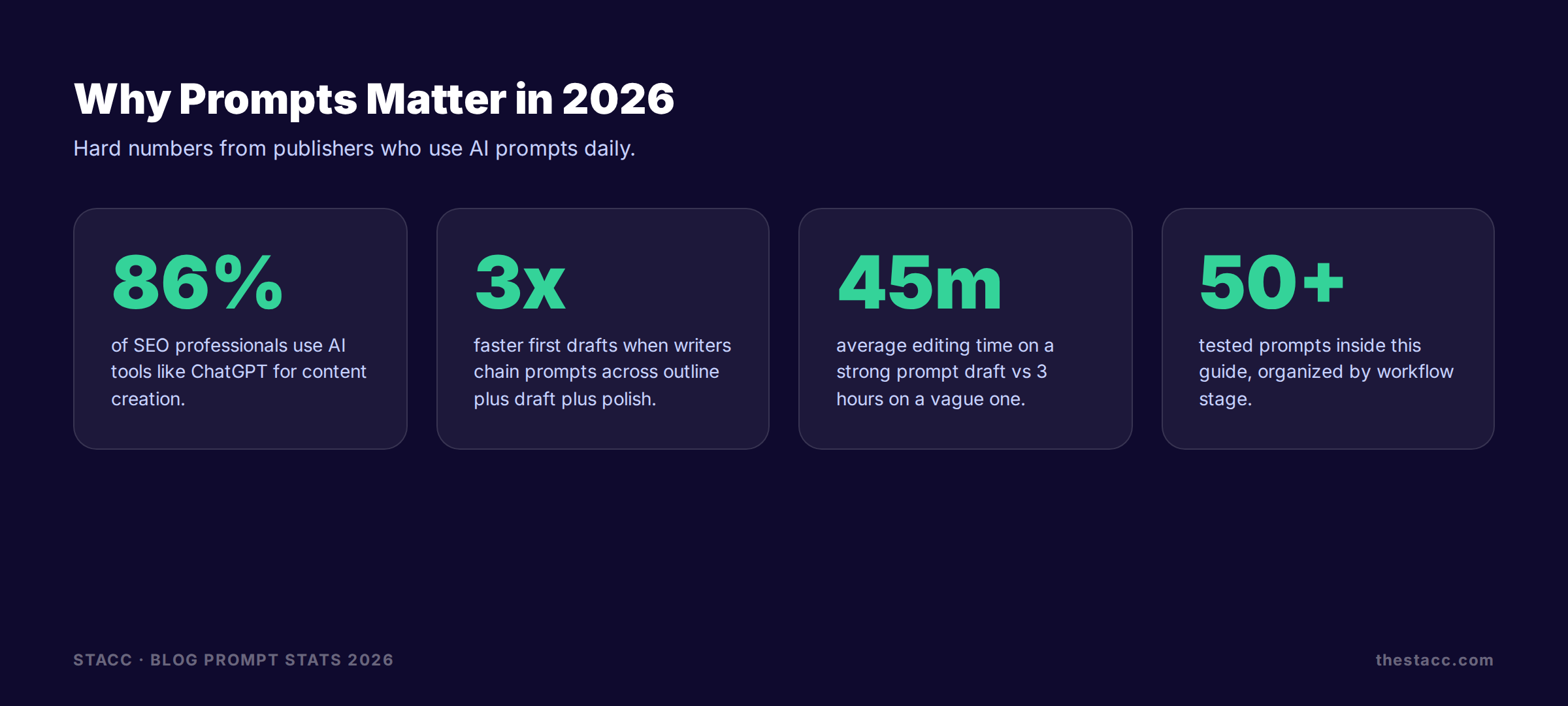
We publish 3,500+ blog posts every month across 70+ industries. Our average SEO score is 92%. Every prompt in this guide was tested across that production pipeline before it landed on this page.
Here is what you will learn:
- The 6-element prompt structure that produces ranking drafts
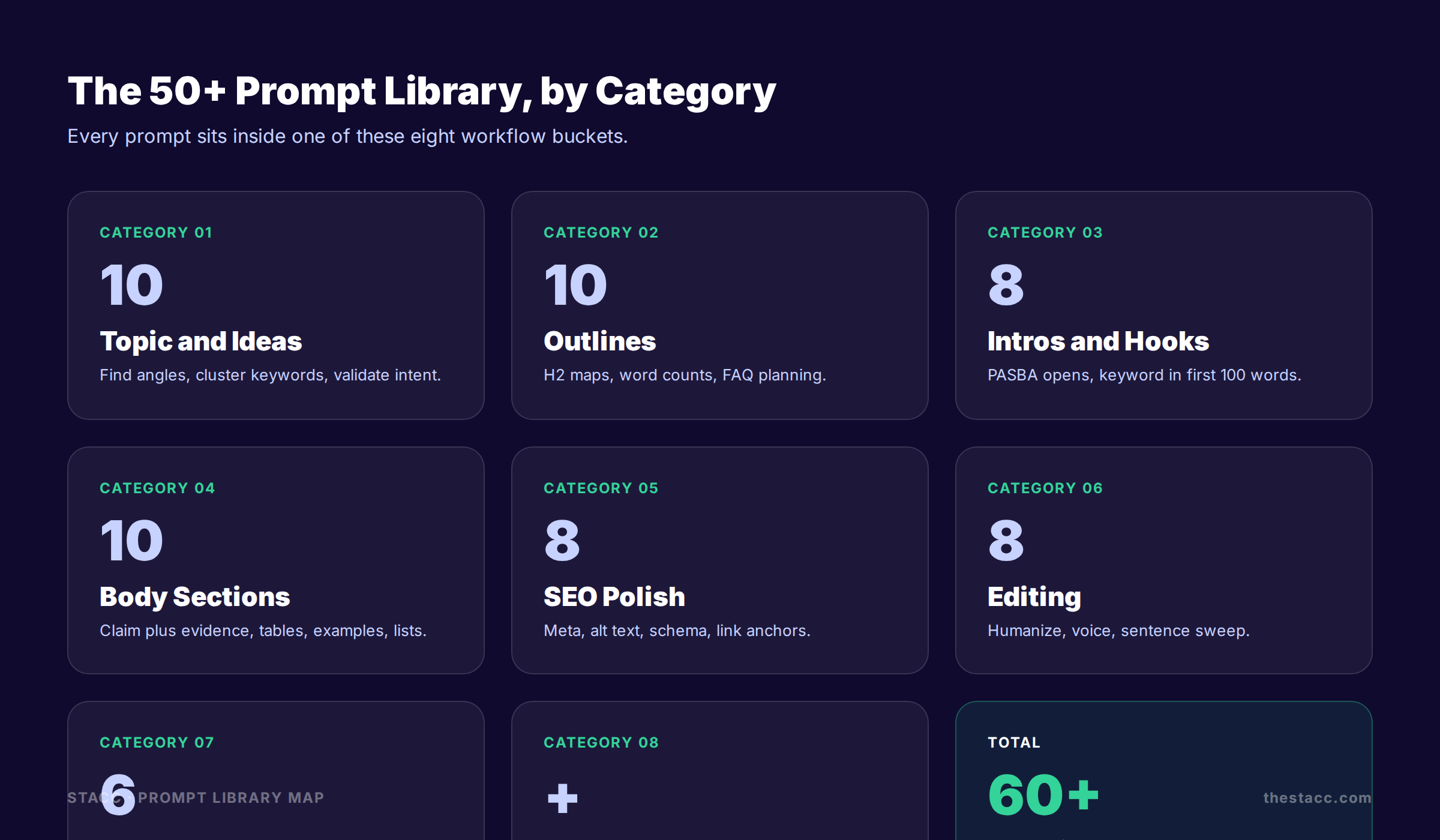
- 10 prompts for topic mining and keyword clustering
- 10 prompts for blog outlines and section maps
- 8 prompts for intros that hook in the first 100 words
- 10 prompts for body sections, tables, and examples
- 8 prompts for SEO meta, alt text, schema, and link anchors
- 8 prompts for humanizing AI drafts and removing AI tells
- 6 prompts for repurposing one blog post into 8 assets
- 7 prompt mistakes that wreck output every time
Chapter 1: The Anatomy of a Prompt That Produces Ranking Content
AI models do exactly what you ask. That is the whole game. A weak prompt gives the AI no constraints, so it defaults to safe, balanced, hedged content. That output reads like every other AI-generated article on the topic. Google indexed millions of those last year. Yours will not rank against them.
A strong prompt acts like a creative brief. It tells the model who to be, who is reading, what to write, how long, in what voice, with what unique angle. The strategic decisions stay with you. The typing happens at machine speed.
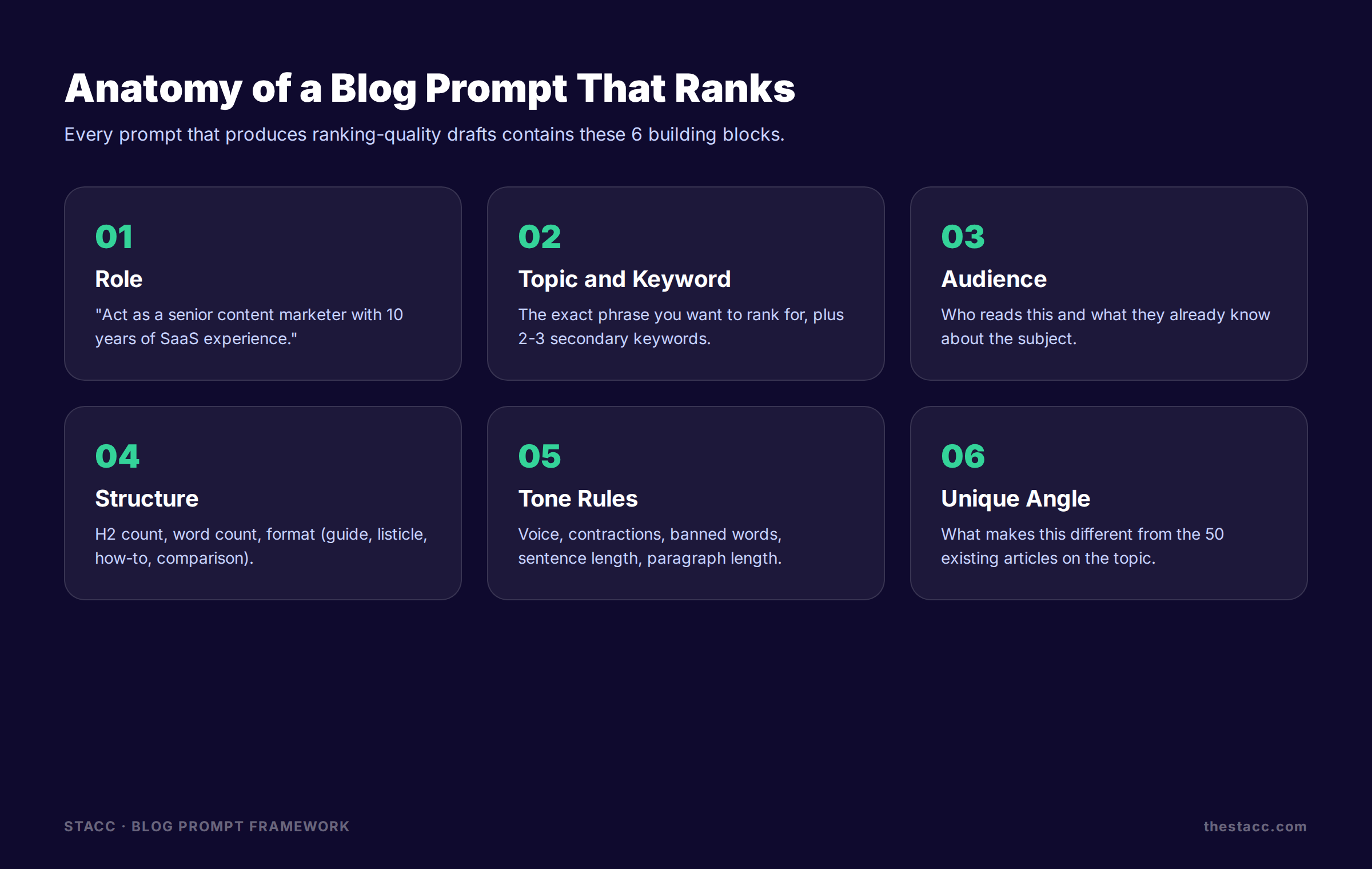
The Six Elements of Every Working Blog Prompt
Every prompt in this guide includes all six of these elements. Skip one and the draft gets weaker. Skip three and you spend 3 hours rewriting from scratch.
- Role — Tell the model who to be. “Act as a senior content marketer with 10 years of B2B SaaS experience.”
- Topic and keyword — The exact phrase you want to rank for, plus 2-3 secondary keywords.
- Audience — Who reads this and what they already know about the subject.
- Structure — H2 count, word count, format (guide, listicle, how-to, comparison, list post).
- Tone rules — Voice, contraction rules, banned words, sentence length, paragraph length.
- Unique angle — What this article does that the top 10 ranking pages do not.
The Prompt Equation in Practice
Specificity is the variable that matters. Length is a weak proxy.
| Prompt type | First draft quality | Editing time |
|---|---|---|
| Vague (“Write about SEO”) | Generic filler. Unranked. | 3 to 4 hours to rewrite |
| Better (“Write an SEO guide for ecommerce”) | Missing structure and angle. | 90 to 120 minutes to fix |
| Strong (full 6-element prompt) | Edit-ready. Structured. On-brand. | 30 to 45 minutes to polish |
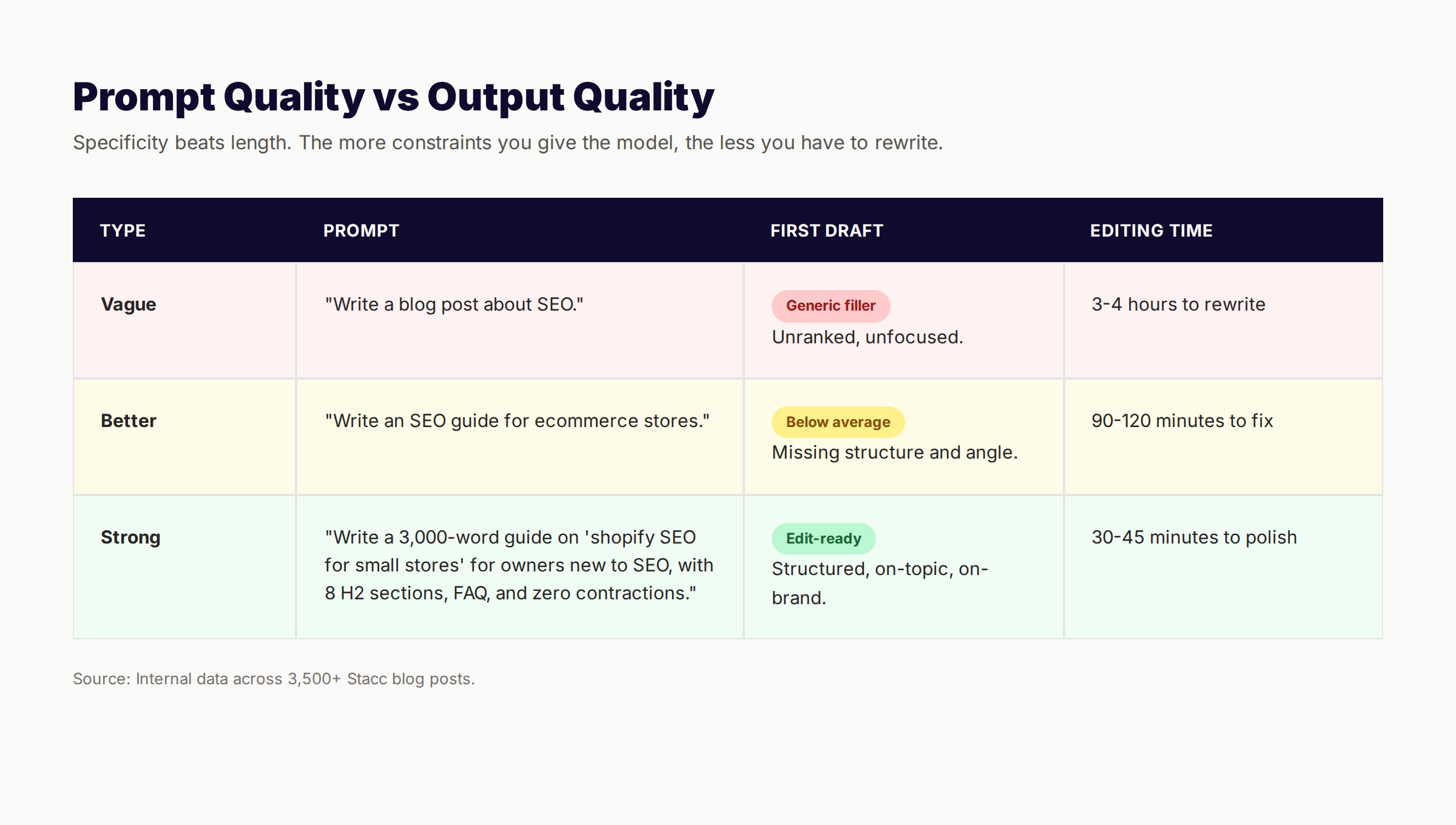
The goal is not zero editing. The goal is a first draft that needs polishing, not a rewrite. Every prompt below targets that outcome.
For a deeper breakdown of prompts focused on SEO articles specifically, see our companion guide on AI prompts for SEO articles.
Want the prompts running in production? We publish 30 to 80 ranking blog posts per month using these prompts. Start for $1 →
Chapter 2: Prompts for Topic Mining and Idea Generation
Most blog content fails before a single word gets written. The topic is too broad, too saturated, or wrong for the audience. AI prompts will not fix that for you, but they will surface options faster than a 3-hour brainstorm. Use them for breadth. Use real keyword tools like Ahrefs and Semrush for the data layer.
We recommend running the first 3 prompts in this chapter on every new content cycle. They take 10 minutes and replace a half-day workshop.
Prompt 1: Generate seed topics for a niche
Act as a content strategist for [industry]. My audience is [persona]
with [pain point]. Generate 30 blog topic ideas across these buckets:
beginner education, advanced tactics, comparisons, case studies, and
news commentary. Format as a table with columns: Topic, Bucket,
Suggested Format (guide, listicle, how-to, comparison).
Prompt 2: Cluster keywords into pillar and supporting topics
Here is a list of 40 keywords I want to target: [paste list]. Group
them into topical clusters where each cluster shares a parent topic.
Name each cluster. For each cluster, pick one pillar page keyword and
list the supporting article keywords underneath. Format as a nested
list.
Prompt 3: Find content gaps versus competitors
I want to rank for "[keyword]". The top 3 ranking pages cover these
H2 sections: [paste headings from competitors]. Identify 5 content
gaps these articles miss. For each gap, suggest a unique angle, a
data point I could include, and an example I could cite.
Prompt 4: Validate search intent for a topic
For the keyword "[keyword]", classify the search intent (informational,
commercial, transactional, navigational). Then list the top 3 content
formats that match that intent. End with the 1 format you would
recommend for a [business type] targeting [audience].
Prompt 5: Generate long-tail variations
Take this seed keyword: "[your keyword]". Generate 20 long-tail variations
that a [target audience] would search when they are ready to [desired
action]. Group them by intent: informational, commercial, transactional.
Focus on phrases with 4 or more words.
Prompt 6: Find topics from customer pain points
Here are 10 recurring questions our support team gets from [audience]:
[paste questions]. Turn each question into a blog topic. For each
topic, give me a working title, a one-sentence angle, and the primary
keyword I should target.
Prompt 7: Mine Reddit and forums for topic ideas
Act as a researcher mining Reddit for blog topic ideas. The audience is
[persona]. Generate 15 thread titles you would expect to see in
[r/subreddit name] in the last 6 months. For each, propose a blog post
that would rank for the same query and outperform the thread.

(Then validate the actual threads by searching site:reddit.com directly.)
Prompt 8: Build a 90-day content calendar from one topic cluster
I want to build a 90-day content calendar around the pillar topic
"[topic]". Suggest 12 supporting blog posts, 1 per week. For each
post, give me a working title, primary keyword, content format, and
1 unique angle that connects it back to the pillar.
Prompt 9: Identify trending angles on an evergreen topic
The evergreen topic is "[topic]". List 5 trending angles or sub-topics
that have gained search interest in the last 12 months. For each,
suggest a specific blog post title and 1 data point or recent news
event that would make the post timely.
Prompt 10: Rank topic ideas by ROI potential
Here are 20 blog topic ideas: [paste list]. Score each from 1 to 10 on
search potential, business relevance, and difficulty to rank. Sum the
scores. Sort from highest to lowest combined score. Recommend the top
5 to write first and explain why.
For the keyword research side of this work, see our guide on keyword research for blog posts.
Chapter 3: Prompts for Outlines and Section Maps
The single best AI use case in blogging is the outline. The model is fast, fluent, and unbiased. Use it to map H2 and H3 structures, then layer in your judgment on angle and depth. A strong outline cuts writing time in half and prevents the structural collapse you see in single-shot drafts.
We outline before we draft. Every time. No exceptions.
Prompt 11: Build an H2 outline from a keyword
Act as an SEO content strategist. Build a detailed H2 outline for a
blog post targeting the keyword "[keyword]". Audience is [persona].
Target length is [word count] words. Include 7 to 9 H2 sections, plus
suggested H3 subsections under each H2. End with a FAQ section
containing 5 questions. Add a one-line angle for each H2 explaining
what makes the section unique.
Prompt 12: Reverse-engineer competitor outlines
Here are the H2 sections from the top 3 ranking pages for "[keyword]":
[paste H2s from each]. Build a new outline that covers every important
section from the top 3, but adds 3 unique H2s the competitors miss.
Flag the unique H2s with [UNIQUE].
Prompt 13: Add word counts per section
Here is my blog outline: [paste outline]. Total target is [N] words.
Assign a target word count to each H2 and FAQ section. Make sure the
intro and chapter 1 carry weight, the body chapters are balanced, and
the closing is short. Format as a table with columns: Section, Word
Count, Notes.
Prompt 14: Generate FAQ questions from People Also Ask
Generate 6 FAQ questions for a blog post targeting "[keyword]". Pull
from common People Also Ask phrasings: "what is", "how do I", "why
does", "is X better than Y", "how much does X cost", "how long does X
take". Write each question in plain reader language, not marketing
language.
Prompt 15: Map internal link opportunities to outline
Here is my outline: [paste outline]. Here is a list of related blog
posts on my site: [paste titles and URLs]. For each H2 in the outline,
suggest 1 to 2 internal links that fit naturally. Give the anchor text
and the section where the link should appear.
Prompt 16: Outline a comparison post (X vs Y)
Build an outline for a comparison post titled "[X] vs [Y]". Audience
is [persona] trying to choose between the two. Include H2 sections
for: at-a-glance verdict, pricing, features, ease of use, best for X,
best for Y, who should pick which, FAQs. Add a comparison table
under at-a-glance verdict.
Prompt 17: Outline a “best of” list post
Build an outline for a "Best [product category] in 2026" post. Target
length is 4,000 words. Include: intro with the methodology, a
comparison table at the top, 10 product cards (each with name, best
for, pricing, pros, cons, who should buy), a how-to-choose section, an
FAQ. Suggest the order to rank the 10 picks.
Prompt 18: Outline a step-by-step guide
Build an outline for a step-by-step guide titled "[How to do X]". Each
step gets its own H2. Include 8 to 12 steps. For each step, list 1 H3
covering "what to watch for" and 1 H3 covering "tools you can use".
End with a results section and a FAQ.
Prompt 19: Cluster H3s under each H2
Here is my H2 outline: [paste H2s]. For each H2, generate 3 to 5 H3
subsections. Order them logically. Avoid orphan H3s. Make sure no two
H3s overlap in scope. Format as a nested list under each H2.
Prompt 20: Stress-test an outline before drafting
Critique this blog outline against the search intent for "[keyword]":
[paste outline]. Flag any sections that drift off-intent. Flag any
missing sections compared to top 3 ranking pages. Recommend 2 changes
that would strengthen the outline for ranking and 1 change for reader
experience.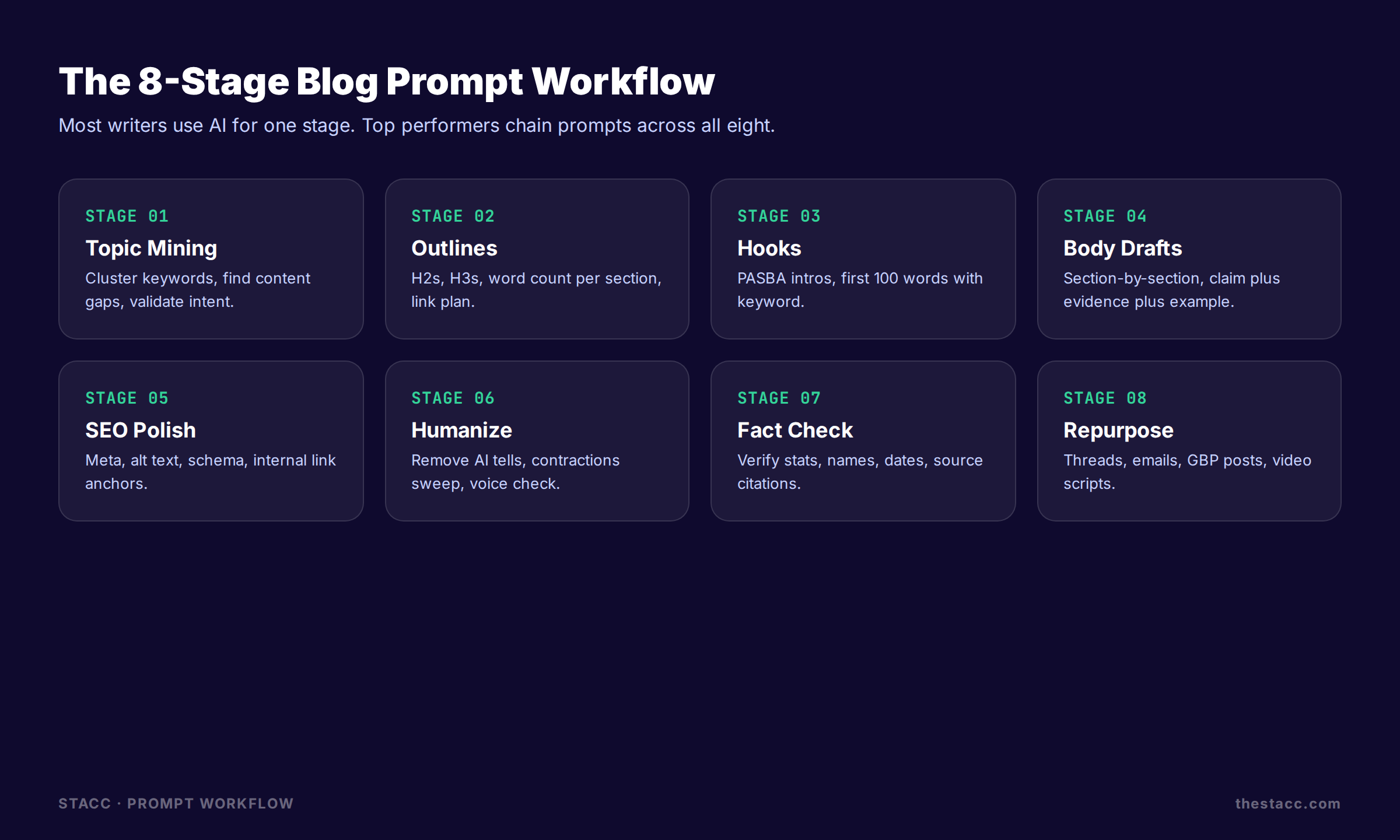
For a fuller treatment of outline structure, see our blog post outline guide.
Chapter 4: Prompts for Intros and Hooks
The first 100 words decide whether the reader stays. They also need to contain the primary keyword for SEO. Most AI intros default to throat-clearing: “In today’s digital scene, content marketing is…” That intro buries the keyword, bores the reader, and signals AI to Google.
The PASBA framework solves this. Problem. Agitate. Solution. Bridge. Action. Every prompt below builds toward that pattern.
Prompt 21: PASBA intro for any blog post
Write a 4-paragraph intro for a blog post titled "[title]". Use the
PASBA framework:
- Paragraph 1: Name the reader's exact pain in 1 to 2 sentences.
- Paragraph 2: Agitate. What this pain costs them (time, money, rankings).
- Paragraph 3: State what this article delivers and how it differs.
- Paragraph 4: 1-line bridge to a bullet list of "Here is what you
  will learn".
Primary keyword "[keyword]" must appear in the first 100 words. Zero
contractions. No banned AI phrases.
Prompt 22: Stat-led hook
Write a 3-sentence opening hook for a blog post on "[topic]". Open
with a specific statistic from a credible source (Ahrefs, Semrush,
HubSpot, Google). Cite the source inline. Follow with 2 sentences
that reframe what that stat means for the reader. No transition
words.
Prompt 23: Contrarian hook
Write a 2-paragraph opening for a blog post that takes the contrarian
position on "[common belief]". Open with a flat statement that
contradicts the mainstream view. Back it up with 1 specific example.
End the paragraph with a sentence that previews what the article will
prove. Zero hedging.
Prompt 24: Story-led hook (use sparingly)
Write a 3-sentence story-led opening for a blog post on "[topic]".
The story should describe a specific moment for [persona] hitting
[problem]. End the story with a sentence that names the broader
problem the article solves. Keep it concrete, no abstractions.
Prompt 25: Rewrite a weak AI intro
Here is an AI-generated blog intro: [paste intro]. Rewrite it to:
1. Remove every banned phrase (use, move through, in today's,
furthermore, strong, smooth, game-changer, supercharge).
2. Cut every contraction.
3. Move the primary keyword "[keyword]" into the first 30 words.
4. Replace any hedging with direct statements.
5. Keep the rewrite under 180 words.
Prompt 26: Generate 10 hook variations to pick from
Generate 10 different opening sentences for a blog post on "[topic]".
Vary the style: stat-led, contrarian, question-led, story-led,
data-led, framework-led, list-led. Mark each with its style label.
After the list, recommend the strongest 2 and explain why.
Prompt 27: Add the “here is what you will learn” bullet list
Here is my intro: [paste intro]. Add a 1-line bridge sentence at the
end ("Here is what you will learn:") followed by 5 bullet points. Each
bullet promises a specific outcome the reader will get from the
article. No vague verbs like "explore" or "understand". Use
action-driven verbs like "build", "fix", "rank", "save".
Prompt 28: Insert credibility bridge
Here is my intro: [paste intro]. Insert a single 2-sentence
credibility bridge between paragraph 3 and the "Here is what you
will learn" list. The bridge should cite a specific data point or
result from my company that proves I have authority to write this.
The data point is: [your stat]. Keep the tone matter-of-fact.
For more on writing intros that hook, see our headline writing guide.
Chapter 5: Prompts for Body Content and Sections
The body is where AI drafts die. Most models produce paragraph after paragraph of throat-clearing, hedging, and vague claims. The fix is to prompt each H2 section separately with explicit instructions on claim, evidence, example, and format. Chain the prompts. Do not ask for the entire article in a single shot.
Prompt 29: Write one H2 section at a time
Write the body of H2 section "[section title]" for a blog post on
"[topic]". Target 400 to 500 words. Structure:
1. Open with a bold claim or specific stat (no transition words).
2. Support with 2 to 3 sentences of evidence.
3. Add 1 concrete example.
4. Include either a table, a numbered list, or a bullet list.
5. Close with 1 actionable takeaway sentence.
Zero contractions. Sentences under 20 words. Paragraphs under 3
sentences.
Prompt 30: Generate a comparison table
For the topic "[X vs Y]" or "[N options for X]", generate a comparison
table with columns: [list columns]. Include [N] rows. Use specific
numbers, not vague qualifiers like "great" or "powerful". Mark the
recommended option with a row highlight note. Format in markdown.
Prompt 31: Expand a single bullet point into a paragraph
Here is a bullet point: "[bullet]". Expand it into a 4 to 5 sentence
paragraph. Open with the bullet as a claim. Add 1 example, 1
counter-example or nuance, and 1 actionable line. Zero filler. No
banned words.
Prompt 32: Write a numbered list of steps
For the topic "[task]", write a numbered list of [N] steps. Each step
gets a bold step heading and a 2 to 4 sentence explanation. Each step
must include: what to do, why it matters, and how to know it worked.
End the list with 1 short paragraph summarizing the result.
Prompt 33: Write a checklist
For the topic "[task]", write a checklist of 8 to 12 items. Format each
item as a markdown checkbox: "- [ ] Item". Each item must be a
specific action, not a category. Group items into 2 or 3 sub-headings
if it improves scannability.
Prompt 34: Add a callout or blockquote
For this section: [paste section]. Insert 1 callout blockquote that
either (a) cites a memorable stat with a source, or (b) summarizes the
single most important takeaway in 1 to 2 lines. Format as a markdown
blockquote.
Prompt 35: Write a mini case study
Write a 250-word mini case study for the section "[section title]".
Use a specific (or composite) scenario: [persona] was facing [problem]
and tried [solution]. Walk through the 3-step process they followed.
End with the specific result. Use numbers, not adjectives.
Prompt 36: Add evidence and sources to a draft
Here is a draft section: [paste section]. For each claim that needs
proof, add either (a) a statistic from a credible source (Ahrefs,
Semrush, HubSpot, Google), (b) a named example, or (c) a primary
research citation. Insert the source inline as a markdown link. Do
not invent sources.
Prompt 37: Vary sentence and paragraph rhythm
Here is a body section: [paste section]. Rewrite for varied rhythm:
mix 5-word sentences with 18-word sentences. Break long paragraphs
into 1 or 2-sentence paragraphs. Add at least one 3-word fragment
where it earns attention. No banned words. Zero contractions.
Prompt 38: Convert a paragraph into a comparison table or list
Here is a paragraph: [paste paragraph]. Convert it into either a
markdown table or a bulleted list, whichever is more scannable. Add
a 1-sentence lead-in and a 1-sentence wrap-up around the new format.
For more on body section quality, see our guide on content writing tips and our SEO content writing examples.
Tired of editing 50 AI drafts per month? Stacc writes, edits, and publishes them for you. See pricing →
Chapter 6: Prompts for SEO Polish
Once a draft is structured and readable, the SEO layer takes 30 minutes per post if you prompt it correctly. Meta tags, alt text, schema hints, and internal link anchors are easy wins. Most writers leave them as afterthoughts. Top performers prompt for them on every post.
Prompt 39: Write a meta title and description
Generate a meta title and description for a blog post titled "[title]"
targeting "[keyword]". Rules:
- Title: 50 to 60 characters, keyword in the first 30 characters, no
  clickbait, includes a value cue (number, year, or benefit).
- Description: 145 to 155 characters, keyword in first sentence,
  ends with a benefit-led hook. No marketing fluff.
Give me 3 title options and 3 description options. Mark your top pick.
Prompt 40: Generate alt text for inline images
For these inline images: [list image descriptions]. Generate alt text
for each. Rules:
- 8 to 14 words.
- Include the primary keyword in at least 1 image.
- Describe the visual content, not just the keyword.
- Plain language, no "image of" preamble.
Format as a numbered list.
Prompt 41: Suggest schema markup hints
For this blog post: [paste title and intro]. Suggest the most relevant
schema.org type (Article, HowTo, FAQPage, Product, Review). List the
required properties for that schema type. If FAQPage applies, output
the FAQ schema as JSON-LD ready to paste into the head.
Prompt 42: Generate internal link anchor text
Here are 5 internal pages on my site: [paste URLs and titles]. Here
is my draft: [paste draft]. For each internal page, suggest the
strongest natural anchor text and the section of the draft where the
link should appear. Avoid generic anchors like "click here" or "this
post".
Prompt 43: Audit keyword density and placement
Audit this draft: [paste draft]. Report:
1. Primary keyword "[keyword]" count and density (target 0.8 to 1.5%).
2. Whether the keyword appears in: title, slug, first 100 words, at
least 1 H2, meta description, at least 1 image alt.
3. Secondary keywords found and missing.
4. 3 specific places to add the keyword without keyword stuffing.
Prompt 44: Generate the URL slug
For a blog post titled "[title]" targeting "[keyword]", generate 5 URL
slug options. Rules:
- 3 to 5 words maximum.
- Include the primary keyword.
- No stop words (a, the, and, or).
- All lowercase, hyphens between words.
- Match the slug pattern of high-ranking competitors when possible.
Mark your recommended pick.
Prompt 45: Suggest FAQ schema questions
Generate 6 FAQ questions for a blog post on "[topic]" that match
People Also Ask phrasings. For each question, write a 50 to 80 word
answer. Format the full set as FAQ schema JSON-LD ready to embed.
Prompt 46: Recommend featured snippet structure
For the keyword "[keyword]", recommend the most likely featured
snippet format (paragraph, list, table, definition). Write the
optimized snippet content. Rules:
- Paragraph snippet: 40 to 55 words.
- List snippet: 4 to 8 items.
- Table snippet: 2 to 4 columns, 4 to 8 rows.
Place the snippet content directly under an H2 that matches the
keyword phrasing.
For more on how to think about SEO writing end-to-end, read our SEO content writing guide.
Chapter 7: Prompts for Humanizing AI Drafts
The hardest part of AI blogging is hiding the AI. Models default to safe phrasing, perfectly balanced paragraphs, and a handful of telltale phrases that scream “machine wrote this”. Readers feel it even when they cannot name it. Google catches it more often than people think.
Run every prompt in this chapter on every draft. No exceptions.
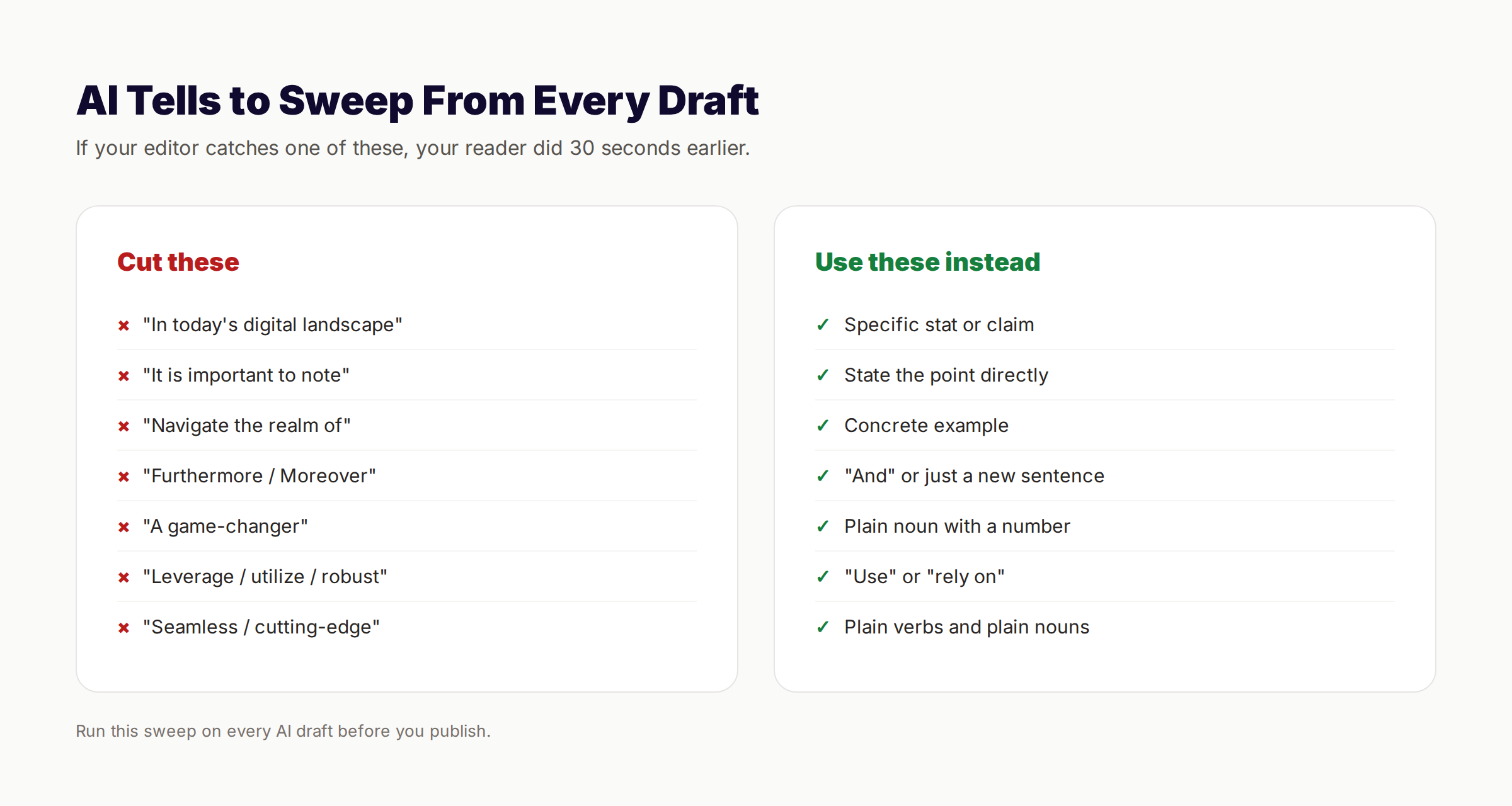
Prompt 47: Strip banned AI phrases
Edit this draft: [paste draft]. Remove every instance of these
phrases: "in today's", "it is important to note", "move through",
"landscape", "realm", "strong", "delve", "tapestry", "furthermore",
"moreover", "additionally", "in conclusion", "needless to say", "at
its core", "when it comes to", "game-changer", "takes it to the next
level", "not just X but Y", "use", "smooth", "new",
"revolutionary", "advanced", "solution", "enable", "supercharge",
"surge", "use", "complete", "state-of-the-art".
Replace with direct, plain language. Keep the meaning. Output the
clean version.
Prompt 48: Eliminate contractions
Edit this draft: [paste draft]. Replace every contraction with its
full form. Specifically: don't, won't, can't, isn't, doesn't, it's,
they're, we're, you're, there's, here's, that's, what's, who's,
couldn't, wouldn't, shouldn't, let's, I'm, I've, he's, she's, we've,
they've, you'll, we'll, they'll. Re-output the full clean draft.
Prompt 49: Cut sentence length
Edit this draft: [paste draft]. Rewrite every sentence over 20 words
into 2 shorter sentences. Break every paragraph over 3 sentences into
2 paragraphs. Switch passive voice to active voice. Keep the meaning.
Output the rewritten draft.
Prompt 50: Add opinion and nuance
Edit this draft: [paste draft]. Add:
1. At least 2 opinionated statements where the author takes a clear
side.
2. At least 1 nuance admission ("The exception is...").
3. At least 1 specific stat in the first 200 words with a source.
Remove hedging words: might, could, perhaps, potentially, somewhat,
arguably, generally speaking.
Prompt 51: Run a voice audit
Audit this draft against this voice rule set:
- Operator-minded, confident, practical.
- Sentences under 20 words.
- Paragraphs under 3 sentences.
- Active voice only.
- Numbers as numerals.
- Oxford comma always.
- Zero contractions.
- Zero banned AI phrases.
Report:
1. Total sentences over 20 words.
2. Total paragraphs over 3 sentences.
3. Passive voice instances.
4. Contraction instances.
5. Banned phrases found.
Suggest 5 specific edits in priority order.
Prompt 52: Convert AI rhythm into human rhythm
Here is an AI draft: [paste draft]. Rewrite for human rhythm:
- Vary sentence length aggressively (mix 5-word and 18-word).
- Add 1 to 2 sentence fragments where they earn attention.
- Start at least 2 sections with a direct statement, not a transition.
- Add 1 personal aside per chapter, marked in plain prose.
Keep meaning, tighten everything.
Prompt 53: Inject specifics where AI was vague
Here is a section: [paste section]. Find every vague claim ("many
businesses", "most marketers", "it can help", "improves performance",
"saves time"). Replace each with a specific number, name, or example.
If you cannot find a specific fact, flag the line with [NEEDS CITE].
Prompt 54: Run a final readability pass
Run this draft through a readability check: [paste draft]. Report
the Flesch-Kincaid reading level. Flag every section that scores
above 10th grade. Suggest 5 rewrites that reduce reading level
without dumbing down the content.
For a full editing workflow, see our guide on how to humanize AI content and editing AI content for quality.
Chapter 8: Prompts for Repurposing One Blog Post Into 8 Assets
The blog post is the seed. Every published article should become an email, a thread, a LinkedIn carousel, a GBP post, a video script, and a lead magnet. Most teams skip this step because it feels like extra work. With prompts, repurposing takes 20 minutes per post and triples the return on the original draft.
Prompt 55: Generate a newsletter from a blog post
Convert this blog post into a 250-word email newsletter: [paste post].
Structure:
- Subject line (under 50 characters, curiosity-led).
- Opening hook (1 to 2 sentences).
- 3 bullet takeaways from the post.
- 1 sentence linking back to the full article.
- PS line with a personal aside.
Tone: conversational, no banned words, zero contractions.
Prompt 56: Generate an X (Twitter) thread
Convert this blog post into an 8 to 12 tweet thread: [paste post].
Rules:
- Tweet 1: A hook with a stat, claim, or question. Under 200
characters.
- Tweets 2 to 10: One key insight per tweet, each under 240
characters.
- Final tweet: 1-line CTA linking back to the full post.
Number each tweet.
Prompt 57: Generate a LinkedIn post
Convert this blog post into a 1,300-character LinkedIn post: [paste
post]. Structure:
- Opening line that earns the click on "see more".
- 5 short paragraphs (2 to 3 lines each).
- 1 bullet list of 3 to 5 takeaways.
- Closing line that invites comments.
- 3 to 5 relevant hashtags.
Tone: operator-minded, no marketing fluff.
Prompt 58: Generate Google Business Profile posts
Convert this blog post into 4 Google Business Profile posts: [paste
post]. Each GBP post:
- 150 to 300 words.
- Include 1 specific tip or insight from the article.
- Include a CTA button label suggestion (Learn more, Get offer, Book).
- Mention the city or service area if relevant.
- Avoid banned phrases.
Number each post 1 to 4 with a content theme.
Prompt 59: Generate a short-form video script
Convert the top 1 takeaway from this blog post into a 45-second video
script: [paste post]. Structure:
- Hook (3 to 5 seconds, a sharp claim or question).
- Body (30 seconds, 3 quick points with on-screen text cues).
- CTA (5 seconds, name the next step).
Format with timestamps and visual direction in brackets.
Prompt 60: Generate a lead magnet outline
Convert this blog post into a lead magnet outline: [paste post]. Pick
the format that fits best (checklist, template, swipe file,
mini-course, calculator). Outline the lead magnet in 1 page. List
the contents, the cover page hook, and 3 places on the blog post
where it should be offered.
For more on automating the publishing layer of all this, see our guide on automating blog publishing.
Chapter 9: The Mega-Prompt Skeleton (Copy and Paste)
After 60 prompts, here is the master template we use when we need a full draft from a single shot. It bundles every element from chapter 1 into one structured prompt. Fill the brackets, hit send, and edit the result.
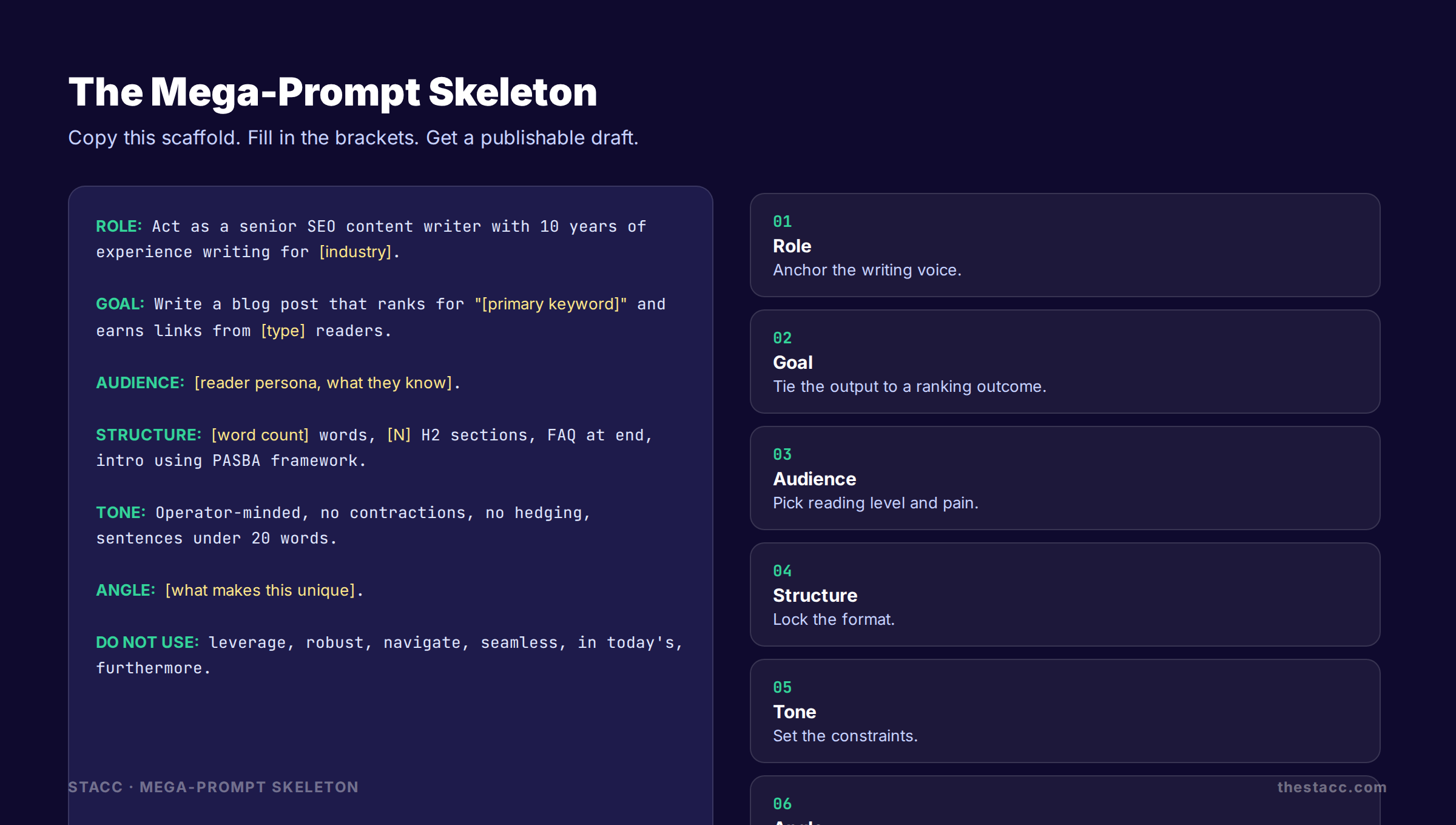
ROLE: Act as a senior SEO content writer with 10 years of experience
writing for [industry]. You have ranked content for thousands of
keywords and know the difference between a draft that ranks and a
draft that does not.

GOAL: Write a blog post that ranks for "[primary keyword]" and earns
links from [reader type].

AUDIENCE: [persona]. They already know [baseline knowledge]. They do
not know [knowledge gap]. They are trying to [outcome].

STRUCTURE:
- [N] total words.
- [N] H2 sections, each 400 to 500 words.
- 3 to 5 H3 subsections per H2.
- FAQ section at the end with 5 questions.
- Intro uses the PASBA framework (Problem, Agitate, Solution, Bridge,
Action). Primary keyword in first 100 words.
- At least 2 markdown tables.
- At least 1 checklist.
- At least 1 CTA blockquote at ~1,500 words.

TONE RULES:
- Operator-minded, confident, practical, no fluff.
- Sentences under 20 words.
- Paragraphs under 3 sentences (prefer 1 to 2).
- Active voice only.
- Numbers as numerals (30 not thirty).
- Oxford comma always.
- ZERO contractions: do not, it is, you are, cannot, does not, etc.

DO NOT USE: use, strong, move through, landscape, realm, smooth,
new, revolutionary, advanced, solution, enable,
game-changer, supercharge, surge, use, complete,
state-of-the-art, in today's, it is important to note, furthermore,
moreover, additionally, in conclusion, at its core, when it comes to.

ANGLE: [what makes this post different from the top 10 ranking pages].

DELIVERABLE: Output the full draft in markdown with H2s and H3s, FAQ,
and at least 3 internal link anchor text suggestions marked with
[INTERNAL LINK: anchor text].
This single prompt replaces the 6 most common AI prompt failures. Save it. Modify it. Make it yours.
7 Prompt Mistakes That Wreck AI Drafts
Most complaints about AI content are complaints about prompts. Fix the prompt and the same model produces something usable. Here is what consistently wrecks output across the thousands of drafts we have reviewed.
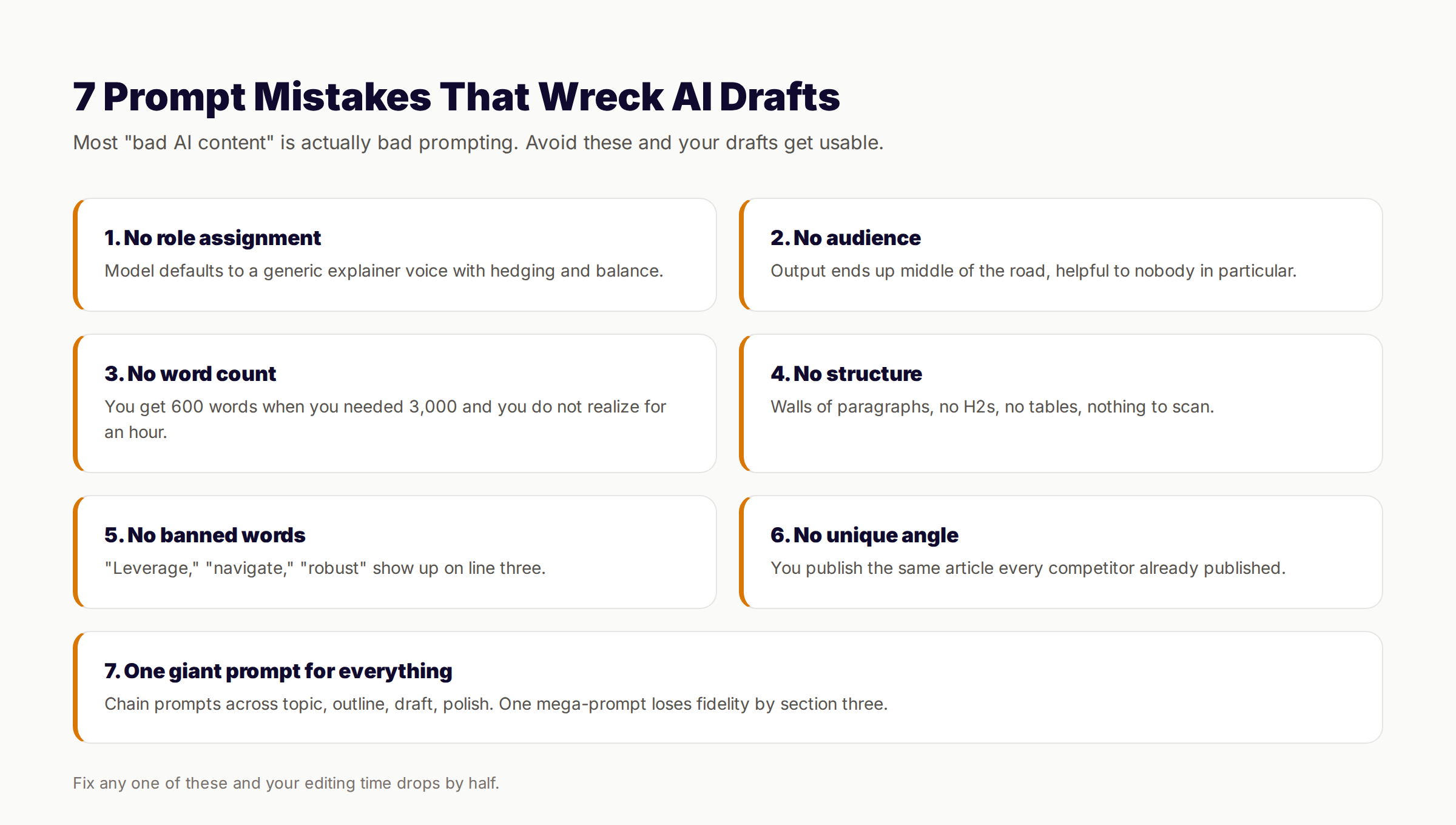
- No role assignment. The model defaults to a generic explainer voice. Always anchor the role.
- No audience. Output ends up middle of the road. Useful to nobody.
- No word count. You get 600 words when you needed 3,000. Or 6,000 words of filler when you needed 1,500.
- No structure. Walls of paragraphs. No H2s. No tables. Nothing scannable.
- No banned words. “Leverage,” “strong,” and “move through” appear by line three.
- No unique angle. You publish the article every competitor already published.
- One mega-prompt for everything. Models lose fidelity after a few thousand tokens. Chain prompts across topic, outline, draft, polish.
Each one alone makes editing harder. Stack three and you are rewriting from scratch.
Stacc handles the prompts, drafts, edits, and publishing. Your SEO team. $99/month. Start for $1 →
How We Use These Prompts at Stacc
We publish 3,500+ blog posts a month across 70+ industries. Every post moves through an 8-stage prompt workflow: topic mining, outline, intro, body, SEO polish, humanize, fact check, repurpose. The prompts in this guide are the same prompts our editorial system runs in production. They are not theory. They are working tools.
Here is how the stages compound:
| Stage | Prompts Used | Time per Post | Output |
|---|---|---|---|
| Topic mining | 1 to 10 | 5 minutes | 1 validated topic + keyword |
| Outline | 11 to 20 | 10 minutes | H2 map, FAQs, link plan |
| Intro | 21 to 28 | 5 minutes | PASBA intro under 200 words |
| Body | 29 to 38 | 25 minutes | 3,000+ word draft |
| SEO polish | 39 to 46 | 10 minutes | Meta, alt, schema, anchors |
| Humanize | 47 to 54 | 15 minutes | Editor-ready draft |
| Fact check | n/a | 10 minutes | Cited stats, named sources |
| Repurpose | 55 to 60 | 15 minutes | 4 to 6 derivative assets |
Total: roughly 95 minutes per post once the workflow is dialed in. The Stacc Content Compound Effect kicks in around month 3 because the same prompt library writes 30 to 80 posts in parallel, every month, without losing structure or voice.
If you want to learn the broader thinking behind this approach, read how we use AI to write blog posts and our AI blog writing case study.
Frequently Asked Questions
What is the best AI writing prompt for blog posts?
There is no single best prompt. There is a best prompt framework. Every working blog prompt includes a role, a topic and keyword, an audience, a structure (word count and H2 count), tone rules with banned words, and a unique angle. Drop any one of those and the draft gets worse. The mega-prompt skeleton in chapter 9 bundles all six into one template you can copy and paste.
How many AI prompts does a full blog post need?
A polished post typically uses 6 to 10 prompts across the workflow. One for the topic, one for the outline, one for the intro, one to three for body sections, one for SEO meta, one for humanizing, one or two for repurposing. Chaining beats single-shot prompting because models lose fidelity over long token windows.
Can AI prompts produce blog posts that rank on Google?
Yes, when paired with editing. AI-assisted blog posts rank when the prompt enforces structure (H2 outline, FAQs, internal links), the writer adds first-hand experience and verified data, and the final draft is edited for voice and accuracy. Pure unedited AI output rarely ranks. Edited AI output with strong prompts ranks at the same rate as human-only writing in most niches.
What words should I tell AI never to use in blog posts?
Ban these in every prompt: use, strong, move through, landscape, realm, smooth, new, revolutionary, advanced, solution, enable, game-changer, supercharge, surge, use, complete, state-of-the-art, in today’s, it is important to note, furthermore, moreover, additionally, in conclusion, at its core, when it comes to. Also ban all contractions. The output reads sharper immediately.
Should I use one big prompt or chain multiple prompts?
Chain them. Models lose track of constraints after a few thousand tokens. A chained workflow (topic, outline, intro, body, SEO, humanize) consistently produces stronger drafts than a single mega-prompt. Use the mega-prompt skeleton only when you need a fast directional draft you plan to rewrite.
How long should a blog post written with AI prompts be?
Match the search intent and the top-ranking pages. For most informational queries, 2,500 to 4,000 words wins. For listicle queries (“best X for Y”), 4,000 to 6,000 words. For local SEO queries, 1,500 to 2,500 is often enough. Tell the model the target word count and the per-section word count in the structure block of your prompt.
The Takeaway
AI writing prompts for blog posts are not about typing less. They are about thinking more before you type. Lock the role, the audience, the structure, and the angle, and the model gives you a draft you can ship. Skip those steps and you get the same generic content everyone else publishes.
Steal the prompts above. Test them on your next post. Watch the editing time fall.
Sources:
- Shopify: AI Prompts for Writing Articles
- Search Engine Land: SEO Prompts for ChatGPT
- Ryan Robinson: 27 ChatGPT Prompts for Bloggers
Related Tools & Resources
Free SEO Tools:
Best Lists:

Written by
Siddharth GangalSiddharth is the founder of theStacc and Arka360, and a graduate of IIT Mandi. He spent years watching great businesses lose organic traffic to competitors who simply published more. So he built a system to fix that. He writes about SEO, content at scale, and the tactics that actually move rankings.
30 SEO blog articles published every month
Keyword-optimized, scheduled, and live on your site. Automatically.
30-day trial · Cancel anytime
theStacc
Stop writing SEO content manually
30 blog articles, 30 GBP posts, and social media content. Published every month. Automatically.
Start Your $1 Trial$1 for 3 days · Cancel anytime