Does Google penalize AI content in 2026? No, but it does penalize low quality. See what Google's 2026 policy says and how to publish safely.
86.5% of top-ranking pages contain some AI-generated content. That is not a typo. It is the result of an Ahrefs study that analyzed 600,000 pages across 100,000 keywords. The correlation between AI content percentage and ranking position was 0.011 — statistically zero.
Yet the question "does Google penalize AI content?" still dominates SEO forums, agency calls, and content team Slack channels. The confusion is not without cause. Every few months, another site loses 60–80% of its organic traffic after a Google update. The headlines blame AI. The reality is more specific.
Google does not penalize AI content. Google penalizes low-quality content. The fact that AI makes it easy to produce low-quality content at scale is what created the problem — not the technology itself.
theStacc has published 3,500+ blog posts across 70+ industries using AI-assisted workflows. We have tracked rankings, penalties, recoveries, and algorithm updates since 2022. This guide covers everything we know about whether Google penalizes AI content in 2026 — what the data says, what Google actually targets, and how to publish AI content that ranks safely.
Here is what you will learn:
- The exact answer to "does Google penalize AI content" — with data, not opinions
- What Google's 2026 spam policies actually say about AI-generated content
- The three systems Google uses to evaluate content (and why none of them check for AI)
- Real penalty statistics from the March 2026 spam update
- The difference between AI-assisted and AI-generated content — and why it matters for rankings
- How much AI content is acceptable by Google (there is no percentage limit)
- A step-by-step checklist to ensure your AI content stays safe
Table of Contents
- Chapter 1: The Short Answer — Does Google Penalize AI Content?
- Chapter 2: What Google's Official Policies Actually Say
- Chapter 3: Can Google Even Detect AI-Generated Content?
- Chapter 4: What the Data Shows — 600,000 Pages Analyzed
- Chapter 5: The March 2026 Spam Update — Who Got Hit and Why
- Chapter 6: How Much AI Content Is Acceptable by Google?
- Chapter 7: The Right Way to Publish AI Content in 2026
- Chapter 8: Common Mistakes That Get AI Content Penalized
- Frequently Asked Questions
Chapter 1: The Short Answer — Does Google Penalize AI Content?
No. Google does not penalize content simply because it was created with AI. Google's algorithms evaluate content based on quality, helpfulness, and originality — not the tool that produced it.
This is not a guess. It is Google's stated position, confirmed repeatedly by Search Central documentation, Google spokespeople, and independent data studies. The confusion arises because many sites that publish AI content also publish low-quality content. When those sites get penalized, observers blame the AI. Google blames the quality.
Where the Confusion Comes From
Three things create the myth that Google penalizes AI content:
1. Sites publishing AI content at scale get hit by updates. In March 2026, niche information sites with 500+ AI pages lost 60–80% of their organic traffic. But they were not penalized for using AI. They were penalized for scaled content abuse — publishing hundreds of thin, unoriginal pages with no editorial oversight.
2. The term "AI content" lumps everything together. A detailed guide drafted with AI assistance and heavily edited by an expert is "AI content." A 1,000-word article generated by pressing a button and published unchanged is also "AI content." Google treats them very differently.
3. SEO blogs profit from fear. Articles with titles like "Google's AI Crackdown" and "Will You Get Penalized?" get clicks. The truth — "Google does not care about your tools, only your output" — is less dramatic.
What Google Actually Penalizes
Google's spam policies target specific behaviors, not tools:
| Behavior | What It Means | Risk Level |
|---|---|---|
| Scaled content abuse | Generating many pages primarily to manipulate rankings | High |
| Automatically generated content with no value | Pages that add nothing beyond what already exists | High |
| Scraped or republished content | Rephrasing competitor content without adding perspective | High |
| Doorway pages | Large volumes of low-value pages targeting slight keyword variations | High |
| Misleading content | Fake reviews, false claims, or content designed to deceive | High |
None of these policies mention AI. A human writing 500 thin pages by hand would face the same penalty as a site generating 500 thin pages with AI.
Stop worrying about your tools. Start worrying about your output. Google does not check what software you used. It checks whether your content helps the person searching. theStacc drafts with AI-assisted workflows — every post is reviewed by a human editor before it goes live.
Chapter 2: What Google's Official Policies Actually Say
Google's official position on AI-generated content has been consistent since February 2023. The Search Central blog post "Google Search's guidance about AI-generated content" stated it directly: "Our focus on the quality of content, rather than how content is produced, is a useful guiding principle."
The Origin-Agnostic Principle
Google evaluates content based on what it is, not how it was made. This principle applies to every type of automation — from basic template substitution to advanced large language models.
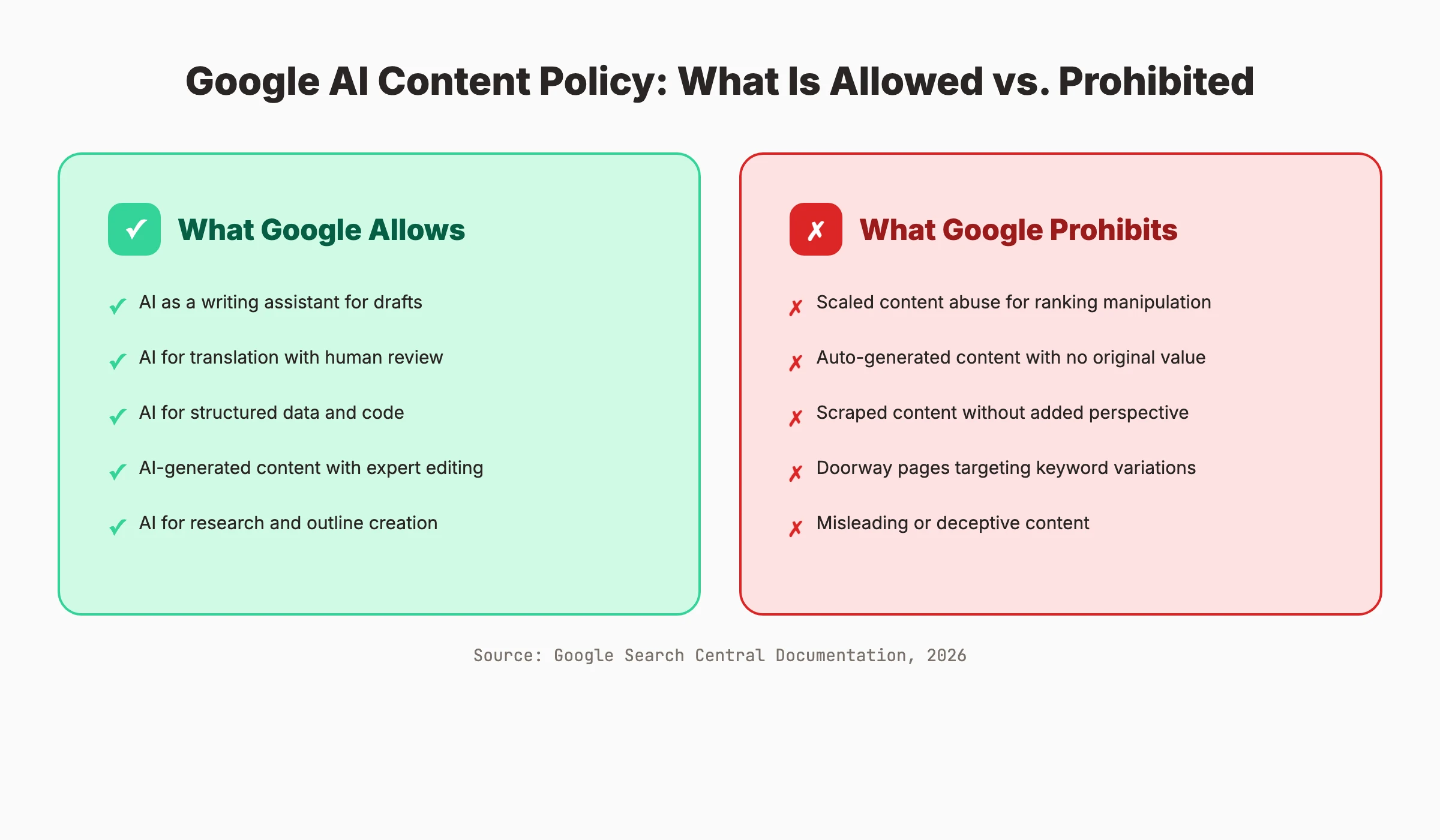
Google's documentation lists acceptable uses of AI in content creation:
- Using AI as a writing assistant to improve drafts
- Using AI for translation, with human review
- Using AI to generate structured data or code snippets
- Using AI to create outlines or research summaries
- Publishing AI-generated content that has been meaningfully reviewed, edited, and enriched with original insight
Google also lists what it prohibits:
- Using automation to generate content with the primary purpose of manipulating search rankings
- Publishing mass-produced content that adds no value for users
- Creating doorway pages or thin affiliate content at scale
- Generating fake reviews or misleading claims
The Spam Policies Update of March 2024
In March 2024, Google introduced the term "scaled content abuse" into its spam policies. The definition focuses on intent and outcome, not production method: "Generating many pages primarily to manipulate search rankings, with little or no value added for users."
This policy applies regardless of how the content was created. A team of human writers producing 1,000 near-identical pages would violate the same policy as a site using AI to do it faster.
Google's Quality Rater Guidelines and AI Content
The January 2025 update to Google's Search Quality Rater Guidelines added explicit guidance for evaluating AI-generated content. Section 4.6.6 addresses "MC Created with Little to No Effort, Little to No Originality, and Little to No Added Value."
Quality raters are instructed to flag AI-generated content as "Lowest" quality when it lacks originality and value. This matters because raters train Google's algorithms. When human raters consistently flag certain patterns, SpamBrain and the Helpful Content System learn to detect those patterns automatically.
The key phrase is "when it lacks originality and value." AI content that is original, valuable, and helpful is not flagged.
Chapter 3: Can Google Even Detect AI-Generated Content?
Yes, Google can detect patterns associated with AI-generated content. But Google does not use AI detection as a ranking signal. The systems that evaluate content look for quality signals, not origin signals.
SynthID and AI Watermarking
In 2024, Google DeepMind introduced SynthID, a system that embeds invisible watermarks into AI-generated text from Gemini models. SynthID can identify whether text was generated by Google's own AI systems.
However, SynthID has limitations:
- It only works on content generated by Gemini, not ChatGPT, Claude, or other models
- Heavy rewriting, translation, or editing can reduce watermark reliability
- Google's stated purpose for SynthID is content authenticity and misinformation detection, not SEO ranking
Google Search Advocate John Mueller confirmed in 2025 that Google does not use AI detection tools to determine rankings. The focus remains on content quality.
What Google Actually Detects
Google's SpamBrain system does not detect "AI content." It detects patterns that correlate with low-quality, mass-produced content. These patterns include:
| Pattern | Why It Triggers SpamBrain |
|---|---|
| Identical page templates | Same structure across hundreds of pages signals automation |
| Predictable sentence rhythm | Uniform sentence length and structure throughout a site |
| Missing author signals | No bylines, author pages, or expertise verification |
| Thin content clusters | Large groups of pages below 300 words |
| Rapid publishing velocity | New sites publishing 50+ articles per week without authority |
| Duplicate meta patterns | Identical title tags across pages |
A human writer producing content with these patterns would trigger the same flags as AI-generated content. Conversely, AI-assisted content that varies structure, includes author credentials, and provides depth will not trigger these flags.
The Detection Myth
Many SEO tools claim to detect AI content with high accuracy. In practice, these tools are unreliable. A 2024 study by the University of Maryland found that popular AI detection tools had false positive rates between 15% and 50% on human-written text. Another study by Stanford researchers showed that non-native English writers were disproportionately flagged as AI-generated.
Google does not rely on these tools. It relies on behavioral and structural patterns that indicate low quality — patterns that are visible regardless of authorship method.
Chapter 4: What the Data Shows — 600,000 Pages Analyzed
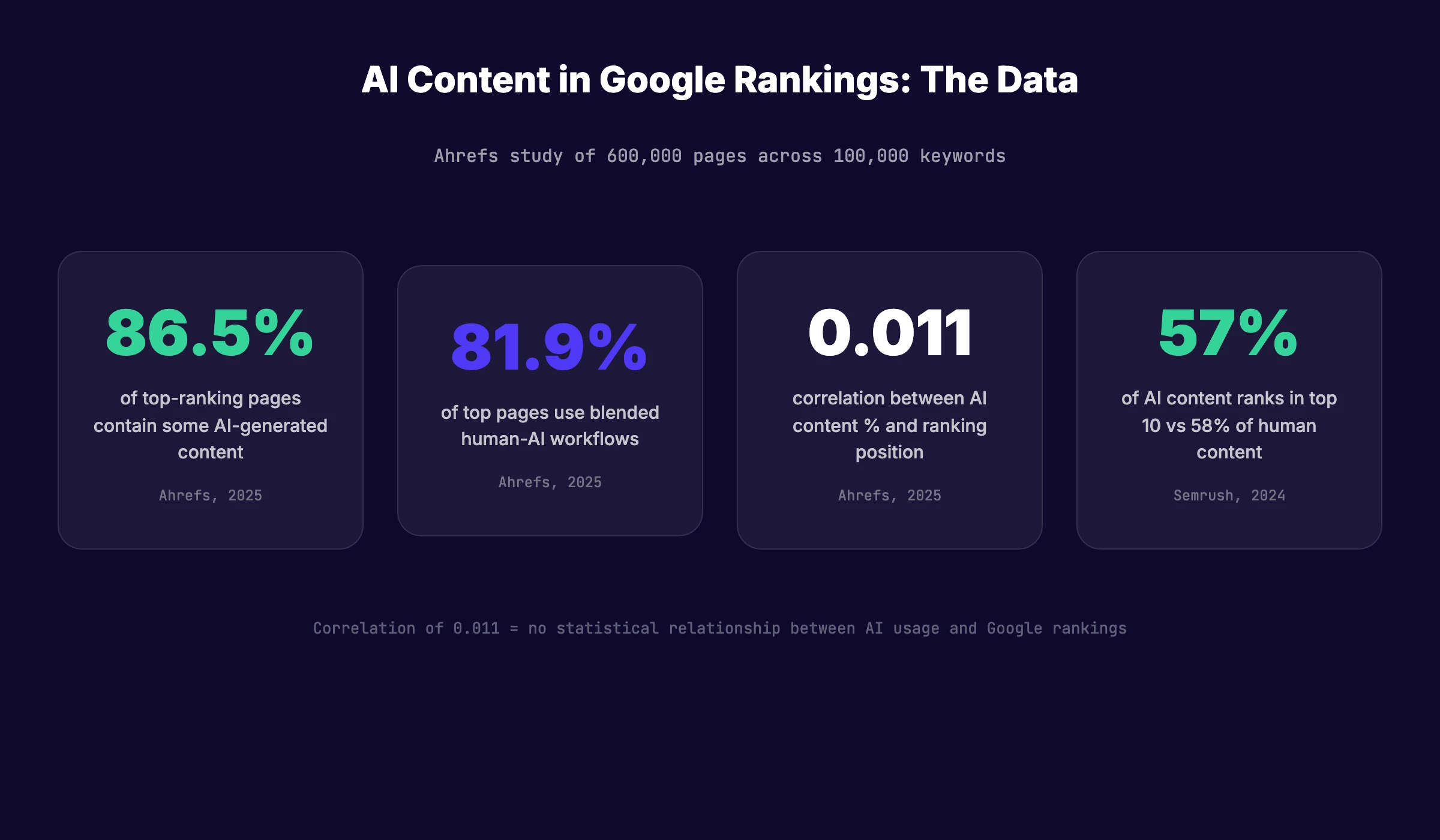
The most complete study on AI content and Google rankings comes from Ahrefs. In 2025, Ahrefs analyzed 600,000 pages across 100,000 keywords using its proprietary AI content detector. The results are definitive.
The Ahrefs Study: Key Findings
| Finding | Percentage | Implication |
|---|---|---|
| Top-ranking pages with some AI content | 86.5% | AI content is present in the vast majority of high-ranking pages |
| Pages with blended AI and human input | 81.9% | Hybrid workflows dominate top results |
| Purely human-written top-ranking pages | 13.5% | Fully human content is a minority in top positions |
| Fully AI-generated top-ranking pages | 4.6% | Pure AI content can rank but is rare at the top |
| Correlation between AI % and ranking position | 0.011 | No statistical relationship between AI usage and rankings |
The correlation of 0.011 is the critical number. In statistical terms, this means there is effectively zero relationship between how much AI content a page contains and where it ranks. AI usage does not help rankings. It does not hurt them. It is irrelevant to the ranking algorithm.
The Semrush Survey: 700+ Marketers
Semrush conducted a complementary study in late 2024, analyzing 20,000 articles and surveying over 700 marketers:
- 73% of surveyed users combine AI tools with human writing
- 57% of AI content appeared in the top 10 search results, compared to 58% of human content — a difference of 1 percentage point
- 39% of marketers using AI reported more organic traffic
- Only 9% said AI content brought worse SEO results
- Of that 9%, only 14% blamed lower content quality (the rest cited other factors)
The eMarketer Analysis
eMarketer's analysis of the Ahrefs data, published in July 2025, concluded: "Google ranks content on quality, not how it is created." The article noted that while pure AI content "rarely ranks No. 1," hybrid human-AI workflows are the norm among top-performing pages.
What the Numbers Mean
Three conclusions emerge from the data:
1. AI content is already the standard. 86.5% of top-ranking pages use some AI. The question is no longer whether to use AI. It is how to use it well.
2. Human oversight matters. Pure AI content represents only 4.6% of top-ranking pages. The sweet spot is AI-assisted content with meaningful human editing, fact-checking, and enrichment.
3. Quality is the only signal that counts. The 0.011 correlation means AI usage is not a ranking factor. Content quality — depth, originality, helpfulness, E-E-A-T — is what determines rankings.
Chapter 5: The March 2026 Spam Update — Who Got Hit and Why
Google rolled out the March 2026 spam update on March 24, 2026. It completed in 19.5 hours — the fastest spam update in Google's documented history. The speed signaled that Google's spam detection systems had become exceptionally efficient.
What the Update Targeted
The March 2026 update was not a new policy. It was stronger enforcement of existing scaled content abuse rules. Three specific patterns were hit hardest:
Pattern 1: Mass AI Page Generation Sites publishing 50–500 AI articles daily with identical structure, no editorial review, and no original value. These sites often went from zero to thousands of pages in weeks.
Pattern 2: Template-with-Variable Substitution The classic programmatic SEO approach: "Best [service] in [city]" pages across hundreds of locations, where only the city name changes. When the underlying content adds no local insight or original data, it qualifies as scaled content abuse.
Pattern 3: Aggregator Scraping Without Added Value Product roundups and comparison pages stitched from external sources without original analysis, testing, or perspective.
Penalty Statistics by Site Type
| Site Type | Traffic Loss | Primary Violation |
|---|---|---|
| Niche information sites (500+ AI pages) | 60–80% | Scaled content abuse, no original research |
| Affiliate review sites (AI product comparisons) | 40–70% | No first-hand product experience |
| Location-based service pages (template-generated) | 30–60% | Near-identical pages, no local value |
| AI content agencies (unlimited content packages) | 50–80% | No editorial oversight, mass production |
The Key Distinction
Sites that were penalized were not penalized for using AI. They were penalized for:
- Publishing content at a rate no human team could sustain (50–500 articles per day)
- Using identical templates across hundreds or thousands of pages
- Adding no original value, research, or perspective
- Lacking author credentials, editorial policies, or expertise signals
- Creating content primarily for search engines rather than users
A site publishing one high-quality AI-assisted article per day with human review would not trigger these penalties. The issue is scale without quality, not AI itself.
Recovery Timelines
| Penalty Type | Typical Recovery Time | What Recovery Requires |
|---|---|---|
| Scaled content abuse (algorithmic) | 3–6 months | Substantial content improvement or removal of thin pages |
| Helpful Content System sitewide demotion | 6–12 months | Significant portion of site content improved or removed |
| Manual action | Weeks to months | Fix the issue + submit reconsideration request |
Publish AI-assisted content without the penalty risk. theStacc combines AI-assisted drafting with human editorial review on every post. We have published 3,500+ articles across 70+ industries with zero spam penalties.
Chapter 6: How Much AI Content Is Acceptable by Google?
Google does not specify a percentage limit for AI-generated content. There is no "20% rule," "50% threshold," or "80% cap." Google's algorithms evaluate content based on quality, helpfulness, and user value — regardless of how it was created.
The Myth of Percentage Limits
A common misconception is that Google allows only a certain percentage of AI content per site. This myth likely originated from:
- Agency sales tactics: Some agencies claim their "human-only" approach is safer, implying AI has a limit
- Misinterpreted studies: When researchers report that "86.5% of top pages contain some AI," readers assume the remaining 13.5% represents a limit
- Confusion with Adsense: Google Adsense has separate policies for AI content on monetized pages, which are stricter than Search policies
What Actually Determines Acceptability
Instead of a percentage, Google evaluates these factors:
| Factor | What Google Looks For |
|---|---|
| Originality | Does the content add something new, or just rephrase existing sources? |
| Helpfulness | Does it answer the user's question completely and accurately? |
| E-E-A-T | Does it demonstrate experience, expertise, authoritativeness, and trustworthiness? |
| User satisfaction | Do visitors stay, engage, and find what they need? |
| Editorial oversight | Was the content reviewed by someone with subject matter expertise? |
A site could publish 100% AI-assisted content and rank well if every page meets these standards. A site could publish 10% AI content and be penalized if those pages are thin, unoriginal, and unhelpful.
The Practical Answer
For most content teams, the practical approach is:
- Use AI for research, outlining, and first drafts
- Have a subject matter expert review, edit, and enrich every piece
- Add original data, personal experience, or unique perspective that AI cannot generate
- Fact-check all claims, statistics, and technical details
- Ensure every page stands on its own as a helpful resource
This approach typically results in content that is 30–70% AI-drafted and 100% human-reviewed. The exact percentage varies by topic, writer, and workflow. The percentage does not matter. The quality does.
Chapter 7: The Right Way to Publish AI Content in 2026
Publishing AI content that ranks safely requires a workflow, not a tool. The sites that succeed with AI content in 2026 follow a consistent process that prioritizes quality over volume.
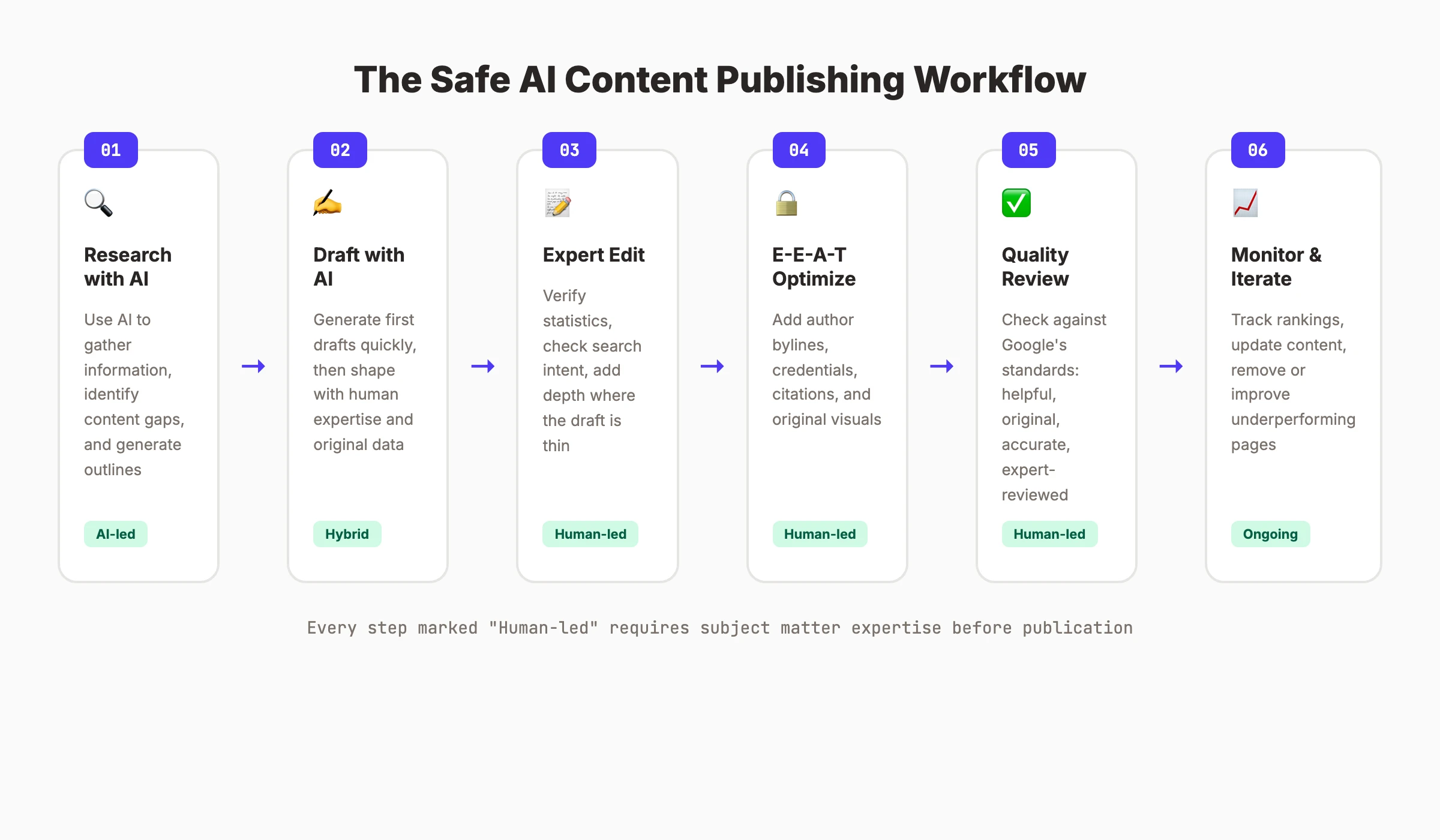
The 6-Step Safe AI Content Workflow
Step 1: Research with AI, Decide with Humans Use AI to gather information, identify gaps in existing content, and generate outlines. But the strategic decisions — which topics to cover, what angle to take, who the content serves — must be made by a human who understands the audience and business goals.
Step 2: Draft with AI, Shape with Expertise AI can produce a solid first draft quickly. But the draft needs human expertise to:
- Add specific details that only someone with experience would know
- Include original data, screenshots, or examples from real work
- Correct AI hallucinations and outdated information
- Ensure the tone and perspective match the brand
Step 3: Edit for Quality, Not Just Grammar Editing AI content requires more than fixing typos. A qualified editor should:
- Verify every statistic and claim against original sources
- Check that the content fully answers the search intent
- Ensure the structure is logical and easy to follow
- Add transitions, examples, and depth where the draft is thin
Step 4: Optimize for E-E-A-T Every piece of AI-assisted content should include:
- An author byline with credentials and expertise area
- A publication date and last-updated date
- Links to authoritative external sources
- Internal links to related content on your site
- Original images, charts, or data visualizations where possible
Step 5: Review Against Google's Quality Standards Before publishing, ask these questions:
- Would a user find this helpful without needing to search again?
- Does this content add something that does not already exist in search results?
- Is the author qualified to write about this topic?
- Would I be comfortable showing this to an expert in the field?
Step 6: Monitor and Iterate After publishing, track performance:
- Monitor rankings and traffic in Google Search Console
- Watch for manual actions or security issues
- Update content regularly with new information
- Remove or improve pages that underperform
AI Content and E-E-A-T
E-E-A-T — Experience, Expertise, Authoritativeness, and Trustworthiness — is where AI content lives or dies. Google mentions E-E-A-T over 120 times in the Search Quality Rater Guidelines.
Experience is the hardest for AI to satisfy. AI cannot test products, visit locations, or conduct original research. The fix is to add human experience to AI drafts: specific details, real examples, and firsthand observations.
Expertise requires a human with knowledge in the subject area to fact-check claims, add nuance, and correct errors. AI has broad knowledge but shallow expertise.
Authoritativeness and Trustworthiness are structural. They depend on author bios, consistent publishing, backlinks, transparent policies, and accurate sourcing.
For a deeper dive into E-E-A-T requirements, see our E-E-A-T guide for blogs.
Chapter 8: Common Mistakes That Get AI Content Penalized
Most AI content penalties are avoidable. The mistakes that trigger penalties are predictable, and the fixes are straightforward.
Mistake 1: Publishing AI Content Unchanged
AI-generated drafts are starting points, not finished products. Publishing AI output without editing is the fastest path to a penalty. Unedited AI content typically lacks:
- Original perspective or unique insights
- Accurate, up-to-date information (AI training data has a cutoff date)
- Proper tone and brand voice
- Fact-checked claims and statistics
The fix: Every AI draft must be reviewed and edited by a human with subject matter expertise before publication.
Mistake 2: Publishing at Unsustainable Scale
A team of 5 skilled writers produces at most 10–15 high-quality articles per week. A site publishing 50–500 articles per day without proportional staff is signaling automated content production.
The fix: Match publishing volume to your editorial capacity. Quality per article matters more than total article count.
Mistake 3: Using Identical Templates Across Hundreds of Pages
Programmatic SEO can work when each page adds genuine local or topical value. It fails when pages are identical except for a few variables.
The fix: If you use templates, ensure each page contains unique insights, local data, or original analysis that justifies its existence.
Mistake 4: Missing Author and Expertise Signals
Pages without author bylines, author pages, or expertise verification look anonymous. Anonymous content is harder to trust — and trust is a ranking factor.
The fix: Include author names, credentials, and expertise areas on every article. Create author pages that demonstrate qualifications.
Mistake 5: Targeting Keywords Instead of Serving Users
Content created primarily to rank for keywords — rather than to help users — violates Google's Helpful Content System. AI makes it easy to generate keyword-targeted content at scale. That is exactly what Google penalizes.
The fix: Start with the user's question or problem. Create content that answers it completely. Optimize for keywords after the content is genuinely helpful.
Mistake 6: Ignoring AI Hallucinations
AI models sometimes generate plausible-sounding but false information. A single uncorrected hallucination can destroy trust and trigger quality flags.
The fix: Fact-check every statistic, claim, and technical detail. Verify against original sources, not just AI output.
The Penalty Prevention Checklist
Use this checklist before publishing any AI-assisted content:
- ✓ A human expert has reviewed and edited the content
- ✓ All statistics and claims are fact-checked against original sources
- ✓ The content adds original value not found in existing search results
- ✓ An author byline with credentials is included
- ✓ The content fully answers the user's search intent
- ✓ The page has a unique structure (not copied from a template)
- ✓ Internal and external links to authoritative sources are included
- ✓ The content is dated and will be updated regularly
- ✓ The page would be helpful even if it never ranked on Google
- ✓ A human would be proud to put their name on this content
Get the AI content workflow that works. theStacc handles research, drafting, editing, optimization, and publishing — with human review at every step. Zero spam penalties.
What practitioners are saying on X
AI search advice ages quickly. Here is high-signal public discussion from SEO and growth operators — context for your roadmap, not a substitute for primary data.
- @hridoyreh (Mar 2026): Widely shared SEO skill tree: foundations, research, technical, on-page, content, links, AI SEO/GEO, analytics, UX, brand, programmatic — useful map for stats and how-to posts. See the post on X.
- @jakezward (Feb 2026): 2026 SEO predictions emphasize AI Overview share-of-SERP, schema for LLM token efficiency, brand mentions in AI answers as a KPI, proprietary data as a moat, and content refresh beating net-new AI slop. See the post on X.
- @alexgroberman (Jul 2026): Case narrative: organic value plus multi-engine citations (ChatGPT, Perplexity, Grok) from knowledge-hub pages, category authority links, commercial intent content, and tight internal linking — not thin product copy. See the post on X.
Grok, AI Overviews, and multi-engine visibility
Analytics and SEO setup pages should keep entity names and steps extractable for AI Overviews, ChatGPT, Perplexity, and Grok.
- Google AI Overviews: Use passage-ready answers, tables, and FAQ schema where relevant.
- ChatGPT / Perplexity: Cite named sources next to key claims.
- Grok: Maintain accurate entity facts on-site and in high-signal X posts.
Publish content built for Google and AI citations. theStacc Content SEO ships SEO-scored articles structured for rankings and generative engines.
Frequently Asked Questions
No. Google does not penalize content simply for being AI-generated. Google penalizes low-quality, unhelpful, or manipulative content regardless of how it was produced. AI content that meets Google's quality standards can rank just as well as human-written content.
Google does not specify a percentage limit. There is no "20% rule" or any other threshold. Google evaluates content based on quality, helpfulness, and originality — not the percentage of AI involvement. A site could publish 100% AI-assisted content and rank well if every page meets quality standards.
Google cares about quality, not authorship method. Google's official position is origin-agnostic: "Our focus on the quality of content, rather than how content is produced, is a useful guiding principle." AI-generated content that is helpful, original, and accurate is treated the same as human-written content with those same qualities.
Yes. AI content is allowed on Google. Google's Search Central documentation explicitly states that using AI for content creation is not against policies. What is prohibited is using AI (or any automation) to generate content with the primary purpose of manipulating search rankings.
Google does not reject content for being AI-generated. Google rejects content that is unhelpful, thin, misleading, or created primarily to manipulate rankings. AI can be used to create helpful content. The tool is not the issue — the output is.
Google does not punish articles for being AI-written. It punishes articles that are low-quality, unoriginal, or created to game search rankings. An AI-written article that provides genuine value, accurate information, and original perspective will not be punished.
There is no "20% rule" in Google's official documentation. This appears to be a myth or misinterpretation. Google has never published a percentage limit for AI content. Content quality is evaluated page by page, not by calculating AI involvement percentages.
Yes, Google can detect patterns associated with AI-generated content through systems like SpamBrain. However, Google does not use AI detection as a ranking signal. The systems evaluate content quality signals — originality, helpfulness, E-E-A-T — not authorship origin.
No. Google does not penalize content based on which AI tool created it. Content generated by ChatGPT, Gemini, Claude, or any other tool is evaluated by the same quality standards. The tool name is irrelevant to Google's ranking systems.
AI content affects SEO the same way any content affects SEO: through quality signals. Well-researched, expertly reviewed AI-assisted content can improve SEO. Unedited, low-quality AI content can hurt SEO. The effect depends on quality, not the fact that AI was involved.
The data is clear: Google does not penalize AI content. Google penalizes low-quality content. The 86.5% of top-ranking pages that contain some AI content prove that AI and high rankings are not mutually exclusive.
The sites that lost traffic in 2026 were not the ones using AI. They were the ones using AI to produce thin, unoriginal, mass-produced content without editorial oversight. The sites that gained traffic were the ones using AI as a tool while adding human expertise, experience, and originality that algorithms cannot replicate.
The question is no longer "does Google penalize AI content?" The question is whether your AI content is good enough to meet Google's quality standards. If it is, the tool you used to create it does not matter.
Publish AI content that ranks — safely. theStacc writes, edits, and publishes SEO articles with human review built into every post. No penalty risk. No quality guesswork.
Related Tools & Resources
Free SEO Tools:
Best Lists:
Sources & references

Researched, written, and published articles that compound organic traffic.
Weekly local SEO teardowns
One practical email a week. Map Pack, GBP, AI Overviews — no fluff. Unsubscribe anytime.