SEO for insurance agents: local rankings, Google Business Profile setup, the pages that generate quote requests, and how to measure lead flow.
Insurance agent SEO is the single highest-ROI marketing channel most agents ignore. While competitors spend $50 or more per click on Google Ads, organic search delivers the same leads at a fraction of the cost.
The numbers back this up. 69% of insurance consumers search online before scheduling an appointment. 68% have no specific brand in mind when they start searching. That means the agent who ranks first on Google wins the client. Not the agent with the biggest ad budget.
But ranking for insurance terms is hard. National carriers dominate head terms. CPCs are among the highest in any industry. And most agents have no idea where to start with SEO.
This guide covers every aspect of insurance agent SEO. Local search, Google Business Profile, content strategy, keyword targeting, on-page optimization, and review management. Each chapter includes specific tactics built for the insurance industry.
We have published 3,500+ SEO articles across 70+ industries, including independent agents, brokerages, and multi-line agencies. This guide is built on what we see working right now.
Here is what you will learn:
- Why SEO beats PPC for insurance agents on cost per lead
- How to dominate the local 3-pack in your service area
- The exact keyword strategy that targets high-intent insurance searches
- How to create content that ranks for competitive insurance terms
- How reviews directly impact your local search visibility
Why Insurance Agents Need SEO Over PPC
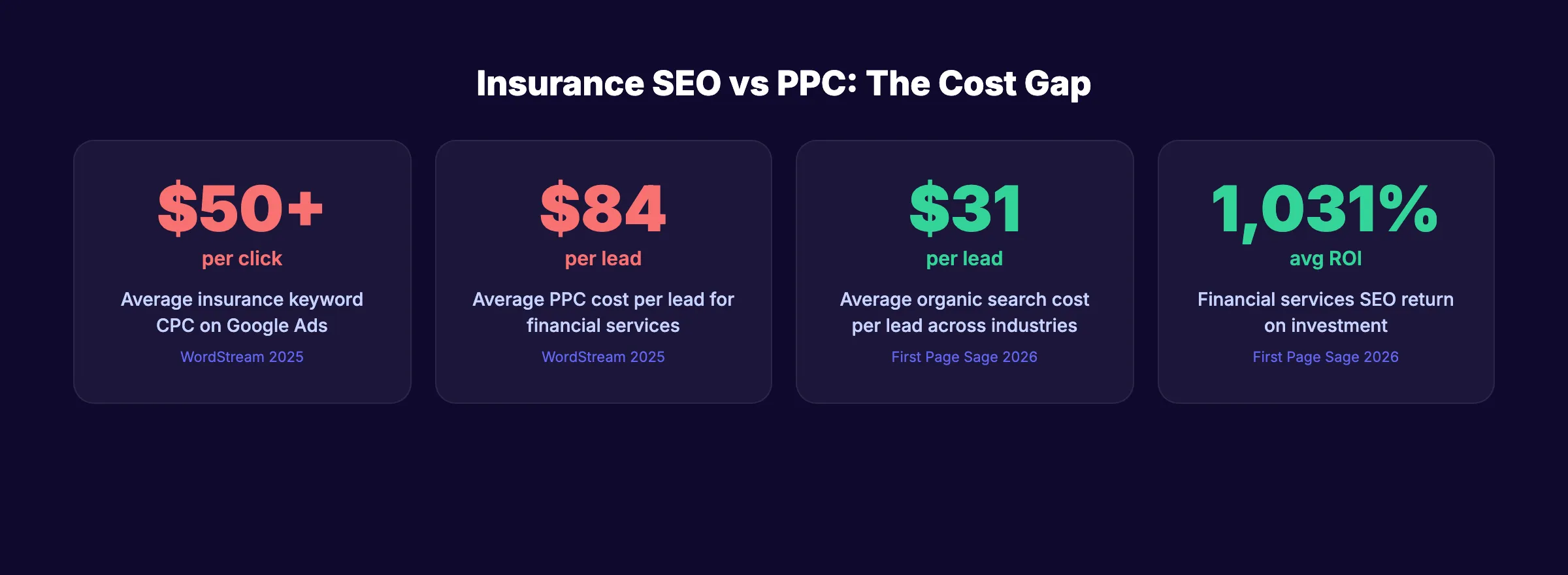
Insurance is one of the most expensive industries for paid search. The average cost per click for insurance keywords exceeds $50, with some terms like "car insurance quotes" reaching $80 or more per click. The average cost per lead in financial services sits at $83.93.
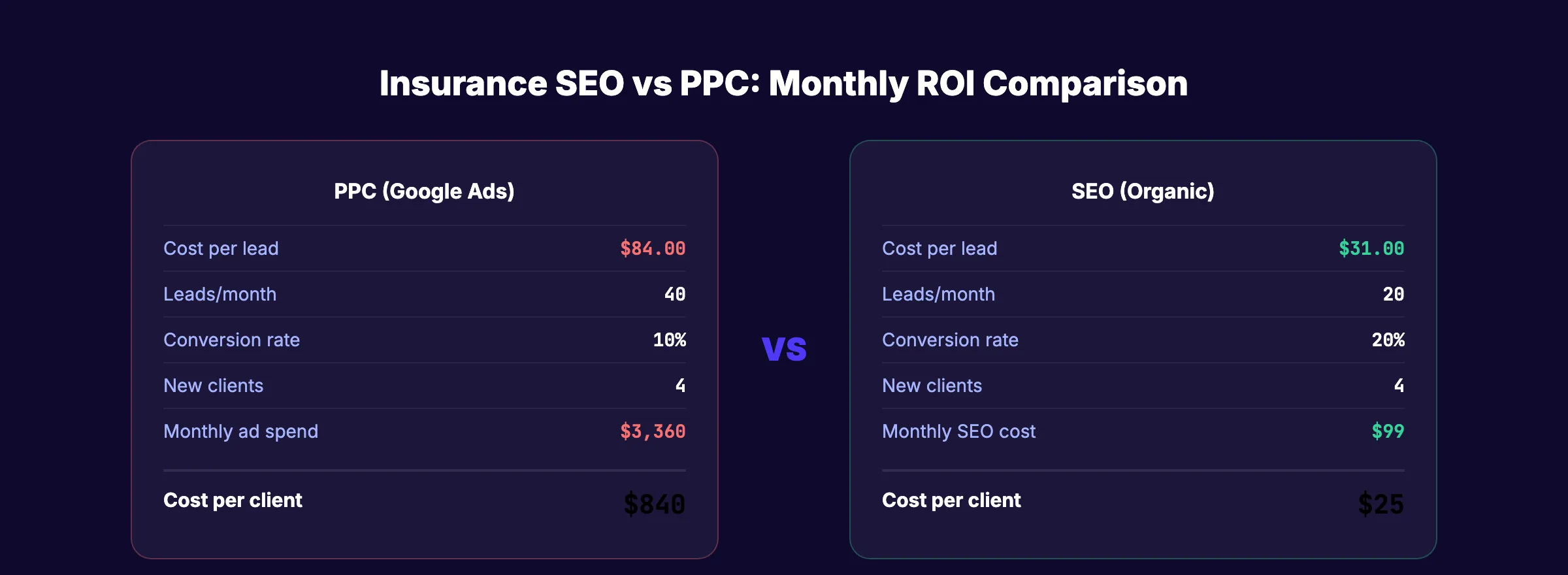
That math breaks most independent agents. Spending $84 per lead when conversion rates hover around 5% to 10% means each new client costs $840 to $1,680 in ad spend alone.
SEO flips that equation. Financial services SEO delivers an average ROI of 1,031%. Organic leads cost roughly $31 per lead compared to $181 for PPC across all industries.
How Insurance Searches Break Down
Insurance searches fall into 3 categories:
| Search Type | Example | Intent | Competition |
|---|---|---|---|
| Head terms | "car insurance" | Research | Dominated by national carriers |
| Local terms | "insurance agent near me" | Ready to buy | Winnable for independent agents |
| Long-tail terms | "do I need umbrella insurance if I have an LLC" | Education | Low competition, high conversion |
Independent agents cannot compete with GEICO and State Farm on head terms. Those companies spend hundreds of millions on brand SEO. But local and long-tail terms are wide open. A solo agent in Denver can rank #1 for "independent insurance agent Denver" with consistent local SEO.
Where SEO Fits in the Insurance Sales Funnel
| Funnel Stage | What They Search | SEO Tactic |
|---|---|---|
| Awareness | "what does homeowners insurance cover" | Blog content targeting informational keywords |
| Consideration | "best insurance agent in [city]" | Google Business Profile + local SEO |
| Decision | "[agency name] reviews" | Review management + branded content |
Most agents only market at the decision stage. SEO fills the entire funnel. For a deeper look at local SEO fundamentals, start with our complete guide.
Your SEO team. $99 per month. SEO-scored articles published automatically. Built for local service businesses like insurance agencies.
Local SEO for Insurance Agents
46% of all Google searches have local intent. For insurance agents, that number is even higher. When someone searches "insurance agent near me," Google shows 3 results in the local map pack before any organic listings.
Ranking in that 3-pack is the single most valuable SEO position for an insurance agent.
The 3 Local Ranking Factors
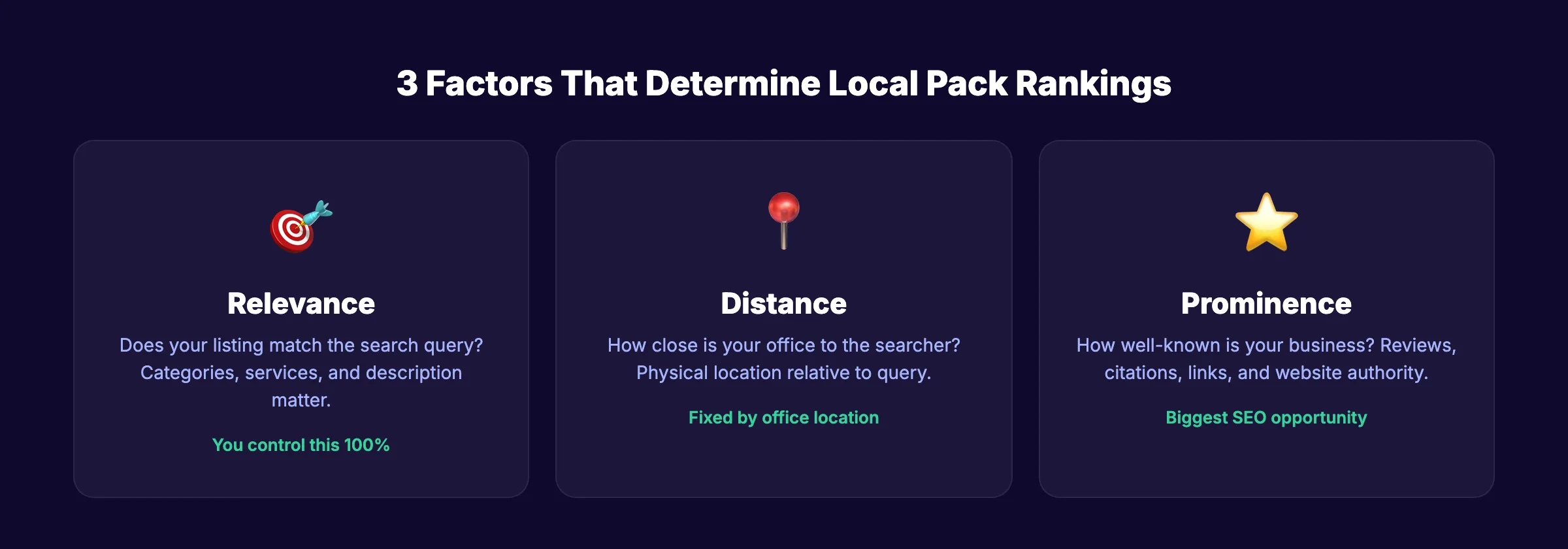
Google's local algorithm weighs 3 primary factors:
- Relevance. Does your listing match what the searcher wants? Accurate categories, services, and description.
- Distance. How close is your office to the searcher? You cannot fake this.
- Prominence. How well-known and trusted is your business? Reviews, citations, and website authority drive this.
Citations and NAP Consistency
NAP stands for Name, Address, Phone number. Every online listing of your agency must match exactly. A mismatch between "Smith Insurance Agency" on Google and "Smith Insurance" on Yelp confuses Google and hurts rankings.
Build citations on these platforms:
- ✓ Google Business Profile (mandatory)
- ✓ Bing Places
- ✓ Yelp
- ✓ Insurance-specific directories (TrustedChoice, IA Magazine)
- ✓ BBB (Better Business Bureau)
- ✓ Local Chamber of Commerce
- ✓ Facebook business page
- ✓ Apple Maps
Audit your existing citations with our SEO audit tool to find inconsistencies.
Service Area Targeting
If you serve multiple cities, create a dedicated page for each major service area on your website. A page titled "Auto Insurance in Boulder, CO" with locally relevant content ranks for location-specific searches that a generic homepage never will.
Do not duplicate content across city pages. Each page needs unique content about that specific area. Mention local landmarks, neighborhoods, and risks specific to that location (flood zones, wildfire areas, hail corridors).
Google Business Profile Optimization
Your Google Business Profile is the most important single asset for insurance agent SEO. 76% of people who search "near me" visit a business within 24 hours.
Complete Every Field
Google ranks complete profiles higher than incomplete ones. Fill in:
- Business name. Exact legal name. Do not stuff keywords.
- Primary category: "Insurance Agency" or "Insurance Broker"
- Secondary categories. Add all that apply (Auto Insurance Agency, Health Insurance Agency, Life Insurance Agent, Home Insurance Agency)
- Services. List every insurance line you offer with descriptions
- Service area. Define every city and county you serve
- Business hours. Include holiday hours
- Business description: 750 characters. Lead with your primary insurance services and location.
- Attributes. Add all relevant attributes (woman-owned, veteran-owned, appointment required, etc.)
GBP Posts for Insurance Agents
Google Business Profile posts keep your listing active and signal relevance to Google. Post 2 to 3 times per week. See our guide on GBP posting frequency for the data behind this cadence.
Post ideas for insurance agents:
| Post Type | Example | Frequency |
|---|---|---|
| Educational | "5 things your renters insurance does not cover" | 2x/week |
| Seasonal | "Hurricane season starts June 1. Review your homeowners policy now." | Monthly |
| Community | "Proud sponsor of the [City] Little League" | Monthly |
| Offer | "Free insurance review for new homeowners" | Bi-weekly |
Photos and Videos
Agencies with 100+ photos get 520% more calls than those with fewer than 10. Upload photos of your office, team, community events, and branded materials. Add new photos monthly.
3,500+ blogs published. Every article is SEO-scored before publish. Every article passes a 40-point quality audit before it goes live.
Keyword Strategy for Insurance Agent SEO
Most insurance agents target the wrong keywords. They chase "car insurance" (a term GEICO spends millions to own) instead of "independent insurance agent for small business in [city]" (a term nobody competes for).
The Insurance Keyword Pyramid
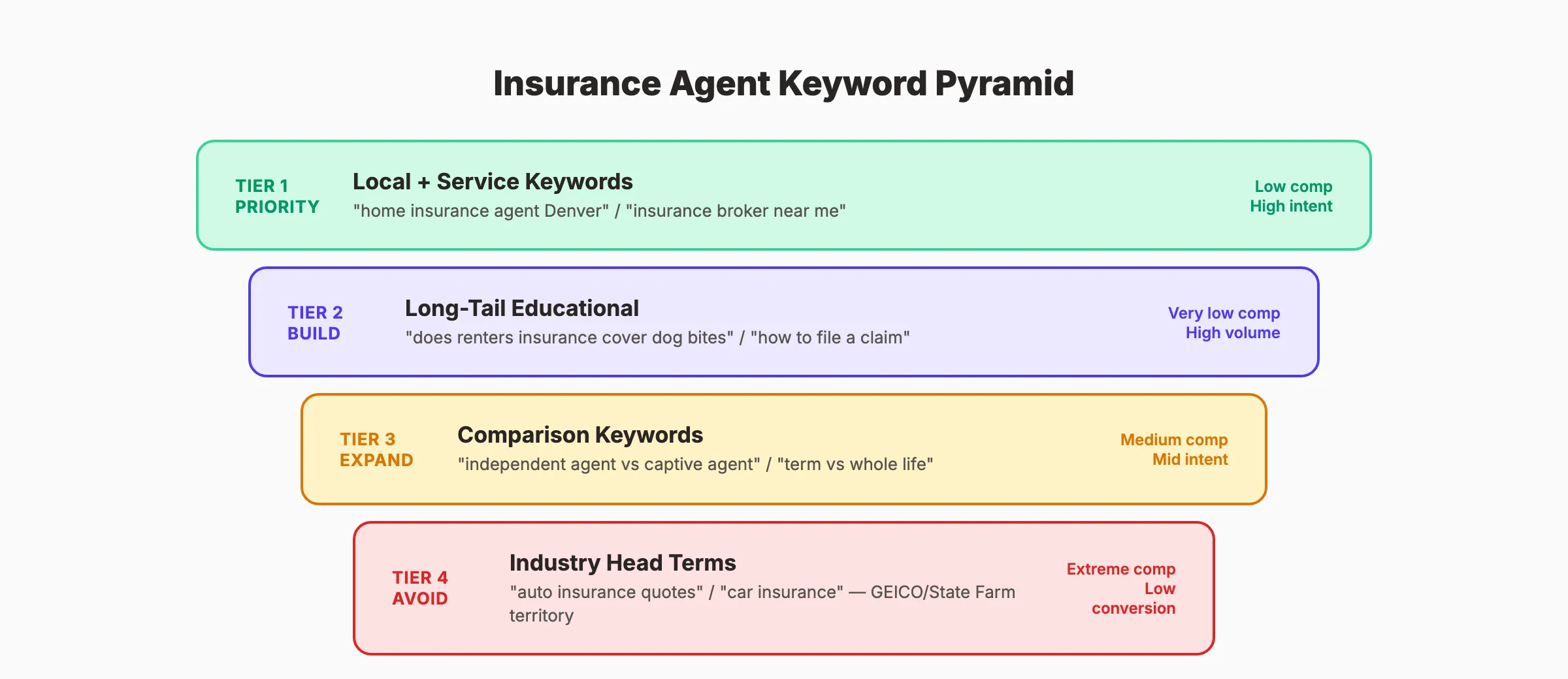
| Tier | Keyword Type | Example | Volume | Competition | Priority |
|---|---|---|---|---|---|
| Tier 1 | Local + service | "home insurance agent [city]" | 50-500/mo | Low | Highest |
| Tier 2 | Long-tail educational | "does renters insurance cover dog bites" | 200-2,000/mo | Very low | High |
| Tier 3 | Comparison | "independent agent vs captive agent" | 500-1,500/mo | Medium | Medium |
| Tier 4 | Industry head terms | "auto insurance quotes" | 100K+/mo | Extreme | Avoid |
High-Intent Insurance Keywords
Focus your keyword research on terms with buying intent:
- "[insurance type] agent in [city]"
- "[insurance type] quotes [city]"
- "best insurance agent near me"
- "independent insurance broker [city]"
- "business insurance [city]"
- "cheap [insurance type] [city]"
These terms have lower volume but much higher conversion rates. Someone searching "auto insurance agent in Austin" is ready to call.
Content Keywords That Build Authority
For blog content, target questions your prospects actually ask:
- "how much does [insurance type] cost in [state]"
- "what does [insurance type] cover"
- "do I need [insurance type]"
- "[insurance type] vs [insurance type]"
- "how to file an insurance claim"
- "best insurance for [profession/situation]"
Each of these becomes a blog post that builds topical authority around insurance topics. Over time, Google recognizes your site as an authority on insurance content, which lifts rankings for all your pages.
Content That Ranks for Insurance Topics
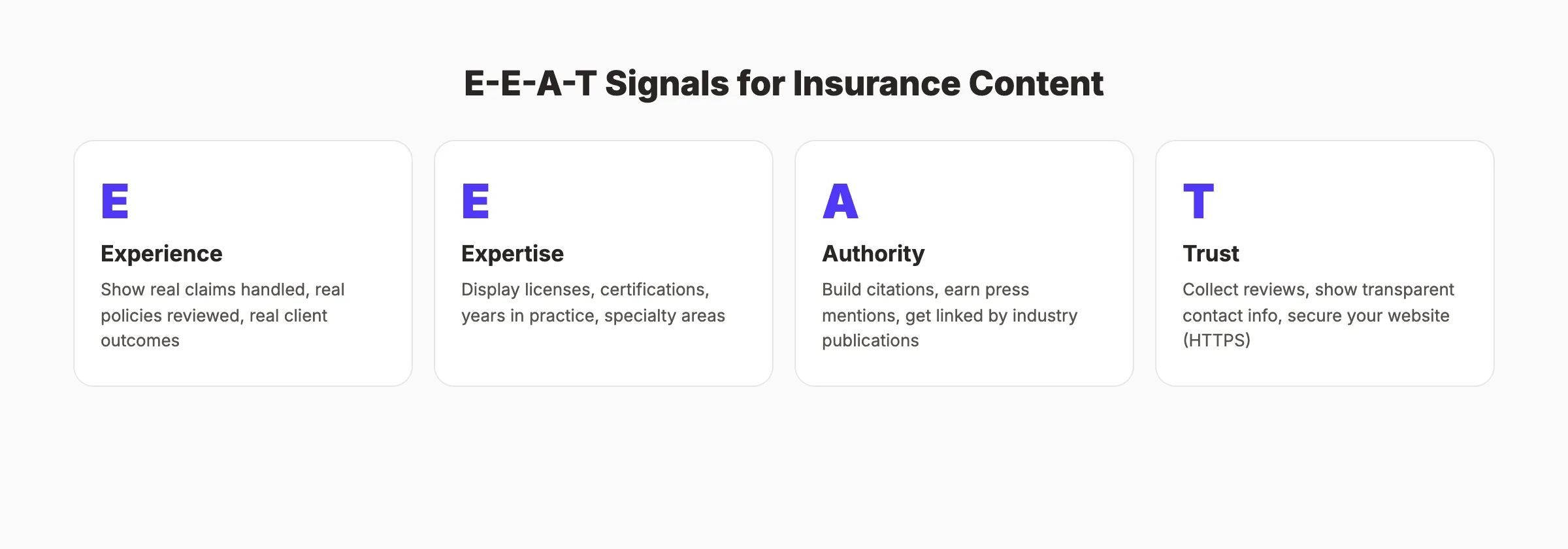
Insurance is a YMYL (Your Money or Your Life) category. Google holds YMYL content to a higher standard because bad insurance advice can cause real financial harm. That means your content needs strong E-E-A-T signals.
E-E-A-T for Insurance Content
| Signal | What It Means for Insurance Agents |
|---|---|
| Experience | Show you have handled real claims, reviewed real policies, advised real clients |
| Expertise | Display insurance licenses, certifications, and years of practice |
| Authoritativeness | Build citations, earn local press mentions, get linked by industry sites |
| Trustworthiness | Show reviews, transparent pricing, contact information on every page |
Content Types That Work for Insurance SEO
1. Coverage explanation pages (highest volume) "What Does Homeowners Insurance Cover?". These rank for thousands of long-tail variations. Write one per major insurance line.
2. Cost guides by state (highest conversion) "How Much Is Auto Insurance in Texas?". Include real rate data, factors that affect pricing, and a call to action for a personalized quote.
3. Comparison content (builds authority) "Term Life vs Whole Life Insurance: Which Is Right for You?". These attract mid-funnel searchers comparing options.
4. Local risk content (zero competition) "Flood Insurance in [City]: What Homeowners Need to Know". Combine local expertise with insurance knowledge. No national carrier creates this content.
5. FAQ clusters (voice search + featured snippets) "Does Car Insurance Cover Rental Cars?". Short, direct answers that Google surfaces in featured snippets and AI Overviews.
For help building a content calendar, see our step-by-step guide.
Publishing Frequency
Agents who publish 4 or more blog posts per month see measurably better rankings than those who publish sporadically. Consistency signals to Google that your site is active and maintained.
A case study from Goodcover (an insurance startup) showed 1,374% organic growth after publishing 50 targeted blog posts. Volume matters. Consistency matters more.
Rank everywhere. Do nothing. Blog SEO, Local SEO, and Social on autopilot. theStacc starts at $99 per month with a free trial.
On-Page SEO for Insurance Websites
Most insurance agent websites fail basic on-page SEO checks. Missing title tags, duplicate meta descriptions, no header structure, and images without alt text are common across the industry.
The Insurance On-Page Checklist
For every page on your site, verify:
- ✓ Title tag includes your primary keyword and location (under 60 characters)
- ✓ Meta description is 145 to 155 characters with a benefit statement
- ✓ H1 tag matches the page topic (one per page)
- ✓ H2 tags break content into scannable sections
- ✓ Primary keyword appears in the first 100 words
- ✓ Images have descriptive alt text ("auto insurance policy document" not "image1.jpg")
- ✓ Page loads in under 3 seconds on mobile
- ✓ URL is short and descriptive ("/auto-insurance-austin" not "/page?id=4872")
- ✓ Internal links connect to related pages on your site
Use our free on-page SEO checker to audit any page in seconds.
Schema Markup for Insurance Agents
Schema markup helps Google understand what your business does. Insurance agents should add InsuranceAgency schema to their homepage.
Key properties to include:
@type: InsuranceAgencyname: Your agency nameaddress: Full office addresstelephone: Main phone numberareaServed: Cities and states you serveopeningHours: Business hoursaggregateRating: Your average review scoresameAs: Links to your social profiles
Schema does not directly improve rankings, but it helps Google display rich results. An insurance listing with star ratings, hours, and phone number visible in search results gets more clicks than a plain text listing.
Mobile Optimization
62% of insurance searches happen on mobile devices. If your website does not load fast and function well on a phone, you lose more than half your potential leads before they see your content.
Check your mobile performance with our website SEO score tool.
Reviews and Reputation Management
Reviews directly impact local search rankings. BrightLocal's research shows that 98% of consumers read online reviews for local businesses. For insurance, trust is everything. No one buys a policy from an agent with 3 stars.
How Reviews Affect Insurance SEO
| Review Factor | SEO Impact |
|---|---|
| Review quantity | More reviews = higher local rankings |
| Review velocity | Steady stream of new reviews signals active business |
| Review diversity | Reviews on multiple platforms (Google, Yelp, BBB) strengthens presence |
| Review response | Responding to every review shows engagement |
| Star rating | 4.0+ stars required to appear in some local search features |
Building a Review System
Most agents wait for reviews to appear organically. That approach produces 2 to 3 reviews per year. A systematic approach produces 2 to 3 per week.
The insurance agent review system:
- After every policy sale, send a personalized review request email within 24 hours
- After every claim resolution, send a follow-up asking about their experience
- At annual renewals, request a review as part of your renewal check-in
- Make it easy. Send a direct link to your Google review form (not your GBP listing page)
For detailed review-building tactics, see our guide on how to get more Google reviews.
Responding to Reviews
Respond to every review within 24 to 48 hours. Thank positive reviewers by name. For negative reviews, acknowledge the concern, take the conversation offline, and avoid sharing client details publicly. Our guide on responding to negative reviews covers the exact framework.
Measuring Insurance SEO Results
SEO for insurance agents takes 3 to 6 months for early traction. Set realistic expectations and track the right metrics from day one.
The Insurance SEO Dashboard
| Metric | Tool | What It Tells You | Check Frequency |
|---|---|---|---|
| Organic impressions | Google Search Console | Whether Google shows your pages in results | Weekly |
| Keyword rankings | Ahrefs, Semrush, or GSC | Whether you rank for target insurance terms | Bi-weekly |
| GBP views and actions | GBP Insights | How many people see and interact with your listing | Weekly |
| Organic traffic | Google Analytics | Whether search visitors reach your site | Weekly |
| Phone calls from organic | Call tracking | Whether SEO generates actual client calls | Weekly |
| Quote requests | Form submissions | Whether traffic converts to leads | Weekly |
ROI Calculation for Insurance SEO
Here is the math for a typical independent agent:
- Average insurance policy value: $1,200 per year
- Client lifetime value (5-year average retention): $6,000
- SEO investment: $99 to $500 per month
- Organic leads per month (after 6 months): 10 to 30
- Lead-to-client conversion rate: 15% to 25%
- New clients from SEO per month: 2 to 8
At $6,000 lifetime value per client and 4 new clients per month, SEO generates $24,000 per month in lifetime client value. Against a $99 to $500 monthly investment, the ROI exceeds 4,000%.
Compare that to PPC where $84 per lead and 10% conversion means each client costs $840 in ad spend. The same 4 clients cost $3,360 per month in ads with zero compounding benefit.
Skip the agency. Keep the results. theStacc starts at $99 per month with a free trial. Articles published automatically.
What practitioners are saying on X
Systems and fundamentals still compound; AI search adds new KPIs.
- @jakezward (Feb 2026): 2026 SEO predictions emphasize AI Overview share-of-SERP, schema for LLM token efficiency, brand mentions in AI answers as a KPI, proprietary data as a moat, and content refresh beating net-new AI slop. See the post on X.
- @hridoyreh (Mar 2026): Widely shared SEO skill tree: foundations, research, technical, on-page, content, links, AI SEO/GEO, analytics, UX, brand, programmatic — useful map for stats and how-to posts. See the post on X.
- @HlynurStefDev (Jul 2026): Public case: niche site traffic jumped from ~18 to 4,162 Google visits/month after focused technical/on-page SEO work (GSC screenshots claimed) — reminds that fundamentals still move numbers. See the post on X.
Grok, AI Overviews, and multi-engine visibility
For “insurance seo guide”, multi-engine visibility still starts with clear definitions, sourced numbers, and extractable section answers. Grok additionally factors live X discussion — keep public claims consistent with this page.
- Google AI Overviews: Use passage-ready answers, tables, and FAQ schema where relevant.
- ChatGPT / Perplexity: Cite named sources next to key claims.
- Grok: Maintain accurate entity facts on-site and in high-signal X posts.
Publish content built for Google and AI citations. theStacc’s Content SEO module ships SEO-scored articles structured for rankings and generative engines — including clearer entity pages models like Grok can quote.
FAQ
Yes. Financial services SEO delivers an average ROI of 1,031% according to First Page Sage. Insurance agents benefit even more because local SEO targets a defined geographic area with less competition than national terms. A solo agent can rank #1 in their city within 6 months of consistent effort.
Expect 3 to 6 months for initial ranking improvements on long-tail and local terms. Competitive keywords take 6 to 12 months. Google Business Profile optimization often shows results within 30 to 60 days because local rankings update faster than organic rankings.
SEO costs range from $99 per month for automated content services to $3,000+ per month for full-service agency retainers. Most independent agents get strong results in the $99 to $500 per month range. The key is consistent content publishing and local SEO maintenance. See our full SEO cost breakdown for details.
Target local keywords first ("insurance agent [city]"), then educational long-tail keywords ("what does umbrella insurance cover"), then comparison keywords ("term vs whole life insurance"). Avoid head terms like "car insurance" where national carriers dominate. Focus on terms where searchers want a local agent, not a national brand.
Yes, but it requires 10 to 15 hours per month for keyword research, content creation, GBP management, and link building. Most agents find their time is better spent selling policies. Outsourcing SEO to a service like theStacc costs less than one hour of an agent's billable time per month and produces a steady stream of optimized articles.
Complete every field in your profile. Choose "Insurance Agency" as your primary category. Add all insurance lines as secondary categories and services. Post 2 to 3 times per week with educational and community content. Upload photos monthly. Respond to every review within 48 hours. Our GBP optimization guide covers each step.
Insurance agent SEO is a long-term investment that compounds over time. Every article, every review, and every GBP post builds on the last. The agents who start now own the search results in their market 12 months from now. The agents who wait keep paying $50 per click.
Stop writing. Start ranking. theStacc publishes SEO articles per month for $99. Built for local service businesses like insurance agencies.
Related Tools & Resources
Free SEO Tools:
Best Lists:
Sources & references
- [1] Princeton / Georgia Tech et al. — GEO research (arXiv:2311.09735)
- [2] @hridoyreh on X — Widely shared SEO skill tree: foundations, research, technical, on-page, content, links, AI SEO/GEO, analytics, UX, bran
- [3] @jakezward on X — 2026 SEO predictions emphasize AI Overview share-of-SERP, schema for LLM token efficiency, brand mentions in AI answers
- [4] Referenced source — www.wordstream.com

Manage Google Business Profile posts, review replies, and local rank tracking.
Weekly local SEO teardowns
One practical email a week. Map Pack, GBP, AI Overviews. No fluff. Unsubscribe anytime.
Explore this topic: SEO for insurance companies that are tired of renting leads from the people they compete with..