Local SEO delivers 700% ROI in 6-12 months. Learn how automated SEO cuts costs, tracks returns, and drives revenue for local businesses in 2026.
Most local business owners spend money on SEO and have no idea if it is working. They pay an agency $1,500 per month, see a rankings report, and hope the phone rings. Six months later, they are not sure whether the investment paid off. This is not a strategy. It is a gamble.
Automated SEO changes the equation. Instead of guessing, you get measurable systems that track every dollar, every click, and every call. Local SEO already delivers a 700% average return on investment within 6 to 12 months, according to BrightEdge research from 2026. When you add automation to the mix, you cut labor costs, eliminate repetitive tasks, and accelerate the timeline to profitability.
In this guide, you will learn how to calculate the true ROI of automated SEO for your local business, which tasks to automate first, and how to build a system that proves its value every month. theStacc has helped hundreds of local businesses automate their SEO workflows, and this guide covers everything we have learned about turning search visibility into revenue.
Table of Contents
- What Automated Local SEO Actually Means
- Why Local SEO ROI Is Different from Regular SEO
- The Real Numbers: What Local SEO ROI Looks Like in 2026
- Which SEO Tasks Should Local Businesses Automate First
- How to Calculate Your Local SEO ROI Step by Step
- The Hidden Costs of Manual SEO vs. Automated SEO
- Building Your 90-Day Automated Local SEO System
- Common Mistakes That Kill Local SEO ROI
- Frequently Asked Questions
What Automated Local SEO Actually Means
Automated local SEO refers to the use of software, scripts, and AI-driven tools to handle repetitive search optimization tasks without manual intervention. This includes Google Business Profile posting, review request workflows, citation monitoring, rank tracking, content publishing, and technical audit alerts. The goal is not to replace human judgment. It is to remove the busywork so business owners and marketers can focus on strategy and customer relationships.
Most local businesses operate with limited staff. The owner handles sales, operations, and marketing. There is no dedicated SEO team. Automation fills that gap by running SEO tasks in the background 24 hours a day, 7 days a week. A well-configured system can publish weekly blog posts, send review requests after every job, monitor local rankings across multiple locations, and alert you when a competitor outranks you.
The key distinction is this: automated SEO is not a black box that promises magical rankings. It is a set of tools that execute proven tactics at scale. You still need a strategy. You still need quality content. But automation handles the distribution, tracking, and repetitive maintenance that eats up 80% of an SEO professional's time.
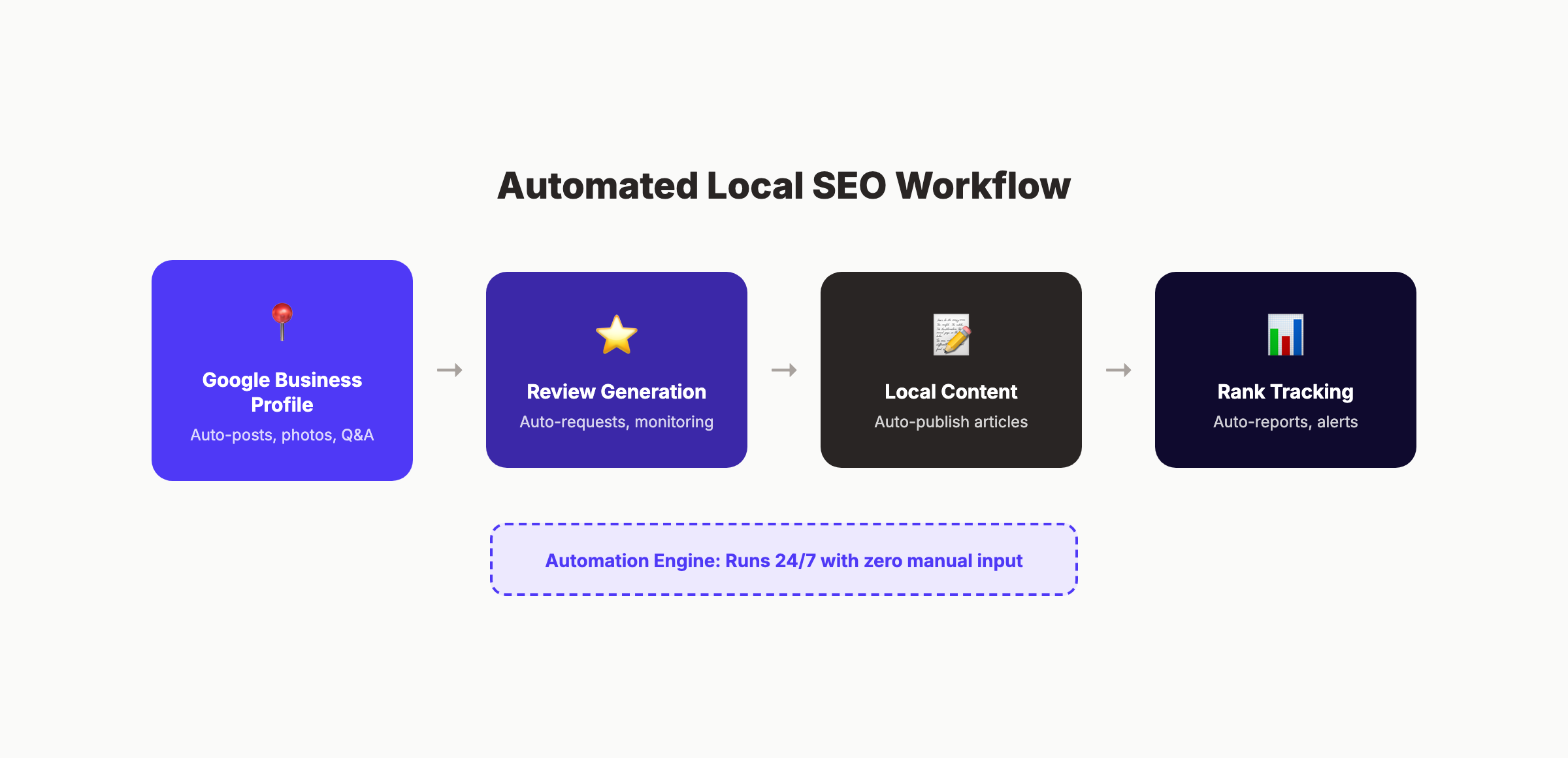
theStacc's platform, for example, automates content creation and publishing for local businesses. The system researches keywords, writes location-specific articles, and publishes them to your website on a schedule you set. This removes the biggest bottleneck in local SEO: consistent content production.
Why Local SEO ROI Is Different from Regular SEO
Local SEO operates on a different set of rules than national or e-commerce SEO. The ranking factors are distinct. The conversion behavior is faster. And the competitive environment is more manageable. Understanding these differences is critical for calculating accurate ROI.
First, local searchers have immediate intent. According to Google Local Insights data from 2026, 76% of local mobile searches result in an in-person visit within 24 hours. A person searching for "emergency plumber near me" is not browsing. They are ready to hire. This means local SEO traffic converts at a much higher rate than general organic traffic.
Second, the local pack dominates the search results page. The top three local pack results capture 44% of all clicks, per OnTheMap research from 2026. Businesses ranked in the local pack receive 126% more traffic than those ranked in positions 4 through 10. This creates a winner-take-most dynamic where small improvements in local rankings produce outsized returns.
Third, local SEO has fewer variables. National SEO campaigns compete against thousands of websites with massive backlink profiles and domain authority. Local SEO campaigns often compete against 10 to 30 businesses in a specific geographic radius. A business with strong citations, active Google Business Profile management, and consistent reviews can outrank much larger competitors.
Fourth, the cost structure favors small businesses. Local SEO does not require expensive link building campaigns or enterprise-level tools. The core investments are Google Business Profile optimization, citation consistency, review generation, and local content. These are all tasks that automation handles efficiently at a fraction of the cost of manual execution or agency retainers.
Stop guessing whether your SEO budget is working. Most local business owners cannot connect their monthly SEO spend to actual revenue. theStacc tracks every lead, call, and conversion from your automated SEO campaigns, so you see the exact return on every dollar. Sign up for free →
The Real Numbers: What Local SEO ROI Looks Like in 2026
The data on local SEO ROI is compelling. Local SEO delivers a 700% average return on investment within 6 to 12 months, according to BrightEdge research from 2026. That means every $1,000 invested in local SEO generates approximately $7,000 in attributable revenue. For context, the median SEO ROI across all industries stands at 748%, or $7.48 for every $1 spent, based on First Page Sage data covering Q1 2021 through Q3 2025.
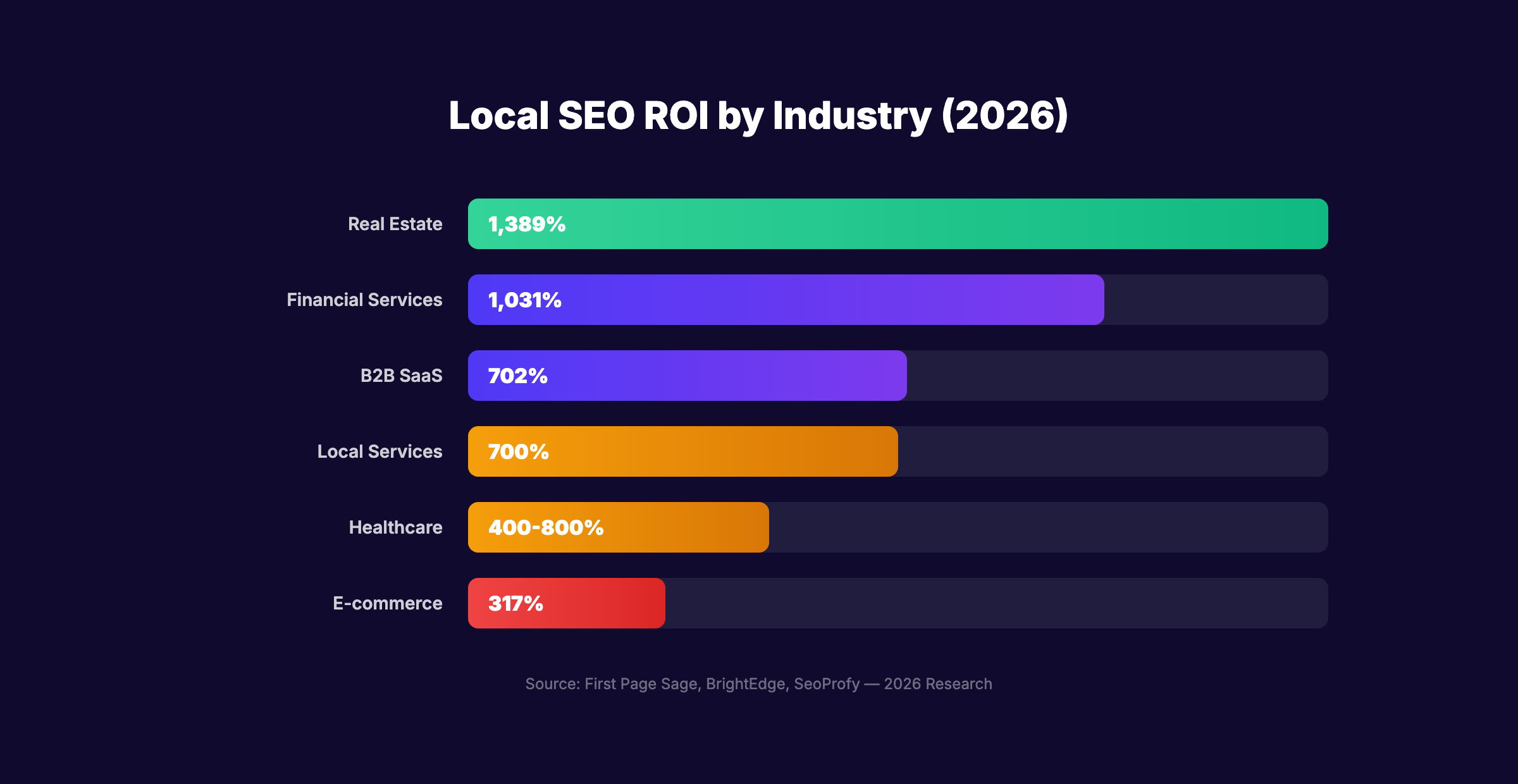
Here is how the numbers break down by industry, based on First Page Sage 2026 research:
| Industry | Average ROI | Typical Break-Even Timeline |
|---|---|---|
| Real Estate | 1,389% | 6-12 months |
| Financial Services | 1,031% | Extended timeline |
| B2B SaaS | 702% | 7 months |
| Local Services (HVAC, plumbing, construction) | 680-700% | 5-6 months |
| Healthcare / Professional Services | 400-800% | Variable |
| E-commerce | 317% | 9 months |
Local service businesses see the fastest returns. HVAC companies, plumbers, and contractors typically break even in 5 to 6 months because each new customer represents high lifetime value. A single HVAC installation can generate $5,000 to $15,000 in revenue, making the cost of local SEO trivial by comparison.
The lead quality data is equally strong. SEO leads close at 14.6%, compared to just 1.7% for outbound marketing, according to SmartBug Media research from 2026. Local SEO leads are actively searching for your service. They are not cold prospects. They are warm leads with demonstrated intent.
Cost per lead is another critical metric. SEO generates leads at approximately $31 per conversion, which is 84% lower than the $198 industry average, per SeoProfy data from 2026. When you automate the SEO process, you reduce that cost even further by eliminating labor overhead.
The 2026 search environment also includes AI-driven changes. AI Overviews now appear in 31% of Google search results, per First Page Sage data. Businesses that optimize for AI-driven local search, structured data, and Google Business Profile completeness are capturing clicks that competitors miss. According to Digital Applied research from 2026, 56% of businesses have not optimized for AI-driven local search, creating a significant competitive gap for early movers.
Which SEO Tasks Should Local Businesses Automate First
Not every SEO task should be automated. Strategy requires human judgment. Content quality requires human oversight. But the operational tasks, the repetitive maintenance, and the data collection are perfect for automation. Here is the priority order for local businesses.
Google Business Profile Management
Your Google Business Profile is the single most important asset in local SEO. It is also the most time-consuming to maintain manually. Automation can handle weekly posts, photo uploads, Q&A monitoring, and review response drafting. Businesses that post to their Google Business Profile weekly see 35% more clicks on their listings, per data cited by OnTheMap in 2026. Automation ensures this happens consistently, even when you are busy with customers.
Review Generation and Monitoring
Reviews are a top-three local ranking factor. They also influence conversion rates dramatically. People are willing to pay 22% more for a local product or service if the business has a strong online reputation, according to LOCALiQ research. Automated review request systems send follow-up messages to customers after a service is completed, prompting them to leave feedback on Google. The system can also alert you when new reviews arrive, so you can respond promptly.
Citation Monitoring and NAP Consistency
NAP stands for Name, Address, Phone number. Consistent NAP data across all directories and listing sites is a foundational local ranking signal. Automated citation tools scan the web for your business information and flag inconsistencies. They can also submit your data to major directories automatically. Over 40% of businesses have adopted an automated approach to local listing management, according to FinancesOnline data.
Local Content Publishing
Content is the biggest bottleneck for most local businesses. Writing location-specific articles, service pages, and blog posts takes time that most owners do not have. Automated content systems research local keywords, generate articles optimized for your service area, and publish them on a schedule. This creates a steady stream of locally relevant content that signals geographic relevance to Google.
Rank Tracking and Reporting
Manual rank checking is tedious and inaccurate. Automated rank trackers monitor your positions for target keywords across multiple locations and devices. They generate weekly or monthly reports showing trends, competitor movements, and opportunity keywords. This data is essential for proving ROI to stakeholders and making informed strategy adjustments.
Technical SEO Monitoring
Automated technical audit tools crawl your website regularly and alert you to issues like broken links, slow page speed, missing schema markup, and mobile usability problems. For local businesses, technical issues can tank rankings quickly. Automated monitoring catches problems before they become costly.
Your competitors are already automating their SEO. Over 40% of local businesses now use automated tools for listing management, citation monitoring, and review generation. The businesses that combine automation with smart strategy are the ones capturing the top three local pack positions. See how theStacc automates your entire local SEO workflow →
How to Calculate Your Local SEO ROI Step by Step
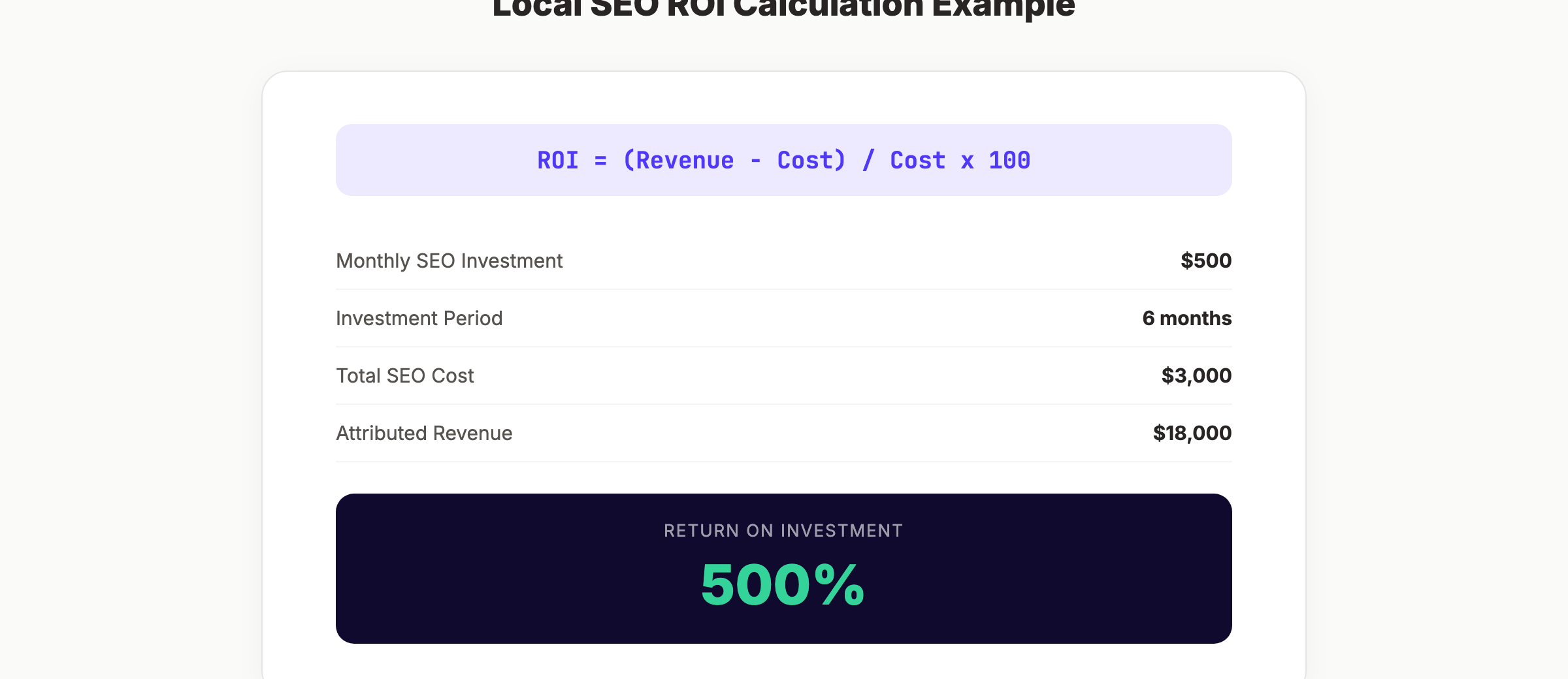
ROI calculation for local SEO is straightforward once you have the right data. The formula is:
ROI = (Revenue from SEO - Cost of SEO) / Cost of SEO x 100
Here is how to apply it with real numbers.
Step 1: Track Revenue from SEO
You need to know exactly how much revenue comes from organic search. Set up the following tracking systems:
- Google Analytics 4 with conversion goals tied to form submissions, phone calls, and appointment bookings
- Call tracking numbers on your website and Google Business Profile to attribute phone leads to SEO
- Customer relationship management tags that mark leads as "organic search" in your pipeline
- Revenue attribution that connects closed deals back to their original traffic source
For local businesses, the simplest approach is to ask every new customer: "How did you find us?" Record the answer in your customer database. Over time, this produces an accurate picture of SEO-driven revenue.
Step 2: Calculate Total SEO Costs
Include every cost associated with your SEO efforts:
| Cost Category | Example Monthly Amount |
|---|---|
| SEO software and tools | $100 - $500 |
| Content creation (internal or automated) | $200 - $1,000 |
| Agency or consultant fees | $0 - $2,000 |
| Citation and listing services | $50 - $200 |
| Review management platform | $50 - $150 |
| Call tracking service | $30 - $100 |
| Total Monthly SEO Cost | $430 - $3,950 |
Automated SEO typically falls in the lower half of this range because software replaces labor. A business using theStacc for automated content, plus a citation tool and call tracking, might spend $300 to $600 per month total.
Step 3: Apply the Formula
Let us use a realistic example. A plumbing company spends $500 per month on automated SEO tools and content. After 6 months, they attribute $18,000 in new customer revenue to organic search.
- Total SEO cost: $500 x 6 months = $3,000
- Revenue from SEO: $18,000
- ROI: ($18,000 - $3,000) / $3,000 x 100 = 500%
This is conservative. Many local businesses see higher returns, especially in high-ticket service industries.
Step 4: Account for Customer Lifetime Value
The basic formula measures first-transaction revenue. But local businesses thrive on repeat customers. A plumber who fixes a leak this month might replace a water heater next year. Factor in lifetime value for a more accurate picture.
If the average plumbing customer spends $800 on the first job and $2,400 over three years, the true ROI of acquiring that customer through SEO is much higher than the initial transaction suggests.
Step 5: Measure Over Time
Local SEO ROI compounds. Month 1 might show a loss. Month 3 might break even. Month 6 typically shows strong positive returns. Month 12 and beyond is where the real gains materialize. Track ROI quarterly, not weekly, to account for the natural ramp-up period.
The Hidden Costs of Manual SEO vs. Automated SEO
Most local business owners underestimate the true cost of manual SEO. They look at the agency invoice and think that is the total expense. It is not. The hidden costs are substantial.
Time Cost
Manual SEO requires constant attention. Posting to Google Business Profile, responding to reviews, checking citations, writing content, analyzing rankings, these tasks consume 5 to 15 hours per week for a small business. At an owner's effective hourly rate of $50 to $150, that is $250 to $2,250 per week in opportunity cost. Over a year, the time cost of manual SEO can exceed $50,000.
Inconsistency Cost
Humans are inconsistent. A busy week means no blog post. A vacation means no Google Business Profile updates. A sick day means no review responses. Search algorithms reward consistency. Inconsistent execution produces inconsistent results. Automated systems do not take vacations. They publish on schedule, every time.
Delayed Results Cost
Manual SEO moves slowly. An agency might take two weeks to publish a blog post. A business owner might update their Google Business Profile once a month. These delays extend the timeline to positive ROI by months. Automated systems compress the timeline by executing tasks immediately and consistently.
Error Cost
Manual processes introduce errors. A wrong phone number in a citation. A missed negative review. A broken link on a service page. Each error has a cost: lost leads, damaged reputation, or ranking drops. Automated systems follow checklists precisely and catch errors before they propagate.
Opportunity Cost
Every hour spent on manual SEO is an hour not spent on revenue-generating activities. The owner who spends Tuesday morning writing a blog post is not following up with leads, meeting prospects, or improving operations. Automation returns that time to the business.
Here is a comparison of total costs over 12 months:
| Cost Factor | Manual SEO | Automated SEO |
|---|---|---|
| Agency or consultant fees | $18,000 | $0 - $6,000 |
| Software subscriptions | $1,200 | $2,400 |
| Owner time (10 hrs/week at $75/hr) | $39,000 | $5,200 |
| Inconsistency penalty (estimated lost revenue) | $6,000 | $0 |
| Total 12-Month Cost | $64,200 | $7,600 - $13,600 |
The automated approach costs 75% to 85% less when you account for time and opportunity costs. And because automation executes consistently, the results often arrive faster.
Reclaim 10 hours every week. Manual SEO drains the time you should spend serving customers and growing your business. theStacc automates content creation, publishing, and local optimization, so you focus on what you do best. Get your time back for free →
Building Your 90-Day Automated Local SEO System
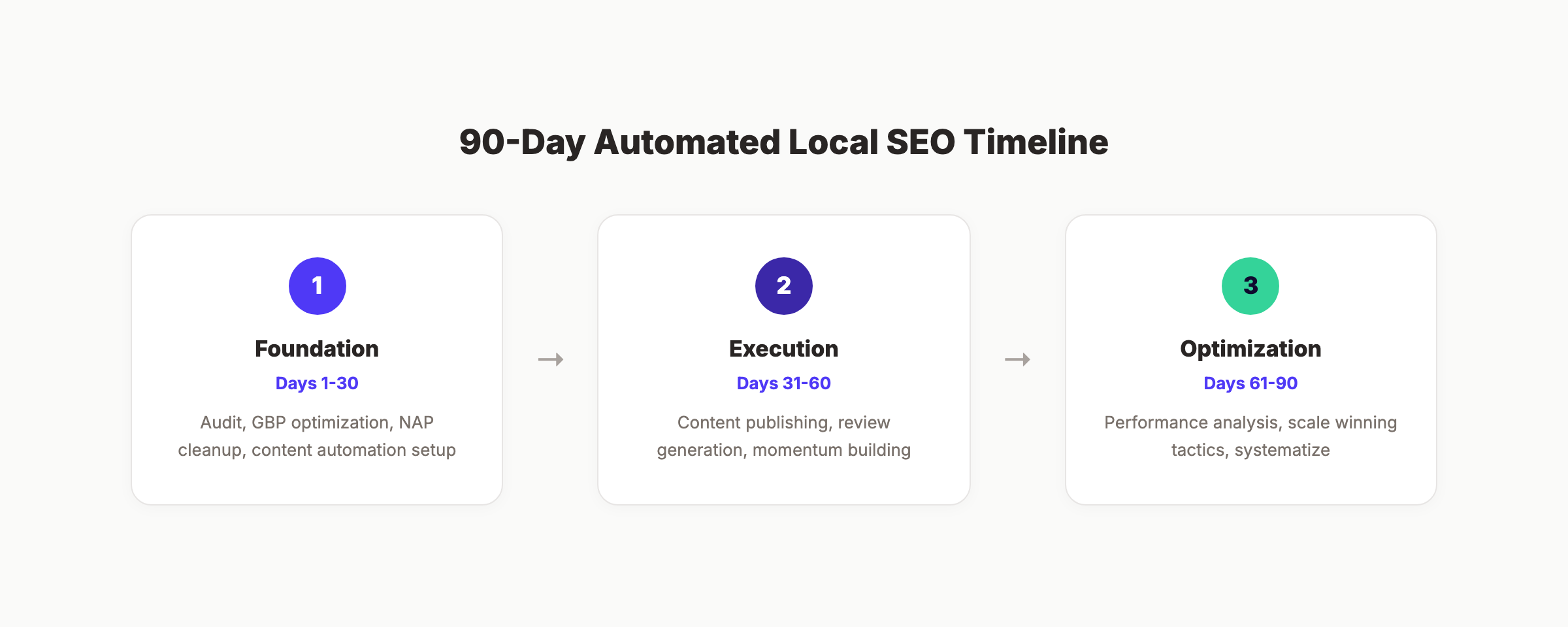
A 90-day timeline is realistic for seeing measurable results from automated local SEO. Here is the exact sequence to follow.
Days 1-30: Foundation and Setup
Week 1: Audit and Baseline
- Run a complete local SEO audit using an automated tool
- Document current rankings for your top 10 target keywords
- Record baseline metrics: website traffic, Google Business Profile views, call volume, form submissions
- Fix critical technical issues: mobile usability, page speed, schema markup
Week 2: Google Business Profile Optimization
- Claim and verify your Google Business Profile if not already done
- Complete every field: description, services, products, attributes, Q&A
- Upload 10 to 20 high-quality photos
- Set up automated posting schedule (3 posts per week minimum)
- Configure review request automation
Week 3: Citation and NAP Cleanup
- Use an automated citation tool to scan for NAP inconsistencies
- Correct every instance of outdated or incorrect business information
- Submit your NAP to the top 30 local directories
- Set up ongoing monitoring for new inconsistencies
Week 4: Content Automation Setup
- Identify 10 to 20 location-specific keywords for your service area
- Configure automated content generation for local blog posts and service pages
- Set publishing schedule: 2 to 4 articles per month
- Implement call tracking and conversion tracking on all pages
Days 31-60: Execution and Momentum
Week 5-6: Content Publishing Begins
- First automated articles go live
- Monitor indexing speed and initial ranking movements
- Continue Google Business Profile posting schedule
- Send first batch of automated review requests to recent customers
Week 7-8: Review Generation and Response
- Respond to every new review within 24 hours
- Target 5 to 10 new reviews per month
- Monitor review sentiment and address negative feedback promptly
- Add review widgets to your website
Days 61-90: Optimization and Scale
Week 9-10: Performance Analysis
- Compare current metrics to baseline
- Identify which keywords are moving and which are stagnant
- Adjust content strategy based on early winners
- Expand automated posting to additional platforms if relevant
Week 11-12: Scale and Systematize
- Double down on tactics showing the best ROI
- Add location pages for additional service areas
- Expand keyword targets based on ranking data
- Document your system for ongoing maintenance
By day 90, you should see measurable improvements in rankings, traffic, and leads. Most local businesses see a 30% traffic surge within 4 months, according to KeyStar Agency research from 2025. The businesses that stick with the system for 12 months see the full 700% ROI that BrightEdge documented.
Common Mistakes That Kill Local SEO ROI
Even with automation, local businesses make mistakes that destroy their returns. Avoid these pitfalls.
Mistake 1: Ignoring Google Business Profile
Some businesses treat their Google Business Profile as a one-time setup task. They verify it, add basic information, and never touch it again. This is a massive error. Google Business Profile is a dynamic platform that rewards active management. Businesses posting weekly get significantly more visibility than dormant profiles.
Mistake 2: Chasing Vanity Metrics
Rankings matter, but they are not the end goal. A number one ranking for a keyword that never converts is worthless. Focus on metrics that connect to revenue: calls, form submissions, appointment bookings, and closed deals. Automated tracking systems make this easy, but you have to configure them correctly.
Mistake 3: Inconsistent NAP Data
A single incorrect phone number on one directory can confuse Google and hurt your rankings. Many businesses have outdated information scattered across dozens of sites from years past. Automated citation monitoring catches these issues, but you must act on the alerts.
Mistake 4: Neglecting Reviews
Reviews are not a set-it-and-forget-it system. Automated review requests help, but you still need to respond to every review personally. A business with 50 Google reviews earns 266% more leads than one with few or no reviews, per OnTheMap data from 2026. Yet many businesses never ask for reviews.
Mistake 5: Expecting Instant Results
Local SEO is not pay-per-click advertising. It does not produce leads on day one. The typical break-even timeline is 5 to 6 months for service businesses. Businesses that quit at month 3 never see the returns that patient competitors enjoy. Automation accelerates the timeline, but it does not eliminate it.
Mistake 6: Using Generic Content
Automated content must be locally specific. An article titled "Why Plumbing Matters" does nothing for your local SEO. An article titled "How to Prevent Frozen Pipes in Denver Winters" signals geographic relevance and attracts local searchers. Configure your automation to produce location-aware content.
Mistake 7: Not Tracking Phone Calls
Phone calls are the primary conversion method for most local businesses. If you are not tracking which calls come from organic search, you cannot calculate ROI accurately. Use dedicated call tracking numbers for your website and Google Business Profile.
- ✓ Set up Google Business Profile posting automation
- ✓ Configure call tracking for all organic traffic sources
- ✓ Audit NAP consistency across top 30 directories
- ✓ Set up automated review request workflows
- ✓ Track revenue attribution by traffic source
- ✓ Publish location-specific content at least twice per month
- ✓ Respond to every review within 24 hours
- ✓ Monitor rankings weekly with automated reports
What practitioners are saying on X
AI search advice ages quickly. Here is high-signal public discussion from SEO and growth operators — context for your roadmap, not a substitute for primary data.
- @noelcetaSEO (Sep 2025): Local SEO playbook still centers complete GBP, NAP consistency, quality citations, local keywords, location content, review velocity, and local links. See the post on X.
- @irentdumpsters (Jan 2026): Most businesses have a GBP; few fully optimize every ranking-relevant section for Map Pack visibility. See the post on X.
- @EldarCohenSEO (Jul 2026): 2026 WhiteSpark-oriented reminder: primary Google Business category is a top Map Pack ranking factor — wrong primary category can erase visibility for money queries. See the post on X.
Grok, AI Overviews, and multi-engine visibility
Local topics like “roi automated seo local business” get cited when GBP, NAP, reviews, and service-area steps are concrete. Grok mixes those web facts with Map Pack operator advice circulating on X.
- Google AI Overviews: Use passage-ready answers, tables, and FAQ schema where relevant.
- ChatGPT / Perplexity: Cite named sources next to key claims.
- Grok: Maintain accurate entity facts on-site and in high-signal X posts.
Frequently Asked Questions
A good ROI for local SEO is 500% to 700% within the first 12 months. Local service businesses like HVAC, plumbing, and construction typically see the fastest returns, breaking even in 5 to 6 months. Real estate and financial services can achieve over 1,000% ROI, though the timeline is longer. The key is consistent execution and accurate tracking.
Most local businesses see measurable improvements within 90 days and positive ROI within 5 to 6 months. Automated SEO accelerates this timeline by ensuring consistent execution of tasks like content publishing, review requests, and Google Business Profile updates. Full ROI potential typically materializes between 6 and 12 months.
Yes, when done correctly. Safe automation handles repetitive operational tasks like posting, monitoring, and reporting. It does not attempt to manipulate rankings through artificial link building, keyword stuffing, or spam content. The safest approach combines automation for execution with human oversight for strategy and quality control.
The most cost-effective approach is to start with free and low-cost tools. Google Business Profile is free. Google Analytics and Google Search Console are free. Affordable automation tools for citations, reviews, and rank tracking range from $50 to $200 per month. Content automation through platforms like theStacc starts at accessible price points and replaces the need for expensive agency retainers.
Use a simple dashboard showing three numbers: monthly SEO spend, organic traffic, and attributed revenue. Connect your website to Google Analytics with conversion tracking. Add call tracking numbers. Ask new customers how they found you. Present the data monthly using the ROI formula: (Revenue - Cost) / Cost x 100. Automated reporting tools make this process effortless.
Yes. Modern local SEO automation platforms are designed for non-technical users. They offer guided setup, pre-built templates, and intuitive dashboards. The technical heavy lifting, server configuration, and API integrations are handled by the platform. You configure the strategy and review the results.
Automation is especially effective for multi-location businesses. Managing SEO for 5, 10, or 50 locations manually is nearly impossible. Automated systems can publish location-specific content, monitor citations for every location, track rankings across all markets, and generate consolidated reports. The ROI multiplies with each additional location.
An agency provides strategy and execution but charges $1,500 to $5,000 per month and requires ongoing management. Automation provides execution at a fraction of the cost, typically $200 to $800 per month, with consistent performance and transparent reporting. Many businesses use a hybrid approach: automation for repetitive tasks and an agency or consultant for high-level strategy.
Key Takeaways
- Local SEO delivers a 700% average ROI within 6 to 12 months, with service businesses breaking even in as little as 5 months
- Automation reduces total SEO costs by 75% to 85% when you account for time, consistency, and opportunity costs
- The highest-impact tasks to automate are Google Business Profile management, review generation, citation monitoring, and local content publishing
- Accurate ROI calculation requires tracking revenue attribution, not just rankings or traffic
- A 90-day automated system produces measurable results, with full ROI realized by month 6 to 12
- Common mistakes include neglecting Google Business Profile, chasing vanity metrics, and expecting instant results
Automated local SEO is not a shortcut. It is a force multiplier. It takes the proven tactics that work and executes them consistently, at scale, without draining your time or budget. The businesses that adopt automated systems now will capture the local pack positions that their competitors are leaving open.
Ready to turn your local SEO into a revenue engine? theStacc automates the entire local SEO workflow, from content creation to publishing to tracking, so you see exactly how every dollar performs. Most businesses are set up in under 30 minutes. Sign up for free →
Related Tools & Resources
Free SEO Tools:
Best Lists:
Sources & references
- [1] Princeton / Georgia Tech et al. — GEO research (arXiv:2311.09735)
- [2] @noelcetaSEO on X — Local SEO playbook still centers complete GBP, NAP consistency, quality citations, local keywords, location content, rev
- [3] @irentdumpsters on X — Most businesses have a GBP; few fully optimize every ranking-relevant section for Map Pack visibility.
- [4] @EldarCohenSEO on X — 2026 WhiteSpark-oriented reminder: primary Google Business category is a top Map Pack ranking factor — wrong primary cat

Researched, written, and published articles that compound organic traffic.
Weekly local SEO teardowns
One practical email a week. Map Pack, GBP, AI Overviews — no fluff. Unsubscribe anytime.