The complete guide to marketing automation for local businesses. Covers the 5 highest-ROI automations, costs, tools, and industry playbooks. Updated 2026.
The average local business owner spends 20 hours per week on manual marketing tasks, according to Crowley Media Group. That is half a full-time salary spent on work that software can handle for under $200 a month.
Marketing automation for local business is not a luxury for enterprise companies anymore. 45% of small businesses already use it. The ones that do generate 80% more leads and see a 451% increase in qualified sales leads, per The CMO.
The problem is that most automation guides are written for SaaS companies and ecommerce brands. A dentist in Phoenix and a Shopify store have completely different needs. This guide is built specifically for local service businesses.
We have published 3,500+ blog posts and managed local SEO across 70+ industries. Here is what actually works for local businesses.
What you will learn:
- The 5 automations that deliver 80% of the value for local businesses
- How to build a review request pipeline that runs on autopilot
- Industry-specific playbooks for dentists, restaurants, contractors, and salons
- Honest cost breakdowns by budget tier
- How to connect marketing automation to local SEO and Google Business Profile
- The mistakes that waste money and annoy customers
What Is Marketing Automation for Local Business?
Marketing automation uses software to handle repetitive marketing tasks without manual effort. For local businesses, this typically means:
- Email sequences that nurture leads and retain customers
- SMS reminders that reduce no-shows and drive rebookings
- Review requests sent automatically after each service
- Social media posts scheduled across platforms
- Blog and SEO content published on a regular cadence
The global marketing automation market hit $8 billion in 2026, according to EntrepreneursHQ. But for a local business, the market size does not matter. What matters is time saved and customers gained.
A restaurant does not need a lead scoring algorithm. A plumber does not need multi-touch attribution. Local businesses need simple, effective workflows that run in the background while they focus on serving customers.
The 80/20 Rule of Local Automation
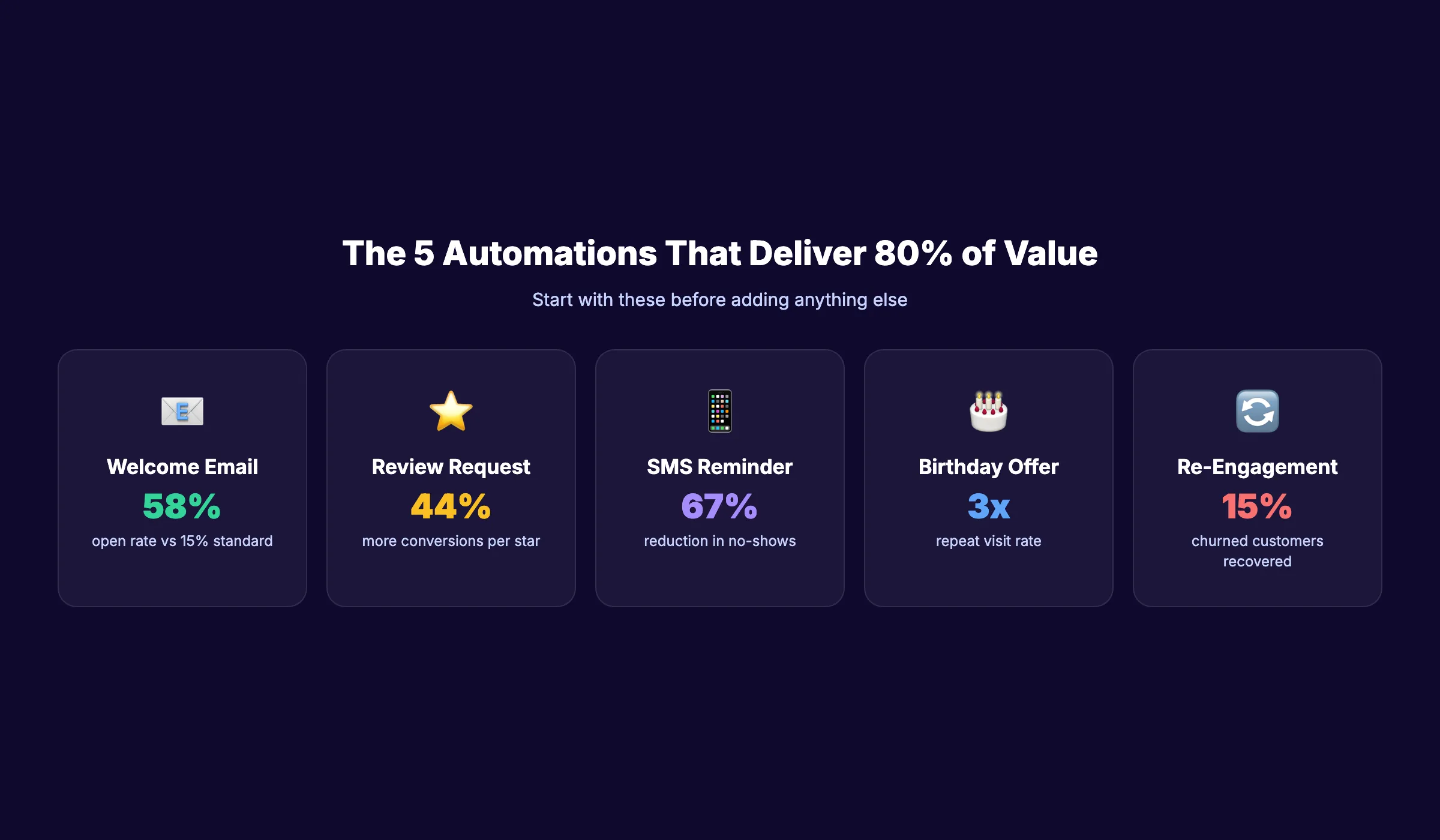
80% of the value comes from 5 specific automations. Master these before adding anything else.
| Automation | What It Does | Estimated Impact |
|---|---|---|
| Welcome email sequence | Greets new subscribers or customers | 58% open rate vs 15% for standard emails |
| Review request after service | Sends a Google review link automatically | 1 star rating increase = 44% more conversions |
| Appointment reminder (SMS) | Reduces no-shows with 24-hour reminders | 67% reduction in no-shows |
| Birthday/anniversary offer | Sends a personalized discount | Drives repeat visits and loyalty |
| Re-engagement for lapsed customers | Reaches out after 60-90 days of inactivity | Recovers 10-15% of churned customers |
Start with one. Get it working. Then add the next. The biggest mistake is trying to automate everything at once.
The Review Request Pipeline
For local businesses, online reviews are the single highest-ROI marketing asset. 98% of consumers read reviews before choosing a local business. 63% of reviewers never receive a reply from the business.
A review request pipeline automates the entire cycle: request, follow-up, response, and showcase.
How to Build It
Step 1: Trigger after service completion. When a job is finished, an appointment ends, or a receipt is generated, the system sends a review request via SMS or email.
Step 2: Include a direct link. Do not send customers to your website and hope they find the review button. Send a direct Google review link. Use our Review QR Code Generator to create physical signage.
Step 3: Follow up once. If no review appears after 3 days, send one gentle reminder. Never send more than one follow-up.
Step 4: Respond to every review. Use our Review Response Generator to draft professional responses. For negative reviews, follow our guide on responding to negative Google reviews.
Step 5: Showcase positive reviews. Pull 4-5 star reviews into your website, social media, and Google Business Profile posts automatically.
This pipeline costs almost nothing to run and directly drives new customer acquisition. For more strategies, read our guide on getting more Google reviews.
Rank everywhere. Do nothing. Blog SEO, Local SEO, and Social on autopilot. theStacc handles your content marketing for $99/mo.
Marketing Automation by Industry
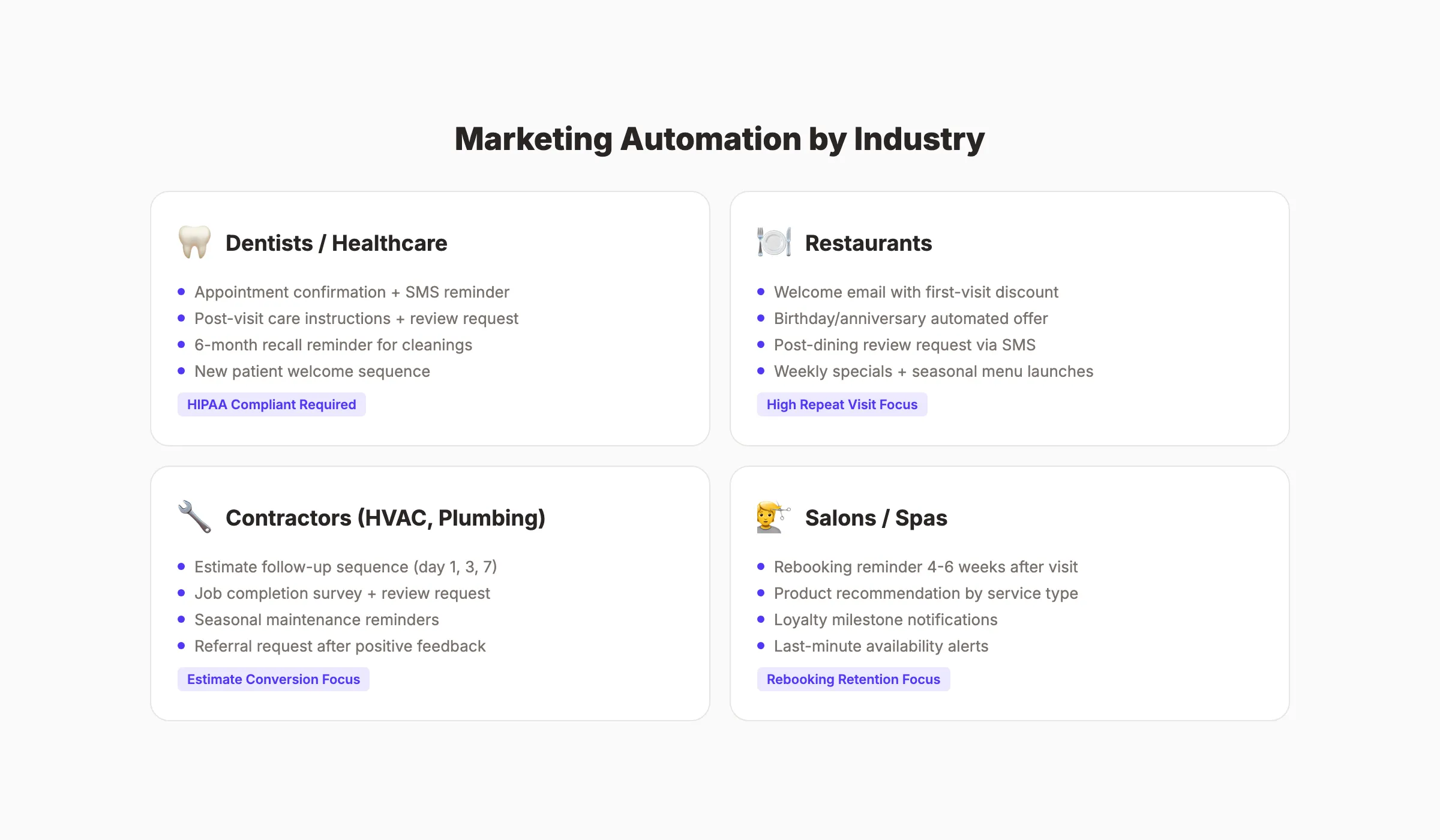
Generic automation advice fails because a dental office and a roofing company serve customers in completely different ways. Here are specific playbooks.
Dentists and Healthcare
The patient journey is appointment-driven. Automation should focus on reducing no-shows and filling the schedule.
Key automations:
- Appointment confirmation (email + SMS) immediately after booking
- 24-hour reminder with office address and parking instructions
- Post-visit follow-up with care instructions and review request
- 6-month recall reminder for cleanings and checkups
- New patient welcome sequence with office tour video and insurance FAQ
Compliance note: All patient communications must follow HIPAA rules. Never include protected health information in automated messages. See our healthcare SEO guide for more context.
Restaurants and Hospitality
Restaurants rely on repeat visits and word-of-mouth. Automation should drive both.
Key automations:
- Welcome email with first-visit discount or free appetizer
- Birthday/anniversary automated offer (30 days before)
- Weekly specials email or SMS blast (Tuesday for weekend reservations)
- Post-dining review request via SMS (2 hours after reservation time)
- Seasonal menu launch announcements
- Event/catering inquiry auto-response with pricing guide
For SEO-specific tactics, read our restaurant SEO guide.
Contractors (Plumbers, HVAC, Electricians)
Service businesses need to convert estimates into jobs and turn one-time customers into repeat clients.
Key automations:
- Estimate follow-up sequence (day 1, day 3, day 7 after sending estimate)
- Job completion survey + review request
- Seasonal maintenance reminders (spring AC tune-up, fall furnace check)
- Referral request after successful job completion
- Annual service agreement renewal reminders
See our construction and contractor SEO guide for complementary strategies.
Salons and Spas
Rebooking is everything. The goal is to never lose a client to forgetfulness.
Key automations:
- Appointment confirmation with stylist name and service details
- Rebooking reminder 4-6 weeks after last visit
- Product recommendation email based on services received
- Loyalty program milestone notifications
- Last-minute availability alerts for cancellations
How Much Does Marketing Automation Cost?
Most guides avoid this question. Here are honest numbers for local businesses.
| Budget Tier | Monthly Cost | What You Get | Best For |
|---|---|---|---|
| Free | $0 | Basic email automation (500-1,000 contacts), limited templates | Solo operators testing the waters |
| Starter | $20-50/mo | Email + SMS automation, basic CRM, review requests | 1-location businesses with < 2,000 contacts |
| Growth | $50-200/mo | Multi-channel automation, social scheduling, blog SEO, GBP posting | Growing businesses ready to scale marketing |
| Professional | $200-500/mo | Full CRM, advanced segmentation, multi-location, paid ad automation | Multi-location or high-volume businesses |
| Enterprise | $500-2,000+/mo | Custom workflows, dedicated support, API integrations, analytics | Large franchises or agencies |
Where theStacc fits: theStacc operates in the Growth tier. For $99/mo, you get 30 SEO blog posts published automatically. Add Local SEO for $49/mo (15 GBP posts) and Social Media for $49/mo (30 posts across 3 platforms). Bundle 2+ modules and save 15%.
The trap most local businesses fall into is paying $500+/month for an enterprise platform and using 10% of its features. Start with what you need. Upgrade when you outgrow it.
How to Calculate Your ROI
Marketing automation delivers $5.44 for every $1 spent over 3 years, according to The CMO. But that is an industry average. Here is how to calculate it for your specific business.
Formula: (Revenue from automated campaigns - Cost of tools) / Cost of tools = ROI %
Example for a dental practice:
- Monthly automation cost: $150 (email + SMS + review tool)
- New patients per month from automated review pipeline: 8
- Average patient lifetime value: $1,200
- Monthly revenue attributable to automation: $9,600
- ROI: ($9,600 - $150) / $150 = 6,300%
Even conservative estimates show strong returns. If automation brings in just 2 additional customers per month at $500 average value, that is $1,000/month in revenue from a $150 investment.
Time savings are equally valuable. A business owner billing $100/hour who saves 10 hours per week through automation reclaims $4,000/month in potential billable time. That alone pays for the entire automation stack several times over.
Track these 4 metrics monthly to measure your automation ROI:
| Metric | What to Measure | Target |
|---|---|---|
| New leads from automated sequences | Form fills, calls, bookings attributed to automation | Increasing month over month |
| Review velocity | New Google reviews per week | 2-5 per week for most local businesses |
| No-show rate | Percentage of missed appointments | Under 10% with SMS reminders |
| Re-engagement conversions | Lapsed customers who return after automated outreach | 10-15% conversion rate |
Your SEO team. $99 per month. 30 optimized articles, published automatically.
Connecting Automation to Local SEO
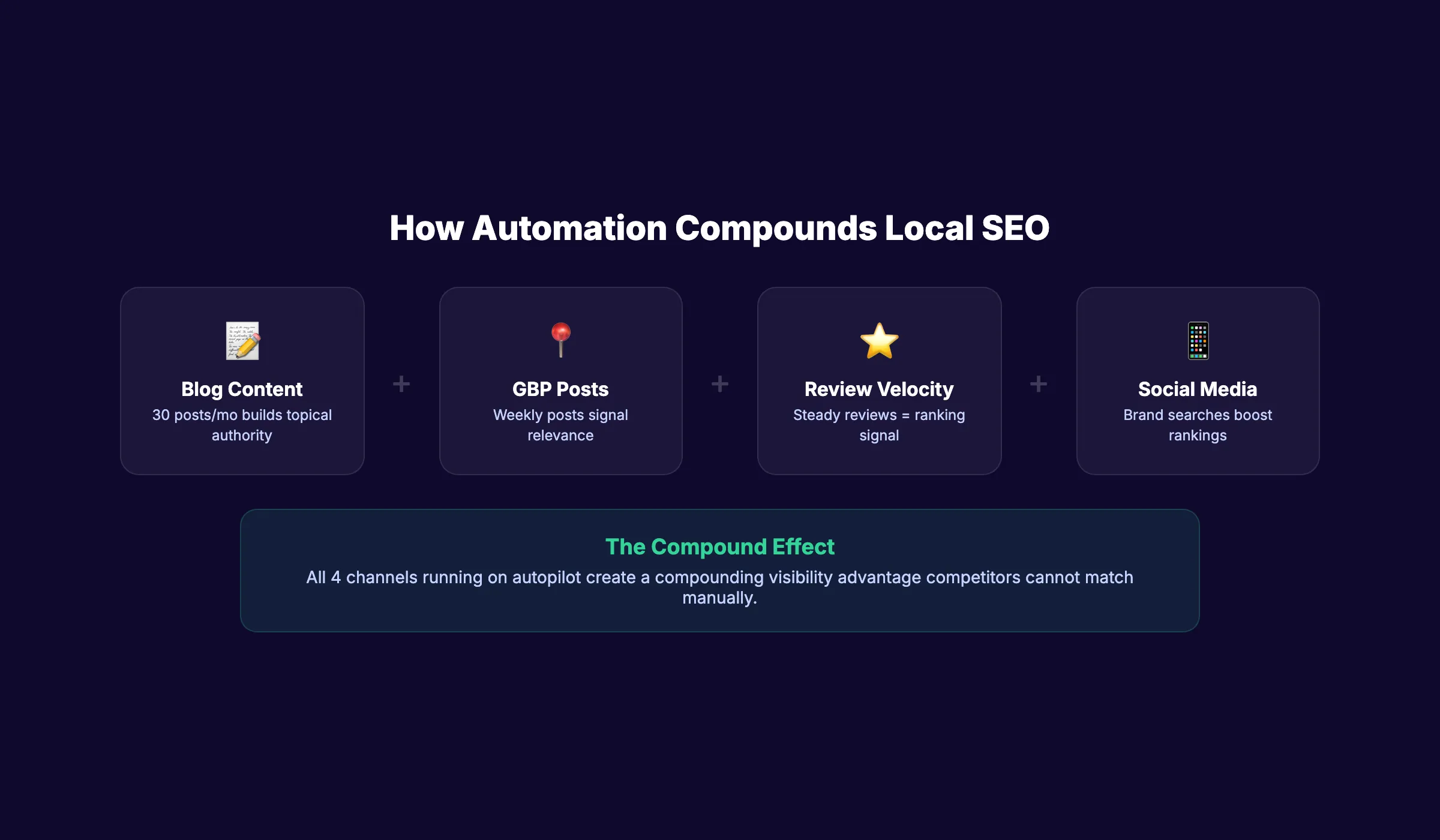
Marketing automation and local SEO are not separate strategies. They compound each other.
Blog Content Automation
Publishing consistent blog content builds topical authority and drives organic traffic. The problem is that most local businesses publish 1-2 posts per month at best. At that pace, ranking takes years.
Automating content production (through a service like theStacc) increases publishing frequency to 30 posts per month. Each post targets a specific keyword and links back to your service pages. Over 60-90 days, this builds a content moat that competitors cannot match manually.
GBP Post Automation
Google Business Profile posts signal activity and relevance to Google. Businesses that post weekly to their GBP rank higher in the local pack. Use our GBP Post Generator to create posts, then schedule them to publish automatically.
Review Velocity
Google tracks how frequently you receive new reviews. A steady stream of reviews signals a healthy, active business. The review request pipeline from the previous section automates this entirely.
Social Media Automation
Social signals do not directly affect Google rankings. But a consistent social media presence drives brand searches, which do affect rankings. Automating social posts across Instagram, LinkedIn, and Facebook keeps your brand visible without daily manual effort.
The Compound Effect in Numbers
Here is what the compound effect looks like over 6 months for a typical local business:
| Month | Blog Posts (Cumulative) | GBP Posts | New Reviews | Organic Traffic Trend |
|---|---|---|---|---|
| 1 | 30 | 4 | 8-10 | Baseline |
| 2 | 60 | 8 | 16-20 | +10-15% |
| 3 | 90 | 12 | 24-30 | +25-40% |
| 4 | 120 | 16 | 32-40 | +50-80% |
| 5 | 150 | 20 | 40-50 | +80-120% |
| 6 | 180 | 24 | 48-60 | +120-200% |
No single channel produces these results alone. The compound effect requires all 4 channels running simultaneously. That is why automation matters. No local business can publish 30 blog posts, create 4 GBP posts, request 10 reviews, and schedule 30 social posts manually every month.
For more on how these channels work together, read about the theStacc Stack Method: combining Blog SEO and Local SEO for compounding results.
7 Marketing Automation Mistakes Local Businesses Make
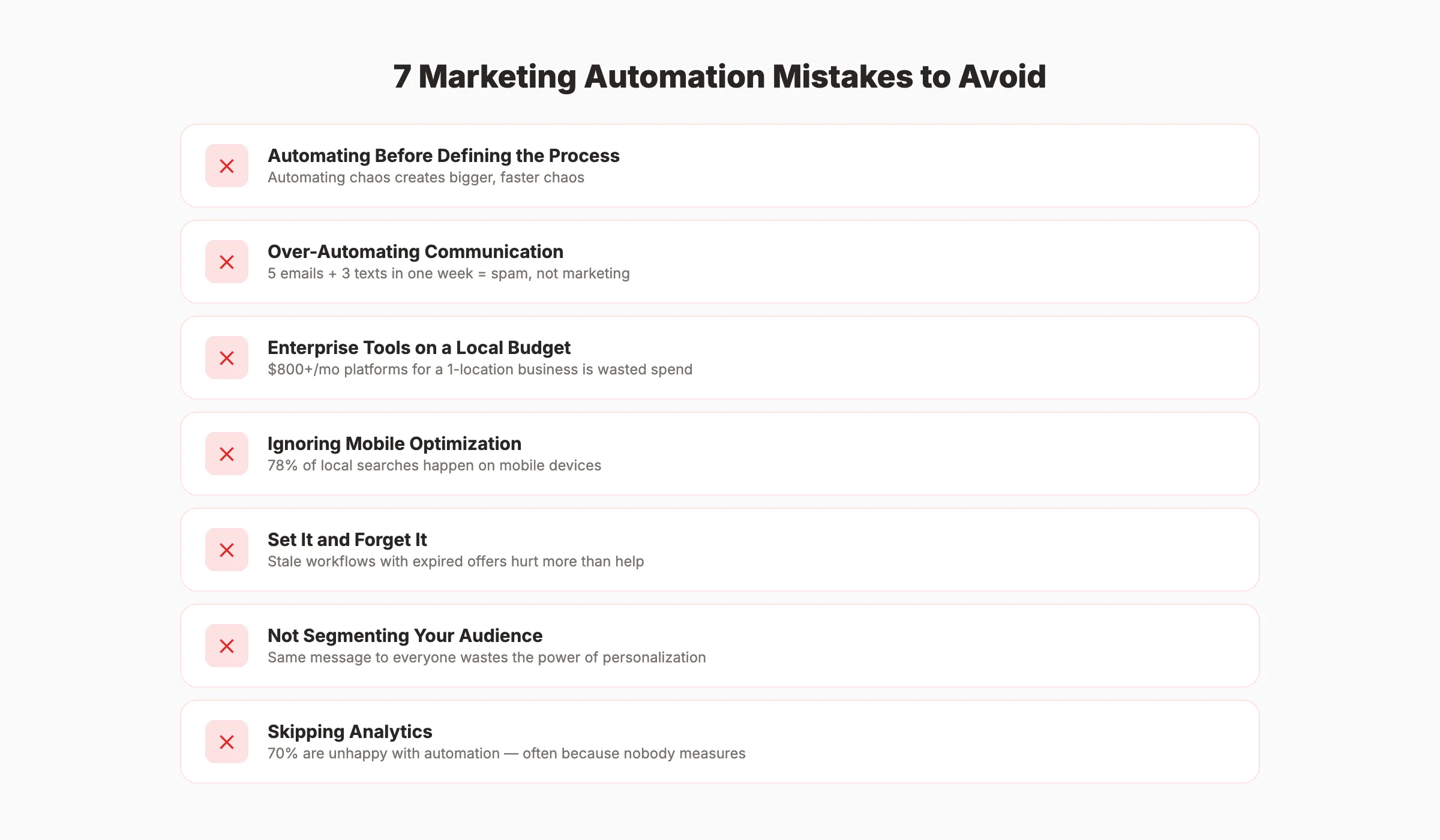
1. Automating Before Defining the Process
If your follow-up process is inconsistent manually, automating it creates inconsistent messages at scale. Document your best version of each workflow. Test it manually. Then automate the proven version.
2. Over-Automating Customer Communication
Sending 5 emails, 3 texts, and 2 social DMs in the first week after someone books an appointment is not automation. It is spam. Set frequency caps. 2-3 touches per week maximum across all channels.
3. Using Enterprise Tools on a Local Budget
HubSpot and Salesforce are powerful platforms. They are also $800-2,000+/month. A single-location plumber does not need a $12,000/year marketing platform. Start with tools built for your scale. For the best options, see our list of marketing automation tools for small business.
4. Ignoring Mobile
78% of local searches happen on mobile devices. If your automated emails and landing pages do not render properly on phones, you are losing the majority of potential customers.
5. Setting It and Forgetting It
Automated workflows decay. Seasonal offers expire. Links break. Staff names change. Audit every active workflow quarterly. Update messaging, offers, and contact information.
6. Not Segmenting Your Audience
Sending the same message to every customer wastes the primary advantage of automation: personalization. Segment by service type, visit frequency, location, and customer value.
7. Skipping Analytics
70% of businesses are unhappy with their automation software, per The CMO. Often the problem is not the software. It is that no one tracks whether the automations are actually working. Set up dashboards for open rates, conversion rates, and revenue per workflow.
3,500+ blogs published. Every article is SEO-scored before publish. See what theStacc can do for your local business.
How to Get Started: The Automation Ladder
Do not try to automate everything at once. Follow this sequence.
Level 1: Foundation (Week 1-2)
- Set up a CRM or contact database
- Create a welcome email for new customers or leads
- Start collecting email addresses and phone numbers at every touchpoint
Level 2: Reviews and Reminders (Week 3-4)
- Build the review request pipeline (service completed → SMS → follow-up)
- Set up appointment reminders (24-hour SMS + email)
- Start responding to all Google reviews within 24 hours
Level 3: Content and Social (Month 2)
- Begin automated blog publishing (target 4+ posts per week for SEO traction)
- Schedule social media posts across 2-3 platforms
- Start automated GBP posting weekly
Level 4: Nurture and Retain (Month 3)
- Build a re-engagement sequence for lapsed customers (60-90 days inactive)
- Set up birthday and anniversary automated offers
- Create a referral request workflow after positive reviews
Level 5: Optimize (Ongoing)
- Review analytics monthly. Kill underperforming workflows.
- A/B test subject lines, send times, and offers
- Add seasonal campaigns based on your industry calendar
- Track revenue attribution per automation workflow
Seasonal Automation Calendar
Local businesses are seasonal by nature. Build automations that activate based on your industry calendar.
| Industry | Q1 (Jan-Mar) | Q2 (Apr-Jun) | Q3 (Jul-Sep) | Q4 (Oct-Dec) |
|---|---|---|---|---|
| HVAC | Furnace tune-up reminders | AC season prep offers | Peak AC service push | Winter prep campaigns |
| Dental | New year dental resolutions | Spring cleaning specials | Back-to-school checkups | Year-end insurance reminders |
| Restaurant | Valentine's reservations | Patio season launch | Summer event catering | Holiday party bookings |
| Landscaping | Spring cleanup offers | Ongoing maintenance | Fall aeration campaigns | Holiday lighting installs |
Pre-build these campaigns once. Set them to activate automatically each year. Update offers and pricing annually during your quarterly workflow audit.
What practitioners are saying on X
AI search advice ages quickly. Here is high-signal public discussion from SEO and growth operators — context for your roadmap, not a substitute for primary data.
- @noelcetaSEO (Sep 2025): Local SEO playbook still centers complete GBP, NAP consistency, quality citations, local keywords, location content, review velocity, and local links. See the post on X.
- @irentdumpsters (Jan 2026): Most businesses have a GBP; few fully optimize every ranking-relevant section for Map Pack visibility. See the post on X.
- @EldarCohenSEO (Jul 2026): 2026 WhiteSpark-oriented reminder: primary Google Business category is a top Map Pack ranking factor — wrong primary category can erase visibility for money queries. See the post on X.
Grok, AI Overviews, and multi-engine visibility
Local topics like “marketing automation local business” get cited when GBP, NAP, reviews, and service-area steps are concrete. Grok mixes those web facts with Map Pack operator advice circulating on X.
- Google AI Overviews: Use passage-ready answers, tables, and FAQ schema where relevant.
- ChatGPT / Perplexity: Cite named sources next to key claims.
- Grok: Maintain accurate entity facts on-site and in high-signal X posts.
Rank higher in the Map Pack without a full-time local SEO hire. theStacc’s Local SEO module handles daily GBP posts, review reply workflows, and local visibility tracking — built for service businesses that need calls, not vanity rankings.
FAQ
Yes. Companies that use marketing automation see $5.44 in revenue for every $1 spent, according to The CMO. 76% of companies see ROI within 1 year. For local businesses, the time savings alone justify the cost. Saving 20 hours per week on manual marketing lets you redirect that time to billable work or customer service.
Start with review requests. Online reviews are the highest-ROI marketing asset for local businesses. 98% of consumers read them before making a decision. A simple automated SMS after each service, with a direct Google review link, generates consistent reviews with zero ongoing effort. Add appointment reminders as your second automation.
Expect to spend $50-200/mo for a growth-stage setup. Free tools exist but limit contacts and features. theStacc offers Blog SEO for $99/mo, Local SEO for $49/mo, and Social Media for $49/mo. Bundle 2+ modules for 15% off. Avoid enterprise platforms ($500+/mo) unless you have 5+ locations.
It can replace the repetitive execution work: scheduling posts, sending emails, requesting reviews, and publishing content. It cannot replace strategic thinking, brand positioning, or customer relationship management. Think of automation as your marketing team's hands, not its brain.
Three ways. First, automated blog content builds topical authority and drives organic traffic. Second, automated review requests increase review velocity, which is a confirmed local ranking factor. Third, automated GBP posting signals an active, relevant business to Google. Together, these compound into stronger local search visibility.
The 3 most damaging mistakes: (1) over-automating communication so customers feel spammed, (2) paying for enterprise tools when starter tools would suffice, and (3) setting up workflows and never auditing them. Quarterly reviews of every active automation prevent stale messaging and wasted spend.
Marketing automation for local business is not about buying the fanciest platform. It is about building simple workflows that save time, generate reviews, keep customers coming back, and compound your visibility across search and social.
Start with the review request pipeline. Add appointment reminders. Layer in content and social automation. Review your workflows every quarter. That sequence, repeated over 6-12 months, is how local businesses turn marketing from a manual chore into a growth engine.
Sources & references
- [1] Princeton / Georgia Tech et al. — GEO research (arXiv:2311.09735)
- [2] @noelcetaSEO on X — Local SEO playbook still centers complete GBP, NAP consistency, quality citations, local keywords, location content, rev
- [3] @irentdumpsters on X — Most businesses have a GBP; few fully optimize every ranking-relevant section for Map Pack visibility.
- [4] @EldarCohenSEO on X — 2026 WhiteSpark-oriented reminder: primary Google Business category is a top Map Pack ranking factor — wrong primary cat
- [5] Referenced source — crowleymediagroup.com

Manage Google Business Profile posts, review replies, and local rank tracking.
Weekly local SEO teardowns
One practical email a week. Map Pack, GBP, AI Overviews — no fluff. Unsubscribe anytime.
Explore this topic: Top 10 Best Local SEO Automation Tools (2026).