SEO Best Practices 2026: What Works Right Now
The SEO best practices that actually drive rankings in 2026. What changed, what works, what stopped working, and your action plan. Updated April 2026.
Stacc Editorial • 2026-04-04 • SEO Tips
In This Article
Every year, SEO shifts. Some tactics fade. New ones emerge. The businesses that adjust keep ranking. The ones that run last year’s playbook fall behind.
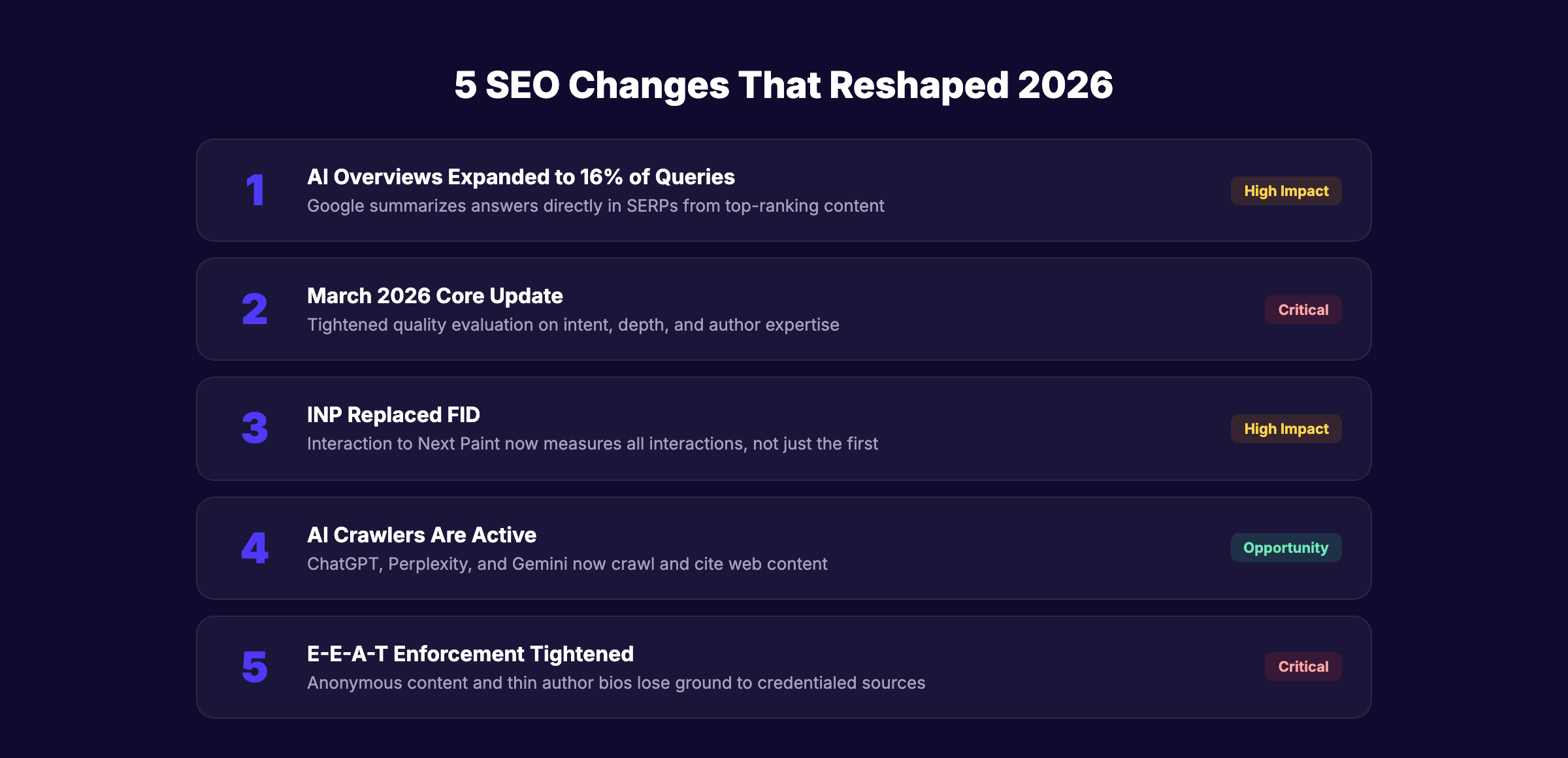
2026 brought real changes. Google’s March core update tightened quality evaluation. AI Overviews now appear for 16% of all queries. INP replaced FID as a Core Web Vital. AI search engines like ChatGPT and Perplexity now crawl and cite web content. And 97% of AI Overview citations come from pages already ranking in the top 20 organic results.
The SEO best practices that worked in 2024 do not all work in 2026. This guide covers what actually drives rankings right now and gives you a prioritized action plan.
We have published 3,500+ blog posts across 70+ industries. This is what we see working across every site we touch.
Here is what you will learn:
- The 5 biggest changes that reshaped SEO in 2025 and 2026
- The 10 SEO best practices driving results right now
- 5 tactics that stopped working (and what to do instead)
- A prioritized action plan you can start this week
- The tools you need to execute
What Changed in SEO (2025 to 2026)
These are not predictions. These are confirmed changes that already affect your rankings.
Change 1: AI Overviews Expanded
Google AI Overviews now appear for roughly 16% of all queries, up from a limited test in 2024. They pull answers directly from ranking content and display them above traditional results.
What this means: Pages that rank in the top 20 feed AI Overviews. Pages that do not rank do not appear in AI answers either. Traditional SEO is now a prerequisite for AI visibility.
What to do: Keep ranking well in organic results. Structure content with clear, concise answers that AI systems can extract. Read our guide on AI Overview optimization.
Change 2: March 2026 Core Update
Google’s March 2026 core update increased weight on intent alignment, content depth, and author expertise. Sites relying on generic keyword coverage or thin content lost visibility. Sites with deep, fact-driven content gained.
What this means: Surface-level articles no longer compete. Google evaluates whether your content genuinely satisfies the query better than alternatives.
What to do: Audit your top pages for content depth. Compare against top 3 competitors. Fill gaps.
Change 3: INP Replaced FID as a Core Web Vital
Interaction to Next Paint (INP) replaced First Input Delay in March 2024 and is now fully factored into rankings. INP measures how fast your page responds to any user interaction, not just the first one.
What this means: Pages with heavy JavaScript that respond slowly to clicks, scrolls, or form inputs rank lower. Only 47 to 54% of websites currently pass all Core Web Vitals.
What to do: Test your pages with Google PageSpeed Insights. Target INP under 200ms on mobile.
Change 4: AI Search Engines Now Crawl Your Site
ChatGPT, Perplexity, Google Gemini, and Claude now actively crawl and index web content. Your robots.txt file determines which AI crawlers can access your pages.
What this means: Blocking AI crawlers means your content cannot appear in AI search responses. Allowing them creates a new traffic and citation source.
What to do: Review your robots.txt for AI crawler directives. Allow crawlers from major AI platforms unless you have a specific reason to block them.
Change 5: E-E-A-T Enforcement Tightened
Google’s quality raters now use E-E-A-T (Experience, Expertise, Authoritativeness, Trustworthiness) as a primary evaluation framework. AI systems use the same signals to decide which sources get cited.
What this means: Anonymous content, thin author bios, and sites without clear expertise signals lose ground to credentialed, well-cited content.
What to do: Add author bios with credentials. Link to author profiles. Cite sources. Show first-hand experience.
Your SEO team. $99 per month. 30 optimized articles, published automatically. Start for $1 →
10 SEO Best Practices That Work in 2026
These are the tactics driving real results right now, ranked by impact.
1. Match Content Format to Search Intent
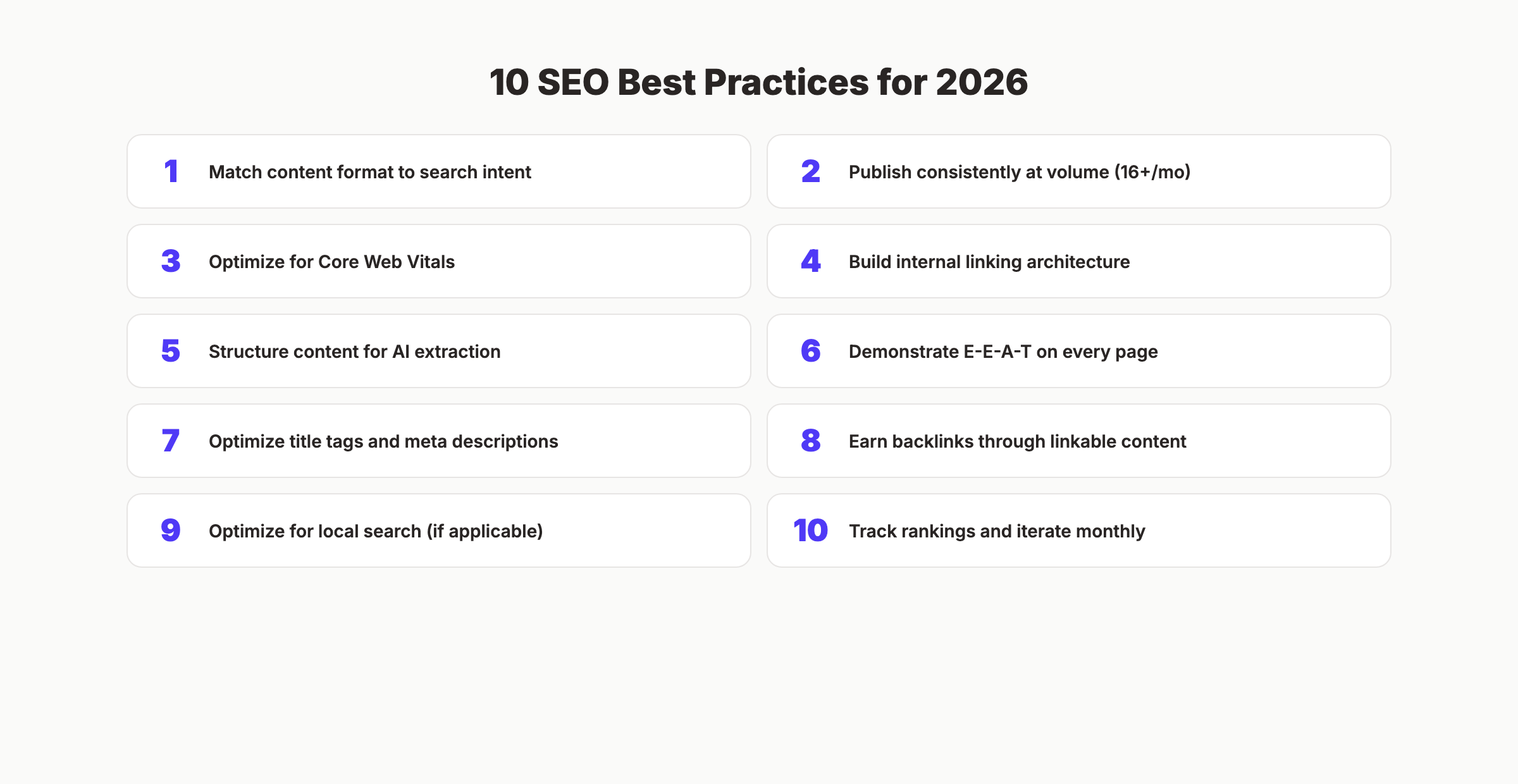
Search intent determines whether your page ranks. Google analyzes the top results for every query. If the top 5 are all guides and your page is a product listing, you will not rank.
How to implement: Search your target keyword. Note the dominant format (guide, listicle, comparison, product page). Match it. Check the average word count of top 3 results. Meet or exceed it.
2. Publish Consistently at Volume
Companies publishing 16+ posts per month see 3.5x more traffic than those publishing fewer than 4. Volume builds topical authority, which Google rewards with higher rankings across an entire topic cluster.
How to implement: Set a minimum publishing cadence of 8 articles per month. Cover your core topics deeply with content clusters. Every new article strengthens the authority of related pages.
3. Optimize for Core Web Vitals
Pages that pass all 3 Core Web Vitals (LCP under 2.5s, INP under 200ms, CLS under 0.1) rank measurably better. Sites improving from “Poor” to “Good” report 25% conversion rate increases.
How to implement: Run PageSpeed Insights on your top 20 pages. Compress images. Reduce JavaScript. Set explicit image dimensions. Use a CDN. Fix the worst-performing pages first.
4. Build Internal Linking Architecture
Internal links distribute authority, help Google discover pages, and keep visitors on your site. The best-ranking sites have deliberate linking structures, not random “related post” suggestions.
How to implement: Link every new post to 3 to 5 existing relevant posts. Update older posts to link to newer content. Use descriptive anchor text, not “click here.”
5. Structure Content for AI Extraction
AI systems extract concise, direct answers from web content. Pages structured for easy extraction get cited more often in AI Overviews, ChatGPT, and Perplexity.
How to implement: Answer key questions in 1 to 2 sentences under clear H2/H3 headings. Use tables and numbered lists. Add FAQ sections with direct answers. Apply structured data markup.
6. Demonstrate E-E-A-T on Every Page
Experience, Expertise, Authoritativeness, and Trustworthiness are not optional signals. They determine whether Google trusts your content enough to rank it.
How to implement:
- Add author bylines with credentials and profile pages
- Cite authoritative external sources with specific links
- Show first-hand experience (case studies, original data, screenshots)
- Display trust signals (reviews, testimonials, certifications)
- Implement Author and Organization schema markup
7. Optimize Title Tags and Meta Descriptions
Your title tag is the single strongest on-page ranking signal. Your meta description determines whether users click. Together they control your SERP performance.
How to implement: Keep titles under 60 characters. Include the primary keyword in the first half. Write meta descriptions between 145 and 155 characters with a benefit and keyword. Test different formats: numbers, brackets, and “how to” structures.
Stop writing. Start ranking. Stacc publishes 30 SEO articles per month for your business, on autopilot. Start for $1 →
8. Earn Backlinks Through Linkable Content
Backlinks remain the strongest off-page ranking signal. But link building in 2026 is about creating content worth linking to, not mass outreach.
How to implement: Publish original research, data studies, and definitive guides. Create free tools. Write comparison posts that bloggers reference. Use HARO and journalist outreach for high-authority mentions.
9. Optimize for Local Search (If Applicable)
46% of all Google searches have local intent. Local SEO is its own discipline with separate ranking factors: Google Business Profile, reviews, NAP consistency, and local citations.
How to implement: Claim your GBP. Choose the right categories. Post weekly. Respond to reviews within 24 hours. Build local citations. Create location-specific landing pages. Read our guide on improving Google Maps rankings.
10. Track Rankings and Iterate Monthly
SEO without measurement is guessing. Track rankings, traffic, and conversions monthly. Identify what works and do more of it. Identify what fails and fix or cut it.
How to implement: Set up Google Search Console and Google Analytics. Track your target keywords weekly in Ahrefs or Semrush. Review top-performing and declining pages monthly. Update declining content.
Key metrics to watch:
| Metric | Tool | Review Frequency |
|---|---|---|
| Keyword rankings | Ahrefs / Semrush | Weekly |
| Organic traffic by page | Google Analytics | Monthly |
| Core Web Vitals | Search Console | Monthly |
| Click-through rate | Search Console | Monthly |
| Indexation coverage | Search Console | Monthly |
| Backlink profile | Ahrefs | Monthly |
| Conversion rate from organic | Analytics + CRM | Monthly |
Pages declining for 2+ consecutive months need attention. Either the content decayed, a competitor published something better, or an algorithm update shifted intent. Diagnose the cause before fixing.
5 SEO Tactics That Stopped Working
Stop doing these. They waste time, budget, or both.
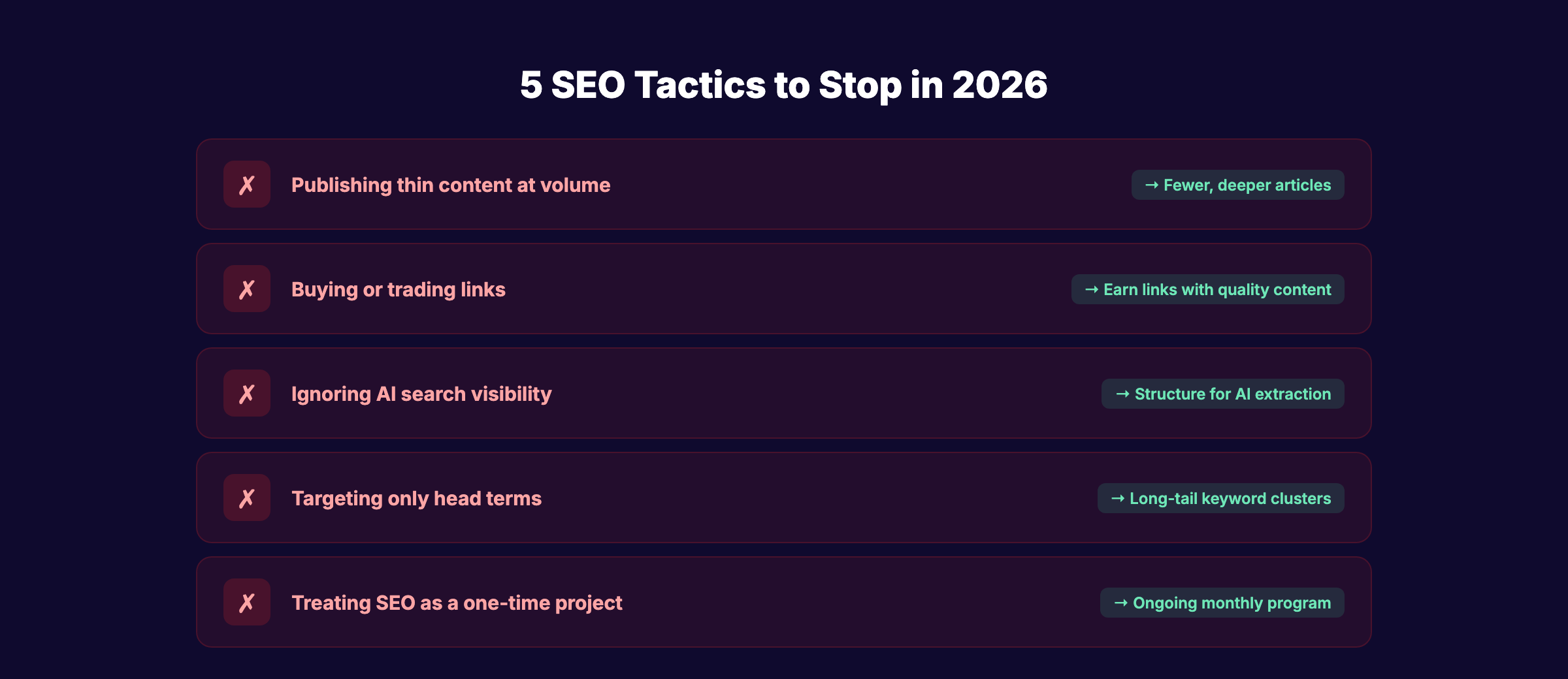
Stop: Publishing Thin Content at Volume
Writing 50 short (under 500 word) blog posts per month and hoping some rank. Google’s March 2026 update specifically targeted thin, undifferentiated content. Volume without depth hurts domain authority.
Do this instead: Publish fewer, deeper articles. A single 3,000-word guide that ranks on page 1 drives more traffic than 20 thin posts that rank nowhere. Follow a proven blog post structure.
Stop: Buying or Trading Links
Google’s spam detection has improved dramatically. Purchased links, link exchanges, and PBN (Private Blog Network) links carry higher penalty risk than ever. The short-term ranking boost is not worth the long-term risk.
Do this instead: Earn links through quality content. Publish original research that others want to cite. Write guest posts on legitimate sites. Build relationships with journalists through HARO. Focus on creating resources that naturally attract links: data studies, free tools, definitive guides, and original frameworks.
Stop: Ignoring AI Search Visibility
Pretending AI search does not exist is like ignoring mobile in 2015. ChatGPT, Perplexity, and Google AI Overviews collectively handle millions of queries per day. If your content is not structured for AI citation, you are invisible to a growing audience.
Do this instead: Optimize for AI search visibility. Add schema markup. Write clear, extractable answers. Build topical authority.
Stop: Targeting Only Head Terms
Competing for single-word or two-word keywords (like “SEO” or “marketing”) against domain authorities is a losing strategy for most businesses. These terms have extreme competition and low conversion intent.
Do this instead: Target long-tail keywords with 3+ words. “SEO best practices for small business 2026” converts better than “SEO” and has 10x lower competition. Build content clusters around specific topic areas. Use our keyword research glossary entry to understand how to identify the right terms.
Stop: Treating SEO as a One-Time Project
Setting up title tags and meta descriptions once, then never touching your site again. SEO is continuous. Content decays. Competitors publish. Algorithms update. Rankings drop if you stop.
Do this instead: Run monthly reviews. Update content every 6 to 12 months. Refresh statistics and examples. Monitor rankings weekly. Treat SEO as an ongoing program, not a project. Schedule quarterly content audits to identify pages that need updating, consolidating, or removing. Build a content calendar that includes both new content and refresh cycles.
3,500+ blogs published. 92% average SEO score. See what Stacc can do for your site. Start for $1 →
Your 2026 SEO Action Plan
Here is exactly what to do, in order of impact.
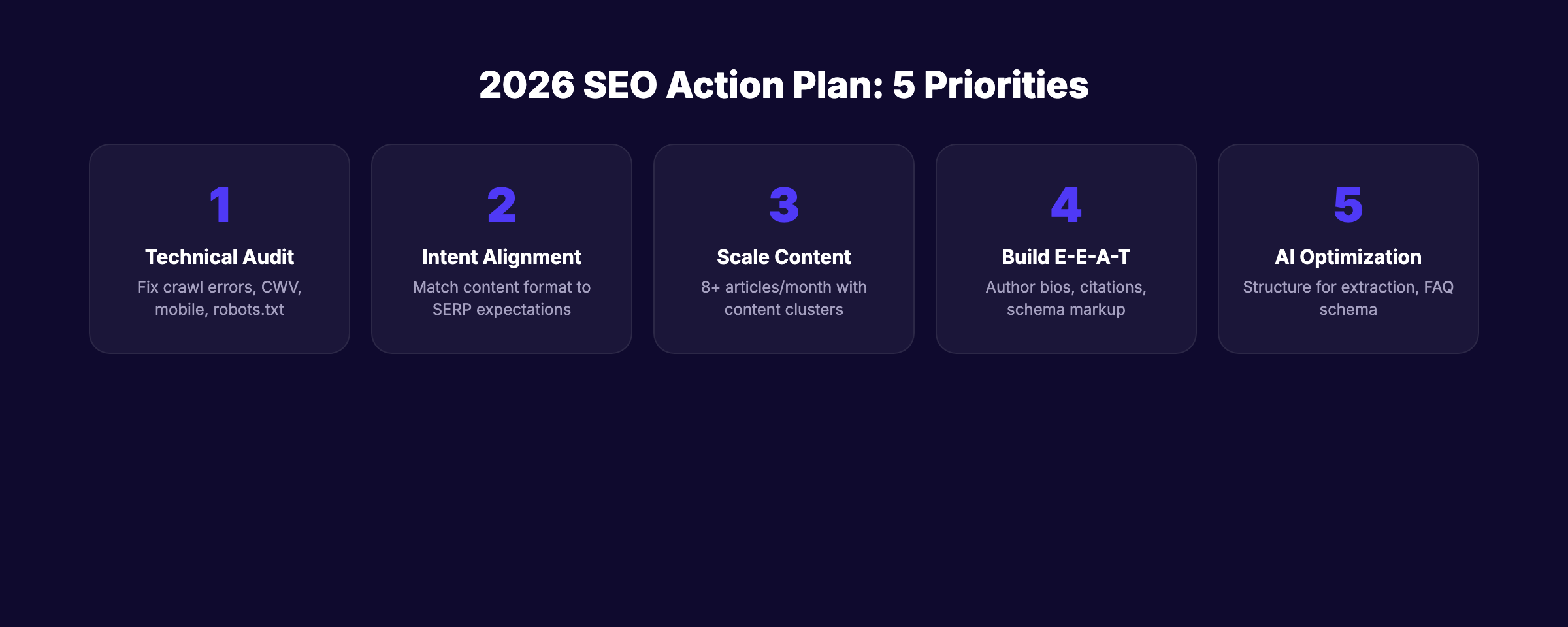
Priority 1: Audit and Fix Technical Foundation
Before anything else, ensure Google can crawl, index, and render your site properly. Run a technical SEO audit.
- Submit XML sitemap to Google Search Console
- Fix all crawl errors and broken links
- Pass Core Web Vitals on mobile (LCP, INP, CLS)
- Verify mobile usability (no horizontal scroll, tap targets 48px+)
- Check
robots.txtfor AI crawler access - Implement HTTPS sitewide
Priority 2: Align Content with Search Intent
Audit your top 20 pages by organic traffic. For each page, search the target keyword and compare your format to the top 3 results.
- Identify intent mismatches (your format does not match SERP)
- Restructure mismatched pages to match dominant format
- Add missing sections that top competitors include
- Verify primary keyword in title, first 100 words, 1+ H2, and meta description
Priority 3: Scale Content Production
Volume drives topical authority. Authority drives rankings. Rankings drive traffic. This is the compounding engine.
- Set a publishing cadence of 8+ articles per month
- Build content clusters around your core topics
- Create a content calendar with assigned topics and deadlines
- Verify every post meets minimum quality standards before publishing
Priority 4: Build E-E-A-T Signals Across Your Site
Trust signals compound. Every author bio, citation, and case study makes your entire domain more credible.
- Add detailed author bios to every blog post
- Create standalone author profile pages
- Implement Author and Organization schema markup
- Cite authoritative external sources in every article
- Add testimonials, reviews, and case studies to key pages
Priority 5: Optimize for AI Search
AI search visibility follows traditional SEO. Rank first, then get cited.
- Structure key content with extractable answers
- Add FAQ schema to informational pages
- Allow AI crawlers in
robots.txt - Monitor AI search citations with Ahrefs or brand mention tools
- Read our full guide on AI Overview optimization
Tools and Resources for 2026 SEO
For SEO Auditing and Tracking
- Google Search Console (free) — Monitor indexing, rankings, and Core Web Vitals
- Google Analytics (free) — Track traffic, behavior, and conversions
- Ahrefs — Keyword research, backlink analysis, rank tracking
- Semrush — All-in-one SEO platform with competitive analysis
- Screaming Frog — Technical site crawling and audit
For Content Optimization
- Surfer SEO — On-page optimization and content scoring
- Clearscope — Content optimization with NLP analysis
- Google PageSpeed Insights — Core Web Vitals testing
- Schema Markup Validator — Test structured data implementation
For Done-For-You SEO Content
- Stacc — Publishes 30 SEO-optimized articles per month for $99. Blog SEO, Local SEO, and Social Media on autopilot. We handle keyword research, writing, optimization, and publishing so you do not have to. Start for $1 →
Skip the agency. Keep the results. Stacc starts at $99 per month with a $1 trial. Start for $1 →
How SEO Best Practices Differ by Business Type
Not every business should execute SEO the same way. Priorities shift based on your model.
Local service businesses (plumbers, dentists, lawyers) should prioritize GBP optimization, local citations, review generation, and location-specific content. Local SEO drives phone calls and foot traffic. Read our guide to getting found on Google as a local business.
B2B SaaS and service companies should prioritize blog content at volume, thought leadership E-E-A-T signals, and long-tail keyword targeting. The sales cycle is longer. Content builds trust before the demo request.
E-commerce brands should prioritize product page optimization, category page SEO, technical performance (page speed directly impacts cart conversions), and structured data for product rich results.
Agencies and consultants should prioritize their own blog content as proof of expertise. Ranking for “SEO best practices” while selling SEO services is the ultimate credibility signal.
The 10 best practices in this guide apply across all business types. The priority order changes based on where your revenue comes from.
FAQ
What are the most important SEO ranking factors in 2026?
The top ranking factors in 2026 are high-quality content that matches search intent, backlinks from authoritative domains, Core Web Vitals performance (LCP, INP, CLS), E-E-A-T signals (experience, expertise, authority, trust), and topical authority built through consistent, deep content publishing. Technical accessibility remains foundational.
How often should I update my SEO strategy?
Review your SEO strategy monthly. Check rankings, traffic trends, and conversion rates. Update content every 6 to 12 months to refresh statistics, add new sections, and maintain relevance. Major strategy adjustments should follow Google core updates, which happen several times per year.
Is SEO still worth it in 2026 with AI search?
Yes. 97% of AI Overview citations come from pages already ranking in the top 20 organic results. Traditional SEO is now the prerequisite for visibility in both Google search and AI search engines. Sites that rank well appear in both organic results and AI-generated answers.
How many blog posts should I publish per month for SEO?
Research shows companies publishing 16+ posts per month see 3.5x more traffic. We recommend a minimum of 8 per month for meaningful results. 20 to 30 per month is where compounding effects become significant. Consistency matters more than perfection. 4 solid posts every week outperforms 1 perfect post per month.
What is the biggest SEO mistake businesses make?
Treating SEO as a one-time project instead of an ongoing program. Setting up title tags and metadata once, publishing a handful of blog posts, then stopping. SEO compounds over time. The businesses that rank consistently are the ones that publish consistently, monitor rankings monthly, and update content regularly.
Do I need to hire an SEO agency?
Not necessarily. Agencies cost $1,000 to $5,000+ per month and often produce 4 to 8 articles. Services like Stacc deliver 30 optimized articles per month for $99, which is 70 to 90% cheaper. The right choice depends on your budget, how much hands-on strategy you need, and whether you want done-for-you execution or advisory support.
SEO in 2026 rewards depth, consistency, and technical excellence. The fundamentals still matter: match intent, write quality content, build links, and keep your site fast. The difference is that the bar is higher. Thin content, slow pages, and anonymous authorship no longer pass.
Start with the technical audit. Align your content with intent. Scale production. Build trust signals. Optimize for AI. Execute consistently and measure everything. That is how you rank in 2026.
Written and published by Stacc. We publish 3,500+ articles per month across 70+ industries. All data verified against public sources as of March 2026.