
How to Get Featured Snippets: 7 Steps (2026)
Win featured snippets on Google with 7 proven steps. Covers paragraph, list, and table formats plus AI Overview interaction. Updated March 2026.
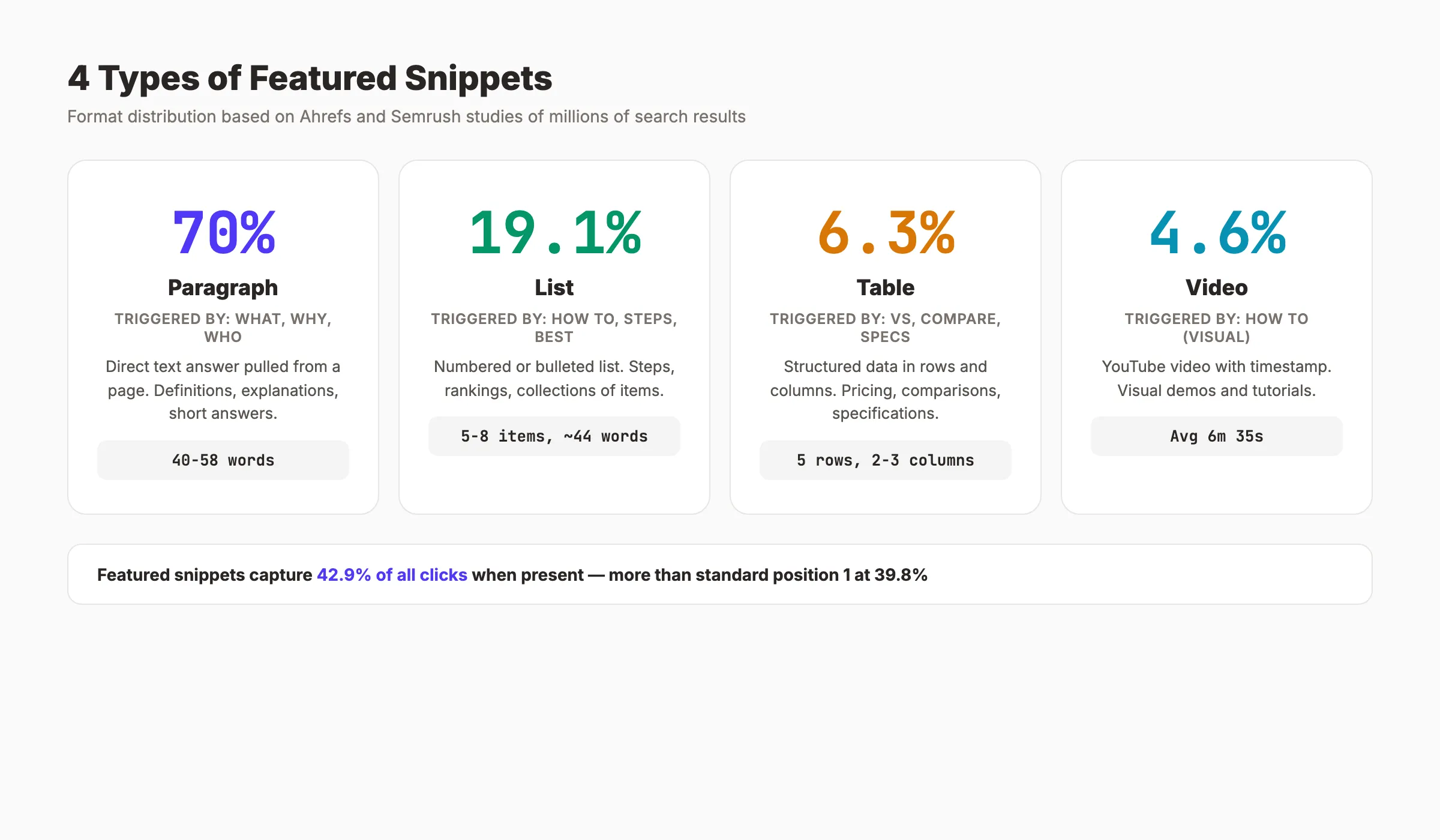
Featured snippets capture 42.9% of all clicks when they appear on a search result page. That is more than the standard position 1 organic result at 39.8%. If a competitor holds the snippet above you, they take nearly half the traffic before anyone scrolls.
Featured snippet visibility declined 64% between January and June 2025 as Google expanded AI Overviews. But snippets are not dead. They still appear on millions of queries. And here is what most SEOs miss: pages that win featured snippets get cited in AI Overviews at roughly 2 times the rate of non-snippet pages.
Optimizing for featured snippets in 2026 is a two-for-one strategy. You get the SERP box and increase your chances of appearing in AI-generated answers.
We have published 3,500+ blog posts across 70+ industries. Many win featured snippets because we follow a specific 7-step process. This guide covers every step.
Here is what you will learn:
- What a featured snippet is and the 4 types Google displays
- How to find keywords where snippet opportunities exist
- How to match the exact format Google expects
- How to structure your content for paragraph, list, and table snippets
- How featured snippets interact with AI Overviews in 2026
- How to track and defend your snippet positions
What Is a Featured Snippet
A featured snippet is a highlighted answer box at the top of Google search results. Google pulls content directly from a web page and displays it above the first organic result. This position is called “position zero.”
Google selects featured snippets programmatically. According to Google’s documentation, the search engine determines whether a page would make a good snippet based on the query and available content. You cannot request a snippet. You earn it by formatting your content the way Google needs.
The 4 Types of Featured Snippets
| Snippet Type | Share | Optimal Length | Triggered By |
|---|---|---|---|
| Paragraph | 70% | 40-58 words | ”What is,” “why,” definitions |
| List (ordered/unordered) | 19.1% | 5-8 items, ~44 words | ”How to,” steps, rankings |
| Table | 6.3% | 5 rows, 2-3 columns | Comparisons, pricing, specs |
| Video | 4.6% | 6 min 35 sec avg | Visual how-to demos |
Key Statistics for 2026
- 12.29% of search queries display a featured snippet
- 99.58% of snippets come from pages already ranking in the top 10
- 40.7% of voice search answers come from featured snippets
- Snippet visibility declined 64% in early 2025 but stabilized in late 2025
- Pages winning snippets get cited in AI Overviews at 2 times the rate of non-snippet pages
Step 1: Find Keywords with Featured Snippet Opportunities
Not every keyword triggers a featured snippet. Your first step is finding the right keywords to target.
How to find them:
- Open Google Search Console and export keywords where your site ranks in positions 2 through 10
- Search each keyword manually on Google and note which ones display a featured snippet
- Prioritize keywords where you already rank in the top 5. These have the highest chance of winning
- Focus on question-based queries. 29% of snippet-triggering keywords begin with “what,” “how,” “why,” or “when”
Query types most likely to trigger snippets:
| Query Type | Snippet Trigger Rate | Example |
|---|---|---|
| ”Why” questions | 78% | “Why is page speed important for SEO?" |
| "Can” questions | 72% | “Can you rank without backlinks?" |
| "Do” questions | 67% | “Do meta descriptions affect rankings?" |
| "Where” questions | 19% | “Where to find free SEO tools?” |
Build a spreadsheet of 20 to 30 target keywords. Include the current ranking position, whether a snippet exists, and the snippet format. Keywords where you rank positions 2 through 5 with an existing snippet are your highest-priority targets.
55.5% of snippets trigger on keywords with 10 or more words. Short, broad keywords rarely show snippets. Long-tail question queries are where the opportunity lives. Use Google Search Console to export your current rankings and filter for question-based queries with high impression counts.
For finding the right keywords, see our keyword research guide.
Step 2: Match the Snippet Format Google Expects
Format mismatch is the most common reason pages rank on page 1 but do not win the snippet. Google already knows what format the answer needs. Your job is to deliver it.
Search your target keyword. Study the existing snippet. Match that format exactly.
| Format | Optimal Length | Structure Required |
|---|---|---|
| Paragraph | 40-58 words (250-320 chars) | Direct answer in 2-3 sentences under an H2 or H3 |
| Ordered list | 5-8 items, ~44 words total | Numbered list or sequential H3 headings under an H2 |
| Unordered list | 5-8 items | Bulleted list under a question-based H2 |
| Table | 5 rows, 2-3 columns | Markdown or HTML table with clear headers |
If Google shows a list snippet for “best ways to improve page speed,” do not write a paragraph answer. Write a numbered list.
Step 3: Write a Direct Answer Block
This is where most content fails. The page covers the topic well but never gives Google a clean, extractable answer.
For Paragraph Snippets
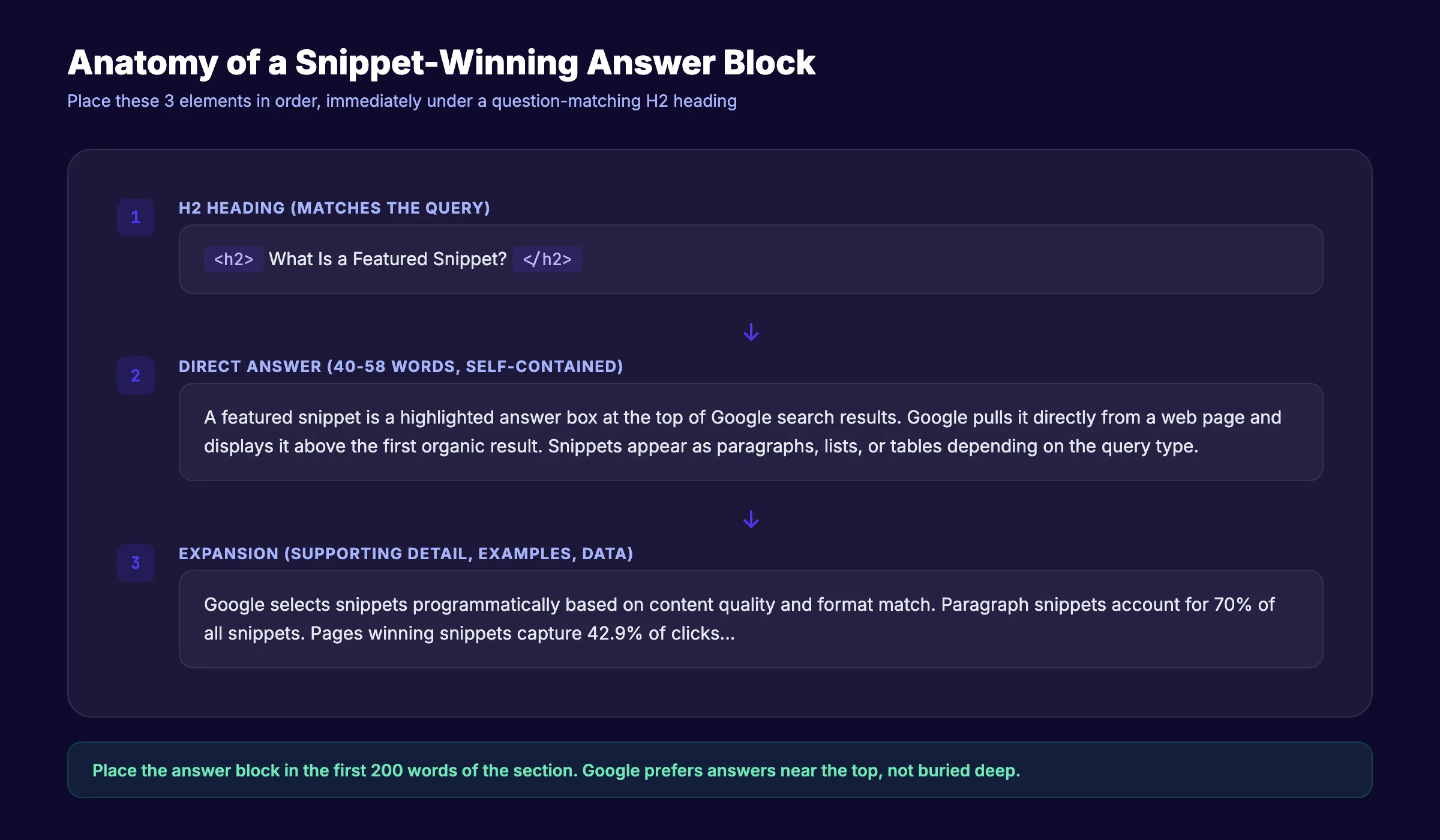
Write 40 to 58 words that directly answer the question. Place this immediately after an H2 or H3 containing the target keyword. No preamble. Start with the answer.
Bad (too vague):
“There are many factors that go into featured snippets, and understanding them can help your SEO strategy.”
Good (direct, extractable):
“A featured snippet is a highlighted answer box at the top of Google search results. Google pulls it from a web page and displays it above the first organic result. Snippets appear as paragraphs, lists, or tables depending on the query type.”
For List Snippets
Use sequential H3 headings under an H2, or write a clean bulleted/numbered list. Google extracts lists from both formats.
For Table Snippets
Use a properly formatted table with a clear header row. Keep it to 5 rows and 2 to 3 columns. Google rarely displays tables larger than this.
Pro tip: Place your answer block in the first 200 words of the section. Google prefers answers near the top, not buried 3 paragraphs deep.
Stop writing. Start ranking. Stacc publishes 30 SEO articles per month for $99. Every post targets featured snippets and AI visibility. Start for $1 →
Step 4: Structure Content with Clear Headers
Google uses your heading structure to understand what each section covers. A clean H2/H3 hierarchy signals where answers live.
Header rules:
- Use H2 headings for each major question or topic
- Include the target keyword or a close variation in at least 1 H2
- Use H3 headings for subtopics or list items within each H2 section
- Never skip heading levels (H2 to H4 without an H3)
Heading patterns that trigger specific snippet types:
| Heading Pattern | Snippet Type | Example |
|---|---|---|
| ”What is [topic]?” | Paragraph | ”What is a featured snippet?" |
| "How to [action]“ | Ordered list | ”How to optimize for featured snippets" |
| "[Number] best [items]“ | List | ”7 best keyword research tools" |
| "[Topic] vs [topic]“ | Table | ”Ahrefs vs Semrush pricing" |
| "Why [outcome]?” | Paragraph | ”Why do featured snippets matter?” |
Use supporting formatting Google can parse: bold text for definitions, bulleted lists for features, tables for comparisons, and short paragraphs of 1 to 3 sentences.
Step 5: Verify On-Page SEO for Snippet Eligibility
Featured snippets almost exclusively come from top 10 pages. Before optimizing for snippets, make sure your on-page SEO is solid.
Snippet eligibility checklist:
- Page ranks in positions 1 through 10 for the target keyword
- Title tag includes the target keyword in the first 60 characters
- Meta description is 145-155 characters with a benefit
- Target keyword appears in the first 100 words
- At least 3 internal links per 1,000 words
- Page loads in under 3 seconds on mobile
- Content published or updated within the last 12 months
Myth to debunk: Schema markup does not influence featured snippet selection. Google confirms structured data has nothing to do with snippet selection. That said, schema markup still helps with other rich results.
You cannot win a snippet from position 15. 99.58% come from the top 10. On-page SEO gets you there. Snippet formatting gets you to position zero.
Step 6: Optimize for People Also Ask Boxes
People Also Ask (PAA) boxes appear in over 75% of Google searches. Each PAA answer is a mini featured snippet. Winning PAA is often easier than winning the main snippet.
How to target PAA:
- Search your target keyword and note all PAA questions
- Add an FAQ section with 4 to 6 of the most relevant PAA questions
- Answer each in 2 to 4 sentences directly under a bold question heading
- Keep answers under 50 words for paragraph PAA
Google often pulls PAA answers from different pages than the main snippet. A page ranking in position 6 can win a PAA box even if position 1 holds the main snippet.
PAA questions also reveal related queries Google associates with your topic. Covering them builds the topical depth that strengthens content authority.
Your SEO team. $99 per month. 30 optimized articles with snippet-ready headings and answer blocks. Start for $1 →
Step 7: Track, Defend, and Expand Snippet Positions
Winning a featured snippet is not permanent. Snippets rotate between competing pages. Monitoring matters.
Tracking process:
- Check Google Search Console weekly for position changes on snippet keywords
- Search your top snippet keywords monthly to verify you hold the position
- If you lose a snippet, compare your content to the new winner and identify the gap
- Update your content quarterly to maintain freshness
Tracking metrics:
| Metric | Tool | What It Shows |
|---|---|---|
| Snippet ownership | Manual SERP check or Semrush | Whether you hold position zero |
| Click-through rate | Google Search Console | Whether the snippet drives traffic |
| Impression trend | Google Search Console | Visibility direction |
| Position changes | Google Search Console | Early warning of snippet loss |
70% of snippet-holding articles published within the last 2 to 3 years. Regular updates keep your answers fresh and positions stable. For a full analytics setup, see our Google Search Console guide.
Featured Snippets and AI Overviews in 2026
The relationship between featured snippets and AI Overviews is the most important development in search for 2026. Understanding it changes how you prioritize.
What Happened to Snippet Visibility
AI Overviews increased 598% between January and June 2025. Featured snippet visibility declined 64% during the same period. Google replaced many snippet positions with AI-generated answers.
But the decline stabilized. Snippets still appear on millions of queries, especially:
- How-to and procedural queries (ordered list snippets)
- Comparison and vs queries (table snippets)
- Commercial queries (“best X for Y”)
- Queries where AI Overviews cannot generate reliable answers
Why Snippet Optimization Still Matters
Pages winning featured snippets get cited in AI Overviews at roughly 2 times the rate of non-snippet pages. 92.36% of AI Overview citations come from domains already ranking in the top 10. The content patterns that win snippets (direct answers, structured headings, stat-rich blocks) are the same patterns Google’s AI uses to select citation sources.
Snippet optimization is now the most effective path to AI Overview citation. For a deeper guide on AI search, see our generative engine optimization guide.
Where Each SERP Feature Dominates
| Query Type | Dominant Feature | Your Strategy |
|---|---|---|
| Definitions (“what is X”) | AI Overviews | Optimize for both snippet and AI citation |
| How-to / procedural | Featured Snippets (lists) | Win the snippet with ordered list format |
| Comparisons / vs queries | Featured Snippets (tables) | Win the snippet with table format |
| Commercial (“best X for Y”) | Featured Snippets | Win the snippet with ranked list |
| Navigational | Standard results | No snippet strategy needed |
Featured Snippets and Voice Search
40.7% of voice search answers come from featured snippets. Voice assistants read the snippet answer verbatim. Win the paragraph snippet for “what is topical authority” and Google Assistant reads your answer to anyone who asks.
Voice-optimized snippet tips:
- Write answers in complete, conversational sentences
- Answer the question in the first sentence. Add context in the second.
- Avoid jargon or abbreviations that sound awkward read aloud
- Keep paragraph answers under 50 words. Voice assistants cut off longer answers.
This also matters for AI search engines. ChatGPT and Perplexity pull from the same well-structured content that wins featured snippets.
Common Mistakes That Kill Snippet Chances
Most snippet optimization failures come from one of these errors.
1. Burying the answer. Place the direct answer immediately after the matching H2. Not 3 paragraphs into the section.
2. Wrong format for the query. A paragraph for a process query. A list for a definition query. Match the format Google already shows.
3. Targeting keywords you do not rank for. 99.58% of snippets come from the top 10. Get there first through on-page optimization and consistent publishing.
4. Ignoring content freshness. Snippets change sources frequently. Google favors updated content. Stale pages lose snippet positions.
5. Over-satisfying intent in the answer. For non-definition queries, a snippet that answers everything leaves no reason to click. Write a clear answer but leave room for the reader to want more.
6. Neglecting mobile optimization. Featured snippets occupy up to 50% of the mobile screen. Most snippet interactions happen on mobile. If your page loads slowly or displays poorly on phones, Google will select a faster competitor.
7. Ignoring E-E-A-T signals. Content without clear authorship, citations, or demonstrated expertise ranks lower in snippet consideration. Add author bylines, cite sources, and show first-hand experience in your content.
What Results to Expect
After applying these 7 steps across 10 to 20 existing pages, expect:
- First snippet wins within 2 to 4 weeks for low-competition keywords
- Featured snippet visibility for 5 to 15% of your top 10 keywords within 90 days
- A measurable CTR increase. Snippets capture 42.9% of clicks vs 39.8% for standard position 1
- Improved AI Overview citations, since Google uses snippet-quality content for AI answers
- 40.7% of voice search answers drawn from your snippet positions
Snippet optimization compounds. The more snippet-formatted content your site has, the more Google recognizes your pages as snippet-worthy sources. Each win makes the next one easier.
For broader strategies on increasing organic traffic, see our guide. For content that earns snippets and AI citations simultaneously, see how to optimize content for SEO.
3,500+ blogs published. 92% average SEO score. We structure every post for featured snippets, PAA boxes, and AI search. Start for $1 →
FAQ
What is a featured snippet?
A featured snippet is a highlighted answer box at the top of Google search results, above the first organic result. Google pulls it directly from a web page. Snippets appear as paragraphs (70%), lists (19.1%), tables (6.3%), or videos (4.6%). The position is called “position zero” and captures 42.9% of clicks when present.
Are featured snippets still relevant in 2026?
Yes. Snippet visibility declined 64% in early 2025 as AI Overviews expanded. But snippets still appear on millions of queries, especially how-to and comparison searches. Pages that win snippets also get cited in AI Overviews at 2 times the rate of non-snippet pages. Snippet optimization now serves double duty.
How long does it take to get a featured snippet?
Most pages win their first snippet within 2 to 4 weeks of optimization, assuming the page already ranks in the top 10. New pages need to build rankings first (60 to 90 days). Target pages ranking positions 2 through 5 for the fastest results.
What is the ideal length for a featured snippet answer?
For paragraph snippets: 40 to 58 words. For list snippets: 5 to 8 items totaling about 44 words. For table snippets: 5 rows with 2 to 3 columns. Google rarely displays content outside these ranges.
What is the difference between a featured snippet and an AI Overview?
A featured snippet pulls a specific passage from one web page and displays it at the top of search results. An AI Overview generates a new answer by synthesizing information from multiple sources. Snippets show one source. AI Overviews cite 2 to 7 sources. They rarely appear on the same query. For AI search strategy, see our GEO guide.
Does schema markup help win featured snippets?
No. Google confirms structured data does not influence snippet selection. Focus on content formatting, heading structure, and direct answer blocks instead.
Featured snippets reward one thing: content that answers a specific question in the exact format Google expects. Start with 5 keywords where you rank positions 2 through 5. Match the snippet format. Write a direct answer block. The first win usually comes within weeks. Each one compounds from there.
Rank everywhere. Do nothing. Blog SEO, Local SEO, and Social on autopilot. Start for $1 →

Written by
Siddharth GangalSiddharth is the founder of theStacc and Arka360, and a graduate of IIT Mandi. He spent years watching great businesses lose organic traffic to competitors who simply published more. So he built a system to fix that. He writes about SEO, content at scale, and the tactics that actually move rankings.
30 SEO blog articles published every month
Keyword-optimized, scheduled, and live on your site. Automatically.
30-day trial · Cancel anytime
theStacc
Stop writing SEO content manually
30 blog articles, 30 GBP posts, and social media content. Published every month. Automatically.
Start Your $1 Trial$1 for 3 days · Cancel anytime