The useful question is not how to scale with AI but when to keep it out. This guide sets out twelve scenarios where AI drafting creates real risk, from YMYL topics and crisis communications to original research and legal filings, and gives a risk pyramid for deciding case by case.
Most teams ask the wrong question about AI content. They ask "how do we use AI to scale?" when the better question is "when should we NOT use AI for content?" Get the first question wrong and you waste a quarter of work. Get the second question wrong and you lose customers, rankings, or a lawsuit.
The cost of using AI for the wrong content type is not theoretical. A New York attorney paid a $5,000 sanction in 2023 after ChatGPT fabricated 6 case citations in a federal brief. CNET watched its organic traffic collapse by 67% after Futurism exposed factual errors in its AI-written money articles. The FTC launched Operation AI Comply in 2024 specifically to crack down on deceptive AI marketing claims. None of these failures came from a bad model. They came from using AI in scenarios where AI should never have been used.
Knowing when not to use AI is the moat. Anyone can publish a 1,500-word AI draft. Few teams know which 12 scenarios require a human writer, which 5 demand a hybrid workflow, and which content types are safe to let AI lead. That judgment is what separates content programs that ship 30 posts per month from programs that ship 30 posts and watch half of them get suppressed.
We publish 3,500+ blog posts per month across 70+ industries. Every brief passes through a content classifier that flags the scenarios in this guide before a single AI prompt runs. By the end of this article, you will have the same classifier, the risk pyramid, the decision table, and the 7-question pre-publish checklist that prevents bad AI content from reaching your live site.
Here is what you will learn:
- The 12 scenarios where AI content fails on E-E-A-T, legal risk, or trust
- The 4-tier risk pyramid that maps every content type to the right approach
- How to spot a content brief that needs a human writer in under 90 seconds
- The 5-step hybrid workflow that ranks for everything else
- The disclosure rules the FTC, Google, and EU AI Act require in 2026
- The exact pre-publish checklist we run before any AI-assisted post goes live
The Quick Answer: 12 Scenarios Where You Should Not Use AI
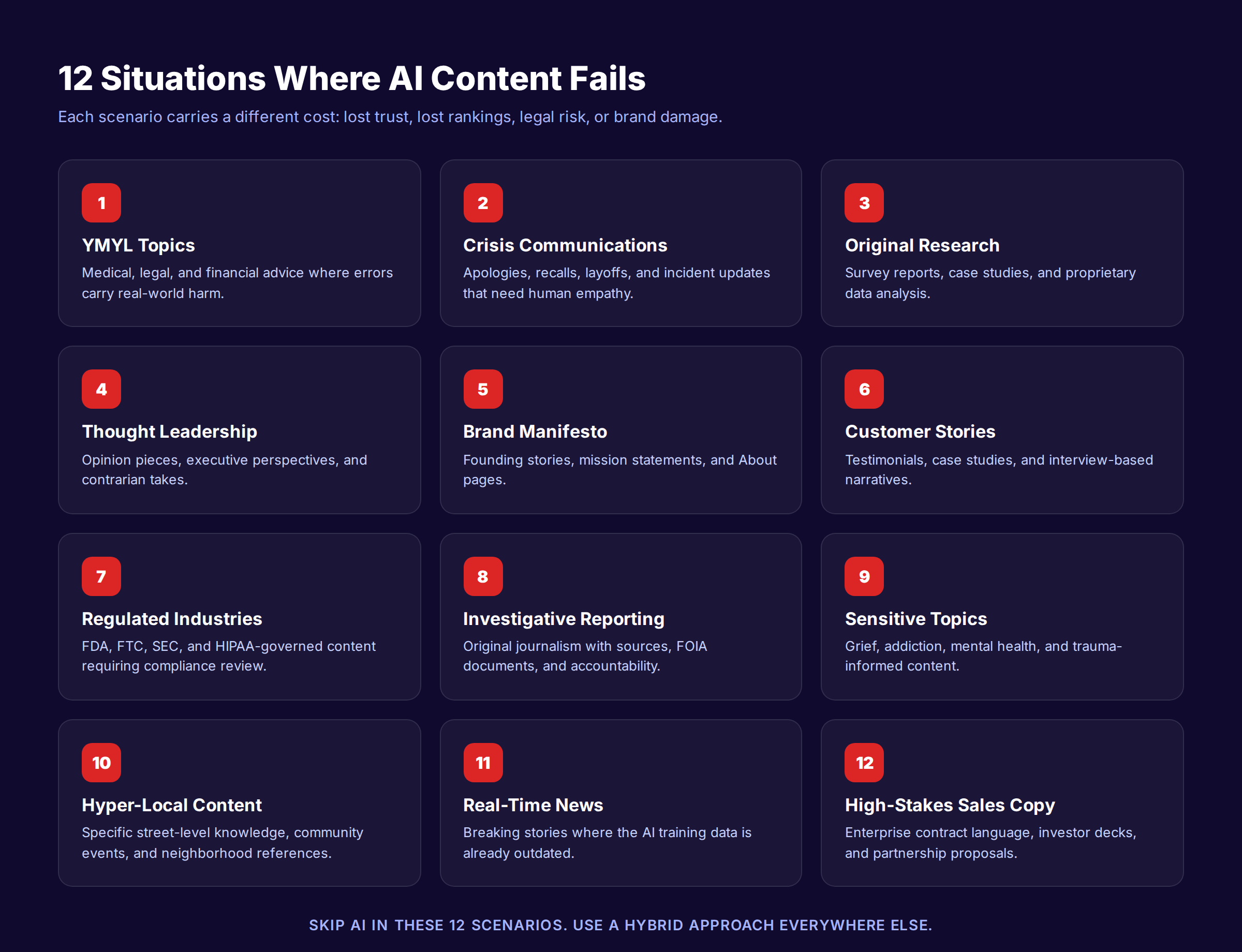
If your content falls into any of these 12 categories, stop. Do not generate a draft. Brief a human writer instead.
- YMYL topics — medical, legal, financial, or safety-critical advice
- Crisis communications — apologies, recalls, layoffs, and incident updates
- Original research — survey reports, proprietary studies, case data
- Thought leadership — opinion pieces, executive perspectives, contrarian takes
- Brand manifesto content — founding stories, mission, values, About pages
- Customer stories — testimonials, case studies, named interviews
- Regulated industry content — FDA, FTC, SEC, HIPAA-governed pages
- Investigative reporting — original journalism with named sources
- Sensitive topics — grief, addiction, mental health, trauma
- Hyper-local content — neighborhood, street, and community-specific knowledge
- Real-time news — breaking stories where AI training data is already stale
- High-stakes sales copy — enterprise contracts, investor decks, partnership proposals
The rest of this guide explains the cost of using AI in each scenario, the warning signs that a brief belongs in this list, and the human-led or hybrid workflow that wins instead.
Why the Question Matters in 2026
AI content is no longer a frontier. It is the default. 51% of marketers use AI tools to write content at least weekly. Over 80% of content teams plan to expand AI use this year. The volume problem is solved. The quality problem is open.
Google does not penalize AI content for being AI. The helpful content system penalizes content for being unhelpful, unoriginal, or untrustworthy. AI is a wedge that splits content into two outcomes. One outcome is faster, cheaper publishing at higher quality. The other outcome is faster publishing at lower quality, lost rankings, brand erosion, and legal exposure.
The dividing line is the brief, not the model. If a human picks the angle, owns the expertise, and edits the output, AI is a force multiplier. If a human delegates the angle, copies the draft, and skips the fact-check, AI becomes a liability. The 12 scenarios in this guide are the ones where even careful editing cannot rescue the post. The defect is structural. The brief itself is wrong for AI.
theStacc publishes content where AI helps and humans lead. 30 SEO articles per month for $99, every post edited by a human, every fact verified, every brand voice trained on your inputs.
The AI Content Risk Pyramid
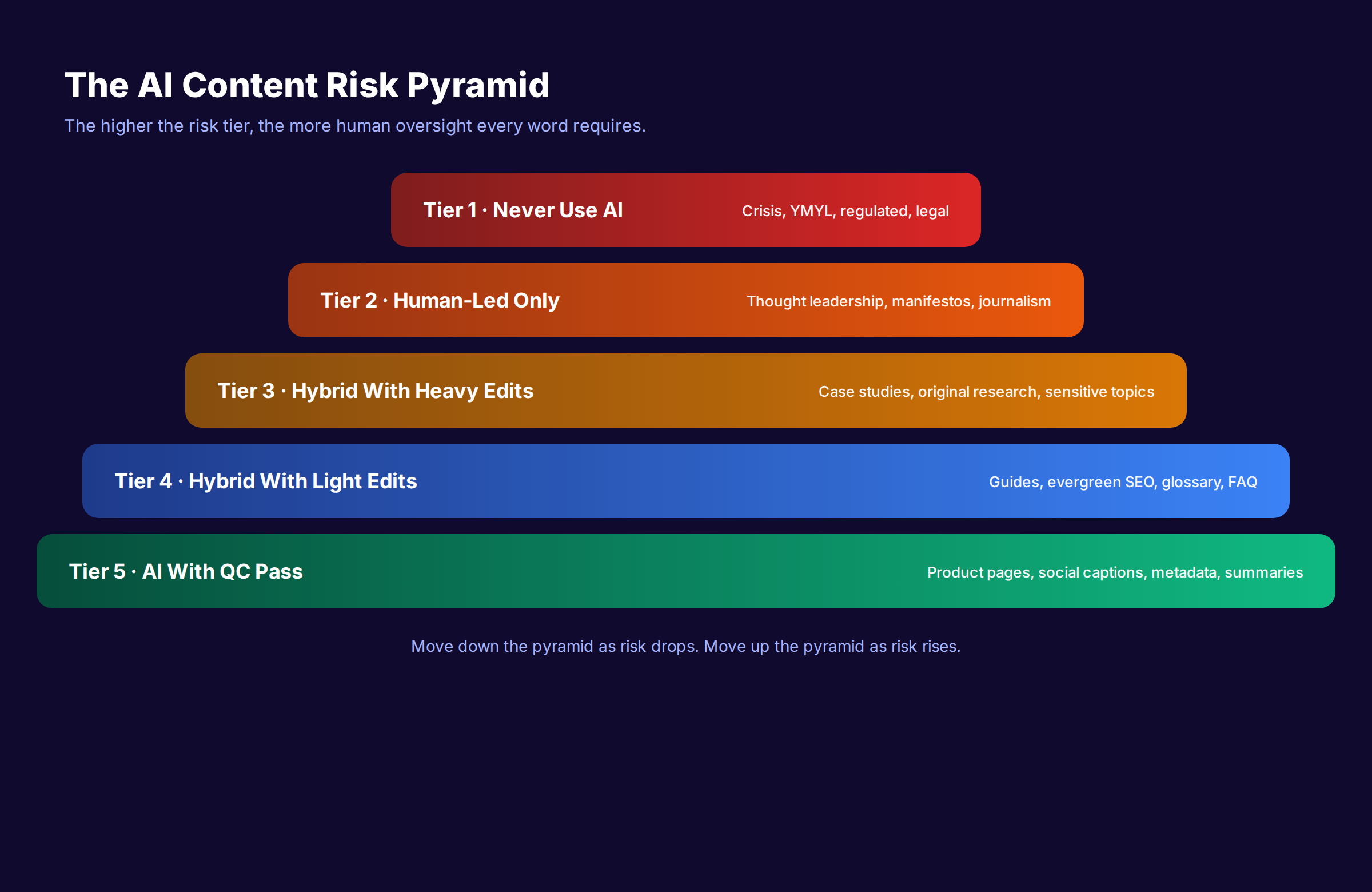
Every content brief lands on one of 5 tiers. The tier dictates the workflow. Misclassifying a brief is the single most expensive mistake content teams make.
Tier 1: Never Use AI
YMYL topics, regulated industries, crisis communications, and legal disclaimers live here. The cost of a hallucinated stat or a misaligned tone is measured in lawsuits, traffic losses, or human harm. A human subject-matter expert writes the entire piece. AI is not used at any step. Even spell-check should be cautious here.
Tier 2: Human-Led Only
Thought leadership, brand manifestos, original journalism, and investor-facing pages live here. AI cannot generate a novel opinion. It cannot conduct an interview. It cannot tell your founding story. A human writes the draft. AI may be used to test counter-arguments, not to generate the prose.
Tier 3: Hybrid With Heavy Edits
Case studies, original research summaries, sensitive topics, and brand-critical landing pages live here. A human owns the angle, the source data, and the final voice. AI accelerates structure and first-pass copy. Every paragraph gets a heavy rewrite. The edit-to-draft time ratio is roughly 1 to 1.
Tier 4: Hybrid With Light Edits
Evergreen SEO guides, glossary entries, comparison pages, and FAQ content live here. AI writes the structural draft. A human runs a fact-check pass, a voice pass, and a SEO pass. The edit-to-draft ratio is 1 to 4. This is where the majority of published content sits in a mature program.
Tier 5: AI With QC Pass
Product descriptions, metadata, social captions, alt text, and bulk summary pages live here. AI generates at scale. A human runs a final quality control gate. The edit-to-draft ratio is 1 to 10. Volume is the point. Quality is enforced by the QC checklist, not by paragraph-level edits.
Most teams default everything to Tier 4 and discover the damage later. Classify the brief first. Pick the tier second. Open the AI tool third.
Scenario 1: YMYL Topics
YMYL stands for Your Money or Your Life. Google defines YMYL content as anything that could materially impact a reader's health, finances, safety, or major life decisions. Medical advice, legal guidance, tax planning, drug interactions, mortgage strategy, and crisis hotlines all qualify.
The risk is not that AI hallucinates. The risk is that AI hallucinates confidently. A reader who follows a hallucinated dosage instruction can be harmed. A reader who follows a fabricated tax loophole can be audited. A reader who follows an invented legal precedent can lose a case. Google holds YMYL pages to the strictest E-E-A-T standards because the downstream cost of error is irreversible.
The workflow rule is simple. A licensed expert writes the content. A second expert reviews it. AI is not used as a drafter. AI may be used as a fact-check assistant, but only as a second opinion against authoritative sources. If your team does not have a credentialed expert in the topic, do not publish on the topic. Refer the reader to an authority who does.
How to Spot a YMYL Brief
Use this 5-question test. If you answer yes to any one, the brief is YMYL.
- Could a reader make a medical, legal, or financial decision based on this page?
- Could acting on the advice cause physical or financial harm?
- Does the topic require a license to practice in real life?
- Would a regulator (FDA, FTC, SEC, state bar) take an interest in this content?
- Would your insurance carrier require a disclaimer on this page?
Scenario 2: Crisis Communications
Apologies, recalls, layoffs, security incidents, and outage post-mortems live here. The reader is not searching for information. The reader is testing whether your brand is human. An AI-written apology is detected within 2 sentences and the brand pays a second penalty on top of the original incident.
A crisis statement does 4 jobs at once. It acknowledges harm without admitting legal liability beyond what is required. It expresses empathy without performing it. It signals the corrective action with specifics. And it leaves a real human accountable on the byline. AI fails on all 4. The model hedges where it should commit, performs where it should restrain, and signs the post "the team" because no model can take ownership.
The workflow rule is that a named human writes every crisis communication. Legal reviews it for liability. Communications reviews it for tone. The CEO or accountable executive signs it. AI is not in the loop.
What a Crisis Statement Needs That AI Cannot Provide
| Requirement | Why AI Fails | The Human Edge |
|---|---|---|
| Personal accountability | Models do not sign letters | A named executive owns the apology |
| Legal precision | Hallucinated wording creates exposure | Counsel reviews every clause |
| Empathetic restraint | Models perform empathy clumsily | Practiced communicators calibrate tone |
| Specific corrective steps | Models generalize action plans | Operators name the fix and the date |
| Stakeholder-aware framing | Models cannot read the room | A human knows which stakeholder is angriest |
Scenario 3: Original Research and Proprietary Data
If your post presents a survey, a customer-data analysis, an industry benchmark, or a proprietary case study, AI cannot write it. The reason is simple. AI does not have access to the underlying data. Anything the model generates about the dataset is invented.
Original research is the highest-impact content asset a brand can produce. Backlinks earned from original research outperform every other content category. Citations from journalists, analysts, and academic papers compound the link profile. AI-generated "research" with fabricated numbers does the opposite. It poisons the brand's authority and exposes the brand to defamation if a quoted entity disputes the data.
The workflow rule is that the data team owns the dataset. An analyst writes the methodology. A writer turns the findings into prose. AI may help with structure or quote pulls, but never with the numbers. Every percentage, every dollar figure, every quote must trace back to a primary source that is auditable by a third party.
theStacc handles SEO content. Human writers own your original research. The hybrid stack is publishing 30 evergreen posts per month while your team produces 1 hero research piece per quarter. Both pieces compound.
Scenario 4: Thought Leadership
Thought leadership is the act of advancing a non-obvious opinion that the field has not yet adopted. The category includes executive op-eds, contrarian takes on industry trends, predictions, and manifesto-style essays. AI cannot do thought leadership. Every prediction the model makes is a regression to the median of its training data.
The model averages opinions. Thought leadership requires the opposite. The piece must say something that the average article does not say, that the average analyst would not predict, and that the average reader has not heard yet. Averaging across 10 million blog posts and producing the most likely next word is the wrong mechanism for the job.
The workflow rule is that the executive or expert dictates the angle, supplies the original observations, and approves the final voice. A ghostwriter may shape the prose. AI may help with structure. The opinion itself must be human and named. Pieces that ship under a named byline with a "this is our team's opinion" voice fall apart the moment readers detect the prose is averaged.
The 3-Question Thought Leadership Filter
Before you publish anything labeled "thought leadership," answer 3 questions:
- Does this piece advance an idea your competitors would publicly disagree with?
- Could the named author defend the position in a podcast interview tomorrow?
- Will the piece still be cited as the origin of a take in 2 years?
If any answer is no, the piece is not thought leadership. It is a summary. Summaries are fine. Just do not market a summary as a contrarian take. Readers can tell.
Scenario 5: Brand Manifesto Content
About pages, founding stories, mission statements, and values pages live here. These pages are the single most-visited content type after the homepage. They are also the content type most likely to leak that a brand uses AI without disclosure. The reader expects warmth, specificity, and the inside-baseball details only a founder knows.
AI-written About pages share the same defects. The story is generic. The values are interchangeable with the values on any competitor's site. The mission statement reads like it was pulled from a vector store of mission statements. None of that is a model failure. The brief itself is wrong. A founding story is by definition something AI does not know.
The workflow rule is that the founder, the executive team, or a named brand journalist writes the manifesto. The voice should be specific, opinionated, and embarrassing in places that other pages are not embarrassing. AI is unhelpful here.
Scenario 6: Customer Stories and Testimonials
Named customer stories require a real customer. AI cannot fabricate a testimonial without violating the FTC Endorsement Guides. The FTC fined a company $193K in 2024 under Operation AI Comply, partly for AI-generated fake reviews. Any quote in a case study must come from a real interview with a real customer who has signed off on the published wording.
This is true even for hybrid workflows. The interview transcript is the source of truth. AI may help structure the case study from the transcript. AI may not invent the quote, exaggerate the result, or add a stat the customer did not provide. Every dollar figure, every percentage lift, every emotional reaction must come from the named customer.
The workflow rule is that the customer success team or the marketing team conducts the interview. The transcript is the corpus. AI structures. A human edits. Legal reviews any specific revenue claims. The customer approves the final wording in writing.
The Customer Story Checklist
- ✓ Customer signed a content release for the named case study
- ✓ Every quote traces to a recorded or transcribed interview
- ✓ Every metric is verifiable in writing by the customer
- ✓ Legal has reviewed any revenue or growth claims
- ✓ The customer has reviewed and approved the final draft
- ✓ The page discloses any AI assistance in structuring the piece
Scenario 7: Regulated Industry Content
Healthcare under HIPAA. Financial services under SEC and FINRA. Pharmaceuticals under FDA. Children's content under COPPA. Privacy disclosures under GDPR and CCPA. EU content under the AI Act transparency obligations that took effect in 2025. Any one of these regulators can force a takedown, levy a fine, or open an enforcement action against AI content that misrepresents the regulated topic.
The defect is not that AI cannot produce compliant prose. The defect is that AI cannot guarantee compliance. A model may produce a sentence that violates a disclosure rule and the next sentence may be fine. The reviewer has to know the regulation cold and read every word. At that point, a human writer is faster than an AI editor.
The workflow rule is that a compliance officer or licensed expert writes the content. Counsel reviews. AI is not in the drafting loop. If the topic is regulated, treat AI like an unlicensed contractor. Useful for note-taking. Not allowed near the final draft.
Scenario 8: Investigative and Original Journalism
Investigative reporting requires sources, FOIA requests, court records, and shoe-leather verification. AI does not file public records requests. AI cannot interview a whistleblower. AI cannot stand by a story in court. Every act of original journalism is a human act.
This category is wider than most marketing teams realize. A pricing comparison that quotes a competitor's leaked deck is investigative work. A market report that names a private acquisition is investigative work. A trends piece that exposes a regulatory loophole is investigative work. If a competitor or regulator might dispute your reporting, treat the piece as journalism. AI is not a reporter.
The workflow rule is that a named human reporter writes the piece. Sources are documented in writing. Counsel reviews any claim about a named entity. AI may transcribe interviews. AI may not generate the lede, the nut graf, or the quotes.
Scenario 9: Sensitive Topics and Trauma-Informed Content
Grief, addiction, mental health, abuse, and trauma require trauma-informed writing. The genre has rules. The rules are not in the AI training data with enough density for the model to apply them reliably. AI content on these topics ranges from clinically cold to performatively sympathetic. Neither tone serves a reader in pain.
A reader searching for "how to write a eulogy" is in active grief. A reader searching "am I addicted" is in active fear. A reader searching "signs of abuse" is in active danger. The post must be calibrated for that reader, not for the average reader of the keyword. AI writes for the average reader by design.
The workflow rule is that a writer with subject-matter experience or formal trauma-informed training writes the piece. Sensitivity readers review. AI is not used as a drafter. The content links to crisis resources and authoritative organizations. The page is reviewed quarterly to ensure the resources are still active.
Trauma-Informed Writing Standards
| Standard | Why AI Fails |
|---|---|
| Centers the reader's safety first | Models bury safety resources in long preambles |
| Avoids commanding language | Models use directive tone by default |
| Names the issue without dramatizing | Models swing between cold and performative |
| Links to vetted crisis resources | Models hallucinate hotline numbers |
| Updates resources on a schedule | Models cannot maintain a page over time |
Scenario 10: Hyper-Local Content
A page about a specific street, a specific community event, a specific neighborhood reputation, or a specific local business climate requires local knowledge. AI generalizes geography. Local SEO content that ranks does the opposite. It mentions the road closure last week, the new pizza place, the school district drama, and the parking rules that locals actually argue about.
This is one of the strongest cases for hybrid workflows. The local expert supplies the source observations. AI structures the post. A human edits to keep the local voice. A purely AI-written local page reads like a stock photo of a city. Locals click off in 3 seconds.
The workflow rule is that the local operator, owner, or community-embedded writer feeds source observations into the brief. AI helps with structure. The final voice belongs to the local. Our local SEO module handles the structural pass and the GBP publishing for businesses that have a local operator but no content team.
Scenario 11: Real-Time News and Breaking Stories
Every AI model has a training cutoff. Anything that happened after the cutoff is invisible. Even retrieval-augmented systems pull from indexes that lag behind the live web. Breaking news, product announcements that happened today, regulatory rulings that dropped this morning, and earnings calls that just ended are not safe AI territory.
The model will confidently summarize an event it does not know. The summary will include details that did not happen. The model will confidently quote a person who did not say the quote. The errors look fluent. A reader who knows the event will spot the errors immediately. A reader who does not know the event will be misled.
The workflow rule is that real-time news is a reporter's job. A human reads the primary source, watches the announcement, calls the spokesperson, and publishes the piece. AI may format the piece for SEO once the facts are nailed down. AI may not generate the news itself.
Scenario 12: High-Stakes Sales Copy
Enterprise contract language, investor decks, partnership proposals, and master services agreements live here. The reader is an attorney, a buyer, or a board member. The cost of a misplaced clause is measured in millions of dollars. The cost of a hallucinated guarantee is measured in lawsuits.
This is not about long-form sales pages. Standard product pages and feature comparisons sit happily in Tier 4. The exclusion applies to the contract-grade artifacts that bind a company to a commitment. Those documents need human counsel, human commercial judgment, and named accountability. AI may produce a first-pass term sheet for internal review. The output never leaves the building without legal and executive sign-off.
The workflow rule is that legal owns contracts. Commercial owns proposals. The CEO or CFO owns investor decks. AI may help with structure or boilerplate. The substance is human.
The Real Cost of Getting It Wrong
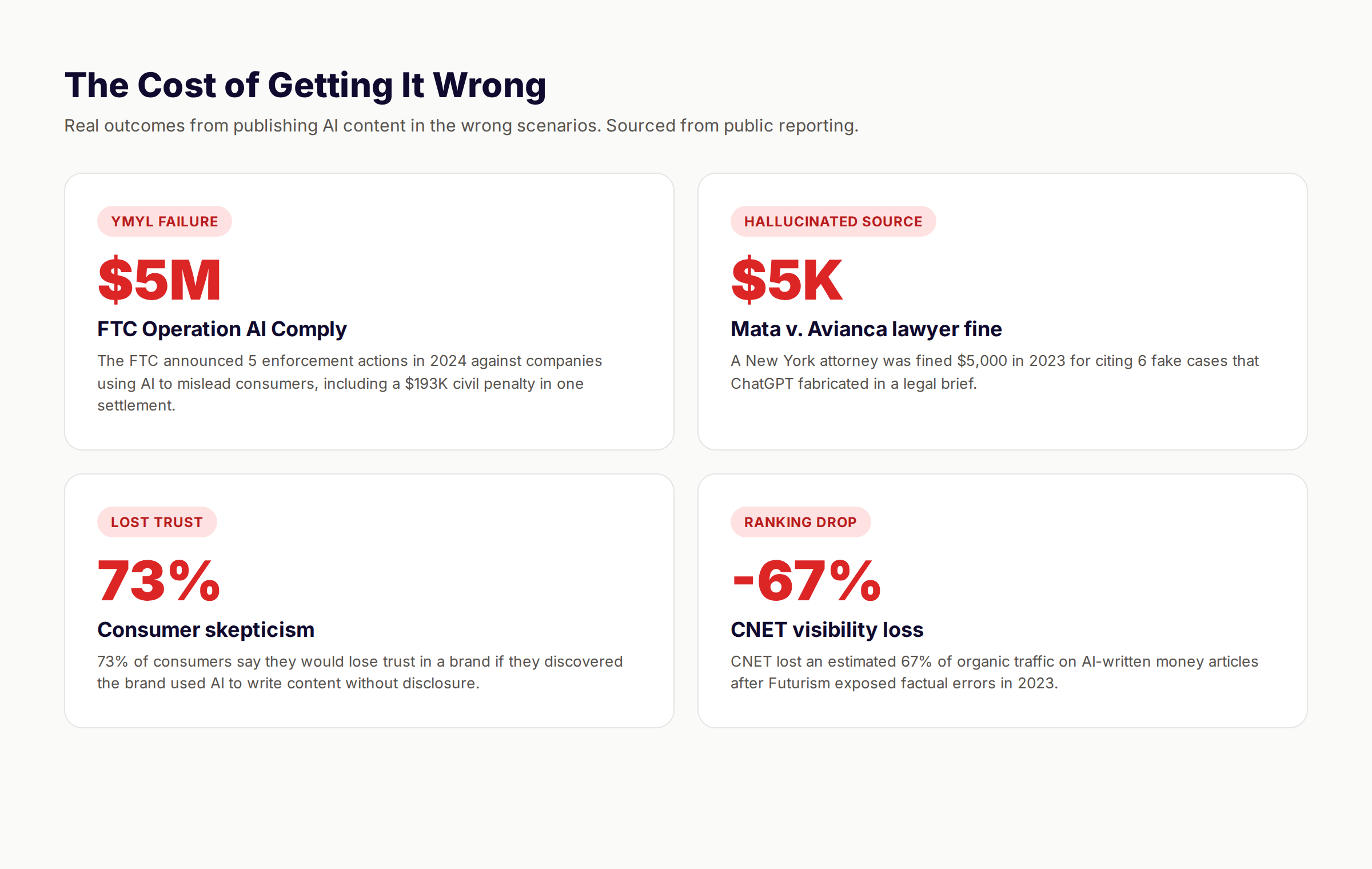
The 4 numbers above are not edge cases. They are the dominant pattern. Brands that publish AI content in the wrong scenarios are paying for the mistake in 4 categories.
Financial Penalties
The FTC announced 5 enforcement actions in 2024 under Operation AI Comply, including a $193K civil penalty against a company using AI to generate fake reviews. The EU AI Act took effect in 2024 with transparency obligations that carry fines of up to €15 million for noncompliance. State attorneys general in Texas, California, and New York opened parallel investigations in 2025.
Lost Rankings
Google's helpful content system suppressed thousands of AI-heavy sites in the August 2024 and November 2024 updates. CNET lost an estimated 67% of organic traffic on its AI-written money articles after Futurism documented factual errors. HouseFresh published a detailed case study showing how aggregator sites running unedited AI lost SERP positions to specialist outlets.
Brand Trust Erosion
Consumer trust collapses fast when readers detect undisclosed AI. A 2024 Forrester study found 73% of consumers say they would lose trust in a brand that used AI to write content without disclosing it. The cost is not the AI use. The cost is the failure to disclose it in a scenario where disclosure is expected.
Legal Exposure
The 2023 case of Mata v. Avianca ended with the attorney paying a $5,000 sanction and his firm being sanctioned for citing 6 fabricated cases that ChatGPT had hallucinated. Subsequent cases have ranged from disciplinary action against attorneys in Colorado, Texas, and Massachusetts to malpractice claims against firms that published AI-generated legal content for client consumption.
These outcomes share a pattern. The model did not malfunction. The brief was wrong for AI. Skipping the scenario test is the costliest shortcut in the content stack.
The Decision Framework: AI, Human, or Hybrid
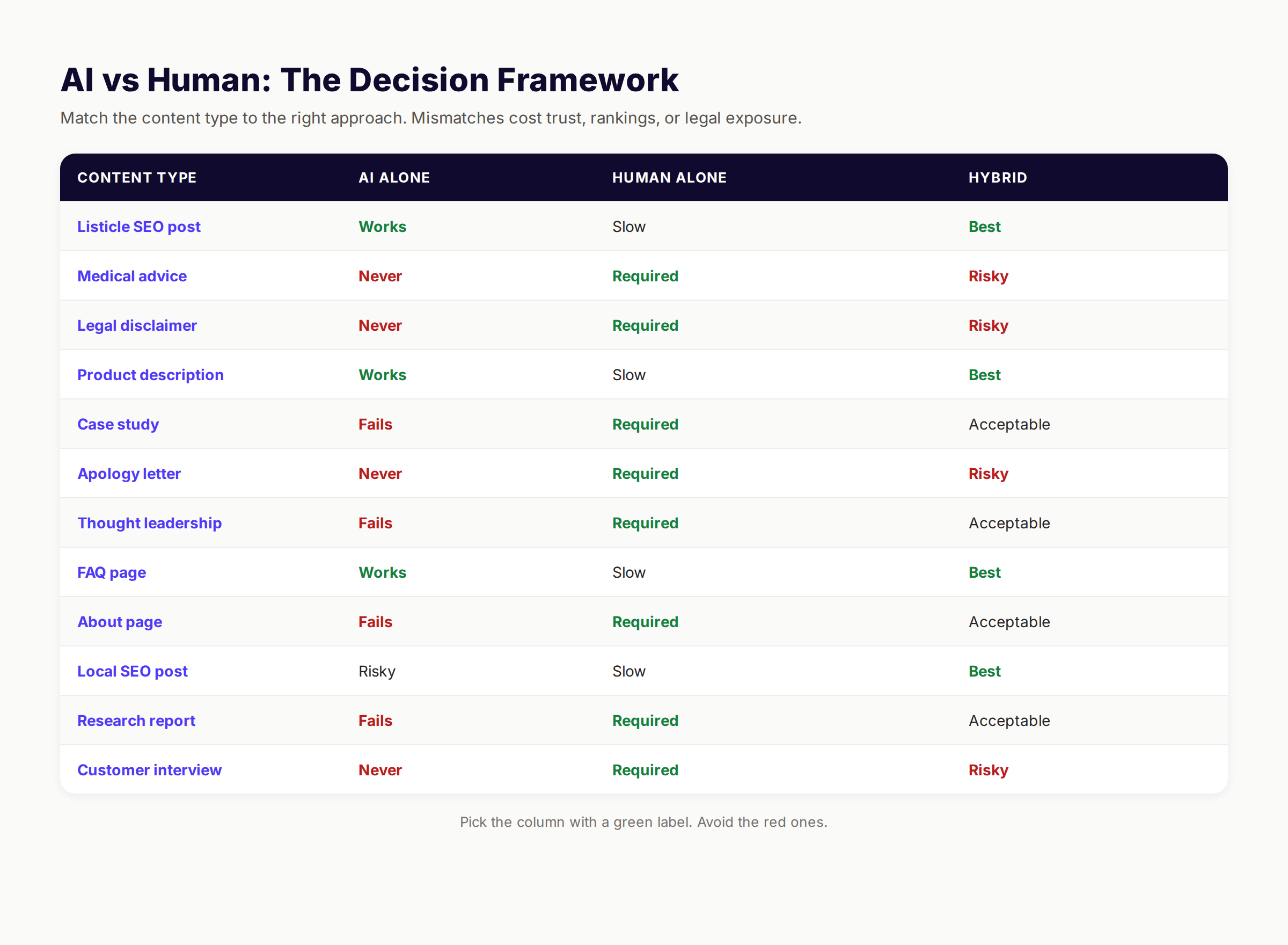
The table above is the working version of the framework. Below is the longer explanation for the cases that are not obvious.
The 3-Question Triage
Before any content brief becomes a draft, run 3 questions.
Question 1: Would a regulator review this page? If yes, route to Tier 1. No AI. If no, continue.
Question 2: Could a reader be harmed by an error on this page? Harm includes physical, financial, legal, or emotional harm. If yes, route to Tier 1 or Tier 2. If no, continue.
Question 3: Does the value come from a specific human voice, dataset, or experience? If yes, route to Tier 2 or Tier 3. If no, the brief is safe for Tier 4 or Tier 5.
This triage takes 90 seconds per brief. Most teams skip it and route everything to Tier 4 by default. The triage is the highest-impact editorial control in an AI-enabled content program.
Examples Run Through the Triage
| Brief | Q1 | Q2 | Q3 | Tier |
|---|---|---|---|---|
| Glossary entry for "schema markup" | No | No | No | Tier 4 |
| FDA-cleared device usage instructions | Yes | Yes | Yes | Tier 1 |
| 2026 SEO trends predictions from our CEO | No | No | Yes | Tier 2 |
| Customer case study with named buyer | No | No | Yes | Tier 3 |
| 50-page glossary for ecommerce platform | No | No | No | Tier 5 |
| Apology for a billing system outage | No | Yes | Yes | Tier 1 |
| Local guide to dentists in Austin | No | No | Yes | Tier 3 |
| Product comparison page | No | No | No | Tier 4 |
| Investor pitch deck for Series B | No | Yes | Yes | Tier 1 |
| Holiday social media captions | No | No | No | Tier 5 |
When the Triage Returns a Hard Case
Some briefs do not classify cleanly. A "best practices" guide for HVAC installers is partly YMYL (worker safety) and partly evergreen SEO. A pricing page is partly sales copy and partly evergreen SEO. The rule for hard cases is to upgrade by 1 tier. If the brief might be Tier 4, treat it as Tier 3. The cost of an upgrade is a slightly longer edit pass. The cost of a downgrade is the content failures listed earlier.
The Hybrid Workflow That Wins for Everything Else
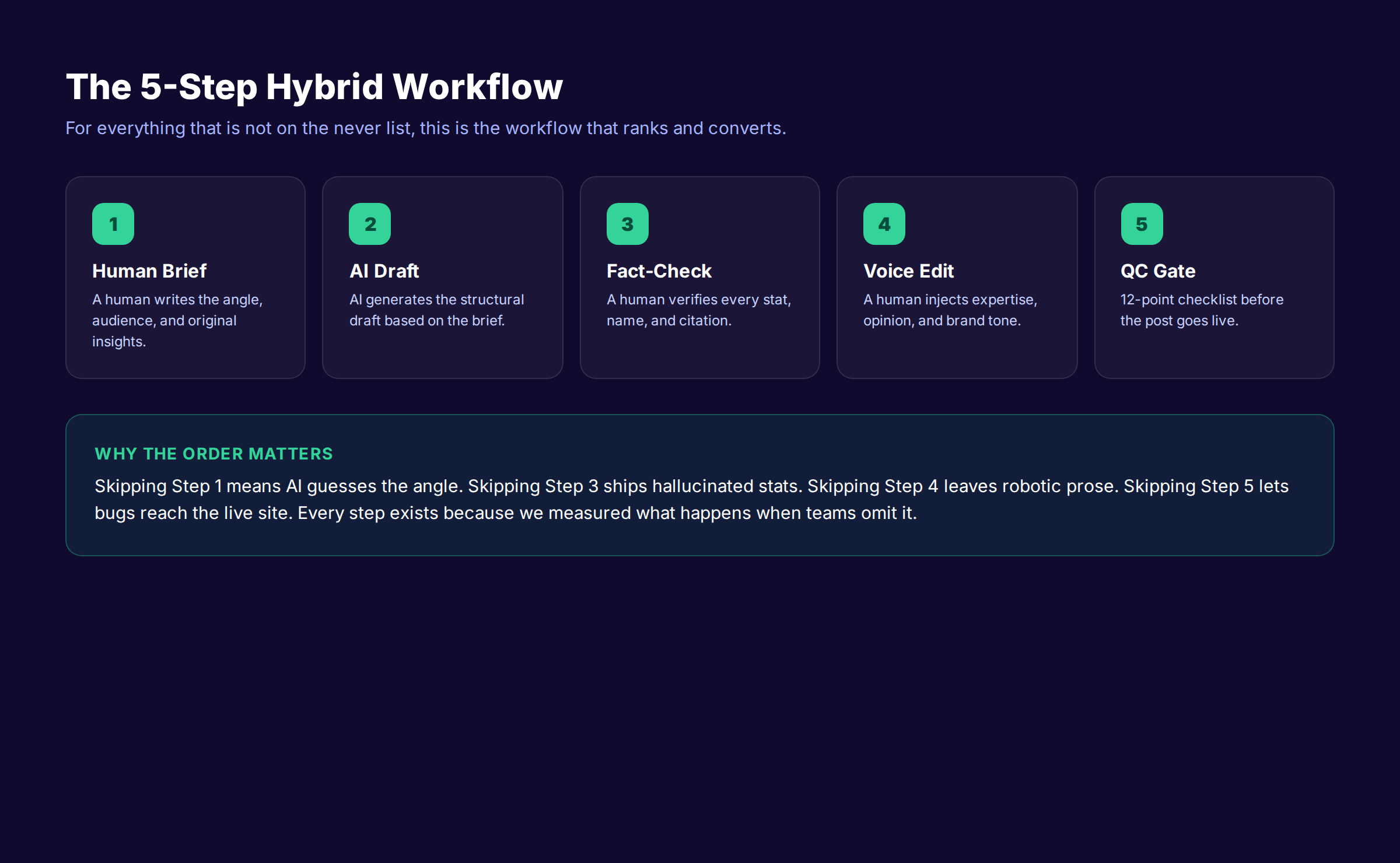
For the 70%+ of content that is not on the never list, the hybrid workflow is the dominant approach. Hybrid content outperforms pure AI on every quality dimension and takes about 40% less time than pure human work.
Step 1: Human Brief
A human writes the angle, the audience, the keyword, the primary call to action, and the original insights the post must include. The brief should be specific enough that 2 different writers could not produce wildly different drafts.
A bad brief reads: "Write a 1,500-word post about content marketing." A good brief reads: "Write a 1,800-word post for SaaS marketing leads at companies between $5M and $50M ARR. Angle: most content marketing dashboards measure the wrong things. Original insight: when we audited 12 dashboards last quarter, 10 of them ignored assisted conversions. Target keyword: 'content marketing dashboard.' Internal links: /blog/content-roi, /blog/marketing-attribution. CTA: book a demo of our analytics tool."
Step 2: AI Draft
With a strong brief, the AI draft takes 5 to 10 minutes. The output is structurally sound, on topic, and 60% to 70% of the way to publishable. The draft is a starting point, not a finished post.
Step 3: Fact-Check
A human reads every claim. Stats, names, dates, percentages, and citations all get verified against primary sources. This step takes 10 to 20 minutes for a 1,500-word post and is non-negotiable. Models hallucinate most confidently on numbers.
Step 4: Voice Edit
A human strips AI fingerprints, injects brand voice, and adds the operational details only an operator could write. This is where the post becomes ranked-worthy and worth reading. The 8-step AI editing system covers this pass in detail.
Step 5: QC Gate
A 12-point pre-publish checklist runs before the post goes live. The checklist covers SEO basics, internal linking, alt text, schema markup, brand disclosures, and the AI use disclosure if required. Skip the QC gate and bugs reach the live site.
The Edit-to-Draft Ratio Tells You If the System Works
Track the ratio of editing time to drafting time. A healthy hybrid workflow runs at 1:4 to 1:6. If your team is spending more time editing than drafting, your prompts are weak. If your team is spending almost no time editing, your QC is weak. Tune the ratio over months.
How AI Disclosure Rules Have Changed
The disclosure landscape in 2026 is sharper than most teams realize. 3 different jurisdictions and 2 different platforms now have explicit rules.
Google's Position
Google's official position is that AI content is not penalized for being AI. The helpful content guidance is explicit on this point. What Google requires is that the content be helpful, original, and authored with experience. Disclosure is not mandatory for Google. Quality is.
The FTC's Position
The FTC Endorsement Guides require disclosure when AI is used to generate testimonials, reviews, or anything that could mislead a consumer. Operation AI Comply has produced 5 named enforcement actions and several settlements. The fines $193K and scale with deception. Hidden AI in a review or endorsement is the most heavily enforced category.
The EU AI Act
Article 50 of the EU AI Act requires that AI-generated content be machine-readable and clearly disclosed. The transparency obligations took effect in 2025 with a phase-in through 2026. Fines run up to €15 million or 3% of global revenue. Any brand serving EU customers needs a disclosure plan.
Platform Rules
YouTube and Meta both require creators to disclose AI-generated content in specific categories. LinkedIn surfaces AI-assistance labels on company posts. TikTok labels AI-generated faces and voices. Each platform has its own enforcement mechanism. Track the rules for the platforms where your content lives.
The Default Disclosure Policy
Our default policy is to disclose AI assistance on any post where a human did not write the majority of the prose. The disclosure goes in a 1-sentence editorial note at the bottom of the post. It is unflashy. It is legally protective. It costs nothing in rankings. We recommend every brand adopt it as the default.
The Pre-Publish Checklist
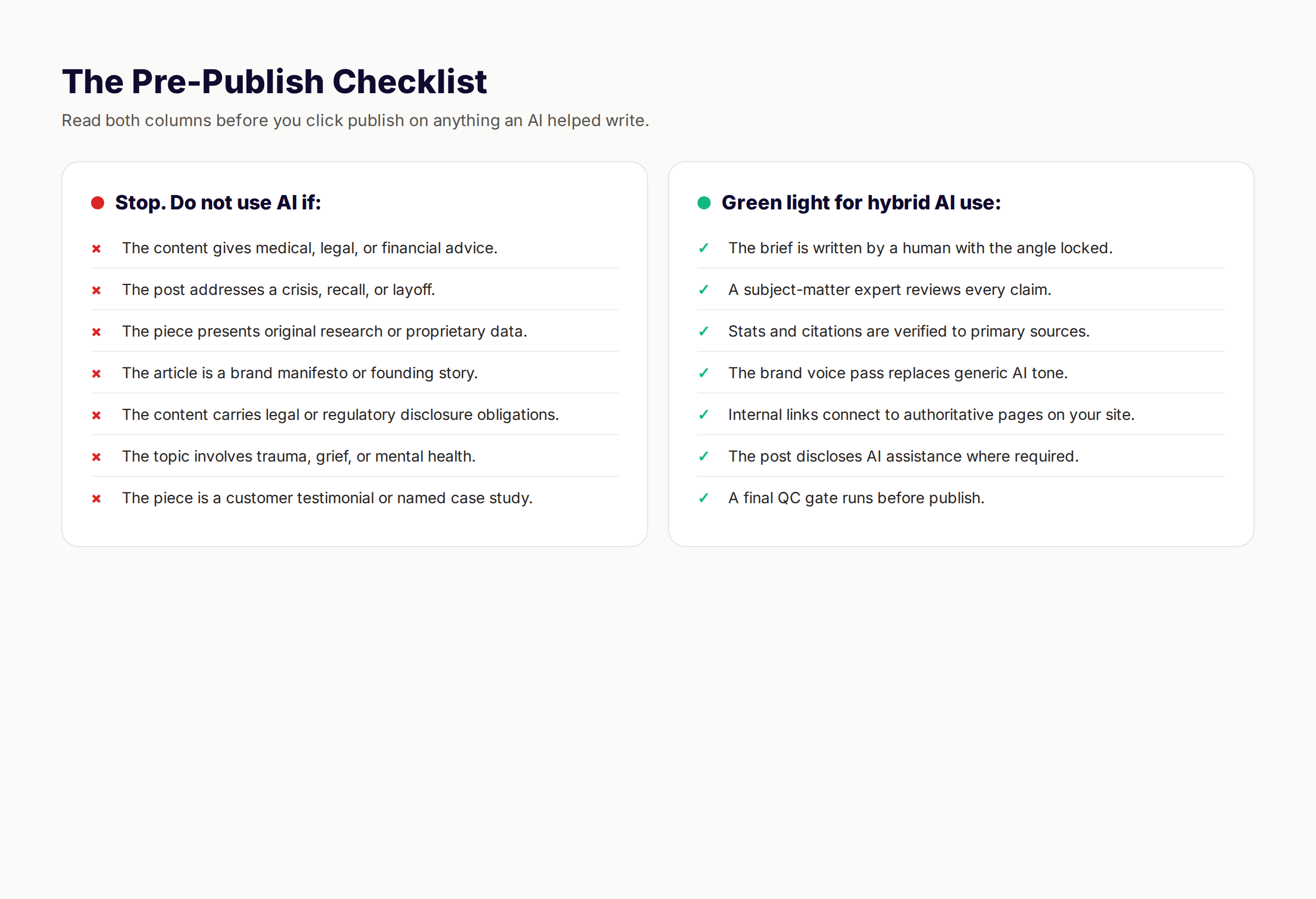
Run this checklist before any AI-assisted post ships to the live site. The checklist exists to catch the brief that should have been classified as Tier 1 or Tier 2 in the first place but slipped through.
Stop Signs (Any Yes Means Block the Post)
- ✓ Does this post give medical, legal, or financial advice?
- ✓ Is this post about a crisis, recall, or layoff?
- ✓ Does this post present original survey or proprietary data?
- ✓ Is this an About page, founding story, or manifesto?
- ✓ Does this post carry regulatory disclosure obligations?
- ✓ Does this post involve grief, addiction, mental health, or trauma?
- ✓ Is this a named customer testimonial or case study?
Green Lights (All Yes Means Proceed)
- ✓ A human wrote the brief with the angle locked in advance
- ✓ A subject-matter expert reviewed every factual claim
- ✓ Every stat and citation has been verified to a primary source
- ✓ The brand voice pass has stripped AI fingerprints
- ✓ Internal links connect to authoritative pages on your site
- ✓ The post discloses AI assistance where required by law or policy
- ✓ A final QC gate has run before publishing
A brief that fails the stop signs goes back to a human writer. A brief that passes the stop signs but fails the green lights goes back to the editor. Only briefs that clear both pass to publish.
How We Apply This at theStacc
We publish 3,500+ blog posts per month across 70+ industries. The classifier runs on every brief before any AI prompt is generated. Around 88% of briefs route to Tier 4 hybrid. Around 7% route to Tier 5 light QC. The remaining 5% route to Tier 1 through Tier 3 and stay with named human writers.
The classifier is not optional. It is the first step in our AI content workflow for every customer. Skipping it would let YMYL briefs, crisis briefs, or research briefs slip into the hybrid pipeline and the failure modes from earlier in this guide would compound across thousands of posts.
For Tier 4 work, our pipeline runs the 5-step hybrid workflow. A human writes the brief. The model drafts. A human edits with the 8-step editing system. The QC gate runs. The post publishes. The edit-to-draft ratio holds at roughly 1:4 across the catalog.
We do not handle Tier 1 work directly. When a customer needs medical, legal, or financial content, we either route them to a credentialed partner or coach them to keep that content in-house with a named expert. The hybrid pipeline is the wrong tool for that job and we say so on the call.
Ship 30 SEO posts per month, every post run through the classifier and edited by a human. theStacc handles the briefs, the drafts, the fact-check, the voice edit, and the publishing. You handle the strategy.
Common Mistakes Teams Make With This Framework
Even teams that adopt the classifier get the application wrong in 6 predictable ways. Each mistake costs trust, rankings, or both.
Mistake 1: Routing By Topic Instead of By Risk
A "personal finance" topic is not automatically Tier 1. A glossary entry defining "compound interest" is Tier 4. A specific advice piece on which 401k allocation to choose is Tier 1. Route by the risk the page creates, not by the topic label.
Mistake 2: Treating the Disclosure as the Whole Compliance Plan
Adding a 1-line AI disclosure does not make a YMYL post safe. Disclosure is the transparency requirement. The harm requirement is unchanged. A disclosed AI-written medical post is still a medical post that was not written by a clinician. Disclosure is necessary, not sufficient.
Mistake 3: Letting Volume Targets Override the Classifier
The cheapest way to miss the 30-post-per-month target is to skip the classifier. The most expensive way is to skip the classifier. The first costs you posts. The second costs you the program. Hold the line on classification even when the queue is full.
Mistake 4: Pretending Tier 2 Work is Tier 4 Work
Thought leadership briefed by the AI tool will read like averaged thought leadership. The brand pays a slow tax. The executive's byline becomes associated with bland takes. Months later the team wonders why the LinkedIn engagement collapsed. Tier 2 work needs a human drafter. There are no shortcuts.
Mistake 5: Skipping the QC Gate Because the Draft Looks Clean
A clean draft is the most dangerous draft. The errors are buried in plausible sentences. The QC gate exists to catch them. Run the gate every time, even when the draft feels finished.
Mistake 6: Forgetting That the Rules Update Quarterly
The FTC, the EU AI Act regulators, and Google all evolve their guidance. A policy that was compliant in 2024 may not be compliant in 2026. Schedule a quarterly review of the disclosure rules, the regulator actions, and the platform policies. Update the classifier as the rules change.
What practitioners are saying on X
AI search advice ages quickly. Here is high-signal public discussion from SEO and growth operators — context for your roadmap, not a substitute for primary data.
- @jakezward (Feb 2026): 2026 SEO predictions emphasize AI Overview share-of-SERP, schema for LLM token efficiency, brand mentions in AI answers as a KPI, proprietary data as a moat, and content refresh beating net-new AI slop. See the post on X.
- @alexgroberman (Jul 2026): Case narrative: organic value plus multi-engine citations (ChatGPT, Perplexity, Grok) from knowledge-hub pages, category authority links, commercial intent content, and tight internal linking — not thin product copy. See the post on X.
- @varunram (Jul 2026): Critique of GEO slopfarm products that combine SEO clickbait with unresearched content marketing — quality and research still separate winners from farms. See the post on X.
Grok, AI Overviews, and multi-engine visibility
AI/search topics like “when not use ai content” need multi-engine notes: AI Overviews, ChatGPT/Perplexity, and Grok. Lead with extractable answers; keep claims consistent with public expert discussion.
- Google AI Overviews: Use passage-ready answers, tables, and FAQ schema where relevant.
- ChatGPT / Perplexity: Cite named sources next to key claims.
- Grok: Maintain accurate entity facts on-site and in high-signal X posts.
Publish content built for Google and AI citations. theStacc’s Content SEO module ships SEO-scored articles structured for rankings and generative engines — including clearer entity pages models like Grok can quote.
Frequently Asked Questions
Avoid AI for any content that gives medical, legal, or financial advice, addresses a crisis, presents original research, voices a brand manifesto, names a customer in a case study, falls under regulated industry rules, conducts investigative reporting, handles sensitive trauma topics, depends on hyper-local knowledge, covers real-time news, or carries high-stakes commercial commitments. Use AI as a hybrid assistant for everything else.
Google does not penalize AI content for being AI. Google's helpful content guidance is explicit that AI use is permitted when the content is helpful, original, and authored with experience. Google does penalize unhelpful content, regardless of whether a human or AI wrote it. The dividing line is quality, not authorship.
In some jurisdictions, yes. The EU AI Act requires disclosure of AI-generated content for brands serving EU customers. The FTC requires disclosure when AI is used in testimonials, endorsements, or anything that could mislead a consumer. Google does not require disclosure but rewards transparency. Our default policy is to disclose AI assistance with a 1-line editorial note on every hybrid post.
No. Thought leadership requires an opinion that diverges from the average of the field. AI averages across its training data and produces the most likely next sentence. The mechanism is the opposite of what thought leadership demands. A named executive or expert must own the angle. AI can help with structure but cannot generate the opinion.
Glossary entries, comparison pages, evergreen SEO guides, FAQ pages, product descriptions, social captions, metadata, alt text, and bulk content with high QC review are safe. The common pattern is low harm, low originality requirement, and clear factual scaffolding. These map to Tier 4 and Tier 5 in the risk pyramid.
Run every stat, name, date, percentage, and citation against a primary source. Open a fresh browser tab for each claim. Discard any source the model invented. Replace fabricated stats with verified ones from named studies. The fact-check pass takes 10 to 20 minutes per 1,500-word post and is the single most important step in the editing workflow.
Yes. Google ranks well-edited hybrid AI content the same as well-edited human content. Research from Rankability confirmed that hybrid content can match human-only content in the top 10. The condition is that the content remains helpful, original, and authored with experience. The 5-step hybrid workflow above meets that standard.
The cost ranges from $5,000 attorney sanctions for fabricated citations to $193K civil penalties in FTC enforcement actions to 67% organic traffic losses when factual errors are exposed. EU AI Act fines run up to €15 million for transparency violations. The financial penalty is paired with brand trust erosion that takes years to rebuild. The cost of getting it wrong is always higher than the cost of getting it right.
The Bottom Line
AI is a force multiplier when applied to the right content types. It is a liability when applied to the wrong content types. The 12 scenarios in this guide are the ones where even careful editing cannot rescue the post. Classify the brief first. Pick the workflow second. Open the AI tool third.
The teams that win with AI content over the next 3 years will be the ones with the strongest classifier, the cleanest hybrid workflow, and the discipline to leave Tier 1 work to humans. Volume is solved. Judgment is the new moat.
If you want the classifier, the workflow, and the editing system applied to your content program without building it internally, our content SEO module ships 30 to 80 hybrid posts per month at $99 to $199. Every post passes through the framework you just read. Every post is edited by a human. Every fact is verified.
See 3 days of fully edited posts in your queue
This article was researched and published by theStacc. We use the classifier and the workflow described above on every customer's content. All regulatory citations and case examples were verified against public sources as of May 2026. This guide was drafted with AI assistance and edited by a human editor under our Tier 4 hybrid workflow, in line with our default disclosure policy.
Related Reading
- How to Edit AI Content for Quality (8-Step System)
- AI Content Workflows That Actually Scale
- Does AI Content Rank on Google?
- Humanize AI Content (Without Killing Speed)
- Google's AI Content Policy Explained
Related Tools & Resources
Free SEO Tools:
Best Lists:
Sources & references
- [1] Princeton / Georgia Tech et al. — GEO research (arXiv:2311.09735)
- [2] @jakezward on X — 2026 SEO predictions emphasize AI Overview share-of-SERP, schema for LLM token efficiency, brand mentions in AI answers
- [3] @alexgroberman on X — Case narrative: organic value plus multi-engine citations (ChatGPT, Perplexity, Grok) from knowledge-hub pages, category
- [4] @varunram on X — Critique of GEO slopfarm products that combine SEO clickbait with unresearched content marketing — quality and research
- [5] Referenced source — www.courtlistener.com

Researched, written, and published articles that compound organic traffic.
Weekly local SEO teardowns
One practical email a week. Map Pack, GBP, AI Overviews — no fluff. Unsubscribe anytime.