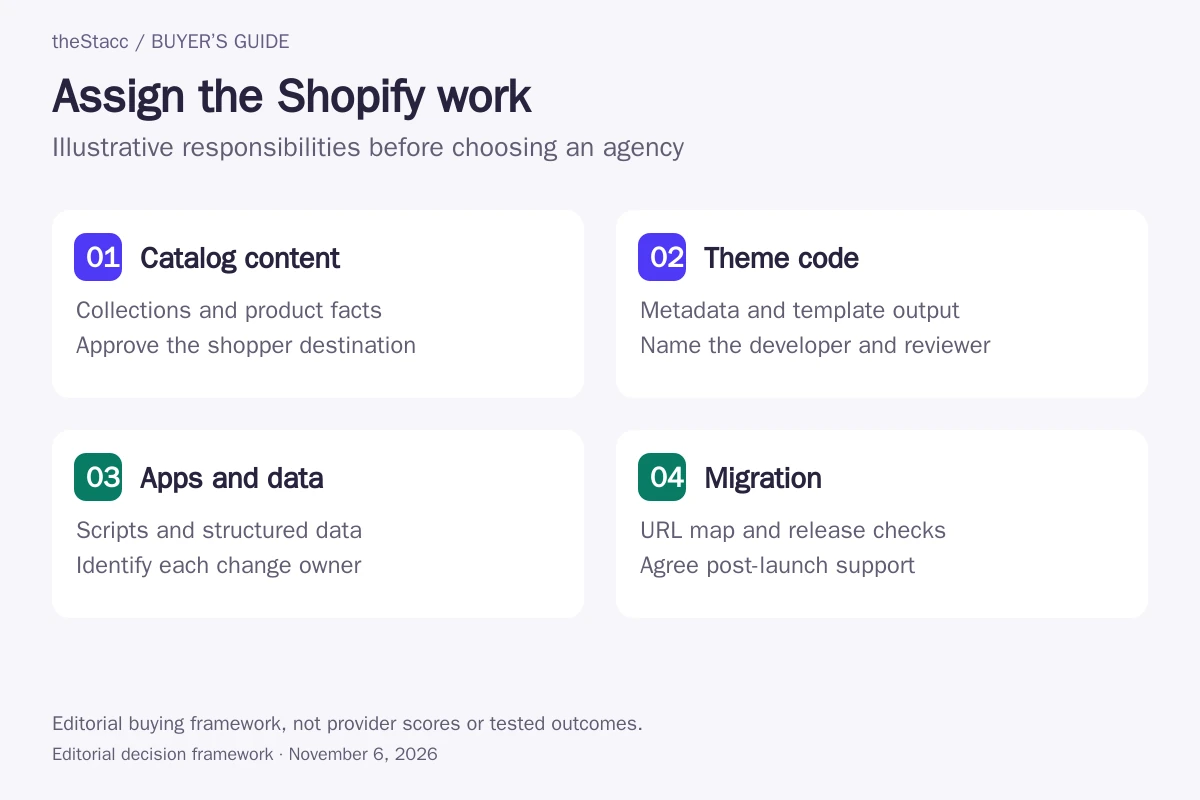
Start with the Shopify work your store needs
The useful question is whether an agency can carry a finding through to a checked change on your storefront. A collection-copy brief needs product knowledge and publishing access. A theme defect needs someone who can change and review the code. An app conflict needs a clear owner across vendors. A migration needs a separate launch plan.
| Workstream | Merchant input | Evidence to request |
|---|---|---|
| Collections and catalog | Real product attributes, category rules and merchandising priorities | A proposed URL and internal-link plan tied to useful shopper needs |
| Theme implementation | Current theme, customizations and existing developer | Who edits, reviews, publishes and rolls back theme changes |
| Apps and structured data | Installed apps and their owners | A check of the storefront output and responsibility for conflicts |
| Plus or migration | Markets, B2B requirements, integrations and launch constraints | A separately scoped technical plan and acceptance checklist |
This guide is about Shopify implementation. For the wider commercial scope of a retainer, see ecommerce SEO packages. To compare agency types across platforms, use SEO agencies for ecommerce.
Compare Shopify responsibilities before the retainer
| Option | Documented scope and Shopify fit | Published buying terms or quote requirement |
|---|---|---|
| theStacc | General managed website, content, local and social service; Shopify publishing beta | Growth Complete: US$1,299/month; three-month minimum |
| Searchbloom | Shopify SEO audits, collection/product content, technical SEO and internal links | Custom price based on monthly work volume |
| Coalition Technologies | Shopify technical fixes, schema, copy, links and wider marketing integrations | Quoted from monthly work-order volume |
| Netalico Commerce | Shopify technical SEO with engineering, theme/app work and migration support | Advertised SEO retainer: $2,700–$10,000/month; confirm currency and scope |
| OuterBox | Shopify collections, filters, Liquid templates, apps, schema and analytics | Request a store-specific proposal; no fixed Shopify fee used here |
| SmartSites | Cross-platform ecommerce SEO with explicit Shopify coverage | Advertised ecommerce plans from $2,600/month for 40 hours; confirm Shopify scope |
| Thrive Internet Marketing | Shopify audits, technical SEO, content, theme work and app integration | No fixed Shopify price verified; page advertises month-to-month services |
| Inflow | Cross-platform ecommerce SEO, content and technical optimization | Custom estimate; explanatory market ranges are not a Shopify quote |
| Ignite Visibility | Broader ecommerce SEO: technical issues, descriptions, links and markup | Request a Shopify-specific proposal; no fixed fee verified |
| Siege Media | Content strategy, creation, digital PR and product-led SEO | Custom scope; no fixed Shopify retainer verified |
| Loopex Digital | Shopify product/collection optimization and platform-specific technical SEO | Request a Shopify proposal; no fixed package fee used here |
| NEWMEDIA | Shopify design/development, app integration, migration and SEO setup | Custom project proposal; recurring SEO scope priced separately in writing |
How this shortlist was researched
theStacc publishes this guide and sells software and managed services; its own offering is included. This comparison uses official-source research and automated editorial assistance. We did not hire these agencies, test their stores or verify client outcomes. Numbering preserves the existing list, not a quality ranking. No Shopify Partner credential is asserted here.
Options are grouped by useful fit rather than scored from first to last. Each profile links to its source. Confirm the selected plan or proposal before buying. See our editorial standards.
Twelve retained options and their implementation limits
1. theStacc
Good fit: A defined content and publishing brief with separate Shopify technical ownership
The current pricing page describes Growth Complete as a managed website, content, local and social service. It lists US$1,299 per month with a three-month minimum and identifies Shopify publishing as beta. A free software account does not start the managed service.
Confirm the supported Shopify destination and fields before using it for store content. The pricing page does not establish that collection-page production, Liquid changes, app remediation or migration delivery is included. Keep those jobs in a separately agreed scope.
Before you buy: Can you demonstrate the proposed Shopify publishing workflow and approval process on an appropriate test destination? Which content types are supported, and who owns theme code, catalog data and rollback?
2. Searchbloom
Good fit: A merchant seeking collection and product SEO alongside a technical work plan
Searchbloom’s Shopify page lists audits, keyword research, collection and product optimization, content creation, link building and technical SEO. It also describes site architecture and performance work. Pricing depends on the desired monthly work volume.
Ask the team to divide its recommendations into admin edits, theme changes and app-related tasks. The page provides a platform-specific starting point; your agreement should name the people who implement and accept each change.
Before you buy: Will you edit the current theme, coordinate with our developer or only supply tickets? Ask for included implementation capacity, collection priorities, reporting access and current cancellation terms.
3. Coalition Technologies
Good fit: A store comparing SEO with coordinated website and marketing work
Coalition’s Shopify service page names technical fixes, schema implementation, search-focused copy and link building. It also describes category/product pages and marketing app integrations. The page says a strategist supplies a quote based on monthly work-order volume.
Use that breadth to request a concrete work order, not an assumption that every listed service comes with the SEO fee. A theme release and an email app setup need different acceptance criteria and permissions.
Before you buy: Which developer handles Liquid and template changes? Identify the app integrations actually included, the schema owner and the release approval process before comparing the quote.
Coalition Technologies: official offering and current details
4. Netalico Commerce
Good fit: A merchant whose priority is implementing technical findings in the storefront
Netalico’s Shopify SEO page describes technical auditing and implementation by the same team. Listed work includes canonicals, faceted navigation, structured data, speed, collection/product optimization and migration planning. The page advertises SEO within monthly retainers of $2,700–$10,000.
This is a relevant starting point when the backlog includes code and app changes. Request the allocation between investigation, engineering and ongoing content; a retainer range does not tell you how much work your store receives.
Before you buy: Who owns the theme branch, review and release? Ask for representative acceptance checks, available engineering time and a separate scope for any replatform or rebuild.
5. OuterBox
Good fit: A catalog that needs SEO and development priorities planned together
OuterBox’s Shopify page explicitly covers collection architecture, product and variant pages, filters, apps, Liquid templates, structured data, internal links and reporting. It also discusses Shopify Plus, Markets and headless storefront requirements.
Its described scope fits a discussion about how merchandising rules become technical requirements. Use your actual catalog and storefront architecture to establish which services are included rather than buying the full list on implication.
Before you buy: Which filtered combinations should become useful landing pages, and which should remain navigation? Ask who implements the decision, tests current canonicals and validates collection links after theme updates.
6. SmartSites
Good fit: A merchant comparing an hourly scope for catalog, technical and content work
SmartSites’ ecommerce page includes Shopify among the platforms it serves. It describes product/category optimization, technical work and product-feed support. The current page advertises plans starting at $2,600 a month for 40 hours of SEO work and a written proposal after consultation.
The published starting point is for ecommerce SEO, not a fixed Shopify development package. Ask how hours are allocated and whether theme engineering, feed remediation and content production draw from the same allowance.
Before you buy: Who handles a theme or app defect discovered by the SEO team? Confirm the hourly allowance, reporting detail, overage approval and whether a separate development contract is needed.
7. Thrive Internet Marketing
Good fit: A merchant seeking SEO with adjacent website and app support
Thrive’s Shopify page lists audits, keyword research, technical SEO, content writing, web design and app integration. It describes month-to-month services, but the reviewed page does not supply a fixed Shopify fee.
Separate the SEO work from optional paid media, design and other channels in the proposal. Broad website capabilities do not identify which developer is available for your current theme or how quickly a specific issue can be resolved.
Before you buy: Ask for the Shopify work order, access requirements, implementation owner, notice period and excluded app or media costs. Have the team explain how proposed changes are checked before release.
Thrive Internet Marketing: official offering and current details
8. Inflow
Good fit: An ecommerce team that wants search priorities aligned with existing developers
Inflow’s ecommerce service page describes technical SEO, content marketing and link building, with support across ecommerce platforms. It directs buyers to request a custom estimate. Its explanatory pricing ranges are not treated here as a fixed Shopify package.
Confirm the Shopify implementation arrangement during scoping. A useful technical roadmap needs an owner for Liquid, app configuration and collection changes, whether that owner is Inflow or your existing development team.
Before you buy: Which findings will your team implement, and which become tickets for us? Request an example handoff with acceptance criteria and an agreed process for checking completed changes.
9. Ignite Visibility
Good fit: A retailer considering ecommerce SEO within a wider marketing relationship
Ignite Visibility’s official service overview describes ecommerce SEO work on technical issues, product descriptions, internal links and structured markup. This supports a broader ecommerce scope; it does not by itself establish a Shopify theme-engineering allocation.
Keep the platform requirement explicit. Ask which Shopify services are delivered internally, which require your developer and which sit outside the SEO engagement.
Before you buy: Can the proposed team show how it would investigate a collection, a filtered URL and an app-generated schema conflict? Confirm deliverables, implementation ownership, fees and release support.
10. Siege Media
Good fit: A store with a content and editorial need and a defined technical owner
Siege Media’s content-marketing page describes strategy, content creation, digital PR and product-led SEO. Its service description is broader than blog writing, but it is not a published Shopify theme maintenance package.
Use it to discuss buying guides, product education and editorial gaps while separately checking catalog and technical responsibilities. Do not assume the content engagement includes app debugging or migration execution.
Before you buy: Who approves product facts, supplies imagery and publishes each asset? Ask how content links into collections and what developer support is included when the proposed format needs theme work.
11. Loopex Digital
Good fit: A store comparing Shopify collection strategy with technical remediation
Loopex’s Shopify service page names product and collection optimization, Shopify-specific technical fixes and a custom strategy. It discusses duplicate URL handling, theme performance and app-related issues as part of the Shopify brief.
Ask how recommendations become code and configuration changes. A technical issue mentioned on a service page still needs a named implementer and an acceptance test in your agreement.
Before you buy: Will your team modify the theme or work through our developer? Request included implementation hours, the collection prioritization method and a current quote specific to this store.
12. NEWMEDIA
Good fit: A merchant evaluating a store project with explicit SEO handoffs
NEWMEDIA’s Shopify service page describes store setup, custom themes, app integration, migration, performance optimization, structured data and maintenance. It invites a project proposal rather than publishing a fixed fee.
A development project and ongoing SEO are different buying decisions. Require the proposal to connect launch checks with post-launch ownership, including what continues after the initial site work ends.
Before you buy: Who prepares URL mapping and validates the new storefront? Ask which ongoing collection, product and technical tasks are covered after launch, and how support and change requests are charged.
Require technical acceptance checks, not a finished audit alone
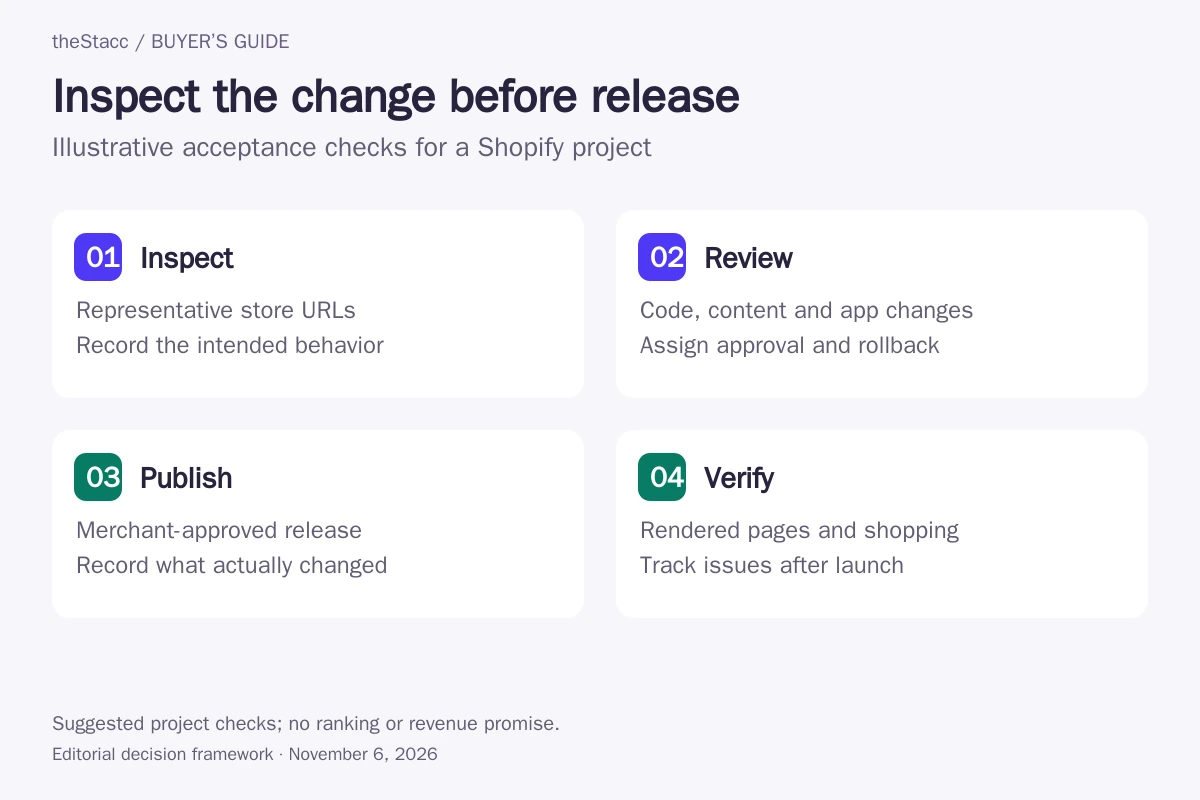
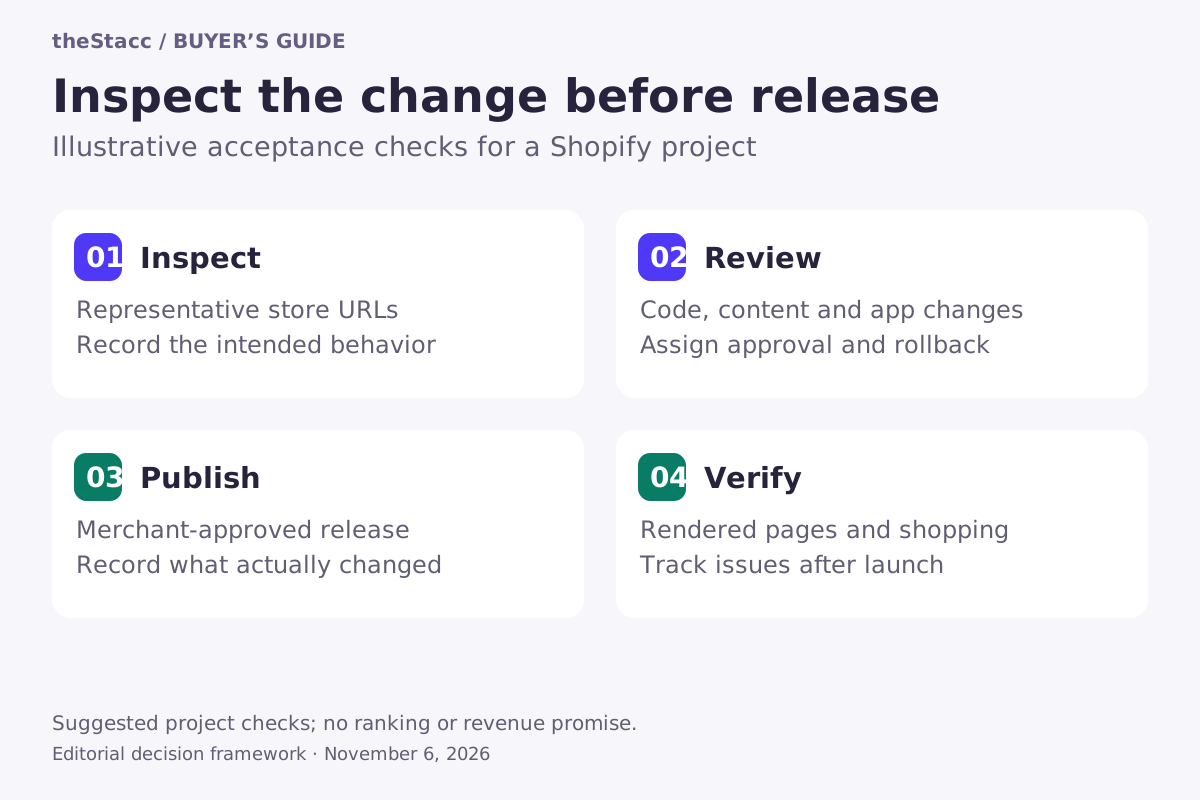
Ask each supplier to walk through a representative product, collection and filtered URL from your store. Agree the intended behavior before any change is approved. The following checks are an editorial procurement framework, not a claim that every Shopify store has these faults.
Themes: inspect the output as well as the admin fields
Shopify’s developer documentation places the title, description and canonical URL in theme metadata. The admin value and the rendered page should agree. Ask the implementer to identify where the current theme outputs these elements and how an update will preserve them. Keep a reviewed change and rollback path for code work. Shopify: theme SEO metadata.
Collections and faceted URLs: decide which pages deserve a search destination
Shopify’s storefront filtering documentation describes filter parameters in collection and search URLs. Have the agency inventory the combinations your store exposes, then distinguish a useful collection destination from a temporary shopping filter. Ask for the intended canonical, crawl behavior, navigation links and product coverage for representative cases. A blanket promise to index every filter, or block every parameter, skips the actual merchandising decision. Shopify: storefront filtering.
Apps: assign the fix to the person who controls it
Shopify identifies apps, third-party libraries, theme code and media among the factors that influence storefront performance. Ask for an app inventory and a proposal that ties each suspected issue to an owner. Retest the affected shopping function after a change. A laboratory score alone does not show how customers experience all pages, and removing an app can remove a feature the business needs. Shopify: web performance overview.
Structured data: check the combined theme and app output
Shopify Theme Store requirements include product rich snippets. That is a starting requirement, not proof that a customized store’s current markup is accurate. Ask who checks the actual product data after theme and app changes, including price, availability and any review fields. For multi-currency stores, Shopify’s developer guidance says structured-data currency should reflect the cart currency. Test the intended market and product state rather than accepting the presence of a JSON-LD script as completion. Shopify: Theme Store requirements; Shopify: multiple currencies and languages.
Make the Shopify Plus brief specific
Ask what Plus changes in your operation. Shopify’s current plan documentation describes additional B2B capabilities and checkout customization options. Those features create implementation questions; they do not establish that an agency’s standard SEO fee covers them. Supply your public versus gated catalog requirements, markets, currencies, integrations and internal engineering responsibilities. Shopify: Plus plan features.
Require a scope for each relevant storefront. A conventional Online Store theme and a headless storefront should not receive an identical implementation promise. Ask who owns routing, metadata, product data and deployment in the architecture you actually run. If an agency cites a Shopify credential in its proposal, verify its current official directory listing or official agency disclosure and record the date; a badge does not specify what your contract includes.
Treat migration as a release project
Shopify’s migration guidance explains that individual page URLs can differ from the old platform and recommends setting up redirects before the domain transfer. Ask for an old-to-new URL inventory, agreed destinations and a check of the result, rather than a promise that traffic cannot change. Shopify: migrating a store.
| Stage | Deliverable | Owner to name |
|---|---|---|
| Before launch | URL map, content inventory, important templates and integration list | Merchant approver and SEO lead |
| Implementation | Redirect configuration, content transfer and reviewed theme changes | Developer or migration implementer |
| Acceptance | Representative URL, metadata, product and shopping-flow checks | Named reviewer with release authority |
| After launch | Broken-link triage, indexing observations and agreed support window | Support owner and merchant contact |
Include rollback and escalation responsibilities. Preserve merchant ownership of the domain, storefront, analytics and source material. A migration proposal should also say what happens when old content has no direct equivalent and who approves that decision.
Compare the cost of implementation, not just the audit
The public prices in this guide buy different services. Netalico advertises an SEO retainer range that includes implementation; SmartSites publishes an ecommerce starting plan based on hours; theStacc’s Growth Complete has a minimum commitment and a broader managed-service scope. None is a standardized Shopify package comparison.
- Separate the initial audit from recurring work and any migration project.
- Name the development capacity included and how extra work is approved.
- Identify app subscriptions, theme licenses and platform fees paid by the merchant.
- Specify whether product data, collection copy, images and translations are supplied or produced.
- Record currency, taxes, minimum term, cancellation notice and end-of-contract access.
Do not convert a provider’s general market-pricing article into its own quote. Request a written scope based on your store. The ecommerce SEO package guide covers broader package comparison; affordable SEO services covers general service-budget tradeoffs.
Keep completed changes separate from search outcomes
Ask for a change log that identifies what shipped, which URLs or templates it affects and how it was checked. Then review search and commercial observations over stated dates. A closed technical ticket is evidence of implementation; it is not evidence of increased orders. A rank movement is not automatically caused by the latest theme change.
Define how reports handle brand versus non-brand searches, product and collection landing pages, returns, cancellations and tracking gaps. Keep Shopify, analytics and Search Console access under the merchant’s control. If the available data cannot connect a visit to an order, state the limitation rather than assigning an invented return to the agency.
Choose a shortlist around the work you need shipped
For a storefront engineering brief, start by comparing the documented Shopify scope of Netalico, OuterBox, Coalition and NEWMEDIA. For ongoing product, collection and technical SEO, compare Searchbloom, SmartSites, Thrive and Loopex with implementation responsibilities made explicit. These are starting groups based on the service pages, not exclusive capabilities or performance rankings.
Inflow and Ignite warrant a platform-specific proposal when broader ecommerce search support is the need. Siege belongs in a content and editorial discussion, with technical ownership agreed separately. theStacc is a publisher-owned managed-service option whose Shopify beta publishing support needs a concrete compatibility check. The right choice depends on the actual contract and your team’s capacity.
Evaluate theStacc against your actual workflow
theStacc publishes this guide and sells software and managed marketing services. Confirm who implements Shopify theme, collection and migration work before choosing a plan. Review the current plans before choosing a paid service.
Start free → to explore the software, or Book a demo → to discuss your requirements.
Shopify SEO agencies: questions answered
What should a Shopify SEO agency be able to implement?
The agreement should distinguish admin content changes, theme code, app configuration and migration work. Ask who implements each category, who approves it and what evidence shows the change works on your storefront. An audit alone does not establish implementation capacity.
How is this different from an ecommerce SEO package?
An ecommerce SEO package describes commercial scope across online stores and platforms. A Shopify agency brief adds platform-specific responsibilities for themes, collections, filter URLs, apps, structured data and migration behavior. Compare the package price only after those responsibilities are clear.
Should every filtered collection URL be indexed?
No blanket rule fits every store. Ask the agency to distinguish useful search landing pages from temporary shopping filters using your catalog and shopper intent. Require a documented plan for representative URLs, including canonical behavior and internal links, before approving changes.
Do Shopify apps replace technical SEO work?
An app can provide a defined function, but its presence does not prove the storefront output is correct. Ask who checks the combined theme and app behavior, who resolves conflicts and how the affected shopping functions are tested after a change.
Do I need a different brief for Shopify Plus?
Include the Plus capabilities your business actually uses, such as relevant B2B or checkout requirements, alongside markets, integrations and engineering ownership. Do not assume those implementation tasks are included in a general SEO retainer.
How much do the listed Shopify SEO agencies cost?
Published terms vary by scope. Netalico advertises SEO retainers of $2,700–$10,000 per month. SmartSites advertises ecommerce plans from $2,600 per month for 40 hours. Other providers require a scoped proposal or do not publish a fixed Shopify fee in the sources reviewed. Confirm currency, taxes, minimum term and included implementation before comparing prices.
Is theStacc a Shopify theme-development service?
The pricing page describes a broader managed service and labels Shopify publishing beta. It does not establish that Liquid changes, collection-page production, app remediation or migrations are included. Confirm supported destinations and fields and agree technical responsibilities separately.
Can an agency guarantee rankings survive a migration?
No ranking outcome is guaranteed. Evaluate the URL map, content transfer, redirect checks, release approval and post-launch support plan. These are controllable responsibilities; rankings, traffic and orders remain outcomes to observe after launch.
Sources and scope of this comparison
Official service, pricing and Shopify documentation pages were checked November 6, 2026. Direct requests to Searchbloom, Coalition Technologies and Thrive were blocked; readable official-page text was retrieved through a separate web tool and archived. Provider scope is an advertised service description, not independently verified delivery. Inflow and Ignite are described from broader ecommerce pages; Siege from its content-marketing service page. Market pricing articles are not treated as provider quotes. Source links appear beside profiles and technical guidance. Recheck pricing, service scope and platform requirements before purchase.