86% of SEO professionals now use AI for keyword research. Discover 7 data-backed trends killing manual methods and reshaping search in 2026.
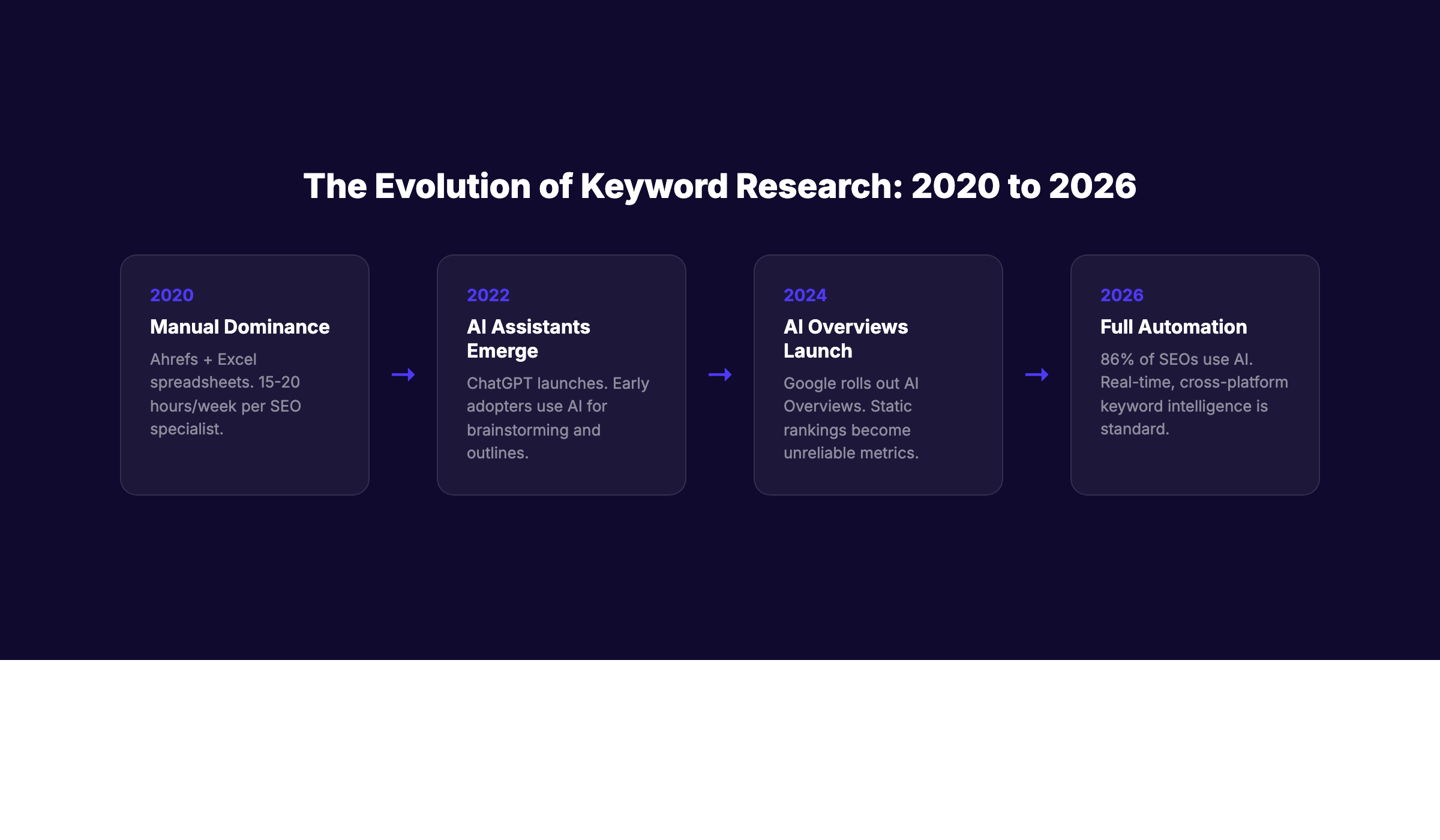
Keyword research used to be a craft. A skilled SEO specialist would spend 15 to 20 hours each week poring over search volume data, competitor rankings, and keyword difficulty scores. They would build lists in spreadsheets, cluster terms by hand, and revise those lists monthly when the data went stale. That world is ending.
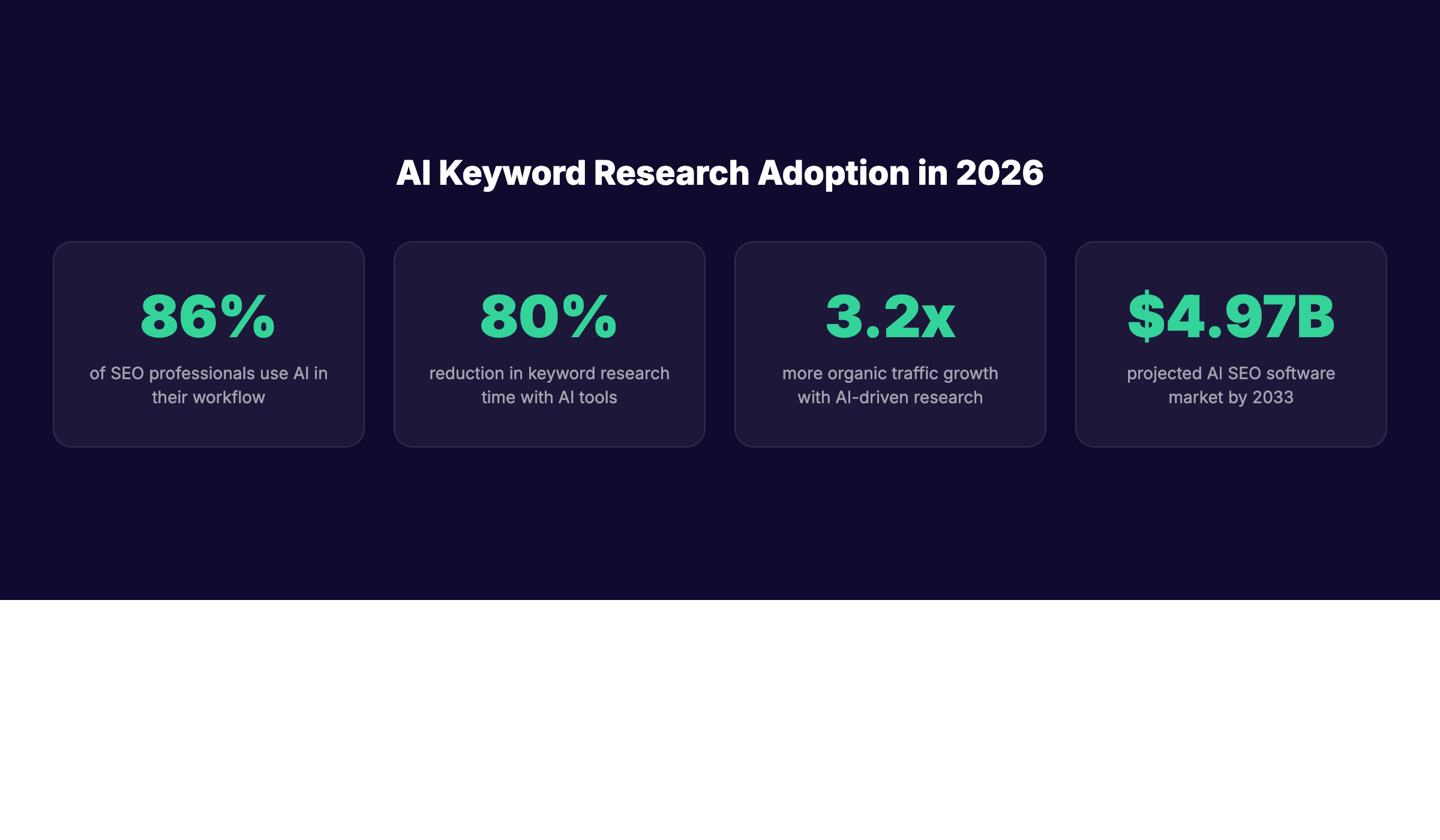
In 2026, 86% of SEO professionals have integrated AI into their workflow, according to DemandSage research. The average enterprise SEO team now uses 4.2 AI tools. Keyword research that once took a full workday now completes in 45 to 60 minutes. The practitioners still doing it manually are not preserving a craft. They are falling behind.
This article identifies the seven trends driving this shift. Each trend is backed by data from 2025 and 2026. Each has practical implications for how you plan, create, and measure content. theStacc builds AI-driven content systems for businesses every day, and the patterns below are what we see across every client engagement.
Here is what the data shows:
| Trend | Key Number | What It Means |
|---|---|---|
| AI adoption hits majority | 86% of SEOs use AI | Manual methods are now the minority approach |
| Research time collapses | 80% reduction | What took 4-6 hours now takes under 1 hour |
| Traffic impact accelerates | 3.2x organic growth | AI-driven research outperforms manual consistently |
| AI search splits the market | 527% traffic growth | New platforms demand new research methods |
| Content output scales | 42% more articles monthly | Teams produce more without adding headcount |
| Zero-click search rises | 58.5% of queries | Ranking position matters less than citation |
| Market value explodes | $4.97B by 2033 | Investment confirms this is permanent change |
Trend 1: AI Adoption Among SEO Professionals Crossed the Tipping Point
The most important trend is also the simplest: AI is no longer optional in SEO. It is the standard.
Eighty-six percent of SEO professionals integrated AI into their strategy in 2026, according to DemandSage data. Eighty-two percent of enterprise SEO specialists plan to increase their AI investment this year. The average enterprise team now runs 4.2 AI tools simultaneously, per Aira's 2025 State of SEO report covering 2,500 practitioners.
This is not early adopter behavior. This is mainstream adoption. When nearly 9 in 10 practitioners in a field adopt a technology, the holdouts do not look principled. They look outdated.
The adoption curve follows a familiar pattern. First, AI handled discrete tasks: generating title tags, writing meta descriptions, brainstorming content ideas. Then it moved to core workflows: keyword clustering, intent classification, competitor gap analysis. Now it is becoming the primary interface for search intelligence itself.
Keyword research was one of the last holdouts. Practitioners insisted that human judgment was essential for understanding nuance, context, and business strategy. That was true in 2022. It is less true in 2026. AI tools now process 10,000 keyword variations in under an hour, identify semantic relationships that humans miss, and update in real time rather than monthly.
The implication is direct. If your keyword research process still relies on manual spreadsheet work, you are operating at a fraction of the speed and scale of your competitors.
Trend 2: Research Time Has Collapsed by 80%
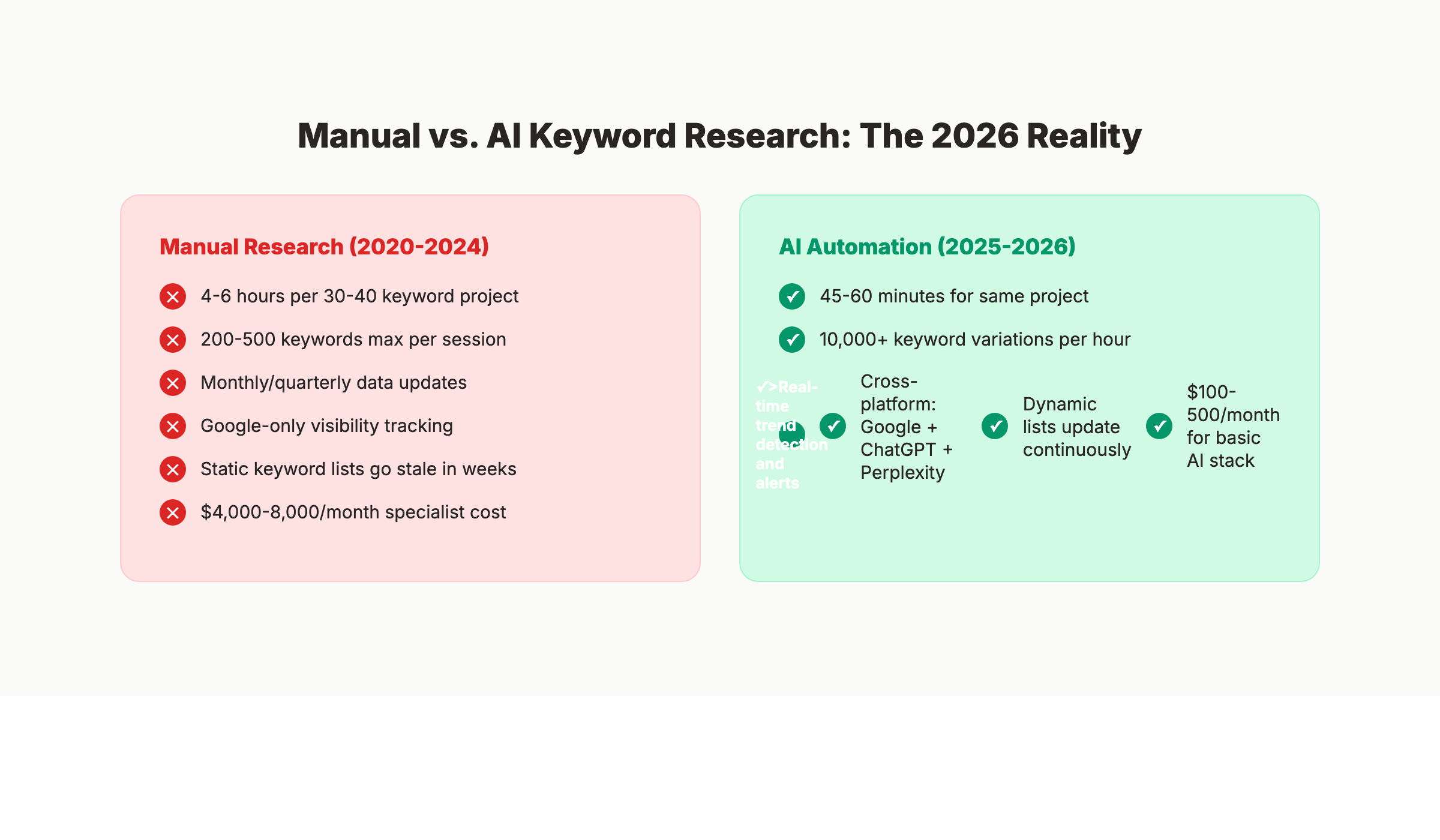
The second trend is about speed. AI reduces keyword research time by 80%, according to DemandSage data from 2026. What used to take 4 to 6 hours for a 30-to-40-keyword project now takes 45 to 60 minutes.
The time savings break down across the entire workflow:
- Discovery: AI finds 5,000 related terms in minutes versus 200 to 500 manually
- Clustering: Semantic grouping happens automatically instead of requiring manual review
- Intent analysis: AI classifies search intent for thousands of terms simultaneously
- Brief creation: Content briefs generate in minutes rather than hours
- Competitor analysis: Gap identification runs continuously, not quarterly
Ryze AI reports that their clients see keyword discovery that is 92% faster and intent analysis that is 95% faster. A task that consumed 15 to 20 hours per week now takes under 2 hours.
This is not just about efficiency. It is about what becomes possible when time constraints disappear. A team that saves 18 hours per week on research can reinvest that time into content quality, strategic planning, or simply producing more. AI users produce 42% more content each month, 17 articles compared to 12, according to SEOProfy data from 2025.
The businesses gaining the most from this trend are not just the ones using AI tools. They are the ones reallocating the time those tools save toward higher-value activities.
Trend 3: AI-Driven Research Delivers 3.2 Times More Organic Traffic Growth
Speed without results is just fast failure. The third trend proves that AI-driven keyword research produces measurably better outcomes.
Brands using AI-driven keyword research report 3.2 times more organic traffic growth than those using manual methods, according to Ryze AI client data. Eighty-three percent of large organizations report measurable SEO gains from AI integration. Only 6.22% saw no improvement at all.
The performance advantage comes from several factors working together:
First, AI identifies long-tail opportunities that manual research misses. Sixty-eight percent of search traffic comes from long-tail keywords, per BrightEdge data. These terms have lower individual volume but higher collective value. A human researcher might identify 50 relevant long-tail terms. An AI system finds 5,000.
Second, AI detects trends before they peak. Manual research relies on historical search volume data, which lags by weeks or months. AI monitors real-time signals across search engines, social platforms, and AI chat interfaces. Brands can identify emerging topics 2 to 4 months before they peak in traditional search volume.
Third, AI optimizes for the full search ecosystem, not just Google. Traditional keyword research focuses on google.com. AI research accounts for ChatGPT, Perplexity, Gemini, and Google AI Overviews. Eighty percent of LLM citations come from URLs outside Google's top 10, according to BrightEdge. Manual research focused on Google rankings misses these opportunities entirely.
Trend 4: AI Search Traffic Is Growing 527% Year Over Year
The fourth trend is the most disruptive. Search is splitting into two channels: traditional Google search and AI-driven search. The second channel is growing explosively.
AI search traffic increased 527% year over year, rising from roughly 17,000 sessions to 107,000 sessions between January and May 2024 versus the same period in 2025, according to Search Engine Land. AI agents now account for roughly 33% of organic search activity, per BrightEdge.
This split changes everything about keyword research. Traditional methods optimize for Google rankings. They track position, click-through rate, and search volume on google.com. AI search operates on different principles:
- Prompts replace keywords. Users ask ChatGPT "What is the best CRM for a 10-person sales team?" instead of searching Google for "best CRM small business."
- Citations replace rankings. Being mentioned in an AI response matters more than ranking position 3 on Google.
- Conversational context replaces single queries. AI search understands follow-up questions, preferences, and constraints.
Fifty-seven percent of searches now include AI Overviews as of June 2025, according to SEO.com. When an AI Overview appears, the click-through rate for the top organic result drops from 1.41% to 0.64%, a 54% decrease, per Ahrefs data. The old metric of "ranking position" is becoming less relevant as AI summaries satisfy user intent without requiring a click.
Keyword research in 2026 must account for both channels. Tools that only track Google rankings are measuring a shrinking portion of the search market.
Trend 5: Content Output Has Increased 42% Without Adding Headcount
The fifth trend is about production capacity. AI does not just make research faster. It makes the entire content pipeline more productive.
AI users produce 42% more content each month, according to SEOProfy data from 2025. The average goes from 12 articles per month to 17. This increase happens without adding writers, editors, or managers. The additional output comes from time saved in research, outlining, and optimization.
The production acceleration follows a predictable pattern:
- Research phase: AI reduces time by 80%, from 6 hours to 1 hour per article
- Outlining phase: AI generates structured outlines in minutes, saving 1 to 2 hours
- Drafting phase: AI-assisted writing cuts first-draft time by 50% to 70%
- Optimization phase: Automated scoring and suggestions reduce editing time
- Publishing phase: AI tools handle formatting, internal linking, and metadata
The cumulative effect is transformative. A two-person content team using AI tools can match the output of a four-person team working manually. Or they can maintain the same output and reinvest the saved time into higher-quality, more strategic content.
Seventy-five percent of businesses use AI to reduce time spent on manual tasks, according to SEOProfy. The question is no longer whether AI increases productivity. It is what businesses do with the productivity gains.
Your competitors are publishing 42% more content than you. theStacc automates keyword research, content planning, and AI search optimization so your team focuses on strategy, not spreadsheets. See how theStacc scales content production
Trend 6: Zero-Click Searches Now Dominate, Making Traditional Rankings Obsolete
The sixth trend reveals a structural problem with manual keyword research. It optimizes for the wrong outcome.
Fifty-eight point five percent of searches in the United States end without a click, according to SparkToro data from 2024. In the European Union, the figure is 59.7%. Users get their answers directly from search results, featured snippets, and AI Overviews without visiting any website.
When an AI Overview appears, only 8% of users click a traditional link, compared to 15% without a summary, per Pew Research from 2025. About 1 in 4 searches with AI summaries end without further action. The traffic that manual keyword research optimizes for is disappearing.
This creates a fundamental mismatch. Manual keyword research asks: "What terms have high search volume and low competition?" AI-era research must ask: "What terms trigger citations, mentions, and brand visibility in AI responses?"
The metrics are different:
| Traditional Metric | AI-Era Replacement |
|---|---|
| Keyword ranking position | AI citation frequency |
| Search volume | Prompt monitoring across AI platforms |
| Click-through rate | Brand mention rate in AI responses |
| Share of voice | AI Share of Voice across LLMs |
| SERP features | AI Visibility Index |
Eighty-five percent of AI Overview citations were published in the last two years, and 44% were from 2025, according to Google data. Fresh, authoritative content is what AI systems cite. Manual keyword research that ignores AI citation dynamics is planning for a search market that no longer exists.
Trend 7: The AI SEO Software Market Is Projected to Reach $4.97 Billion by 2033
The seventh trend confirms that this shift is permanent. Markets do not invest billions in temporary disruptions.
The AI SEO software market was valued at $1.99 billion in 2024 and is projected to reach $4.97 billion by 2033, growing at a compound annual growth rate of 15.2%, according to SEO.com data from 2026. That growth rate reflects sustained demand, not a bubble.
The investment is flowing into specific capabilities:
- Real-time keyword intelligence: Tools that update continuously rather than monthly
- Cross-platform visibility: Tracking across Google, ChatGPT, Perplexity, and Gemini
- Predictive trend detection: Identifying rising topics before competitors
- Automated content briefs: Generating research-backed outlines at scale
- Citation monitoring: Tracking brand mentions in AI responses
Eighty-two percent of enterprise SEO specialists plan more AI investment in 2026. Companies investing in AI report revenue increases of 3% to 15%, with sales ROI uplift of 10% to 20%. Rocky Brands saw a 30% increase in search revenue through AI-driven SEO, per BrightEdge data.
The market data tells a clear story. AI keyword research is not a fad. It is the infrastructure that search marketing will run on for the next decade.
What These Trends Mean for Your Business
The seven trends above paint a clear picture. Manual keyword research is not dying because AI is trendy. It is dying because AI delivers better results in less time across every metric that matters.
Here is what you should do about it:
Audit your current process. Time how long your team spends on keyword research each week. Include discovery, clustering, intent analysis, competitor review, and brief creation. If the total exceeds 10 hours per week for a single content producer, you have a significant automation opportunity.
Pilot one AI tool. You do not need to replace your entire stack on day one. Start with one tool that addresses your biggest pain point. ChatGPT Plus at $20 per month handles research and brainstorming. Dedicated SEO tools like Surfer SEO or Clearscope add optimization and clustering.
Track AI-specific metrics. Add AI referral traffic and citation tracking to your reporting. Monitor traffic from chatgpt.com, perplexity.ai, and gemini.google.com. Run weekly test queries in ChatGPT to see if your brand is cited.
Reinvest time savings strategically. The 80% reduction in research time is only valuable if you use it well. Redirect those hours toward content quality, strategic planning, or expanding into new topic areas.
Build hybrid workflows. The highest-performing teams combine AI scale with human judgment. Let AI handle data processing, pattern recognition, and initial clustering. Let humans handle strategic prioritization, brand alignment, and final quality control.
What practitioners are saying on X
AI search advice ages quickly. Here is high-signal public discussion from SEO and growth operators — context for your roadmap, not a substitute for primary data.
- @jakezward (Feb 2026): 2026 SEO predictions emphasize AI Overview share-of-SERP, schema for LLM token efficiency, brand mentions in AI answers as a KPI, proprietary data as a moat, and content refresh beating net-new AI slop. See the post on X.
- @alexgroberman (Jul 2026): Case narrative: organic value plus multi-engine citations (ChatGPT, Perplexity, Grok) from knowledge-hub pages, category authority links, commercial intent content, and tight internal linking — not thin product copy. See the post on X.
- @varunram (Jul 2026): Critique of GEO slopfarm products that combine SEO clickbait with unresearched content marketing — quality and research still separate winners from farms. See the post on X.
Grok, AI Overviews, and multi-engine visibility
AI/search topics like “ai keyword research automation” need multi-engine notes: AI Overviews, ChatGPT/Perplexity, and Grok. Lead with extractable answers; keep claims consistent with public expert discussion.
- Google AI Overviews: Use passage-ready answers, tables, and FAQ schema where relevant.
- ChatGPT / Perplexity: Cite named sources next to key claims.
- Grok: Maintain accurate entity facts on-site and in high-signal X posts.
Publish content built for Google and AI citations. theStacc’s Content SEO module ships SEO-scored articles structured for rankings and generative engines — including clearer entity pages models like Grok can quote.
Frequently Asked Questions
Manual keyword research is not completely dead, but it is now a niche approach. Eighty-six percent of SEO professionals use AI in their workflow. Manual methods still work for ultra-niche topics with low search volume, brand-new markets without historical data, and small operations publishing 1 to 2 articles per month. For competitive markets and scaled content operations, AI automation has become essential.
AI reduces keyword research time by 80%, according to DemandSage data from 2026. A project that took 4 to 6 hours manually now takes 45 to 60 minutes. Weekly research time drops from 15 to 20 hours to under 2 hours. The savings come from faster discovery, automatic clustering, instant intent classification, and automated brief generation.
The best tool depends on your budget and needs. ChatGPT Plus at $20 per month handles research, brainstorming, and brief creation. Ahrefs and Semrush now include AI features for clustering and intent analysis. Surfer SEO and Clearscope optimize content for target keywords. For full automation, platforms like Ryze AI and SEOBot AI offer end-to-end keyword research and content planning.
Not if you use it correctly. Sixty-seven percent of businesses see an improvement in content quality when using AI, according to DemandSage. The key is using AI for research and optimization while maintaining human oversight for strategy, brand voice, and final editing. AI finds opportunities faster. Humans make the creative and strategic decisions.
Track three categories of metrics. First, efficiency metrics: hours saved per week, keywords processed per hour, and content pieces produced per month. Second, performance metrics: organic traffic growth, keyword rankings gained, and conversions from organic search. Third, cost metrics: tool subscription costs versus labor costs replaced. Most businesses see 300% to 500% ROI within 6 months.
Yes. Many effective tools start at $20 to $100 per month. ChatGPT Plus costs $20 per month and handles research, drafting, and optimization. Free tools like Google Search Console and Google Trends provide baseline data. A functional AI keyword research stack costs under $200 per month, compared to $4,000 to $8,000 per month for a dedicated SEO specialist.
Traditional keyword research focuses on Google search volume, ranking difficulty, and competitor positions. AI keyword research adds real-time trend detection, semantic clustering, cross-platform visibility across ChatGPT and Perplexity, prompt-based discovery, and predictive analytics. It also processes thousands of terms in minutes rather than hundreds in hours.
The right tool depends on your budget and workflow. ChatGPT Plus ($20/month) handles research, clustering, and drafting for small teams. Ahrefs and Semrush now include AI features that surface question-based keywords and content gaps automatically. Surfer SEO and Clearscope optimize content for semantic relevance. For AI search visibility specifically, tools like Profound and ZipTie track how often your brand appears in ChatGPT and Perplexity responses. Most enterprise teams stack 3 to 4 tools rather than relying on one.
Start with a hybrid approach. Use AI to generate your initial keyword list and cluster it semantically. Then apply human judgment to prioritize clusters by business value, not just search volume. Run AI-generated briefs through a human editor who understands your brand voice. Measure results weekly: track organic traffic, keyword rankings, and AI citation frequency. Most teams see measurable improvement within 30 days and full workflow integration within 90 days.
Conclusion
Manual keyword research is not coming back. The data is unambiguous. Eighty-six percent adoption, 80% time reduction, 3.2 times traffic growth, 527% AI search growth, 42% more content output, 58.5% zero-click searches, and a $4.97 billion market forecast. These are not marginal improvements. They are structural changes.
The practitioners who thrive in 2026 will not be the ones who resisted AI. They will be the ones who learned to use it strategically. AI handles scale, speed, and pattern recognition. Humans provide judgment, creativity, and brand voice. The combination is more powerful than either alone.
The death of manual keyword research is not a loss. It is an upgrade. The time you once spent copying search volume into spreadsheets can now go toward building content that earns citations in AI responses, ranks across every search platform, and drives real business results.
Stop spending 15 hours a week on keyword research. theStacc automates discovery, clustering, and AI search optimization so your team focuses on creating content that ranks everywhere. Automate your keyword research with theStacc
Related Tools & Resources
Free SEO Tools:
Best Lists:
Sources & references
- [1] Princeton / Georgia Tech et al. — GEO research (arXiv:2311.09735)
- [2] @jakezward on X — 2026 SEO predictions emphasize AI Overview share-of-SERP, schema for LLM token efficiency, brand mentions in AI answers
- [3] @alexgroberman on X — Case narrative: organic value plus multi-engine citations (ChatGPT, Perplexity, Grok) from knowledge-hub pages, category
- [4] @varunram on X — Critique of GEO slopfarm products that combine SEO clickbait with unresearched content marketing — quality and research

Plan topics, review article drafts, and publish to a connected CMS.
Weekly local SEO teardowns
One practical email a week. Map Pack, GBP, AI Overviews. No fluff. Unsubscribe anytime.
Explore this topic: Keyword Research · Top 10 Best Keyword Research Tools (2026).