Competitor Analysis: The Complete SEO Guide
How to do SEO competitor analysis step by step. Covers keywords, backlinks, content gaps, and tools. Free template included. Updated 2026.
Siddharth Gangal • 2026-03-30 • SEO Tips
In This Article
90% of web pages get zero organic traffic from Google. The pages that rank study what already works. That is what competitor analysis does.
A competitor analysis guide gives you the exact blueprint your competitors used to earn their rankings. Which keywords they target. Where their backlinks come from. What content formats they use. Which gaps they missed. Every insight becomes an action item for your own SEO strategy.
Most businesses skip competitor analysis because it feels complicated. They pick keywords from thin air, write content without structure, and wonder why they do not rank. The businesses that win study the competition first and build from data, not guesses.
We have published 3,500+ blog posts across 70+ industries. Every content strategy starts with competitor analysis. This guide covers the exact process we use.
Here is what you will learn:
- How to identify your real SEO competitors (they are not who you think)
- The 6-step competitor analysis process with tools and templates
- How to find keyword gaps worth thousands in organic traffic
- How to reverse-engineer competitor backlink strategies
- Content gap analysis that reveals exactly what to write next
- Which tools to use (free and paid) and how to compare them
How to Identify Your Real SEO Competitors
Your SEO competitors are not the same as your business competitors. A local plumber competes with other plumbers for customers. But for the keyword “how to fix a leaky faucet,” that plumber competes with Home Depot, WikiHow, and YouTube.
Find Your SERP Competitors
Search your top 10 target keywords in Google. The sites that consistently appear in the top 5 results are your SEO competitors. Record each one.
| Keyword | #1 Result | #2 Result | #3 Result |
|---|---|---|---|
| [keyword 1] | competitor A | competitor B | competitor C |
| [keyword 2] | competitor A | competitor D | competitor B |
| [keyword 3] | competitor B | competitor E | competitor A |
The sites that appear across multiple keywords are your primary competitors. Sites that appear for only 1 keyword are secondary competitors.
Categorize Your Competitors
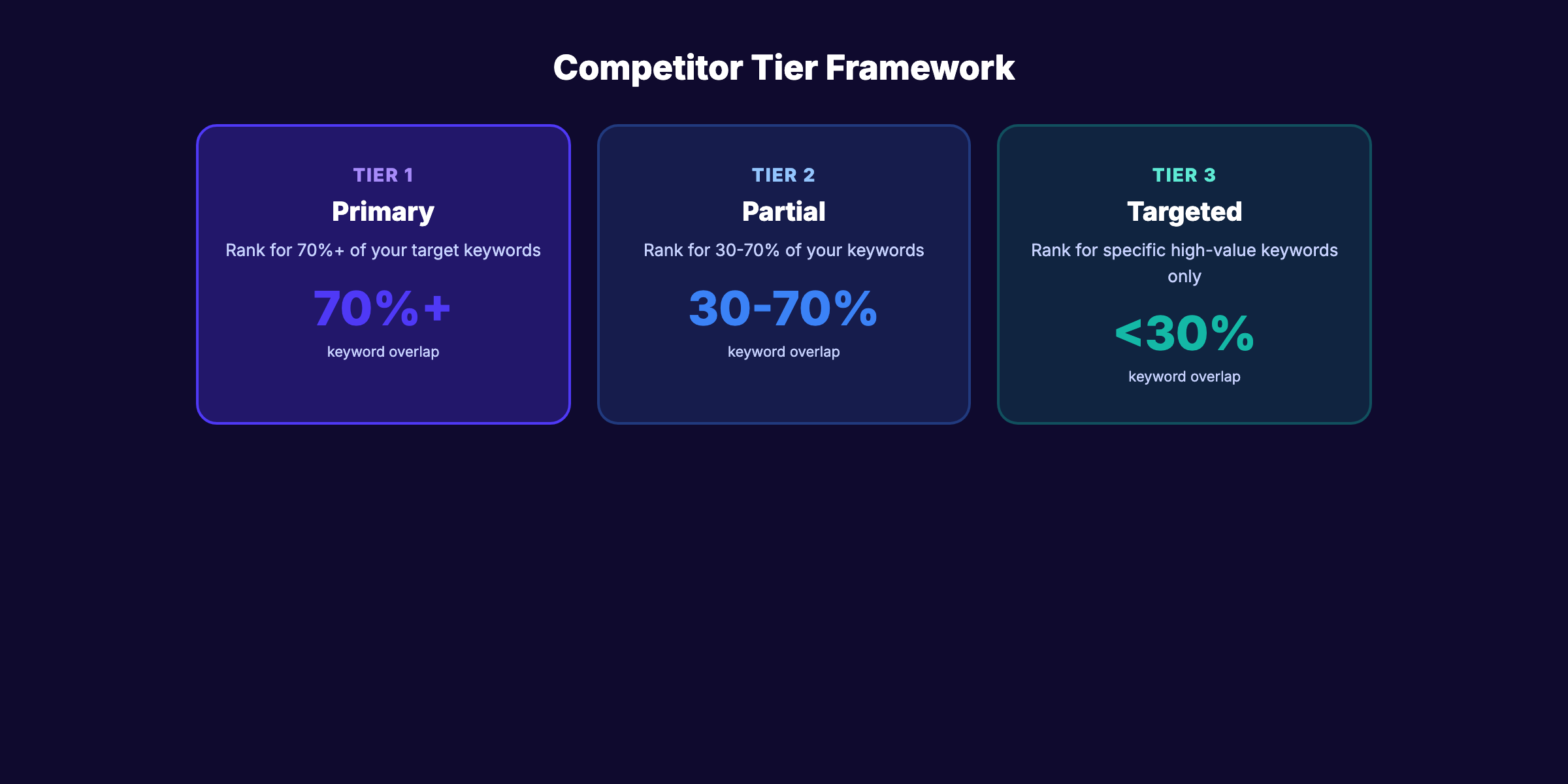
Group competitors into 3 tiers based on overlap and threat level:
- Tier 1: Sites that rank for 70%+ of your target keywords. Direct competition.
- Tier 2: Sites that rank for 30 to 70% of your target keywords. Partial overlap.
- Tier 3: Sites that rank for specific high-value keywords. Targeted threat.
Focus your analysis on Tier 1 competitors. They define the ranking standard you need to meet or exceed.
Tools for Competitor Discovery
- Google Search: Manual search for your top keywords. Free and accurate.
- Semrush Organic Research: Enter your domain. View the “Competitors” tab. Semrush identifies sites competing for the same keywords.
- Ahrefs Site Explorer: Enter a competitor URL. View “Competing domains” for keyword overlap.
- Google Search Console: Check which queries you rank for. Search those queries. Note who outranks you.
Stop writing. Start ranking. Stacc publishes 30 SEO articles per month for your business, automatically. Start for $1 →
Step 1: Keyword Gap Analysis
Keyword gap analysis reveals the keywords your competitors rank for that you do not. These gaps represent the highest-return opportunities in SEO.
How to Run a Keyword Gap Analysis
- Enter your domain and 3 to 5 competitor domains into Semrush or Ahrefs
- Filter for keywords where competitors rank in the top 10 but you do not rank at all
- Sort by search volume to prioritize the highest-traffic opportunities
- Filter by keyword difficulty to find winnable targets
What to Look For
Missing keywords: Terms your competitors rank for that you have zero content targeting. These are immediate content creation opportunities.
Underperforming keywords: Terms where you rank on page 2 or 3 while competitors rank on page 1. These need content optimization rather than new content.
Low-difficulty gaps: Keywords with decent volume (100+ monthly searches) and low difficulty (under 30). These are quick wins.
Free Keyword Gap Method (No Paid Tools)
If you do not have Semrush or Ahrefs, use this manual process:
- Search your top 10 keywords in Google
- Open each top 3 result and scan their content for subtopics
- List every subtopic you do not cover on your own site
- Cross-reference with People Also Ask boxes for additional gaps
- Prioritize subtopics that appear across multiple competitor pages
The manual method takes longer but produces the same actionable insights.
Prioritize With a Scoring Matrix
| Keyword | Volume | Difficulty | Competitor Rank | Priority |
|---|---|---|---|---|
| Example term A | 2,400 | 25 | #3 | High |
| Example term B | 880 | 45 | #7 | Medium |
| Example term C | 320 | 15 | #2 | High |
| Example term D | 5,200 | 70 | #1 | Low (too difficult) |
Target keywords where volume is high, difficulty is low, and competitors already prove the keyword converts. This is the foundation of your keyword research strategy.
Step 2: Content Analysis
Content analysis reveals what types of content rank, how they are structured, and what makes them effective.
Analyze Top-Ranking Content
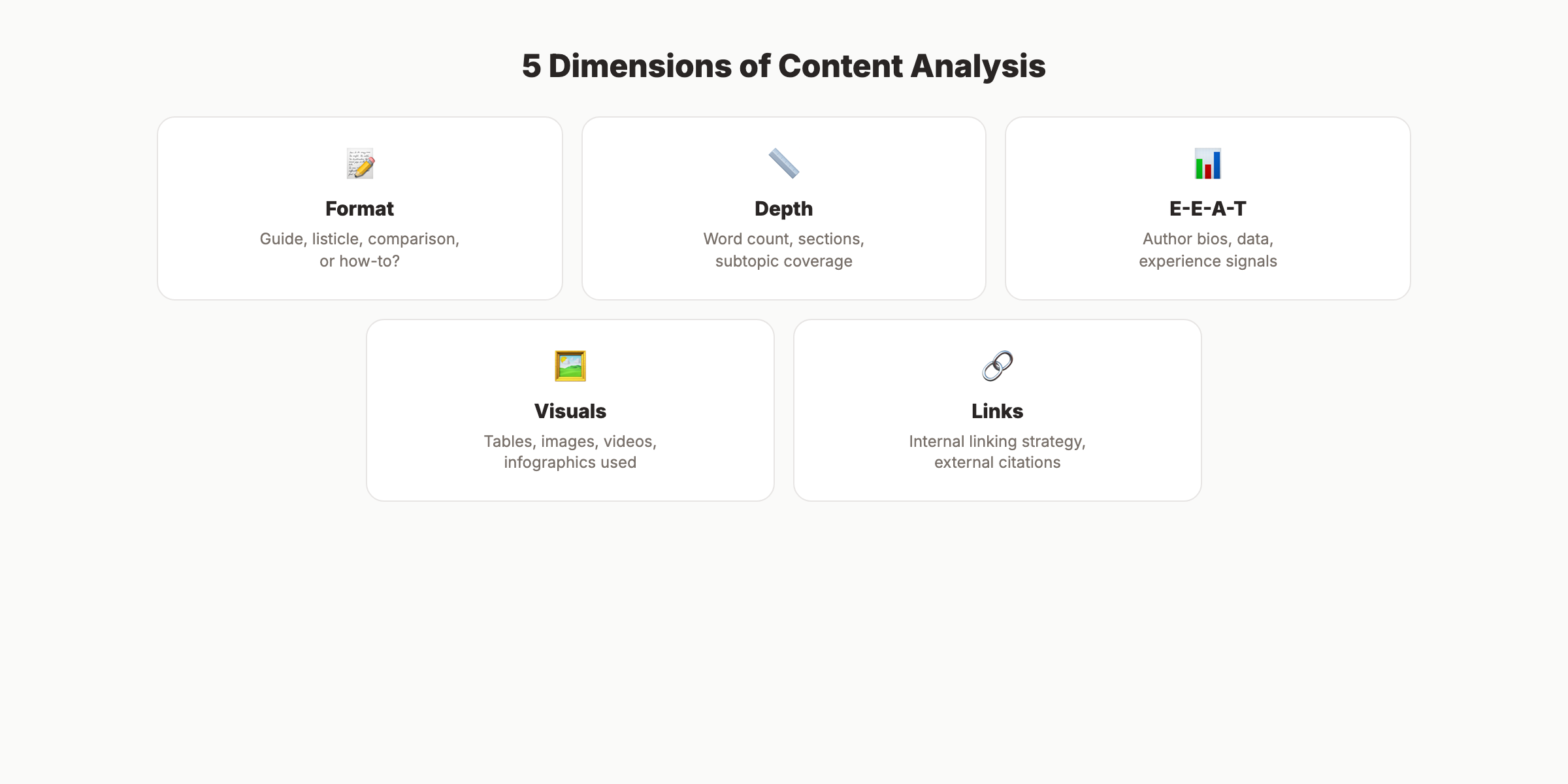
For each target keyword, open the top 3 ranking pages. Document:
- Format: Is it a guide, listicle, comparison, or how-to?
- Word count: How long is the content? Count words with a browser extension.
- H2/H3 structure: What sections does it cover? Copy the heading hierarchy.
- Visual content: Tables, images, infographics, videos?
- E-E-A-T signals: Author bios, data citations, first-person experience?
- Internal and external links: How many and to where?
Identify Content Gaps
Content gaps are topics the top results miss. Every competitor leaves something out. That gap is your opportunity to create the most complete resource.
Common content gaps include:
- Missing sections that searchers expect (check People Also Ask questions)
- Outdated statistics or examples
- Lack of actionable steps or templates
- No visual aids (tables, images, checklists)
- Generic advice without specific examples
Build a Content Advantage
Your content must cover everything competitors cover PLUS the gaps they miss. This is how you create the page Google considers the best result for a query.
The formula: Competitor coverage + content gaps + better format + stronger E-E-A-T = ranking advantage.
See our guide on finding content gaps for a detailed walkthrough.
Step 3: Backlink Analysis
Backlinks are the strongest off-page ranking factor. Analyzing competitor backlinks reveals exactly where to focus your link building efforts.
Map Competitor Backlink Profiles
For each Tier 1 competitor, pull their backlink profile using Ahrefs or Semrush. Record:
| Metric | Competitor A | Competitor B | Competitor C | Your Site |
|---|---|---|---|---|
| Referring domains | 1,200 | 850 | 2,100 | 340 |
| Domain authority | 62 | 48 | 71 | 35 |
| Top linked page | /blog/guide | /tools | /blog/stats | ? |
| Link growth rate | +45/mo | +20/mo | +80/mo | +10/mo |
Find Link Opportunities
Common backlinks: Sites that link to 2+ of your competitors but not to you. These sites already link to similar content. A strong outreach pitch can earn that link.
Broken link opportunities: Use Ahrefs to find broken backlinks pointing to competitor pages. Create equivalent content on your site. Reach out to the linking site and offer your page as a replacement.
Content-based links: Identify which competitor pages earn the most backlinks. These reveal what content types attract links in your niche. Data studies, original research, and tool pages tend to earn the most links.
Set Link Building Targets
Compare your referring domain count to competitors ranking in your target positions. The gap between your count and theirs is your link building target.
If position 1 has 1,200 referring domains and you have 340, you need approximately 860 more referring domains to compete. That does not mean you need exactly that number. But it tells you the scale of effort required.
Your SEO team. $99 per month. 30 optimized articles, published automatically. No writers. No agencies. Start for $1 →
Step 4: Technical SEO Comparison
Technical SEO determines whether Google can efficiently crawl and index your site. Comparing technical performance against competitors reveals hidden disadvantages.
Key Technical Metrics to Compare
| Factor | What to Check | Tool |
|---|---|---|
| Page speed | LCP, INP, CLS scores | PageSpeed Insights |
| Mobile usability | Mobile-friendly test results | Google Mobile Test |
| Indexation | Pages indexed vs total pages | Google Search Console |
| Core Web Vitals | Pass/fail across all pages | CrUX Dashboard |
| HTTPS | SSL certificate status | Browser check |
| Crawl errors | 404s, redirect chains, blocked resources | Screaming Frog |
Run a Comparative Audit
Test your site and 3 competitor sites through Google PageSpeed Insights. Compare Core Web Vitals scores. If competitors load in 1.5 seconds and your site loads in 4 seconds, you have a technical disadvantage that no amount of content can overcome.
Check your technical SEO checklist against competitor performance. Fix any areas where you fall behind.
Step 5: Local SEO Competitor Analysis
For businesses that serve specific geographic areas, local SEO competitor analysis adds a critical layer.
Google Business Profile Comparison
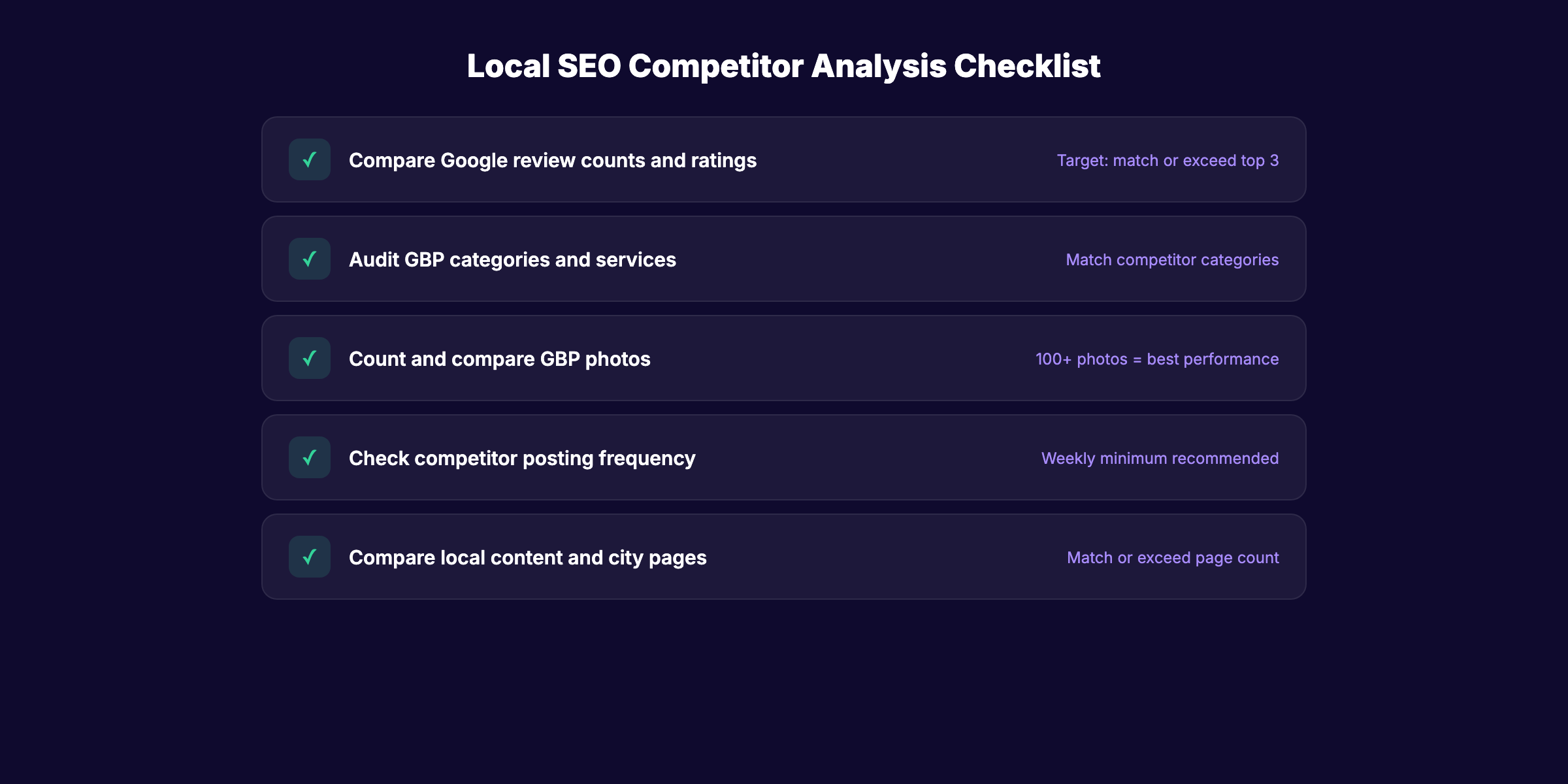
Compare your GBP against top local competitors:
- Reviews: Count and average star rating. If competitors have 200 reviews at 4.5 stars and you have 30 reviews at 4.0, review generation is your priority.
- Categories: Which primary and secondary categories do competitors use? Match them.
- Photos: Count competitor photos. Profiles with 100+ photos outperform those with fewer than 20. See our GBP photos guide.
- Posts: How often do competitors post? Weekly posting signals activity to Google.
- Services: Which services do competitors list? Ensure yours are complete.
Local Content Analysis
Check whether competitors publish location-specific content. Service area pages, city guides, and local blog posts build local authority. If competitors have 50 location pages and you have 5, the content gap is clear.
Citation Comparison
Compare your business listings across directories (Yelp, Yellow Pages, Apple Maps, Facebook) against competitors. Consistent NAP data across more directories improves local rankings.
Step 6: Build Your Action Plan
Analysis without action is wasted time. Convert every finding into a specific task.
The Competitor Analysis Action Template
| Finding | Action | Priority | Timeline |
|---|---|---|---|
| Missing 50 keywords competitors rank for | Create 50 new blog posts targeting gap keywords | High | 60 days |
| Competitor has 3x more backlinks | Launch outreach campaign targeting common links | High | Ongoing |
| Competitor content is 2,000 words. Ours is 800 | Expand existing pages to 2,500+ words | Medium | 30 days |
| Competitor page speed is 1.5s. Ours is 4s | Run technical SEO audit and fix speed issues | High | 14 days |
| Competitor has 200 reviews. We have 30 | Implement review generation campaign | Medium | 90 days |
Prioritize by Impact and Effort
Quick wins (high impact, low effort): Fix technical issues. Optimize existing pages for underperforming keywords. Add missing schema markup.
Medium-term projects (high impact, medium effort): Create content for keyword gaps. Build backlinks from common link sources. Optimize Google Business Profile.
Long-term investments (high impact, high effort): Build topical authority through consistent content publishing. Develop original research for passive link building. Scale content production with automated content creation.
Review Cadence
Run a full competitor analysis every 3 to 6 months. Track ranking changes weekly. Adjust your strategy based on what moves in the SERPs.
3,500+ blogs published. 92% average SEO score. See what Stacc can do for your site. Start for $1 →
How to Monitor Competitors After the Initial Analysis
A competitor analysis is not a one-time project. The SERPs change every day. New competitors appear. Existing competitors publish new content and earn new backlinks. Monitoring keeps your strategy current.
Set Up Ranking Alerts
Track your top 20 keywords weekly. Record your position and the top 3 competitors for each keyword. When a competitor jumps 5 or more positions, investigate what changed. New content? New backlinks? A site redesign?
Use Google Search Console for your own ranking data. Use Semrush or Ahrefs position tracking for competitor positions.
Monitor Competitor Content Publishing
Subscribe to competitor blogs via RSS or email. Track how often they publish, what topics they cover, and what formats they use. If a competitor suddenly increases publishing frequency from 4 to 20 articles per month, they are investing heavily in content. You need to respond.
AI tools and content calendars help you match or exceed competitor publishing rates without a proportional increase in effort.
Track Backlink Changes
Set up weekly backlink reports for your top 3 competitors. New backlinks reveal their outreach strategy. Lost backlinks reveal vulnerabilities. A competitor losing 50 referring domains in a month signals potential issues you can exploit.
Watch for New Market Entrants
New competitors enter your keyword space regularly. Run a quick SERP check monthly for your top keywords. Any new site ranking in the top 10 deserves a full analysis. Early detection prevents surprises.
Quarterly Review Process
Every 3 months, update your full competitor analysis:
- Re-run keyword gap analysis
- Check for new competitors in top 10
- Compare backlink growth rates
- Review content publishing frequency
- Update your action plan priorities
The businesses that monitor competitors continuously outperform those that analyze once and forget.
Best Tools for Competitor Analysis
| Tool | Best For | Starting Price |
|---|---|---|
| Semrush | Keyword gap analysis, traffic analytics, content gap | $139.95/mo |
| Ahrefs | Backlink analysis, referring domains, content explorer | $29/mo (Starter) |
| Moz | Domain authority tracking, local SEO comparison | $49/mo |
| Screaming Frog | Technical SEO crawls, on-page comparison | Free (500 URLs) |
| Google Search Console | Your own keyword data, indexing status | Free |
| PageSpeed Insights | Core Web Vitals comparison | Free |
| SpyFu | PPC competitor research, ad history | $39/mo |
| Ubersuggest | Budget keyword research, basic competitor data | $12/mo |
For a full comparison of SEO tools, see our dedicated guide.
The Free Stack
If your budget is zero, you can still run a solid competitor analysis using:
- Google Search for manual SERP analysis
- Google Search Console for your own keyword data
- Screaming Frog Free for technical crawls (up to 500 URLs)
- PageSpeed Insights for speed comparison
- Ahrefs Webmaster Tools for basic backlink data (free for your own site)
FAQ
How often should I do competitor analysis?
Run a full analysis every 3 to 6 months. Monitor rankings weekly. Check for new competitors quarterly. The search results change constantly. A competitor that did not exist 6 months ago could be outranking you today.
What is the most important part of competitor analysis?
Keyword gap analysis. It directly tells you which content to create next. Every other analysis supports the goal of closing keyword gaps that competitors already rank for. See our SEO competitor analysis post for a deeper breakdown.
How many competitors should I analyze?
3 to 5 for a thorough analysis. More than 5 creates data overload without proportional insight. Focus on Tier 1 competitors who rank for 70% or more of your target keywords.
Can I do competitor analysis without paid tools?
Yes. Google Search, Google Search Console, PageSpeed Insights, and Screaming Frog Free cover the basics. Paid tools like Semrush and Ahrefs make the process faster and provide deeper data, but they are not required to start.
What do I do after completing a competitor analysis?
Build an action plan. Prioritize keyword gaps for content creation. Fix technical issues. Launch link building outreach. Start with high-impact quick wins and work toward longer-term projects.
How does competitor analysis differ for local businesses?
Local competitor analysis adds Google Business Profile comparison, review analysis, citation audits, and location-specific content evaluation. The same keyword and backlink analysis applies, but the local layer is critical for businesses serving specific geographic areas.
Common Competitor Analysis Mistakes
Analyzing too many competitors. Stick to 3 to 5. More than that creates data overload without better decisions.
Copying instead of improving. The goal is not to replicate competitor content. The goal is to create something better by covering what they cover plus the gaps they miss.
Ignoring your own strengths. Competitor analysis reveals their playbook. But your unique expertise, data, and perspective are what differentiate your content. Use competitor data as a starting point, not a ceiling.
Running the analysis once and forgetting. SEO is dynamic. A competitor analysis from 6 months ago is outdated. Quarterly reviews keep your strategy aligned with current SERP reality.
Focusing only on keywords. Backlinks, technical performance, content quality, and user experience all affect rankings. A keyword-only analysis misses half the picture.
The businesses that outrank their competitors study them first. Competitor analysis is not optional. It is the foundation of every SEO strategy that works. Start with the 6-step process, build your action plan, and execute systematically.
Written and published by Stacc. We publish 3,500+ articles per month across 70+ industries. All data verified against public sources as of March 2026.