
GEO vs AEO vs SEO (2026): Strategies, Tactics & Examples
Practical geo vs aeo vs seo strategies for 2026: step-by-step tactics, real examples, and tools to improve rankings and drive organic traffic.
Three acronyms now define how businesses get found online. GEO vs AEO vs SEO is not a debate about which one wins. It is a question of how all three work together.
Gartner projects that organic search traffic to commercial websites will decline 25% by 2026 as users shift to ChatGPT, Perplexity, Gemini, and Copilot. At the same time, 60% of Google searches already end without a click. The businesses that keep growing are the ones optimizing for all three discovery channels, not just one.
Most guides treat GEO, AEO, and SEO as competing strategies. They are not. They are layers of the same visibility system. Miss one layer and you leave traffic, citations, and revenue on the table.
We have published 3,500+ blog posts across 70+ industries. We optimize every article for search engines, answer engines, and generative AI simultaneously. This guide covers the exact framework we use.
Here is what you will learn:
- What SEO, AEO, and GEO each do (and do not do)
- The specific tactics that differ across all three
- How to build content that ranks, gets featured, and gets cited
- A practical implementation checklist you can use today
- How to measure success in each channel
What Is SEO (Search Engine Optimization)?
SEO is the practice of optimizing web content to rank higher in traditional search engine results pages. Google processes 8.5 billion searches per day. Bing handles another 1 billion. SEO targets these search engines to drive organic clicks to your website.
How SEO Works
Search engines crawl your website, index your pages, and rank them based on hundreds of signals. The core ranking factors include:
- Relevance. Does your content match the search query?
- Authority. Do other trusted sites link to yours?
- Technical health. Can search engines crawl and render your pages?
- User experience. Does your site load fast and work on mobile?
- Content quality. Does your page satisfy the search intent behind the query?
SEO has three pillars:
| Pillar | What It Covers |
|---|---|
| On-page SEO | Title tags, meta descriptions, headings, keyword placement, internal links |
| Off-page SEO | Backlinks, brand mentions, digital PR, social signals |
| Technical SEO | Site speed, crawlability, indexing, schema markup, Core Web Vitals |
For a deep dive into on-page optimization, read our on-page SEO guide.
What SEO Delivers
SEO drives clicks. Users search, see a list of links, and click through to your website. You own that traffic. You can retarget visitors, capture emails, and convert them into customers.
The downside: SEO takes time. Ranking movement typically starts in 60-90 days. Competitive keywords can take 6-12 months.
Where SEO Falls Short in 2026
SEO alone no longer captures the full picture. Zero-click searches now account for 60% of queries. AI Overviews appear on a growing share of Google results, pushing organic listings further down the page. Users who ask questions through ChatGPT or Perplexity never see a traditional search result at all.
SEO remains the foundation. But it is no longer the entire building.
What Is AEO (Answer Engine Optimization)?
AEO is the practice of structuring content so that answer engines select it as the direct response to a query. Answer engines include Google Featured Snippets, Google AI Overviews, voice assistants (Alexa, Siri, Google Assistant), and the answer boxes in Bing.
How AEO Works
Answer engines scan indexed content for the clearest, most direct answer to a specific question. They prioritize:
- Direct answer format. Content that leads with a concise definition or answer in the first 40-60 words of a section
- Structured data , Schema markup (FAQ, HowTo, Q&A) that explicitly labels question-answer pairs
- Authority signals , E-E-A-T (Experience, Expertise, Authoritativeness, Trustworthiness)
- Content clarity. Short paragraphs, clear headings, logical structure
The key difference from SEO: AEO does not aim for a click. It aims for your content to become the answer. The user sees your information without visiting your site.
AEO Tactics
| Tactic | Purpose |
|---|---|
| Definition-lead sentences | Open sections with “[Entity] is a [category] that [differentiator]“ |
| FAQ schema markup | Give answer engines machine-readable Q&A pairs |
| Concise answer blocks | Provide 40-60 word answers immediately after question headings |
| People Also Ask targeting | Structure content around the exact questions Google shows |
| Voice search optimization | Use natural language, question-based headings |
For targeting People Also Ask boxes specifically, read our PAA optimization guide.
What AEO Delivers
AEO delivers brand visibility at the point of answer. Your business name, data, or expertise appears in featured snippets, AI Overviews, and voice responses.
The trade-off: you may not get a click. But you build brand awareness, topical authority, and trust with users who see your name as the source of the answer.
12% of Google queries show a featured snippet result. When your content wins that snippet, your brand appears above every organic listing on the page.
Stop writing. Start ranking. Stacc publishes 30 SEO-optimized articles per month on your website automatically. Start for $1 →
What Is GEO (Generative Engine Optimization)?
GEO is the practice of optimizing content so that large language models (LLMs) cite, reference, or surface it in their AI-generated responses. GEO targets platforms like ChatGPT, Perplexity, Google Gemini, Claude, and Microsoft Copilot.
How GEO Works
Generative AI models work differently from search engines. They do not show a list of links. They synthesize information from multiple sources into a single response. When a user asks ChatGPT “What is the best SEO strategy for a local business?” the model pulls from its training data and, increasingly, from real-time web retrieval to construct an answer.
Getting cited in that answer requires:
- Topical authority , Deep coverage of a subject across multiple pages, not just one thin article
- Factual density. Specific numbers, data points, named sources, and original research
- Structured formatting. Clear headings, definition-lead sentences, and well-organized sections that LLMs can parse
- Source credibility. Mentions across multiple trusted platforms (Wikipedia, industry publications, authoritative directories)
- AI crawler access. Allowing AI crawlers (GPTBot, ClaudeBot, PerplexityBot) to access your content
The research behind GEO comes from a 2024 Georgia Tech, Princeton, and IIT Delhi study that tested optimization strategies across 10,000 queries. They found that adding statistics improved AI citation rates by 30-40%, and that authoritative, well-structured content consistently outperformed keyword-stuffed pages.
GEO Tactics
| Tactic | Purpose |
|---|---|
| Cite statistics with sources | LLMs prefer content with verifiable data points |
| Build multi-page topical clusters | Establishes entity-level authority |
| Allow AI crawlers in robots.txt | GPTBot, ClaudeBot, PerplexityBot need access |
| Create an llms.txt file | Gives AI models a structured map of your content |
| Publish original data and research | Creates unique content LLMs cannot find elsewhere |
| Maintain entity presence across platforms | LinkedIn, Wikipedia, Crunchbase, industry directories |
For a complete GEO implementation guide, read our generative engine optimization guide.
What GEO Delivers
GEO delivers brand citations inside AI responses. When ChatGPT mentions your business name, links to your content, or references your data, you reach users who never opened a search engine.
AI-generated traffic to U.S. retail sites increased 4,700% year-over-year as of July 2025. Fewer than 10% of sources cited by ChatGPT, Gemini, and Copilot rank in Google’s top 10 for the same query. That means GEO is not just about SEO rankings. It is a separate visibility channel.
GEO vs AEO vs SEO: Side-by-Side Comparison
Here is how all three strategies compare across every key dimension.
| Dimension | SEO | AEO | GEO |
|---|---|---|---|
| Goal | Rank in search results | Become the featured answer | Get cited by AI models |
| Target platforms | Google, Bing, Yahoo | Google Snippets, AI Overviews, Voice Assistants | ChatGPT, Perplexity, Gemini, Claude, Copilot |
| User behavior | Types query, scans links, clicks | Asks question, reads answer on SERP | Asks AI a question, reads synthesized response |
| Success metric | Rankings, organic traffic, CTR | Featured snippet wins, PAA captures, voice answers | AI citations, brand mentions, referral traffic from AI |
| Content format | Long-form, keyword-optimized | Concise answers, FAQ structure, schema markup | Authoritative, data-rich, well-structured |
| Key ranking factor | Backlinks + relevance + technical health | Answer clarity + structured data + authority | Topical authority + factual density + source credibility |
| Click behavior | User clicks to your site | User may not click (zero-click) | User may not click (AI provides summary) |
| Time to results | 60-90 days minimum | 2-4 weeks for snippet capture | Varies (depends on AI model training/retrieval cycles) |
| Who benefits most | All businesses | Businesses targeting question-based queries | Businesses with authoritative, data-rich content |
| Overlap with SEO | N/A (is SEO) | 70-80% overlap | 50-60% overlap |
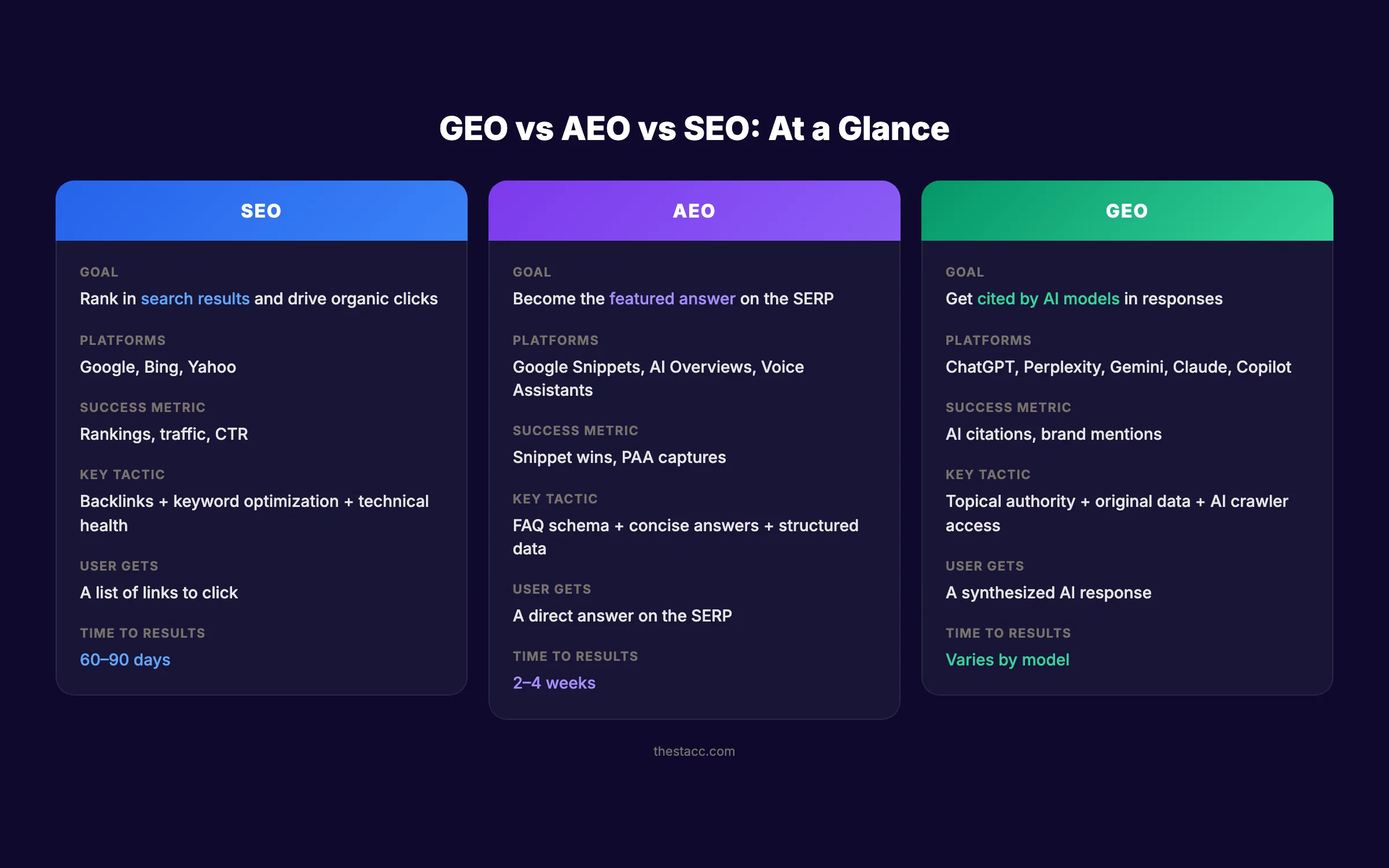
The key insight: AEO and GEO both build on SEO fundamentals. Strong on-page SEO, solid technical SEO, and high-quality content are prerequisites for all three strategies.
How GEO, AEO, and SEO Work Together
Most marketers make the mistake of treating these as separate strategies with separate budgets. In practice, the overlap is massive.
The Three-Layer Visibility Model
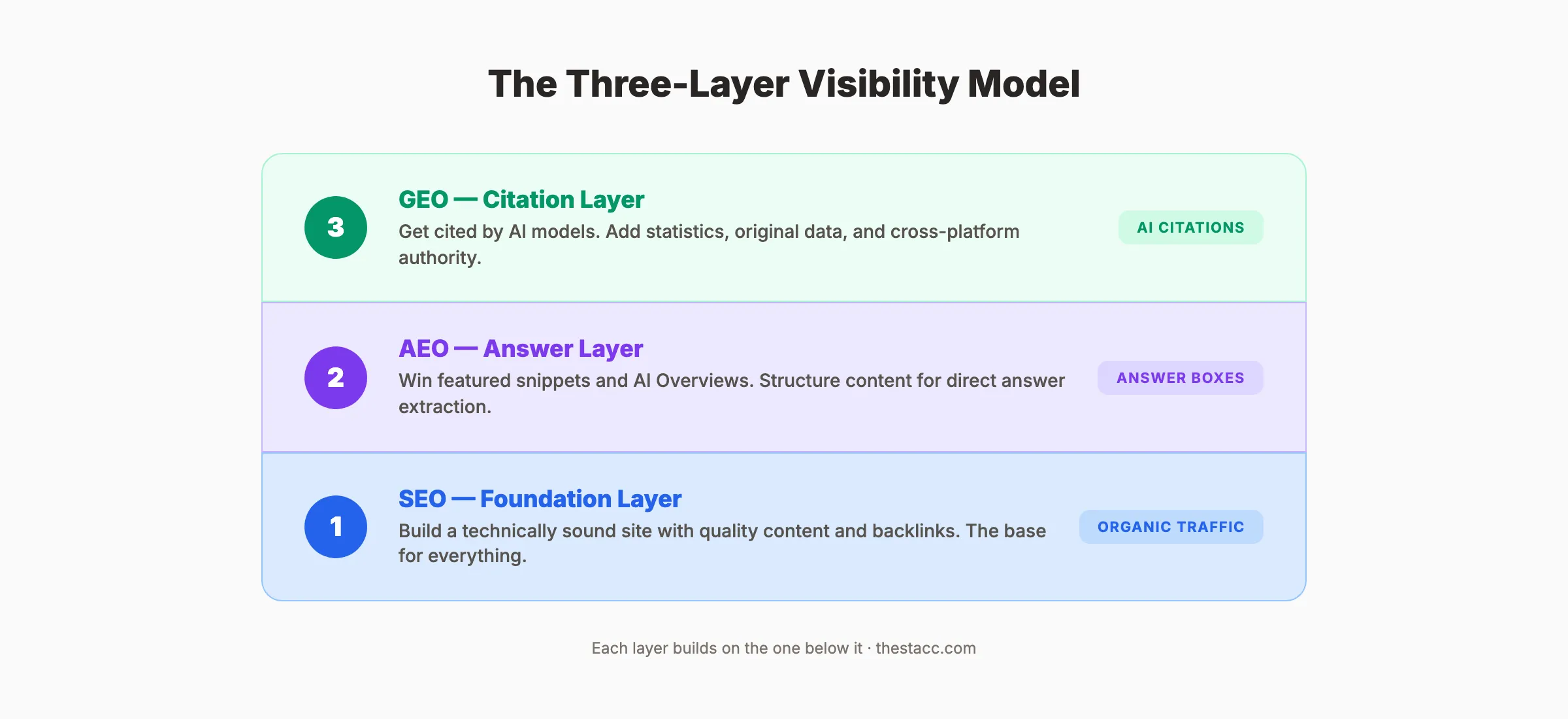
Think of it as stacking layers, not choosing lanes.
Layer 1: SEO (Foundation) Build a technically sound website with strong content and backlinks. This creates the indexed, authoritative content base that both answer engines and AI models rely on.
Layer 2: AEO (Answer Layer) Structure your SEO content for direct answer extraction. Add FAQ schema. Use definition-lead sentences. Target People Also Ask queries. This turns your ranked content into snippet-winning content.
Layer 3: GEO (Citation Layer) Enhance your content with statistics, original data, and cross-platform authority. Allow AI crawlers. Create an llms.txt file. Build entity presence across platforms AI models cross-reference. This turns your authoritative content into AI-cited content.
What One Action Achieves Across All Three
| Action | SEO Benefit | AEO Benefit | GEO Benefit |
|---|---|---|---|
| Publish a well-structured 3,000-word guide | Ranks for target keywords | Sections get pulled as featured snippets | AI models cite it as an authoritative source |
| Add FAQ schema to every blog post | Improves rich result eligibility | Directly feeds answer engines Q&A data | Gives LLMs structured question-answer pairs |
| Build topical authority with content clusters | Boosts rankings for related keywords | Increases chance of snippet capture across cluster | Establishes entity authority that LLMs recognize |
| Include statistics with source citations | Adds credibility for E-E-A-T | Data points get pulled into AI Overviews | LLMs prefer citing content with verifiable numbers |
| Earn backlinks from authoritative sites | Direct ranking factor | Signals answer engine that content is trustworthy | Multi-source authority increases AI citation rate |
The businesses seeing the best results in 2026 are not running three separate optimization programs. They are running one content program that satisfies all three layers simultaneously.
Your SEO team. $99 per month. 30 optimized articles, published automatically to your website. Start for $1 →
How to Optimize for All Three: Implementation Checklist
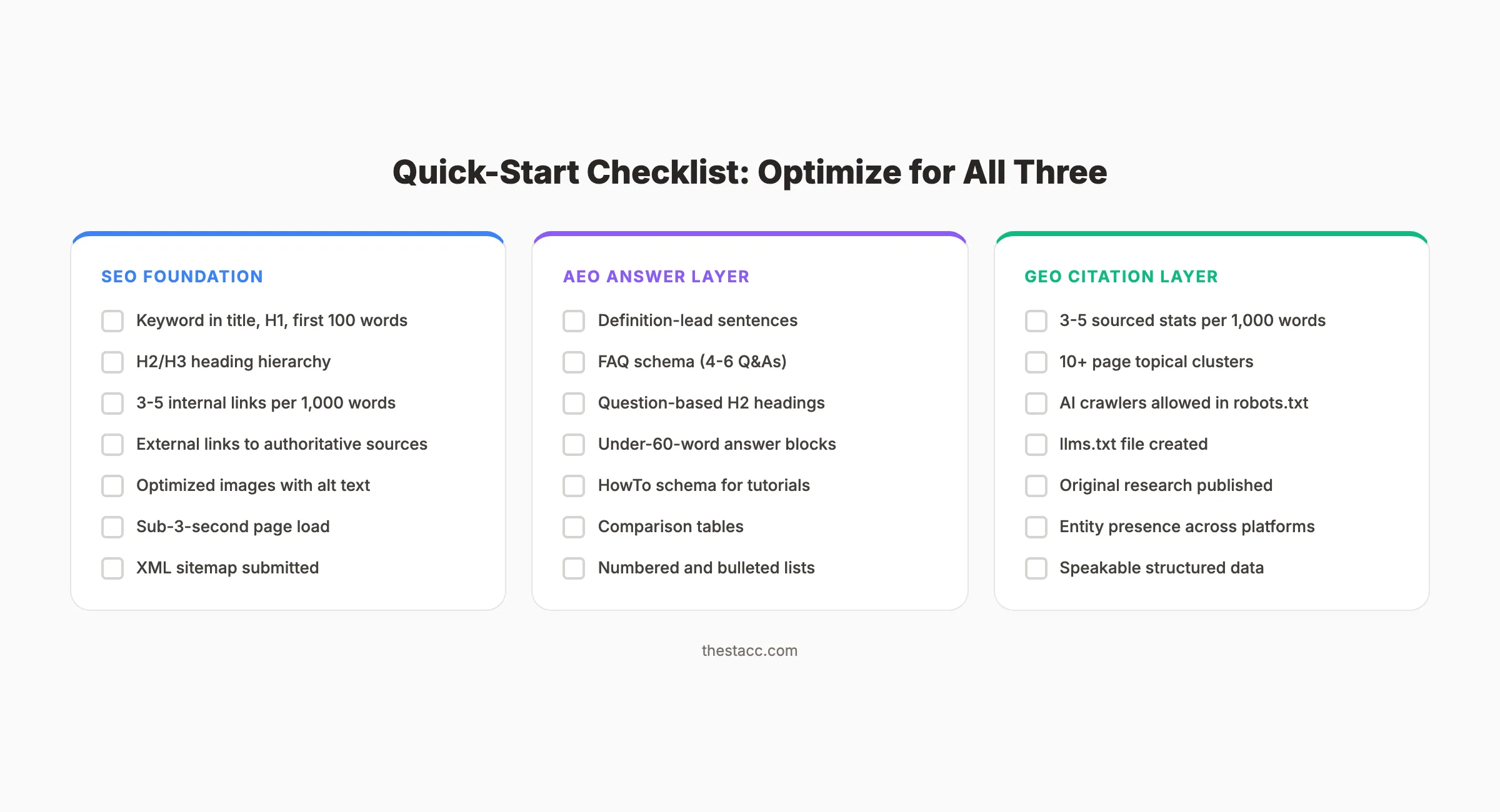
Here is the exact process to optimize content for SEO, AEO, and GEO at the same time.
Step 1: Build the SEO Foundation
Every piece of content needs these basics before you think about AEO or GEO:
- Target keyword in title, H1, first 100 words, and meta description
- Clear H2/H3 heading hierarchy covering subtopics
- Internal links to related content (3-5 per 1,000 words)
- External links to authoritative sources (2-3 per post)
- Optimized images with descriptive alt text
- Fast page load (under 3 seconds)
- Mobile-responsive design
- XML sitemap submitted to Google Search Console
For new websites, start with our SEO for new websites guide.
Step 2: Structure Content for Answer Engines
Once the SEO foundation is solid, add the AEO layer:
- Open each major section with a definition-lead sentence
- Add FAQ schema with 4-6 question-answer pairs per post
- Use question-based H2 headings that match PAA queries
- Keep answer paragraphs under 60 words for snippet extraction
- Add HowTo schema for step-by-step content
- Include tables comparing options (answer engines pull these directly)
- Use numbered lists for processes and bulleted lists for features
Step 3: Optimize for Generative AI Citation
Layer in GEO tactics on top of your SEO and AEO work:
- Include 3-5 statistics with named sources per 1,000 words
- Build content clusters of 10+ pages around each core topic
- Allow AI crawlers in
robots.txt(GPTBot, ClaudeBot, PerplexityBot, Google-Extended) - Create and maintain an llms.txt file
- Publish original research, surveys, or data studies
- Maintain consistent entity information across LinkedIn, Crunchbase, Wikipedia, and industry directories
- Use author bylines with verifiable credentials
- Add speakable structured data for voice-AI compatibility
Step 4: Track and Iterate
Optimization is not a one-time task. Monitor all three channels:
- Track keyword rankings weekly (SEO)
- Monitor featured snippet wins and losses (AEO)
- Check AI citation presence monthly using tools like Perplexity and ChatGPT (GEO)
- Review Google Search Console for AI Overview impressions
- Audit AI crawler access quarterly using server logs
For tracking AI visibility specifically, read our guide on tracking AI search visibility.
How to Measure Success Across SEO, AEO, and GEO
Each layer has its own metrics. Here is how to track performance across all three.
SEO Metrics
| Metric | Tool | Target |
|---|---|---|
| Organic traffic | Google Analytics, Search Console | Month-over-month growth |
| Keyword rankings | Ahrefs, Semrush, Rank Math | Top 10 for target keywords |
| Click-through rate | Google Search Console | Above average for position |
| Backlinks acquired | Ahrefs, Moz | Steady monthly growth |
| Core Web Vitals | PageSpeed Insights | All metrics passing |
AEO Metrics
| Metric | Tool | Target |
|---|---|---|
| Featured snippet wins | Semrush, Ahrefs | Track count over time |
| PAA captures | Manual tracking, Semrush | Presence in related PAA boxes |
| AI Overview inclusions | Google Search Console | Monitor new reporting features |
| Rich result impressions | Google Search Console | Growing impression count |
| Voice search appearances | Limited tracking available | Test key queries on assistants |
GEO Metrics
| Metric | Tool | Target |
|---|---|---|
| AI citations | Manual queries on ChatGPT, Perplexity, Gemini | Brand mentioned in responses |
| AI referral traffic | Google Analytics (filter by referrer) | Growing traffic from AI sources |
| Brand mention frequency | Mention tracking tools, manual monitoring | Increasing mentions over time |
| AI crawler activity | Server log analysis | Regular crawls from GPTBot, ClaudeBot |
| Content indexing by AI | Test queries about your content | Accurate information returned |
The Pew Research Center found that when users see an AI summary in search results, only 8% click through to a website. That number drops from the 15% click rate when no AI summary appears. This means GEO metrics matter even when they do not show up in your traditional analytics dashboard.
3,500+ blogs published. 92% average SEO score. See what Stacc can do for your site. Start for $1 →
Common Mistakes When Combining GEO, AEO, and SEO
Mistake 1: Blocking AI Crawlers
Some businesses block GPTBot, ClaudeBot, and other AI crawlers in their robots.txt file. This prevents your content from appearing in AI responses entirely. Unless you have a specific licensing reason to block AI access, allow these crawlers. Read our AI crawlers guide for details on each crawler and how to configure access.
Mistake 2: Choosing One Strategy Over the Others
GEO is not a replacement for SEO. AEO is not a replacement for either. Businesses that abandon SEO fundamentals to chase AI citations will lose both channels. SEO provides the indexed, authoritative content base that AEO and GEO depend on.
Mistake 3: Ignoring Structured Data
Schema markup serves all three strategies. FAQ schema helps answer engines. Article and Organization schema helps AI models understand your content. Product schema helps both. Skipping structured data means leaving performance gains on the table across every channel.
Mistake 4: Writing for Keywords Only
Keyword-optimized content ranks in search engines. But answer engines need clear, concise answers. And AI models need factual density, statistics, and authoritative sourcing. Content that only targets keywords without addressing these additional needs will rank but will not get featured or cited.
Mistake 5: No Original Data
AI models have access to millions of pages that say the same thing. Content with original statistics, proprietary data, or unique research stands out. If every competitor publishes “10 SEO tips” with the same recycled advice, the AI model has no reason to cite yours over theirs. Give it a reason.
The Future of Search: Where GEO, AEO, and SEO Are Heading
Search is fragmenting. Users now discover content through:
- Traditional search engines (Google, Bing)
- AI chat interfaces (ChatGPT, Claude, Gemini)
- Answer panels (Google AI Overviews, Bing Copilot)
- Social search (TikTok, Reddit, LinkedIn)
- Voice assistants (Alexa, Siri, Google Assistant)
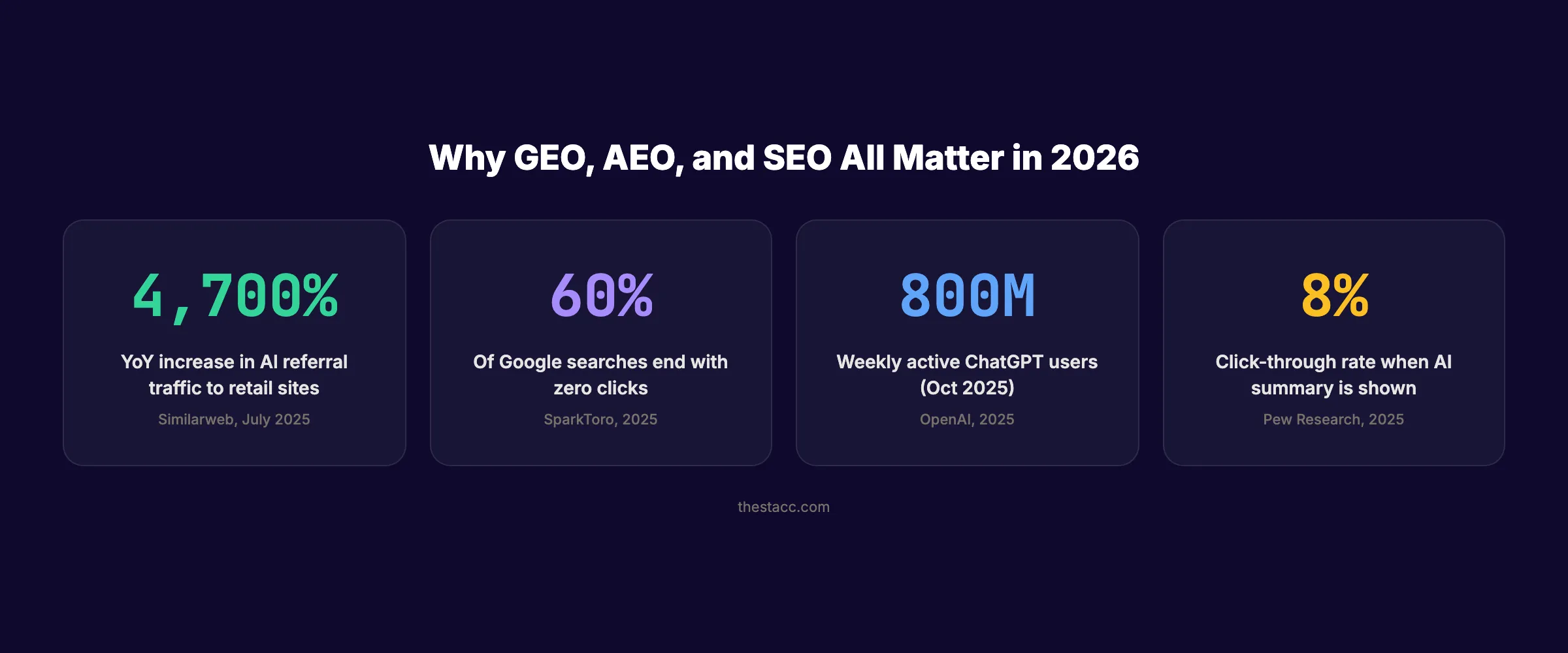
38% of Americans have used AI tools like ChatGPT, Gemini, and Perplexity as of August 2025. ChatGPT alone reached 800 million weekly active users by October 2025, doubling from 400 million in just 8 months.
This growth rate means GEO will become more important every quarter. But it will not replace SEO or AEO. Each channel serves a different user behavior:
- SEO captures users who want to browse and compare options
- AEO captures users who want a quick, direct answer
- GEO captures users who want a synthesized, conversational response
The winning strategy is presence across all three. Build once, optimize for all.
FAQ
What does GEO stand for in marketing?
GEO stands for Generative Engine Optimization. It is the practice of optimizing content so that AI platforms like ChatGPT, Perplexity, Gemini, and Claude cite or reference it in their generated responses. GEO focuses on topical authority, factual density, and structured formatting.
Is AEO the same as GEO?
AEO and GEO are related but different. AEO (Answer Engine Optimization) targets featured snippets, AI Overviews, and voice assistant responses within search interfaces. GEO (Generative Engine Optimization) targets citations inside standalone AI chat platforms. Some practitioners use the terms interchangeably, but the platforms and tactics differ.
Does GEO replace SEO?
No. GEO builds on SEO fundamentals. AI models rely on the same authority, credibility, and content quality signals that search engines use. Without strong SEO, your content is unlikely to be indexed, linked, or recognized as authoritative enough for AI citation. SEO is the foundation. GEO is an additional layer.
How do I know if AI models are citing my content?
Test by asking specific questions about your industry on ChatGPT, Perplexity, and Gemini. Check whether your brand, data, or content is referenced. Monitor server logs for AI crawler activity (GPTBot, ClaudeBot, PerplexityBot). Track referral traffic from AI platforms in Google Analytics. Read our AI search visibility tracking guide for a detailed process.
Which should I prioritize: SEO, AEO, or GEO?
Start with SEO. It is the foundation that both AEO and GEO depend on. Once your site has a technically sound structure, quality content, and growing organic traffic, layer in AEO tactics (structured data, FAQ schema, answer formatting). Then add GEO tactics (AI crawler access, original data, cross-platform authority). Most optimization work serves all three simultaneously.
Can Stacc help with GEO and AEO optimization?
Yes. Every article Stacc publishes is optimized for search engines, answer engines, and AI citation. We structure content with FAQ schema, definition-lead sentences, statistics with sources, and clear heading hierarchies. The result is content that ranks, gets featured, and gets cited. See pricing.
Build Once, Optimize for All
GEO, AEO, and SEO are not competing strategies. They are three layers of the same visibility system.
SEO builds the foundation. AEO captures the answer box. GEO earns the AI citation. Together, they put your business in front of users no matter how they search.
The businesses growing fastest in 2026 are not choosing between these channels. They are building content that works across all of them. Start with the GEO implementation checklist and optimize from there.
Related Tools & Resources
Free SEO Tools:
Best Lists:

Written by
Siddharth GangalSiddharth is the founder of theStacc and Arka360, and a graduate of IIT Mandi. He spent years watching great businesses lose organic traffic to competitors who simply published more. So he built a system to fix that. He writes about SEO, content at scale, and the tactics that actually move rankings.
30 SEO blog articles published every month
Keyword-optimized, scheduled, and live on your site. Automatically.
30-day trial · Cancel anytime
theStacc
Stop writing SEO content manually
30 blog articles, 30 GBP posts, and social media content. Published every month. Automatically.
Start Your $1 Trial$1 for 3 days · Cancel anytime