
Grok Search SEO: How to Rank in X AI Answers
Grok has 17.8% US market share and pulls from live X posts. Learn how to optimize for Grok search visibility and earn AI citations. Updated April 2026.
Grok surged to 17.8% US chatbot market share in January 2026. That is up from 1.9% just one year earlier. With 298.6 million monthly visits and direct access to live X (Twitter) posts, Grok is now the third largest AI search platform behind ChatGPT and Gemini.
Grok search SEO is the practice of optimizing your content and X presence to appear in Grok-generated answers. Unlike ChatGPT or Perplexity, Grok pulls from real-time X data alongside web content. A trending X thread about your brand can influence what Grok tells users about you within hours.
Most businesses ignore Grok entirely. They optimize for Google, maybe ChatGPT, and stop there. That leaves 17.8% of the US AI chatbot market untouched. For brands with an active X presence, Grok represents the fastest path to AI visibility.
We have published 3,500+ SEO articles across 70+ industries and tracked how each AI platform handles brand citations differently. This guide explains what Grok search is, how it sources answers, and how to optimize your content and X presence for maximum Grok visibility.
Here is what you will learn:
- What Grok search is and how it differs from other AI platforms
- How Grok sources answers from X data and web content
- The specific signals that drive Grok citations
- How to optimize your X profile and posts for Grok visibility
- The content strategy that earns Grok citations from your website
- How to track and measure your Grok search performance
What Is Grok Search?
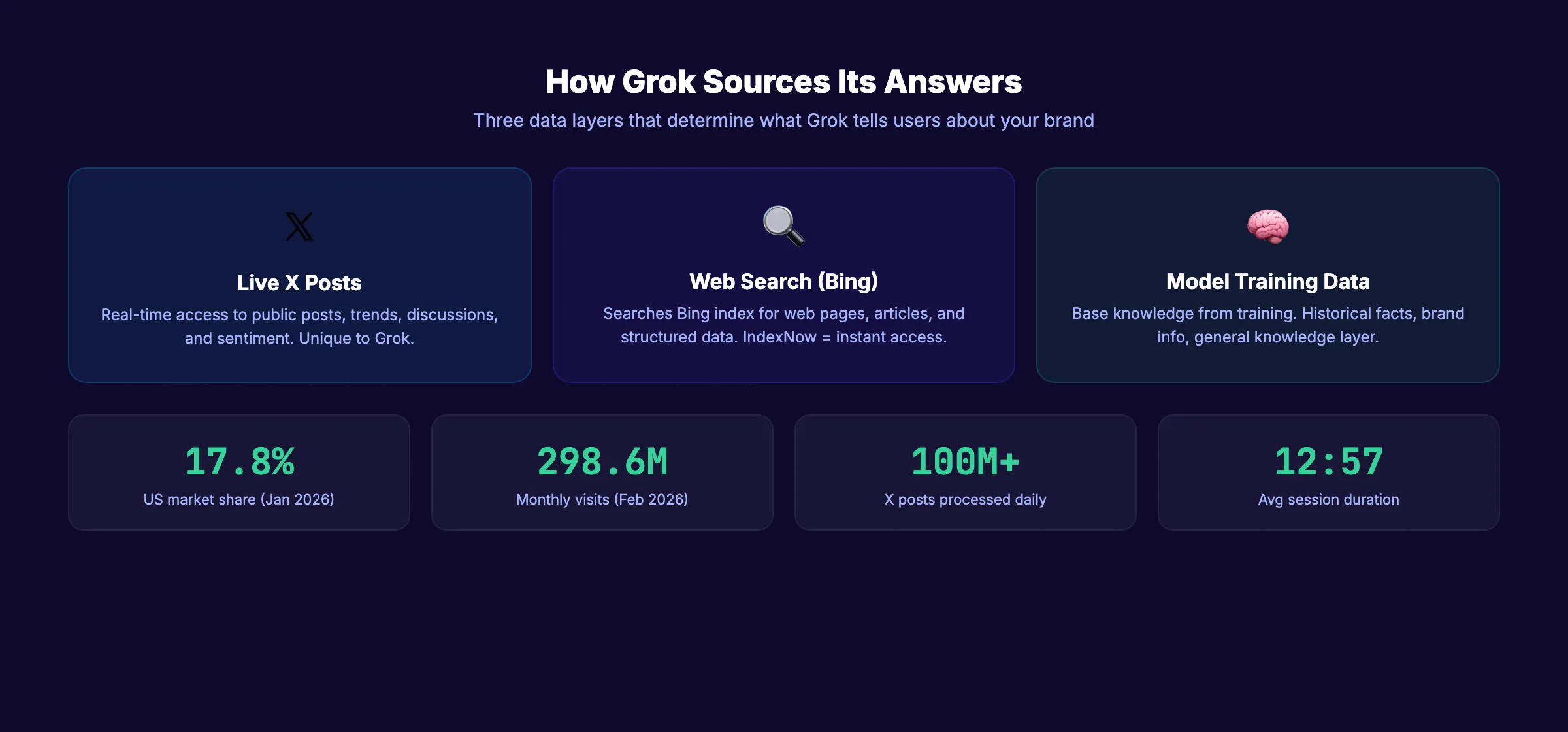
Grok is an AI assistant built by xAI (Elon Musk’s AI company). It generates conversational answers to user questions using 3 data sources: its own language model training data, live web search results, and real-time public X (Twitter) posts.
When a user asks Grok a question, it does not return a list of links. It synthesizes a single conversational answer with optional source citations. The critical difference from other AI platforms is the X integration. Grok reads live tweets, trends, and user discussions in real time.
Grok vs Other AI Platforms
| Feature | Grok | ChatGPT | Perplexity | Google AI Mode |
|---|---|---|---|---|
| Real-time X data | Yes (native) | No | Limited | No |
| Web search | Yes (via Bing) | Yes (via Bing) | Yes (own index) | Yes (Google index) |
| Source citations | Optional | In search mode | Always | Inline |
| US market share | 17.8% | 50%+ | ~5% | Growing |
| Monthly visits | 298.6M | 3B+ | 500M+ | 75M+ daily users |
| Unique advantage | Live social signals | Largest user base | Citation transparency | Google search data |
| Content freshness bias | Very high | Moderate | High | High |
The unique advantage Grok offers for brands: your X activity directly influences AI-generated answers about you. No other major AI platform gives social media posts this level of weight in its answer generation.
How Grok Sources Its Answers
Understanding how Grok finds and selects sources is essential for optimization. The process differs from traditional search and from other AI platforms.
Source 1: Live X Posts and Trends
Grok has direct API access to public X posts. It processes over 100 million posts daily. When a user asks Grok about a topic, Grok evaluates:
- Recent posts mentioning the topic from high-engagement accounts
- Trending conversations and hashtag activity
- Community notes and fact-check signals
- Discussion volume and sentiment around brands or topics
- Posts from verified or X Premium accounts (weighted higher)
This means your X posting activity directly affects what Grok says about your brand. A business with 0 X posts in the last 30 days provides Grok with no social signal data. A business posting 3 to 5 times per week with relevant hashtags gives Grok a constant stream of fresh data points.
Source 2: Web Search via Bing
Grok performs web searches through Bing to supplement its X data. This means standard web SEO practices apply. Pages indexed in Bing appear in Grok web search results.
The critical action: submit your pages to Bing via the IndexNow protocol immediately after publishing. Pages enter the live Bing index within minutes. Grok DeepSearch then has access to them for live queries.
If you only submit to Google and ignore Bing, your content reaches Grok slower. For a full guide on technical SEO basics, read our on-page SEO guide.
Source 3: Model Training Data
Like all LLMs, Grok has a base knowledge layer from training data. This covers general knowledge, brand information, and historical facts. You cannot directly optimize for training data, but the content you publish on your website and across the web eventually feeds into future model updates.
Stop writing. Start ranking. Stacc publishes 30 SEO articles per month for $99. Build the content signals that Grok and every other AI platform evaluate. Start for $1 →
The Signals That Drive Grok Citations
Not all content gets equal treatment in Grok answers. Here are the specific signals that determine whether Grok cites your brand.
X Engagement Signals
| Signal | Impact | How to Improve |
|---|---|---|
| Post frequency | High | Post 3-5 times per week minimum |
| Engagement rate (likes, replies, reposts) | High | Create discussion-worthy content |
| Hashtag relevance | Medium | Use 2-3 specific hashtags per post |
| @mentions from credible accounts | High | Engage with industry voices |
| Thread depth | Medium-high | Publish X threads with detailed insights |
| X Premium verification | Medium | Verified accounts receive higher signal weight |
Web Content Signals
| Signal | Impact | How to Improve |
|---|---|---|
| Bing indexation speed | High | Use IndexNow protocol for instant indexing |
| Content freshness | Very high | Update key pages quarterly, publish weekly |
| Answer-first formatting | High | Lead sections with direct 40-60 word answers |
| Entity clarity | Medium-high | Name specific topics, brands, and audiences |
| Schema markup | Medium | Add Article, FAQ, and Organization schema |
| Topical authority | High | Cover topics across 20+ related pages |
Brand Authority Signals
| Signal | Impact | How to Improve |
|---|---|---|
| Multi-platform presence | High | Active profiles on X, LinkedIn, YouTube, directories |
| Consistent brand mentions | High | Uniform messaging across all platforms |
| Review signals | Medium | Generate reviews on G2, Trustpilot, or vertical sites |
| Wikipedia/Wikidata entity | Medium | Create entity if eligible |
| Press coverage | Medium | Earn editorial mentions on authoritative sites |
The combination of strong X presence AND strong web content creates the highest Grok visibility. Brands that are active on X but have weak websites get mentioned but not cited. Brands with strong websites but no X presence miss the social signal layer entirely.
How Grok Handles Brand Queries
When someone asks Grok “What is [your brand]?”, Grok assembles its answer from 3 layers. First, it checks its training data for baseline information. Second, it runs a web search to find your website, review sites, and press coverage. Third, it scans recent X discussions mentioning your brand.
The third layer is what makes Grok unique. If your brand has active X discussions from credible accounts, Grok incorporates those perspectives into its answer. Positive sentiment from verified industry accounts strengthens your brand recommendation. Negative sentiment or lack of discussion weakens it.
This creates a direct incentive to manage your X brand presence actively. Every positive X conversation about your brand feeds into what Grok tells the next person who asks about you.
For a broader understanding of how all AI platforms handle brand queries, read our LLM visibility guide.
How to Optimize Your X Presence for Grok
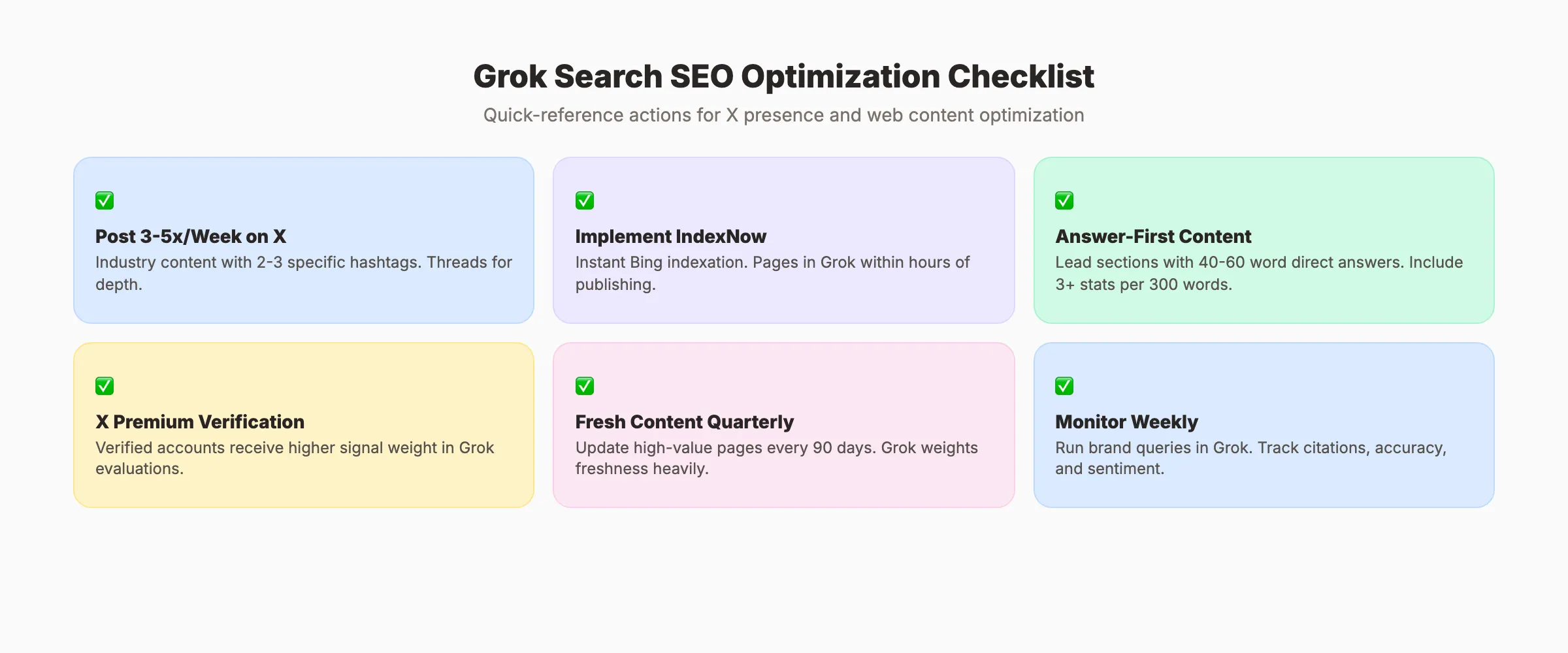
Your X (Twitter) strategy directly affects your Grok search visibility. Here is the specific optimization checklist.
Profile Optimization
- Use your brand name as your X handle (consistency with your domain helps entity matching)
- Write a bio that includes your primary keywords and service description
- Pin a post that summarizes what your brand does (Grok reads pinned posts)
- Add your website URL in the profile (creates an explicit entity link)
- Verify your account through X Premium (higher signal weight)
Posting Strategy
- Post 3 to 5 times per week with industry-relevant content
- Use 2 to 3 specific, relevant hashtags per post (not generic trending tags)
- Publish X threads that break down topics in detail (threads generate more engagement)
- Share your blog content with key takeaways (creates X-to-web entity connections)
- Reply to industry discussions (engagement from credible accounts boosts your authority)
- Use @mentions when referencing brands, tools, or people (creates entity relationships)
Content Types That Perform Best on X for Grok
| Content Type | Why Grok Values It | Posting Frequency |
|---|---|---|
| Data and statistics | Extractable facts for answers | 2-3 per week |
| Opinion with reasoning | Signals expertise on topic | 1-2 per week |
| Thread explainers | Depth on specific topics | 1 per week |
| Industry news commentary | Freshness + authority signal | As relevant |
| Customer results / case studies | Proof of expertise | 1-2 per month |
The key principle: X posts serve as real-time entity signals for Grok. Every post that mentions your brand alongside relevant industry terms strengthens the association Grok makes between your brand and those topics.
For a broader social media strategy that feeds AI visibility, read our guide on repurposing blog content for social media.
How to Optimize Your Website for Grok Citations
Your website content matters for Grok too. Web optimization for Grok follows the same principles as generative engine optimization with 2 Grok-specific additions.
Grok-Specific: Bing Indexation Speed
Grok uses Bing for web search. If your pages are not indexed in Bing, Grok cannot find them through web search. Most SEOs focus exclusively on Google and neglect Bing indexation.
Action items:
- Set up Bing Webmaster Tools and submit your sitemap
- Implement the IndexNow protocol for instant Bing indexation
- Verify your pages appear in Bing search results within 24 hours of publishing
- Check that your
robots.txtdoes not block Bingbot
Grok-Specific: Content Freshness
Grok weights content freshness more heavily than any other AI platform. A page published and indexed today can appear in Grok answers tomorrow. A page not updated since 2023 gets deprioritized even if the content is accurate.
Action items:
- Update high-value pages with current data at least quarterly
- Add “Updated [Month Year]” timestamps that Grok can parse
- Publish new content weekly to maintain a fresh content profile
- Remove or redirect outdated content that contradicts current information
Standard GEO Optimization (Also Applies to Grok)
- Use answer-first formatting: lead every section with a direct answer in 40 to 60 words
- Structure content with clear H2/H3 headings matching natural language questions
- Include specific statistics and data points (3+ per 300 words for maximum citation rate)
- Add FAQ sections with FAQ schema for easy extraction
- Build topical authority across your subject area with 20+ related pages
- Publish an
llms.txtfile describing your site structure
3,500+ blogs published. 92% average SEO score. Every article builds the topical authority that Grok evaluates when generating answers. Start for $1 →
Tracking Your Grok Search Performance
Grok does not provide a webmaster console or analytics dashboard. Tracking requires manual monitoring and third-party tools.
Manual Monitoring
Run your target queries directly in Grok (available at grok.com or through X). Check whether your brand appears in the generated answer. Document which queries cite your brand and which do not. Repeat weekly.
Key queries to monitor:
- Your brand name (“What is [your brand]?”)
- Your primary product categories (“best [your category] for [your audience]”)
- Competitor comparison queries (“[your brand] vs [competitor]”)
- Industry topic queries where you want to be cited as an authority
Third-Party Tracking Tools
Several platforms now track Grok visibility alongside other AI platforms:
| Tool | What It Tracks | Grok Coverage |
|---|---|---|
| AIclicks | Brand mentions across AI platforms | Yes |
| LLMrefs | URL-level citations across AI models | Yes |
| Promptmonitor | AI visibility and share of voice | Yes |
| Riff Analytics | Brand mention tracking in Grok | Yes (specialized) |
Metrics to Track
| Metric | Definition | Target |
|---|---|---|
| Grok share of voice | % of target queries where your brand appears | 10%+ for core queries |
| Citation accuracy | Whether Grok states correct facts about you | 90%+ accuracy |
| X-to-Grok correlation | Whether X posting spikes correlate with Grok mentions | Positive correlation |
| Bing indexation speed | Hours from publish to Bing index | Under 24 hours |
For a broader framework on AI visibility measurement, read our guide on tracking AI search visibility and LLM visibility.
Grok SEO and the Bigger AI Visibility Picture
Grok is one platform in a multi-platform AI search world. The businesses that succeed optimize for all major AI platforms simultaneously, not just one.
The good news: 80% of what works for Grok also works for ChatGPT, Perplexity, and Google AI Mode. Answer-first content, schema markup, topical authority, and brand consistency drive citations across every platform.
The Grok-specific 20% is X activity and Bing indexation. Those 2 factors differentiate Grok optimization from general AI SEO.
Here is the priority order for most businesses:
- Build content foundation (works for all AI platforms including Grok)
- Optimize for Google AI Mode and ChatGPT (largest audiences)
- Add X posting strategy (unlocks Grok-specific signals)
- Implement IndexNow for Bing (ensures Grok web search access)
- Monitor and optimize per platform (track where your brand appears and adjust)
For the full AI search optimization framework, read our guides on the answer economy and how AI search is changing SEO.
Why Most Businesses Ignore Grok (And Why That Is an Opportunity)
Most SEO strategies stop at Google. Some add ChatGPT. Very few include Grok. That gap creates an opportunity for early movers.
With 17.8% US market share and the fastest growth rate of any AI chatbot, Grok visibility compounds over time. The brands that establish strong X presence and Bing indexation now will have a significant head start when Grok adoption doubles in the next 12 months.
The investment is minimal. Posting 3 to 5 times per week on X takes 30 minutes. Implementing IndexNow takes one afternoon. The return is visibility in a fast-growing AI platform that most competitors have not started optimizing for.
Early movers win in every new search channel. Grok is no different.
Rank everywhere. Do nothing. Blog SEO, Local SEO, and Social on autopilot. Build visibility across Google, ChatGPT, Perplexity, and Grok simultaneously. Start for $1 →
FAQ
Is Grok search the same as X search?
No. X search is the built-in search function on the X platform that finds posts and users. Grok search is an AI assistant that generates conversational answers using X data, web content, and its own model. Grok synthesizes information. X search finds specific posts.
Do I need X Premium for my brand to appear in Grok?
No. Grok reads all public X posts regardless of account status. But X Premium verification gives your posts higher signal weight, and X Premium+ subscribers get direct Grok access. Verification improves your brand authority signal in Grok evaluations.
How quickly do X posts affect Grok answers?
Grok processes X data in near real-time. A viral thread or trending discussion can influence Grok answers within hours. For web content, indexation through Bing takes minutes to hours with IndexNow. Training data updates happen on longer cycles (months).
Should I optimize for Grok separately or as part of my overall AI SEO?
Both. 80% of Grok optimization overlaps with general AI SEO (content structure, schema, authority). The Grok-specific additions are X posting strategy and Bing IndexNow implementation. Add these 2 elements on top of your existing AI SEO foundation.
How does Grok handle local business queries?
Grok pulls local information from web search (Bing) and X posts. Businesses with optimized Google Business Profiles that also appear in Bing local results get cited in Grok local answers. Active X accounts posting about local services provide additional Grok signals.
What percentage of the AI search market does Grok represent?
Grok holds 17.8% of the US chatbot market share as of January 2026. Globally, the share is smaller (2 to 5%). For US-focused businesses, Grok represents a significant audience. For global businesses, prioritize ChatGPT and Google AI Mode first, then add Grok optimization.
Grok is the fastest-growing AI search platform in the US market. Its unique integration with live X data gives brands with active social presence a direct path to AI citations that no other platform offers. Start with your X posting strategy, implement IndexNow for Bing, and layer Grok optimization on top of your existing AI SEO foundation.
Related Tools & Resources
Free SEO Tools:
Best Lists:

Written by
Siddharth GangalSiddharth is the founder of theStacc and Arka360, and a graduate of IIT Mandi. He spent years watching great businesses lose organic traffic to competitors who simply published more. So he built a system to fix that. He writes about SEO, content at scale, and the tactics that actually move rankings.
30 SEO blog articles published every month
Keyword-optimized, scheduled, and live on your site. Automatically.
30-day trial · Cancel anytime
theStacc
Stop writing SEO content manually
30 blog articles, 30 GBP posts, and social media content. Published every month. Automatically.
Try for free$1 for 3 days · Cancel anytime