Home Inspector SEO: The Complete Guide (2026)
Master home inspector SEO with this 9-chapter guide. Covers Google Business Profile, local keywords, content marketing, and reviews. Updated for 2026.
Siddharth Gangal • 2026-03-29 • Local SEO
In This Article
Most home inspectors depend on real estate agent referrals for 80% or more of their bookings. That works until a top referring agent retires, switches companies, or starts sending work to a competitor.
One lost referral relationship can cost $30,000 to $50,000 in annual revenue overnight. And rebuilding that pipeline through networking alone takes months.
Home inspector SEO fixes that problem. It puts your inspection business in front of buyers, sellers, and agents who are actively searching Google right now. Instead of waiting by the phone, you show up first when someone types “home inspector near me” or “pre-purchase inspection in [your city].”
We publish 3,500+ SEO-optimized articles across 70+ industries, including home inspection companies. This guide covers everything we know about ranking a home inspection business on Google.
Here is what you will learn:
- Why home inspector SEO delivers a higher ROI than paid ads or referral-only marketing
- The exact keywords that generate inspection bookings (not just traffic)
- How to optimize your Google Business Profile for the local pack
- On-page SEO tactics built for home inspector websites
- Content marketing strategies that attract both homebuyers and real estate agents
- How reviews and agent relationships fuel your search rankings
- Technical SEO fundamentals every inspector site needs
- How to measure your SEO results and calculate ROI
Why SEO Matters for Home Inspectors
The home inspection industry generates roughly $5 billion in annual revenue across the United States. Over 3 million home inspections happen every year. Yet most inspectors still rely on a handful of agent referrals and word-of-mouth to fill their calendar.
That model has a ceiling. SEO removes it.
97% of Consumers Search Online First
According to local SEO statistics, 97% of people search online before hiring a local service provider. For home inspectors, that means buyers and agents are Googling “home inspector in [city]” before they ever ask a colleague for a name.
If your business does not appear on page 1, you do not exist to those searchers. The first organic result captures 28% of all clicks. The fifth result gets just 2.7%.
Referrals Are Not a Growth Strategy
Agent referrals are valuable. They are not reliable. A single agent might send you 3 to 5 inspections per month. But agents change brokerages, retire, or build relationships with newer inspectors who offer lower fees.
SEO creates a second pipeline that you own. It generates direct inquiries from homebuyers, sellers ordering pre-listing inspections, and agents searching for inspectors in your service area. That pipeline compounds over time. Every blog post, every review, and every optimized page stacks on the work you did last month.
Home Inspection SEO Is Less Competitive Than You Think
Unlike dentists or plumbers competing against hundreds of local providers, most metro areas have 20 to 50 active home inspectors. Many of those have outdated websites with zero SEO. That means a focused home inspector SEO strategy can reach page 1 in 1 to 3 months, not 6 to 12.
The home inspection market is growing at a 9.1% CAGR. More inspections mean more searches. Inspectors who rank now will capture that growth.
Home Inspection Keywords That Generate Bookings
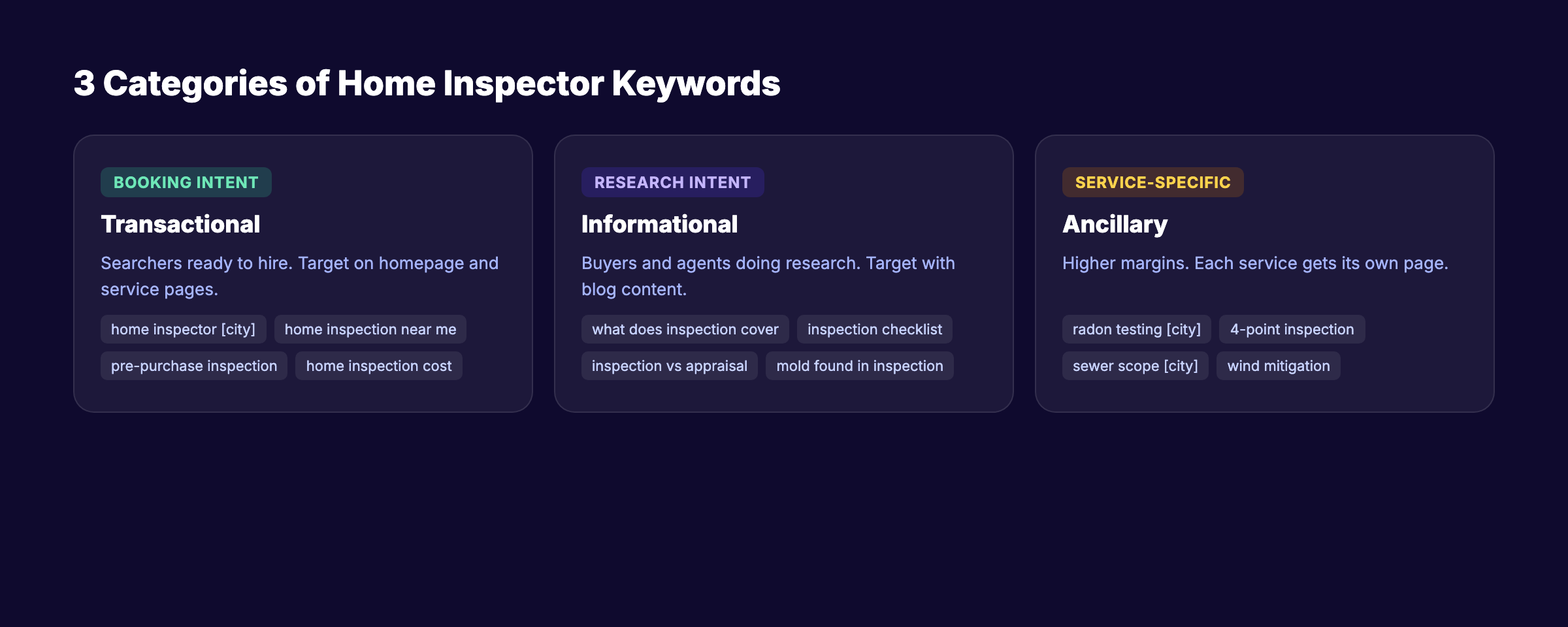
Not all keywords are equal. Some drive tire-kickers reading about the inspection process. Others drive homebuyers ready to book an inspection this week. Your keyword research strategy needs to prioritize the second group.
Transactional Keywords (Booking Intent)
These keywords signal a searcher who is ready to hire. They should be your top priority for homepage and service page optimization.
| Keyword Pattern | Example | Search Intent |
|---|---|---|
| home inspector + [city] | “home inspector Tampa” | Ready to book |
| home inspection + near me | ”home inspection near me” | Ready to book |
| home inspection + cost + [city] | “home inspection cost Denver” | Comparing prices |
| [service] + inspection + [city] | “radon inspection Austin” | Specific service need |
| pre-purchase inspection + [city] | “pre-purchase inspection Seattle” | Active homebuyer |
Informational Keywords (Agent and Buyer Research)
These keywords attract people earlier in the buying process. They build topical authority and trust. Use them for blog content.
| Keyword Pattern | Example | Who Searches |
|---|---|---|
| what does a home inspection cover | ”what does a home inspection cover” | First-time buyers |
| home inspection checklist | ”home inspection checklist for buyers” | Buyers and agents |
| home inspection vs appraisal | ”home inspection vs appraisal” | Confused buyers |
| [issue] found in home inspection | ”mold found in home inspection” | Buyers post-inspection |
| do I need a [service] inspection | ”do I need a sewer scope inspection” | Buyers weighing add-ons |
Ancillary Service Keywords
Many inspectors offer radon testing, mold inspection, termite/WDI inspection, 4-point inspections, wind mitigation reports, thermal imaging, and sewer scope inspections. Each ancillary service deserves its own page with location-specific keywords.
A home inspector in Florida should target “4-point inspection Miami” and “wind mitigation report Fort Lauderdale.” An inspector in the Midwest should target “radon testing [city]” and “sewer scope inspection [city].”
These pages capture searchers with specific needs and higher willingness to pay. Understanding search intent for each service helps you match the right content to the right searcher.
Stop waiting for agent referrals to fill your calendar. Stacc builds the SEO pipeline you own. 30 articles per month, published on autopilot. Start for $1 →
Google Business Profile for Home Inspectors
Your Google Business Profile is the single most important ranking factor for the local pack. That is the map section showing 3 businesses at the top of local search results. For home inspectors, appearing here means bookings.
Around 64% of consumers use Google Business Profiles to find contact details for local businesses. If your profile is incomplete, outdated, or missing reviews, you are invisible.
Set Up Your Profile Correctly
Start with Google Business Profile optimization. Choose the right primary category. For home inspectors, use “Home Inspector” as the primary category. Add secondary categories for ancillary services like “Radon Inspection Service” or “Mold Inspection Service.”
Fill in every field:
- Business name (match your legal name exactly)
- Service area (list every city and county you cover)
- Phone number (use a local number, not a toll-free line)
- Website URL (link to your homepage)
- Business hours (include Saturday availability if you offer it)
- Business description (250 words with your target keywords)
- Services list (every inspection type with descriptions)
Photos and Posts That Convert
Upload at least 25 photos. Include images of you performing inspections, your vehicle with branding, your equipment (thermal imaging camera, moisture meters), and sample report screenshots. Google gives higher visibility to profiles with more photos.
Post weekly updates to your profile. Share seasonal tips (“3 Things to Check Before Buying a Home This Spring”), announce new services, or highlight positive reviews. GBP posts signal to Google that your business is active.
Use GBP management tools to schedule posts and monitor your profile performance without logging in daily.
On-Page SEO for Home Inspector Websites
Your website is the foundation of your home inspector SEO strategy. Every page needs to tell Google exactly what you do, where you do it, and why you are the best choice. This is on-page SEO applied to the home inspection industry.
Title Tags and Meta Descriptions
Your homepage title tag should follow this formula:
[City] Home Inspector | [Business Name] | [Differentiator]
Example: “Tampa Home Inspector | Precision Inspections | ASHI Certified, Same-Day Reports”
Keep title tags under 60 characters. Write meta descriptions between 145 and 155 characters. Include your primary keyword and a benefit.
Page Structure for Home Inspectors
Every home inspection website needs these core pages, each optimized for a specific keyword:
| Page | Target Keyword | Purpose |
|---|---|---|
| Homepage | ”home inspector [city]“ | Primary ranking page |
| Services | ”home inspection services [city]“ | Overview of all services |
| Radon Testing | ”radon testing [city]“ | Ancillary service page |
| Mold Inspection | ”mold inspection [city]“ | Ancillary service page |
| Termite/WDI | ”termite inspection [city]“ | Ancillary service page |
| 4-Point Inspection | ”4-point inspection [city]“ | Florida-specific service |
| Wind Mitigation | ”wind mitigation [city]“ | Florida-specific service |
| Sewer Scope | ”sewer scope inspection [city]“ | Regional service page |
| Service Areas | ”[suburb] home inspector” | Location pages |
| About | ”about [business name]“ | Trust and E-E-A-T signals |
| Sample Report | ”home inspection report sample” | Conversion tool |
Content on Service Pages
Each service page needs at least 500 words. Include what the inspection covers, how long it takes, what equipment you use (thermal imaging, moisture meters), what the report includes, and your pricing range. Answer the questions buyers ask before booking.
Add your ASHI or InterNACHI certification badges. Link to your sample report. Include a clear call-to-action button to your scheduling software, whether that is Spectora, ISN, HomeGauge, or Palm-Tech.
Follow the complete on-page SEO guide for detailed optimization instructions.
Local SEO and the Map Pack
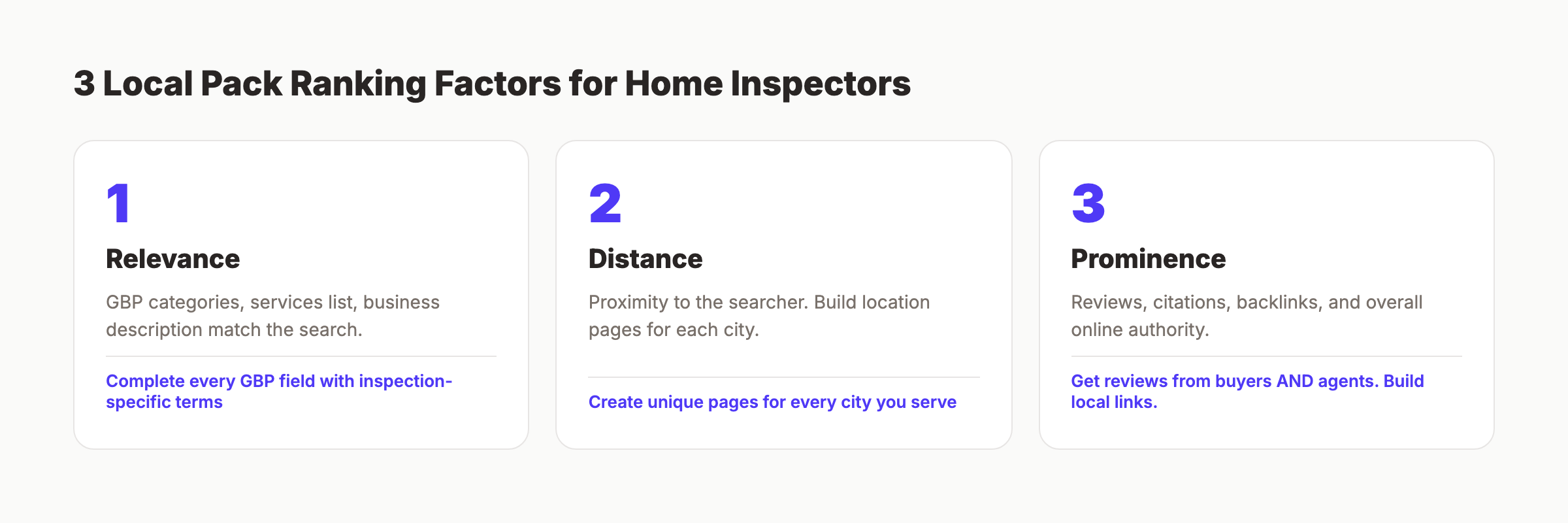
Local SEO is the engine behind home inspector visibility. When a buyer types “home inspector near me,” Google uses 3 main factors to decide who appears in the local pack: relevance, distance, and prominence. Your job is to maximize all 3.
Read the full local SEO guide for the broader strategy. Here is what applies specifically to home inspectors.
NAP Consistency Across the Web
NAP stands for Name, Address, Phone number. Google cross-references your business information across dozens of directories. If your business name is “Precision Home Inspections LLC” on Google but “Precision Inspections” on Yelp, that inconsistency hurts your rankings.
Audit and fix your citations on these platforms:
- Google Business Profile
- Yelp
- Bing Places
- Apple Maps
- Better Business Bureau
- Angi (formerly Angie’s List)
- HomeAdvisor
- InterNACHI directory
- ASHI directory
- Your state licensing board directory
Build Location-Specific Pages
If you serve multiple cities, create a dedicated page for each one. A page targeting “home inspector Clearwater FL” should mention Clearwater neighborhoods, local real estate market conditions, and specific inspection concerns (hurricane damage, aging roofs, Chinese drywall).
Do not create thin, duplicate pages with only the city name swapped out. Each location page needs 400+ words of unique content. Google penalizes doorway pages.
Local Link Building
Earn backlinks from local sources. Join your local Chamber of Commerce. Sponsor a local real estate event. Write a guest post for a local real estate blog. Get listed in your city newspaper’s business directory.
Local links carry more weight for local SEO than a link from a national website. One link from your city’s real estate association is worth more than 10 links from random directories.
Use local SEO tools to track your local rankings and monitor citation accuracy.
Local SEO puts your inspection business on the map. Literally. We publish local content that ranks. Start for $1 →
Content Marketing for Home Inspectors
Blogging is the most underused marketing channel in the home inspection industry. Most inspectors have zero blog posts on their website. That is an enormous opportunity for anyone willing to publish consistently.
Content does 3 things for your inspection business. It ranks for informational keywords that bring new visitors. It builds trust with buyers and agents who read your expertise. And it creates pages that earn backlinks from real estate blogs and local news sites.
Blog Topics That Attract Homebuyers
Write about the questions homebuyers ask before, during, and after an inspection. These topics drive consistent organic traffic month after month.
Pre-Inspection Topics:
- What does a home inspection cover?
- How much does a home inspection cost in [city]?
- Do I need a home inspection for new construction?
- Home inspection vs. appraisal: What is the difference?
During-Inspection Topics:
- Should you attend your home inspection?
- What to expect during a home inspection
- Questions to ask your home inspector
Post-Inspection Topics:
- How to read your home inspection report
- Common home inspection findings (and which ones matter)
- Can you negotiate repairs after a home inspection?
Blog Topics That Attract Real Estate Agents
Agents are your referral pipeline. Write content they want to share with their clients.
- Top 5 things to fix before a pre-listing inspection
- What agents should tell buyers about the inspection process
- How to choose a home inspector (an agent’s guide)
When an agent shares your blog post with a client, you become the default inspector recommendation. That is content marketing compounding into referrals.
Publishing Frequency
Aim for 4 to 8 blog posts per month. Consistency matters more than volume. Businesses publishing 16+ blog posts per month get 3.5 times more traffic than those publishing 0 to 4. Start with a content calendar and stick to it.
Follow the SEO content writing guide to write posts that rank. Use the blog SEO framework for on-page optimization of every article.
Reviews and Real Estate Agent Referrals
Google reviews are both a ranking signal and a conversion tool. A home inspector with 75 five-star reviews will outrank and outbook a competitor with 8 reviews every time. Reviews are the bridge between SEO and revenue.
How Many Reviews Do You Need?
Count the reviews your top 3 competitors have on Google. Your goal is to exceed the highest number by 20%. If the top inspector in your city has 60 reviews, your target is 72.
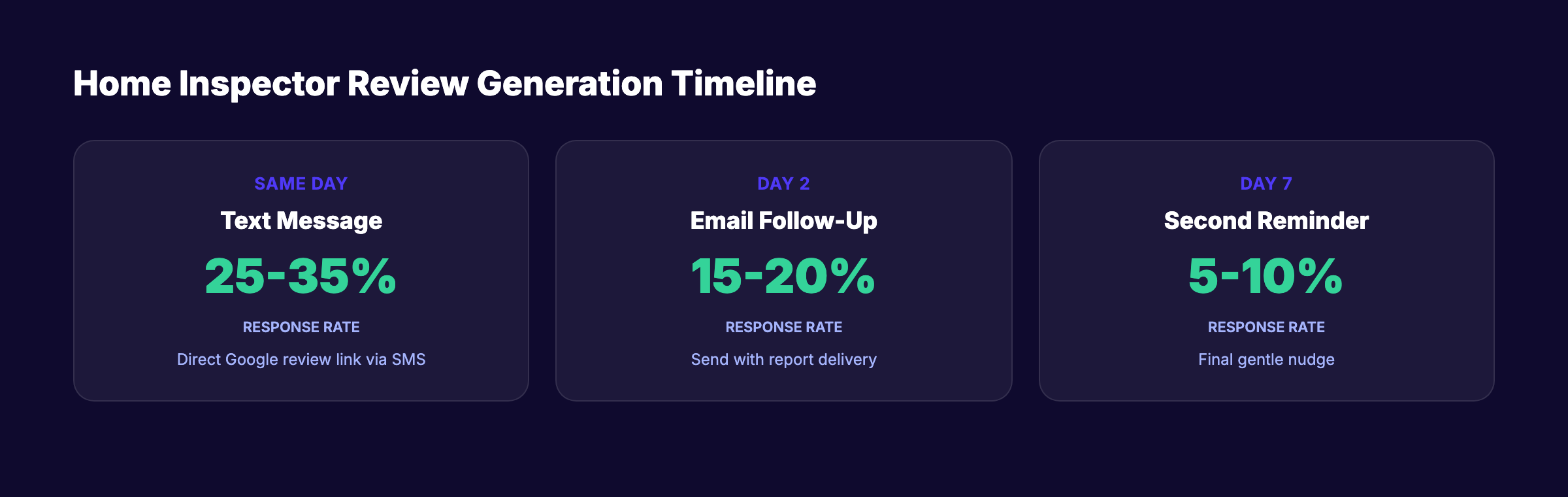
Here is a framework for systematic review generation:
| Timing | Method | Expected Response Rate |
|---|---|---|
| Same day as inspection | Text message with direct review link | 25-35% |
| 2 days post-inspection | Email follow-up with report delivery | 15-20% |
| 1 week post-inspection | Second email reminder | 5-10% |
Use a review request generator to create templates. Use a review response generator to reply to every review within 24 hours. Responding to reviews signals to Google that your business is active and engaged.
Get Reviews From Both Buyers and Agents
Most inspectors only ask buyers for reviews. Ask agents too. When a listing agent sees that you deliver thorough, fair reports on time, ask for a Google review mentioning your professionalism. Agent reviews carry social proof with other agents searching for inspectors.
Read the complete guide on how to get more Google reviews for detailed scripts and strategies.
Turn SEO Visibility Into Agent Relationships
When agents search “home inspector [city]” and find your website, they evaluate you the same way a buyer does. A professional website with blog content, sample reports, clear pricing, and dozens of reviews positions you as the obvious choice.
Use review management tools to monitor reviews across Google, Yelp, and industry-specific platforms.
Technical SEO for Home Inspector Sites
Technical SEO ensures Google can crawl, index, and rank your website without friction. Most home inspector websites run on platforms like Spectora, HomeGauge, or WordPress. Each has different technical requirements.
Site Speed and Mobile Performance
Google uses Core Web Vitals as a ranking factor. If your site takes more than 3 seconds to load on mobile, you lose both rankings and visitors. Over 60% of home inspection searches happen on mobile devices.
Run your site through Google PageSpeed Insights. Target these scores:
- Largest Contentful Paint (LCP): Under 2.5 seconds
- First Input Delay (FID): Under 100 milliseconds
- Cumulative Layout Shift (CLS): Under 0.1
Common fixes for inspector websites: Compress photos (especially inspection sample images), enable browser caching, and use a CDN if your hosting provider does not include one.
Schema Markup
Add schema markup to your website. For home inspectors, implement these schema types:
- LocalBusiness Schema — Business name, address, service area, phone, hours, reviews
- Service Schema — Each inspection service with pricing and descriptions
- FAQ Schema — For FAQ pages and blog posts with question-and-answer content
Use the schema markup generator to create structured data without writing code.
Crawlability and Indexing
Make sure Google can find all your pages. Submit an XML sitemap through Google Search Console. Configure your robots.txt to allow crawling of all public pages.
Check for and fix broken links monthly. Set up Google Analytics 4 to track visitor behavior.
Technical issues silently kill rankings. Run a free audit with our SEO audit tool to find what your site needs to fix today. Start for $1 →
Measuring Results and ROI
SEO without measurement is guessing. You need to track specific metrics to know what is working, what needs adjustment, and whether your investment is paying off.
Key Metrics for Home Inspectors
| Metric | Tool | What It Tells You |
|---|---|---|
| Organic traffic | Google Analytics 4 | Total visitors from search |
| Keyword rankings | Google Search Console | Which terms you rank for |
| Map pack position | Local rank tracker | Your local pack visibility |
| Phone calls from GBP | GBP Insights | Direct leads from Google |
| Website form submissions | Google Analytics 4 | Online booking requests |
| Review count and rating | GBP dashboard | Social proof strength |
| Backlink count | Best free SEO tools | Authority growth |
Calculate Your SEO ROI
Take the number of organic leads per month. Multiply by your conversion rate (most inspectors convert 40% to 60% of inbound inquiries). Multiply by your average inspection fee.
Example:
- 30 organic leads per month
- 50% close rate = 15 inspections
- $400 average fee = $6,000 monthly revenue
- SEO investment: $99 to $500 per month
- ROI: 12x to 60x
Use the SEO ROI calculator to model your specific numbers. Read the full guide on how to measure content marketing ROI.
Timeline Expectations
Home inspector SEO moves faster than most industries. The competition is lower, and Google rewards local businesses that optimize properly.
| Timeframe | Expected Results |
|---|---|
| Month 1 | GBP optimized, site audit complete, first blog posts live |
| Month 2-3 | Ranking movement for long-tail keywords, GBP appearing in local pack |
| Month 3-6 | Page 1 rankings for primary city keywords, steady organic leads |
| Month 6-12 | Dominant local pack position, compound traffic growth |
Read how long SEO takes for a detailed breakdown of ranking timelines by industry.
FAQ
How much does SEO cost for a home inspector?
DIY SEO costs nothing but your time, which most inspectors do not have between inspections, report writing, and running the business. Professional SEO services range from $99 per month for content-only options to $1,500+ for full-service agencies. A done-for-you SEO service that publishes 30 articles per month starts at $99, making it the most cost-effective option for solo inspectors and small firms.
How long does it take for a home inspector to rank on Google?
Most home inspectors can reach page 1 for local keywords within 1 to 3 months. The home inspection industry has lower online competition than fields like dental, legal, or HVAC. Consistent publishing, review generation, and GBP optimization accelerate the timeline.
Do home inspectors need a blog?
Yes. A blog is the most effective way to build topical authority, rank for informational keywords, and attract both homebuyers and real estate agents. Inspectors who blog consistently generate 3 to 5 times more organic traffic than those who do not. Each post is a new page Google can rank.
What keywords should home inspectors target first?
Start with “[city] home inspector” and “[city] home inspection” on your homepage and service pages. Then target ancillary services like “radon testing [city]” and “mold inspection [city].” Blog content should target informational queries like “what does a home inspection cover” and “home inspection checklist.”
Should I use Spectora, ISN, or HomeGauge for my website?
Each platform offers built-in website templates. Spectora and HomeGauge include basic SEO features like title tags and meta descriptions. However, inspector-specific platforms often limit your ability to add blog content, custom pages, and schema markup. A WordPress site with your scheduling software embedded gives you the most SEO flexibility.
How do I get real estate agents to find me through Google?
Agents search Google just like buyers do. Rank for “[city] home inspector” and create content agents want to share, such as pre-listing inspection guides and buyer education articles. A strong Google presence with 50+ reviews makes you the safe recommendation for any agent.
That is everything you need to build a home inspector SEO strategy that generates bookings without depending on a handful of agent referrals. Pick one chapter. Start there. Stack the results.
Your SEO compounds with every page, every review, and every blog post you publish. The inspectors who start now will own the local search results 6 months from today.
Written and published by Stacc. We publish 3,500+ articles per month across 70+ industries. All data verified against public sources as of March 2026.