
Page Authority vs Domain Authority: Complete Guide
Page authority vs domain authority explained. Learn what each Moz metric measures, how they differ, and which matters more for your SEO strategy in 2026.
Stacc Editorial • 2026-04-04 • SEO Tips
In This Article
Page Authority vs Domain Authority: Complete Guide
Most SEO teams obsess over domain authority. They chase a single number while ignoring the metric that actually predicts which pages rank. A Moz study found that page authority correlates more directly with individual URL rankings than domain authority alone.
Understanding page authority vs domain authority saves you from wasting months on the wrong optimization targets. One measures your entire site. The other measures a single URL. Confusing the two leads to misallocated budgets and stalled rankings.
In this guide, you will learn:
- What domain authority and page authority actually measure
- The 7 key differences between PA and DA
- When to prioritize each metric in your SEO strategy
- How to improve both scores with proven tactics
- The mistakes that keep most sites stuck below DA 30
We publish 3,500+ blog posts across 70+ industries. Every article we ship goes through on-page optimization that directly affects page authority. This guide covers everything we have learned about these two metrics.
Table of Contents
- What Is Domain Authority?
- What Is Page Authority?
- Page Authority vs Domain Authority: Key Differences
- How Domain Authority Affects Your SEO Strategy
- How Page Authority Affects Individual Rankings
- How to Improve Domain Authority
- How to Improve Page Authority
- Common Mistakes When Using PA and DA
- FAQ
What Is Domain Authority? {#what-is-domain-authority}
Domain authority is a search engine ranking score created by Moz. It predicts how likely an entire website is to rank in search engine results pages. The score runs from 1 to 100 on a logarithmic scale. Higher scores mean stronger ranking potential across all pages on that domain.
Understanding domain authority is the starting point for comparing it against page authority. Both metrics serve different purposes in your SEO workflow.
How Moz Calculates Domain Authority
Moz uses a machine learning model trained against real Google search results. The algorithm analyzes over 40 signals from the Moz Link Explorer index. These signals include the total number of backlinks, the number of unique referring domains, MozRank, and MozTrust scores.
The model predicts ranking probability. It does not directly influence Google rankings. Google has confirmed that domain authority is not a ranking factor in its algorithm. Moz itself states this clearly in its documentation.
The 1 to 100 Logarithmic Scale
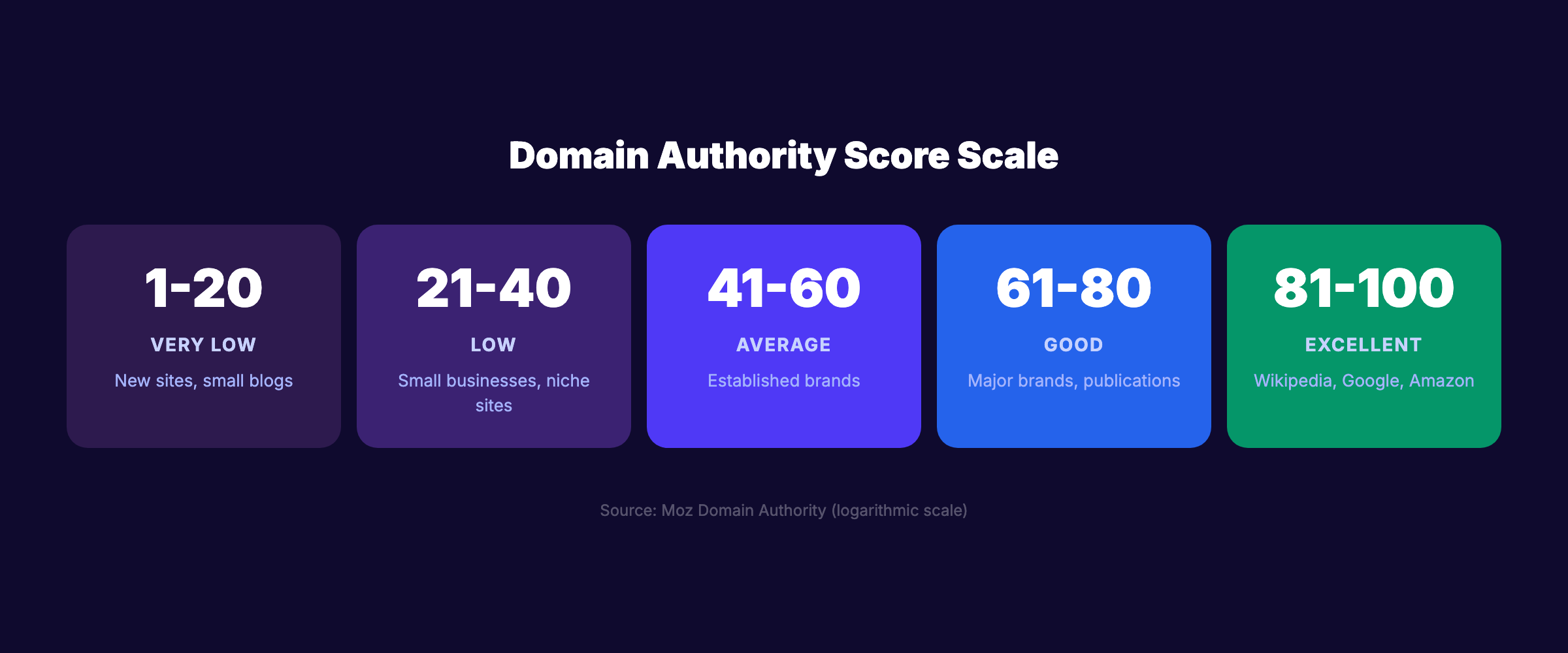
The scoring system uses a logarithmic scale. Moving from DA 20 to DA 30 requires far less effort than moving from DA 60 to DA 70.
| DA Score Range | Category | Typical Sites |
|---|---|---|
| 1-20 | Very Low | New websites, small blogs |
| 21-40 | Low | Small businesses, niche sites |
| 41-60 | Average | Established businesses, regional brands |
| 61-80 | Good | Major brands, popular publications |
| 81-100 | Excellent | Wikipedia, Google, Amazon |
Brand-new websites almost always start at DA 1. Sites like Wikipedia sit near DA 100. Most small business websites fall between DA 15 and DA 40.
What Is a Good Domain Authority Score?
No universal “good” DA score exists. The metric only matters relative to your competitors. A DA of 35 is strong if your top 5 competitors average DA 25. That same DA 35 is weak if competitors average DA 55.
Check your competitors first. Use Moz Link Explorer or similar tools. Then set realistic targets based on your competitive set. A competitor analysis reveals where you stand and what gap you need to close.
What Is Page Authority? {#what-is-page-authority}
Page authority measures the ranking strength of a single web page. Moz created this metric alongside domain authority. While DA evaluates an entire domain, PA focuses on one specific URL. The score also runs from 1 to 100 on the same logarithmic scale.
A homepage might have PA 45 while a deep blog post on the same site has PA 12. Each URL earns its own score based on the links and signals pointing to that specific page.
How Page Authority Differs from Domain Authority
Domain authority aggregates signals across every page on a domain. Page authority isolates signals for one URL. Think of DA as a team batting average and PA as an individual player’s average.
A site with DA 50 can have pages with PA ranging from 5 to 65. The homepage and top-linked pages will have the highest PA scores. Newer pages with few backlinks will have lower PA scores regardless of the domain’s overall authority.
What Signals Determine Page Authority
Moz calculates page authority using similar machine learning models as DA. The key difference is scope. PA focuses on signals pointing to that specific URL.
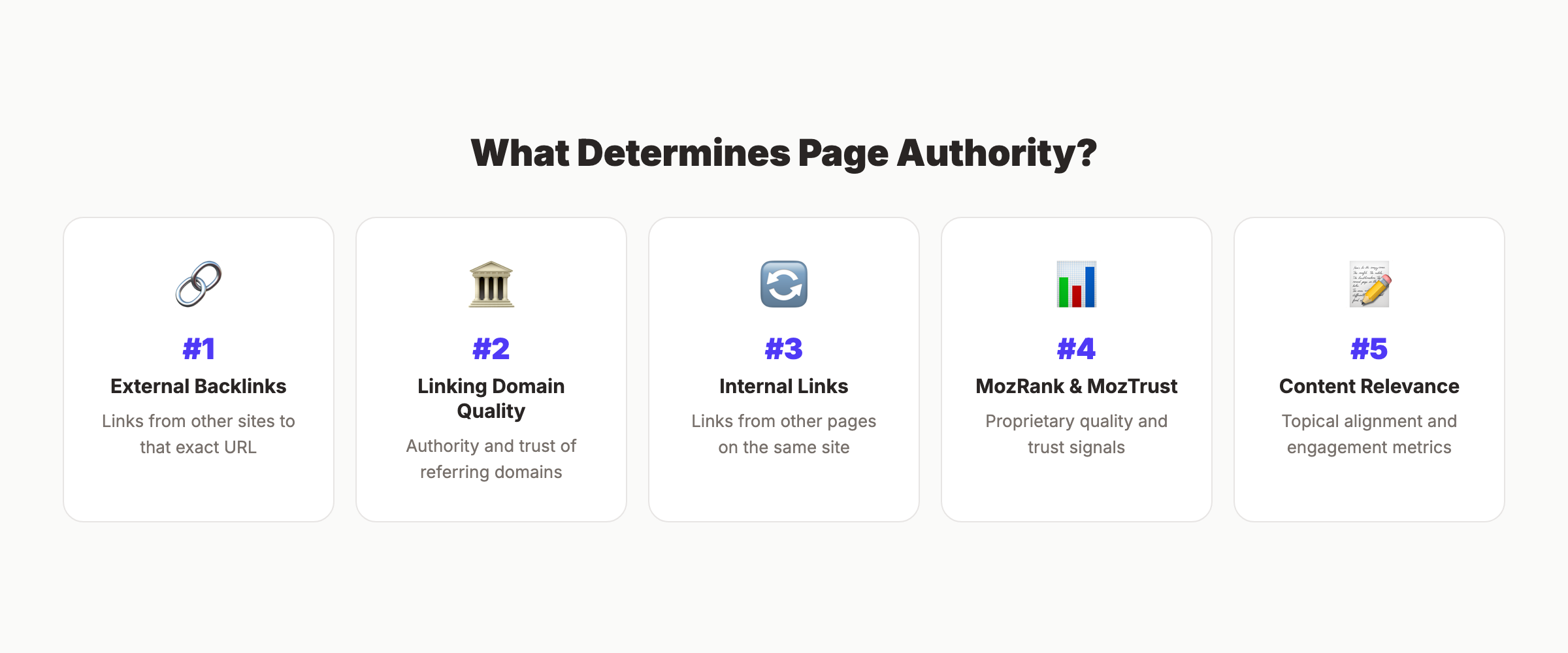
Key factors include:
- Number of external links pointing to that exact URL
- Quality and authority of those linking domains
- Internal links from other pages on the same site
- Content relevance and engagement signals
- MozRank and MozTrust for that specific page
The link equity flowing to a specific page is the primary driver. A page that earns 50 links from high-authority sites will have a much higher PA than a page with 5 links from low-quality directories.
When Page Authority Matters Most
PA matters when you care about ranking a specific URL. If you want your “best CRM software” page to rank on page 1, that page’s PA score tells you more about its ranking potential than your site’s overall DA.
Use PA to evaluate individual content performance. If a blog post has PA 8 while competing pages average PA 35, that single post needs more links and optimization. Your overall DA will not save an under-linked page.
Page Authority vs Domain Authority: Key Differences {#page-authority-vs-domain-authority-key-differences}
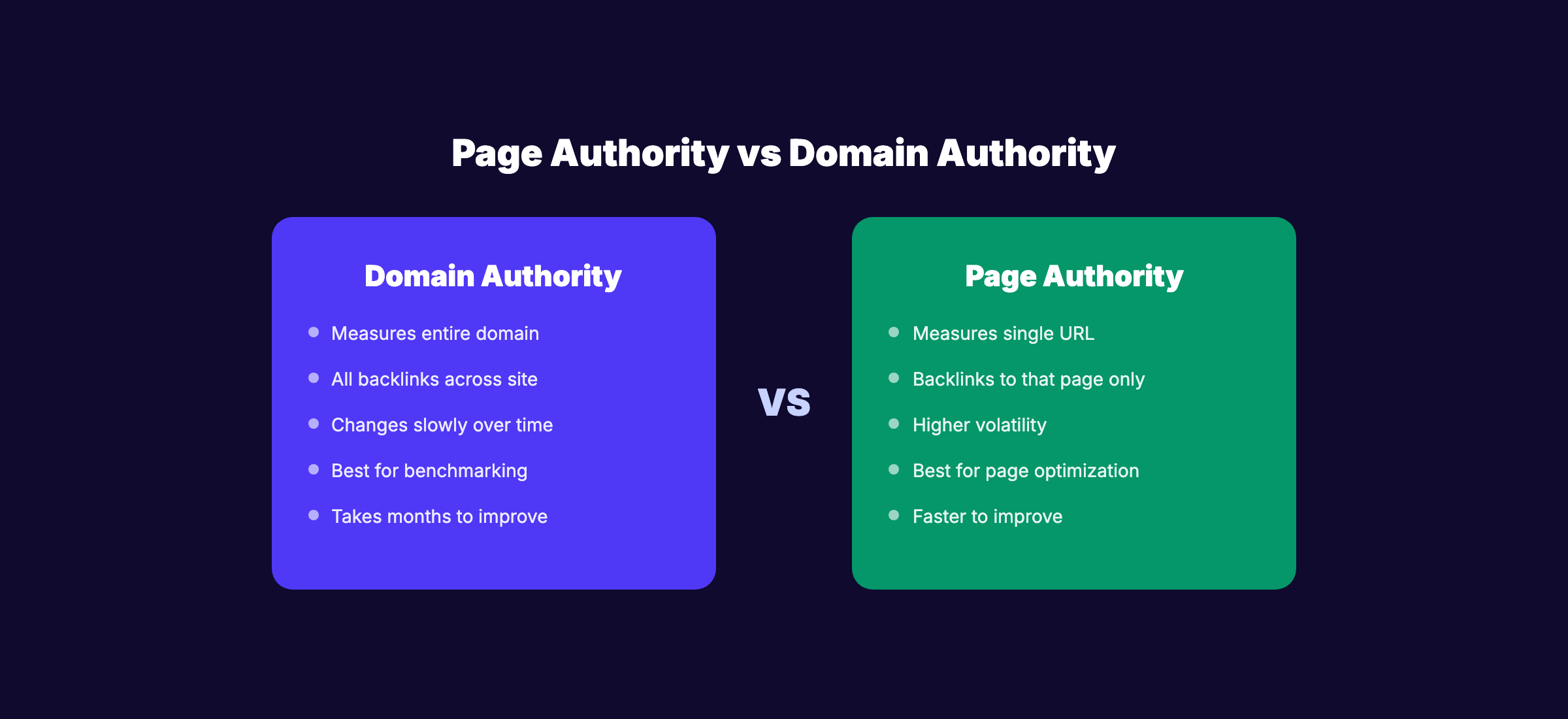
The page authority vs domain authority debate comes down to scope. DA measures site-wide strength. PA measures individual page strength. Both use the same 1 to 100 scale, but they answer different questions about your SEO performance.
Here is the complete comparison between these two Moz metrics.
Side-by-Side Comparison Table
| Factor | Domain Authority (DA) | Page Authority (PA) |
|---|---|---|
| Scope | Entire domain | Single URL |
| Created by | Moz | Moz |
| Scale | 1-100 (logarithmic) | 1-100 (logarithmic) |
| Primary input | All backlinks to the domain | Backlinks to that specific page |
| Speed to improve | Slow (months to years) | Faster (weeks to months) |
| Best use case | Competitive benchmarking | Individual page optimization |
| Volatility | Low (changes slowly) | Higher (changes with each new link) |
| Google ranking factor | No | No |
How They Work Together
DA and PA have a symbiotic relationship. When you build links to individual pages, those pages gain PA. As more pages gain higher PA scores, the overall DA rises. The reverse also applies. A site with higher DA passes more link equity to new pages through internal links.
This creates a compounding effect. A site with DA 55 publishes a new blog post. That post immediately benefits from the domain’s existing authority through internal links. The same blog post on a DA 15 site starts with far less inherited authority.
Which Metric Matters More?
Neither metric matters more in every situation. The answer depends on your goal.
Focus on DA when:
- Evaluating a site for link building outreach
- Benchmarking against competitors
- Assessing overall site health over time
Focus on PA when:
- Deciding which pages need more links
- Evaluating specific ranking opportunities
- Prioritizing content for optimization
For most SEO teams, PA provides more actionable insight. You cannot rank a domain. You rank individual pages. PA tells you which pages have the strength to compete and which need more support.
Stop writing. Start ranking. Stacc publishes 30 SEO articles per month for $99. Start for $1 →
How Domain Authority Affects Your SEO Strategy {#how-domain-authority-affects-your-seo-strategy}
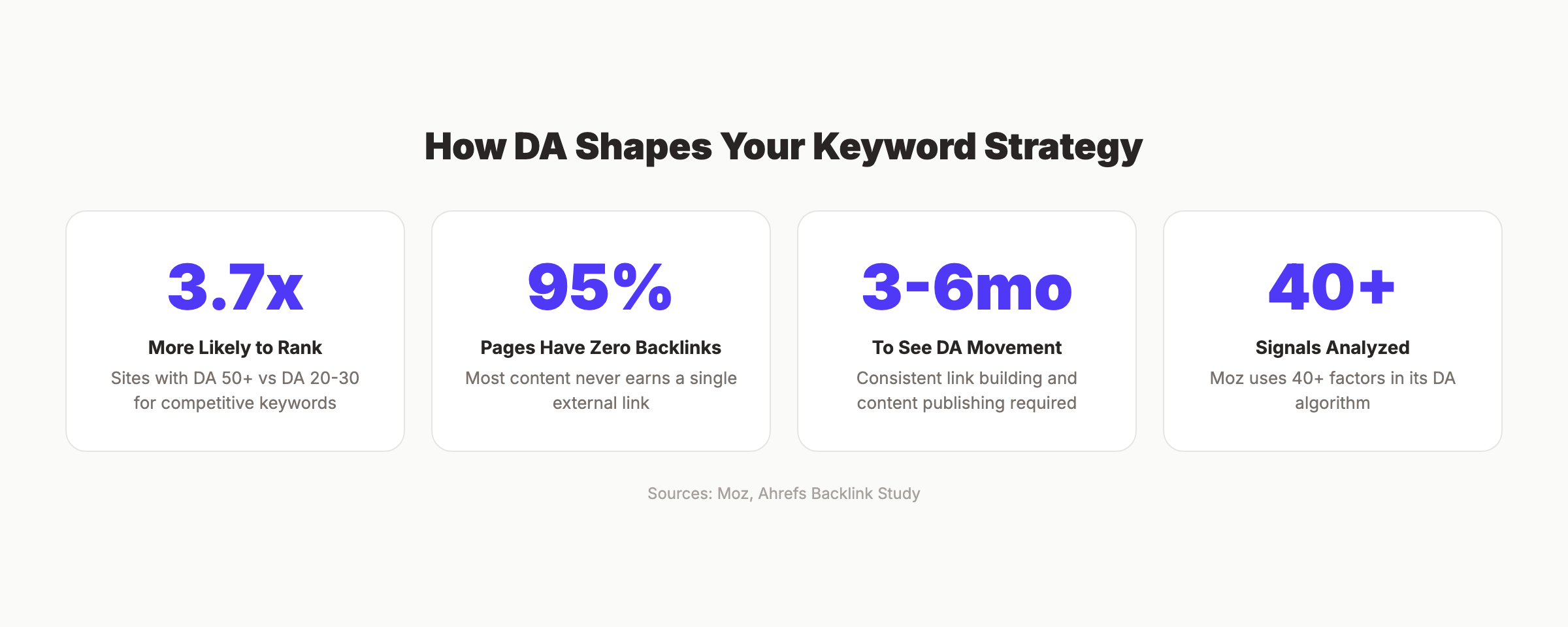
Domain authority shapes which keywords you can realistically target. A DA 20 site will struggle to rank for keywords where the top 10 results average DA 60+. Understanding your DA helps you pick winnable battles and set realistic timelines.
DA as a Competitive Benchmarking Tool
The most practical use of DA is competitive analysis. Pull the DA scores for the top 10 results on your target keyword. If they average DA 45 and your site sits at DA 18, you need a different strategy than direct competition.
This does not mean you cannot rank. Pages with lower DA sites regularly outrank higher DA competitors. But it signals that you need stronger on-page SEO, more targeted content, or longer-tail keyword variations.
Correlation vs Causation
DA correlates with rankings. It does not cause them. This distinction matters.
Google does not check your Moz DA score. Google evaluates hundreds of ranking factors including content quality, backlink profile, user experience, and topical relevance. DA happens to reflect many of the same signals Google values.
Sites with high DA tend to rank well because they have earned many quality backlinks over time. The backlinks drive rankings. DA merely reflects the backlink profile that drives rankings.
DA and Keyword Difficulty
Most SEO tools use domain authority data to calculate keyword difficulty scores. Ahrefs, Semrush, and Moz all factor domain-level authority into their difficulty ratings.
A keyword with difficulty 65 typically means the ranking pages have strong DA and PA scores. Targeting that keyword with a DA 20 site requires either exceptional content, a unique angle, or a long-term link building campaign to close the authority gap.
How Page Authority Affects Individual Rankings {#how-page-authority-affects-individual-rankings}
Your domain authority sets the floor. Your page authority determines which specific URLs break through. Every ranking happens at the page level. Google ranks pages, not domains. PA is the metric that reflects this reality.
Page-Level Ranking Signals
Google evaluates each URL independently. Two pages on the same domain can have completely different ranking outcomes. One page might sit on page 1 for its target keyword while another languishes on page 5.
The difference often comes down to page-level signals. The number of backlinks to that specific URL, the quality of those links, the internal link support, and the content quality all contribute to PA and to ranking outcomes.
Using PA to Prioritize Optimization
PA reveals your highest-potential pages. Sort your pages by PA score and compare against their current rankings.
Pages with high PA but poor rankings likely have content or technical issues. Fix the content and watch rankings improve.
Pages with low PA but strong content need more links. Direct your link building outreach toward those URLs. Use internal linking to funnel authority from high-PA pages to lower-PA targets.
PA Benchmarking Against Competitors
Pull the PA scores of the pages ranking for your target keyword. If the top 3 results have PA 40, 38, and 42, your page needs PA in that range to compete.
You can check PA using Moz Link Explorer, the MozBar browser extension, or third-party tools that pull Moz data. Track PA monthly for your most important pages.
| PA Score | Competitive Level | Action Needed |
|---|---|---|
| 1-15 | Low | Needs significant link building |
| 16-30 | Moderate | Needs targeted link acquisition |
| 31-50 | Strong | Competitive for most keywords |
| 51-70 | Very Strong | Can target high-difficulty keywords |
| 71-100 | Elite | Top-tier pages, major brands |
Your SEO team. $99 per month. 30 optimized articles, published automatically. Start for $1 →
How to Improve Domain Authority {#how-to-improve-domain-authority}
Improving domain authority requires consistent effort across your entire site. DA does not change overnight. Most sites see meaningful DA improvements over 3 to 6 months of sustained work. The key is building a strong backlink profile and maintaining site quality.
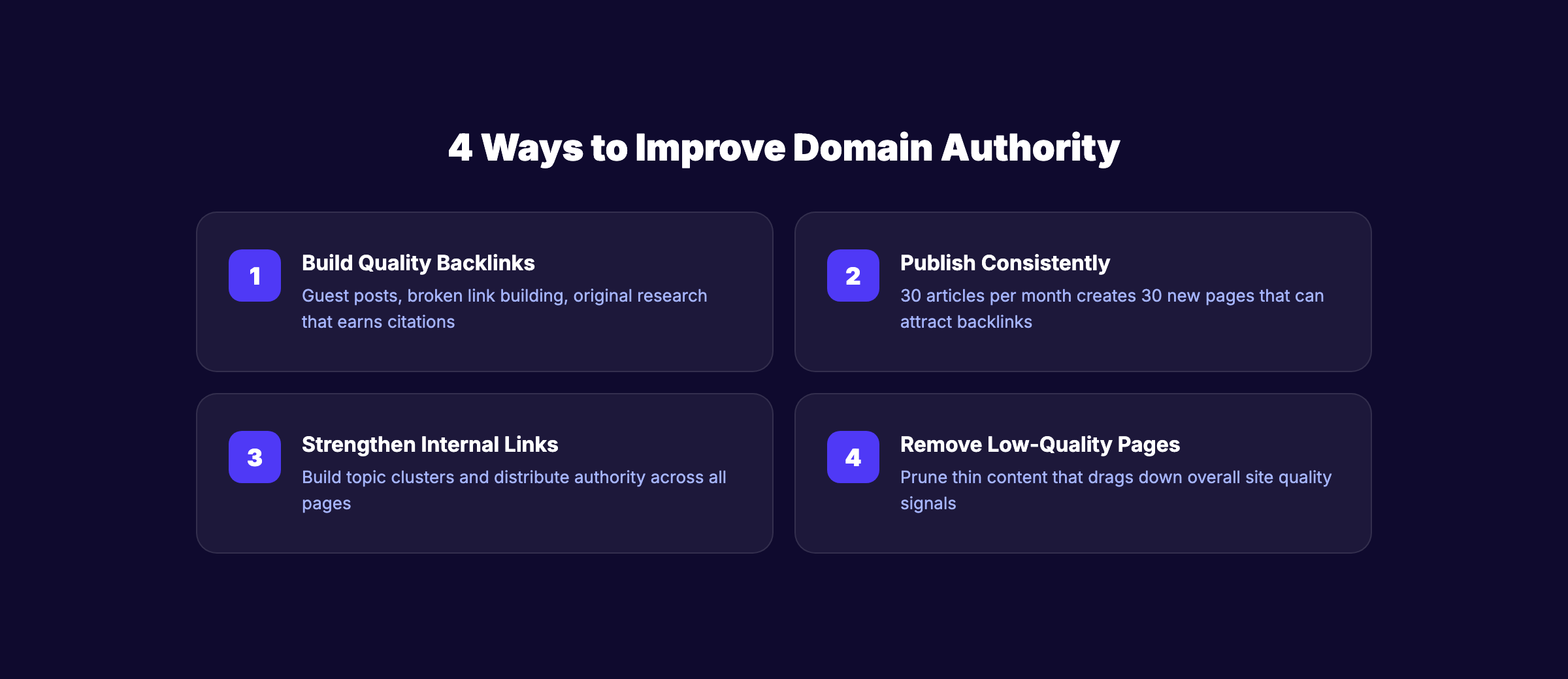
Build High-Quality Backlinks
Backlinks remain the strongest driver of domain authority. But quality matters far more than quantity. One link from a DA 70 site provides more value than 50 links from DA 10 sites.
Focus on these link building strategies:
- Guest posting on relevant industry publications
- Broken link building to replace dead links with your content
- Creating link-worthy assets like original research and data studies
- Building relationships with journalists and bloggers
Audit your existing backlink profile regularly. A backlink audit identifies toxic backlinks dragging your DA down. Disavow spam links that provide no value.
Publish Content Consistently
Sites that publish regularly tend to have higher DA scores. Each new piece of quality content creates a new page that can earn backlinks. Over time, this builds a larger backlink profile across more URLs.
A content marketing strategy with consistent publishing creates a compounding effect. We call this the Content Compound Effect. Thirty articles per month creates 30 new ranking opportunities and 30 new pages that can attract backlinks.
Strengthen Your Internal Link Structure
Internal links distribute authority throughout your site. When a high-PA page links to a newer page, it passes link equity. A strong internal link structure ensures that every page on your site benefits from your best-performing content.
Build content clusters around core topics. Link related pages together. Use descriptive anchor text that signals relevance to search engines.
Remove Low-Quality Pages
Pruning weak pages can improve DA. Pages with thin content, zero backlinks, and no traffic drag down your site’s overall quality signals. Audit your content regularly. Delete or redirect pages that add no value.
A site with 200 strong pages often has higher DA than a site with 2,000 pages where 1,800 are thin or duplicate content.
How to Improve Page Authority {#how-to-improve-page-authority}
Page authority responds faster to optimization than domain authority. A targeted link building campaign can move a page’s PA within weeks. The key is directing signals to specific URLs rather than spreading effort across your entire site.
Earn Backlinks to Specific Pages
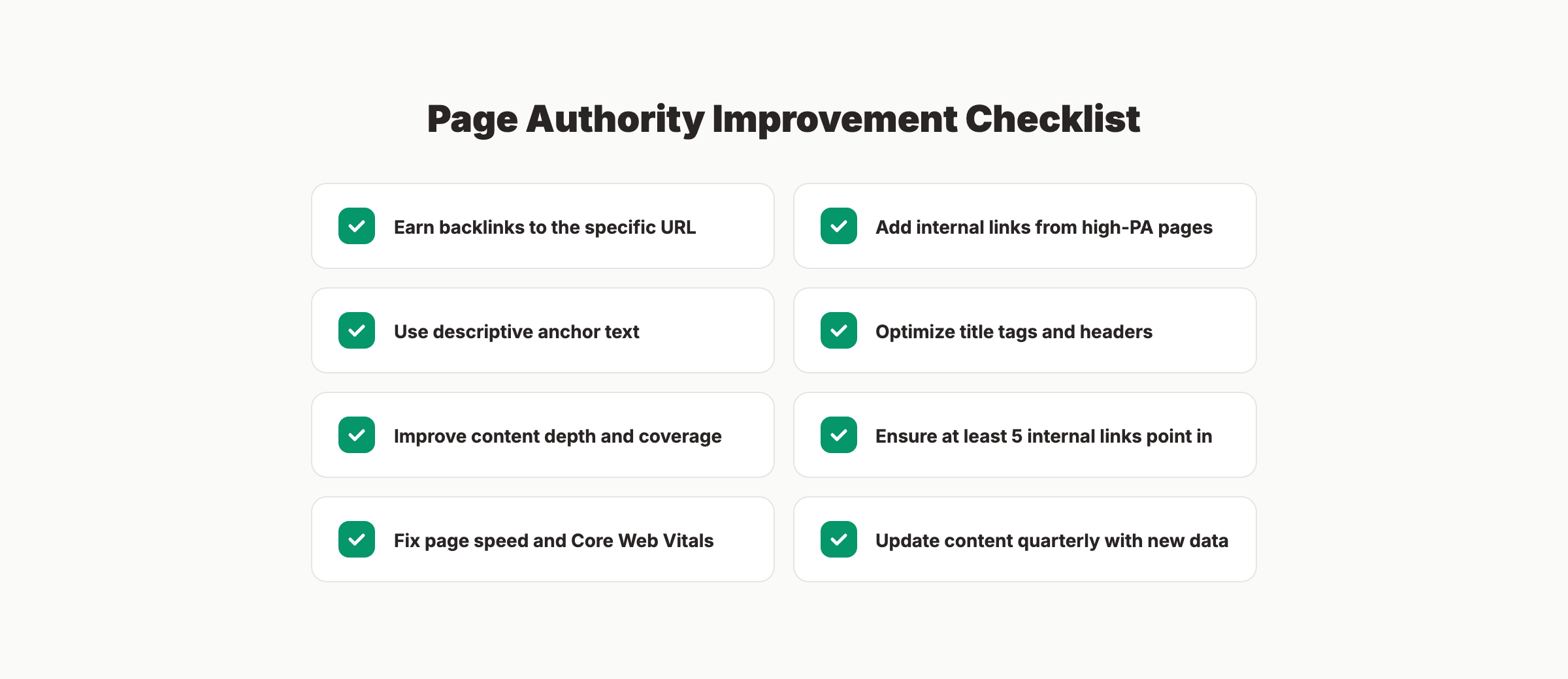
The most direct way to increase PA is earning backlinks to that exact URL. Do not just build links to your homepage. Target the pages you want to rank.
Effective tactics include:
- Creating original data or research that others cite
- Writing definitive guides that become reference resources
- Outreach campaigns targeting specific URLs
- Resource page link building for your best content
Each new quality backlink to a page increases its PA. Focus on earning links from sites with DA 30 or higher for the strongest impact.
Optimize Internal Linking to Target Pages
Internal links are the fastest way to boost PA for specific pages. You control your internal link structure completely. No outreach required.
Follow this process:
- Identify your top 10 pages by PA score
- Find relevant pages that could link to your target URL
- Add contextual links with descriptive anchor text
- Check that every important page receives at least 5 internal links
- Use your on-page SEO checklist to verify structure
Pages buried deep in your site architecture receive less link equity. Move important pages closer to the homepage through navigation or hub pages.
Improve On-Page SEO Signals
On-page optimization supports PA growth indirectly. Better content attracts more backlinks naturally. Pages that fully satisfy search intent earn more shares and citations.
Optimize these elements:
- Title tags with primary keywords
- Header structure (H1, H2, H3 hierarchy)
- Content depth and topic coverage
- Image optimization with alt text
- Page speed and Core Web Vitals
Update and Refresh Existing Content
Old content loses PA over time as links break and competitors publish better resources. Regular content updates signal freshness to search engines and give you opportunities to earn new links.
Refresh your top pages quarterly. Add new data, update statistics, expand thin sections, and fix broken outbound links. Updated content regains lost PA and often surpasses its previous peak.
Publish 30 articles per month. On autopilot. Every post is optimized for on-page SEO from day one. Start for $1 →
Common Mistakes When Using PA and DA {#common-mistakes-when-using-pa-and-da}
PA and DA are useful directional metrics. They become harmful when teams treat them as absolute truth. Here are the mistakes that waste the most time and budget.
Treating DA and PA as Google Ranking Factors
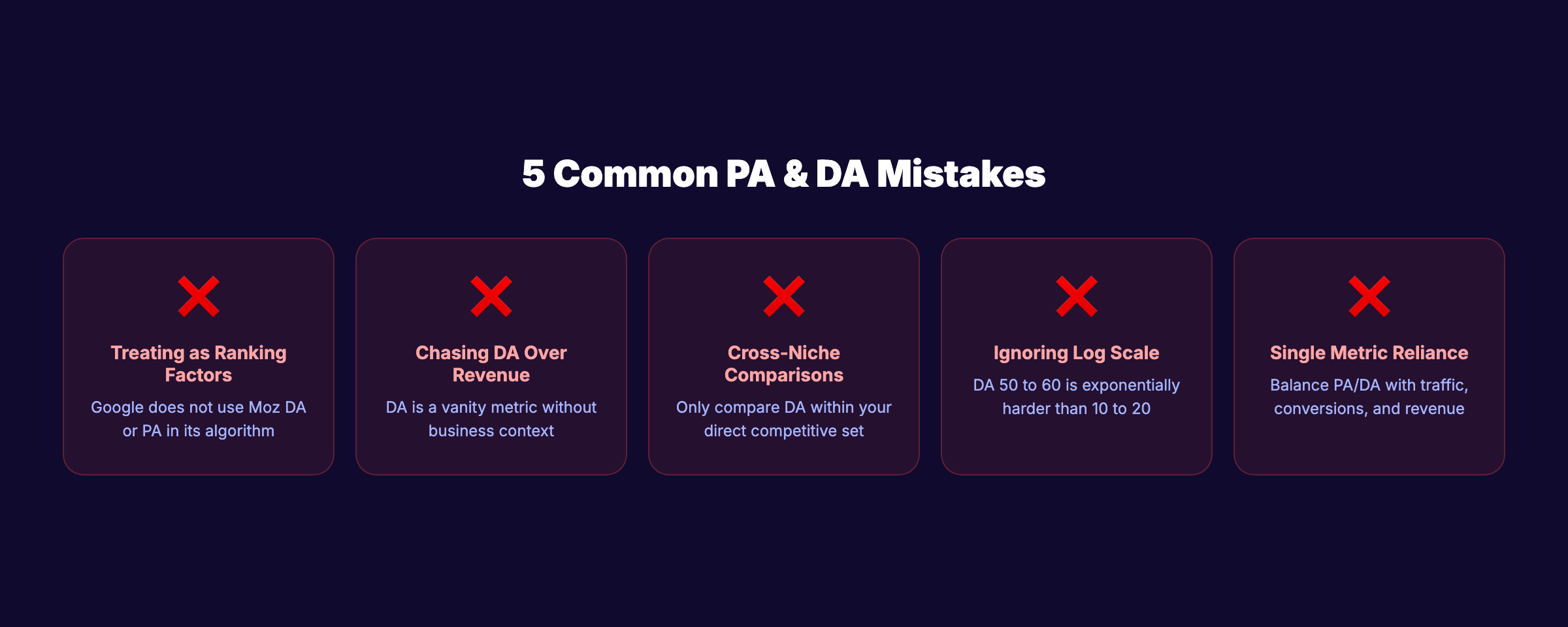
This is the most common and most damaging mistake. Google does not use Moz’s DA or PA scores. These are third-party predictions, not Google ranking factors.
A page with PA 15 can outrank a page with PA 50 if it has better content, stronger topical relevance, or more aligned search intent. PA and DA predict ranking potential. They do not determine ranking outcomes.
Chasing DA Score Instead of Revenue
Some teams spend months trying to move DA from 25 to 30 with no clear business purpose. DA is a vanity metric unless it connects to traffic, leads, or revenue.
A DA 22 site earning $50,000 per month from organic traffic outperforms a DA 55 site earning $5,000. Focus on traffic and conversions. Use DA only as a directional benchmark for competitive analysis.
Comparing DA Across Different Niches
DA scores only make sense within the same niche. Comparing a local plumber’s DA 18 against a national SaaS company’s DA 65 tells you nothing useful.
Compare yourself against direct competitors only. A dental practice with DA 22 competing against other dental practices averaging DA 15 is in a strong position.
Ignoring the Logarithmic Scale
Teams set unrealistic goals because they misunderstand the logarithmic scoring. Moving from DA 10 to DA 20 might take 3 months. Moving from DA 50 to DA 60 could take 2 years.
Set incremental targets. A 5-point DA increase over 6 months is a reasonable goal for most small to mid-size sites. Anything faster than that usually involves aggressive link building.
Over-Relying on a Single Metric
PA and DA are two of dozens of useful SEO metrics. Do not ignore organic traffic, keyword rankings, click-through rates, conversion rates, and topical authority.
Build a balanced SEO dashboard. Include DA and PA alongside revenue-driving metrics. Let business outcomes guide your strategy, not a single third-party score.
FAQ {#faq}
Is domain authority a Google ranking factor?
No. Domain authority is a Moz metric, not a Google ranking factor. Google has confirmed it does not use DA in its algorithm. DA correlates with rankings because it reflects backlink signals that Google does value. Use DA for competitive benchmarking, not as a ranking target.
What is a good page authority score?
A good page authority score depends on your competitive set. For most niches, PA 30 to 50 is strong enough to compete for moderate-difficulty keywords. Compare your PA against the pages currently ranking for your target keyword. If they average PA 35, aim for PA 35 or higher.
Can a low DA site outrank a high DA site?
Yes. Google ranks individual pages, not domains. A DA 20 site can outrank a DA 60 site if the specific page has better content, stronger page-level backlinks, and more aligned search intent. Off-page SEO at the page level often matters more than domain-level authority.
How long does it take to improve domain authority?
Most sites see meaningful DA improvements in 3 to 6 months of consistent link building and content publishing. The logarithmic scale means early gains come faster. Moving from DA 10 to DA 20 takes far less effort than moving from DA 40 to DA 50.
Should I focus on PA or DA first?
Focus on PA for specific pages you want to rank. Focus on DA for long-term site growth. In practice, the best approach is building links to your highest-priority pages. This improves PA for those URLs and gradually lifts DA across the entire domain. Read our blog SEO guide for a complete strategy.
What tools measure page authority and domain authority?
Moz Link Explorer is the primary tool for both PA and DA scores. The MozBar browser extension shows PA and DA in search results. Ahrefs offers similar metrics called URL Rating (UR) and Domain Rating (DR). Semrush provides Authority Score at both the domain and page level.
Final Takeaway
Page authority and domain authority measure different things. DA evaluates your entire site. PA evaluates a single URL. Both are Moz predictions, not Google ranking factors.
The smartest approach is building links to your highest-priority pages. This lifts PA for those specific URLs and compounds into higher DA over time. Stop chasing a vanity number. Start building authority where it drives revenue.
Rank everywhere. Do nothing. Stacc publishes and optimizes your content automatically. 30 articles per month for $99. Start for $1 →
Written and published by Stacc. We publish 3,500+ articles per month across 70+ industries. All data verified against public sources as of March 2026.
