
Perplexity SEO: The Complete Guide (2026)
Learn how to get cited by Perplexity AI search. Covers ranking factors, optimization strategies, PerplexityBot setup, and tracking. Updated March 2026.
Siddharth Gangal • 2026-03-30 • SEO Tips
In This Article
Perplexity AI processes over 1.2 billion search queries per month. It grew 800% year over year. And Gartner predicts traditional search volume will drop 25% by 2026 because of AI chatbots like Perplexity (Gartner).
Perplexity SEO is no longer optional. It is a new acquisition channel. The platform has 45 million monthly active users who ask questions and get answers with cited sources. If your website is one of those cited sources, you get traffic without a single ad dollar.
The problem: most SEO teams still treat Perplexity like Google. They optimize for keywords, chase backlinks, and ignore the structural changes that AI search engines reward. The result is zero citations and zero referral traffic from a platform growing faster than any search engine in history.
We have published 3,500+ blog posts across 70+ industries. Our content appears in AI search results across Perplexity, ChatGPT, and Google AI Overviews. The optimization process overlaps with traditional SEO in some areas. In others, it requires an entirely different approach.
Here is what you will learn in this guide:
- What Perplexity SEO is and how it differs from Google SEO
- How Perplexity selects which sources to cite
- 8 strategies to get your content cited by Perplexity
- Technical setup for PerplexityBot crawler access
- Common mistakes that block your content from AI citations
- How to track and measure Perplexity referral traffic
- A comparison of optimization tactics across Perplexity, ChatGPT, and Google AI Overviews
What Is Perplexity SEO
Perplexity SEO is the practice of optimizing your website content to appear as a cited source in Perplexity AI search results. Unlike Google, where you rank as a blue link, Perplexity generates a written answer and displays source citations alongside it.
Getting “cited” by Perplexity means the platform references your page as evidence for a claim in its response. Each citation links back to your site. Users click these citations to verify information or learn more. That click is your traffic.
This is a fundamental shift in how search works. Google shows 10 links and lets users choose. Perplexity reads dozens of pages, synthesizes an answer, and credits specific sources. Your goal is no longer to rank in position 1. Your goal is to be the source Perplexity trusts enough to cite.
The field falls under a broader discipline called generative engine optimization (GEO). GEO covers optimization for all AI search platforms. Perplexity SEO is GEO applied specifically to the Perplexity platform.
Why Perplexity SEO Matters Now
The numbers tell the story:
| Metric | Value | Source |
|---|---|---|
| Monthly active users | 45 million | DemandSage |
| Monthly search queries | 1.2 to 1.5 billion | SEOProfy |
| Year-over-year user growth | 800% | DemandSage |
| Company valuation | $20 billion | Business of Apps |
| AI search preference over traditional | 44% vs 31% | McKinsey |
McKinsey projects that $750 billion in revenue will flow through AI search channels by 2028. Brands unprepared for AI search risk 20 to 50% traffic declines.
Perplexity is the third-largest AI chatbot behind ChatGPT and Microsoft Copilot. It is also the most citation-friendly. Every Perplexity response includes numbered source links. Every citation is a potential click to your site.
How Perplexity Chooses Sources to Cite
Perplexity does not use the same ranking algorithm as Google. Understanding how it selects sources is the foundation of any Perplexity SEO strategy.
Perplexity uses a multi-step process:
Step 1 — Search. Perplexity sends a web search query (typically through its own index and Bing) based on the user’s prompt.
Step 2 — Retrieve. It pulls the top results and crawls the page content in real time.
Step 3 — Evaluate. A reranking model scores each page for relevance, authority, freshness, and answer quality.
Step 4 — Synthesize. The language model generates a response using the highest-scored sources.
Step 5 — Cite. Each factual claim in the response gets a numbered citation linking to the source.
The Ranking Factors That Matter
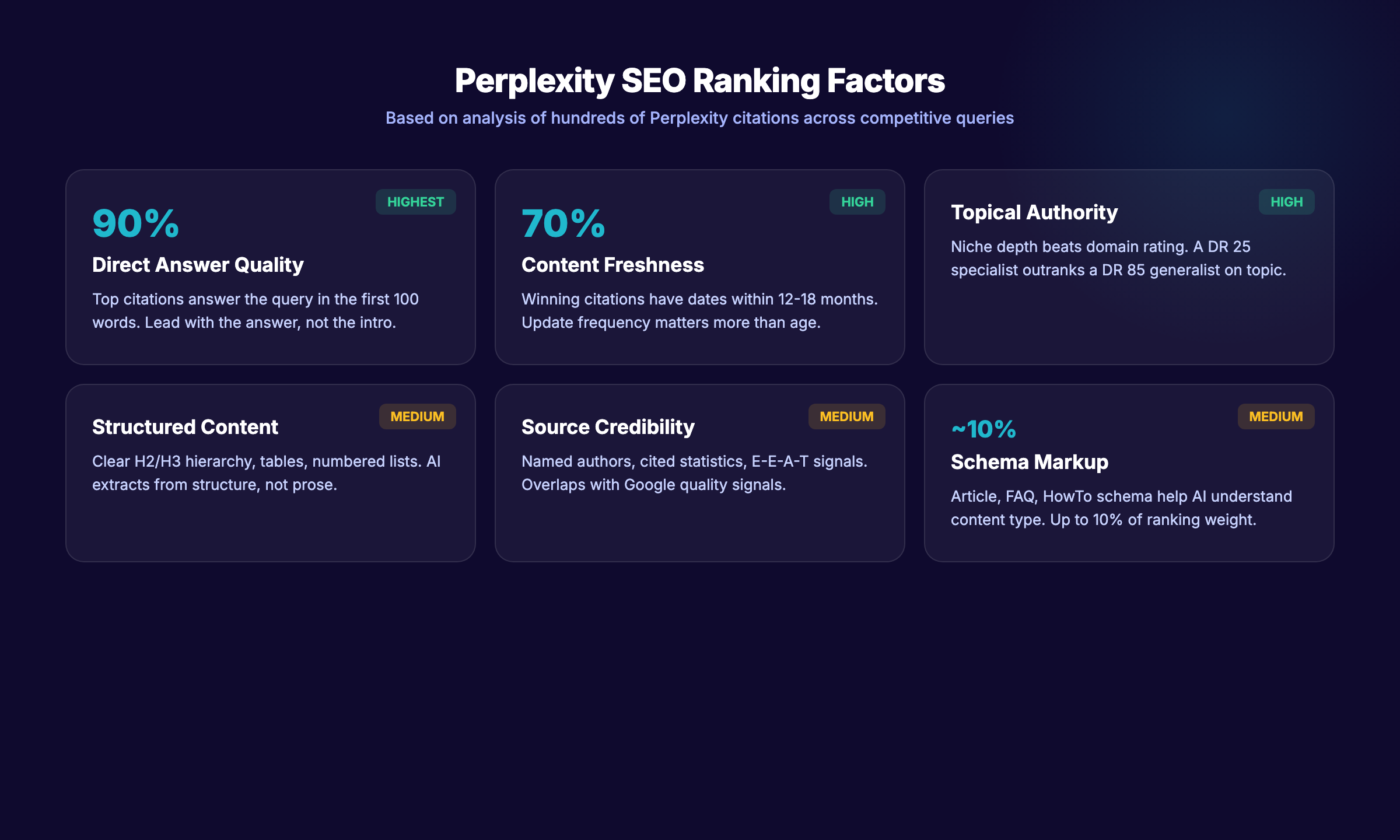
Based on analysis of Perplexity citations across hundreds of queries, these factors determine which pages get cited:
1. Direct Answer Quality (Highest Weight)
90% of top-cited sources provide a clear, direct answer within the first 100 words of the page (LLMClicks study). Perplexity needs a concise, extractable answer. Bury your answer below 500 words of fluff and Perplexity skips your page entirely.
2. Content Freshness
70% of winning citations come from content published or updated within the last 12 to 18 months. Perplexity heavily weights recency. A 2023 guide on the same topic loses to a 2026 update with current data. Keep your content fresh with regular updates.
3. Topical Authority
Domain Rating alone does not determine citations. A DR 25 site with deep expertise in HVAC plumbing will outrank a DR 85 generalist site for HVAC queries. Perplexity evaluates topical depth, not global authority. Build authority through content clusters focused on your niche.
4. Structured Content
Perplexity parses content structure to extract information. Pages with clear H2/H3 hierarchies, tables, numbered lists, and concise paragraphs get cited more often than walls of text. Structure your content for easy extraction by AI systems.
5. Source Credibility Signals
Named authors, cited statistics, links to primary sources, and mentions on authoritative third-party sites all boost credibility. These overlap with E-E-A-T signals that Google uses.
6. Format Matching
Perplexity matches content format to query type. Listicles win “best of” queries. Tables dominate comparison queries. Step-by-step guides lead how-to queries. Match your content format to the query intent.
Stop writing. Start ranking. Stacc publishes 30 SEO-optimized articles per month for $99. Every post is structured for both Google and AI search visibility. Start for $1 →
Perplexity SEO vs Google SEO: Key Differences
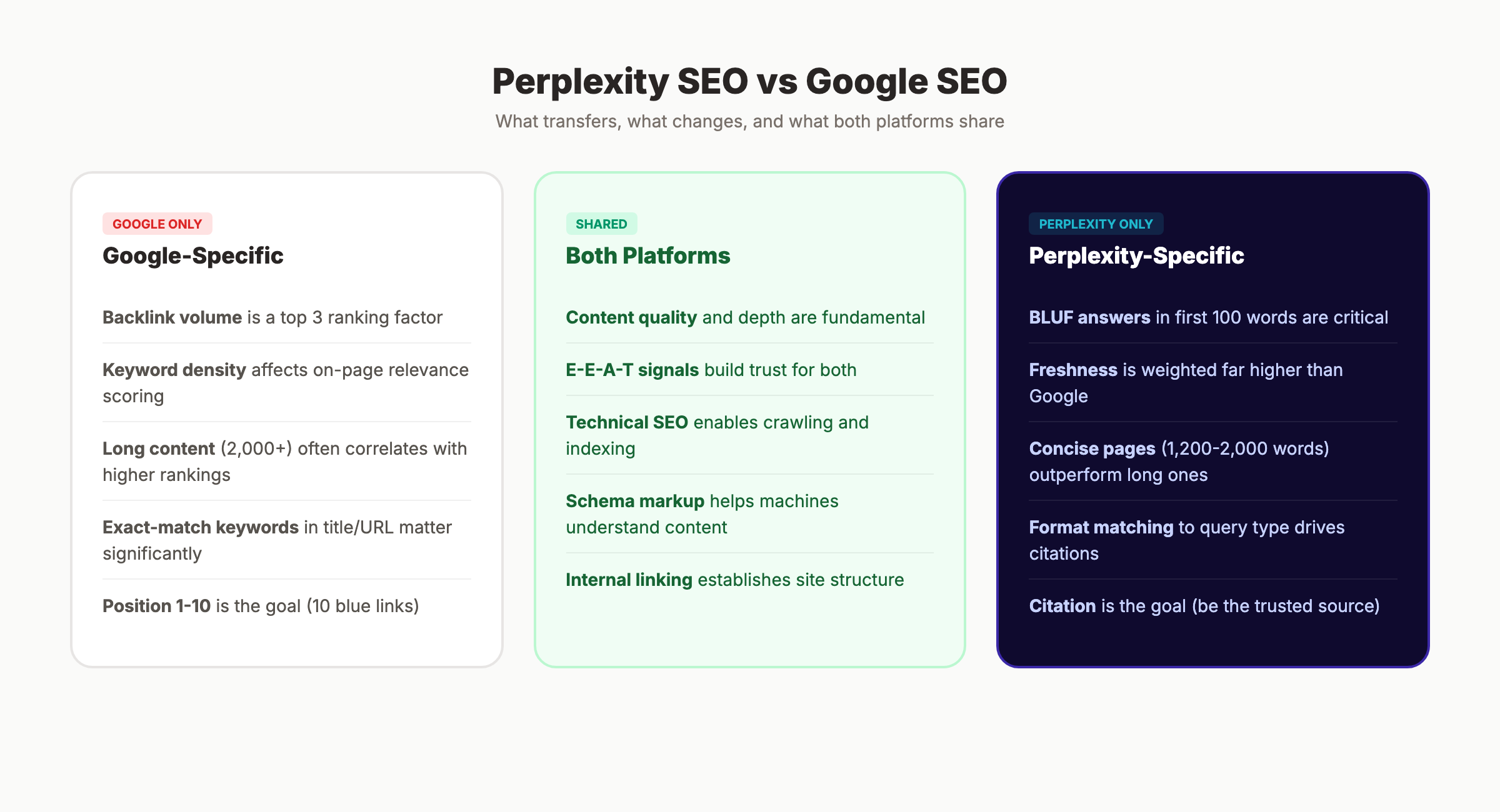
Perplexity SEO and Google SEO share a foundation. Good content, technical accessibility, and authority matter for both. But the differences are significant enough that optimizing for one does not automatically optimize for the other.
| Factor | Google SEO | Perplexity SEO |
|---|---|---|
| Goal | Rank as a blue link (position 1-10) | Get cited as a source in the AI answer |
| Ranking unit | Web page | Specific passage or claim |
| Backlinks | Major ranking factor (top 3) | Indirect signal through domain trust |
| Keyword density | Matters for on-page relevance | Less relevant. Clarity and directness matter more |
| Content length | Longer often ranks better (1,500-3,000+) | Concise, extractable answers win (1,200-2,000 optimal) |
| Freshness | Important for some queries | Critical for almost all queries |
| Featured snippets | Bonus visibility | Direct parallel. Citation = AI featured snippet |
| Click behavior | User clicks your link from SERP | User clicks citation number to verify AI answer |
| Schema markup | Enhances rich results | Helps AI understand content structure (up to 10% factor) |
| Update frequency | Monthly or quarterly is often fine | Weekly to monthly updates improve citation retention |
What Transfers From Google SEO
You do not need to start over. These Google SEO practices directly help Perplexity SEO:
- On-page optimization: title tags, header hierarchy, meta descriptions
- Technical SEO: crawlability, page speed, mobile-friendliness
- Internal linking: helps both crawlers and AI understand site structure
- Content quality: well-researched, original, expert-level content
- Schema markup: structured data that machines can parse
What Does Not Transfer
These Google tactics have little or no effect on Perplexity citations:
- Keyword density optimization. Perplexity understands semantics. Stuffing keywords hurts readability and citation chances.
- Backlink volume campaigns. Perplexity uses trust signals, but a page’s link profile is not weighted like Google’s PageRank.
- Long-tail keyword matching. Perplexity rephrases queries internally. Exact keyword matches matter less than covering the topic thoroughly.
- Ranking position. Being position 1 on Google does not guarantee a Perplexity citation. Perplexity re-evaluates independently.
8 Strategies to Get Cited by Perplexity
These strategies come from analyzing which pages consistently earn Perplexity citations across competitive queries.
Strategy 1: Lead With the Answer (BLUF Method)
BLUF stands for Bottom Line Up Front. Place your core answer in the first 100 words of the page. Do not make readers (or AI) scroll through an introduction to find the answer.
Bad approach:
“Before we discuss the best CRM for small business, let us talk about what a CRM is, why you need one, and the history of customer relationship management…”
Good approach:
“The best CRM for small business in 2026 is HubSpot CRM (free tier) for companies under 10 employees and Salesforce Essentials ($25/user/month) for teams needing automation.”
Perplexity extracts the direct answer. If your answer is clear, concise, and in the first paragraph, your citation chances increase dramatically.
Strategy 2: Structure Content for Machine Extraction
AI systems parse HTML structure to find relevant sections. Make extraction easy:
- Use descriptive H2 and H3 headings that state the topic (not clever puns)
- Put key claims in the first sentence of each section
- Use tables for any comparison data
- Use numbered lists for sequences and processes
- Keep paragraphs under 3 sentences
- Bold key terms and statistics
Each H2 section should function as a standalone answer to a sub-question. Perplexity often cites a specific section, not your entire page.
Strategy 3: Match Content Format to Query Type
The LLMClicks study found that format matching is one of the strongest citation signals:
| Query Type | Winning Format | Example Query |
|---|---|---|
| ”Best [X]“ | Ranked list with brief descriptions | ”best project management tools" |
| "[X] vs [Y]“ | Comparison table + verdict | ”Notion vs Asana" |
| "How to [X]“ | Numbered step-by-step guide | ”how to set up Google Analytics" |
| "What is [X]“ | Definition + explanation + examples | ”what is topical authority" |
| "[X] statistics” | Data table with sources | ”email marketing statistics 2026" |
| "[X] cost” / “[X] pricing” | Pricing table or range breakdown | ”SEO agency pricing” |
If the top Perplexity result for your target query uses a list format, your guide format is at a disadvantage. Check what format Perplexity currently cites for your target queries and match it.
Strategy 4: Publish and Update Frequently
Freshness is non-negotiable for Perplexity. Half of all Perplexity citations come from content published in the current calendar year.
Recommended update cadence:
- Statistics posts: Monthly
- Tool comparisons: Quarterly
- Guides and how-to content: Every 6 months
- Evergreen definitions: Annually
Add visible “Last updated: [date]” indicators to your pages. Perplexity reads these date signals. A page updated this month outperforms an identical page last updated 18 months ago. Build a content refresh strategy into your editorial calendar.
Strategy 5: Build Topical Authority, Not Domain Authority
Perplexity trusts specialists over generalists. A website with 30 articles about email marketing will get cited for email marketing queries over a website with 1,000 articles about random topics.
Build depth in your niche:
- Create pillar pages for core topics
- Surround each pillar with 8 to 15 supporting articles
- Link them together with descriptive anchor text
- Cover the topic from every angle: beginner, advanced, tools, mistakes, data
This cluster approach signals to Perplexity that your site has deep expertise. It also builds topical authority that transfers to Google rankings.
Your SEO team. $99 per month. 30 optimized articles, published automatically. Build topical authority that ranks on Google and gets cited by AI. Start for $1 →
Strategy 6: Add Statistics and Cite Primary Sources
Perplexity values pages that contain specific data points with cited sources. When your page says “email marketing delivers $42 ROI per $1 spent (DMA, 2025),” Perplexity can verify that claim and confidently cite your page as evidence.
Pages without data or with uncited claims are harder for Perplexity to trust. Add at least 3 to 5 statistics per article. Link each statistic to its primary source. This is the same pattern that strengthens E-E-A-T signals for Google.
Strategy 7: Get Mentioned on Pages Perplexity Already Cites
This is the “barnacle SEO” approach adapted for AI search. Find pages that Perplexity already cites for your target queries. Then get your brand mentioned on those pages.
How to do it:
- Search your target query on Perplexity
- Note every source citation in the response
- Identify which cited pages accept guest contributions, have resource sections, or cover related topics
- Pitch to get your brand, product, or data mentioned on those pages
When Perplexity scans a page it already trusts and finds your brand mentioned, it increases the chance your own site gets cited in future queries. This strategy works especially well for “[best X]” queries where list pages dominate.
Strategy 8: Implement Schema Markup and Structured Data
Schema markup helps AI systems understand your content type, author credentials, and data structure. First Page Sage estimates schema contributes up to 10% of Perplexity’s ranking factors.
Priority schema types for Perplexity SEO:
- Article schema with
datePublishedanddateModified - FAQPage schema for question-answer content
- HowTo schema for step-by-step guides
- Organization schema with
sameAslinks to authoritative profiles - Author schema with credentials and expertise signals
Use our schema markup generator to create JSON-LD for your pages. Test with Google’s Rich Results Test to verify proper implementation.
Technical Setup: PerplexityBot and Crawler Access
Perplexity uses a web crawler called PerplexityBot to index and retrieve content. If your site blocks this crawler, Perplexity cannot cite your pages. Period.
Check Your Robots.txt
PerplexityBot respects robots.txt directives. Verify your file allows access:
## Allow PerplexityBot
User-agent: PerplexityBot
Allow: /

## Also verify these AI crawlers are allowed
User-agent: GPTBot
Allow: /

User-agent: ClaudeBot
Allow: /
If your robots.txt has a blanket Disallow: / for unknown bots, PerplexityBot is blocked. Review our AI crawlers guide for the full list of AI crawler user agents and recommended configurations.
Verify PerplexityBot Access
PerplexityBot identifies itself with this user agent string:
Mozilla/5.0 AppleWebKit/537.36 (KHTML, like Gecko; compatible; PerplexityBot/1.0; +https://perplexity.ai/perplexitybot)Check your server access logs for PerplexityBot requests. If you see zero entries, your WAF (Web Application Firewall), CDN, or security plugin may be blocking it.
Common blockers:
- Cloudflare Bot Fight Mode (can block PerplexityBot)
- WordPress security plugins with aggressive bot filtering
- Rate limiting rules that block crawlers making rapid requests
- Geographic IP blocking that restricts Perplexity’s server locations
Speed and Rendering
PerplexityBot crawls and reads your page in real time when generating an answer. Slow pages get lower priority. Pages that require JavaScript to render content may not be fully readable.
Optimization checklist:
- Server response time under 500ms
- No critical content behind JavaScript rendering
- No content gated behind cookie consent overlays (PerplexityBot cannot click “accept”)
- No aggressive pop-ups or interstitials blocking content
- Images have descriptive alt text (PerplexityBot reads alt text for context)
Set Up llms.txt
The llms.txt standard is an emerging protocol for telling AI systems about your site structure. Create a /llms.txt file at your domain root that lists your most important pages, their topics, and update frequency. Perplexity does not officially support llms.txt yet, but other AI systems do, and early adoption signals AI-friendliness.
3,500+ blogs published. 92% average SEO score. See what Stacc can do for your site. Every post is optimized for Google and AI search engines. Start for $1 →
Common Perplexity SEO Mistakes
These mistakes prevent content from earning Perplexity citations even when the content itself is good.
Mistake 1: Burying the Answer
Long introductions kill Perplexity citations. If your answer to the query starts at word 500, Perplexity has already found a cleaner source. Lead with the answer. Always.
Mistake 2: Applying Google Keyword Tactics
Keyword density, exact-match keyword placement in every H2, and synonym stuffing do not help with Perplexity. The AI understands semantics. Write clearly for the topic. Stop optimizing for keyword frequency.
Mistake 3: Ignoring Content Freshness
A post last updated in 2023 will not get cited in 2026. Perplexity date-checks aggressively. If your content does not have a recent publication or update date, it drops out of citation consideration.
Mistake 4: Blocking PerplexityBot
Many sites block unknown crawlers by default. If PerplexityBot cannot access your pages, no optimization strategy will help. Check your robots.txt and WAF settings before anything else.
Mistake 5: Writing Walls of Text
No headings, no lists, no tables, no structure. Perplexity struggles to extract useful passages from unstructured prose. Format your content for machine parsing.
Mistake 6: No Named Author or Credentials
Anonymous content with no author byline, no expertise signals, and no citations earns zero trust from Perplexity. Add author bios with relevant credentials. Cite your sources. Show your experience.
Mistake 7: Targeting Queries Where Perplexity Does Not Cite
Not every query triggers external citations. Perplexity sometimes answers from its training data alone, with no source links. Before optimizing for a query, search it on Perplexity and check if the response includes external citations. If it does not, that query is not a Perplexity SEO opportunity.
How to Track and Measure Perplexity Citations
You cannot improve what you do not measure. Here is how to track whether your Perplexity SEO efforts are working.
Google Analytics 4
Perplexity referral traffic appears in GA4 under Acquisition > Traffic Acquisition. Filter by source/medium containing “perplexity.”
The referral URL pattern is:
perplexity.ai / referralCreate a custom segment for Perplexity traffic to track page views, session duration, and conversions from this channel separately.
Server Log Analysis
Check your server logs for PerplexityBot crawl activity. Increasing crawl frequency is a leading indicator. If PerplexityBot crawls your pages more often, your content is entering its retrieval pipeline.
Manual Citation Checks
Search your target queries on Perplexity weekly. Document which of your pages appear as citations. Track citation count, position, and the specific claims your page supports. Our guide on tracking AI search visibility covers the full measurement framework.
Third-Party Monitoring
Tools like Otterly.AI and LLMClicks offer Perplexity citation monitoring. They track your brand’s citation frequency across multiple AI search platforms and alert you to changes.
| Tracking Method | What It Measures | Cost |
|---|---|---|
| GA4 referral data | Traffic volume and engagement from Perplexity | Free |
| Server log analysis | PerplexityBot crawl frequency and pages crawled | Free (requires log access) |
| Manual citation checks | Which pages get cited for which queries | Free (time-intensive) |
| Otterly.AI / LLMClicks | Automated citation monitoring across AI platforms | $50 to $300 per month |
Perplexity vs ChatGPT vs Google AI Overviews
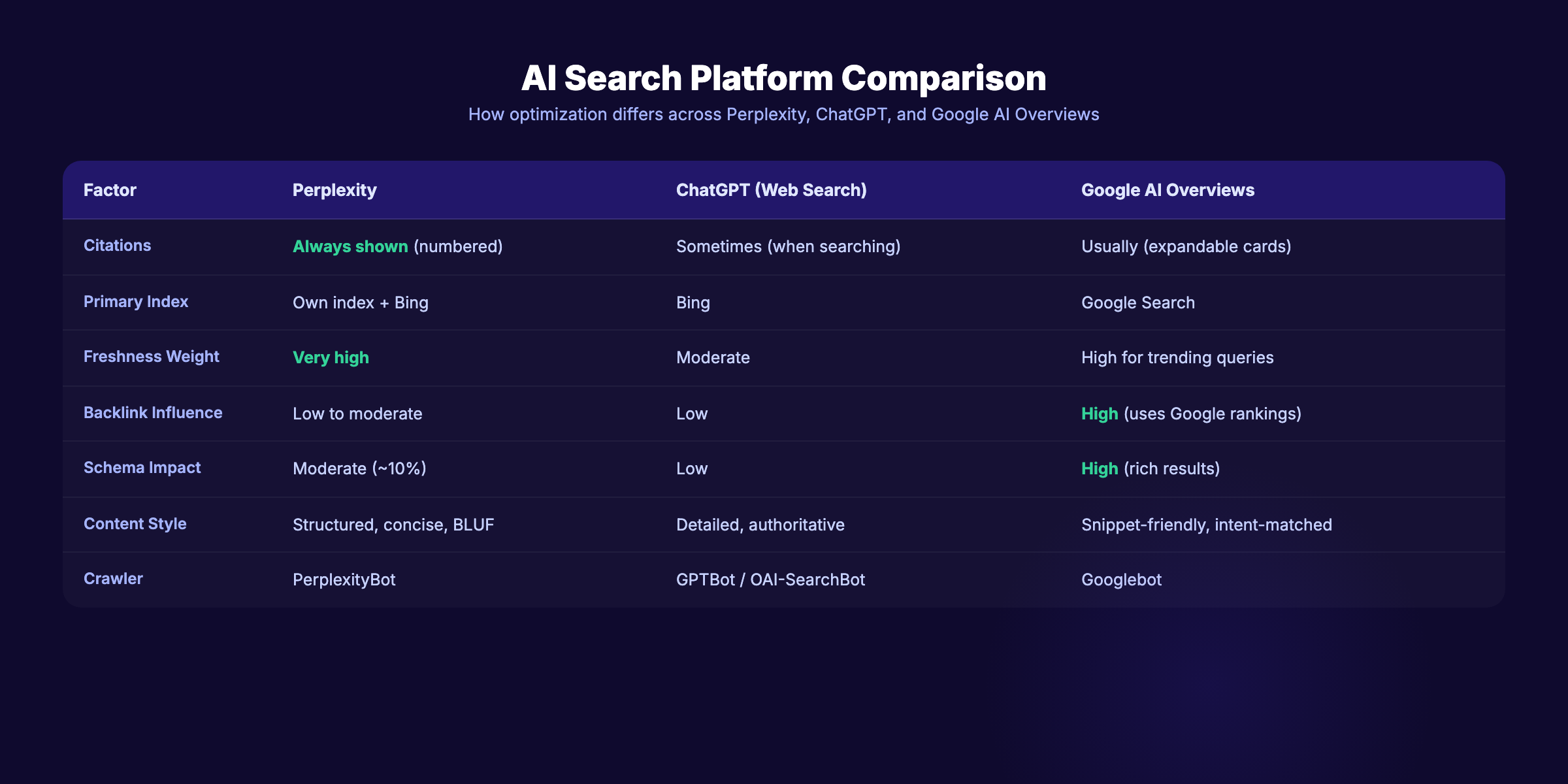
Each AI search platform selects sources differently. Optimizing for one does not guarantee visibility on the others. Here is how they compare.
| Factor | Perplexity | ChatGPT (with search) | Google AI Overviews |
|---|---|---|---|
| Citations shown | Always (numbered sources) | Sometimes (when using web search) | Usually (expandable source cards) |
| Primary index | Own index + Bing | Bing | Google Search |
| Freshness weight | Very high | Moderate | High for trending queries |
| Backlink influence | Low to moderate | Low | High (uses Google rankings) |
| Schema impact | Moderate (up to 10%) | Low | High (directly influences rich results) |
| Content format preference | Structured, concise, BLUF | Detailed, authoritative | Matches query intent, snippet-friendly |
| Crawler name | PerplexityBot | GPTBot / OAI-SearchBot | Googlebot (standard) |
| How to allow crawler | robots.txt allow PerplexityBot | robots.txt allow GPTBot | Already crawled if indexed on Google |
| Best optimization guide | This guide | Get cited by AI search | Optimize for AI Overviews |
The Overlap Strategy
The good news: 80% of optimization effort transfers across all 3 platforms.
Content that earns Perplexity citations typically also performs well on ChatGPT and Google AI Overviews. The shared principles:
- Clear, direct answers to specific questions
- Structured content with headers, tables, and lists
- Cited statistics from primary sources
- Recent publication or update dates
- Strong E-E-A-T signals (author, credentials, experience)
- Fast-loading, crawlable pages
Read our full GEO guide for the cross-platform optimization framework. The Princeton/IIT Delhi study found that GEO strategies can boost AI search visibility by up to 40% (arXiv).
FAQ
How does Perplexity AI choose which sources to cite?
Perplexity searches the web, retrieves top-ranking pages, and runs a reranking model that scores each page for relevance, answer quality, freshness, and authority. It then generates an answer and attaches numbered citations to the highest-scoring sources. Direct answers in the first 100 words, recent publication dates, and structured content are the strongest signals.
Is Perplexity SEO different from Google SEO?
The foundation is the same: quality content, technical accessibility, and authority. The differences are in weighting. Perplexity values content freshness and direct answer placement much more than Google. Backlinks matter less. Content structure and extractability matter more. Think of Perplexity SEO as Google SEO plus additional formatting and freshness requirements.
Does domain authority matter for Perplexity?
Less than you think. Perplexity evaluates topical authority over global domain authority. A DR 25 niche site with 30 deep articles on one topic will outrank a DR 85 generalist site for that topic. Build depth in your niche rather than chasing domain-wide metrics.
How do I check if Perplexity is citing my website?
Search your target queries on perplexity.ai and look for your domain in the numbered citations. In Google Analytics 4, filter traffic by source containing “perplexity” to see referral volumes. For automated monitoring, tools like Otterly.AI and LLMClicks track citations across AI platforms.
Can small websites get cited by Perplexity?
Yes. Small sites with deep topical expertise regularly earn citations over larger competitors. The keys are content freshness, direct answers, structured formatting, and demonstrable expertise. A 10-page site that covers one topic thoroughly can outperform a 10,000-page site that covers it superficially.
What is the difference between Perplexity SEO and answer engine optimization (AEO)?
Answer engine optimization is the broader category. It covers optimization for any platform that provides direct answers, including Google featured snippets, Google AI Overviews, ChatGPT, Perplexity, and Gemini. Perplexity SEO is AEO applied specifically to the Perplexity platform.
Perplexity SEO is where organic search is heading. The platform is growing faster than any search engine in the last decade, and every cited source gets direct referral traffic. Start with the BLUF method, structure your content for extraction, keep it fresh, and make sure PerplexityBot can access your pages. The brands that optimize for AI search now will own the citations that drive traffic for years.
Written and published by Stacc. We publish 3,500+ articles per month across 70+ industries. All data verified against public sources as of March 2026.
