How to Rank #1 on Google: The Definitive Guide
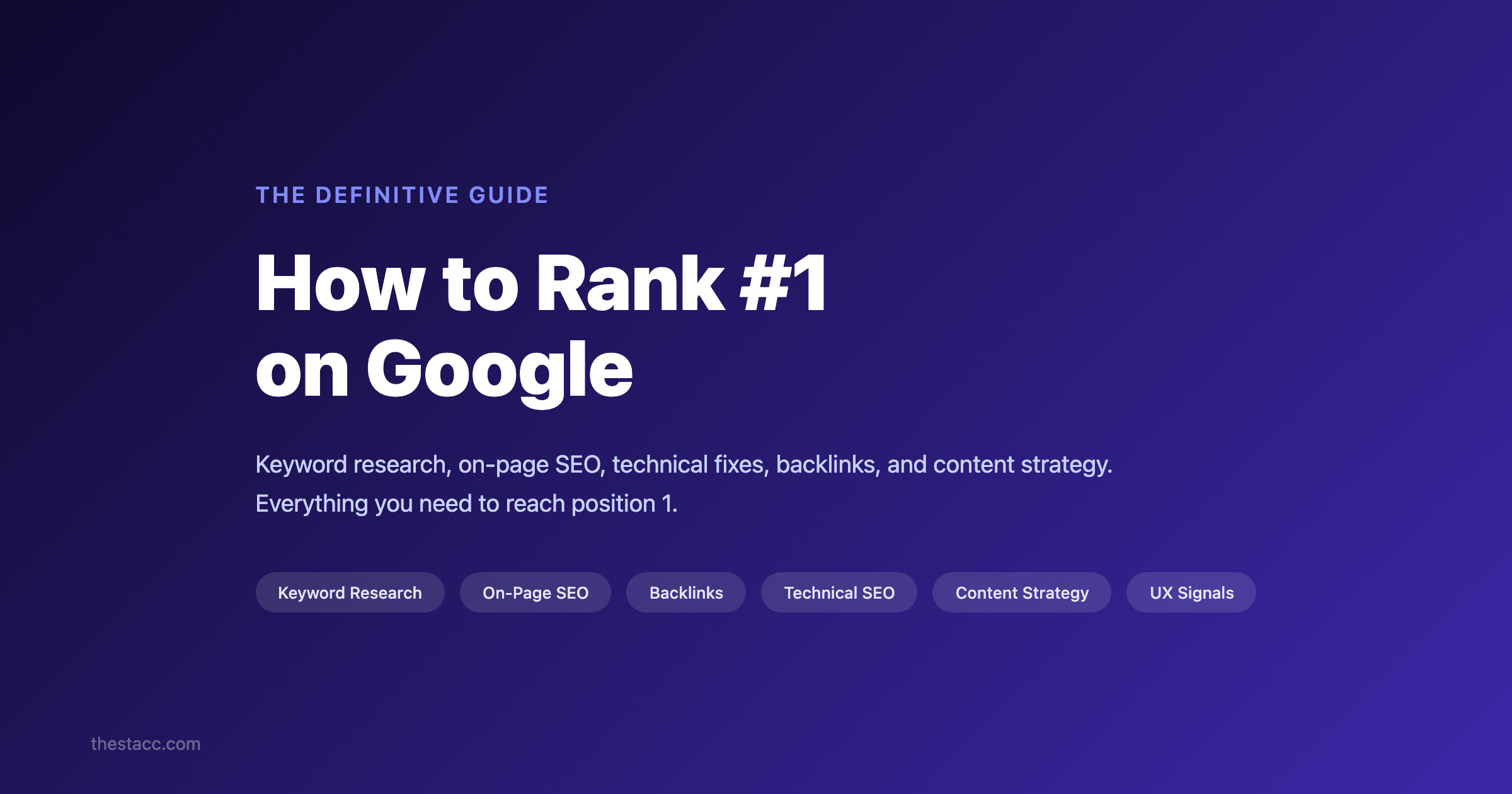
Learn how to rank number 1 on Google with this 8-chapter guide. Covers keyword research, on-page SEO, backlinks, and technical fixes. Updated for 2026.
Stacc Editorial • 2026-04-04 • SEO Tips
In This Article
Most businesses never reach page 1 of Google. They publish content, wait, and wonder why nothing happens. The gap between position 10 and position 1 is not luck. It is strategy.
The #1 organic result on Google earns a 39.8% click-through rate. Position 10 gets 1.6%. That difference decides whether your business gets discovered or ignored.
This guide breaks down every factor that determines who ranks number 1 on Google. We cover keyword research, on-page optimization, content quality, backlinks, technical SEO, and ongoing maintenance.
We publish 3,500+ SEO articles across 70+ industries every month. This guide covers what we have learned about reaching and holding position 1.
Here is what you will learn:
- How Google decides who earns the top spot
- How to find keywords you can realistically rank for
- The on-page SEO elements that separate #1 from #5
- How to create content that outranks every competitor
- Which backlink strategies still move the needle in 2026
- Technical fixes that remove ranking barriers
- How to track, defend, and maintain a #1 position
- Common mistakes that keep pages stuck on page 2
How Google Decides Who Ranks #1
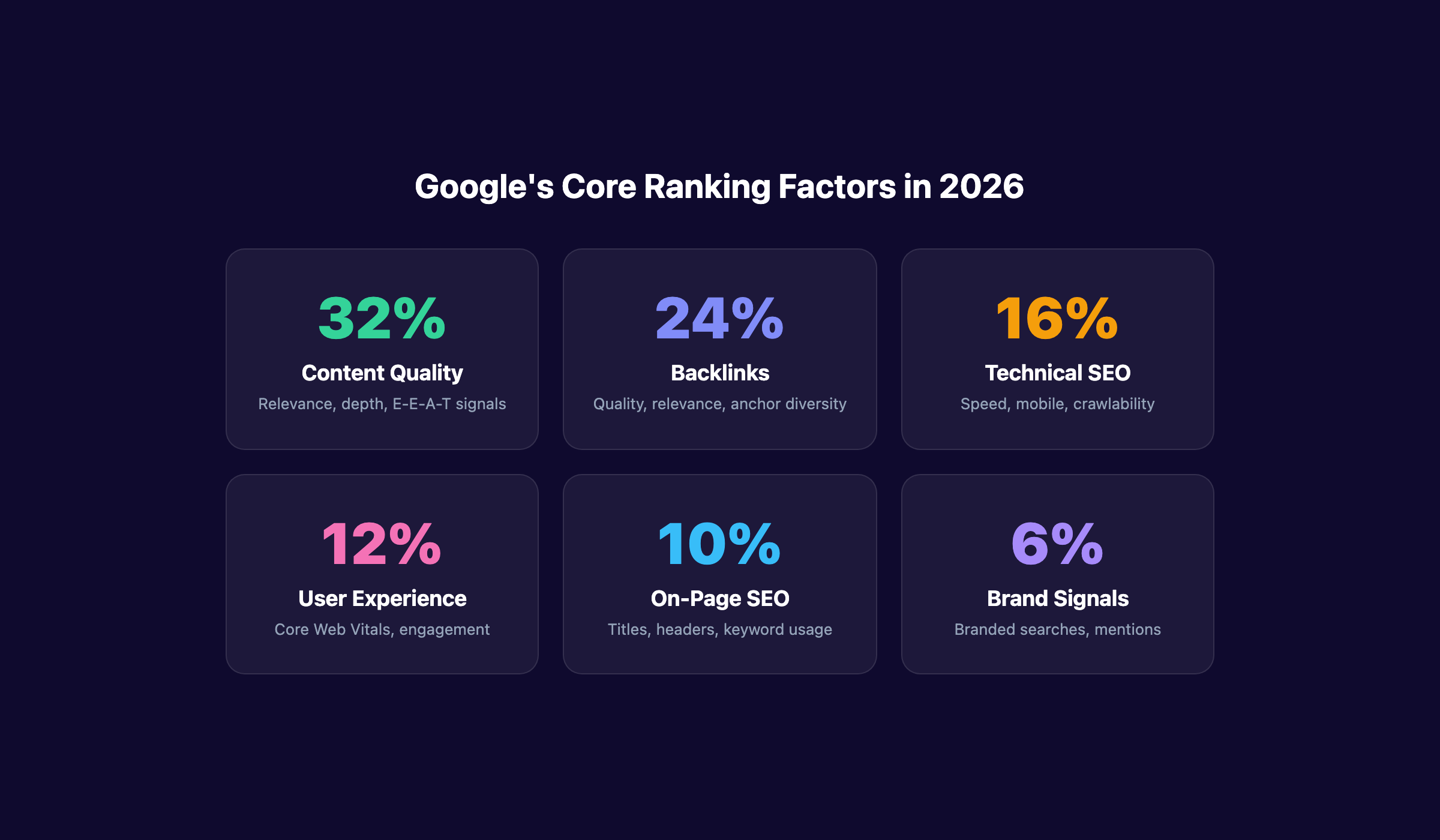
Google uses more than 200 ranking factors to determine search results. But not all factors carry equal weight. Understanding which ones matter most gives you a clear roadmap to position 1.
The top 3 organic results capture 68.7% of all clicks. Everything below that fights over scraps. Knowing what Google values helps you focus effort where it counts.
Content Quality Is the Biggest Factor
Google’s Helpful Content system filters pages written for algorithms instead of people. Content must answer the full query, provide original insights, and leave the reader satisfied.
A page that forces someone to hit the back button and search again fails Google’s quality test. Pages that fully resolve the query earn higher rankings and stay there longer. The SEO checklist for 2026 covers every quality signal to check.
E-E-A-T Signals Determine Trust
E-E-A-T stands for Experience, Expertise, Authoritativeness, and Trustworthiness. Google evaluates these signals to decide if a page deserves to rank for sensitive or important topics.
Author bios, cited sources, original research, and real-world credentials all strengthen E-E-A-T. Our E-E-A-T guide explains how to build each signal from scratch.
Algorithm Updates Shift the Rules
Google rolls out 500 to 600 algorithm updates per year. Most are minor. But core updates can rearrange entire SERPs overnight.
Sites that follow fundamentals (quality content, strong links, solid technical foundations) recover faster from updates. Sites that rely on shortcuts get penalized. Monitor Google Search Central for official announcements about major changes.
How to Find the Right Keywords to Rank For
Targeting the wrong keyword is the most expensive SEO mistake you can make. You spend months creating content for a term you cannot win. Smart keyword research prevents that waste.
The first position on Google has an average of 220 backlinks. If your site has a Domain Rating of 15, targeting a keyword where the top results have DR 80+ and hundreds of links is a losing bet. Pick battles you can win.
Start with Seed Keywords
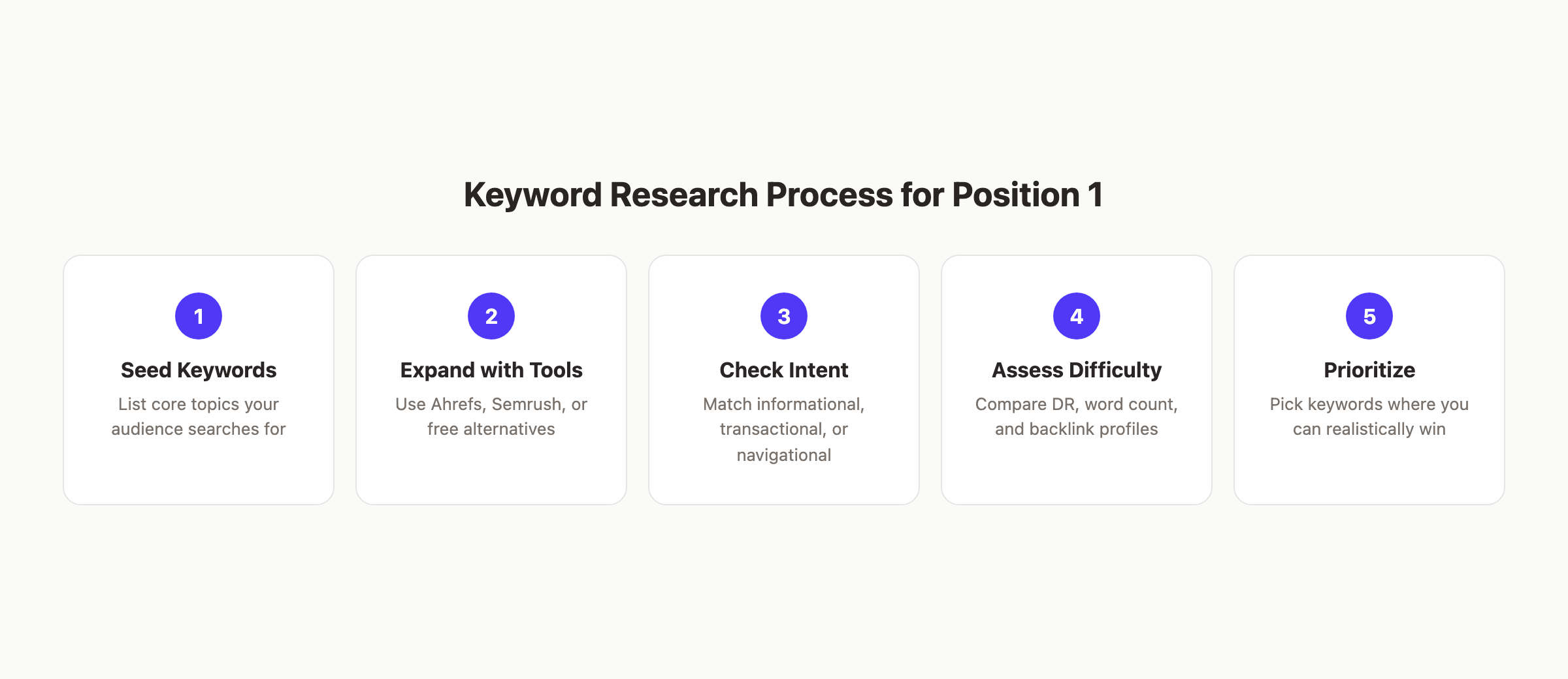
List 10 to 15 core topics your audience searches for. These are broad terms related to your product, service, or industry.
For a plumber, seed keywords might include “drain cleaning,” “water heater repair,” and “emergency plumber.” For a SaaS company, terms like “project management software” or “CRM for small business” work. Start broad and narrow from there.
Use Tools to Expand and Validate
Run seed keywords through keyword research tools like Ahrefs, Semrush, or Google Keyword Planner. Look for long-tail variations with decent search volume and lower competition.
Long-tail keywords convert better because they match specific intent. “Best CRM for real estate agents under $50” converts higher than “CRM software.” The free keyword research tools list covers options that cost nothing to start with.
Match Search Intent Before Writing
Every keyword has an intent behind it. Google categorizes intent as informational, navigational, transactional, or commercial investigation.
Search your target keyword and study the top 5 results. If Google shows product pages, a blog post will not rank there. If it shows guides and tutorials, a product page will not work. Match the format that Google already rewards for that query. Our guide on search intent breaks this down further.
Stop guessing which keywords to target. Stacc publishes 30 SEO articles per month, each matched to the right keyword and intent. Start for $1 →
How to Optimize On-Page SEO for Position 1
On-page SEO is the factor you control most directly. Every element on your page sends signals to Google about what the page covers and who it should rank for.
Pages in position 1 consistently nail the basics: keyword in the title, clear heading structure, and optimized meta descriptions. Skipping any one of these gives competitors an easy advantage.
Title Tags and Meta Descriptions
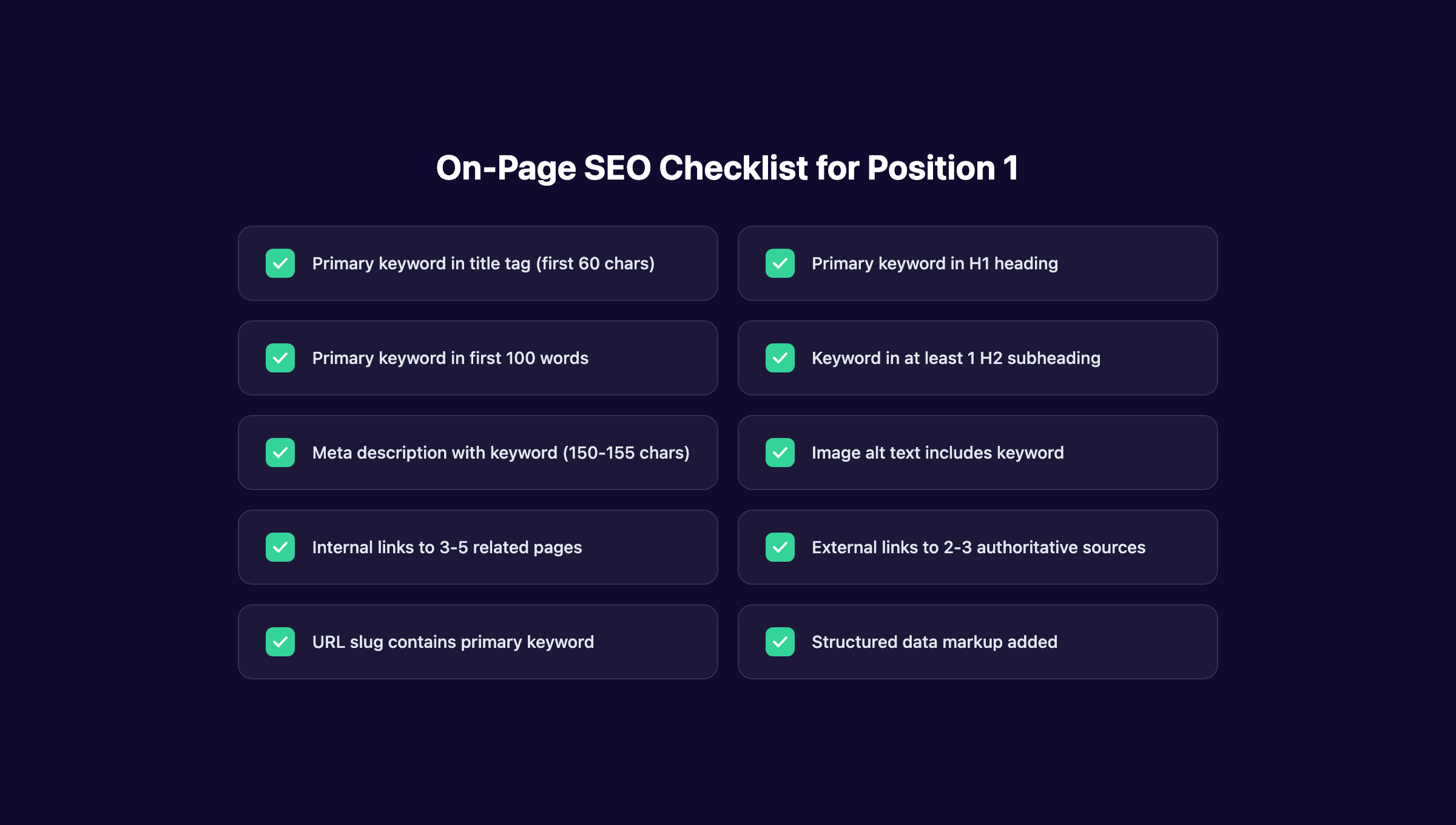
Place your primary keyword within the first 60 characters of your title tag. Google truncates titles longer than 60 characters in search results.
Write a meta description between 145 and 155 characters. Include the keyword and a clear benefit statement. Meta descriptions do not directly affect rankings, but they affect click-through rate. Higher CTR can indirectly improve your position.
Header Structure (H1, H2, H3)
Use one H1 tag per page. It should contain your primary keyword or a close variation. Structure your content with H2 sections for major topics and H3 sections for subtopics.
Google uses headers to understand page structure and content hierarchy. A clear heading tag structure also improves readability and keeps users on the page longer. Both signals help rankings.
Keyword Placement and Density
Include your primary keyword in the first 100 words of the page. Use it naturally in at least one H2 heading. Sprinkle related terms and synonyms throughout the content.
Do not stuff keywords. Google penalizes unnatural keyword density. Aim for 1 to 2% density for your primary term. Use semantically related phrases to cover the full topic without repetition.
Internal Linking
Link to 3 to 5 related pages within your site for every 1,000 words. Use descriptive anchor text that tells readers and Google what the linked page covers.
Strong internal linking distributes page authority across your site. It also helps Google discover and index new pages faster. Every page should link to at least 2 other pages and receive links from at least 2 other pages.
| On-Page Element | Best Practice | Impact |
|---|---|---|
| Title tag | Keyword in first 60 chars | High |
| Meta description | 145-155 chars with keyword | Medium |
| H1 tag | One per page with keyword | High |
| First 100 words | Include primary keyword | High |
| Internal links | 3-5 per 1,000 words | Medium |
| Image alt text | Descriptive with keyword | Medium |
| URL slug | Short, keyword-included | Medium |
How to Create Content That Outranks Competitors
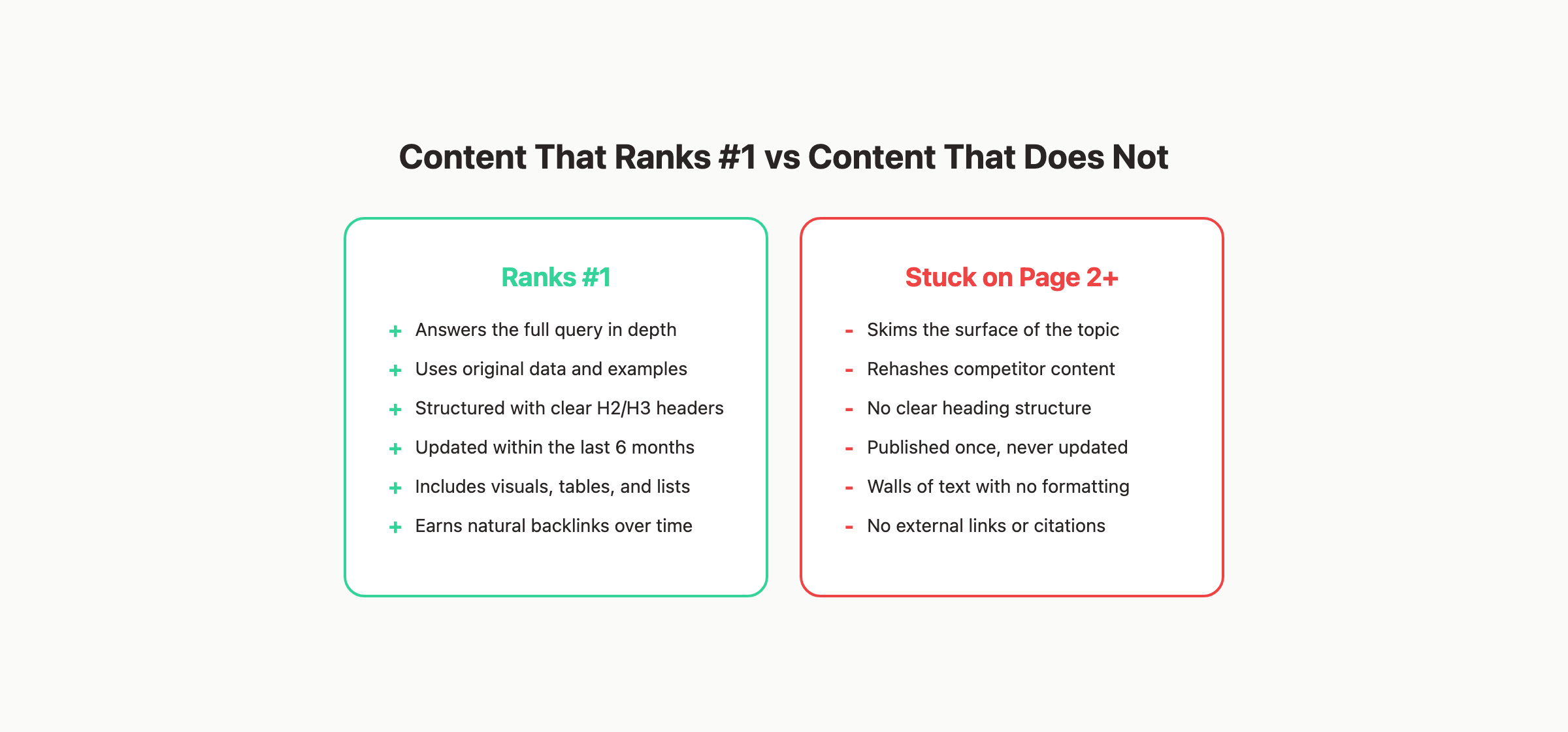
Content quality is the single biggest ranking factor. Google does not want the longest page. It wants the page that best satisfies the searcher.
Most SEO advice tells you to write “longer content.” That advice is wrong. A 1,200-word page that perfectly answers the query will outrank a 5,000-word page that rambles. Depth of answer matters more than word count.
Cover the Topic Completely
Analyze the top 5 results for your target keyword. Note every subtopic they cover. Your page should address all of those subtopics plus at least 1 to 2 angles they miss.
Use content optimization tools to identify semantic gaps. These tools compare your draft against top-ranking pages and highlight missing topics. Filling those gaps is the fastest way to move from page 2 to page 1.
Add Original Value
Pages that rank #1 almost always contain something competitors do not have. This could be original data, proprietary screenshots, expert quotes, case studies, or unique frameworks.
If you run a survey, publish the results. If you have customer data, share anonymized insights. Original value earns backlinks naturally because other sites want to cite your unique findings. Our guide on blog post structure shows how to organize original insights within your content.
Keep Content Fresh
Google favors recently updated content for time-sensitive queries. Pages that go stale lose rankings to fresher competitors.
Set a calendar reminder to update your top-performing pages every 3 to 6 months. Add new data, remove outdated information, and update screenshots. A content calendar helps you track which pages need refreshing and when.
Your SEO team. $99 per month. 30 optimized articles, published automatically. Every one structured to outrank competitors. Start for $1 →
How to Build Authority Through Backlinks
Backlinks remain one of Google’s top 3 ranking factors. The average page in position 1 has 3.8 times more backlinks than pages in positions 2 through 10.
One link from a relevant, high-authority site is worth more than 100 links from low-quality directories. Quality always beats quantity in link building. Focus your effort on earning links that actually move rankings.
Guest Posting on Relevant Sites
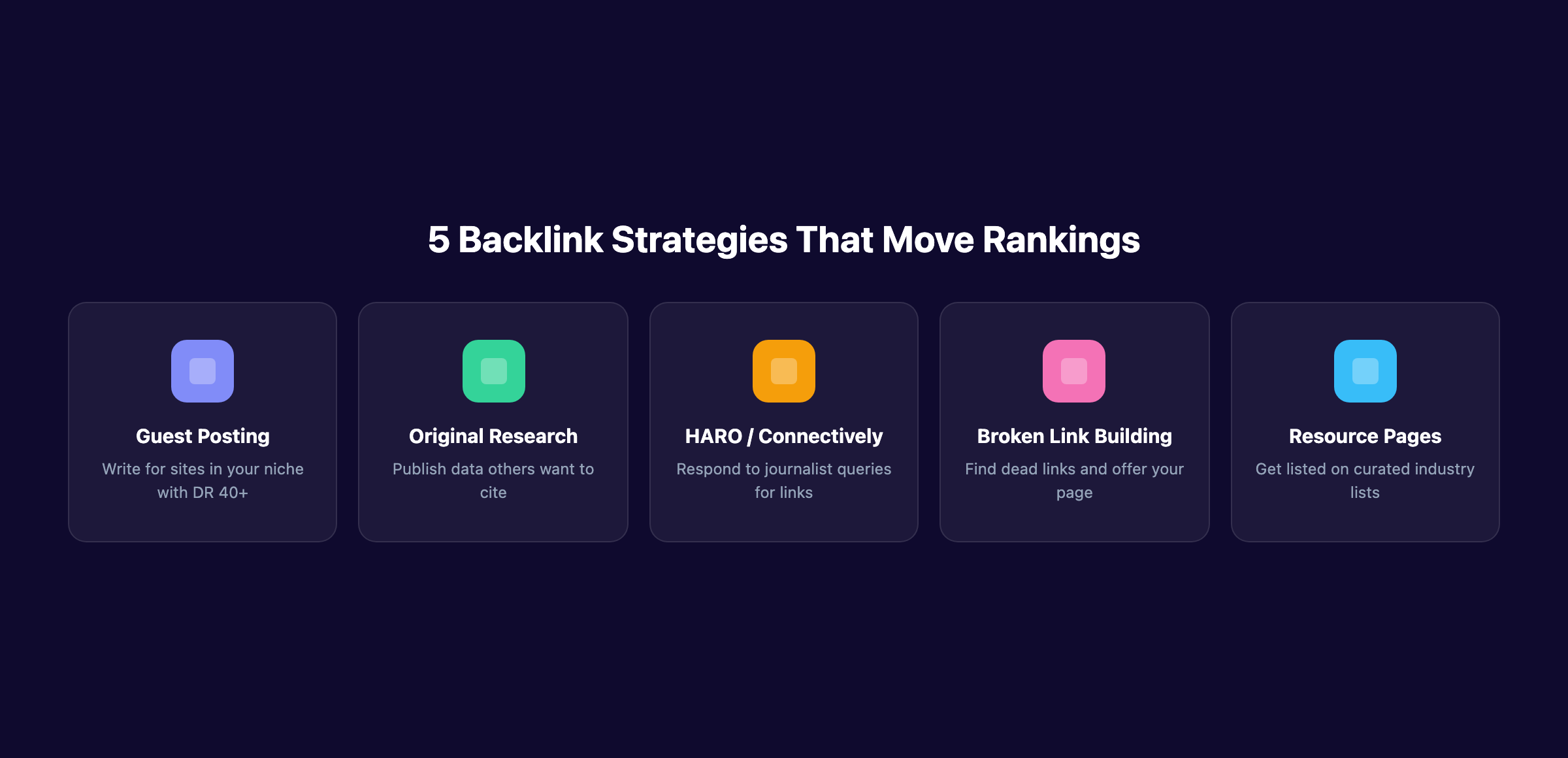
Write articles for websites in your niche that have a Domain Rating of 40 or higher. Include a natural link back to your target page within the content or author bio.
Target sites that your audience already reads. A plumber benefits from a link on a home improvement blog. A SaaS company benefits from a link on a marketing publication. Use our link building outreach templates to pitch guest post opportunities.
Publish Original Research
Original data attracts links passively. When you publish statistics, surveys, or case studies that no one else has, journalists and bloggers cite your page as a source.
Industry reports, benchmark studies, and data visualizations all work. The initial effort is high, but one piece of original research can earn links for years. Our SEO statistics page demonstrates this approach.
Use HARO and Journalist Queries
Services like HARO (Help a Reporter Out) connect you with journalists looking for expert quotes. Each response can earn a backlink from major publications.
Respond quickly with specific, quotable answers. Include your credentials and a link to your relevant page. Our HARO link building guide explains the exact process for earning consistent press links.
Broken Link Building
Find pages in your niche with broken outbound links. Contact the site owner and suggest your page as a replacement.
Use tools like Ahrefs or Check My Links to identify broken links on resource pages. This method works because you solve a problem for the site owner while earning a link. The link building tools guide reviews the best software for finding broken link opportunities.
| Link Type | Effort | Impact | Timeline |
|---|---|---|---|
| Guest posting | Medium | High | 2-4 weeks |
| Original research | High | Very high | 1-3 months |
| HARO responses | Low | High | 1-2 weeks |
| Broken link building | Medium | Medium | 2-6 weeks |
| Resource page outreach | Low | Medium | 1-3 weeks |
How to Fix Technical SEO Issues That Block Rankings
Great content cannot rank if Google cannot crawl, index, or render your pages. Technical SEO removes barriers between your content and search engines.
Over 60% of searches happen on mobile devices. A page that loads slowly or displays poorly on phones will never reach position 1. Technical foundations must be solid before content and links can do their work.
Core Web Vitals
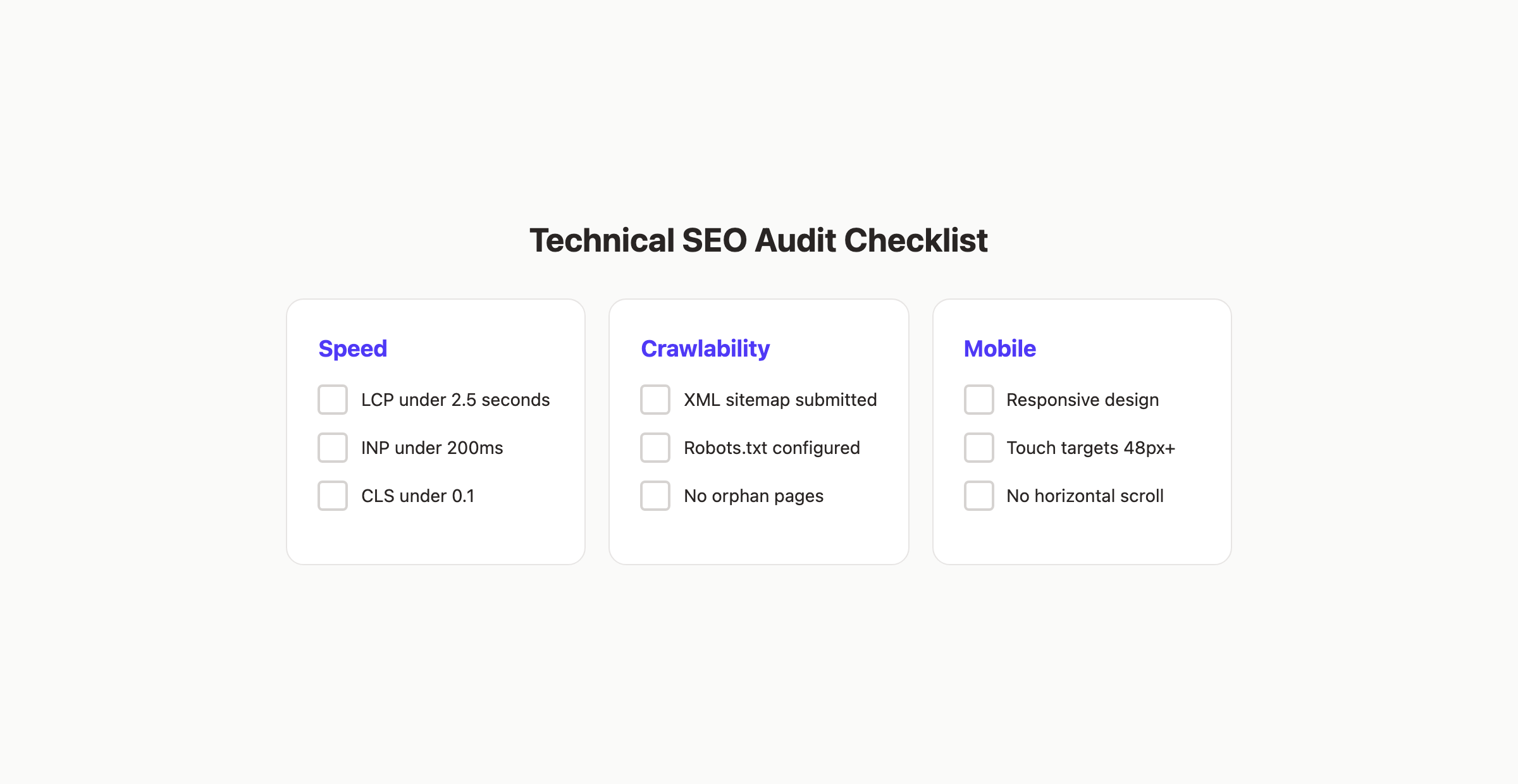
Google measures 3 Core Web Vitals: LCP (Largest Contentful Paint), INP (Interaction to Next Paint), and CLS (Cumulative Layout Shift). All 3 directly affect rankings.
Target LCP under 2.5 seconds, INP under 200 milliseconds, and CLS under 0.1. Test your pages with Google PageSpeed Insights. Our INP optimization guide covers the technical fixes for the newest Core Web Vital metric.
Mobile Optimization
Google uses mobile-first indexing. The mobile version of your page is the version Google evaluates for rankings.
Ensure responsive design, tap targets of at least 48 pixels, and no horizontal scrolling. Test every page on multiple devices. The mobile SEO guide walks through every mobile optimization step.
Crawlability and Indexing
Submit an XML sitemap through Google Search Console. Configure your robots.txt file to allow Googlebot access to important pages. Block thin or duplicate pages from being crawled.
Check for crawl budget issues if your site has more than 10,000 pages. Orphan pages (pages with no internal links pointing to them) often go unindexed. Every important page needs at least 2 internal links.
Schema Markup
Structured data helps Google understand your content and can earn rich results in search. FAQ schema, How-To schema, and Article schema all increase visibility.
Pages with rich results earn higher click-through rates. A schema markup guide for your specific content type can increase CTR by 20 to 30% according to Google’s structured data documentation.
- Run PageSpeed Insights on all key pages
- Fix any Core Web Vital failures
- Verify mobile rendering on 3 device sizes
- Submit XML sitemap to Search Console
- Check for crawl errors in Search Console
- Add schema markup to all content pages
- Set up 301 redirects for broken URLs
3,500+ blogs published. 92% average SEO score. Every article we publish passes a technical SEO check before going live. Start for $1 →
How to Track and Maintain Your #1 Position
Reaching position 1 is hard. Staying there is harder. Competitors publish new content, earn new links, and update their pages to overtake you.
The businesses that hold top rankings treat SEO as an ongoing process. They monitor performance weekly, refresh content quarterly, and build links consistently. A set-and-forget approach guarantees you will lose your spot.
Monitor Rankings Weekly
Track your target keywords in Google Search Console or a rank tracking tool. Watch for position drops that signal a competitor is closing the gap.
Set alerts for any keyword that drops more than 3 positions. Early detection gives you time to respond before you fall off page 1. The SEO reporting guide explains which metrics to track and how often.
Refresh Content Every 3 to 6 Months
Update statistics with current data. Replace outdated screenshots. Add new sections that cover emerging subtopics.
Google notices when a page gets updated. Fresh content signals relevance. Pages that were last updated 18 months ago lose ground to pages updated last month. Schedule refreshes in your content calendar.
Defend Against Competitors
Run a monthly competitor analysis on pages that rank just below you. Study what they are improving. If a competitor publishes a more detailed version of your page, update yours immediately.
Watch for new backlinks your competitors earn. If they get a link from a high-authority site, find similar opportunities for your own page. Use competitor keyword analysis to spot threats early.
| Maintenance Task | Frequency | Priority |
|---|---|---|
| Keyword rank tracking | Weekly | High |
| Content refresh | Every 3-6 months | High |
| Competitor monitoring | Monthly | Medium |
| Backlink audit | Quarterly | Medium |
| Technical SEO check | Quarterly | Medium |
Common Mistakes That Prevent Ranking #1
Most pages fail to rank not because of bad luck but because of avoidable errors. Fix these mistakes and you remove the biggest barriers to position 1.
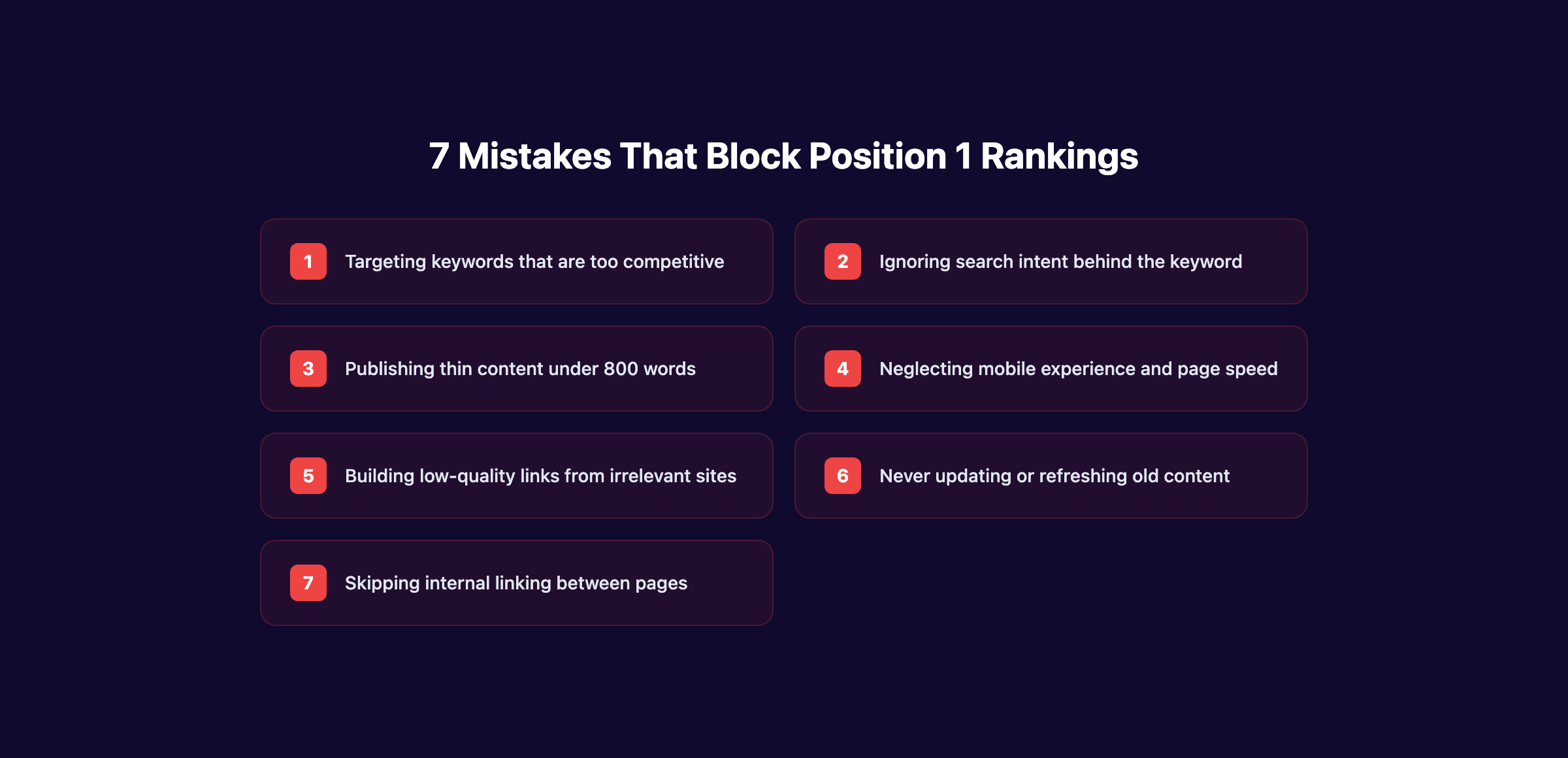
Targeting Keywords Beyond Your Authority
A new site with 10 pages cannot rank for “best credit cards.” That keyword requires massive authority, hundreds of backlinks, and years of topical coverage.
Start with long-tail keywords where the top results have lower Domain Ratings. Build authority gradually. Move to harder keywords as your site grows. Our guide on how many blog posts you need to rank puts realistic numbers behind this strategy.
Ignoring Search Intent
Publishing a product page for an informational keyword (or vice versa) guarantees failure. Google matches content format to intent.
Always search your keyword first. If the top results are all 2,000-word guides, write a guide. If they are product comparison pages, create a comparison. Format mismatch is one of the most common reasons pages get stuck on page 2.
Publishing Thin, Surface-Level Content
Pages under 800 words rarely rank for competitive keywords. Thin content fails to cover the topic in enough depth to satisfy Google’s quality requirements.
The exception: some queries need short, direct answers. But for most guide-style and how-to keywords, you need at least 1,500 to 2,500 words of substantive content. Every paragraph should add value, not filler.
Neglecting Page Speed
A page that takes 5 seconds to load loses over half its visitors before they see a single word. Slow pages cannot rank because users bounce immediately.
Compress images, minimize JavaScript, and use a CDN. Target a page load time under 2.5 seconds. Speed improvements alone have moved pages from position 8 to position 3 in documented case studies.
Skipping Internal Links
Pages with zero internal links pointing to them are invisible to Google’s crawler. They also pass no authority to or from other pages on your site.
Build a web of internal links across your site. Use content clusters to group related pages together. This structure tells Google which pages are most important and how topics connect.
Why Position 1 Matters: The Data
The numbers make the case for investing in a #1 ranking. The gap between position 1 and every other position is enormous.
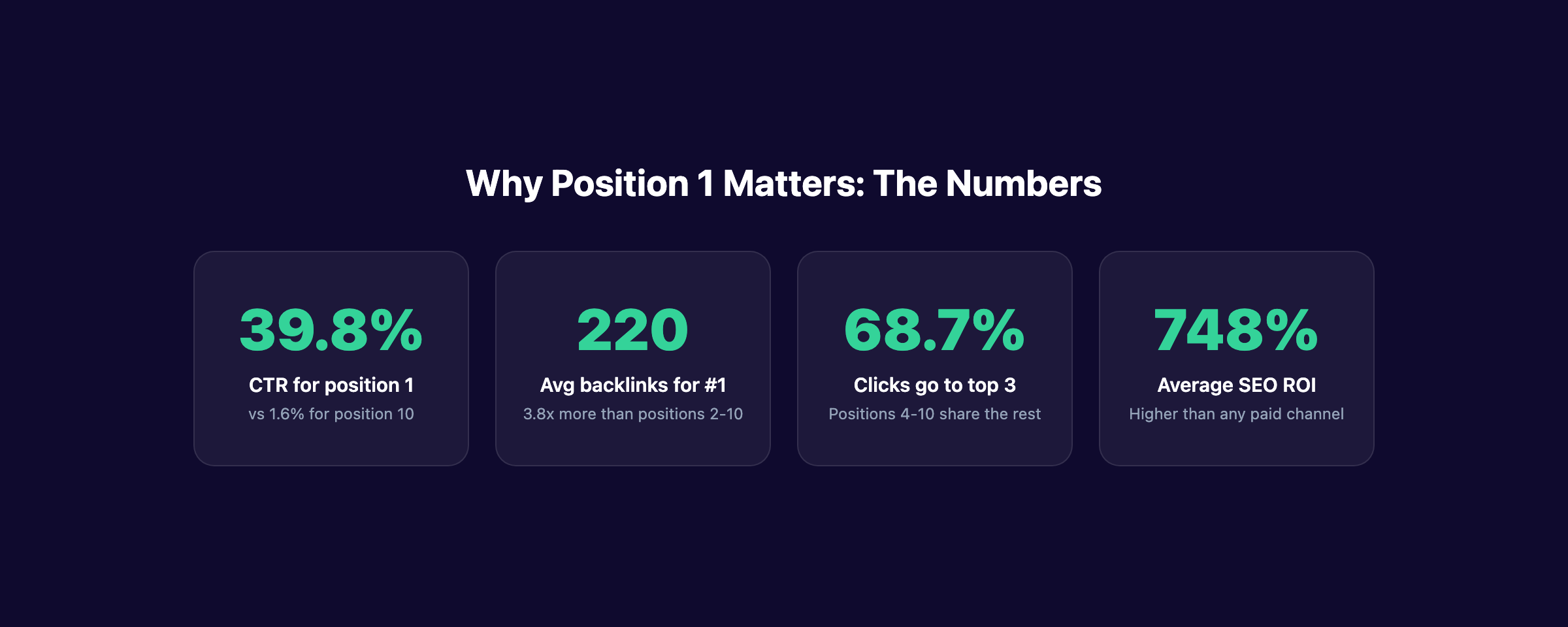
| Position | Average CTR | Relative Traffic |
|---|---|---|
| 1 | 39.8% | Baseline |
| 2 | 18.7% | 53% less |
| 3 | 10.2% | 74% less |
| 5 | 4.4% | 89% less |
| 10 | 1.6% | 96% less |
Source: Backlinko CTR study and AIOSEO 2026 SEO statistics.
A well-executed SEO campaign delivers an average ROI of 748%, according to SeoProfy’s 2026 analysis. No paid advertising channel comes close to that return.
The SEO industry is worth $84 billion in 2026 and growing at 12% annually. Businesses that invest in organic search now compound their advantage over competitors who wait.
Stop writing. Start ranking. Stacc publishes 30 SEO articles per month for $99. Every article targets position 1. Start for $1 →
FAQ
How long does it take to rank #1 on Google?
Most websites see initial ranking movement within 60 to 90 days. Reaching position 1 for moderately competitive keywords takes 3 to 6 months. Highly competitive keywords can take 6 to 12 months or longer, depending on your site authority, content quality, and backlink profile.
Can you rank #1 on Google without backlinks?
For low-competition keywords, yes. But for any keyword with real search volume and competition, backlinks are essential. The average page in position 1 has 220 backlinks. You can rank without links for hyper-specific long-tail terms, but scaling to competitive keywords requires a link building strategy.
How much does it cost to rank #1 on Google?
The cost varies by approach. Hiring an SEO agency runs $1,000 to $5,000 per month. Freelance writers charge $80 to $250 per article. A service like Stacc publishes 30 optimized articles for $99 per month. The true cost depends on competition level, your current authority, and how quickly you want results.
Does paying for Google Ads help organic rankings?
No. Google Ads and organic search operate independently. Paying for ads does not improve your organic position. However, running ads can increase brand awareness, which may lead to more branded searches and indirect SEO benefits over time.
How often should I update content to maintain rankings?
Refresh your top-performing pages every 3 to 6 months. Update statistics, add new information, and remove outdated sections. For fast-moving topics (like SEO or technology), quarterly updates prevent competitors from outranking you with fresher content.
Is SEO still worth it with AI Overviews taking clicks?
Yes. While zero-click searches now represent about 60% of queries, the clicks that do happen are highly valuable. Organic traffic converts at higher rates than paid traffic. Ranking in position 1 also increases your chances of being cited in AI Overviews and AI search results.
Ranking #1 on Google requires strategy across every dimension: keywords, content, links, technical foundations, and ongoing maintenance. No single tactic gets you there alone. The businesses that reach and hold position 1 are the ones that execute consistently across all of them.
Start with the chapter that addresses your biggest gap. Then work through the rest systematically.
Your SEO team. $99 per month. We publish 30 optimized articles every month so you can focus on running your business. Start for $1 →
Written and published by Stacc. We publish 3,500+ articles per month across 70+ industries. All data verified against public sources as of March 2026.