
Brand Mentions vs Backlinks: Off-Page SEO Evolution
Brand mentions now rival backlinks as off-page ranking signals. Learn how Google values each, what the data says, and how to build both. Updated April 2026.
Brand Mentions vs Backlinks: The Complete Guide to Off-Page SEO in 2026
Off-page SEO used to mean one thing: get more backlinks. That era is over.
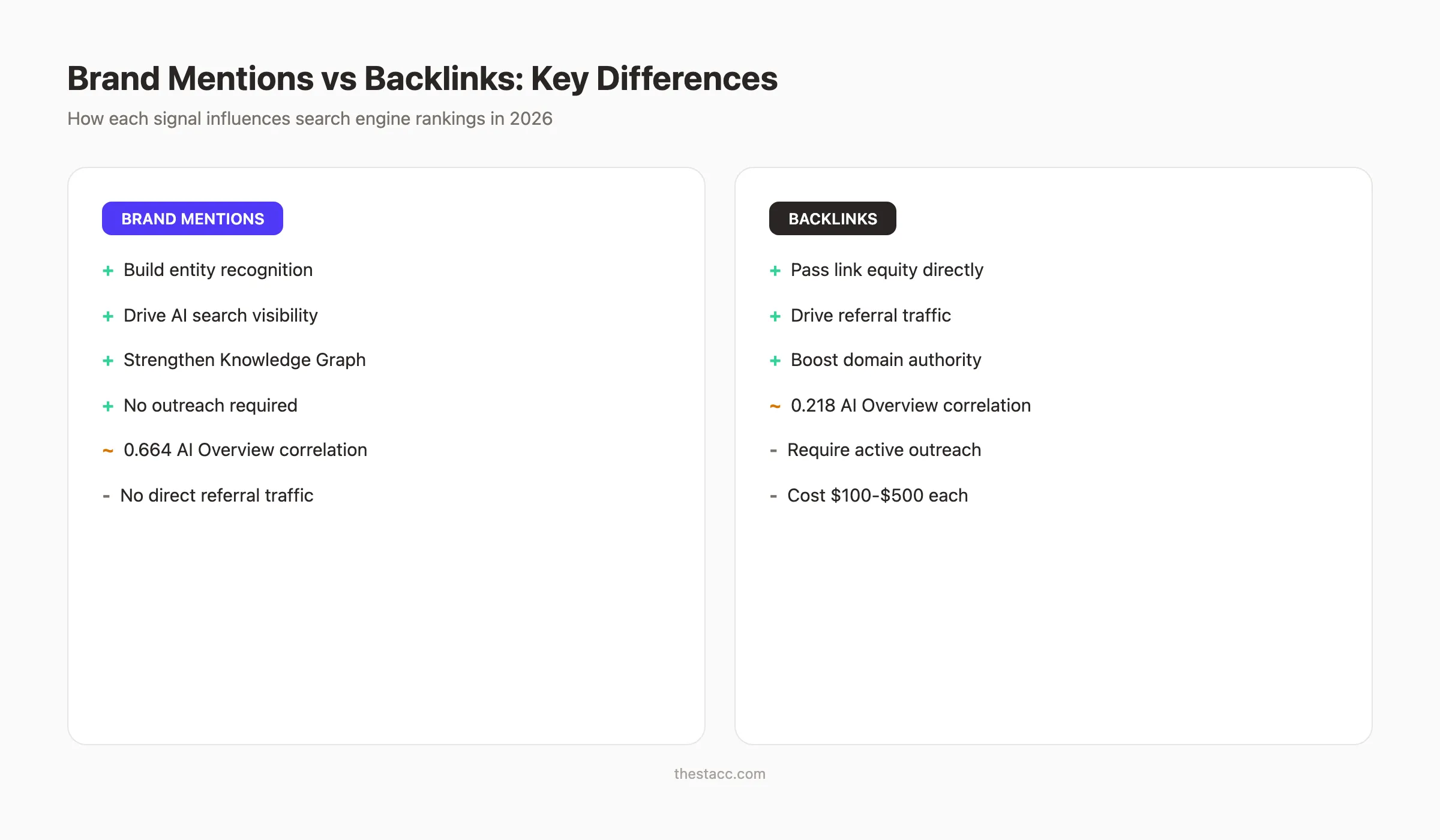
In 2026, brand mentions vs backlinks is not an either-or debate. It is a shift in how search engines measure authority. Google now processes unlinked brand mentions as ranking signals. Ahrefs data from a 75,000-brand study shows that web mentions correlate at 0.664 with AI Overview visibility. Backlinks correlate at just 0.218.
That gap should change how you approach off-page SEO.
This guide breaks down the complete picture. We publish 3,500+ blog posts across 70+ industries and track how both signals affect real rankings.
Here is what you will learn:
- The exact differences between brand mentions and backlinks
- How off-page SEO shifted from links to entity signals
- What the latest data says about each signal’s weight
- How Google processes unlinked mentions through NLP
- Why brand mentions dominate AI search visibility
- A step-by-step system for building mentions at scale
- How to convert existing mentions into backlinks
- The combined strategy that outperforms either signal alone
Table of Contents
- Chapter 1: What Brand Mentions and Backlinks Actually Are
- Chapter 2: How Off-Page SEO Evolved from Links to Mentions
- Chapter 3: The Data. Brand Mentions vs Backlinks in 2026
- Chapter 4: How Google Processes Unlinked Brand Mentions
- Chapter 5: Brand Mentions and AI Search Visibility
- Chapter 6: How to Build Brand Mentions at Scale
- Chapter 7: How to Convert Mentions into Backlinks
- Chapter 8: The Combined Strategy That Works
- FAQ
Chapter 1: What Brand Mentions and Backlinks Actually Are {#chapter-1}
Most SEO guides blur the line between these two signals. They are distinct mechanisms with different impacts on how search engines perceive your brand. Understanding the difference is the first step to building a modern off-page strategy.
Backlinks Defined
A backlink is a clickable hyperlink from one website to another. It passes referral traffic. It signals to search engines that the linking site vouches for the target page.
Backlinks have been a core ranking factor since Google launched PageRank in 1998. The logic is simple. If many trustworthy sites link to you, your content must be valuable.
There are 3 types that matter:
| Backlink Type | SEO Impact | Example |
|---|---|---|
| Dofollow | Passes full link equity | Editorial link in a Forbes article |
| Nofollow | Treated as a ranking hint since 2020 | Reddit comment link |
| Sponsored/UGC | Minimal direct SEO value | Paid placement or forum post |
A single backlink from a high-authority domain can move rankings. But acquiring quality backlinks takes time, outreach, and often budget. The average cost of a guest post backlink ranges from $100 to $500.
Brand Mentions Defined
A brand mention is any reference to your brand name, product, or URL on another website without a clickable hyperlink. These are also called unlinked mentions or implied links.
Example: A blogger writes “Stacc publishes 30 SEO articles per month for under $100” without linking to thestacc.com. Google still sees this. It still processes the association.
Brand mentions appear across many formats:
- News articles and press coverage
- Product roundups and reviews
- Social media posts and comments
- Forum discussions on Reddit and Quora
- Podcast show notes and transcripts
- YouTube video descriptions
The Core Difference
Backlinks transfer link equity. Brand mentions transfer entity recognition. Both build authority, but through different mechanisms.
A backlink says “go to this site.” A brand mention says “this brand exists and is relevant to this topic.” Search engines in 2026 weigh both of these signals when determining domain authority and topical relevance.
Chapter 2: How Off-Page SEO Evolved from Links to Mentions {#chapter-2}
Off-page SEO has transformed across 3 distinct eras. Understanding this timeline explains why brand mentions carry so much weight today.
Era 1: The Link Graph (1998 to 2012)
PageRank made backlinks the currency of SEO. More links meant higher rankings. The quality of those links mattered less than the quantity.
This created an entire link building industry. Link farms, blog networks, directory spam, and article spinning became standard tactics. By 2011, an estimated 60% of link building activity involved some form of manipulation.
Google fought back. The Penguin algorithm update in 2012 penalized manipulative link schemes. Overnight, sites that relied on low-quality backlinks lost 50% or more of their organic traffic.
Era 2: Quality Links and Signals (2012 to 2022)
After Penguin, link building shifted toward quality. Guest posting, digital PR, and broken link building became the standard playbook.
But Google was already looking beyond links. In 2014, Google filed a patent for “implied links.” The patent described a system where search engines could use brand mentions, without hyperlinks, as authority signals. This was a direct signal that the link-only model had limits.
During this era, Google also introduced:
- E-E-A-T as a quality framework for evaluating content authority
- BERT and natural language processing for understanding context
- The Knowledge Graph for mapping entity relationships
Each of these reduced dependence on raw link counts and increased the value of brand recognition across the web.
Era 3: Entity-Based Search (2022 to Present)
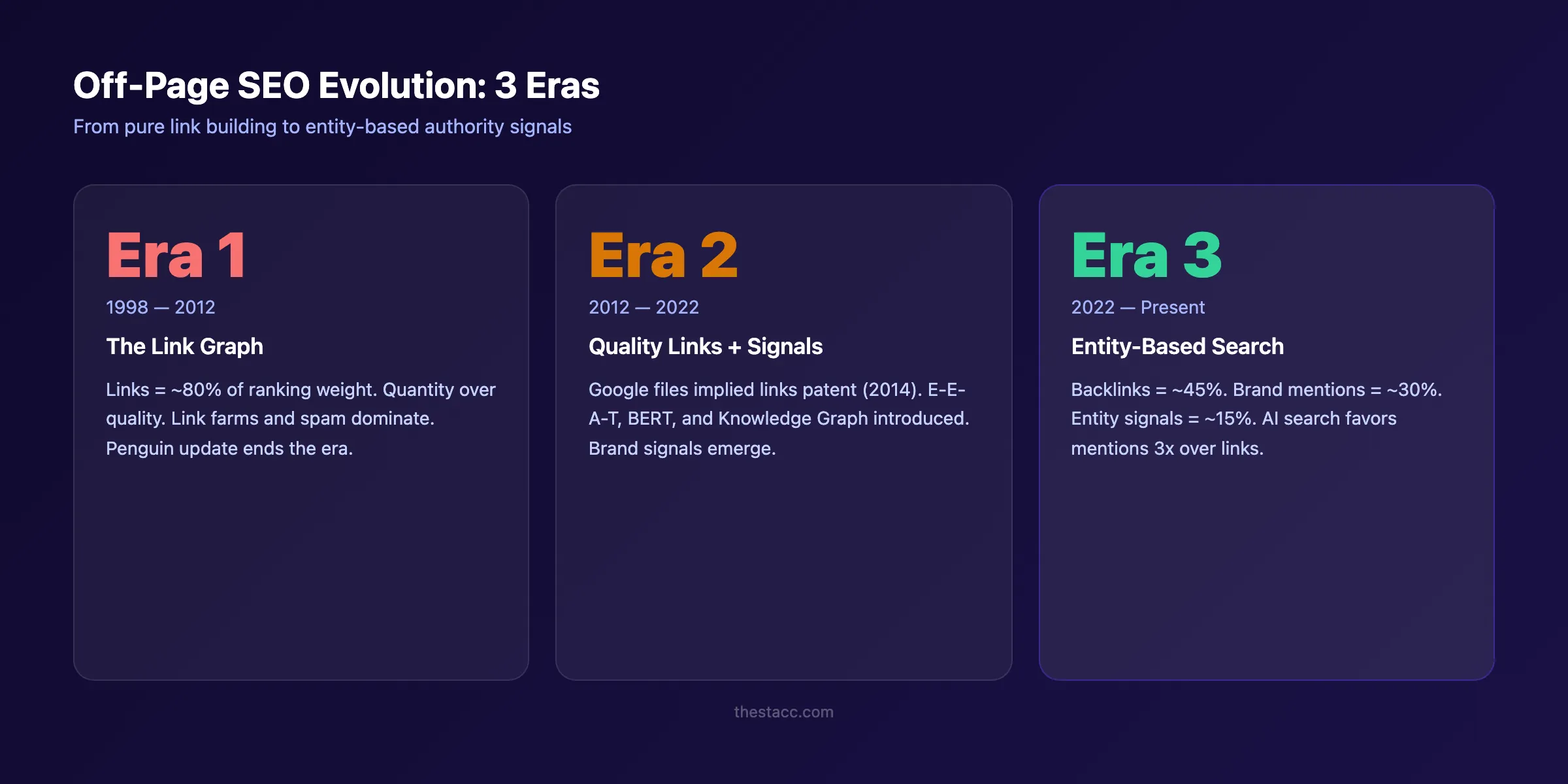
The current era combines links, mentions, and entity signals. Google does not rank pages in isolation. It ranks entities. Brands, people, concepts. Based on their prominence across the entire web.
Off-page ranking weight has shifted dramatically:
| Signal Type | 2012 Weight | 2026 Weight | Direction |
|---|---|---|---|
| Backlinks | ~80% | ~45% | Declining |
| Brand mentions | ~5% | ~30% | Growing fast |
| Entity/co-citation signals | ~5% | ~15% | Growing |
| Social signals | ~10% | ~10% | Stable |
This does not mean backlinks are dead. It means they are no longer the only game in town. Sites that ignore brand mentions leave half their off-page potential untapped.
Your off-page strategy should match how search engines actually work in 2026. Stacc publishes 30 SEO-optimized articles per month to build both backlink-worthy content and brand recognition. Start for $1 →
Chapter 3: The Data. Brand Mentions vs Backlinks in 2026 {#chapter-3}
Opinions about SEO signals are everywhere. Data is more useful. Here is what large-scale studies reveal about how brand mentions and backlinks compare in 2026.
The Ahrefs 75,000-Brand Study
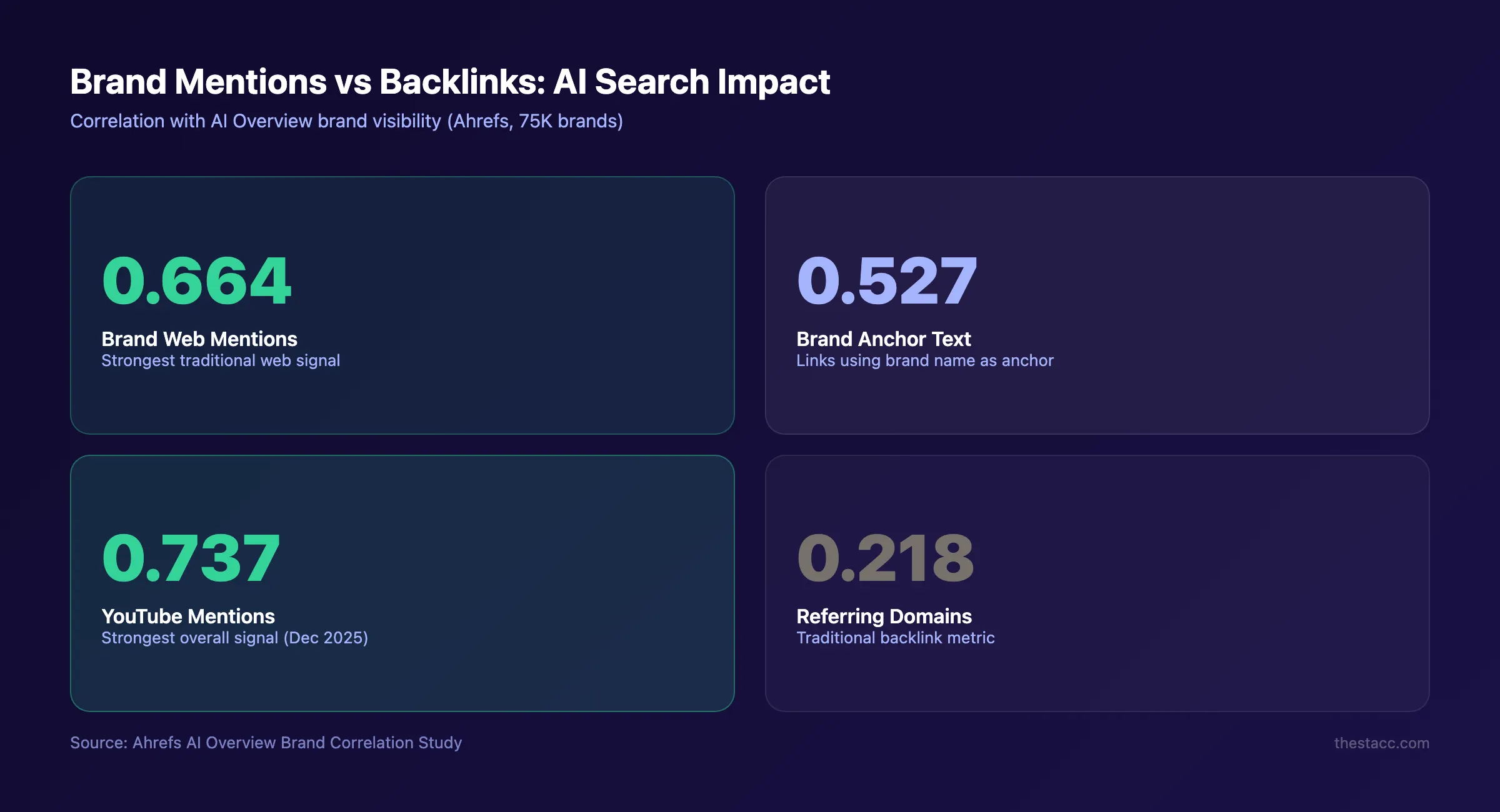
Ahrefs analyzed 75,000 brands to identify which factors correlate most strongly with AI Overview visibility. The results surprised many SEO professionals.
| Factor | Correlation with AI Overview Visibility |
|---|---|
| Brand web mentions | 0.664 |
| Brand anchor text | 0.527 |
| Brand search volume | 0.392 |
| Referring domains (backlinks) | 0.218 |
| Domain Rating | 0.195 |
Brand mentions correlated 3 times more strongly than backlinks with AI Overview visibility. A follow-up study in December 2025 found that YouTube mentions showed an even stronger correlation at 0.737.
Brands in the top quartile for web mentions earned 10 times more visibility in AI Overviews than those in the next closest quartile.
Off-Page Signal Weighting Data
SearchAtlas research shows that integrated brand mention strategies increased keyword rankings by an average of 18%. The same study found that 60% of new Knowledge Panels were triggered by unlinked brand mentions from trusted sources.
Businesses that actively monitor and build brand mentions rank 25% to 40% higher than competitors who ignore them.
What the Data Means for Your Strategy
The numbers point to a clear conclusion. Backlinks still move rankings. But brand mentions now move them faster for AI search visibility and entity recognition.
For traditional organic rankings, backlinks remain critical. For AI search visibility, brand mentions dominate. A complete off-page strategy needs both.
The exception is new brands with zero web presence. If nobody has mentioned your brand anywhere, backlinks provide a stronger initial signal. Brand mentions compound over time and require an existing reputation to accelerate.
Chapter 4: How Google Processes Unlinked Brand Mentions {#chapter-4}
Google does not just count brand mentions. It evaluates them through multiple layers of analysis. Understanding these layers helps you build mentions that actually influence rankings.
Natural Language Processing and Entity Recognition
Google uses NLP models like BERT and Gemini to read web pages the way a human would. When a blog post says “Stacc handles SEO for small businesses,” Google identifies:
- The entity (Stacc)
- The relationship (provides SEO services)
- The context (small businesses)
- The sentiment (neutral to positive)
This information feeds into Google’s Knowledge Graph, which maps entities and their relationships. The more contexts Google finds your brand mentioned in, the stronger your entity profile becomes.
The Implied Links Patent
Google’s 2014 patent on “implied links” formalized how unlinked mentions factor into rankings. The patent describes implied links as “a reference to a target resource… which is included in a source resource but is not an express link.”
The patent specifies 4 evaluation criteria:
- Source trustworthiness. Mentions from .gov, .edu, and high-authority publications carry more weight
- Contextual relevance. A mention in a relevant industry article matters more than a random blog post
- Sentiment. Positive and neutral mentions help. Negative mentions can hurt.
- Recency. Recent mentions signal current relevance
Co-Citation and Co-Occurrence
When your brand is mentioned alongside established competitors, Google strengthens the association. This is co-citation.
If an article discusses “SEO tools like Ahrefs, Semrush, and Stacc,” Google infers that Stacc belongs in the same category. This happens without any links involved.
Co-occurrence works similarly. When your brand name consistently appears near terms like “blog SEO” or “content marketing,” Google connects your entity to those topics. This is how topical authority builds outside of your own website.
Sentiment Analysis
Not all mentions are equal. Google’s NLP can distinguish between:
- “Stacc delivers great results for small businesses” (positive)
- “Stacc is an SEO service provider” (neutral)
- “We had a terrible experience with Stacc” (negative)
Positive mentions from authoritative sources carry the most weight. Negative mentions from low-authority sites have minimal impact. But a pattern of negative mentions across trusted publications can suppress entity authority.
This is why reputation management and brand monitoring overlap with off-page SEO. They affect the same signals.
Building brand authority takes consistent publishing across channels. Stacc handles blog content, local SEO, and social media so your brand shows up everywhere search engines look. Start for $1 →
Chapter 5: Brand Mentions and AI Search Visibility {#chapter-5}
AI search engines process brand mentions differently than traditional Google search. This is where the gap between mentions and backlinks is widest.
How AI Models Use Brand Mentions
ChatGPT, Perplexity, Google AI Overviews, and Gemini all pull from training data that includes billions of web pages. When your brand is mentioned frequently across trusted sources, AI models learn to associate your brand with specific topics and queries.
AI search engines do not follow links. They do not calculate PageRank. They identify entities based on how often and where those entities appear in their training data.
This means a single unlinked mention in a respected industry publication can influence AI recommendations more than a backlink from a low-authority site. The source quality and frequency of mentions matter most.
The YouTube Mention Factor
Ahrefs’ December 2025 study revealed that YouTube mentions show the strongest correlation (0.737) with AI visibility across ChatGPT, AI Mode, and AI Overviews. This outperformed every other factor studied.
YouTube transcripts are indexed. AI models process them. If your brand is mentioned in popular YouTube videos within your industry, AI search engines pick up on that signal.
Branded web mentions still correlate at 0.66 to 0.71. But the YouTube finding suggests that diversifying mention sources across platforms matters.
AI Overviews and Brand Citations
Google AI Overviews cite specific brands when answering queries. The brands that get cited share common traits:
- They appear in multiple trusted sources across the web
- They have consistent brand information and messaging
- They are mentioned in context with the query topic
- They have strong E-E-A-T signals across their web presence
Optimizing for AI Overviews requires building the kind of web presence that generates mentions naturally. Publishing high-quality content consistently is the most reliable path to earning both mentions and citations.
Zero-Click Search and Mention Value
Over 60% of Google searches now end without a click. Zero-click searches mean users get answers directly in the search results, often from AI Overviews.
In this environment, being mentioned in an AI Overview is more valuable than ranking in position 5 organically. Your brand gets visibility even when users never visit your site.
Brand mentions drive AI citation. Backlinks do not. This alone makes brand mentions essential for any 2026 off-page strategy.
Chapter 6: How to Build Brand Mentions at Scale {#chapter-6}
Building brand mentions requires a different approach than building backlinks. You are not asking for a link. You are earning a reputation.
Publish Original Research and Data
Original data gets cited. Blog posts rehashing existing information do not. When you publish proprietary statistics, survey results, or case studies, other writers reference your findings.
Content marketing strategy should include at least 1 data-driven piece per month. Track which topics in your industry lack fresh data. Fill that gap. Journalists, bloggers, and AI training data all prioritize original sources.
Build a Consistent Publishing Cadence
Brands that publish 20 to 30 articles per month earn significantly more mentions than those publishing 2 to 4. This is the Content Compound Effect in action.
Each article creates new opportunities for:
- Other sites to reference your content
- AI models to associate your brand with topics
- Journalists to discover your expertise
- Social shares that spread your brand name
Publishing at scale requires either a large content team or an automated system. Stacc publishes 30 SEO-optimized articles per month for $99, making high-volume publishing accessible to any business.
Target Industry Publications and News Sites
A mention in your industry’s top publications carries 10 times more weight than a mention on a random blog. Identify the 10 to 20 most authoritative sites in your space.
Create content that those publications want to reference. Build relationships with editors and journalists. Offer expert quotes for articles they are writing.
- List the top 20 publications in your industry
- Subscribe to journalist request platforms like HARO and Connectively
- Prepare 5 expert quotes ready for quick response
- Pitch 1 original data story per quarter
Engage in Community Discussions
Reddit and Quora are cited in Google AI Overviews more than almost any other platforms. Active participation in relevant subreddits builds brand recognition.
Do not spam. Provide genuine value. Answer questions thoroughly. When your brand name comes up naturally in helpful discussions, that mention carries authority.
The same principle applies to industry forums, Slack communities, and LinkedIn groups. Be present where your audience discusses problems you solve.
Create Tools and Resources Others Reference
Free tools generate consistent mentions. When someone uses your SEO audit tool or calculator and writes about it, your brand gets mentioned whether or not they include a link.
Interactive tools, templates, and frameworks all serve this purpose. The key is creating something useful enough that people want to tell others about it.
Consistent content publishing is the fastest path to building brand mentions. Stacc handles 30 articles per month on autopilot so your brand shows up across the web. Start for $1 →
Chapter 7: How to Convert Mentions into Backlinks {#chapter-7}
Every unlinked brand mention is a potential backlink. The site already knows your brand. They already chose to reference you. Converting that mention into a link is far easier than cold outreach.
Find Your Unlinked Mentions
Tools like Ahrefs Content Explorer, Brand24, and Google Alerts can identify sites mentioning your brand without linking to you.
Run this audit monthly:
- Search “your brand name” -site:yourdomain.com in Google
- Use Ahrefs Content Explorer to find unlinked mentions
- Set up Google Alerts for your brand name and product names
- Check social media monitoring tools for brand references
Most businesses find 20 to 50 unlinked mentions within their first audit. Each one represents a warm outreach opportunity.
The Outreach Framework
Converting a mention to a link requires a simple, respectful email. Here is a framework that works:
- Thank them for mentioning your brand
- Note the specific article and context
- Ask if they would consider adding a link for their readers’ convenience
- Provide the exact URL to link to
Keep the email under 100 words. Do not over-explain. Do not offer anything in exchange. The fact that they already mentioned you means they see value in your brand.
Prioritize High-Impact Conversions
Not all mentions are worth pursuing. Focus outreach on:
| Priority | Source Type | Why It Matters |
|---|---|---|
| High | Industry publications with DR 60+ | Maximum link equity transfer |
| Medium | Relevant blogs with DR 30 to 60 | Good equity and referral traffic |
| Low | Small blogs and forums | Minimal SEO impact |
A successful backlink audit includes both cleaning up toxic links and reclaiming unlinked mentions. The reclamation side often delivers faster results because the relationship already exists.
Expected Conversion Rates
Expect a 5% to 15% conversion rate on unlinked mention outreach. That is 2 to 3 times higher than cold backlink outreach, which typically converts at 1% to 5%.
The math works in your favor. If you find 50 unlinked mentions and convert 10%, that is 5 high-quality backlinks from sites that already endorse your brand. Those links carry strong topical relevance because the mentioning site chose your brand organically.
Chapter 8: The Combined Strategy That Works {#chapter-8}
The best off-page SEO strategies in 2026 do not choose between brand mentions and backlinks. They build both simultaneously through a unified approach.
The Stacc Stack Method for Off-Page SEO
This method layers 3 channels to create compounding off-page authority:
Layer 1: Blog SEO (Mentions + Links)
Publishing 20 to 30 optimized articles per month builds topical authority on your own domain. This content gets referenced, cited, and linked to by other sites. Each article is a potential source of both brand mentions and backlinks.
Layer 2: Local SEO (Mentions + Citations)
Google Business Profile posts, local citations, and review signals all generate brand mentions in local search contexts. These mentions strengthen your entity profile for geographic queries.
Layer 3: Social Media (Mentions + Reach)
Social posts spread your brand name across platforms that AI models index. LinkedIn articles, X threads, and YouTube content all contribute to the mention signals that drive AI search visibility.
Content Types That Generate Both Signals
| Content Type | Brand Mention Potential | Backlink Potential | Best For |
|---|---|---|---|
| Original research | Very high | Very high | Authority building |
| Expert roundups | High | Medium | Network expansion |
| Industry guides | Medium | Very high | Organic traffic |
| Tool reviews | High | Medium | Product visibility |
| Case studies | High | High | Trust signals |
| Data visualizations | Very high | Very high | Social sharing |
Measurement Framework
Track both signals monthly:
- Count new referring domains (backlinks)
- Count new unlinked brand mentions
- Monitor branded search volume trends
- Track AI search visibility across ChatGPT, Perplexity, and AI Overviews
- Measure Knowledge Panel appearance rate
- Run a quarterly SEO audit covering off-page signals
The ratio between mentions and backlinks should shift over time. Early-stage brands need more backlinks for direct ranking impact. Established brands benefit more from scaling mentions for AI visibility and entity authority.
What This Looks Like in Practice
A business publishing 30 articles per month through Stacc, maintaining an active local SEO presence, and posting consistently on social media will generate hundreds of brand mention opportunities. Some convert to backlinks organically. Others build entity authority that drives AI search citations.
The compounding effect is real. Month 1 might produce 5 mentions. Month 6 might produce 50. Month 12 could produce 200+. Each mention reinforces the next, creating a flywheel that traditional link building alone cannot match.
Off-page SEO requires consistent effort across multiple channels. Stacc handles blog content, local SEO, and social media in one platform starting at $99 per month. Start for $1 →
FAQ {#faq}
Are brand mentions a confirmed Google ranking factor?
Google has not officially confirmed brand mentions as a ranking factor in the same way it confirmed backlinks. But Google’s 2014 implied links patent describes how unlinked mentions can function as authority signals. Multiple large-scale studies, including Ahrefs’ 75,000-brand analysis, show strong correlations between brand mentions and search visibility. The practical evidence is overwhelming.
Can brand mentions replace backlinks entirely?
No. Brand mentions and backlinks serve different functions. Backlinks pass link equity and directly influence traditional rankings. Brand mentions build entity authority and drive AI search visibility. The strongest off-page strategies use both. New brands should prioritize backlinks for initial ranking power, then scale brand mentions as their web presence grows.
How do I track unlinked brand mentions?
Use tools like Ahrefs Content Explorer, Brand24, Mention, or Google Alerts. Set up monitoring for your brand name, product names, founder names, and common misspellings. Run monthly audits to identify new mentions and prioritize conversion opportunities. Tracking AI search visibility requires separate tools like Ahrefs Brand Radar or manual query monitoring.
Do social media mentions count as brand mentions for SEO?
Social media mentions contribute to brand signals, but differently than web mentions. Most social platforms use nofollow links. The SEO value comes from entity recognition and AI training data. Reddit and YouTube mentions carry particular weight because AI search engines frequently cite these platforms. LinkedIn and X (formerly Twitter) mentions have less direct SEO impact but build the brand presence that leads to web mentions.
How many brand mentions do I need to see SEO impact?
There is no specific threshold. The impact depends on mention quality, source authority, and your competitive space. Brands in the top quartile for web mentions in the Ahrefs study earned 10 times more AI Overview visibility. Focus on earning mentions from your industry’s top 20 publications first. Quality matters more than quantity, especially in the early stages of building your off-page presence.
What is the difference between a brand mention and a citation?
In SEO, the terms often overlap. A citation typically refers to a structured reference including your business name, address, and phone number (NAP). This is most relevant for local SEO. A brand mention is broader. It includes any reference to your brand name in any context. All citations are brand mentions, but not all brand mentions are citations.
Off-page SEO in 2026 requires more than backlinks. Brand mentions, entity signals, and AI visibility now account for over half of off-page ranking weight. The brands winning in search are the ones showing up everywhere, not just in link profiles.
Build both. Measure both. Let the compounding effect do the work.
Ready to build off-page authority on autopilot? Stacc publishes blog content, local SEO posts, and social media to grow your brand presence across every channel search engines monitor. Start for $1 →
Related Tools & Resources
Free SEO Tools:
Best Lists:

Written by
Siddharth GangalSiddharth is the founder of theStacc and Arka360, and a graduate of IIT Mandi. He spent years watching great businesses lose organic traffic to competitors who simply published more. So he built a system to fix that. He writes about SEO, content at scale, and the tactics that actually move rankings.
30 SEO blog articles published every month
Keyword-optimized, scheduled, and live on your site. Automatically.
30-day trial · Cancel anytime
theStacc
Stop writing SEO content manually
30 blog articles, 30 GBP posts, and social media content. Published every month. Automatically.
Try for free$1 for 3 days · Cancel anytime