
Copywriting vs Content Writing: Key Differences
Copywriting vs content writing explained. See the differences in goals, formats, skills, pay rates, and when your business needs each one. Updated 2026.
Copywriting vs content writing confuses most business owners. They hire a “writer” expecting blog posts and get sales pages instead. Or they hire a “content writer” expecting landing page copy and get 2,000-word articles that do not convert.
The two disciplines serve different goals, use different techniques, and produce different results. Confusing them wastes budget and produces content that does not match the job. The global copywriting services market reached $25.29 billion in 2023 and is projected to hit $42.22 billion by 2030. Content marketing generates 3x more leads than outbound marketing while costing 62% less. But only when the right type of writing targets the right stage of the buyer journey.
We have published 3,500+ articles across 70+ industries. We write both copy and content every day. This guide breaks down the real differences, when to use each one, and what modern businesses actually need.
Here is what you will learn:
- The core difference between copywriting and content writing
- When your business needs a copywriter vs. a content writer
- How each type of writing fits into the marketing funnel
- Real salary and cost data for both disciplines
- Why the line between them is disappearing in 2026
- Which approach drives the most organic traffic
The Core Difference in One Sentence
Copywriting sells. Content writing educates.
That is the simplest way to separate them. A copywriter writes to make someone take immediate action. Buy now. Sign up. Book a call. A content writer writes to build trust, answer questions, and attract organic traffic over time.
Both are forms of professional writing. Both serve marketing goals. The difference is the timeline and the action.
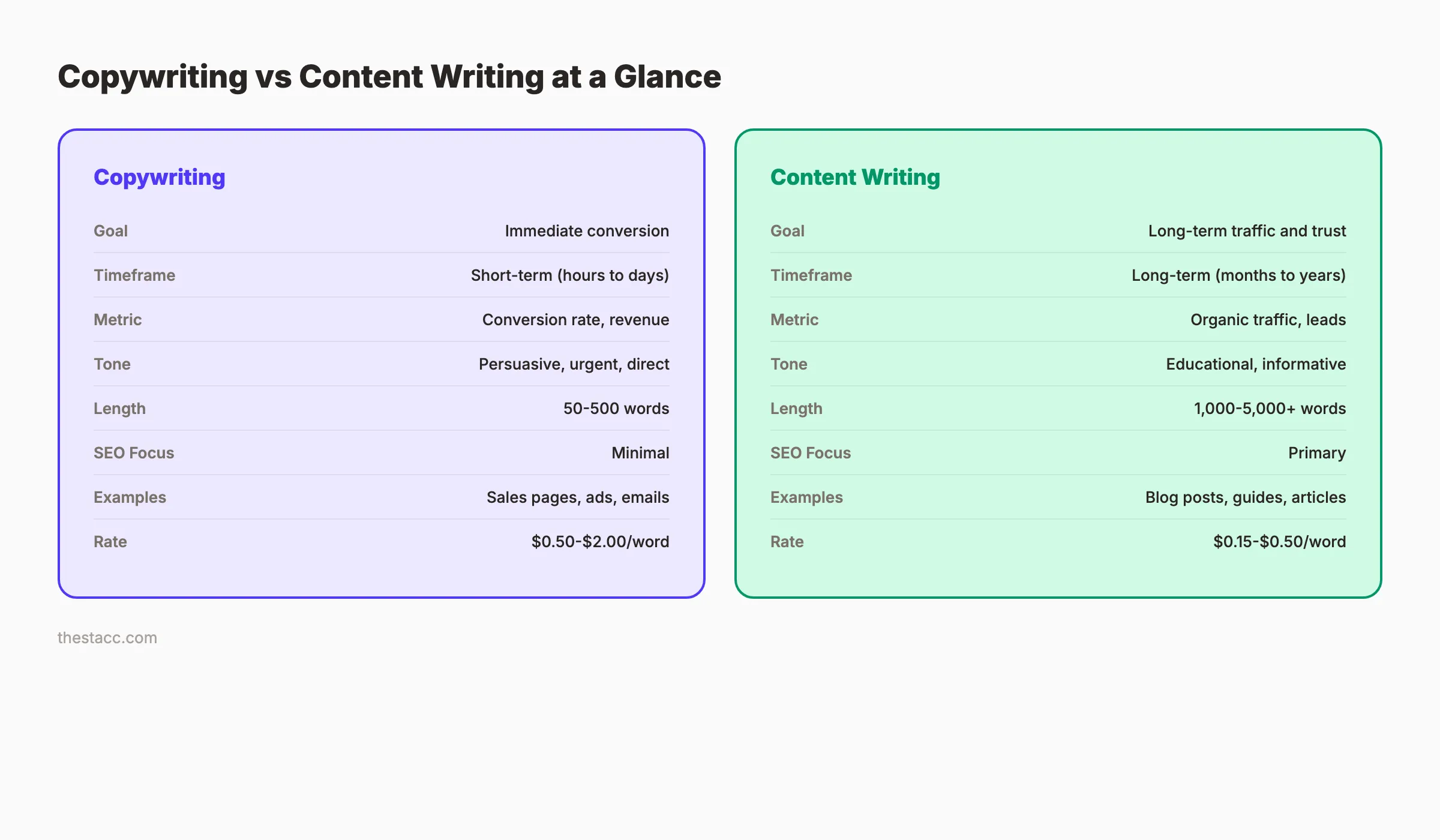
| Copywriting | Content Writing | |
|---|---|---|
| Primary goal | Immediate conversion | Long-term traffic and trust |
| Timeframe | Short-term (hours to days) | Long-term (months to years) |
| Success metric | Conversion rate, revenue | Organic traffic, engagement, leads |
| Tone | Persuasive, urgent, direct | Educational, informative, helpful |
| Length | Short (50-500 words typical) | Long (1,000-5,000+ words) |
| SEO focus | Minimal (conversion-focused pages) | Primary (keyword-targeted content) |
| Examples | Sales pages, ads, email subject lines, CTAs | Blog posts, guides, whitepapers, articles |
What Copywriting Looks Like
Copywriting is direct-response writing. Every word exists to move the reader toward a specific action. The best copywriting feels like a conversation that ends with “yes.”
Where Copywriting Appears
- Landing pages. Sales pages designed to convert visitors into customers
- Email marketing. Subject lines, sales sequences, and promotional emails
- Ad copy. Google Ads, Facebook Ads, LinkedIn Ads, display ads
- Product descriptions. Ecommerce listings designed to drive purchases
- Sales letters. Direct mail and digital sales letters
- Website headlines. Hero sections, CTAs, and conversion-focused page elements
- Social media ads. Paid social copy optimized for clicks
What Makes Good Copywriting
Good copy follows proven formulas. AIDA (Attention, Interest, Desire, Action). PAS (Problem, Agitation, Solution). These frameworks exist because they work. Decades of direct-response testing prove that structured persuasion outperforms unstructured writing.
Good copywriting is specific. “Save 30% on your monthly SEO costs” converts. “Save money on marketing” does not. Numbers, deadlines, and specificity create urgency.
Good copywriting is short. Every unnecessary word reduces conversion rates. A headline that works in 6 words does not need 12.
Copywriting Examples
Weak copy: “Our marketing services help businesses grow their online presence through various digital channels.”
Strong copy: “30 SEO articles per month. $99. Published to your site automatically.”
The strong version is specific, benefit-focused, and action-oriented. The weak version uses vague language that describes nothing concrete. For more on writing effective headlines, read our blog headlines guide.
What Content Writing Looks Like
Content writing builds the long game. Each piece of content targets a keyword, answers a question, and attracts organic traffic that compounds over time. The goal is not immediate conversion. The goal is being found, building trust, and staying top-of-mind.
Where Content Writing Appears
- Blog posts. SEO-optimized articles targeting specific keywords
- Ultimate guides. Long-form resources covering a topic end-to-end
- Whitepapers. In-depth research reports for B2B lead generation
- Case studies. Customer success stories with data and outcomes
- Newsletter content. Educational email content (not sales sequences)
- Resource pages. How-to content, tutorials, and educational articles
- FAQ pages. Answers to common customer questions
What Makes Good Content Writing
Good content writing starts with search intent. Before writing a word, the writer understands what the searcher wants to learn and how detailed the answer needs to be.
Good content writing is structured for both humans and search engines. H2 and H3 headings organize information. Short paragraphs keep readers engaged. Tables and lists make data scannable. Internal links connect related topics. Read our guide on SEO content writing for the full framework.
Good content writing is deep. A 300-word blog post does not rank. A 2,000-word guide that answers every related question does. The ideal blog post length for SEO depends on the keyword, but depth always outperforms brevity in competitive niches.
Content Writing Examples
Weak content: “SEO is important for businesses. There are many ways to improve your SEO. Contact us to learn more.”
Strong content: “Sites that publish 16+ blog posts per month get 3.5x more traffic than those publishing 0-4 times. Here is the exact publishing cadence we use for clients across 70+ industries.”
The strong version teaches something specific and measurable. The weak version says nothing a reader could not guess on their own.
Stop writing. Start ranking. Stacc publishes 30 SEO content articles per month for $99. Keyword-targeted, optimized, and published automatically. Start for $1 →
Where Each One Fits in the Marketing Funnel
The confusion between copywriting and content writing often comes from not understanding where each fits in the buyer journey.
Top of Funnel: Content Writing Dominates
At the top of the funnel, potential customers do not know your brand. They are searching for answers to problems. “How to reduce customer churn.” “Best CRM for small business.” “What is SEO.”
Content writing captures this traffic. Blog posts, guides, and educational articles rank for these informational keywords and bring new visitors to your site. This is where content marketing strategy lives.
Middle of Funnel: Both Work Together
In the middle of the funnel, visitors know your brand and are evaluating options. They read case studies (content writing), comparison pages (both), and product overviews (copywriting). This is where the two disciplines overlap most.
A comparison page needs content writing for the educational framework and copywriting for the CTA sections that drive conversions.
Bottom of Funnel: Copywriting Dominates
At the bottom of the funnel, the visitor is ready to buy. They are on your pricing page, reading your sales page, or deciding between you and a competitor. Copywriting closes the deal. Headlines, benefit statements, urgency elements, and CTAs convert visitors into customers.
| Funnel Stage | Content Type | Writing Discipline | Goal |
|---|---|---|---|
| Top (Awareness) | Blog posts, guides, how-to articles | Content writing | Attract organic traffic |
| Middle (Consideration) | Case studies, comparisons, webinars | Both | Build trust and educate |
| Bottom (Decision) | Landing pages, pricing pages, CTAs | Copywriting | Convert to customers |
| Post-Purchase | Onboarding emails, help docs | Content writing | Retain and educate |
Understanding this funnel helps you hire the right writer for each job. Do not ask a copywriter to produce your blog strategy. Do not ask a content writer to craft your sales page.

Skills and Techniques Compared
Copywriters and content writers use different skills, even though both write professionally.
Copywriting Skills
- Persuasion psychology. Understanding cognitive biases, urgency triggers, and decision-making
- Direct-response frameworks. AIDA, PAS, Before-After-Bridge, and similar structures
- A/B testing. Writing multiple versions and measuring which converts better
- Headline writing. Crafting attention-grabbing headlines that stop the scroll
- CTA optimization. Writing calls to action that drive clicks
- Conversion rate optimization. Understanding how copy fits into page design and user flow
- Brevity. Saying the maximum in the minimum words
Content Writing Skills
- SEO knowledge. Keyword research, on-page optimization, search intent analysis
- Research depth. Synthesizing multiple sources into authoritative content
- Topic structuring. Organizing information with clear headings, subheadings, and flow
- Long-form writing. Maintaining reader engagement across 2,000-5,000+ words
- Internal linking. Connecting content pieces into a coherent topic cluster
- Data presentation. Using tables, charts, and statistics to support claims
- Consistency. Writing at volume without quality degradation
Where Skills Overlap
Both disciplines require clear writing, audience understanding, and the ability to match tone to brand. Both need to understand the reader’s pain points. The best writers in 2026 can do both. The specialization exists because businesses need different outputs at different stages.
The overlap is growing. SEO content writers now learn conversion rate optimization. Copywriters now study keyword research. The market rewards writers who can produce a blog post that ranks on page 1 AND includes CTAs that drive consultations. Single-skill writers are becoming harder to justify for businesses that need both traffic and conversions from every piece of content.
For teams building a content operation, the tools matter as much as the writers. See our lists of SEO content writing tools and AI blog writing tools to support both disciplines.
Cost and Salary Comparison
The two disciplines have different pricing structures because they deliver different value.
Freelance Rates
| Writing Type | Per-Word Rate | Per-Project Rate | Per-Hour Rate |
|---|---|---|---|
| Copywriting (junior) | $0.10-$0.30/word | $200-$1,000/project | $30-$60/hr |
| Copywriting (experienced) | $0.50-$2.00/word | $1,000-$10,000/project | $75-$200/hr |
| Content writing (junior) | $0.05-$0.15/word | $100-$500/article | $20-$40/hr |
| Content writing (experienced) | $0.15-$0.50/word | $300-$1,500/article | $50-$100/hr |
Copywriters charge more per word because their work directly drives revenue. A sales page that increases conversion by 1% can generate $100,000+ in additional revenue. A blog post that ranks for a keyword generates traffic over months but the direct revenue attribution is harder to measure.
Full-Time Salary Ranges
| Role | US Salary Range (2026) | Median |
|---|---|---|
| Copywriter | $50,000-$96,000 | $62,615 |
| Senior Copywriter | $75,000-$120,000 | $90,000 |
| Content Writer | $44,000-$95,000 | $58,358 |
| Senior Content Writer / Strategist | $65,000-$100,000 | $80,000 |
The pay gap reflects market perception. Copywriting ties more directly to revenue. Content writing ties to traffic and brand building. Both are valuable. The market values direct revenue attribution more.
The exception is SEO content writers with proven ranking track records. Writers who can demonstrate that their articles rank on page 1 for competitive keywords command rates closer to copywriters. The differentiator is not the writing style. It is the measurable business outcome.
The Cost of Volume
Here is where the math changes for most businesses. A freelance content writer charging $300/article produces 1 article per project. Producing 30 articles per month at $300 each costs $9,000/month. For teams comparing in-house vs outsourced content, the volume question drives the decision.
Stacc publishes 30 SEO content articles per month for $99. That is $3.30 per article. The per-article economics have shifted dramatically for content writing. Copywriting, which requires more customization per project, has not seen the same cost reduction.
Your SEO team. $99 per month. 30 optimized content articles, published automatically. No copywriter needed for blog SEO. Start for $1 →
Why the Line Is Disappearing in 2026
The distinction between copywriting and content writing is becoming less useful every year. Modern marketing requires both skills in a single piece of content.
SEO Content Needs Conversion Elements
A blog post that ranks on page 1 but never converts a reader into a lead has failed half its job. Modern SEO content includes CTAs, email capture forms, and persuasive sections that drive action. That is copywriting inside content writing.
Landing Pages Need Educational Content
A sales page with nothing but benefit claims and urgency triggers feels like spam. Modern landing pages include explainer sections, comparison tables, and FAQ content that builds trust before asking for the conversion. That is content writing inside copywriting.
The Rise of the “Content Copywriter”
The fastest-growing content marketing roles blend both disciplines. Companies hire writers who can produce SEO-optimized blog posts that also include strategic CTAs, persuasive section headers, and conversion-focused closing paragraphs.
This blended skill set is what Stacc’s content model is built on. Every article we publish is structured for SEO (content writing) and includes conversion elements (copywriting). The articles rank on Google and drive business results. Pure content writing without conversion elements leaves money on the table. Pure copywriting without SEO leaves traffic on the table.
Which One Does Your Business Need?
The answer depends on your current marketing gaps.
You Need Copywriting If:
- Your website gets traffic but visitors do not convert
- Your landing pages have high bounce rates
- Your email open rates are strong but click rates are low
- You are launching a product and need sales page copy
- Your ad campaigns get impressions but few clicks
- You need to rewrite your homepage, pricing page, or product pages
You Need Content Writing If:
- Your website gets little to no organic traffic
- You publish fewer than 4 blog posts per month
- Your competitors rank above you for target keywords
- You have no content addressing your customers’ common questions
- You need to build topical authority in your industry
- You want to reduce dependence on paid advertising
You Need Both If:
- You want organic traffic that also converts
- You are building a full content marketing funnel
- You need blog content, landing pages, email sequences, and ad copy
- You are scaling content output beyond what one writer can handle
Most businesses need content writing first. Organic traffic is the foundation. Copywriting optimizes the conversion of that traffic. Building a conversion-optimized sales page for a website that gets 50 visitors per month is solving the wrong problem first.
Here is a practical sequence for businesses starting from zero:
- Month 1-3: Publish 15-30 SEO content articles targeting your top keywords
- Month 3-6: Optimize landing pages and CTAs with copywriting (conversion focus)
- Month 6+: Build email sequences combining educational content with sales copy
- Ongoing: Measure which blog posts drive the most leads and double down on similar topics
The businesses that follow this sequence build a traffic base first. Then they optimize conversions. Trying to do both simultaneously with limited budget spreads resources too thin. For more on the right content marketing ROI framework, see our detailed guide.
3,500+ blogs published. 92% average SEO score. Content writing at scale, done for you. See what Stacc can do for your site. Start for $1 →
FAQ
What is the main difference between copywriting and content writing?
Copywriting drives immediate action (buy, sign up, click). Content writing builds long-term traffic and trust through educational, SEO-optimized articles. Copywriting dominates the bottom of the marketing funnel. Content writing dominates the top. Both are necessary for a complete marketing strategy.
Which pays more, copywriting or content writing?
Copywriting generally pays more per word and per project. Experienced copywriters earn $0.50-$2.00/word while experienced content writers earn $0.15-$0.50/word. Full-time copywriters earn a median of $65,000. Content writers earn a median of $55,000. The gap reflects the direct revenue attribution of copywriting work.
Can one person do both copywriting and content writing?
Yes. Many writers develop both skill sets. The “content copywriter” role is growing because businesses need SEO content that also converts. The core writing skills overlap. The difference is in frameworks (persuasion formulas vs. SEO structure) and goals (conversion vs. traffic).
Which is better for SEO, copywriting or content writing?
Content writing drives SEO results. Blog posts, guides, and educational articles target keywords and build organic traffic. Copywriting appears on landing pages and CTAs but does not target informational keywords. For SEO content writing, use content writing principles with strategic copywriting elements in CTAs and headers.
Do I need to hire a copywriter and a content writer separately?
Not necessarily. Hire a content writer who understands conversion for your blog and SEO content. Hire a dedicated copywriter for high-stakes sales pages, ad campaigns, and email sequences. Many businesses start with a content writer and add copywriting expertise as they scale. Alternatively, Stacc handles SEO content writing for $99/month.
Is content writing still relevant with AI tools?
Content writing is more relevant than ever. AI tools generate drafts, but ranking on Google requires depth, accuracy, originality, and strategic optimization that raw AI output does not provide. The role of the content writer has shifted from writing from scratch to researching, structuring, editing, and optimizing content. Volume has become easier. Quality still requires expertise.
Copywriting and content writing serve different purposes at different stages of the marketing funnel. Businesses that understand the difference invest in the right type at the right time.
Start with content writing to build organic traffic. Add copywriting to convert that traffic into revenue. The combination of consistent blog SEO content and conversion-optimized landing pages creates a marketing engine that compounds over time.
The businesses that master both grow faster than those that confuse one for the other. The ones that automate the content side free up budget to invest in the copywriting that closes deals.
Related Tools & Resources
Free SEO Tools:
Best Lists:

Written by
Siddharth GangalSiddharth is the founder of theStacc and Arka360, and a graduate of IIT Mandi. He spent years watching great businesses lose organic traffic to competitors who simply published more. So he built a system to fix that. He writes about SEO, content at scale, and the tactics that actually move rankings.
30 SEO blog articles published every month
Keyword-optimized, scheduled, and live on your site. Automatically.
30-day trial · Cancel anytime
theStacc
Stop writing SEO content manually
30 blog articles, 30 GBP posts, and social media content. Published every month. Automatically.
Start Your $1 Trial$1 for 3 days · Cancel anytime