
What Are Fanout Queries? The AI Search Guide (2026)
Fanout queries split one search into 8-16 sub-queries across AI platforms. Learn how they work, SEO impact, and how to optimize. Updated April 2026.
What Are Fanout Queries? The AI Search Guide (2026)
A single question to Google AI Mode triggers up to 16 parallel searches before generating an answer. The user types one query. The AI system runs 8 to 16 behind the scenes. Each sub-query retrieves different content from different sources. Then the AI synthesizes everything into one response.
This process is called query fan-out. And it changes everything about how SEO works in AI search.
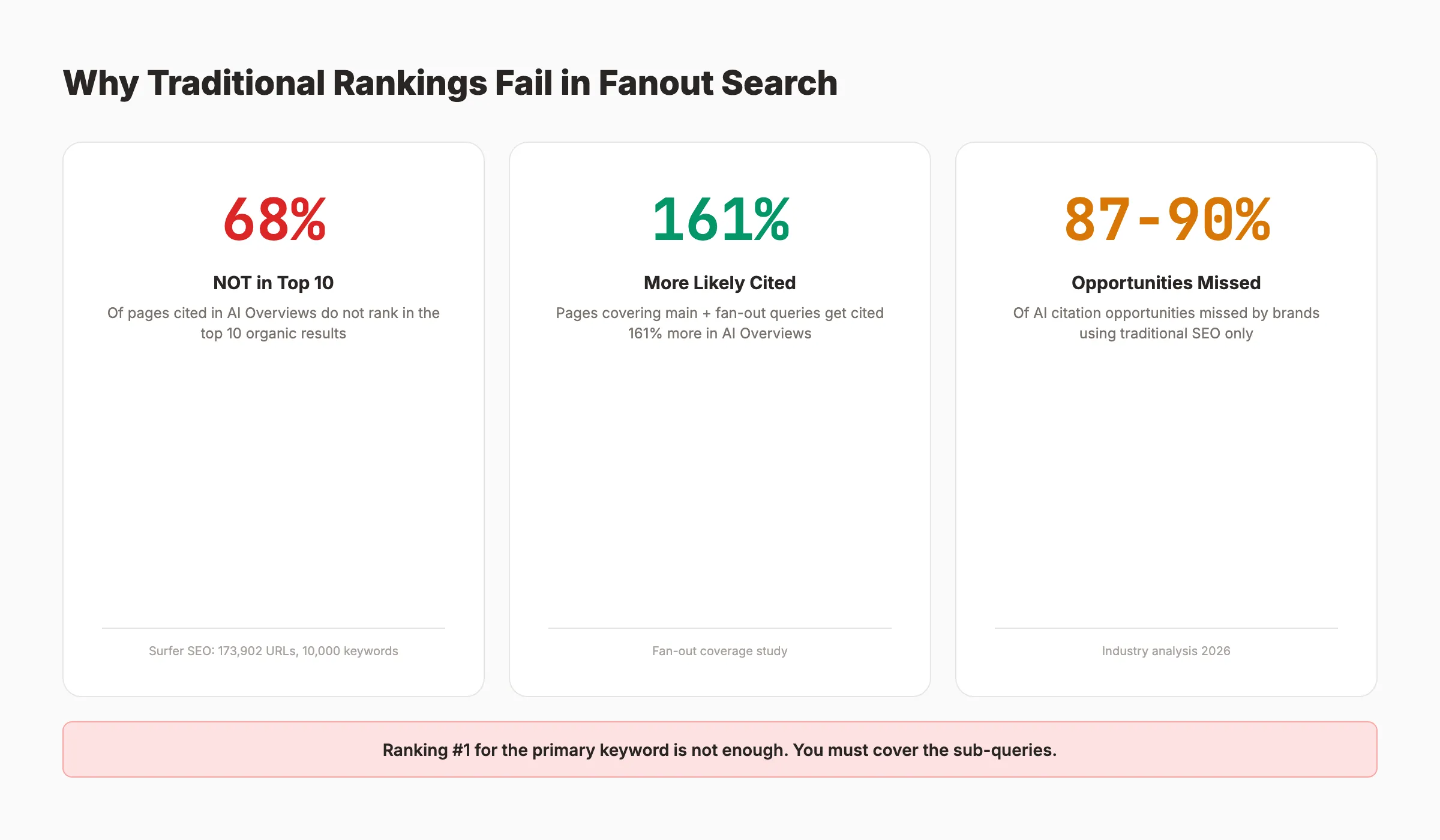
Here is why fanout queries matter: a Surfer SEO study analyzing 173,902 URLs across 10,000 keywords found that 68% of pages cited in AI Overviews were NOT in the top 10 organic results. Ranking on page 1 of Google does not guarantee citation in AI-generated answers. What does guarantee citation is covering the sub-queries that fan-out generates.
Brands relying solely on traditional SEO rankings miss 87 to 90% of AI citation opportunities. That is the cost of ignoring fanout queries.
We have published 3,500+ blogs across 70+ industries with a 92% average SEO score. Understanding fanout queries is central to how we structure content for both traditional and AI search. This guide explains the concept, the strategy, and the implementation.
Here is what you will learn:
- What fanout queries are and how the 3-step process works
- Which AI platforms use fan-out (and how many sub-queries they generate)
- Why 68% of AI-cited pages do not rank in the top 10 organic results
- How to identify the sub-queries AI generates for your target keywords
- The “atomic answer” content structure that wins in fan-out search
- A step-by-step optimization strategy for fanout visibility
How Fanout Queries Work: The 3-Step Process
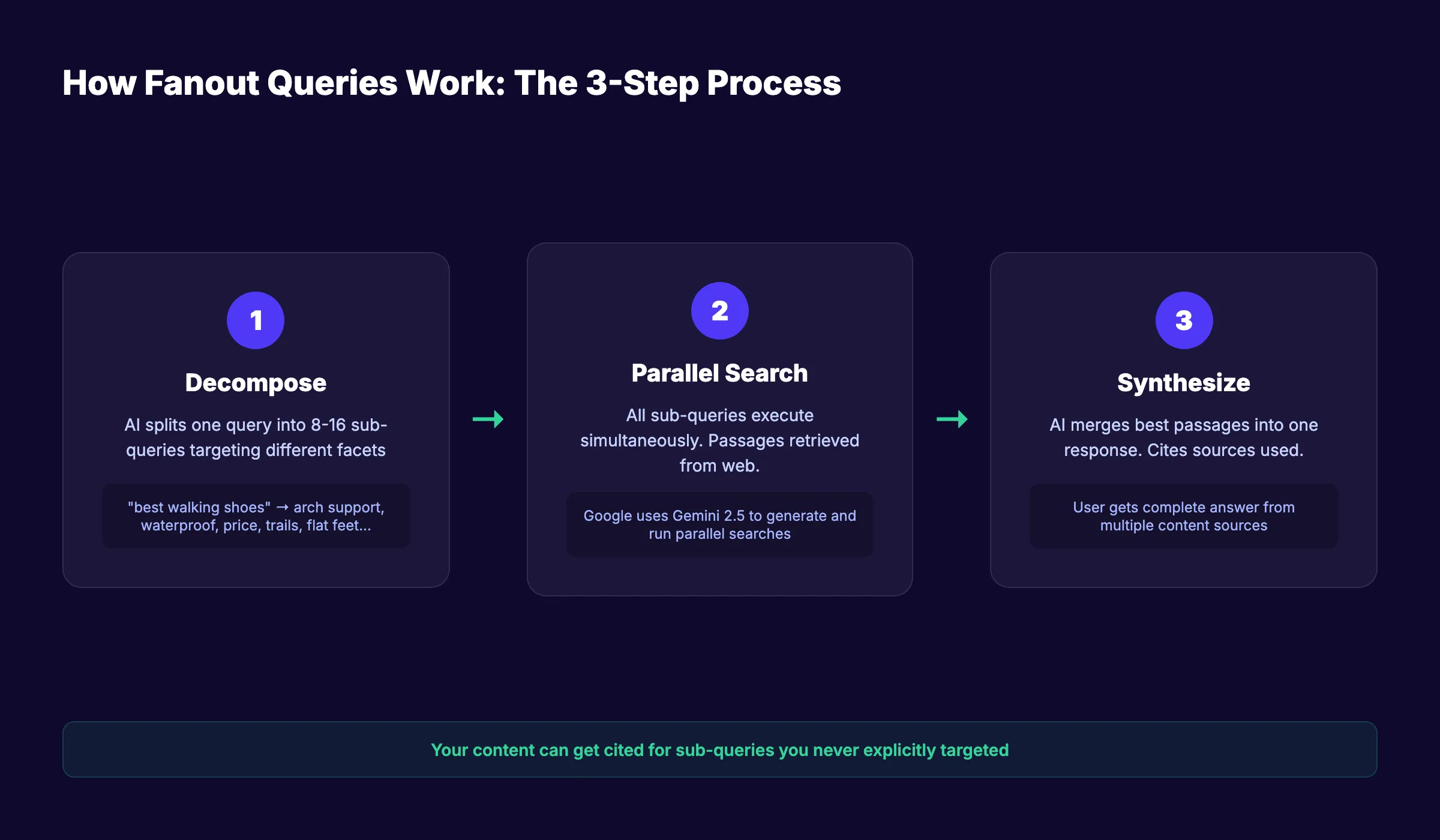
Fanout queries follow a specific 3-step pattern. Every major AI search platform uses this process.
Step 1: Decompose
The AI system takes the user’s query and breaks it into multiple sub-queries. Each sub-query targets a specific facet or subtopic of the original question.
Example: User types “best sneakers for walking.”
The AI decomposes this into:
- “best sneakers for walking men”
- “best sneakers for walking women”
- “best sneakers for walking on trails”
- “best sneakers for walking flat feet”
- “best sneakers for walking arch support”
- “best sneakers for walking in rain”
- “best slip-on sneakers for walking”
- “sneaker walking comfort ratings 2026”
One user query becomes 8 separate searches. The user never sees these sub-queries. They happen invisibly.
Step 2: Parallel Search
The AI system executes all sub-queries simultaneously. For each sub-query, the system retrieves relevant passages (not entire pages) from across the web. Google uses a custom Gemini 2.5 model to generate and execute these parallel searches.
This is the critical difference from traditional search. In traditional search, one query returns one set of results. In fan-out search, one query searches 8 to 16 different result sets at the same time. The content pool is dramatically larger.
Step 3: Synthesize
The AI merges the best passages from all sub-query results into a single, coherent response. It cites the sources it pulled from. The user gets a complete answer that addresses multiple facets of their question. All from one input.
The 3-step process means your content can get cited for sub-queries you never explicitly targeted. If your page about “best walking shoes” contains a strong paragraph about arch support, the AI may pull that paragraph for the “sneakers for walking arch support” sub-query. Even if you never optimized for that exact phrase.
For a deeper understanding of how AI search works, read our guide on Google AI Overviews.
Which AI Platforms Use Fanout
Every major AI search platform uses some form of query fan-out. The implementation varies but the principle is the same.
| Platform | Fan-Out Behavior | Sub-Queries Per Search | Citation Style |
|---|---|---|---|
| Google AI Mode | Up to 16 parallel searches per query | 8 to 16 | Inline links |
| Google AI Overviews | Moderate fan-out for complex queries | 4 to 8 | Source links below |
| ChatGPT (web search) | Generates sub-queries before searching | 8 to 10 | Numbered citations |
| Perplexity | Heavy fan-out with visible sub-queries | 5 to 12 | Inline numbered sources |
| Bing Copilot | Sub-query generation before retrieval | 4 to 8 | Source cards |
Google AI Mode uses the most aggressive fan-out. Search Engine Journal reported that AI Mode does not include traditional organic results alongside its responses. It operates entirely through fan-out retrieval. No blue links. Only synthesized answers from fan-out sub-queries.
This makes AI Mode fundamentally different from AI Overviews (which still show organic results alongside). In AI Mode, fan-out is the only way your content reaches users.
Your SEO team. $99 per month. 30 optimized articles, published automatically. Start for $1 →
Why Traditional SEO Rankings Fail in Fan-Out Search
Here is the data that should change your content strategy.
68% of pages cited in AI Overviews were NOT in the top 10 organic results. This comes from a Surfer SEO study of 173,902 URLs. Nearly 7 out of 10 AI citations go to pages that traditional SEO would consider “not ranking.”
Pages ranking for both main queries and fan-out sub-queries are 161% more likely to be cited compared to pages ranking only for the primary keyword.
Brands relying on traditional SEO miss 87 to 90% of AI citation opportunities. The citation gap is enormous. And it grows as fan-out becomes more sophisticated.
Why This Happens
Traditional SEO targets one keyword per page. You optimize for “best walking shoes” and measure success by your ranking for that exact phrase.
Fan-out search does not work that way. The AI system does not just search for “best walking shoes.” It searches for arch support, trail walking, waterproof options, price comparisons, brand reviews, and foot type recommendations. Simultaneously.
If your page only covers the main keyword and ignores the sub-topics, the AI pulls 0 passages from your content. A competitor with a deeper page covering 8 sub-topics gets cited 8 times in the same response.
The winning strategy is not ranking #1 for one keyword. It is providing the best answer for multiple related sub-queries on one page. This is why topical authority and content clusters matter more in 2026 than individual keyword rankings.
How to Identify Fanout Sub-Queries for Your Keywords
Before optimizing, you need to know which sub-queries AI systems generate for your target keywords. Here are 4 methods.
Method 1: Use Google AI Mode Directly
Search your target keyword in Google AI Mode. The response itself reveals the sub-topics the AI explored. If the answer mentions arch support, waterproofing, price ranges, and brand comparisons, those are the sub-queries it ran.
Method 2: Check People Also Ask and Related Searches
Google’s People Also Ask boxes and related searches at the bottom of the SERP mirror fan-out patterns. These questions represent the sub-topics Google associates with your primary keyword.
Method 3: Analyze Perplexity’s Source Panel
Perplexity shows its sources transparently. Search your target keyword in Perplexity and examine which sources get cited for which sub-topics. This reveals the fan-out structure directly.
Method 4: Map Your Topic Cluster
Use keyword research to build a complete topical map around your primary keyword. Every question, subtopic, and related query in the map is a potential fan-out sub-query. The more thoroughly you map the topic, the more sub-queries you can cover.
Building Your Sub-Query Map
For each target keyword, create a table:
| Primary Keyword | Sub-Query | Content Needed | Covered? |
|---|---|---|---|
| best walking shoes | best walking shoes for flat feet | Paragraph on flat feet support | Yes/No |
| best walking shoes | waterproof walking shoes | Section on waterproof options | Yes/No |
| best walking shoes | walking shoes vs running shoes | Comparison paragraph | Yes/No |
| best walking shoes | walking shoes price comparison | Price comparison table | Yes/No |
Fill the “Covered?” column by auditing your existing content. Every “No” is a missed citation opportunity.
The Atomic Answer Strategy: How to Optimize for Fanout
The content structure that wins in fan-out search is what SEO practitioners call “atomic answers.” One focused, self-contained paragraph per sub-topic. Each paragraph answers one specific question completely.
What an Atomic Answer Looks Like
Bad (merged topics):
Walking shoes come in many varieties. Some are waterproof while others have arch support. Prices range from $50 to $300 depending on the brand. You should consider your foot type, the terrain, and the weather.
Good (atomic answers, each a separate section):
Are waterproof walking shoes worth it? Waterproof walking shoes add $20 to $40 to the price compared to non-waterproof models. For commuters walking in rain 3+ days per week, the investment pays back within 2 months through dry socks alone. Gore-Tex models from Hoka and Salomon rated highest in 2026 waterproofing tests.
How much do quality walking shoes cost? Entry-level walking shoes from New Balance and Asics cost $60 to $90. Mid-range options from Brooks and Hoka run $120 to $160. Premium models from On Running and Salomon reach $180 to $250.
Each paragraph stands alone. The AI can pull one paragraph for one sub-query without needing the surrounding context. That is what makes atomic answers work for fan-out.
How to Structure a Fan-Out Optimized Page
Follow this pattern for your SEO content writing:
- H1: Primary keyword (the main query)
- Opening paragraph: Direct answer to the primary query in 40 to 60 words
- H2: Sub-topic 1 (formatted as a question matching a sub-query)
- Atomic answer paragraph (40 to 80 words, self-contained)
- Supporting detail (table, list, or additional context)
- H2: Sub-topic 2 (next sub-query)
- Repeat for each sub-query in your map
This structure maps directly to how AI systems decompose and retrieve. Each H2 section targets one sub-query. Each atomic answer provides one citable passage.
Read our guide on blog post structure for SEO for the full formatting framework.
3,500+ blogs published. 92% average SEO score. See what Stacc can do for your site. Start for $1 →
Step-by-Step Fanout Query Optimization
Here is the complete implementation process.
Step 1: Identify Your Top 20 Target Keywords
Start with the keywords you already target. Fan-out optimization builds on existing content. You do not need new pages. You need deeper pages.
Step 2: Map 8 to 12 Sub-Queries Per Keyword
Use the 4 identification methods above. For each keyword, document every sub-query the AI system generates. Target 8 to 12 per keyword.
Step 3: Audit Existing Content Against Sub-Query Maps
For each target page, check which sub-queries your content already covers. Mark the gaps. Most pages cover 2 to 3 sub-queries out of 10. That means 70 to 80% of potential citations are missed.
Step 4: Add Atomic Answer Sections
For each missing sub-query, add an H2 section with an atomic answer. Write the question as the heading. Write a 40 to 80 word direct answer as the first paragraph. Add supporting detail below.
Step 5: Implement Supporting SEO Elements
- Add FAQ schema for question-answer sections
- Ensure schema markup covers Article, FAQPage, and HowTo where relevant
- Strengthen E-E-A-T signals with author credentials and external citations
- Internal link to related content cluster pages
- Verify page speed under 1.5 seconds
Step 6: Track Fan-Out Visibility
Monitor AI search visibility for both your primary keywords and their sub-queries. Track which sub-queries generate citations and which do not. Iterate monthly.
The goal: cover 10+ sub-queries per primary keyword with atomic answers. Pages that achieve this level of coverage see 161% higher citation rates in AI Overviews.
Common Fanout Optimization Mistakes
Most businesses that try to optimize for fanout make the same errors.
Mistake 1: Only Covering the Primary Keyword
The most common failure. A page targets “best CRM software” but covers nothing about pricing tiers, integration options, small business vs enterprise use cases, or industry-specific recommendations. The AI runs 12 sub-queries. The page answers 1. Citation rate: near zero.
Mistake 2: Thin Sub-Topic Coverage
Adding a single sentence about each sub-topic is not enough. AI systems evaluate passage quality. A 15-word mention of “waterproof options” will not compete with a competitor’s 80-word atomic answer with specific product names and prices.
Mistake 3: Ignoring Content Clusters
A single pillar page cannot cover every sub-query completely. Some sub-queries deserve their own dedicated articles. Build content clusters where the pillar page covers the main query and supporting articles cover individual sub-queries in full depth.
Mistake 4: Not Updating for New Sub-Queries
AI systems evolve. The sub-queries generated for “best CRM software” in January 2026 differ from those generated in April 2026. New products launch. New comparison angles emerge. Review and update your sub-query maps quarterly.
Mistake 5: Ignoring Passage-Level Optimization
Fan-out retrieves passages, not pages. A page can be 5,000 words long and perfectly structured. But if the specific passage about pricing is buried in a long paragraph with 3 other topics, the AI skips it. Every passage needs to stand alone as an atomic answer.
For the broader optimization framework, read our guide on on-page SEO.
Fanout Queries and Content Strategy
Fan-out optimization changes how you plan content at the strategic level. The shift is from “one keyword, one page” to “one topic cluster, complete coverage.”
The Content Cluster Connection
A topical map built around fan-out sub-queries produces content that AI systems can synthesize from. Your pillar page covers the primary query. Your supporting pages cover individual sub-queries in depth. Internal links connect everything.
When the AI runs fan-out, it pulls from your pillar page for the main answer and from your supporting pages for sub-topic detail. Your entire cluster feeds the response. Competitors with isolated, disconnected pages contribute 1 passage. You contribute 8.
This is the Content Compound Effect in action. Every additional page in a topic cluster adds another fan-out citation opportunity. The value of each page increases as the cluster grows.
How Stacc Handles Fan-Out at Scale
We publish 30 to 80 articles per month for each client. That publishing volume builds topic clusters that cover fan-out sub-queries systematically. Each article targets specific sub-queries within a cluster. Over 3 to 6 months, the cluster reaches a coverage level that dominates both traditional rankings and AI citations.
Read our guide on GEO scoring for how to measure the effectiveness of this approach. And see our guide on AI citability score for how to evaluate individual page performance.
Rank everywhere. Do nothing. Blog SEO, Local SEO, and Social on autopilot. Start for $1 →
FAQ
What are fanout queries?
Fanout queries (also called query fan-out or query decomposition) are the parallel sub-queries that AI search systems generate from a single user query. When someone searches “best walking shoes,” the AI generates 8 to 16 sub-queries about arch support, waterproofing, price ranges, foot types, and brands. The AI retrieves content for each sub-query and synthesizes one response.
How many sub-queries does AI Mode generate?
Google AI Mode generates up to 16 parallel sub-queries per search. ChatGPT typically generates 8 to 10. Perplexity generates 5 to 12. The number depends on the complexity of the original query. Simple factual questions trigger fewer sub-queries. Complex comparison or research queries trigger more.
Do I need to rank #1 to get cited in AI search?
No. 68% of pages cited in AI Overviews do not rank in the top 10 organic results. AI systems cite content based on passage relevance to specific sub-queries, not overall page ranking. A page ranking #15 for the main keyword can get cited if it contains the best answer for a fan-out sub-query.
How do I find the sub-queries for my keywords?
Use 4 methods: search in Google AI Mode and analyze the response, check People Also Ask boxes, examine Perplexity’s source panel, and map your topic cluster with keyword research. The sub-queries align with the subtopics, related questions, and facets AI associates with your primary keyword.
What is an atomic answer?
An atomic answer is a self-contained paragraph (40 to 80 words) that completely answers one specific question. AI systems can extract an atomic answer from a page without needing the surrounding context. Structuring content with atomic answers per sub-query maximizes the chance that AI systems cite your specific passages.
Does Stacc optimize for fanout queries?
Yes. Every article Stacc publishes follows fan-out optimization principles: atomic answer structure, topic cluster coverage, FAQ schema, and E-E-A-T signals. Publishing 30 to 80 articles per month systematically builds the sub-query coverage that AI systems need to cite your content.
Own the Sub-Queries, Own the Answer
Fanout queries are not a future trend. They are how AI search works right now. Every question a user asks triggers 8 to 16 searches you never see. Every one of those searches is a citation opportunity.
The businesses that map their sub-queries, write atomic answers, and build topic clusters will capture traffic from both traditional and AI search. The ones optimizing for a single keyword per page will keep missing 70% of the opportunities AI search creates.
Start with your top 5 keywords. Map the sub-queries. Add atomic answers to your existing pages. Measure the citation impact after 30 days. The data will speak for itself. Then scale the approach across your entire content library.

Written by
Siddharth GangalSiddharth is the founder of theStacc and Arka360, and a graduate of IIT Mandi. He spent years watching great businesses lose organic traffic to competitors who simply published more. So he built a system to fix that. He writes about SEO, content at scale, and the tactics that actually move rankings.
30 SEO blog articles published every month
Keyword-optimized, scheduled, and live on your site. Automatically.
30-day trial · Cancel anytime
theStacc
Stop writing SEO content manually
30 blog articles, 30 GBP posts, and social media content. Published every month. Automatically.
Start Your $1 Trial$1 for 3 days · Cancel anytime