Step-by-step guide to growing your marketing agency. 7 proven steps for lead generation, client retention, and scalable systems. Updated 2026.
Growing a marketing agency comes down to three things: a repeatable lead source, a service you can deliver without the founder in every meeting, and retention high enough that new clients add revenue instead of replacing churn. This guide covers seven steps across lead generation, retention, and delivery systems.
Most marketing agencies hit the same wall.
You land 3-5 clients through referrals. Revenue feels promising. Work fills your calendar. Then growth stalls. Not because demand dried up, but because you built a job for yourself instead of a business.
Without repeatable systems, every new client requires your direct involvement. You cannot hire fast enough because nothing is documented. Revenue stays flat because capacity is capped at your personal hours.
If you are just getting started, see our guide on how to start a digital marketing agency for the foundational steps. This guide picks up where that one ends.
Stacc has published over 3,500 blogs across 70+ industries and works with marketing agencies building scalable content operations. Here is what the agencies that grow consistently do differently.
Here is what you will learn:
- How to position your agency so prospects choose you over generalists
- A 3-channel lead generation system that does not depend on referrals
- How to productize services so delivery gets faster as you scale
- The content strategy that builds authority and attracts inbound clients
- Operations systems that let your team deliver without you
- The right hiring sequence and delegation approach
- How to retain clients longer and expand accounts without constant selling
Time required: 6-12 weeks to implement fully Difficulty: Intermediate What you will need: Your current client list, a basic website, and clarity on the type of work you want to do more of
Step 1: Pick a Niche and Commit to It
Generic agencies compete on price. Specialist agencies compete on expertise.
According to WordStream's guide on digital agency growth, 55% of clients prefer specialist agencies over full-service generalists. The reason is practical: specialists produce better results faster because they have solved the same problems dozens of times.
A dental SEO specialist has seen what works across 50 dental practices. A generalist is figuring it out from scratch each time. Prospects feel that difference in every conversation.
Choose your niche using 3 criteria:
- Industry familiarity: You already have clients there, or you deeply understand how this industry makes buying decisions
- Underserved demand: Competitors exist, but none clearly dominate with authority and case studies
- Recurring need: The industry buys marketing services consistently, not just for one-time campaigns
Strong niche examples: SEO for dental practices, content marketing for B2B SaaS startups, social media for real estate brokers, paid ads for home service companies.
Once you commit, update every surface: your website headline, case study titles, LinkedIn bio, and proposal templates. A niche you show up for halfway does not build the credibility that drives premium pricing.
Niche positioning also simplifies your operations. You build one playbook, refine it across clients, and deliver stronger results with less effort per engagement. That is where margin lives.
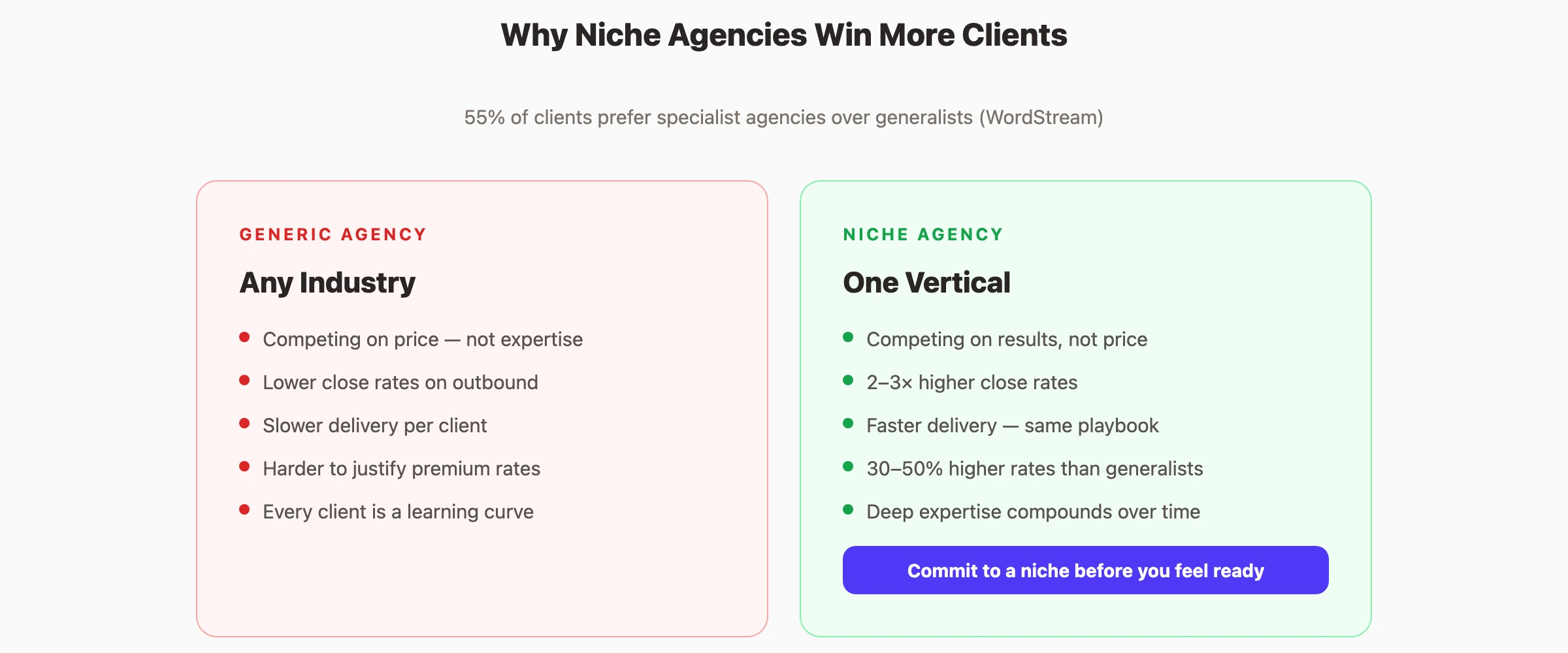
Why this step matters: Agencies with clear specializations report 2-3× higher close rates on outbound proposals. Niche positioning lets you charge 30-50% more than comparable generalist agencies for identical scope.
Pro tip: Do not pick a niche nobody searches for. Before committing, search "[your niche] + marketing agency" on Google. If 5+ competitors appear, demand exists. If zero appear, reconsider.
Step 2: Build a Lead Generation System. Not Just a Referral Network
51% of marketing agencies cite referrals as their primary client acquisition source. Referrals are valuable. Referrals as your only channel are a liability.
When referrals slow. During slow seasons, after a key client departs, or as you scale past your immediate network. Revenue drops with them. A lead generation system runs independently of who you know this month.
Build 3 channels simultaneously:
Channel 1. Inbound SEO
Publish content targeting keywords your ideal clients search before they hire an agency. If you serve law firms, write "SEO for law firms" guides. If you target SaaS startups, write "content marketing for SaaS" posts. This traffic compounds over 6-12 months and costs nothing once published.
Your blog SEO strategy is the foundation of this channel. Agencies that publish 4+ articles per month generate significantly more inbound than those that publish nothing.
Channel 2. Targeted Outbound
Cold email and LinkedIn outreach to your niche converts predictably when done correctly. Short messages, specific to their situation, with one outcome-focused hook. "I helped 3 HVAC companies in Atlanta rank for emergency repair keywords. Can I show you how?" converts far better than a 5-paragraph capabilities pitch.
Channel 3. Structured Referrals
Do not hope for referrals. Engineer them. Offer existing clients a flat fee or service credit for qualified introductions. Tell them exactly who to refer (your specific ideal client profile). Follow up after every closed referral to thank them and remind them the offer stands.
Use a lead magnet. A free audit, template, or report converts cold traffic from channels 1 and 2 into leads before they are ready to buy.
Measure your customer acquisition cost across all 3 channels every quarter. Invest in the channel that produces clients at the lowest cost and highest retention rate. Cut what underperforms.
For a deeper look at turning SEO into a consistent lead source, read our SEO for lead generation guide.
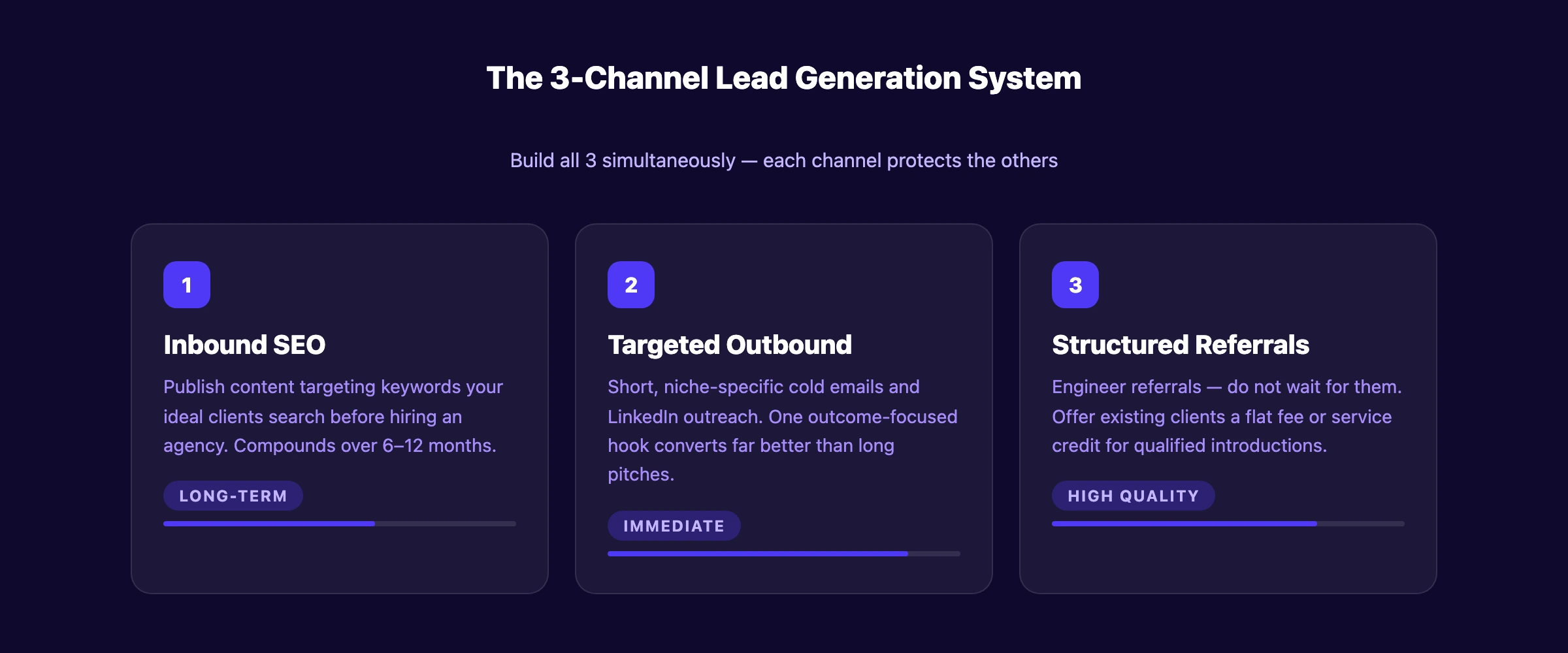
Why this step matters: A single lead channel creates single-point failure. 3 channels working together give you control over your growth pace. And protect revenue when any one channel slows.
Step 3: Productize Your Core Service
Custom projects kill scale.
When every client engagement is different, delivery takes longer. You cannot hire to help because the work is not repeatable. Every proposal starts from scratch. Every new client is a learning curve regardless of how experienced your team becomes.
Productized services convert your expertise into a repeatable package with defined inputs, outputs, and timelines.
Instead of "we do content marketing," offer 3 fixed tiers:
| Package | Deliverables | Price |
|---|---|---|
| Starter | 20 articles/month + quarterly strategy | $2,000/month |
| Growth | 40 articles/month + local SEO + reporting | $4,000/month |
| Scale | Full content + local SEO + social media | $7,500/month |
Each tier has a fixed deliverables list, a fixed delivery timeline, and a fixed price. Prospects know exactly what they buy. Your team knows exactly what to deliver. Pricing conversations become significantly simpler.
Productization does not mean rigid. Add custom elements as paid add-ons. But the core service. The 80% that is the same for every client. Should be consistent enough that a new hire can execute it fully by week 3.
To see this approach applied specifically to content volume, read how to 5x your content output without hiring.
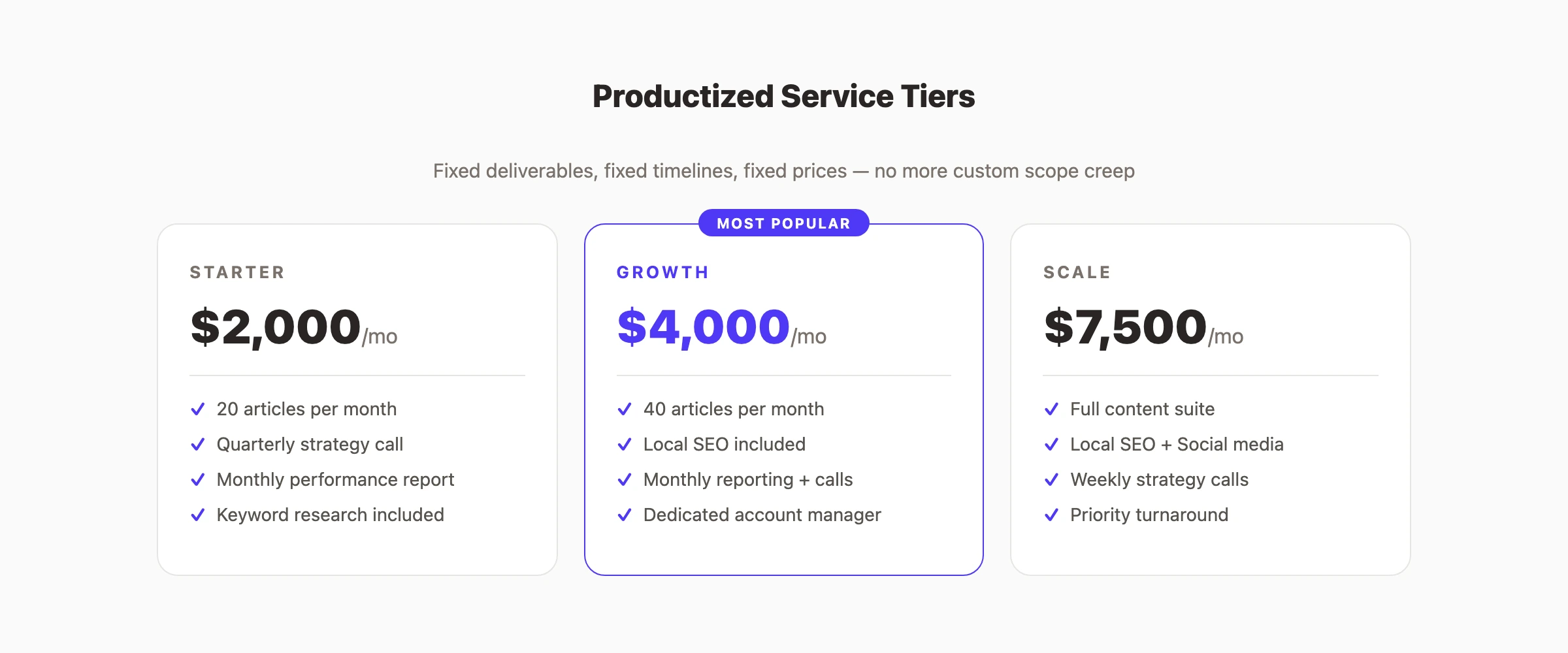
Why this step matters: Productized services reduce average delivery time by 40-60% and make delegation 10× easier. You scale by selling more of the same thing, not by inventing something new for each client.
Pro tip: Start with your most common service. What do 70% of your clients pay for? Productize that offering first before touching anything else.
Stop writing. Start ranking. theStacc plans, writes and publishes SEO-optimized articles automatically, from $99 per month per client. Marketing agencies use it to scale content delivery without adding headcount.
Step 4: Use Content to Attract Clients
The fastest-growing agencies publish consistently. Not because they love writing. Because content compounds.
An article targeting "SEO agency for dental practices" works every day after publication. A cold email works once. The economics of content improve over time; most other channels stay flat per unit of effort.
Three content types produce the highest return for agencies:
Case Studies
A case study showing how you took a dental clinic from 0 to 3,500 monthly organic visitors does more conversion work than any amount of ad spend. It proves you get specific results for the exact type of client a prospect is.
Write every case study with a clear before/after structure: what the client situation was, what you did specifically, and the measurable result with a timeframe. Learn how to write case studies that actually convert.
Niche SEO Guides
Write educational content targeting the keywords your ideal clients search before they know they need an agency. "How to get more patients from Google" targets intent from a dentist discovering organic search. They find your content, learn from it, and associate your agency with the expertise that solves their problem.
Opinion Posts
Share contrarian or data-backed takes on your industry. "Most agencies get local SEO wrong. Here is why" attracts both potential clients and peers in your niche. Opinion posts earn shares, backlinks, and speaking invitations far faster than generic how-to content.
A documented brand SEO strategy coordinates all 3 content types into a system rather than a series of one-off efforts.
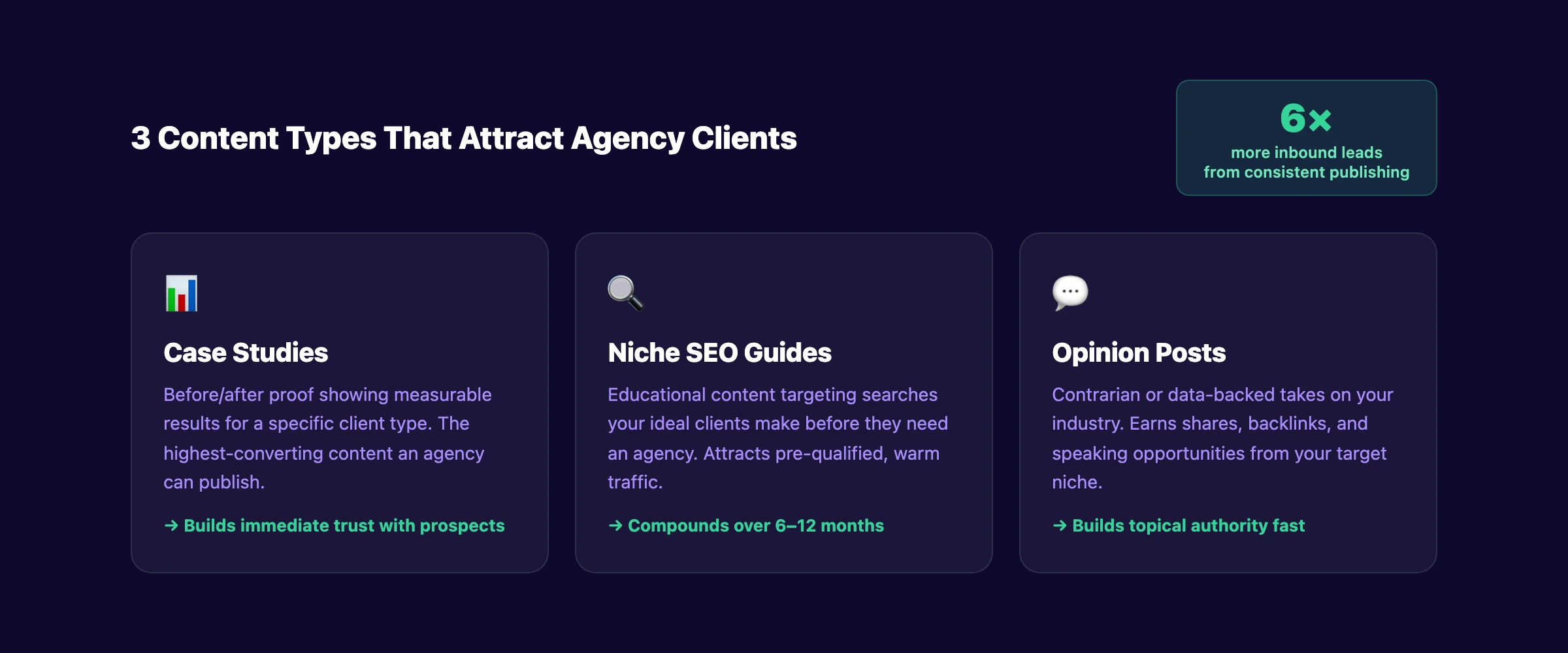
Why this step matters: Agencies that publish consistently generate 6× more inbound leads than those that do not. Content is the only marketing channel that gets cheaper per lead over time. Every month of publishing builds on the last.
Step 5: Build SOPs Before You Hire
Most agency owners hire to escape chaos. That approach consistently backfires.
If your processes exist only in your head, a new hire cannot do the work independently. You spend more time explaining and correcting than you did doing it yourself. Hiring accelerates chaos instead of reducing it.
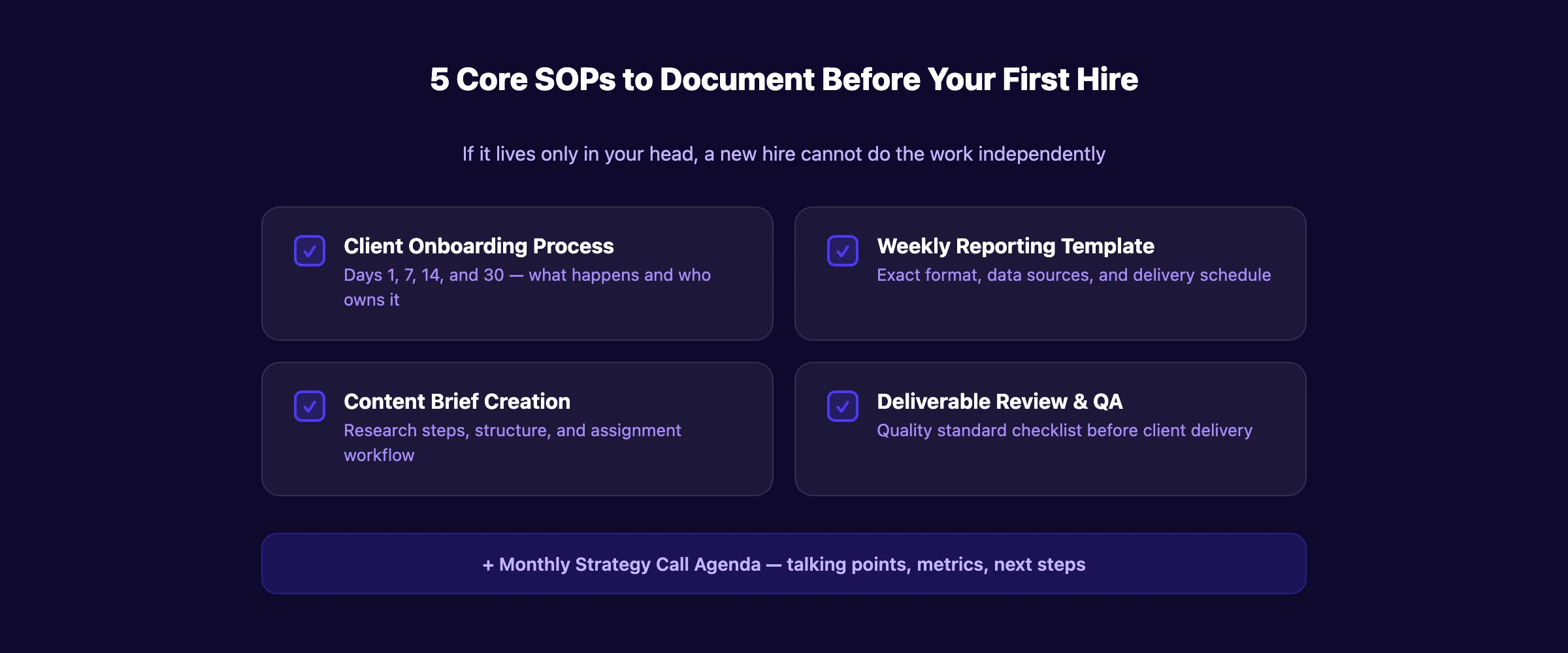
Document these 5 core processes before your next hire:
- ✓ Client onboarding: exactly what happens in days 1, 7, 14, and 30
- ✓ Weekly reporting: the exact template, data sources, and delivery schedule
- ✓ Content brief creation: how to research, structure, and assign a brief
- ✓ Deliverable review and QA: your quality standard and check process
- ✓ Monthly strategy call: agenda, talking points, metrics to review
A process document does not need to be a formal manual. A recorded walkthrough video counts. A Google Doc with annotated screenshots counts. The question to ask: can someone else follow this document and produce the same result you would?
Automation extends this approach. Tools for AI marketing automation handle reporting compilation, email follow-ups, scheduling, and content distribution. Tasks that do not require human judgment but currently consume hours each week.
For the content side specifically, an AI content strategy can build scalable publishing pipelines that reduce the manual effort in brief creation, research, and distribution.
Every repeatable, non-creative task you automate is a task you do not need to hire for. That keeps your cost structure lean as volume grows.
Why this step matters: Agencies with documented SOPs onboard new team members 50-70% faster and deliver more consistently across clients. Delivery consistency reduces churn. Lower churn is compounding growth.
Step 6: Hire Strategically and Delegate the Right Things First
The agency owner bottleneck is the most common growth killer past $20,000 in monthly revenue.
You cannot grow if you are still writing every brief, pulling every report, and joining every client call. The business cannot scale past your personal capacity. Your job at this stage is to build the system. Not run it.
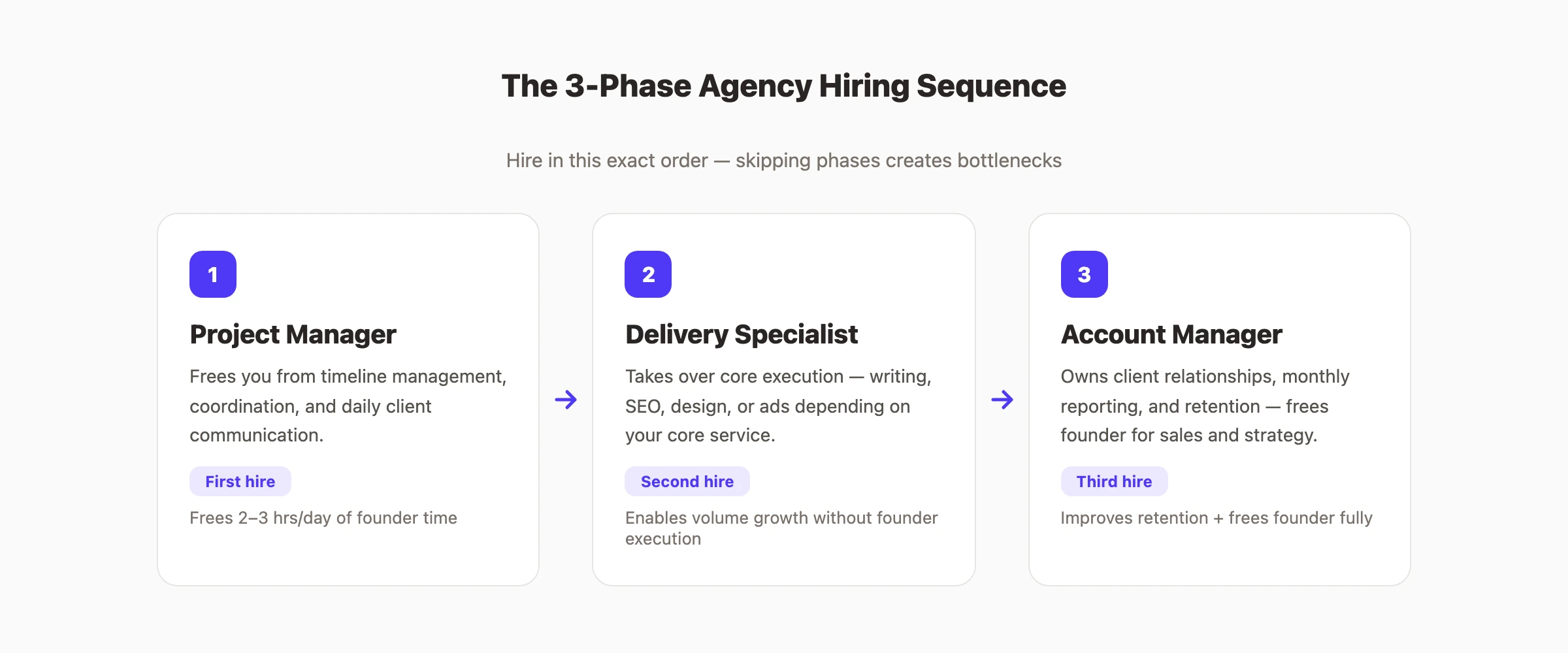
Hire in this exact sequence:
1. Project Manager
Frees you from managing timelines, coordinating deliverables, and client communication. This role owns "is everything on track?". Which currently consumes 2-3 hours per day of your attention and keeps you in reactive mode.
2. Delivery Specialist
Takes over core execution: writing, SEO implementation, design, or paid ads depending on your service. Hire from your niche when possible. A specialist in dental SEO is worth significantly more to your clients and your positioning than a generalist.
3. Account Manager
Owns client relationships, monthly reporting, and retention management. This frees you from the daily client communication that consumes energy without driving growth.
Hire for attitude first, skills second. Specific technical skills can be taught in 60-90 days. Drive, ownership mindset, and communication quality cannot be quickly trained.
Consider outsourcing before you hire full-time. White-label services and freelance specialists let you handle more client volume without full-time overhead or employment risk. For the right hiring approach for an SEO-focused team, see how to build an SEO team at the right stage.
The best SEO tools for agencies can also extend your team's effective capacity before you need to add headcount. Worth evaluating before making a hire.
Why this step matters: Agency founders who delegate 60%+ of delivery work consistently grow faster than those who stay in execution. Every hour freed from delivery is an hour available for business development, strategy, and higher-value client work.
Step 7: Retain Clients Longer and Expand Accounts
New business is expensive. Retention is how agencies actually grow.
A client paying $4,000/month who stays 24 months generates $96,000 in revenue. Replacing that client every 6 months costs you constantly in sales time, onboarding, and relationship ramp-up. And you end the year at the same place you started.
Reduce your churn rate with 3 specific practices:
Structured 30-Day Onboarding
The first 30 days determine whether a client stays 6 months or 3 years. Most churn happens in months 1-3. Before results appear, when expectations are not yet aligned.
Set explicit goals in week 1. Deliver a visible quick win by day 14: a published article, a completed audit, a campaign live. Schedule a 30-day check-in to review progress against the goals you set together.
Transparent Reporting
Clients leave agencies when they lose confidence in the value they receive. Monthly reports showing rankings moved, traffic increased, and leads came through. Not just "we published 8 articles this month". Keep that confidence intact over time.
Build reporting around the outcomes your client cares about, not the activities you completed. Results reporting retains clients. Activity reporting creates doubt.
Expansion Offers
Review your best clients every 90 days for adjacent service opportunities. A client buying blog SEO is a natural fit for local SEO or social media management. An existing client who trusts your results costs 5-7× less to expand than a new client to acquire from scratch.
Pitch expansion proactively: "Based on your results in content, local SEO would accelerate your rankings significantly. Here is what that addition looks like." Make it easy to say yes.
Research on service business economics shows that a 5% increase in client retention increases profitability by 25-95%. Every retained client is revenue you do not have to replace with a new sale.
Why this step matters: The most profitable agency growth does not come from landing 20 new clients. It comes from keeping the 10 you already have and expanding what they buy.
Grow faster by delivering more for your clients. theStacc gives marketing agencies a white-label content engine: SEO-optimized articles per client, planned, written and published automatically at $99/month per client. See pricing →
Results: What to Expect
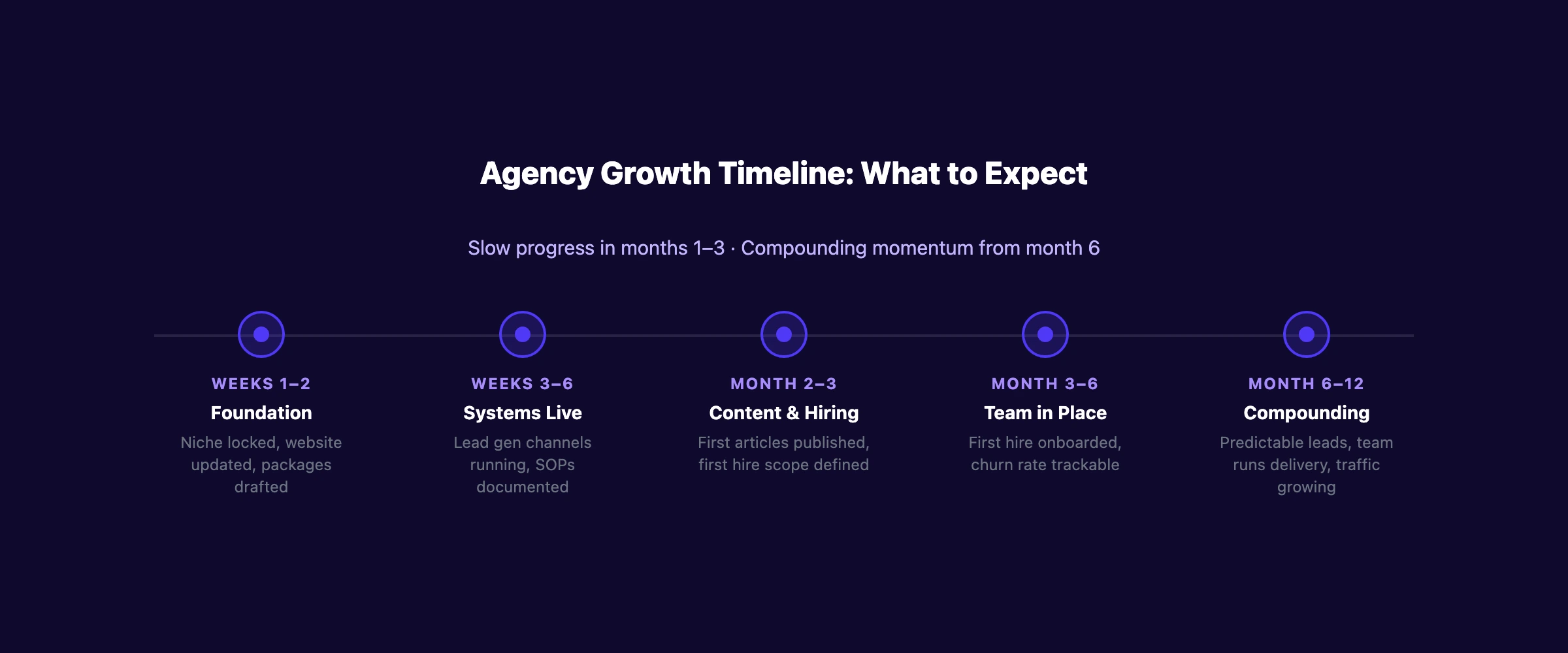
Growth timelines vary by starting point. Here is a realistic sequence after completing these 7 steps:
- Weeks 1-2: Niche locked, website updated, productized service packages drafted
- Weeks 3-6: Lead generation channels operational; first productized proposals sent; SOP documentation underway
- Month 2-3: First content assets published; reporting templates built; first hire scope defined
- Month 3-6: First hire placed; churn rate measurable; inbound content showing early traction
- Month 6-12: Compounding content traffic, predictable lead volume from 3 channels, team handling delivery without founder involvement
Expect slow progress in months 1-3 and accelerating momentum starting around month 6. Agencies that stop at month 4 never see the compound return.
The agencies that plateau are not unlucky. They just stopped building systems before those systems started working.
Troubleshooting
Problem: Committed to a niche but deal flow dropped immediately after repositioning. Solution: Keep 1-2 generalist clients while niche positioning builds traction. Give it 90 days minimum before reassessing. Niche credibility takes time to signal. It does not appear overnight.
Problem: Lead generation channels are live but produced no results in the first 30 days. Solution: SEO content takes 3-6 months to produce significant rankings. Outbound should generate meetings within 2-4 weeks if messaging is specific enough. Check your cold email hook and offer first. Vague outreach fails regardless of volume.
Problem: New hire is not performing as expected after 60 days. Solution: First check whether the SOP exists and is clear before assuming talent failure. Most early underperformance is documentation failure, not capability failure. Walk through the process with them once and observe whether results change.
What practitioners are saying on X
Agency and white-label models evolve fast. Here is operator signal from X on tooling and service delivery.
- @syedbalkhi (Sep 2024): White-label pro services can add multi-six-figure revenue without building an in-house services org — partner delivery behind the brand. See the post on X.
- @ConnorGillivan (Jul 2026): 2026 SEO stack favorite list: Semrush/Ahrefs, GSC, Surfer, KeywordInsights, ChatGPT, SEOwind, Screaming Frog, ClearScope, GA4, Notion/Airtable — tools amplify systems, they don’t replace them. See the post on X.
- @jakezward (Feb 2026): 2026 SEO predictions emphasize AI Overview share-of-SERP, schema for LLM token efficiency, brand mentions in AI answers as a KPI, proprietary data as a moat, and content refresh beating net-new AI slop. See the post on X.
Grok, AI Overviews, and multi-engine visibility
For “how to grow your marketing agency”, multi-engine visibility still starts with clear definitions, sourced numbers, and extractable section answers. Grok additionally factors live X discussion — keep public claims consistent with this page.
- Google AI Overviews: Use passage-ready answers, tables, and FAQ schema where relevant.
- ChatGPT / Perplexity: Cite named sources next to key claims.
- Grok: Maintain accurate entity facts on-site and in high-signal X posts.
Publish content built for Google and AI citations. theStacc’s Content SEO module ships SEO-scored articles structured for rankings and generative engines — including clearer entity pages models like Grok can quote.
FAQ
Most agencies see meaningful revenue growth in months 6-12 after implementing a systematic approach. The first 1-3 months are foundation work: niche positioning, productized services, and lead generation setup. Compounding results from content and referrals typically show up starting in month 6. Agencies that want faster results should prioritize outbound over content in the first 90 days. Outbound generates meetings within weeks, not months.
Start with your existing network and ask for specific introductions. Not "let me know if you know anyone," but "do you know any HVAC company owners I should speak with this month?" Offer a discounted first project with a clearly defined deliverables list. Once you have 1-2 case studies with measurable results, outbound email to your target niche converts significantly better because you have proof.
SEO and content marketing have among the highest margins in the agency space because delivery can be systematized and partially automated. Paid advertising generates strong hourly revenue but requires constant active management and does not compound. SEO results build over time, making retention easier and client lifetime value higher. Most agencies that scale sustainably focus heavily on content and SEO as core services.
At $2,000-$4,000 per month per client, most 1-2 person agencies reach sustainable profitability at 5-8 clients. A high-volume productized model at $1,000 per month needs 15-20 clients for similar margins. Your pricing decision in Steps 1-3 directly determines how many clients you need. And whether adding clients feels like growth or like running faster to stay flat.
Yes. Agencies that publish consistently generate more inbound leads, establish authority in their niche, and close at higher rates because prospects arrive already familiar with the work quality. Agencies have a natural advantage: content marketing is the service you sell. Demonstrating it on your own site is the most credible proof you can offer any prospective client. You are also your own best case study.
Now you have the 7-step framework to grow your marketing agency past the referral plateau.
The agencies that break through are not smarter than the ones that plateau. They build systems first and hire into them. They commit to a niche before they feel ready. They produce content that generates leads while they sleep.
Start with Step 1. Get your niche right before anything else changes.
<script type="application/ld+json"> { "@context": "https://schema.org", "@type": "HowTo", "name": "How to Grow Your Marketing Agency", "description": "A 7-step framework for growing a marketing agency past the referral plateau, covering niching, lead generation, service productization, content marketing, operations, hiring, and client retention.", "totalTime": "PT8W", "step": [ { "@type": "HowToStep", "name": "Step 1: Pick a Niche and Commit to It", "text": "Choose a specific industry niche using three criteria: industry familiarity, underserved demand, and recurring need. Update your website, case studies, and proposals to reflect the niche." }, { "@type": "HowToStep", "name": "Step 2: Build a Lead Generation System", "text": "Build three lead generation channels simultaneously: inbound SEO content, targeted outbound outreach, and a structured referral program with incentives for existing clients." }, { "@type": "HowToStep", "name": "Step 3: Productize Your Core Service", "text": "Convert your most common service into three fixed pricing tiers with defined deliverables, timelines, and prices. This makes delivery repeatable and delegation possible." }, { "@type": "HowToStep", "name": "Step 4: Use Content to Attract Clients", "text": "Publish three types of content consistently: case studies with before/after results, niche SEO guides targeting pre-hire keywords, and opinion posts that build topical authority." }, { "@type": "HowToStep", "name": "Step 5: Build SOPs Before You Hire", "text": "Document five core processes before hiring: client onboarding, weekly reporting, content brief creation, deliverable QA, and monthly strategy calls." }, { "@type": "HowToStep", "name": "Step 6: Hire Strategically and Delegate", "text": "Hire in sequence: project manager first, then delivery specialist, then account manager. Hire for attitude first and skills second. Consider outsourcing before full-time hires." }, { "@type": "HowToStep", "name": "Step 7: Retain Clients Longer and Expand Accounts", "text": "Implement structured 30-day onboarding, outcome-focused monthly reporting, and proactive expansion offers every 90 days to increase client lifetime value." } ] } </script>
Sources & references
- [1] Princeton / Georgia Tech et al. — GEO research (arXiv:2311.09735)
- [2] @hridoyreh on X — Widely shared SEO skill tree: foundations, research, technical, on-page, content, links, AI SEO/GEO, analytics, UX, bran
- [3] @jakezward on X — 2026 SEO predictions emphasize AI Overview share-of-SERP, schema for LLM token efficiency, brand mentions in AI answers
- [4] Referenced source — www.wordstream.com

Researched, written, and published articles that compound organic traffic.
Weekly local SEO teardowns
One practical email a week. Map Pack, GBP, AI Overviews — no fluff. Unsubscribe anytime.