Multi-Engine SEO: The Complete Guide (2026)
850M+ daily searches happen outside Google. This multi-engine SEO guide covers Bing, YouTube, ChatGPT, Perplexity, Reddit, and 6 more platforms. Updated April 2026.
Stacc Editorial • 2026-04-04 • SEO Tips
In This Article
Over 850 million searches happen outside Google every single day. And most businesses optimize for zero of them.
A multi-engine SEO strategy is no longer optional. Google’s global market share dropped to 90.04% in January 2026. Its U.S. desktop share hit 82.38%, the lowest in over 20 years. Meanwhile, ChatGPT processes 5.35 billion monthly visits. Perplexity grew 800% year over year. And 86% of Gen Z search TikTok weekly.
The search market has fractured. Brands that only optimize for Google are leaving traffic, leads, and revenue on every other platform.
We have published 3,500+ blogs across 70+ industries. We track ranking performance across 12 platforms. This guide covers exactly how to rank on each one.
Here is what you will learn:
- Why Google-only SEO is a losing strategy in 2026
- How one Bing optimization covers 5+ search engines
- Platform-specific tactics for YouTube, ChatGPT, Perplexity, and Reddit
- Why AI search visitors convert 4.4x better than organic traffic
- A checklist-based action plan for multi-engine SEO
- How to track and measure results across every platform
Chapter 1: Why the Search Market Has Fractured
Google still dominates. But the gap is closing faster than at any point in the last decade.
The Numbers Tell the Story
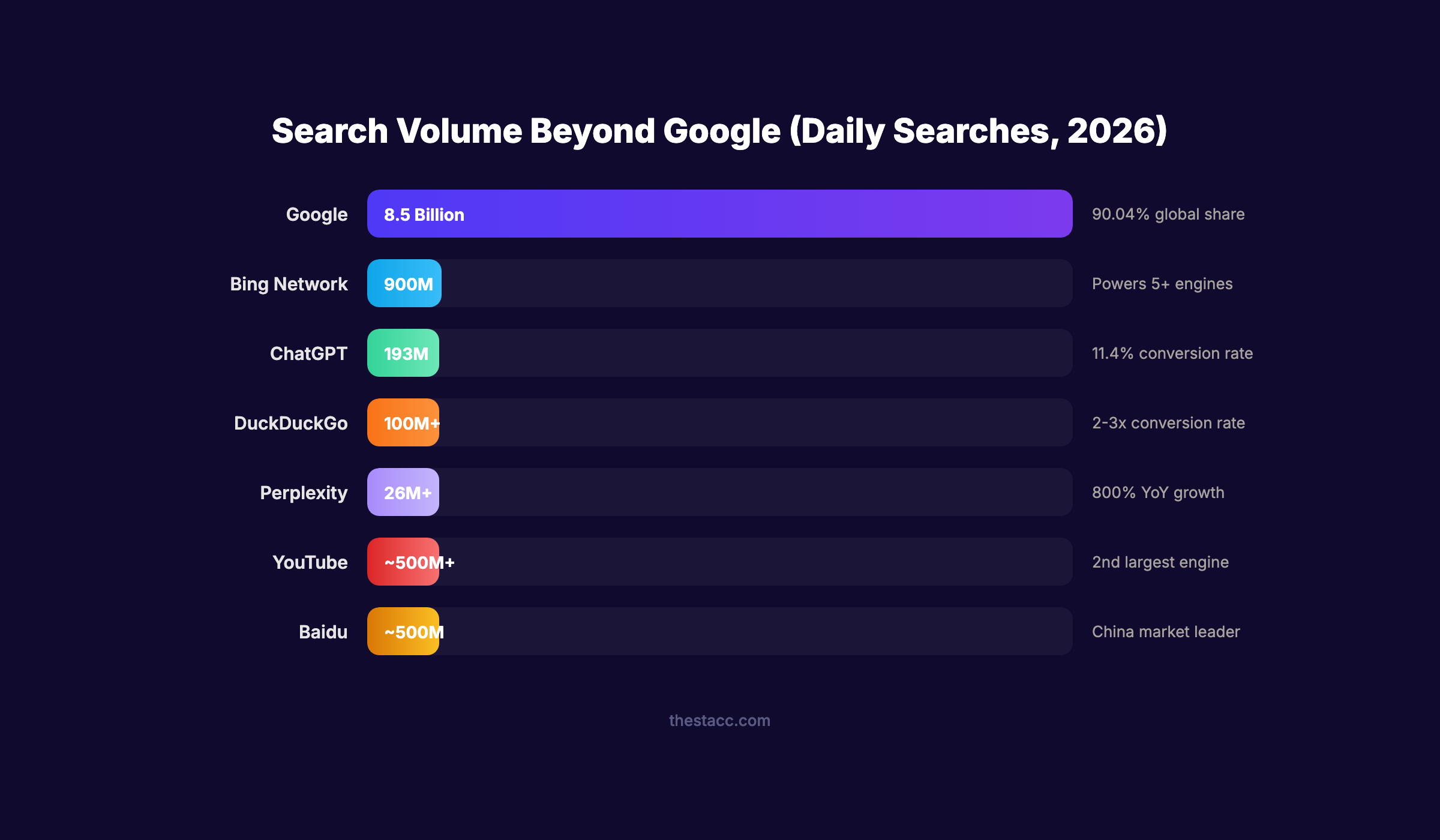
Google’s annual market share drop of 2.07 percentage points is the largest in 10 years. In July 2025, it hit a 10-year low of 89.57% globally. On U.S. desktops, it sits at 82.38%.
That means roughly 1 in 5 desktop searches in the U.S. happens somewhere other than Google.
| Platform | Market Share / Volume | Growth Trend |
|---|---|---|
| Google (global) | 90.04% | Declining (-2.07pp YoY) |
| Bing (global) | 4.61% | Growing (+1.10pp YoY) |
| Bing (U.S.) | 10.48% | Growing (+151% over 10 years) |
| DuckDuckGo | 100M+ daily searches | +50% since 2022 |
| ChatGPT | 5.35B monthly visits | 900M weekly users |
| Perplexity | 780M monthly queries | +800% YoY |
| YouTube | 2nd largest search engine | Stable |
The shift is not just about search engines. It is about where people look for answers. Half of consumers use 4 or more channels during a single purchase journey. The average consumer now touches 6 platforms.
Why This Matters for Your Business
Google’s AI Mode has a 93% zero-click rate. Even within Google, organic clicks are disappearing. AI Overviews drop organic CTR by 61%.
Businesses that diversify across platforms capture traffic their competitors miss entirely. DuckDuckGo users convert 2-3x better than Google users. ChatGPT referral traffic converts at 11.4% versus 5.3% for organic search. Semrush data shows AI search visitors are worth 4.4x traditional organic visitors.
The revenue opportunity outside Google is growing every quarter.
Chapter 2: The Bing Effect — One Optimization, Five Engines
Most marketers dismiss Bing. That is a mistake.
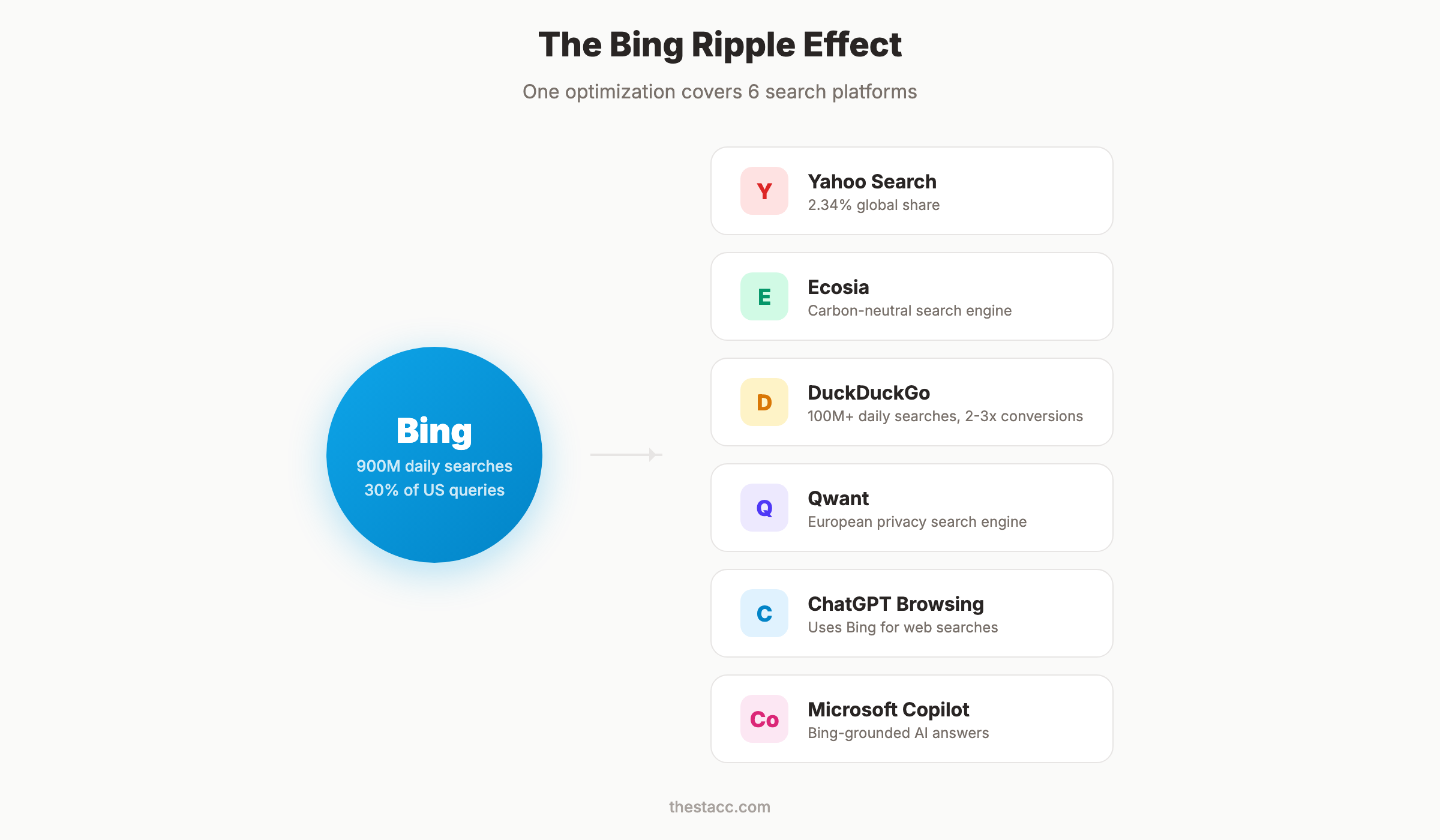
Bing does not just power Bing.com. It powers Yahoo, Ecosia, DuckDuckGo (partially), Qwant, and ChatGPT browsing. When you optimize for Bing, you improve visibility across all of them. Microsoft’s search network handles roughly 30% of all U.S. search queries. That is 900 million daily searches.
How Bing Ranks Differently Than Google
| Ranking Factor | Bing | |
|---|---|---|
| Keyword matching | Semantic and intent-based | Exact match carries more weight |
| Meta descriptions | Not a ranking factor | Direct ranking signal |
| Social signals | Unconfirmed | Confirmed ranking factor |
| Mobile indexing | Mobile-first | Device-agnostic |
| Backlinks | Quality and relevance | Quality, domain age, and trust |
| Multimedia | Important | Even more important |
| Local profiles | Google Business Profile | Bing Places for Business |
The biggest difference: Bing treats meta descriptions as a ranking signal. Google does not. If you write keyword-optimized meta descriptions, Bing rewards you directly. Google ignores them for ranking purposes.
Social signals also matter on Bing. Active social media profiles with engagement directly influence Bing rankings. This is a confirmed factor, unlike Google where social remains indirect.
Your Bing Quick-Win Checklist
- Submit your site to Bing Webmaster Tools
- Include target keywords in meta descriptions
- Claim your Bing Places for Business listing
- Add multimedia (images, video) to key pages
- Ensure exact-match keywords appear in title tags and H1s
- Build social media presence on Facebook, X, and LinkedIn
- Submit an XML sitemap through Bing Webmaster Tools
Most of these take under an hour. The return is visibility across 5 search engines.
Stop writing. Start ranking. Stacc publishes 30 optimized SEO articles per month for $99. Start for $1 →
Chapter 3: DuckDuckGo — Where Privacy Users Convert Better
DuckDuckGo processes over 100 million searches per day. Growth has exceeded 50% since 2022. But the real story is conversion rates. DuckDuckGo users convert 2-3x better than Google users.
Why? No personalization. No tracking. No filter bubbles.
DuckDuckGo users are intentional searchers. They chose a privacy-first engine on purpose. That self-selection produces higher-intent traffic.
How DuckDuckGo Ranks Content
DuckDuckGo pulls primarily from Bing’s index. It also integrates data from Wikipedia, Yelp, StackOverflow, and YouTube. The key differences:
- No personalization. Every user sees the same results for the same query. Rankings are more predictable.
- Content freshness matters more. DuckDuckGo weights recently updated content more heavily than Google does.
- Domain authority and backlinks still count. Age and quality of linking domains carry weight.
- Content quality over brand recognition. DuckDuckGo ranks based on what your content says, not who you are.
Because DuckDuckGo largely relies on Bing, your Bing optimization from Chapter 2 covers most of the work. The extra step: ensure your content is fresh, regularly updated, and answers questions directly without requiring personalization context.
Chapter 4: YouTube — The Second-Largest Search Engine
YouTube is the world’s second-largest search engine. It is also a major citation source for AI platforms. Perplexity draws 13.9% of its top citations from YouTube content.
Optimizing for YouTube does double duty. You gain YouTube search visibility and increase your chances of being cited by AI search platforms.
YouTube’s Top Ranking Factors in 2026
- Watch time. The strongest signal. Longer watch duration tells the algorithm your content delivers value.
- Audience retention. Early drop-offs trigger algorithm penalties. Hook viewers in the first 15 seconds.
- Click-through rate. Custom thumbnails outperform auto-generated screenshots by 8-15x.
- Engagement. Comments, likes, and shares signal viewer satisfaction.
- Metadata relevance. Place your target keyword in the first 40 characters of the title.
The YouTube-to-Google Pipeline
YouTube content frequently appears in Google search results. Three features make this happen:
- Chapters and timestamps. Enable specific video moments to rank as individual results in Google.
- Transcripts and captions. Improve accessibility and give Google text content to index.
- Video descriptions. The first 150 characters appear in search results. Front-load your keywords.
A single YouTube SEO strategy feeds visibility into Google, Perplexity, and YouTube search simultaneously.
Chapter 5: AI Platforms — ChatGPT, Perplexity, Claude, and Gemini
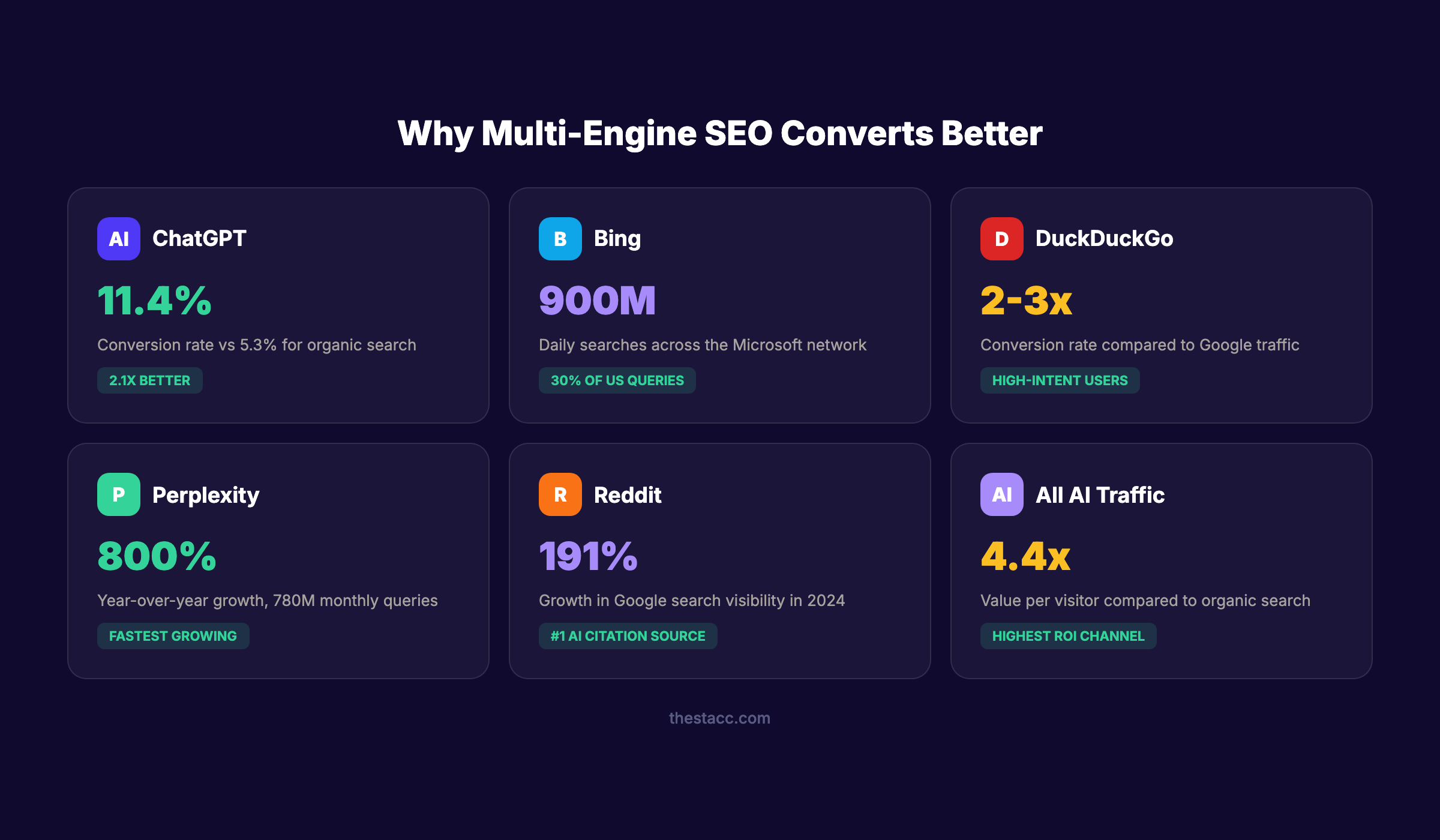
AI platforms represent the fastest-growing search category. Combined AI platform traffic grew 225% year over year. These platforms do not rank pages. They cite sources. The optimization approach is fundamentally different from traditional SEO.
This is Generative Engine Optimization (GEO). And it matters because AI referral traffic converts better than almost any other source.
What AI Platforms Cite
AI models pull from content that meets specific criteria:
- Specific, citable data. Pages with statistics, research findings, and named sources get cited 30-40% more often.
- Clear structure. Question-formatted headers, bullet points, and short direct answer paragraphs.
- Third-party authority. Over 90% of LLM citations come from nonbranded sources. E-E-A-T signals matter enormously.
- Freshness. AI models prefer recently updated content. Add
<time datetime="">tags for explicit freshness signals.
ChatGPT Optimization
ChatGPT commands 80.49% of the AI chatbot market. Its browsing mode uses Bing. This means optimizing for ChatGPT starts with Bing optimization from Chapter 2.
Beyond Bing, ensure:
- GPTBot can crawl your site (check your
robots.txt) - Your content contains structured, extractable answers
- You have an llms.txt file at your domain root
- Key pages use structured data (Organization, FAQPage, HowTo)
ChatGPT referral visitors convert at 11.4% compared to 5.3% for organic search. That is more than double the conversion rate.
Perplexity Optimization
Perplexity has 45 million active users and processes 780 million queries monthly. Its citation patterns are unique.
The top citation source for Perplexity is Reddit, at 46.7% of top 10 sources. YouTube is second at 13.9%. Wikipedia follows at 10.8%.
- Build genuine Reddit presence in your niche
- Create YouTube content that answers common queries
- Maintain accurate Wikipedia or Wikidata entries
- Ensure PerplexityBot can crawl your site
- Write content with clear, citable sentences
Claude and Gemini
Claude processes up to 200,000 tokens per request. It reads entire pages. Depth and completeness matter more for Claude than for other AI platforms.
Gemini grew from 5.7% to 21.5% AI market share in 12 months. It is the fastest-growing AI search platform. Optimize by ensuring your content appears in Google’s index (Gemini draws heavily from Google’s data) and by using schema markup on all key pages.
Your SEO team. $99 per month. 30 optimized articles, published automatically. Start for $1 →
Chapter 6: Reddit — The Platform AI Loves to Cite
Reddit’s presence in Google search results grew 191% in 2024. Reddit threads now outrank many well-optimized commercial pages. And Reddit is the number one citation source for Perplexity.
A Reddit SEO strategy gives you visibility in three places at once: Reddit search, Google results, and AI platform citations.
Why Reddit Outranks Optimized Pages
Google and AI platforms treat Reddit as a high-trust source of authentic human experience. Reddit content represents real user opinions, not marketing copy. This aligns perfectly with E-E-A-T’s experience signal.
Building Authentic Reddit Presence
Reddit will ban overt marketing instantly. The rules:
- Contribute genuine value first. Answer questions. Share expertise. Help people.
- Build karma over months before mentioning any brand or product.
- Post in relevant subreddits where your target audience already participates.
- Optimize post titles. Reddit titles function as both headlines and metadata for Google.
- Never link-drop. Weave references naturally into helpful responses.
The payoff is triple visibility. Your Reddit presence feeds Google rankings, Perplexity citations, and direct Reddit traffic.
Chapter 7: TikTok, Social Search, and Voice
Search behavior has expanded beyond text boxes. Three categories deserve attention.
TikTok and Social Search
86% of Gen Z search TikTok weekly. 41% of Gen Z now prefer social media over traditional search engines for discovery. 72% of users have discovered products through TikTok.
Social search optimization basics:
- Use searchable captions with target keywords (not just hashtags)
- Create content that answers “how to” and “best of” queries
- Repurpose blog content into short-form video
- Optimize profiles with clear category descriptions
Voice Search
Voice assistants are powered by search engines. Alexa uses Bing. Siri uses Apple Search. Google Assistant uses Google. Optimizing for the underlying engine covers voice search automatically.
The extra step: structure content for spoken responses. Short, direct answers to specific questions perform best in voice results. FAQ sections on every page help capture voice queries.
Apple Search — The Sleeping Giant
Apple uses Applebot to crawl the web. It powers Siri suggestions, Safari Suggestions, and Spotlight search. With Apple dominating the mobile device market, its search footprint is larger than most marketers realize.
Prepare now:
- Ensure Applebot can crawl your site (check
robots.txt) - Optimize for Apple Maps (claim your listing)
- Maintain App Store presence if applicable
- Use semantic HTML and structured data for clean extraction
Chapter 8: The Multi-Engine SEO Action Plan
Here is your prioritized checklist. Start with the foundation layer. It improves visibility across every platform simultaneously.
Foundation Layer (Applies to All Platforms)
These actions improve your rankings on Google, Bing, YouTube, AI platforms, and social search.
- Publish structured data on every key page (Organization, FAQPage, Product, Article)
- Add an
llms.txtfile at your domain root - Configure
robots.txtto allow GPTBot, ClaudeBot, PerplexityBot, Applebot, and Bingbot - Use semantic HTML (
<article>,<section>,<time>) - Write FAQ sections on every product page and blog post
- Build internal linking between related content
- Server-side render all critical content (no JavaScript dependencies)
- Update content regularly for freshness signals
- Build topical authority through content clusters
3,500+ blogs published. 92% average SEO score. See what Stacc can do for your site. Start for $1 →
Bing + DuckDuckGo Checklist
- Submit sitemap to Bing Webmaster Tools
- Add target keywords to meta descriptions
- Claim Bing Places for Business listing
- Build social media engagement (Facebook, X, LinkedIn)
- Add multimedia to key pages
- Use exact-match keywords in titles and H1s
YouTube Checklist
- Create a YouTube SEO content plan based on keyword research
- Place target keywords in first 40 characters of titles
- Create custom thumbnails for every video
- Add chapters and timestamps for Google SERP visibility
- Write keyword-optimized descriptions (front-load first 150 characters)
- Add captions and transcripts to every video
AI Platform Checklist
- Audit AI search visibility across ChatGPT, Claude, Perplexity, and Gemini
- Measure your Share of Model monthly
- Optimize for featured snippets (format AI platforms prefer)
- Create content with specific, citable data and named sources
- Ensure all AI crawlers have access through
robots.txt - Get cited by AI search engines through third-party authority
Reddit + Social Checklist
- Identify 5-10 relevant subreddits where your audience participates
- Build authentic presence over 30-60 days before any brand mentions
- Optimize Reddit post titles for both Reddit and Google search
- Create short-form video content for TikTok and Instagram search
- Repurpose blog content into platform-native formats
Measurement and Tracking Setup
- Add ChatGPT, Perplexity, Claude, and Gemini as traffic sources in Google Analytics
- Track Bing Webmaster Tools separately from Google Search Console
- Measure AI citability score quarterly
- Monitor conversion rates by traffic source (AI vs organic vs social)
- Set up the AI vs organic search budget framework
- Review AI search statistics monthly for platform growth trends
Chapter 9: How to Prioritize (The 80/20 of Multi-Engine SEO)
Not every business needs every platform. Here is how to decide where to focus.
| Business Type | Priority Platforms | Why |
|---|---|---|
| B2B SaaS | Google, ChatGPT, LinkedIn, Reddit | B2B buyers research on AI platforms and forums |
| Local service business | Google, Bing, Apple Maps, voice | Local intent spans Google, Bing Places, and Siri |
| E-commerce | Google, Bing, YouTube, TikTok, AI platforms | Product discovery happens everywhere |
| Content publisher | Google, YouTube, Perplexity, Reddit | Citations and referral traffic from AI and social |
| Agency / consultant | Google, ChatGPT, Claude, LinkedIn, Reddit | Prospects ask AI for recommendations |
The foundation layer from Chapter 8 covers all platforms with a single set of actions. Beyond that, invest in the 2-3 platforms where your specific audience searches.
Most advice about multi-engine SEO overcomplicates it. The truth: 80% of the work is the same across platforms. Structured data, clean content architecture, FAQ sections, and third-party authority improve your visibility everywhere. The remaining 20% is platform-specific tuning.
FAQ
Is it worth optimizing for search engines other than Google?
Yes. Over 850 million searches happen outside Google every day. Bing alone handles 900 million daily searches and powers 5 additional search engines. AI platforms add billions more queries monthly. Businesses that optimize only for Google miss these audiences entirely. DuckDuckGo users convert 2-3x better than Google users, and AI referral traffic converts at more than double the rate of organic search.
What is the difference between SEO, GEO, and AEO?
SEO optimizes for traditional search engine rankings. GEO (Generative Engine Optimization) optimizes for AI search platforms like ChatGPT, Perplexity, and Claude. AEO (Answer Engine Optimization) focuses on earning featured snippets and direct answers. A multi-engine SEO strategy combines all three disciplines.
Does optimizing for Bing help with DuckDuckGo and ChatGPT?
Yes. DuckDuckGo uses Bing’s index as its primary data source. ChatGPT’s browsing mode uses Bing for web searches. Yahoo, Ecosia, and Qwant also pull from Bing. Optimizing for Bing improves visibility across all of these platforms simultaneously.
How do I track traffic from AI search platforms?
Set up custom channel groupings in Google Analytics to identify traffic from ChatGPT (referrer: chat.openai.com), Perplexity (perplexity.ai), Claude (claude.ai), and Gemini (gemini.google.com). Our guide on tracking AI search visibility covers the full setup process.
What is multi-engine SEO strategy?
A multi-engine SEO strategy optimizes your content, technical infrastructure, and authority signals across multiple search platforms. Instead of focusing only on Google, it targets Bing, YouTube, AI platforms, Reddit, social search, and voice simultaneously. The approach uses shared foundations (structured data, content quality, third-party authority) that improve visibility everywhere.
Can Stacc help with multi-engine SEO?
Stacc publishes 30 optimized SEO articles per month for $99. Every article includes structured data, FAQ sections, semantic HTML, and internal linking that improve visibility across Google, Bing, AI platforms, and social search. The Content Compound Effect applies across every search engine.
Multi-engine SEO is not about abandoning Google. It is about capturing the audiences Google no longer reaches. The 850 million daily searches happening on other platforms represent revenue your competitors are not pursuing. Start with the foundation layer, expand to your highest-value platforms, and measure everything.
Rank everywhere. Do nothing. Blog SEO, Local SEO, and Social on autopilot. Start for $1 →
Written and published by Stacc. We publish 3,500+ articles per month across 70+ industries. All data verified against public sources as of March 2026.