
Organic Search vs AI Search: Where to Focus Your Budget
Organic search vs AI search budget breakdown with real data. Learn the 70/30 split, ROI benchmarks, and allocation framework for 2026. Updated April 2026.
Marketing teams are spending more on search than ever. They are also wasting more than ever. The reason is a failure to answer one question: where does the organic search vs AI search budget split actually belong?
61% of marketers increased their SEO budgets in 2026, up from 44% last year. At the same time, 98% plan to increase AI search optimization spend. Both channels are growing. But most teams have no framework for deciding how much goes where.
The result is predictable. Money flows toward whatever feels newest. AI search gets the buzz. Traditional SEO gets the leftovers. And the businesses that win are the ones making data-driven allocation decisions instead of following trends.
We have published 3,500+ articles across 70+ industries with a 92% average SEO score. We optimize every piece for both organic search and AI search engines. This guide covers the exact budget framework we recommend, backed by current data.
Here is what you will learn:
- How organic search and AI search traffic compare right now
- The data-backed budget split most enterprises are using
- A chapter-by-chapter framework for allocating your spend
- ROI benchmarks for each channel
- Which businesses should invest more in AI search first
- How to measure returns across both channels
- Common mistakes that waste budget on both sides
Chapter 1: The Current State of Organic Search vs AI Search
The numbers tell a clear story. Organic search is not dying. But it is shrinking for certain query types while AI search grows from a small base.
Organic Search in 2026
Google still processes over 8.5 billion searches per day. Organic search drives the majority of website traffic for most businesses. But the click-through rates are dropping.
- Organic CTR dropped 61% for queries where AI Overviews appear (from 1.76% to 0.61%)
- 73% of B2B websites saw significant traffic losses between 2024 and 2025
- Zero-click searches now account for approximately 60% of all queries
- AI Overviews appear on roughly 25% of Google searches
The decline is not uniform. Transactional queries (buying intent) have maintained stable CTRs. Informational queries (research intent) took the biggest hit. An average 15-25% CTR decline hit informational queries between 2024 and 2026. Transactional queries stayed flat.
That distinction is critical for budget allocation. If your revenue comes from transactional keywords (“buy,” “pricing,” “near me”), organic SEO still delivers strong returns. If your funnel starts with informational queries (“how to,” “what is,” “best way to”), AI search is capturing an increasing share of that traffic.
AI Search in 2026
AI search is growing fast from a small base.
- AI chatbot traffic grew 81% year-over-year in 2025, reaching 55.2 billion visits
- ChatGPT records 5.7 billion monthly visits with 900 million weekly active users
- AI referral traffic accounts for approximately 1.08% of total website visits across industries
- Information Technology leads at 2.8% AI referral share. Most industries are below 2%
The critical data point: visitors from AI search convert at twice the rate of traditional search visitors and convert in one-third the sessions. The traffic volume is small. The traffic quality is exceptional.
Chapter 2: The 70/30 Budget Framework
Most advice on this topic is vague. Here is a specific, data-backed framework.
The Recommended Split
| Budget Category | Percentage | What It Covers |
|---|---|---|
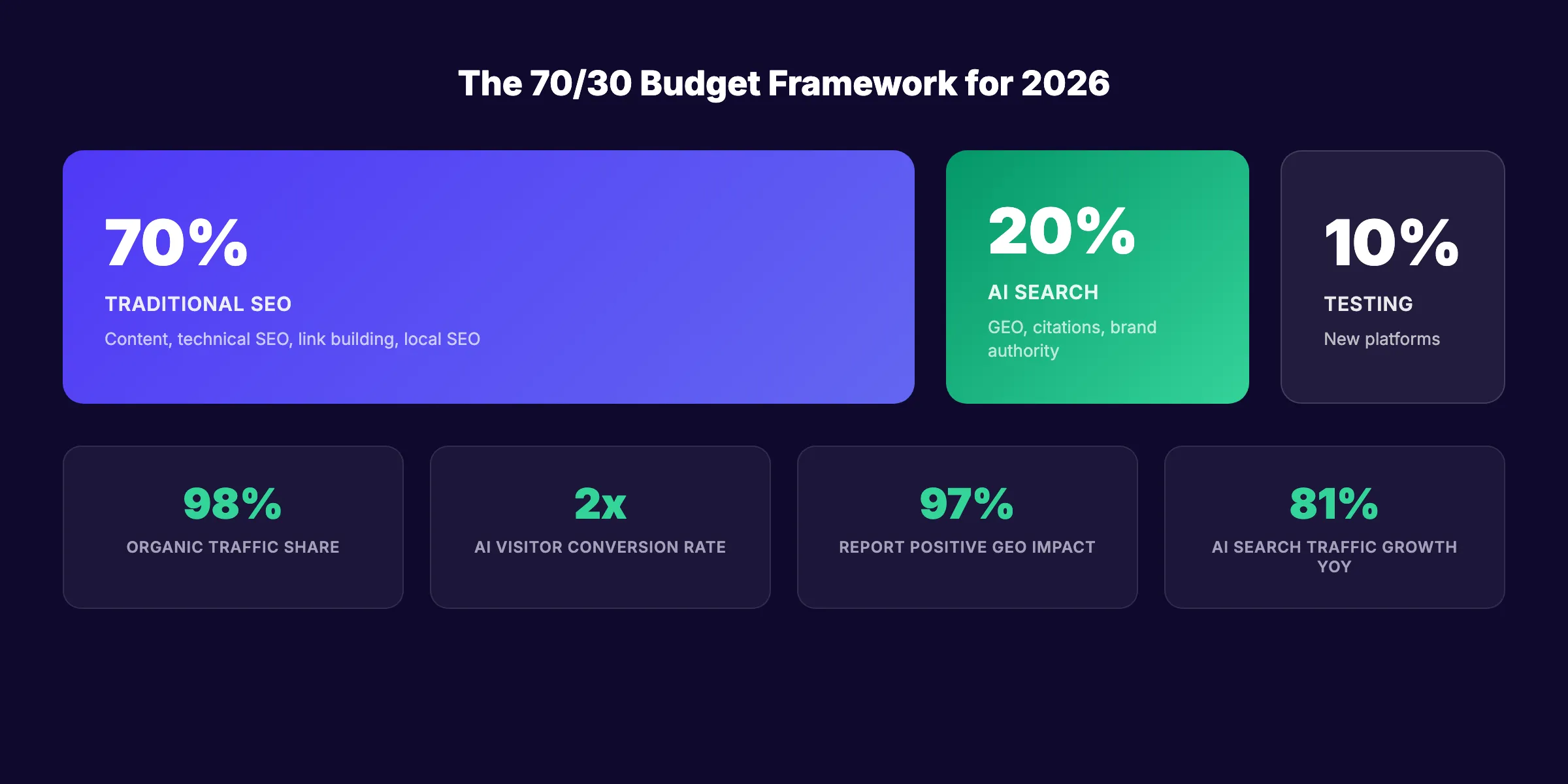
| Traditional SEO | 70% | On-page optimization, technical SEO, content production, link building, local SEO |
| AI Search Optimization | 20% | GEO tactics, schema markup, AI crawler management, citation monitoring, brand authority building |
| Testing and Experimentation | 10% | New AI platforms, paid AI placements (when available), emerging tools, measurement pilots |
This framework comes from industry benchmarks showing enterprises allocate an average of 12% of digital budgets to AEO/GEO, with 94% of CMOs planning to increase that investment. The 70/30 split (with 20% AI + 10% testing) aligns with the most successful allocation patterns reported across industries.
Why 70% Still Goes to Traditional SEO
Organic search still drives 98-99% of total website traffic for most businesses. AI referral traffic at 1-2% is growing fast but remains a fraction of the total. Cutting SEO budget to fund AI search is like reducing your main revenue stream to invest in a side project.
Strong SEO also feeds AI search performance. Pages that rank well in Google are more likely to be cited by Gemini and AI Overviews. Content indexed by Google becomes available to AI crawlers. The SEO investment compounds into AI visibility.
Why 20-30% Goes to AI Search
The 97% positive impact rate from AEO/GEO efforts makes this the highest-signal investment category in marketing. The 2x conversion rate from AI referral traffic means even small traffic gains deliver outsized revenue.
Early movers capture disproportionate share. AI search citation patterns are still forming. Brands that establish authority now will be harder to displace as the channel matures.
Your SEO team. $99 per month. 30 optimized articles, published automatically. Every piece built for organic search and AI engines. Start for $1 →
Chapter 3: What Your Traditional SEO Budget Should Cover
The 70% allocated to traditional SEO needs to cover specific activities. Not all SEO tasks deliver equal returns.
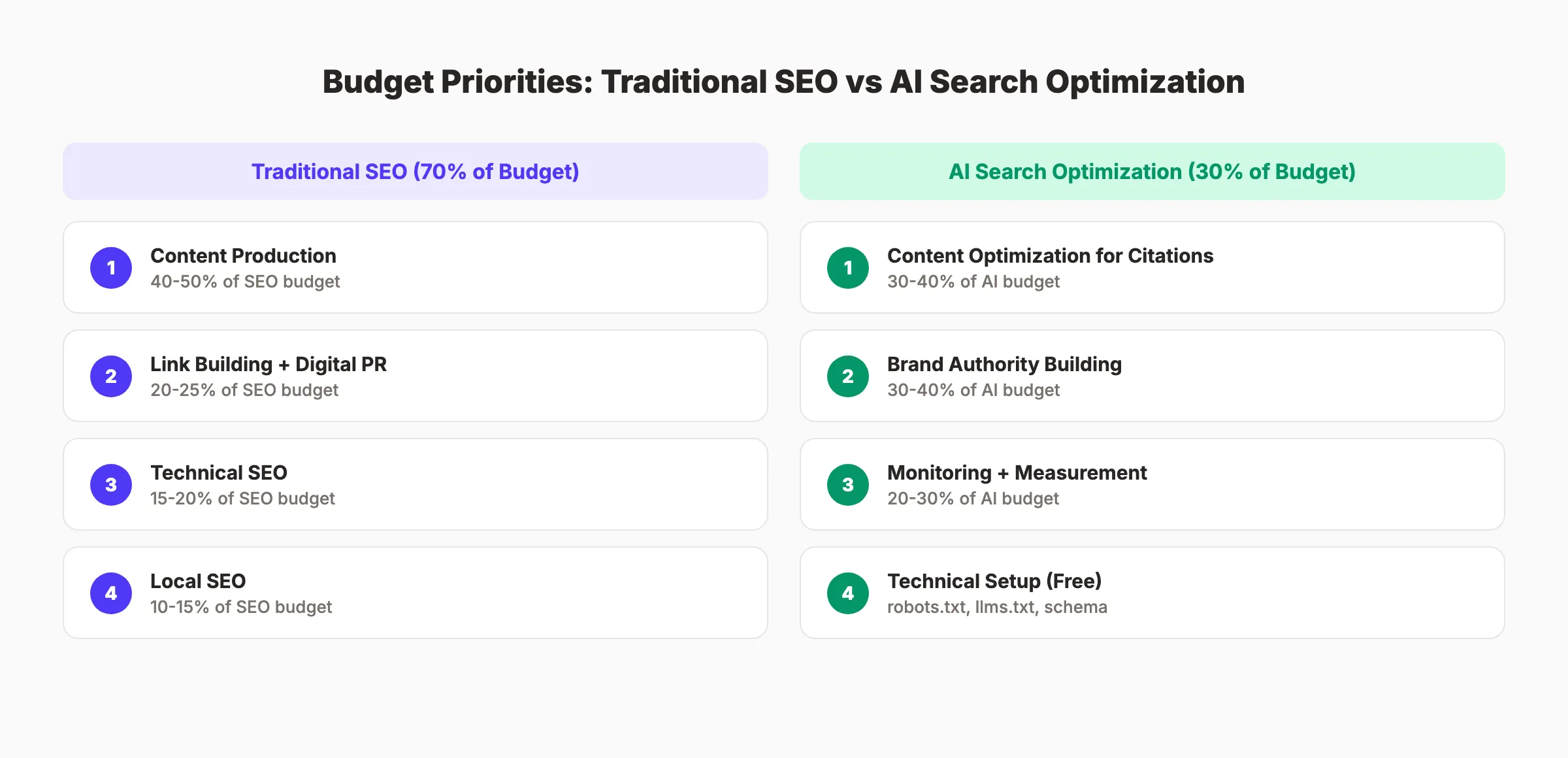
Priority 1: Content Production (40-50% of SEO Budget)
Content is the fuel for both organic rankings and AI citations. Every article you publish creates a new ranking opportunity in Google and a new citation opportunity in AI engines.
- Publish at minimum 20-30 articles per month to build meaningful topical authority
- Focus on search intent matching. Transactional content maintains CTR. Informational content faces AI Overview competition
- Build content clusters around your core topics. AI engines favor brands with deep topical coverage
- Use SEO content writing best practices. Structure, E-E-A-T signals, and data density matter for both channels
Priority 2: Technical SEO (15-20% of SEO Budget)
Technical foundations must be solid. Both Google and AI crawlers need clean access to your content.
- Core Web Vitals optimization (page speed, interactivity, visual stability)
- Crawl budget management and XML sitemap maintenance
- Schema markup implementation (Article, FAQ, HowTo, Organization)
- Internal linking structure that distributes authority
Priority 3: Link Building (20-25% of SEO Budget)
Backlinks remain a top 3 Google ranking factor. They also build the cross-platform authority that AI engines use for citation decisions.
- Earn links from industry publications and authoritative sites
- Build backlinks through original research, data studies, and expert content
- Digital PR that generates brand mentions (AI engines track these)
Priority 4: Local SEO (10-15% if Applicable)
For local businesses, local SEO delivers the highest ROI per dollar spent. Google Business Profile optimization, local citations, and review management drive calls and visits directly.
Chapter 4: What Your AI Search Budget Should Cover
The 20% allocated to AI search optimization covers activities that traditional SEO does not address. For a complete breakdown of GEO vs AEO vs SEO tactics, read our comparison guide.
AI Crawler Access and Technical Setup ($0. No Ongoing Cost)
This is free and should be done immediately.
- Allow GPTBot, ClaudeBot, PerplexityBot, and Google-Extended in your
robots.txt. Read our AI crawlers guide - Create and maintain an llms.txt file
- Implement speakable schema markup for voice AI compatibility
- Verify AI crawl activity in server logs
Content Optimization for AI Citation (30-40% of AI Budget)
Existing content often needs restructuring to earn AI citations.
- Add specific statistics with source links to every major section
- Structure content with self-contained sections that make sense when extracted independently
- Use clear definition-lead sentences (AI engines extract these directly)
- Follow the blog GEO checklist for every new and updated article
Brand Authority Building (30-40% of AI Budget)
AI engines cite brands that appear across multiple trusted platforms. Distributing content across publications increases AI citations by up to 325%.
- Publish guest posts on industry sites
- Maintain profiles on relevant directories and platforms
- Build entity presence on LinkedIn, industry databases, and authoritative directories
- Create original research that other sites cite and reference
Monitoring and Measurement (20-30% of AI Budget)
You cannot optimize what you do not measure. Track AI search visibility with dedicated monitoring.
- AI citation tracking (how often your brand appears in AI responses)
- AI referral traffic segmentation in analytics
- AI crawler activity monitoring in server logs
- Competitive citation share benchmarking
Chapter 5: Budget Allocation by Business Type
The 70/30 framework is a starting point. Your specific business type should shift the allocation.
| Business Type | SEO Budget | AI Budget | Rationale |
|---|---|---|---|
| Local service business | 80% | 20% | Local SEO has highest direct ROI. AI search less relevant for “plumber near me” queries |
| B2B SaaS | 60% | 40% | Informational queries dominate. AI Overviews appear on 25-48% of these queries |
| E-commerce | 75% | 25% | Transactional queries maintain CTR. Product pages less affected by AI Overviews |
| Content publisher / media | 50% | 50% | Informational traffic declining fastest. AI citation is a survival strategy |
| B2B professional services | 65% | 35% | Research-heavy buyer journey. AI engines influence early-stage consideration |
| Healthcare | 55% | 45% | Healthcare AI Overview rate is 48.75%. Highest AI citation competition of any industry |
When to Increase AI Budget Beyond 30%
Shift more budget toward AI search if:
- Your industry has above-average AI Overview rates (healthcare, education, technology)
- Your traffic from informational queries dropped more than 20% year-over-year
- Competitors already appear in AI search results for your core terms
- Your buyer journey starts with research questions (not transactional searches)
- You operate in Information Technology (2.8% AI referral share, highest of all industries)
When to Keep SEO Budget at 80%+
Maintain heavy SEO investment if:
- You serve a local market (local pack and map results are not replaced by AI)
- Your revenue depends on transactional keyword rankings
- Your industry has below-average AI Overview rates (real estate at 4.48%, utilities at 0.35%)
- Your competitors have not invested in AI search optimization yet (you have more time)
Stop writing. Start ranking. Stacc publishes 30 SEO-optimized articles per month for $99. Optimized for organic search and AI engines. Start for $1 →
Chapter 6: ROI Benchmarks for Each Channel
Budget decisions should follow the money. Here is what each channel delivers.
Organic Search ROI
- Average SEO ROI: 748% over 3 years (varies widely by industry and execution quality)
- Timeline to results: 60-90 days for initial ranking movement. 6-12 months for competitive terms
- Revenue model: Owned traffic. Once you rank, the traffic is free. Stopping SEO does not immediately stop traffic (but results decay over 6-12 months)
- Measurement: Clear attribution through Google Analytics and Search Console
AI Search ROI
- Conversion rate: 2x higher than traditional search visitors
- Sessions to convert: One-third fewer sessions needed
- Traffic volume: Small (1-2% of total). Growing at approximately 1% month-over-month
- Revenue model: Citation-based visibility. No direct “ranking” to own. Citations fluctuate per query
- Measurement: Harder to track. Requires dedicated AI monitoring tools and manual testing
The conversion rate difference is the most important number in this comparison. A visitor from ChatGPT or Perplexity arrives with higher intent and clearer context. The AI engine already filtered and summarized options. By the time someone clicks through to your site from an AI response, they are further along in the buying decision than a typical Google searcher.
That 2x conversion rate means 100 visitors from AI search produce the same revenue as 200 visitors from organic search. At scale, even small AI traffic volumes generate meaningful revenue.
The Combined ROI Calculation
Do not compare organic SEO ROI against AI search ROI in isolation. They compound each other.
Strong SEO content ranks in Google AND gets cited by AI engines. A single article can generate organic traffic AND AI referral traffic. The budget produces returns in both channels simultaneously.
That compounding effect is why cutting one channel to fund the other is the wrong approach. A well-structured article optimized for both channels delivers 2 revenue streams from 1 investment.
| Metric | Organic Search Only | AI Search Only | Both Combined |
|---|---|---|---|
| Traffic sources | Google, Bing | ChatGPT, Perplexity, Gemini | All platforms |
| Conversion rate | Baseline | 2x baseline | Blended uplift |
| Time to results | 60-90 days | Ongoing | Faster compounding |
| Content longevity | 6-18 months per article | Refreshes needed every 6 months | Both timelines managed |
| Measurement clarity | High (GSC, GA) | Medium (manual + tools) | Full picture |
Chapter 7: Common Budget Mistakes to Avoid
Mistake 1: Reallocating SEO Budget to AI Search
The most common error. Teams see AI search growing and redirect funds away from SEO. This destroys the foundation that AI search optimization depends on. AI engines cite content that already has authority. Without SEO, that authority does not exist.
Mistake 2: Treating AI Search Budget as a One-Time Project
AI search optimization is not a one-time setup. Citation patterns change. New AI platforms launch. Content freshness requirements mean ongoing updates. 83% of AI citations come from content updated within 12 months. Budget for continuous optimization.
Mistake 3: No Measurement Infrastructure
97% of teams report positive AEO/GEO impact, but most cannot quantify it precisely. Without AI citation tracking and referral traffic segmentation, you cannot optimize spend. Allocate 20-30% of your AI budget to measurement tools and processes.
Mistake 4: Ignoring the Content Overlap
A single piece of content can rank in Google, win a featured snippet, AND get cited by ChatGPT. Teams that create separate content for each channel waste budget. Build one content asset that serves all channels. Optimize once for all three. Our content strategy guide covers the unified approach.
Mistake 5: Following Industry Averages Blindly
The 70/30 framework is a starting point. A healthcare company with 48.75% AI Overview exposure needs a different split than a local plumber with 4% exposure. Use your own traffic data, industry AI Overview rates, and competitive AI citation presence to calibrate.
Pull your year-over-year organic traffic data from Google Search Console. Identify which query categories declined most. Check if competitors appear in AI responses for your target terms. Run those inputs through the business type table in Chapter 5 to set your allocation. Revisit the split quarterly as AI search volumes shift.
3,500+ blogs published. 92% average SEO score. See what Stacc can do for your site. Start for $1 →
FAQ
How much should I spend on AI search optimization per month?
Most businesses spend $1,500 to $5,000 per month on AI search optimization specifically. This covers content restructuring, schema implementation, brand authority building, and citation monitoring. The amount should be roughly 20-30% of your total search marketing budget. Start with a pilot on one product category, then scale based on results.
Is organic SEO still worth investing in during 2026?
Yes. Organic search still drives 98-99% of total website traffic for most businesses. 61% of marketers increased SEO budgets in 2026. While informational query CTRs are declining due to AI Overviews, transactional query CTRs remain stable. SEO also builds the authority signals that AI engines use to decide which sources to cite.
What percentage of my marketing budget should go to search?
The recommended allocation is 60% toward owned and organic channels (SEO, email, content) and 40% toward paid channels (PPC, social ads). Within that organic allocation, split 70% to traditional SEO and 30% to AI search optimization. The exact split depends on your industry and business type.
How do I measure AI search ROI?
Track 3 metrics: AI referral traffic (segment by source in analytics), AI citation count (how often your brand appears in AI responses), and conversion rate from AI traffic vs traditional traffic. AI-referred visitors convert at 2x the rate. Our guide on tracking AI search visibility covers the complete measurement setup.
Should I hire an AI search specialist or train my SEO team?
Train your existing SEO team first. 80% of AI search optimization tactics overlap with traditional SEO best practices. Structured content, schema markup, and authority building serve both channels. Add dedicated AI search expertise only when your AI referral traffic exceeds 3-5% of total visits and justifies a specialist role.
Will AI search replace organic search entirely?
No. AI search is growing but from a small base. Even aggressive projections put AI referral traffic at 5-10% of total website visits by 2028. Organic search will remain the primary traffic source for most businesses. The smart move is optimizing for both, not choosing between them.
The organic search vs AI search budget question has a clear answer: invest in both, with data-driven allocation that matches your specific business. Start with the 70/30 framework. Adjust based on your industry, traffic data, and competitive AI citation presence. Measure both channels. Optimize continuously.
The companies pulling ahead in 2026 are not abandoning SEO for AI. They are building a unified strategy where every dollar invested in content returns value across every search surface. The budget is not a choice between two channels. It is an investment in one content engine that serves all of them.
Related Tools & Resources
Free SEO Tools:
Best Lists:

Written by
Siddharth GangalSiddharth is the founder of theStacc and Arka360, and a graduate of IIT Mandi. He spent years watching great businesses lose organic traffic to competitors who simply published more. So he built a system to fix that. He writes about SEO, content at scale, and the tactics that actually move rankings.
30 SEO blog articles published every month
Keyword-optimized, scheduled, and live on your site. Automatically.
30-day trial · Cancel anytime
theStacc
Stop writing SEO content manually
30 blog articles, 30 GBP posts, and social media content. Published every month. Automatically.
Start Your $1 Trial$1 for 3 days · Cancel anytime