
How to Optimize for ChatGPT Search in 2026
8-step guide to optimize for ChatGPT search. Covers crawlers, content-answer fit, schema, and tracking. Based on a 400K-page ranking study.
ChatGPT now processes 2.5 billion prompts per day. That is not a future prediction. It is happening right now, with 900 million weekly active users searching for answers, recommendations, and buying decisions through conversational AI.
Most businesses still optimize exclusively for Google. They ignore the 12 to 15 percent of global search volume that AI platforms already capture. The result is invisible brands in the fastest-growing search channel of the decade.
This guide walks you through 8 steps to optimize for ChatGPT search, based on data from a 400,000-page ranking study and the latest AI search statistics. We have published 3,500+ blog posts across 70+ industries and tracked how AI search engines discover, retrieve, and cite content.
Here is what you will learn:
- How ChatGPT decides which sources to cite (the 5-factor ranking model)
- The technical setup that makes your site visible to OpenAI crawlers
- Content structure changes that increase your citation probability by 61%
- How to track whether ChatGPT is actually recommending your brand
What You Will Need
Time required: 2 to 4 hours for full implementation
Difficulty: Intermediate
Prerequisites:
- Access to your website CMS and hosting (for robots.txt and schema changes)
- A content management workflow (blog or knowledge base)
- Basic understanding of on-page SEO
Step 1: Understand How ChatGPT Search Ranks Content
Before optimizing anything, you need to know how ChatGPT decides what to cite.
ChatGPT search does not work like Google. Google crawls, indexes, and ranks pages based on hundreds of signals. ChatGPT uses a three-stage process: query rewriting, retrieval, and synthesis.
When a user asks a question, ChatGPT rewrites it into multiple sub-queries. It sends those queries to search providers and retrieves candidate pages. Then it synthesizes an answer by pulling from the most relevant sources and adding inline citations.
A study analyzing 400,000 pages identified 5 ranking factors with specific weights:
| Ranking Factor | Weight | What It Means |
|---|---|---|
| Content-Answer Fit | 55% | How closely your content matches the answer ChatGPT wants to give |
| On-Page Structure | 14% | Logical H2/H3 hierarchy, balanced section lengths, parseable formatting |
| Domain Authority | 12% | Helps during retrieval (getting found), not during citation |
| Query Relevance | 12% | Topical alignment between your page and the user prompt |
| Content Consensus | 7% | Agreement with other trusted sources on the same topic |
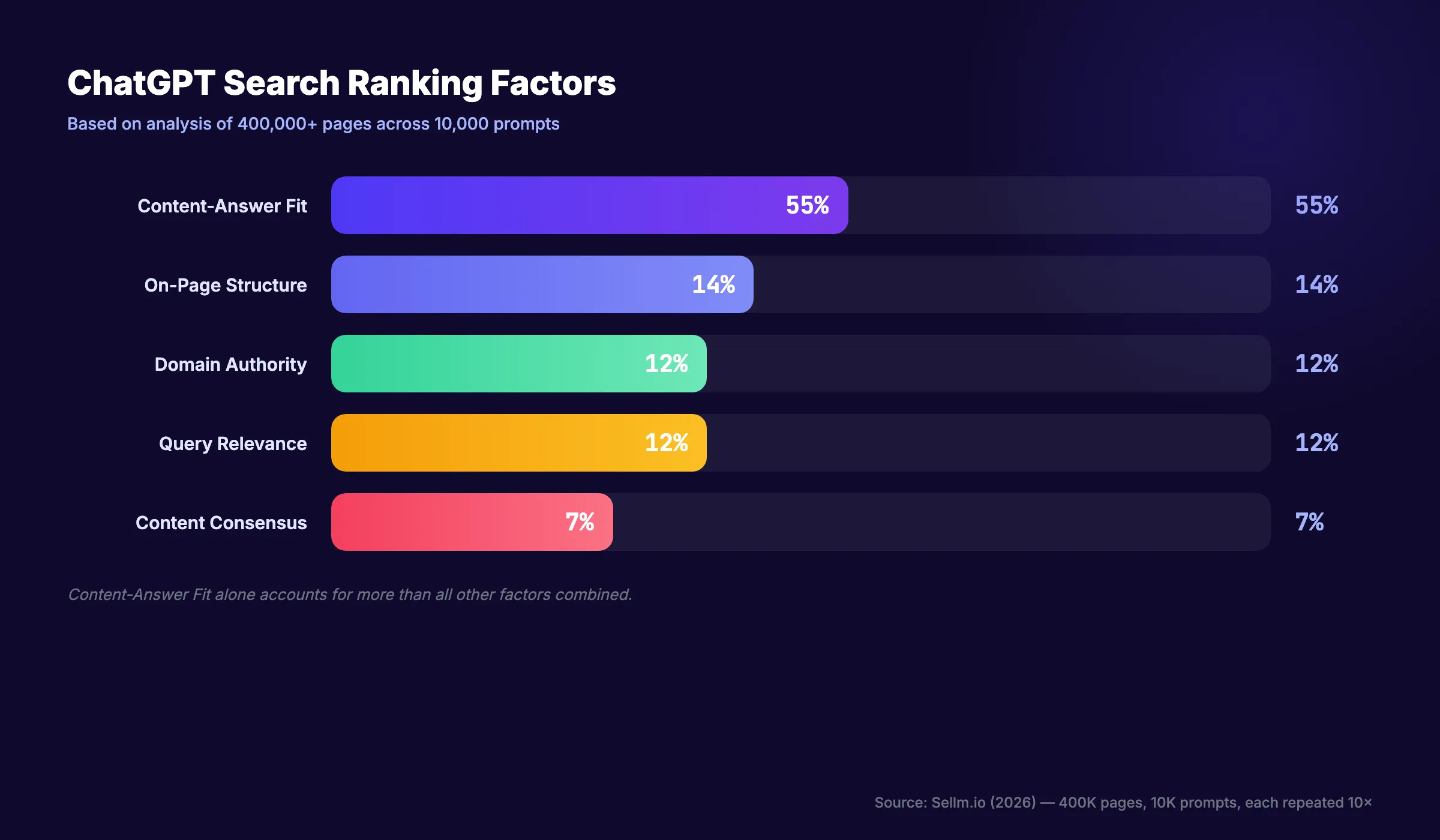
The biggest takeaway: Content-Answer Fit accounts for 55% of the ranking decision. Domain authority only opens the door. Your content quality determines whether ChatGPT actually cites you.
Why this step matters: Every optimization in this guide targets one or more of these 5 factors. Without understanding the model, you will waste time on tactics that do not move the needle.
Step 2: Allow OpenAI Crawlers to Access Your Site
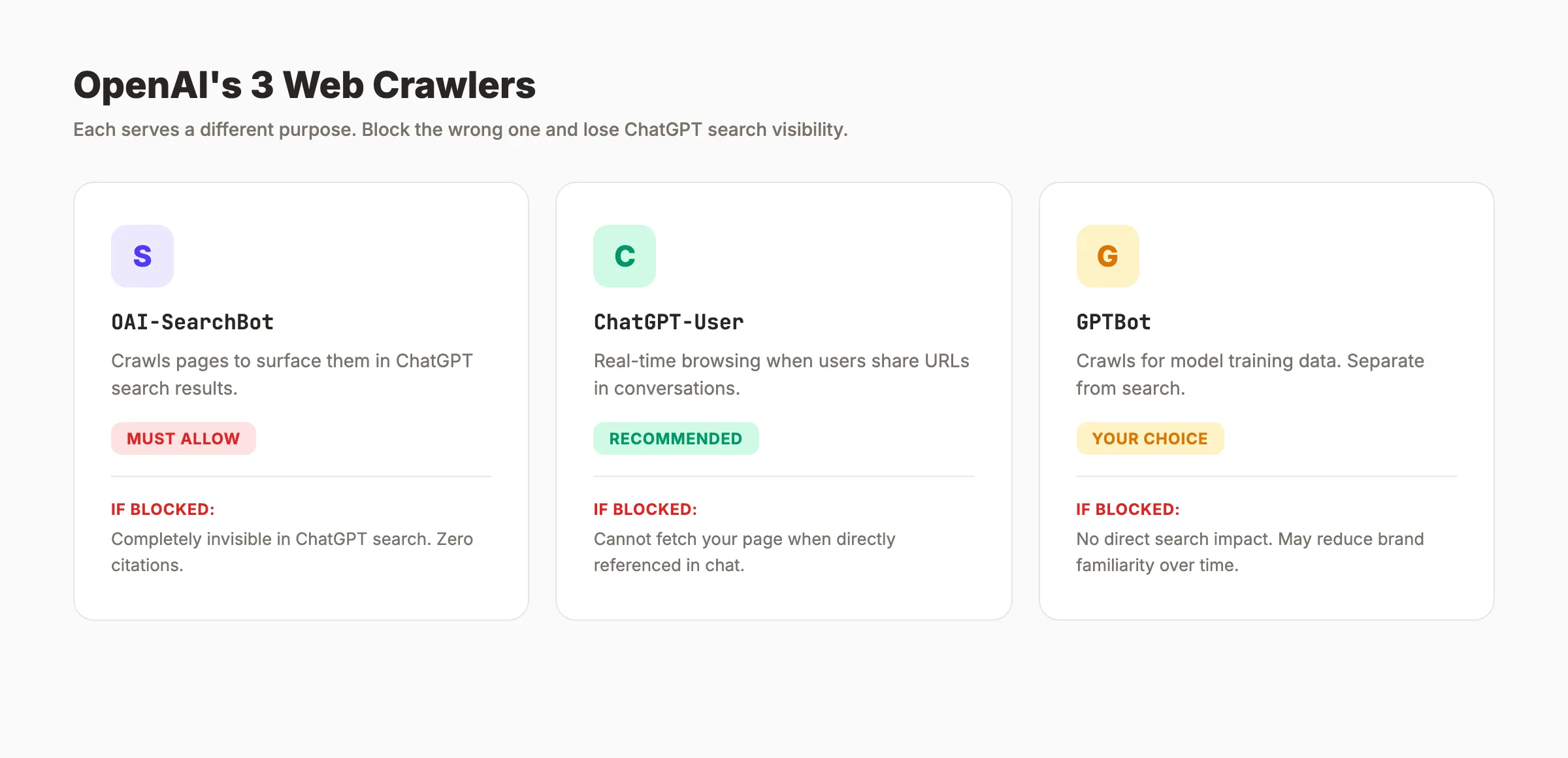
OpenAI uses three separate crawlers. Each serves a different purpose. Blocking the wrong one kills your ChatGPT search visibility without you knowing it.
Here is the breakdown:
| Crawler | Purpose | Block Effect |
|---|---|---|
| OAI-SearchBot | Crawls pages to surface in ChatGPT search results | Invisible in ChatGPT search |
| GPTBot | Crawls for model training data | Not used for training, but may reduce familiarity |
| ChatGPT-User | Real-time browsing during conversations | Cannot fetch your page when directly referenced |
Specifically:
- Open your
robots.txtfile - Confirm that
OAI-SearchBotis NOT blocked - Consider allowing
ChatGPT-Userfor real-time citation - Decide separately on
GPTBotbased on your training data preferences
A safe robots.txt configuration:
User-agent: OAI-SearchBot
Allow: /

User-agent: ChatGPT-User
Allow: /

User-agent: GPTBot
Disallow: /private/
One critical technical detail: OpenAI crawlers cannot render JavaScript. They only see your initial HTML response. If your content loads via client-side JavaScript frameworks, ChatGPT search will see an empty page.
Check your site by viewing the page source (not the rendered DOM). If your article content is missing from the raw HTML, you need server-side rendering. Our AI crawlers guide covers every major AI crawler and how to configure access for each one.
For a deeper look at how robots.txt affects AI visibility, read our robots.txt guide.
Why this step matters: If OAI-SearchBot cannot crawl your site, nothing else in this guide matters. This is the foundation. Changes take about 24 hours to propagate.
Pro tip: Use your server logs to verify that OAI-SearchBot is actually crawling your pages. Our log file analysis guide explains how.
Step 3: Structure Content for Maximum Content-Answer Fit
Content-Answer Fit is the dominant ranking factor at 55%. It measures how closely your content matches the type of answer ChatGPT wants to give for a specific query.
This is different from keyword relevance. Two pages can target the same keyword, but the one structured to deliver a direct, complete answer wins the citation.
Specifically:
- Write direct answers early. Place the core answer within the first 200 words of each section. ChatGPT extracts from the top of content blocks.
- Match the answer format to the query type. If users ask “what is X,” open with a definition. If they ask “how to X,” lead with steps. If they ask “best X,” provide a ranked list.
- Use 10 to 15 H2 sections. The 400K-page study found this is the optimal range for ChatGPT citations.
- Target 5,000 to 7,500 words for in-depth guides. Longer content gets cited more often because it covers more sub-queries.
- Keep titles between 30 and 50 characters. Shorter, focused titles correlate with higher citation rates.
Here is how to structure a section for maximum extractability:
H2: [Clear, query-matching heading]
Paragraph 1: Direct answer to the implied question (2-3 sentences)
Paragraph 2: Supporting evidence or data
Paragraph 3: Practical application or example
ChatGPT does not read your entire page and summarize it. It scans sections, matches them to sub-queries, and extracts specific passages. Each H2 section should be a self-contained answer to one question.
Read our guide on optimizing your first 200 words for AI retrieval for detailed examples of this technique.
Why this step matters: Pages with strong Content-Answer Fit get cited even when they have lower domain authority. This is the single highest-impact optimization you can make.
Step 4: Optimize On-Page Structure for AI Parsing
On-page structure accounts for 14% of the ranking decision. ChatGPT needs to parse your page quickly and extract clean passages.
Specifically:
- Use a clean H1 to H2 to H3 hierarchy. No skipped levels. No decorative headings.
- Keep paragraphs under 3 sentences. Short paragraphs are easier to extract as citations.
- Use tables for comparisons and data. ChatGPT frequently cites tabular data in its responses.
- Add bullet lists for features, steps, and criteria. Lists parse cleanly and translate well into AI answers.
- Include an FAQ section at the bottom. FAQ content directly matches conversational queries.
The blog GEO checklist provides a 15-point audit you can run on every page to verify AI readability.
One underrated signal: balanced section lengths. Pages where every H2 section is roughly the same length (200 to 400 words) perform better than pages with one 2,000-word section and five 50-word sections.
Think of each H2 as a standalone knowledge card. ChatGPT may pull from any single section. Every section should deliver value independently.
For a full structured data guide, see our complete walkthrough.
Why this step matters: Poor structure forces ChatGPT to skip your page entirely, even if your content is the most relevant result. Clean structure is table stakes for AI citation.
Stop writing. Start ranking. Stacc publishes 30 optimized articles per month for $99. Every post is structured for both Google and AI search engines. Start for $1 →
Step 5: Add Schema Markup and Structured Data
Here is a stat most guides skip: 61% of pages that ChatGPT cited had rich schema markup. Only 25% of Google’s top-ranking pages had the same level of structured data.
Schema markup gives ChatGPT explicit signals about what your content is, who wrote it, and how it should be categorized.
Priority schema types for ChatGPT optimization:
| Schema Type | Use Case | Impact |
|---|---|---|
Article / BlogPosting | Blog posts and guides | Identifies content type and publish date |
FAQPage | FAQ sections | Directly maps to question-answer format |
HowTo | Step-by-step guides | Matches “how to” query patterns |
Organization | About/homepage | Establishes brand entity |
Review / AggregateRating | Product reviews | Provides trust signals |
BreadcrumbList | All pages | Shows site hierarchy and topic relationships |
Specifically:
- Add
Articleschema to every blog post withdatePublished,dateModified,author, andpublisherfields - Add
FAQPageschema to any page with an FAQ section - Add
HowToschema to step-by-step guides (like this one) - Include
sameAsproperties on yourOrganizationschema linking to social profiles and Wikipedia (if applicable)
The sameAs property is particularly important. It helps ChatGPT connect your brand entity across different platforms. This feeds into the domain authority signal during retrieval.
Our schema markup SEO guide walks through implementation for every major schema type.
Why this step matters: Schema markup is one of the clearest differentiators between pages that get cited and pages that do not. It is also one of the easiest technical changes to implement.
Step 6: Build Domain Authority Through Third-Party Mentions
Domain authority accounts for 12% of the ranking decision. But it works differently than you might expect.
In ChatGPT search, domain authority primarily affects the retrieval stage, not the citation stage. High-authority domains are more likely to appear in the candidate set that ChatGPT evaluates. But once you are in that set, Content-Answer Fit determines whether you get cited.
The implication: you need enough authority to get retrieved, but you do not need to be Wikipedia.
Specifically:
- Get mentioned on high-authority list articles. ChatGPT heavily references listicles and “best of” roundups. Appearing on these pages signals brand relevance.
- Earn mentions on Reddit and forums. Reddit accounts for 11.3% of ChatGPT’s top citations. Genuine community participation drives visibility.
- Pursue industry directory listings. Being listed in well-known databases and directories increases your entity recognition.
- Collect and manage online reviews. Companies below 70% positive review sentiment are significantly less likely to be recommended by ChatGPT.
- Build traditional backlinks. Backlinks still increase domain rating, which correlates with retrieval probability.
The brand entity optimization for AI search guide explains how to build the kind of authority that AI search engines recognize.
For a broader strategy on earning citations from all AI platforms, read how to build a citation-worthy brand.
Why this step matters: Without sufficient domain authority, your perfectly optimized content never enters the candidate set. Think of authority as the entry ticket and content quality as the competition.
Pro tip: Search ChatGPT directly for queries in your niche. Note which brands appear. Those brands have cleared the authority threshold. Study where they are mentioned online and replicate that footprint.
Your SEO team. $99 per month. 30 optimized articles, published automatically. Blog SEO, Local SEO, and Social on autopilot. Start for $1 →
Step 7: Create Content Consensus Across Sources
Content consensus accounts for 7% of the ranking decision. When multiple trusted sources agree on a claim, ChatGPT treats that claim as more reliable and citable.
This is the “safety in numbers” principle. ChatGPT cross-references your claims against other indexed content. If your page says something that contradicts the consensus, it is less likely to be cited (unless you provide overwhelming evidence).
Specifically:
- Cite authoritative sources in your content. When you reference Google, Ahrefs, or Semrush data, you align your content with sources ChatGPT already trusts.
- Use widely accepted definitions and frameworks. Do not invent terminology when established terms exist.
- Include statistics from recognized studies. Data-backed claims are easier for ChatGPT to verify against other sources.
- Avoid contrarian claims without strong evidence. Unconventional opinions get deprioritized unless supported by original research.
- Publish consistently on the same topics. Multiple pages on related topics from your domain build topical consensus within your own site.
The cross-platform GEO guide covers how content consensus works differently across ChatGPT, Perplexity, Google AI Overviews, and other AI search engines.
Why this step matters: Consensus is the smallest factor at 7%, but it acts as a tiebreaker. When two sources have similar Content-Answer Fit and authority, the one aligned with broader consensus wins.
Step 8: Track and Measure ChatGPT Search Visibility
You cannot optimize what you do not measure. ChatGPT search visibility tracking is still early, but several approaches work today.
Specifically:
- Monitor referral traffic from ChatGPT. In Google Analytics, check for referrals from
chatgpt.comandchat.openai.com. Filter bySource / Mediumto isolate AI traffic. - Track branded prompts manually. Search ChatGPT for your brand name, your product category, and your top keywords. Document which queries return your brand.
- Use AI visibility tools. Platforms like Sellm, Otterly, and AI Clicks track your brand mentions across AI search engines automatically.
- Monitor your AI citability score. This metric measures how likely AI systems are to cite your content.
- Check ChatGPT search weekly. AI search results change faster than Google rankings. Weekly monitoring catches drops early.
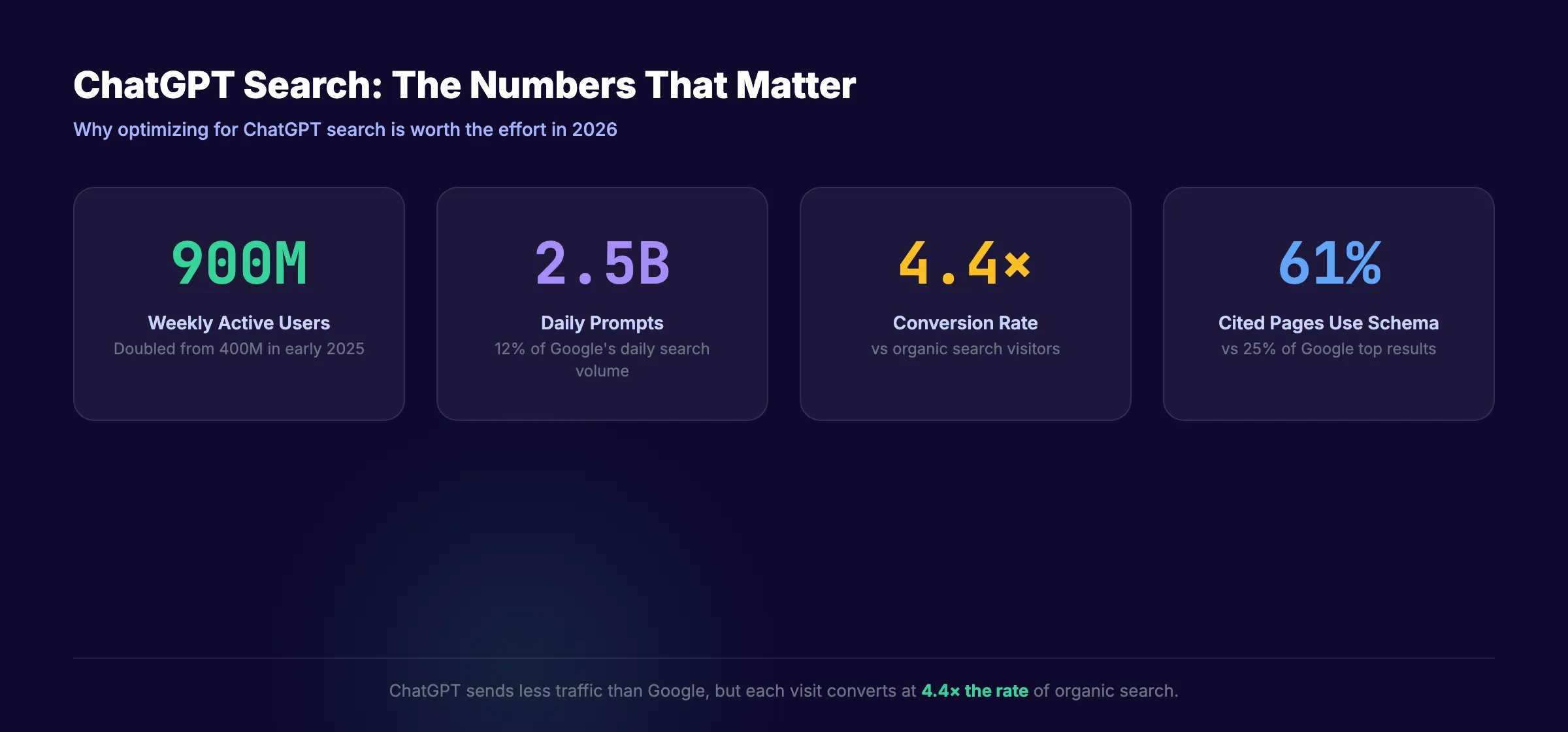
Here is a conversion data point that justifies the effort: AI-referred visitors convert at 4.4 times the rate of organic visitors. ChatGPT sends less total traffic than Google, but each visit is worth significantly more.
For a complete audit framework, our AI citation readiness checklist provides 31 verification points.
Why this step matters: Without measurement, you are optimizing blind. The AI search space moves fast. Monthly tracking prevents you from losing visibility without noticing.
3,500+ blogs published. 92% average SEO score. See what Stacc can do for your site. Every post is optimized for Google and AI search engines. Start for $1 →
Results: What to Expect
After completing these 8 steps, here is a realistic timeline:
- Week 1: Crawler access confirmed. OAI-SearchBot begins indexing your pages.
- Weeks 2 to 4: Restructured content enters the ChatGPT retrieval set. You may see early citations for long-tail queries.
- Months 2 to 3: Schema markup and authority-building efforts compound. Citation frequency increases for competitive queries.
- Months 3 to 6: Consistent publishing and content consensus drive sustained visibility. Referral traffic from
chatgpt.combecomes measurable.
The key variable is your existing domain authority. Sites with established backlink profiles see results faster. New sites need 3 to 6 months of consistent content publishing to cross the authority threshold.
Troubleshooting
Problem: OAI-SearchBot is not crawling my site even though robots.txt allows it.
Solution: Verify your server is not rate-limiting or blocking the crawler via firewall rules. Check server logs for OAI-SearchBot user agent strings. OpenAI crawls on its own schedule. New sites may wait 2 to 4 weeks for the first crawl.
Problem: My content appears in Google but never in ChatGPT responses.
Solution: Check Content-Answer Fit. Your page may rank for a keyword in Google but not match the conversational answer format ChatGPT needs. Restructure your top sections to provide direct, extractable answers. Review how AI search is changing SEO for specific examples.
Problem: ChatGPT cites my competitors but not me.
Solution: Search ChatGPT for your target queries and note which sources get cited. Check those pages for schema markup, content structure, and third-party mentions. Then match or exceed their signals in all 5 ranking factors.
FAQ
How does ChatGPT search work?
ChatGPT search uses a fine-tuned GPT-4o model to rewrite user queries into sub-queries. It retrieves candidate pages from search providers, evaluates them for relevance and quality, then synthesizes an answer with inline citations. It does not maintain a traditional search index like Google.
Does blocking GPTBot affect ChatGPT search visibility?
Not directly. GPTBot crawls for model training, while OAI-SearchBot crawls for search results. Blocking GPTBot does not remove you from ChatGPT search. However, allowing GPTBot may increase ChatGPT’s familiarity with your brand over time.
Is ChatGPT search replacing Google?
No. Google processes 14 billion daily searches compared to ChatGPT’s 2.5 billion daily prompts. Google remains 210 times larger in total search volume. But ChatGPT captures high-intent, research-heavy queries. Optimizing for both is the right strategy. See our AI search market share data for the full breakdown.
What is the difference between GEO and ChatGPT SEO?
Generative Engine Optimization (GEO) is the broader discipline covering all AI search engines. ChatGPT SEO specifically targets ChatGPT search. GEO includes Perplexity, Google AI Overviews, Claude, and Gemini. The tactics overlap significantly, but each platform has unique signals.
How long does it take to see results from ChatGPT search optimization?
Most sites see initial citations within 2 to 4 weeks after technical setup. Meaningful, consistent visibility takes 2 to 3 months. The timeline depends on your existing domain authority and content depth. Sites publishing 20 or more articles per month see results faster due to increased topical coverage.
Can small businesses rank in ChatGPT search?
Yes. Content-Answer Fit accounts for 55% of the ranking decision. A small business with well-structured, expert content on a specific topic can outrank larger competitors. The key is topical depth and clear content structure, not raw domain authority.
Now you know how to optimize for ChatGPT search. The 8 steps cover every ranking factor: crawler access, content structure, schema markup, authority, consensus, and measurement.
Start with Step 2 (crawler access) if you have not verified it yet. That single change determines whether ChatGPT can even find your site. Then move to Step 3 (Content-Answer Fit) for the highest-impact content optimization.
Rank everywhere. Do nothing. Stacc handles Blog SEO, Local SEO, and Social Media on autopilot, starting at $99 per month. Start for $1 →

Written by
Siddharth GangalSiddharth is the founder of theStacc and Arka360, and a graduate of IIT Mandi. He spent years watching great businesses lose organic traffic to competitors who simply published more. So he built a system to fix that. He writes about SEO, content at scale, and the tactics that actually move rankings.
30 SEO blog articles published every month
Keyword-optimized, scheduled, and live on your site. Automatically.
30-day trial · Cancel anytime
theStacc
Stop writing SEO content manually
30 blog articles, 30 GBP posts, and social media content. Published every month. Automatically.
Start Your $1 Trial$1 for 3 days · Cancel anytime