Niche site strategy that survives AI Overviews. Selection, topical authority, monetization, and the 12-month plan from 3,500+ blogs. Updated May 2026.
Most niche sites die between months 4 and 8. The owner publishes 25 posts, watches traffic crawl from 12 daily visits to 47, runs out of patience, and walks away three months before the compounding curve would have rewarded them. The graveyard is full of sites that did everything almost right and quit five articles too soon.
That is the version of the story nobody tells when they share their $10,000 month screenshots. A real niche site strategy is not picking a hot topic and writing 30 posts. It is a 12-to-24-month commitment to one audience, one set of keywords, and one publishing rhythm, executed with enough velocity that Google has no choice but to recognize you as the topical authority. The operators who win in 2026 are the ones who treat niche sites like a publishing business, not a passive income hack.
We publish 3,500+ blog posts a month across 70+ industries for businesses building exactly this kind of compounding content asset. This guide is the playbook we use internally, distilled into one document. It covers how to pick a niche that can survive AI Overviews, how to build topical authority that Google trusts, how to monetize without tanking rankings, and how to scale past the point where most operators give up.
Here is what you will learn:
- Why niche sites still work in 2026 (and the three types that do not)
- The Niche Selection Quadrant for picking a topic with real upside
- How to build topical authority through pillar and cluster content
- The 12-month publishing plan from launch to $1,000 months
- The four revenue streams to stack in the correct order
- The eight mistakes that kill niche sites before they earn anything
- AI Overview survival tactics for review and product content
- The exit math (when to sell, hold, or expand)
What Is a Niche Site Strategy?
A niche site strategy is the deliberate plan for building, growing, and monetizing a website that targets one specific audience with deep, focused content. The strategy covers niche selection, content architecture, keyword targeting, monetization stacking, and the publishing cadence required to reach topical authority. It is the difference between a hobby blog and a content asset.
The word "niche" matters. A general parenting site competes with The Bump, BabyCenter, and 40 other category leaders. A niche site targets "potty training for autistic toddlers" or "single dad budgeting in expensive cities." The narrower the niche, the lower the competition, and the more often Google credits one site with topical authority for the entire topic.
A niche strategy in marketing focuses on one small segment of the total market population. For niche sites, that segment is defined by the audience plus the problem. The site exists to serve readers who Google has not yet found a perfect match for.
What a Niche Site Actually Is
A niche website is a website that focuses on a specific topic, product, service, or audience. Done well, the site provides deep coverage of subjects that broader publishers only graze. A generalist site might publish 50 articles about gardening. A niche site about "indoor hydroponic gardening in small apartments" publishes 200 articles, every one of them aimed at the same reader.
Three things separate niche sites from blogs:
- Audience-first content architecture. Every post answers a question from the same persona, not whatever is trending.
- Long-tail keyword coverage. Niche sites win by stacking 200 low-competition keywords, not chasing one viral term.
- Revenue model designed for compounding. Affiliate links, email lists, and digital products that benefit from every article published.
Why "Niche" Beats "General" in 2026
Google now treats topical authority as a primary ranking signal, especially after the helpful content updates. A site with 200 articles about kayaking will outrank a generalist outdoor site with 20 kayaking articles, even if the generalist has more total domain authority. The Helpful Content System looks for sites that demonstrate deep, sustained coverage of one topic area.
AI Overviews push this harder. Generic content gets summarized and replaced. Specific, experience-rich content gets cited as a source. Niche sites with original photography, real-world testing, and named author credentials survive the AI search transition that is killing thin affiliate roundups.
Why Niche Sites Still Work in 2026
Niche sites work in 2026 because the alternative does not. Building a brand from zero on TikTok takes 18 months of daily content for a 0.4% chance of breaking through. Paid ads require capital you do not have. Affiliate marketing on social platforms means you do not own the audience. A niche site is the only durable asset where one piece of content can pay you 18 months later without any additional input.
The objection most operators bring is that AI Overviews and ChatGPT are killing search traffic. That is partially true. SimilarWeb data shows generic informational queries are down 28% year-over-year for high-traffic affiliate sites. But high-intent queries with commercial purchase intent are flat or up, according to Ahrefs research on AI search impact. The losers are sites that wrote thin "how to" content with no original experience. The winners are sites that wrote deep review content with original testing.
What Niche Sites Look Like When They Work
A working niche site in 2026 has these traits:
| Trait | What It Looks Like |
|---|---|
| Topical coverage | 200+ articles all related to the same niche |
| Author identity | Real name, real bio, real photo, real credentials |
| Original content | First-party photos, test results, opinions |
| Internal linking | Pillar and cluster structure with 20+ links per pillar |
| Revenue stack | Affiliate plus display ads plus email list |
| Publishing velocity | 4-30 new posts per month consistently |
| Domain age | 12+ months minimum before serious revenue |
| Backlink profile | Modest but earned (no PBNs, no paid links) |
Realistic Earnings (With the Math)
Building a niche site that pays $500 per month takes 8 months to over a year for most people. Some operators do not see results until the second or third year. The realistic curve looks like this:
- Month 1-3: $0 revenue. You are publishing, not earning.
- Month 4-6: $20-$200 per month in trickle traffic.
- Month 7-9: $200-$1,000 per month if the niche is right.
- Month 10-12: $1,000-$3,000 per month for sites that execute well.
- Month 13-24: $3,000-$25,000 per month for sites that scale content.
- Month 24+: Exit valuation at 32x monthly profit if you choose to sell.
The 32x multiplier is the rough average for niche site sales on platforms like Empire Flippers and Motion Invest. A site earning $2,500 per month sells for around $80,000. The same site earning $10,000 per month sells for $320,000. The math is why patient operators win and impatient operators leak value.
The Niche Selection Quadrant
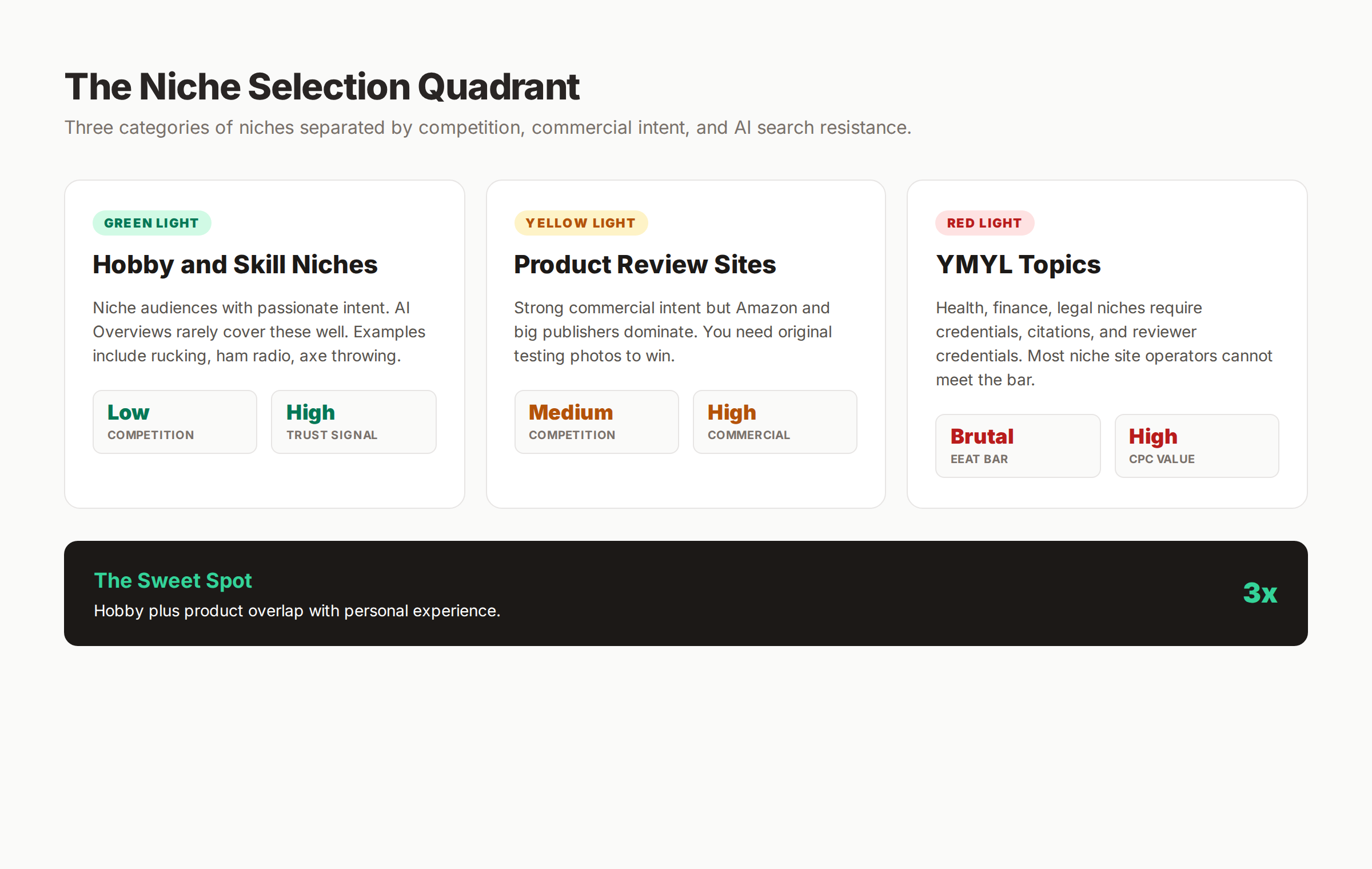
Niche selection is the single most important decision in the entire strategy. Pick well and the rest of the work compounds. Pick poorly and no amount of execution rescues the site. We sort niche candidates into three categories: green light, yellow light, and red light.
Green Light Niches: Hobby and Skill
Hobby and skill niches have passionate audiences, limited large-publisher coverage, and natural product-buying behavior. Examples include rucking, ham radio, axe throwing, urban foraging, model train collecting, gravel cycling, and indoor bouldering. The audiences are small enough that no one has built a category leader, but engaged enough to buy gear, courses, and digital products.
The signal you are in a green light niche:
- Reddit has an active subreddit with 50K+ members
- YouTube has channels with 100K+ subscribers but mostly under 1 million
- Amazon has product categories but pricing varies wildly (poor consumer education)
- Forums still exist and are active
- Google search results are dominated by enthusiast bloggers, not corporate sites
Yellow Light Niches: Product Reviews
Product review niches have strong commercial intent and high CPC but face brutal competition from Amazon, Wirecutter, RTINGS, and category leaders. You can win here, but only with original testing, original photography, and a willingness to actually buy and use products. Generic AI-generated review content gets crushed.
Examples include kitchen gear, audio equipment, outdoor gear, baby products, and home tools. The audiences are huge, but so are the incumbents. Niche down within the category to compete. Instead of "best headphones," go after "best headphones for software developers who take 8 daily calls."
Red Light Niches: YMYL Topics
Your Money or Your Life topics include health, finance, legal, medical, and any niche where bad advice can cause real harm. Google demands credentials, expert citations, and named reviewers for these topics. Most niche site operators cannot meet the bar. The exception is operators with actual credentials: a licensed nurse can build a health niche site, a CPA can build a tax niche site.
If you are not credentialed and you target YMYL, you will publish 200 articles, rank for nothing meaningful, and burn through 14 months of opportunity cost. The CPC numbers look attractive but they are unreachable for non-experts.
The Niche Selection Checklist
- ✓ Audience size is between 500K and 5M potential readers (not 50K, not 50M)
- ✓ Commercial intent exists (products, courses, or services people buy)
- ✓ You have real experience or are willing to acquire it
- ✓ Reddit shows active engagement around the topic
- ✓ Amazon affiliate program covers the relevant product category
- ✓ Competition is enthusiast bloggers, not Fortune 500 publishers
- ✓ You can list 100+ article ideas without external research
- ✓ The niche has at least 2 sub-niches you can expand into later
If 6 of 8 boxes are checked, the niche is worth the 12-month commitment. Fewer than 6, keep looking.
Topical Authority: The Three-Layer Content Architecture
Topical authority is what Google credits to sites that demonstrate deep, sustained coverage of one subject area. It is not a single metric. It is a pattern Google recognizes from your content velocity, internal linking, and semantic coverage. Sites that build topical authority outrank sites with higher domain authority but thinner topical depth.
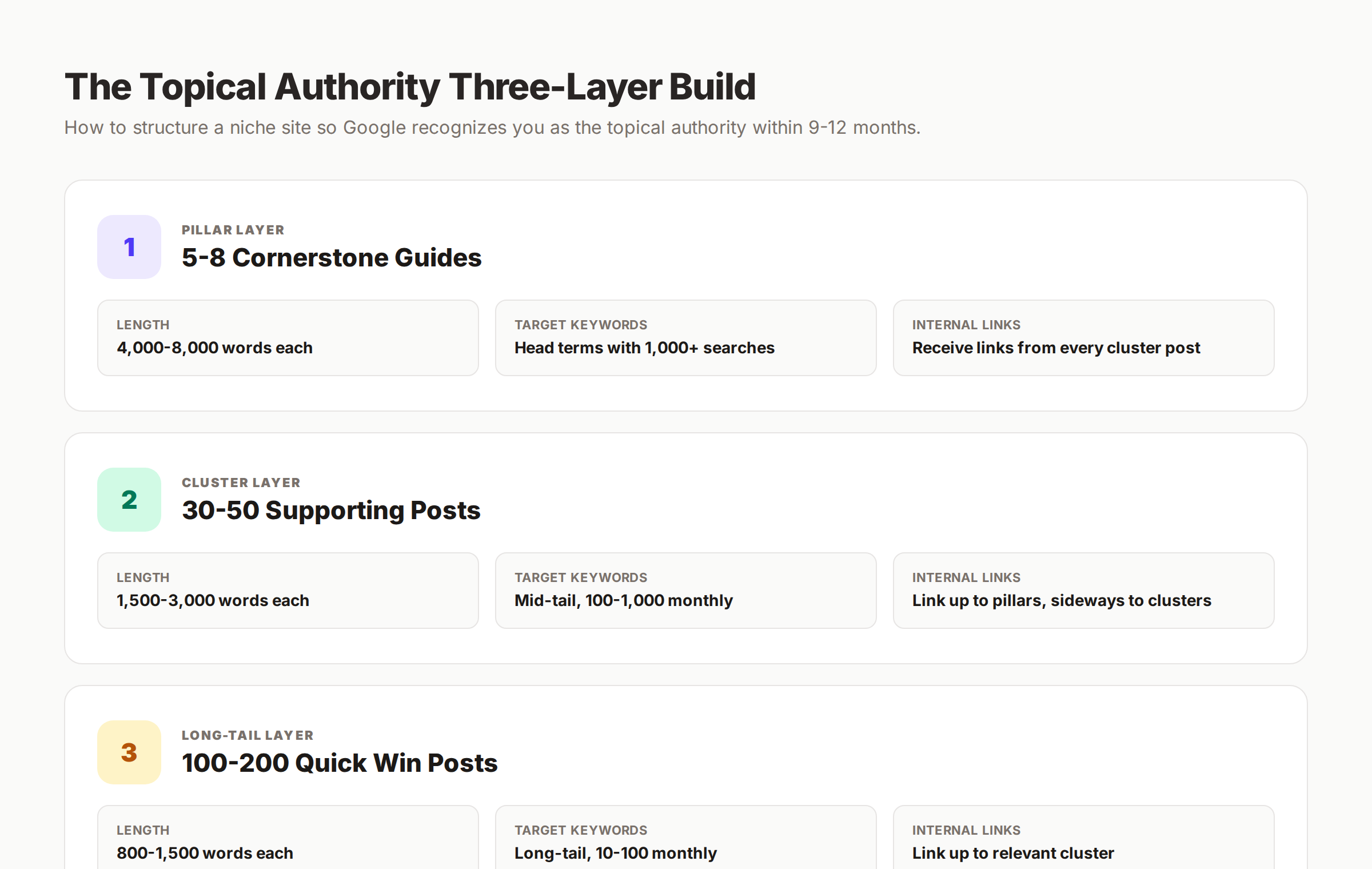
The architecture that produces topical authority has three layers: pillar content, cluster content, and long-tail content. Most niche site operators publish only the long-tail layer and wonder why they never rank for valuable terms.
Layer 1: Pillar Content (5-8 Cornerstone Guides)
Pillar content covers the broadest, highest-value terms in your niche. Each pillar is 4,000-8,000 words, targets a head term with at least 1,000 monthly searches, and serves as the destination for internal links from every related cluster post. Pillar posts get refreshed quarterly and earn the most backlinks over time.
For a niche site about urban beekeeping, the pillars might be:
- The Complete Beginner's Guide to Urban Beekeeping
- Urban Beekeeping Equipment: Every Tool You Need
- Bee Diseases and Treatments for Urban Hives
- Honey Harvesting and Processing at Home
- Bee-Friendly Plants for City Gardens
Pillar posts are the most expensive content to produce but they generate the most return per dollar spent. We treat them as flagship assets in every niche site we manage. Read our guide on content pillars for the full pillar architecture template.
Layer 2: Cluster Content (30-50 Supporting Posts)
Cluster content sits between pillars and long-tail. Each cluster post is 1,500-3,000 words, targets mid-tail keywords with 100-1,000 monthly searches, and links upward to the relevant pillar. Cluster posts are the workhorses of topical authority. They prove to Google that you cover every facet of the topic, not just the obvious questions.
In the urban beekeeping example, cluster posts under the equipment pillar would include:
- Best beekeeping suits under $200
- Langstroth vs top-bar hives compared
- DIY bee feeder plans and templates
- How to choose a queen excluder
- Smoker fuel options that actually work
The cluster post should cite the pillar in the first 200 words and link back with anchor text that matches the pillar's primary keyword. This pattern is what Google's algorithm recognizes as topical coverage.
Layer 3: Long-Tail Content (100-200 Quick Wins)
Long-tail content targets specific, low-competition queries with 10-100 monthly searches. Each post is 800-1,500 words. These posts rank fast (often within 60-90 days), generate qualified traffic, and feed internal link equity to the cluster and pillar layers.
Long-tail post examples for urban beekeeping:
- Can you keep bees on a Brooklyn rooftop?
- Bee laws in Portland Oregon explained
- What to do if neighbors complain about your hives
- Bee waterers for small balcony setups
- How loud are urban beehives really?
The long-tail layer is where AI tools shine. The questions are specific enough that GPT-4 with proper prompting produces strong drafts. The pillar layer requires more human input. Our breakdown of how to build topical authority covers the editing workflow for each layer.
Internal Linking Patterns That Build Authority
Internal linking is what converts content velocity into topical authority. The pattern that works:
| Layer | Links Out | Links In |
|---|---|---|
| Pillar | 30-50 outbound to clusters | 50-100 inbound from clusters and long-tail |
| Cluster | 10-15 outbound to long-tail and pillar | 10-20 inbound from long-tail |
| Long-tail | 3-5 outbound to clusters and pillar | 0-3 inbound |
Most niche sites underbuild the inbound link count to pillars. Every cluster post should link to its pillar within the first 300 words. Every long-tail post should link to one cluster and one pillar. This is the structural pattern Google's link graph algorithm recognizes.
The fastest way to build a topical authority site? Stop writing and start publishing. theStacc publishes 30 SEO articles per month across pillar, cluster, and long-tail keywords. No briefs, no editors, no agency invoices.
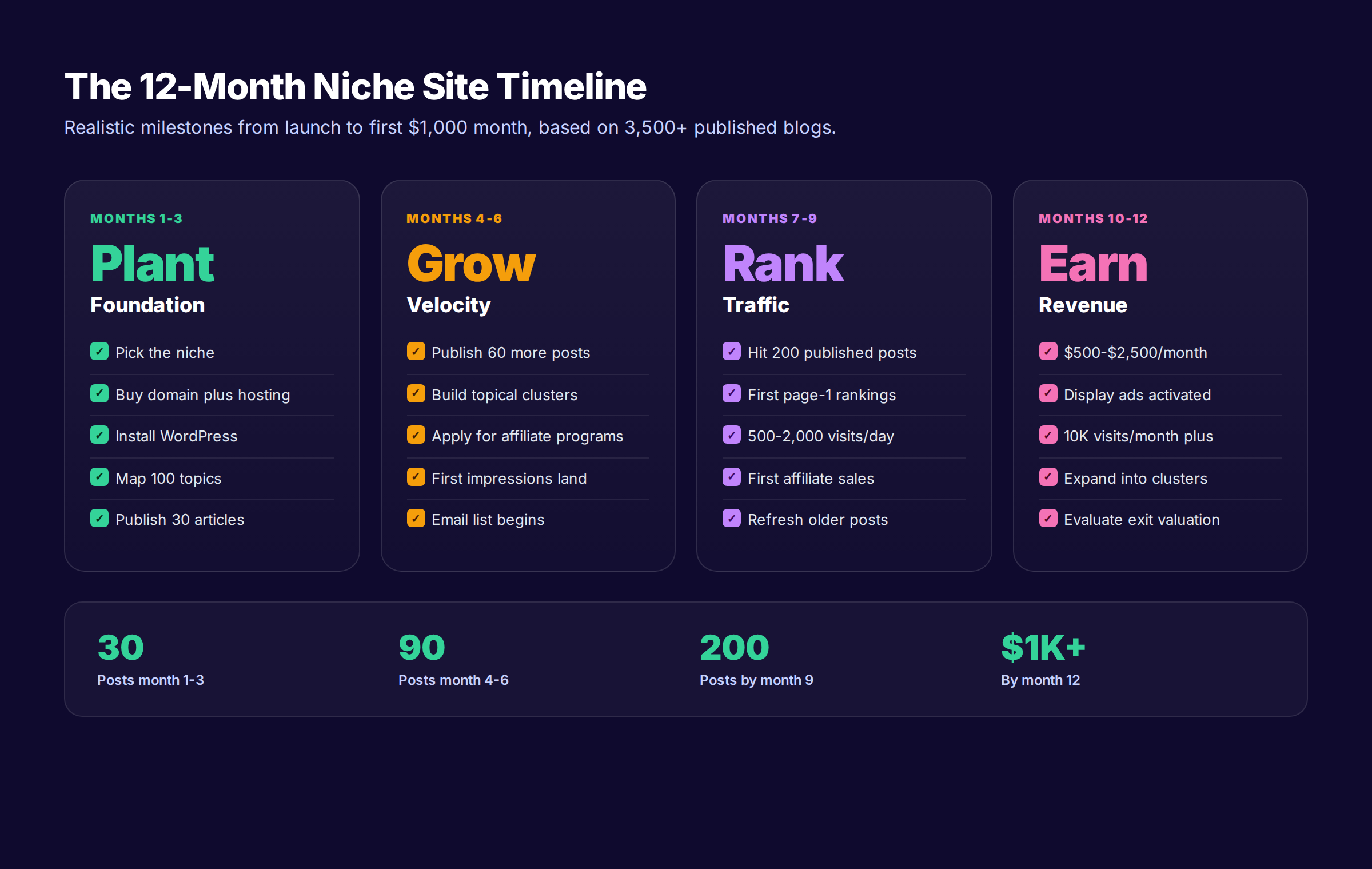
The 12-Month Niche Site Publishing Plan
A niche site needs a publishing cadence the way a restaurant needs a kitchen schedule. Random output produces random results. The 12-month plan below is what we use for every new niche site engagement. The post counts assume one person executing solo with AI assistance, or a 3-person team without AI.
Months 1-3: Foundation Phase
The first 90 days are about infrastructure and content velocity. The goal is to publish 30 articles, all aimed at the same persona, all hitting different long-tail keywords. You will see almost zero traffic during this phase. That is normal.
Month 1 tasks:
- Buy the domain (exact match keyword domains are unnecessary in 2026)
- Set up WordPress on managed hosting (Kinsta, WP Engine, or Cloudways)
- Install the Astra theme or a similar fast, minimal theme
- Configure Rank Math or Yoast SEO
- Build the about page with real author bio and photo
- Map 100 article ideas using free tools (see keyword research for blog posts)
Month 2-3 tasks:
- Publish 30 articles (10 per month minimum)
- Write the first 2 pillar drafts (do not publish yet)
- Apply for Amazon Associates (do this on day 1, approval takes 90 days now)
- Set up Google Search Console and Google Analytics 4
- Begin documenting topic clusters in a content map
Months 4-6: Velocity Phase
Months 4 through 6 are about scaling content output while the foundation indexes. By month 6 you should have 90 total articles published and your first impressions appearing in Search Console. Traffic is still low (under 1,000 monthly visits typically) but the curve is starting.
Month 4-6 tasks:
- Publish 60 more articles (20 per month, or one every 36 hours)
- Launch all pillar pages (5-8 cornerstone guides)
- Build the topic cluster internal linking
- Apply for 3-5 affiliate programs beyond Amazon
- Start an email list with a niche-specific lead magnet
- Submit guest posts to 5 niche-adjacent sites
Months 7-9: Ranking Phase
This is when the curve typically begins. You reach 200 published posts, the topical authority signal becomes visible to Google, and rankings start climbing for cluster and long-tail keywords. Traffic doubles roughly every 30 days during this phase if execution is right.
Month 7-9 tasks:
- Publish 60 more articles (continue 20 per month)
- Refresh the 30 oldest posts with new data and internal links
- Add original photography to top 20 ranking posts
- Set up display ad eligibility tracking (Mediavine requires 50K monthly sessions)
- Begin tracking affiliate revenue per post
Months 10-12: Revenue Phase
By month 10 you should be hitting $500-$2,500 in monthly revenue with 250+ total published posts and 10,000+ monthly visits. The compounding effect is visible: posts you published in month 3 are now driving daily traffic without any additional work.
Month 10-12 tasks:
- Slow new content to 15 per month (start optimizing winners)
- Apply for Mediavine or Raptive when 50K monthly sessions hit
- Begin product development (digital product or course) for owned monetization
- Hire your first contractor (writer or virtual assistant)
- Evaluate exit valuation (32x monthly profit benchmark)
The Four Revenue Streams (Stacked in Order)
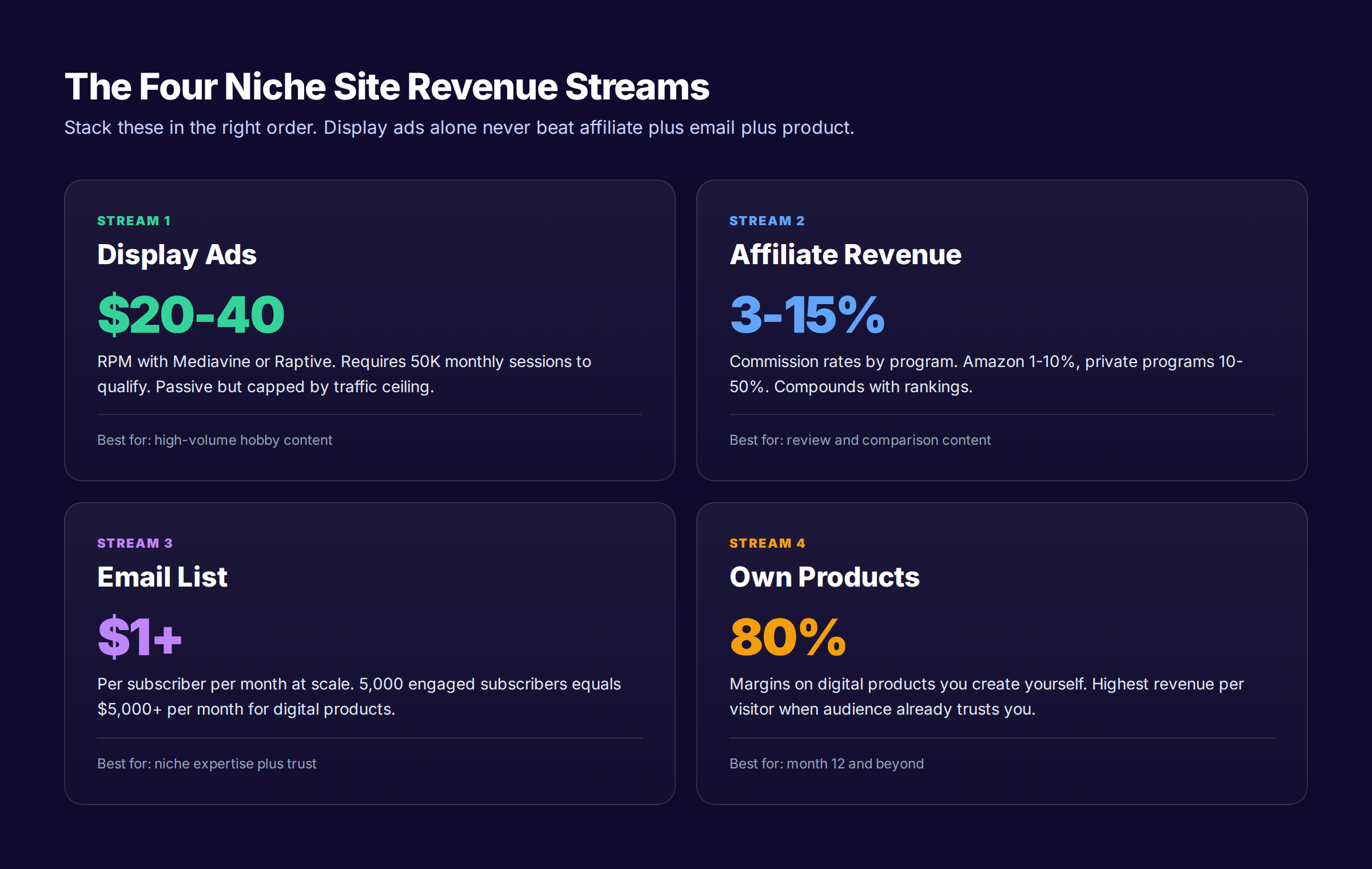
The mistake most niche site operators make is monetizing too early or stacking streams in the wrong order. Display ads in month 2 hurt rankings. Affiliate links without conversion-optimized review pages hurt revenue per visitor. Email lists built before you have content depth hurt deliverability rates.
The correct stacking order is below, with the timeline and the revenue ceiling for each stream.
Stream 1: Affiliate Revenue (Start in Month 4)
Affiliate revenue is the foundation of niche site monetization. Apply for Amazon Associates on day one of the project even though you will not generate sales until month 4 or later. Amazon's approval timeline is now 90+ days for new sites with low traffic.
Commission rates vary dramatically:
| Program | Commission | Cookie Duration |
|---|---|---|
| Amazon Associates | 1-10% by category | 24 hours |
| ShareASale | 5-30% by merchant | 30-90 days |
| Impact Radius | 5-50% by program | 30-180 days |
| Direct partnerships | 10-50% | 30-180 days |
| Software affiliate programs | 20-50% recurring | 60-365 days |
The math favors high-ticket, recurring, or specialized products over Amazon. A single sale of a $300 piece of specialty gear pays more than 100 sales of $15 books. Build your review content for the high-ticket items first.
Stream 2: Display Ads (Start in Month 7-9)
Display ads turn raw traffic into passive revenue. The qualification thresholds matter:
- Google AdSense: No traffic minimum, $2-5 RPM (low quality)
- Ezoic: No traffic minimum, $8-15 RPM
- Mediavine: 50K monthly sessions, $20-40 RPM
- Raptive (formerly AdThrive): 100K monthly sessions, $25-50 RPM
Skip AdSense entirely. The revenue is not worth the user experience hit. Wait until you qualify for Mediavine or Raptive. Display ad placement matters enormously: above the fold, in-content after the first heading, and at the end of the post are the highest-converting positions.
Stream 3: Email List Monetization (Start in Month 6)
Email is the only owned channel. Every other revenue stream depends on Google. The email list survives algorithm updates, AI Overviews, and platform changes. Build it from day one with a niche-specific lead magnet (a checklist, template, or mini-guide).
The math at scale:
- 1,000 subscribers at $1 per subscriber per month = $1,000/month
- 5,000 subscribers at $2 per subscriber per month = $10,000/month
- 20,000 subscribers at $3 per subscriber per month = $60,000/month
Hitting $1+ per subscriber per month requires owned products or strong affiliate partnerships. Pure newsletter sponsorships pay less but are easier to land. See our breakdown of newsletter SEO and growth for the funnel architecture.
Stream 4: Owned Products (Start in Month 12+)
Owned products are the highest-margin revenue stream. A $97 digital product sold to 200 subscribers per month equals $19,400 in monthly revenue at 80% margins. The same traffic on display ads would generate maybe $1,200 in revenue. The revenue multiple is 16x.
Product types that work for niche sites:
- Digital downloads ($27-$97 range)
- Online courses ($197-$997 range)
- Community access ($29-$99/month range)
- Coaching or consulting (custom)
- Physical products (only if you have a fulfillment partner)
Owned products require trust. Do not build them until you have 12+ months of established authority and 5,000+ engaged email subscribers. Earlier than that, the launch flops.
Eight Mistakes That Kill Niche Sites
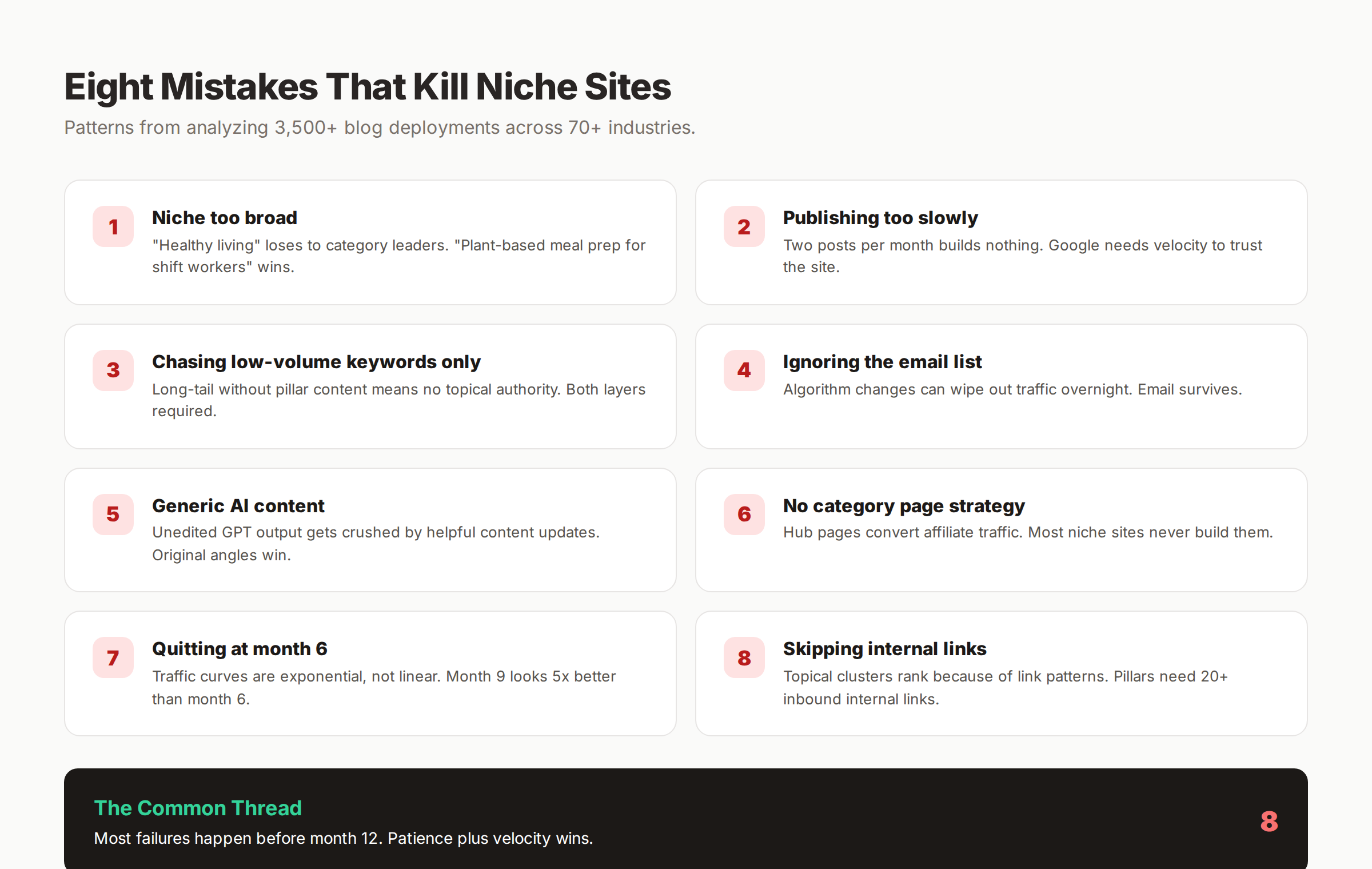
Patterns from analyzing 3,500+ blog deployments show the same eight mistakes show up in 90% of failed niche sites. Most operators commit at least three of them. Fix these before you publish your tenth article.
Mistake 1: Niche Too Broad
"Healthy living" loses to MindBodyGreen, Healthline, and 30 other category leaders. "Plant-based meal prep for shift workers" wins because no category leader serves that audience. The narrower the niche, the more easily you become the topical authority.
Mistake 2: Publishing Too Slowly
Two posts per month builds nothing in 2026. Google's topical authority signal requires velocity. Sites publishing 15-30 posts per month outrank sites publishing 2-3 even when the slower sites have better individual articles. Velocity beats perfection during the foundation phase.
Mistake 3: Chasing Only Long-Tail
Long-tail keywords are easy to rank for but produce small traffic per post. Without pillar content earning topical authority, the long-tail traffic plateaus around 20K monthly visits. Both layers are required for the site to scale past $1,000/month.
Mistake 4: Ignoring the Email List
Every algorithm update is a reminder that Google can take your traffic away at any time. Operators who do not build email lists are one update away from bankruptcy. Start the list on day one. Build it slowly but consistently.
Mistake 5: Generic AI Content
AI-generated content with no editorial layer or original angle gets crushed by helpful content updates. The Helpful Content System is designed to detect this pattern. AI as a drafting tool works. AI as a publishing tool fails. The difference is human-edited, fact-checked, and opinion-injected output versus raw model output.
Mistake 6: No Category Page Strategy
Category pages and tag pages are the highest-converting affiliate pages on most niche sites. They aggregate intent. A category page for "best urban gardening kits" earns 3-5x more affiliate revenue per visit than a single product review. Most niche sites never build them properly.
Mistake 7: Quitting at Month 6
The traffic curve is exponential, not linear. Month 6 looks 4x better than month 3, but month 9 looks 5x better than month 6, and month 12 looks 3x better than month 9. Operators who quit at month 6 (the most common cliff) miss the part of the curve where the work compounds. Patience beats talent on niche sites.
Mistake 8: Skipping Internal Links
Topical clusters rank because of internal link patterns. Pillars need 20+ inbound internal links to function. Most niche site operators add 0-3 links per pillar and wonder why the pillar never ranks. Every cluster post should link to its pillar. Every long-tail post should link to one cluster.
AI Overview Survival for Niche Sites
AI Overviews appear above the first organic result for 28% of commercial queries and 47% of informational queries as of May 2026. Niche sites that fail to optimize for citation in AI Overviews lose traffic on every informational post they publish. The tactical work to be cited:
Structure Content for Extractability
AI models pull citations from content that is structured for clear extraction. The patterns that work:
- Direct definition in the first 100 words ("A niche site strategy is...")
- Numbered lists with clear, atomic steps
- Comparison tables with consistent column headers
- Question-format H2s that match People Also Ask queries
- Named statistics with cited sources
The same patterns that worked for featured snippets still work for AI Overview citations. The bar is just higher: AI models need the answer to be both correct and clearly labeled.
Build Author Identity
AI Overviews increasingly cite sources with named authors, real photos, and verifiable expertise. Anonymous niche sites get summarized but rarely cited. Build the author page early. Add the author bio block to every post. Include a credentials line that establishes why the writer can speak to the topic.
Original First-Party Content
The single biggest differentiator between cited and ignored sources is original, first-party content. Original photos, original testing data, original surveys, original case studies. AI models cannot generate these and recognize them as ground truth. A niche site with 200 articles and 600 original photos beats a niche site with 200 articles and stock photos every time. Read more on EEAT for blogs for the full credibility framework.
Internal Linking to Demonstrate Coverage
When AI Overviews pull a citation, they look at the source's broader topical coverage. A post on "urban beekeeping rooftop laws" gets cited more often if the surrounding internal links point to deep coverage of the urban beekeeping topic. Topical authority works for AI search the same way it works for organic.
How Long Does It Take to Earn $500 Per Month?
The honest answer is 8 months to over a year for most operators. Some do not see meaningful revenue until year two or three. The variables that compress or extend the timeline:
| Variable | Compression Effect |
|---|---|
| Publishing velocity (15+ posts/month) | -3 to -6 months |
| Pre-existing audience or email list | -2 to -4 months |
| Real expertise in the niche | -2 to -3 months |
| Aggressive backlink building | -1 to -3 months |
| Wrong niche selection | +6 to +12 months |
| Sporadic publishing | +6 to +18 months |
| AI Overview vulnerability | +3 to +6 months |
| No email list strategy | +6 to +12 months |
The realistic earnings path for a properly executed niche site:
- Month 4: First Amazon Associates sale ($3-$8)
- Month 6: $50-$150 in monthly revenue
- Month 9: $300-$800 in monthly revenue
- Month 12: $1,000-$3,000 in monthly revenue
- Month 18: $3,000-$8,000 in monthly revenue
- Month 24: $5,000-$25,000 in monthly revenue (top quartile)
Operators who hit $10,000+ per month within 18 months almost always have one of these advantages: an existing audience they migrated, a pre-built email list, or industry expertise that produces faster content.
The Exit Math: Sell, Hold, or Expand?
Niche sites are real assets with real exit multiples. Empire Flippers and Motion Invest data shows the average sale multiple is 32x monthly net profit. A site netting $2,500 per month sells for around $80,000. A site netting $10,000 per month sells for around $320,000.
When to Sell
Consider selling when:
- The site has stable revenue for 6+ consecutive months
- You have lost interest in the niche
- A larger opportunity needs capital
- The niche is showing signs of consolidation (Wirecutter-style aggregators entering)
- AI Overview impact on the niche exceeds 30% traffic drop
When to Hold
Hold the site when:
- Revenue is still climbing month over month
- The niche has 5+ years of growth runway
- You enjoy the content production
- You have unique competitive advantages no buyer could replicate
When to Expand
Expand into adjacent niches when:
- Original niche has stable rankings and revenue
- You have systems and contractors handling production
- An adjacent audience overlaps 30%+ with the original
- The expansion can launch with 50+ posts from existing research
The compounding effect of running 3 niche sites in adjacent verticals is meaningful: shared backlink building, shared email lists (with permission), and shared content production resources. Operators who run 3-5 sites typically out-earn operators who run one site by 3-4x.
Publishing 30 SEO articles per month for $99? That is what theStacc does — automatically. Pillar content, cluster content, and long-tail posts published on your schedule.
What Tools Niche Site Operators Actually Need
The tool stack for niche sites has consolidated. You need fewer tools in 2026 than you did in 2020, but the ones you use matter more.
The Minimum Viable Stack
| Category | Tool | Cost | Why |
|---|---|---|---|
| Hosting | Kinsta or Cloudways | $35-$70/mo | Speed affects rankings and conversions |
| Theme | Astra or GeneratePress | $59-$249/yr | Fast, accessible, conversion-friendly |
| SEO plugin | Rank Math Pro | $59/yr | Schema, internal linking, redirects |
| Keyword research | Ahrefs or Semrush | $99-$129/mo | Required for keyword mapping |
| ConvertKit or Beehiiv | $0-$49/mo | List building from day 1 | |
| Analytics | GA4 plus Search Console | Free | Required for any optimization |
Total minimum monthly stack: $200-$350 per month. Compared to the $3,000-$10,000 cost of hiring a freelancer or agency, the tooling pays for itself fast.
The Content Production Decision
The biggest cost on a niche site is content production. The options:
- Write everything yourself. Free in dollars, costs 20-40 hours per month. Most operators burn out by month 6.
- Hire freelance writers. $80-$250 per article. 30 articles per month = $2,400-$7,500 in writer costs.
- Use AI tools with human editing. $50-$200 per month in tool costs plus your editing time.
- Use a done-for-you service. theStacc publishes 30 articles per month for $99.
The math on theStacc versus alternatives:
- DIY with AI tools: ~$200/month tooling + 15-25 hours of your time
- Freelance writer team: $2,400-$7,500/month plus 8-12 hours of management
- SEO agency: $3,000-$10,000/month plus 4-8 hours of meetings
- theStacc: $99/month, zero hours
For niche site operators trying to hit publishing velocity, the choice is rarely about quality. It is about whether the operator can sustain 90 posts in the first 3 months while doing everything else the site needs.
What practitioners are saying on X
AI search advice ages quickly. Here is high-signal public discussion from SEO and growth operators — context for your roadmap, not a substitute for primary data.
- @hridoyreh (Mar 2026): Widely shared SEO skill tree: foundations, research, technical, on-page, content, links, AI SEO/GEO, analytics, UX, brand, programmatic — useful map for stats and how-to posts. See the post on X.
- @jakezward (Feb 2026): 2026 SEO predictions emphasize AI Overview share-of-SERP, schema for LLM token efficiency, brand mentions in AI answers as a KPI, proprietary data as a moat, and content refresh beating net-new AI slop. See the post on X.
Grok, AI Overviews, and multi-engine visibility
For “niche site strategy”, multi-engine visibility still starts with clear definitions, sourced numbers, and extractable section answers. Grok additionally factors live X discussion — keep public claims consistent with this page.
- Google AI Overviews: Use passage-ready answers, tables, and FAQ schema where relevant.
- ChatGPT / Perplexity: Cite named sources next to key claims.
- Grok: Maintain accurate entity facts on-site and in high-signal X posts.
Publish content built for Google and AI citations. theStacc’s Content SEO module ships SEO-scored articles structured for rankings and generative engines — including clearer entity pages models like Grok can quote.
Frequently Asked Questions
A niche strategy in marketing focuses on one small segment of the total market population. For example, a business may run a campaign targeting single parents with young children, Gen Z plant-based eaters, or pet owners in a specific city. For niche sites, the strategy applies to content: instead of building a general parenting site, build one for "single parents in expensive cities" with content tailored to that audience's specific concerns.
Realistically 8 months to over a year for most operators. Some do not see results until the second or third year. The variables that speed this up are publishing velocity (15+ posts per month), pre-existing audience, real expertise in the niche, and the right niche selection. Sporadic publishing or a poorly chosen niche can push the timeline to 18-24 months.
A niche website is a site that focuses on one specific topic, product, service, or audience instead of covering a broad subject area. The site provides deep value by going further into the topic than generalist publishers. A niche site about "indoor hydroponic gardening for apartments" covers that subject with 200+ articles, while a generalist gardening site might only have 5 articles on the same topic.
A niche strategy is the deliberate decision to focus on one small segment of a larger market. In content and SEO terms, a niche strategy means targeting one audience with deep, focused content rather than competing in broad categories. The strategy includes niche selection, content architecture, keyword targeting, and the monetization stack designed for that specific audience.
AI-adjacent niches are growing fastest, including AI tools for specific industries, AI training for non-technical workers, and AI ethics. Outside of AI, the fastest-growing niches include healthtech for consumers, renewable energy for homeowners, cybersecurity for small business, and longevity and biohacking. These niches have growing audiences, commercial intent, and limited category leader dominance.
Yes, but the bar is higher than it was in 2020. Thin affiliate roundups with no original content do not work anymore. Niche sites with original photography, named author credentials, and 200+ articles of topical depth are still extremely profitable. The operators winning in 2026 are the ones who treat niche sites like real publishing businesses, not passive income hacks.
Most niche sites see the first significant traffic between articles 40 and 80. Real ranking traffic typically arrives between articles 100 and 200. The variable is topical depth: 50 articles all targeting the same niche produce more traffic than 200 articles scattered across multiple topics. Publish for one audience consistently.
AI can draft content but cannot publish content that ranks in 2026. The Helpful Content System detects unedited model output. Use AI as a drafting tool, then add original opinions, first-party photos, named author bylines, and fact-checked statistics. AI as a starting point works. AI as the entire workflow fails the helpful content threshold.
The Bottom Line
A niche site strategy in 2026 is a 12-to-24-month commitment to one audience, one topical coverage area, and one publishing rhythm. The operators who win are the ones who pick a green light niche, build the three-layer content architecture, stack revenue streams in the right order, and refuse to quit at month 6 when the curve looks flat. The graveyard is full of sites that did everything almost right.
The bottleneck for most operators is content velocity. Publishing 30 articles per month while picking the right niche, optimizing for AI Overviews, building topical authority, and managing the email list is not realistic for a solo operator. The choice is to hire writers ($2,400-$7,500/month), build a slower site, or use a done-for-you service that handles publishing at scale.
If you are ready to stop planning and start publishing, theStacc publishes 30 SEO articles per month — automatically, for $99.
See your first articles in 3 days
This article was researched and published by theStacc — the same platform businesses use to build niche sites and authority blogs at scale. We have published 3,500+ blog posts across 70+ industries and the playbook above is what we use internally. All statistics and benchmarks were verified against public sources as of May 2026.
Related Reading
- How to Build Topical Authority That Google Recognizes
- Content Pillars Guide: Architecture for Authority Sites
- Long-Tail Keywords: The Complete Strategy Guide
- Blog Frequency Study: What Publishing Cadence Actually Works
- Domain Authority Guide: What It Is and How to Build It
Sources & references
- [1] Princeton / Georgia Tech et al. — GEO research (arXiv:2311.09735)
- [2] @hridoyreh on X — Widely shared SEO skill tree: foundations, research, technical, on-page, content, links, AI SEO/GEO, analytics, UX, bran
- [3] @jakezward on X — 2026 SEO predictions emphasize AI Overview share-of-SERP, schema for LLM token efficiency, brand mentions in AI answers
- [4] Referenced source — developers.google.com

Plan topics, review article drafts, and publish to a connected CMS.
Weekly local SEO teardowns
One practical email a week. Map Pack, GBP, AI Overviews — no fluff. Unsubscribe anytime.