
Quora SEO Guide: Drive Traffic and Build Authority
Learn how to use Quora for SEO. Covers profile setup, finding questions, writing answers, link building, Spaces, and AI search. Updated April 2026.
Quora SEO Guide: Drive Traffic and Build Authority
Quora gets over 400 million monthly active users and 715 million monthly visits. 73% of that traffic comes from organic search. When someone Googles a question, Quora answers frequently appear on page 1.
Most marketers ignore Quora. They think it is just a Q&A site with nofollow links. That thinking is outdated. In 2026, Quora is a ranking machine, a referral traffic source, and a brand authority builder that costs nothing but time.
Google now prioritizes forum and discussion content in search results. Quora answers rank for thousands of long-tail keywords that your blog might never capture on its own. And AI search engines like Perplexity, ChatGPT, and Google AI Overviews pull directly from Quora answers when generating responses.
This Quora SEO guide covers everything you need to turn the platform into a traffic channel. We have published 3,500+ blogs across 70+ industries with a 92% average SEO score. Quora is part of the content ecosystem that drives those results.
Here is what you will learn:
- How to optimize your Quora profile for maximum SEO value
- The exact process for finding high-value questions worth answering
- How to write answers that rank on Google and drive clicks
- Why Quora link building still works (despite nofollow links)
- How to use Quora Spaces as a content distribution channel
- The AI search opportunity most marketers are missing on Quora
- How to track and measure your Quora SEO results
Why Quora Matters for SEO in 2026
Quora is not a social media platform. It is a search engine in disguise. Here are the numbers that explain why it matters.
Quora Traffic and Authority Stats
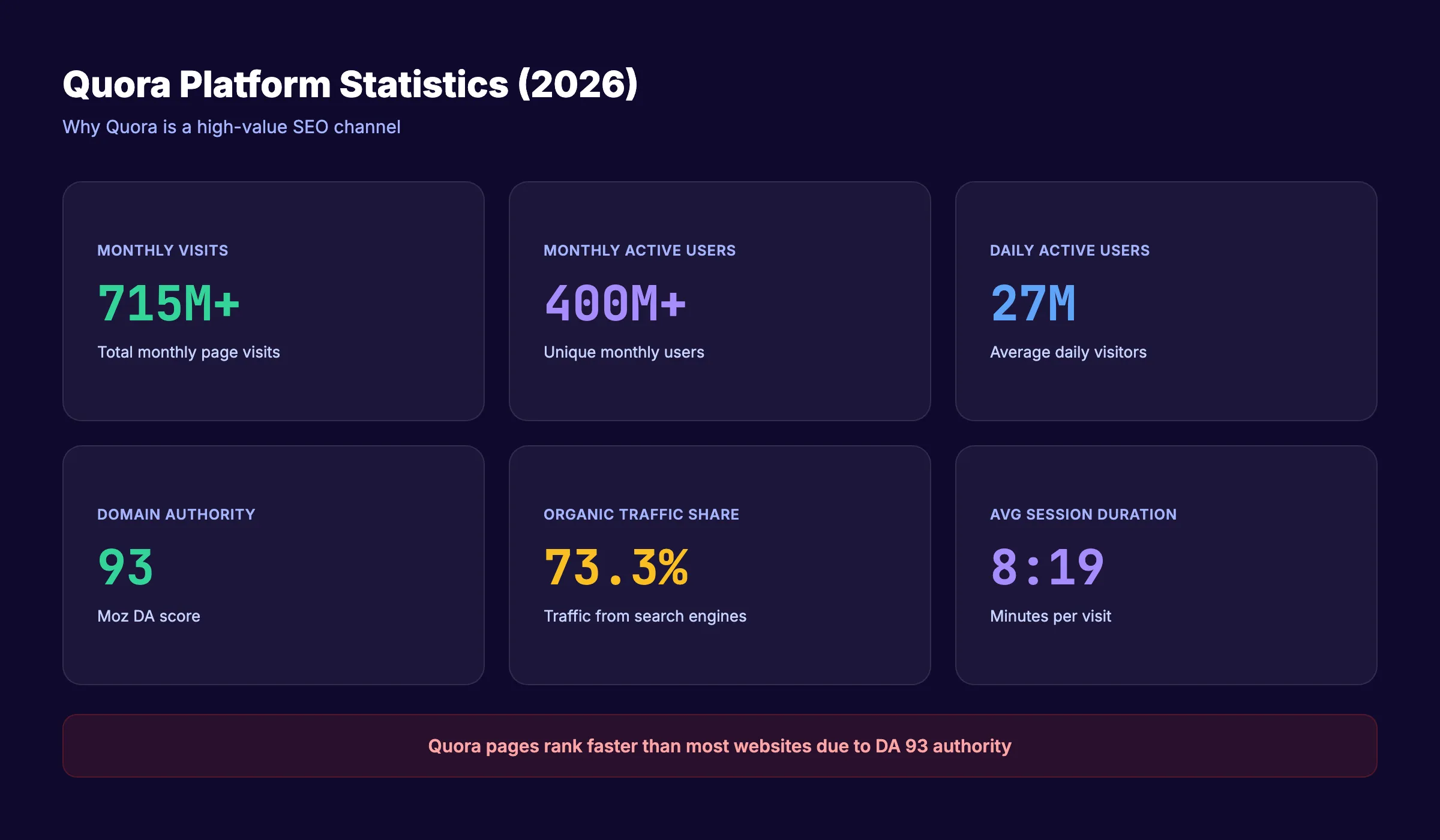
| Metric | Value |
|---|---|
| Monthly visits | 715+ million |
| Monthly active users | 400+ million |
| Daily active users | 27 million |
| Organic search traffic share | 73.29% |
| Domain authority (Moz) | 93 |
| Top traffic country | United States (36.69%) |
| Average session duration | 8 minutes 19 seconds |
Source: Similarweb and DemandSage Quora Statistics 2026.
A domain authority of 93 means Quora pages rank faster and higher than most websites on the internet. When your answer appears on a Quora page that ranks for a keyword, your brand gets visibility without needing your own page to rank.
Three Ways Quora Drives SEO Value
1. Direct SERP visibility. Google shows Quora results for millions of queries. Your answer on a ranking Quora page puts your brand in front of searchers without any link building or content production on your own site.
2. Referral traffic. Users click through from Quora to your website when your answer references a helpful resource. This traffic is highly targeted because the reader already has a specific question.
3. Topical authority signals. Answering dozens of questions in your niche builds a public track record of expertise. Both Google and AI search engines reference this when evaluating brand authority.
Most advice about Quora for SEO focuses exclusively on backlinks. That is the least valuable benefit. The real value is positioning your brand as the answer to questions your customers are already asking.
How to Set Up Your Quora Profile for SEO
Your Quora profile is the first thing people see when they read your answers. An optimized profile converts readers into website visitors. A generic profile gets ignored.
Profile Optimization Checklist
- Real name and professional photo. Anonymous profiles get less engagement and trust. Use the same headshot you use on LinkedIn.
- Keyword-rich bio. Include your expertise area and the topics you cover. Example: “SEO strategist helping local businesses rank on Google. Writing about content marketing, blog SEO, and local search.”
- Website link in profile. Quora allows one website URL in your profile. This link is nofollow but drives direct referral traffic.
- Credential tags. Quora lets you add topic-specific credentials that appear above your answers. Add credentials for every topic you plan to answer in.
- Verified email. Verified accounts rank higher in Quora’s internal algorithm.
Topic Following Strategy
Follow 20 to 30 topics directly related to your business. Quora’s algorithm shows you questions from followed topics in your feed. This makes finding relevant questions easier.
For an SEO-focused business, follow topics like: SEO, Search Engine Optimization, Content Marketing, Local SEO, Blogging, Digital Marketing, Google Search, Small Business Marketing, and Link Building.
Do not follow hundreds of topics. Quality matters more. Quora’s algorithm rewards users who answer consistently within a focused set of topics.
How to Find High-Value Questions to Answer
Not all Quora questions are worth your time. Some have 12 views and no followers. Others have 500,000 views, rank on Google, and receive new answers weekly. Target the second type.
The Question Selection Framework
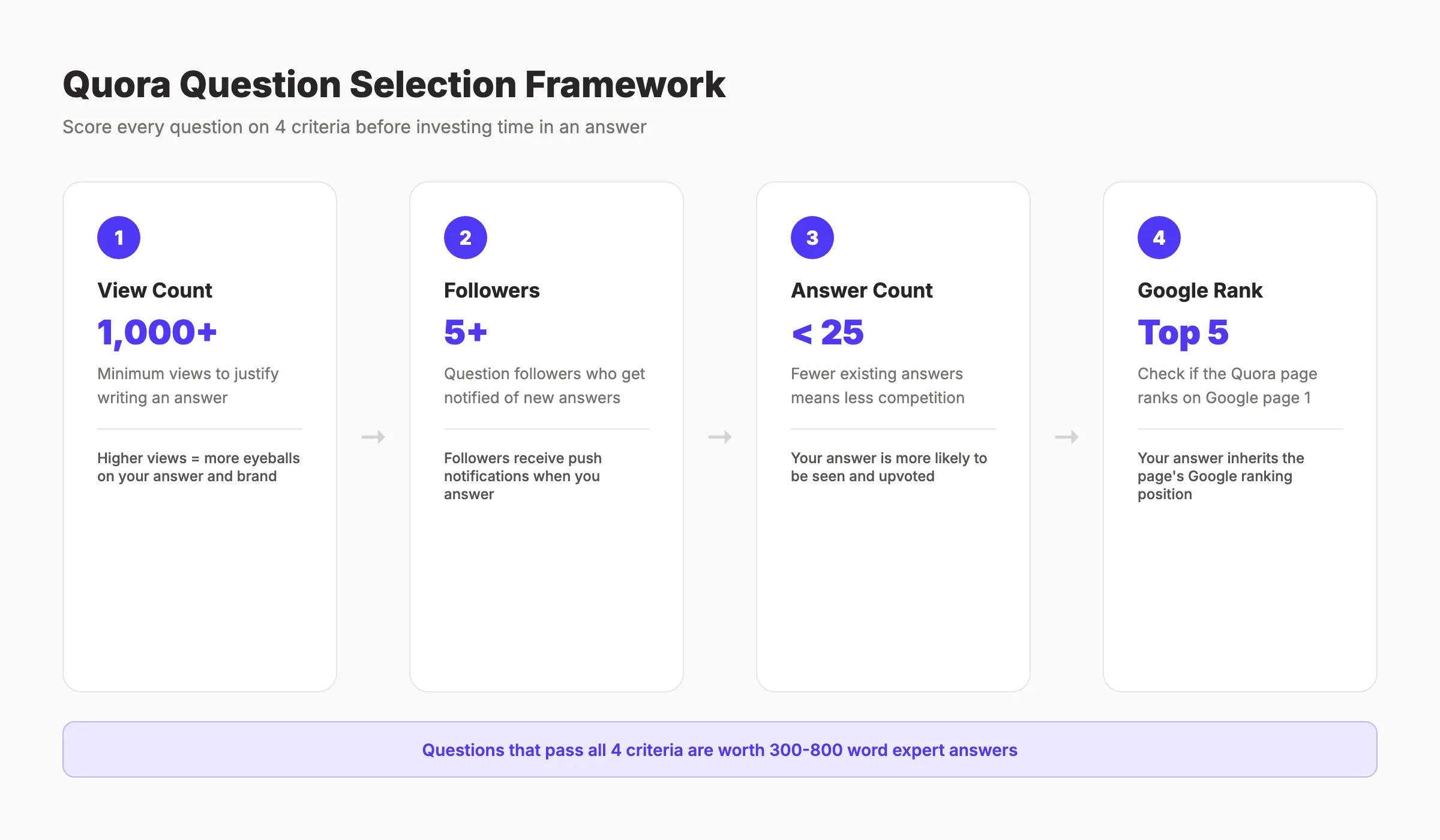
Score every question on these 4 criteria before answering:
| Criteria | What to Look For | Why It Matters |
|---|---|---|
| View count | 1,000+ views minimum | Higher views = more eyeballs on your answer |
| Follower count | 5+ followers | Followers get notified of new answers |
| Answer count | Under 25 answers | Less competition for visibility |
| Google ranking | Question URL ranks on page 1 | Your answer inherits that ranking position |
How to Check if a Question Ranks on Google
Copy the exact question text. Paste it into Google. If the Quora page appears in the top 5 results, that question is gold. Every answer on that page gets organic traffic from Google.
You can also use Google Search Console to see which Quora pages already reference your brand or website.
Finding Questions at Scale
Method 1: Quora search. Type your target keyword into Quora’s search bar. Sort by “most viewed” or “most followed” to find high-traffic questions.
Method 2: Google site search. Search site:quora.com [your keyword] on Google. This shows Quora pages that already rank for your target terms.
Method 3: Competitor analysis. Search for your competitors’ brand names on Quora. Find questions where people ask about them. Answer those questions with a balanced comparison that mentions your brand.
Method 4: Keyword research crossover. Use the same keyword research process you use for blog content. Take your long-tail keywords and check if matching questions exist on Quora. If they do, answer them.
Question Tracking System
Create a spreadsheet with these columns: Question URL, Topic, View Count, Answer Count, Date Answered, Link Included (yes/no), and Monthly Check-In Date. Review monthly to update answers and track which ones drive traffic.
Your SEO team. $99 per month. 30 optimized articles, published automatically. Start for $1 →
How to Write Answers That Rank and Drive Traffic
A Quora answer is not a blog comment. It is a piece of content that can rank on Google, get shared, and drive hundreds of monthly visits. Treat it that way.
The Anatomy of a High-Performing Quora Answer
1. Open with a direct answer. Do not start with “Great question!” or “Well, it depends.” Answer the question in the first 2 sentences. Quora’s algorithm and readers both reward directness.
2. Support with evidence. Add specific numbers, examples, or frameworks. Reference real data. Answers with statistics get 2 to 3x more upvotes than opinion-only responses.
3. Structure with formatting. Use bold text, numbered lists, and headers. Quora supports basic formatting. Structured answers are easier to read and get more engagement.
4. Include a relevant link. One link per answer. Place it mid-answer where it naturally supports a point. Never put links in the first or last sentence. Links that feel organic get clicks. Links that feel promotional get flagged.
5. Close with a takeaway. End with one actionable sentence the reader can apply immediately. This increases saves and shares.
Answer Length Sweet Spot
Short answers (under 100 words) get ignored. Extremely long answers (over 1,500 words) lose readers. The sweet spot is 300 to 800 words. Enough depth to be genuinely helpful. Short enough to hold attention.
For competitive questions with many answers, go longer (800 to 1,200 words) to differentiate from surface-level responses.
What NOT to Do
- Do not paste your blog post into a Quora answer. Quora penalizes duplicate content.
- Do not answer questions outside your expertise. Weak answers hurt your profile authority.
- Do not include more than 1 link per answer. Multiple links look spammy.
- Do not use your company name in every answer. Quora flags overly promotional accounts.
- Do not copy-paste the same answer template across questions. Quora’s algorithm detects patterns.
Optimizing for Google Featured Snippets
Some Quora answers get pulled into Google’s featured snippets. To increase your chances:
- Answer the question in exactly 1 to 2 sentences at the top (paragraph snippet format)
- Use a numbered list for “how to” questions (list snippet format)
- Include a comparison table for “vs” or “best” questions (table snippet format)
The same principles from getting featured snippets on your own site apply to Quora answers.
Quora Link Building: What Works in 2026
Every link from Quora carries a rel="nofollow" tag. Google does not pass PageRank through nofollow links. So why bother?
Because link building is not just about PageRank anymore.
Why Nofollow Quora Links Still Matter
Referral traffic. A well-placed link in a popular Quora answer drives targeted visitors to your site. These visitors already have a question. Your content provides the answer. Conversion rates from Quora referral traffic are often higher than organic search traffic.
Brand signals. Google tracks brand mentions across the web. Your brand appearing on Quora, Reddit, LinkedIn, and industry blogs creates entity signals that reinforce your E-E-A-T profile.
Indexing acceleration. Google crawls Quora frequently because of its high domain authority and fresh content. Links from Quora can help Google discover new pages on your site faster.
AI search citations. Perplexity, ChatGPT, and Google AI Overviews pull from Quora answers. If your Quora answer links to your website, AI systems may follow that reference and cite your content in their responses.
Link Placement Best Practices
| Do | Do Not |
|---|---|
| Link to a specific blog post that expands on your answer | Link to your homepage |
| Place the link mid-answer as a natural “read more” | Place links in the first or last line |
| Use descriptive anchor text (“this guide on local SEO”) | Use generic text (“click here”) |
| Link to genuinely helpful resources (even if not yours) | Only link to your own content |
| Limit to 1 link per answer | Include 3+ links per answer |
Building a Link Ecosystem
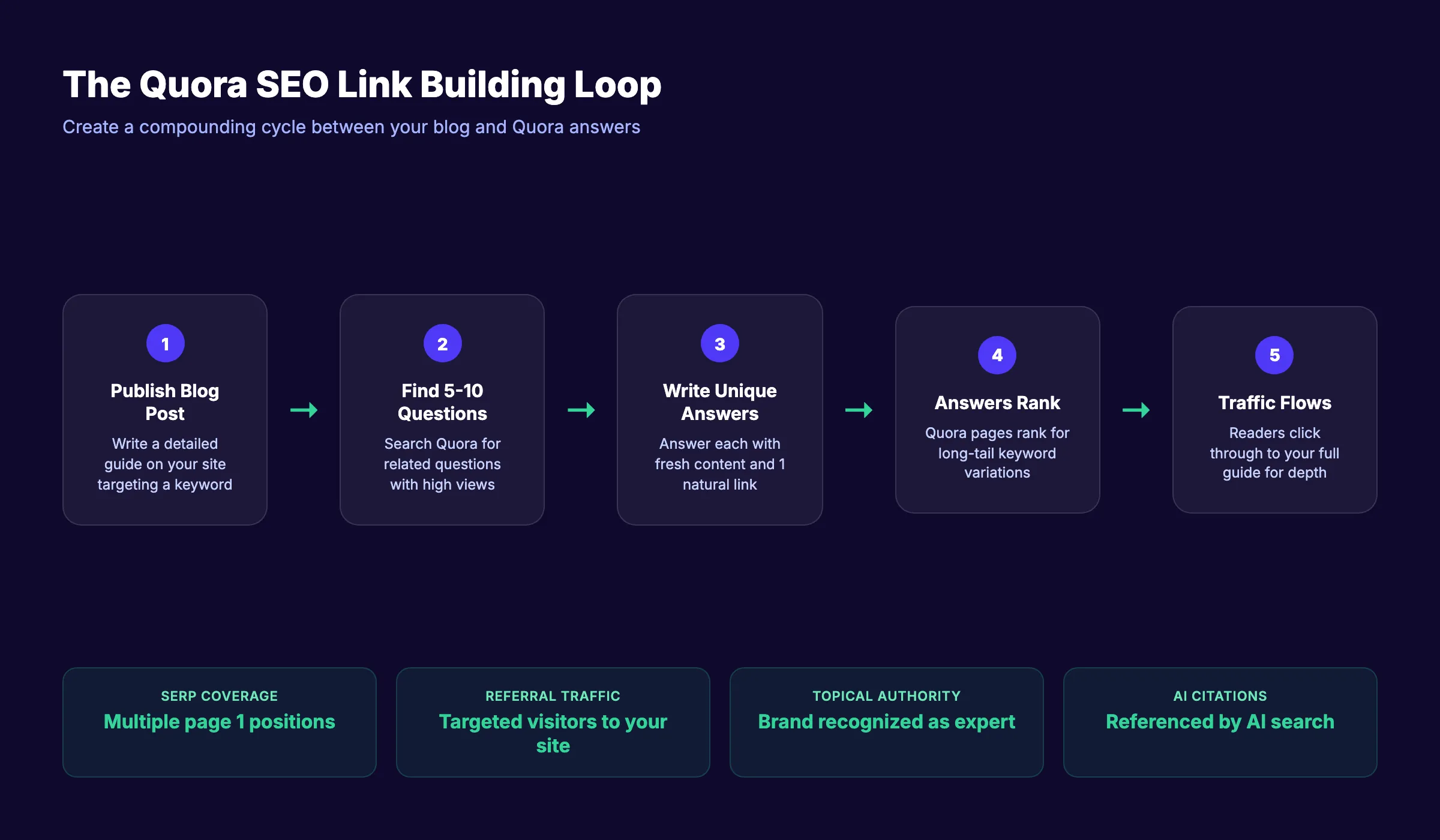
The best Quora SEO strategy creates a loop:
- Publish a detailed blog post on your site (follow our blog SEO guide)
- Find 5 to 10 Quora questions related to that post
- Answer each question with unique, helpful content
- Include a natural link back to your blog post in 3 to 5 of those answers
- The Quora answers rank for long-tail variations of your target keyword
- Readers click through to your full guide for more depth
This approach builds topical authority on Quora while driving qualified traffic to your own content.
3,500+ blogs published. 92% average SEO score. See what Stacc can do for your site. Start for $1 →
Using Quora Spaces for SEO
Quora Spaces are community-driven content hubs. Think of them as topic-specific groups where members share questions, articles, and discussions. They launched in 2018 and have grown significantly.
What Makes Spaces Valuable for SEO
Google indexes Quora Spaces. Space posts appear in search results just like regular Quora answers. But Spaces give you more control over the content format and topic focus.
Content distribution. When you post in a Space, every follower of that Space sees your content. For Spaces with 10,000+ followers, that is instant distribution without any ad spend.
Community building. Running your own Space positions your brand as the hub for a specific topic. This is the Quora equivalent of building an email list.
How to Use Spaces Strategically
Option 1: Answer in existing popular Spaces. Find Spaces related to your niche with 5,000+ followers. Share your answers and relevant content there. This amplifies reach beyond individual questions.
Option 2: Create your own Space. Name it after your primary topic (not your brand). Example: “Local SEO Tips for Small Businesses” instead of “Stacc Blog.” Post consistently (3 to 5 times per week). Invite contributors to keep content flowing.
Option 3: Repurpose blog content. Take key insights from your existing blog posts and share them as Space posts. This is an efficient way to repurpose blog content for social media and discussion platforms simultaneously.
Space Optimization Tips
- Write a keyword-rich Space description (Google indexes this)
- Pin your best-performing posts to the top
- Add relevant topic tags so Quora’s algorithm recommends your Space to interested users
- Cross-promote your Space in relevant Quora answers (“I cover this topic in depth in [Space name]“)
Quora and AI Search: The 2026 Opportunity
This is the angle most Quora SEO guides miss entirely. And it is the biggest opportunity.
Google AI Overviews cite Quora at a 3.6% rate across categories. That number jumps higher in Community, Lifestyle, and Home and Garden topics. Reddit sits at 7.4%. Quora is the second most-cited discussion platform in AI Overviews.
According to a Semrush study on AI citation patterns, Quora citations are strongest in Google AI Overviews specifically. ChatGPT leans toward Wikipedia. Perplexity favors Reddit. But Google AI Overviews is where most search traffic still flows. That is where Quora dominates among discussion platforms.
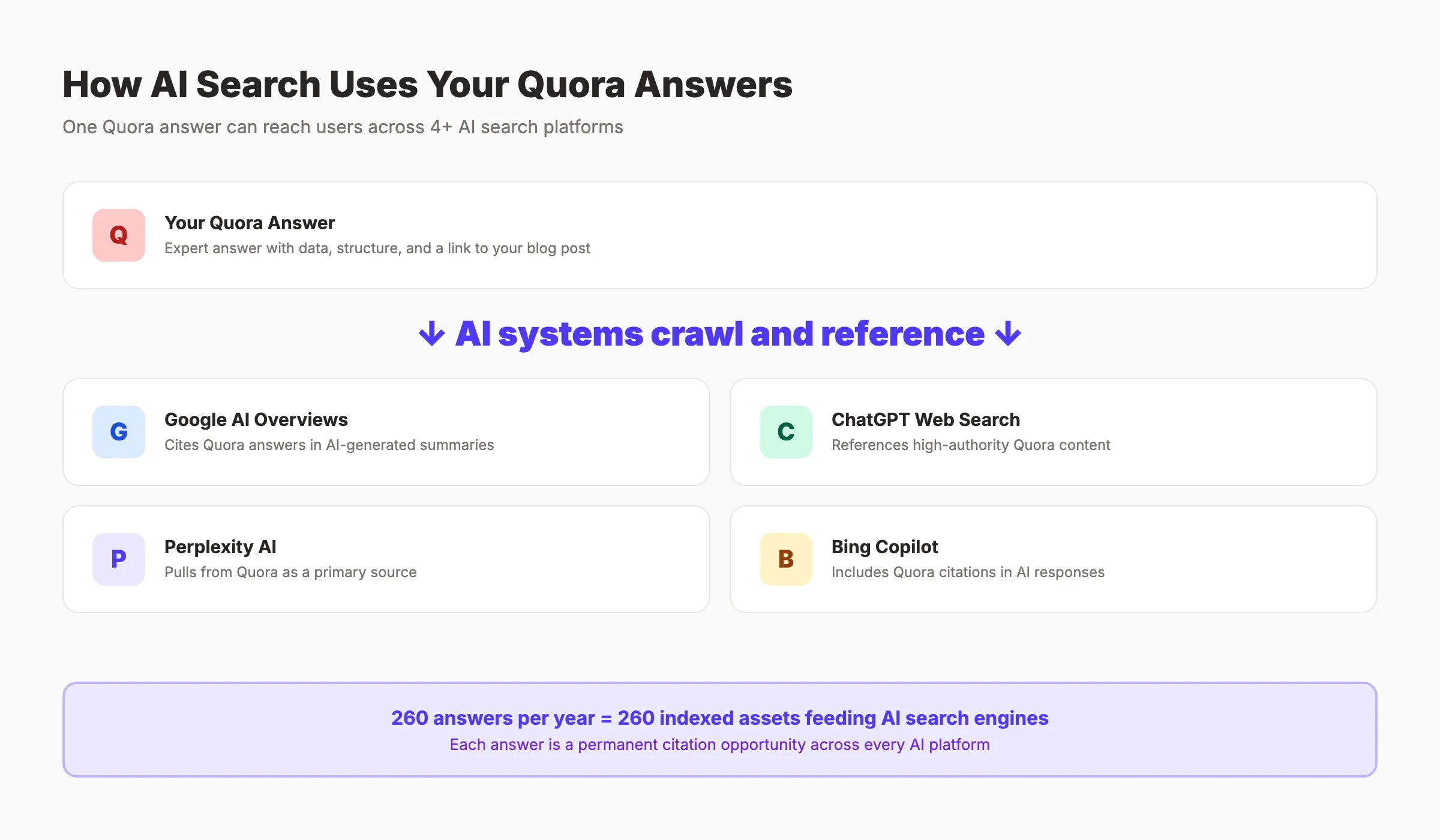
How AI Search Uses Quora Content
When Google generates an AI Overview for a query, it searches for authoritative answers. Quora pages with high engagement and clear, factual responses get cited. If your answer is the top response on a ranking Quora page, Google AI Overviews may reference your content directly.
This makes Quora primarily a Google AI Overviews play. That visibility matters because AI Overviews appear above traditional search results for an increasing number of queries.
How to Optimize Quora Answers for AI Citations
- Answer factually with specific data. AI systems prioritize answers with numbers, statistics, and verifiable claims over opinions.
- Structure answers clearly. Use headers, lists, and short paragraphs. AI systems parse structured content more accurately.
- Include your brand name naturally. When AI systems cite Quora answers, they sometimes attribute the information to the answer author. “According to [Your Name], who works at [Your Company]…” appears in AI responses.
- Link to primary sources. AI systems follow citation chains. If your Quora answer links to your blog post, which links to original research, you create a citation pathway that AI systems can trace.
Read our complete guide on getting cited by AI search engines for more on this strategy.
The Compounding Effect
Every Quora answer you write creates a permanent piece of indexed content. That content can:
- Rank on Google for years
- Drive referral traffic monthly
- Get cited by AI search engines
- Build your brand’s entity profile
- Attract followers to your Quora profile and Spaces
One well-crafted answer per day, 5 days per week, produces 260 indexed pieces of content per year. At zero cost. That is 260 opportunities to rank, drive traffic, and build authority.
How to Measure Your Quora SEO Results
Quora does not provide detailed analytics for free accounts. But you can measure results through your own website analytics and some Quora-specific metrics.
Metrics to Track
| Metric | Where to Find It | What It Tells You |
|---|---|---|
| Quora referral traffic | Google Analytics (Acquisition > Traffic) | How many visitors Quora sends |
| Quora answer views | Your Quora profile stats page | Total eyeballs on your content |
| Upvotes per answer | Individual answer pages | Content quality signal |
| Answer rank position | Scroll position on the question page | Visibility within Quora |
| Google rankings for Quora pages | Search Console or Ahrefs | Whether your answered questions rank |
| AI citations | Track brand mentions in AI responses | Whether AI systems reference your answers |
Setting Up Tracking
Step 1. Add UTM parameters to links in your Quora answers. Use ?utm_source=quora&utm_medium=answer&utm_campaign=[question-topic] so you can track which answers drive the most traffic.
Step 2. Create a Quora segment in Google Analytics. Filter by source = “quora.com” to isolate Quora-driven sessions, conversions, and revenue.
Step 3. Review your Quora profile stats weekly. Track total answer views, upvotes, and shares. Look for patterns in which topics and answer formats perform best.
Step 4. Monitor search intent overlap. Check if the Quora questions you answer also appear in your target keyword list. If they do, you are building authority in the right topics.
Monthly Quora SEO Audit
Run this checklist monthly:
- Answer 15 to 20 new questions (aim for 1 per business day)
- Update your top 5 performing answers with fresh data
- Check referral traffic from Quora in Google Analytics
- Verify links in answers still point to live pages
- Review Quora profile stats for view and upvote trends
- Search Google for your target keywords + “site:quora.com” to find new opportunities
- Post 3 to 5 times in relevant Quora Spaces
Rank everywhere. Do nothing. Blog SEO, Local SEO, and Social on autopilot. Start for $1 →
FAQ
Does Quora help with SEO?
Yes. Quora helps SEO in 3 ways: referral traffic from answers that link to your site, SERP visibility when Quora pages rank for your target keywords, and brand authority signals that strengthen your E-E-A-T profile. The links are nofollow, so they do not directly pass PageRank. But the indirect SEO benefits are significant.
Are Quora backlinks dofollow or nofollow?
All links on Quora carry a rel="nofollow" attribute. Google does not count them as direct ranking signals. However, nofollow links still drive referral traffic, help Google discover new pages, and create brand mentions that contribute to entity authority.
How many Quora answers should I write per week?
Aim for 5 to 7 answers per week (1 per business day). Consistency matters more than volume. Focus on quality answers in your niche rather than spreading across unrelated topics. At this pace, you will have 260+ indexed answers within a year.
Can Quora answers rank on Google?
Yes. Quora has a domain authority of 93. Many Quora pages rank on page 1 for long-tail queries. Google’s recent algorithm updates have increased the visibility of forum and discussion content in search results. Your answer on a ranking Quora page gets organic traffic from Google without any work on your own site.
Is Quora better than Reddit for SEO?
Both platforms offer SEO value, but they serve different purposes. Quora is better for long-form expert answers and building topical authority. Reddit is better for community engagement and trending discussions. For SEO specifically, Quora has a higher domain authority and more structured content that Google ranks consistently.
How do I avoid getting banned on Quora?
Follow 3 rules: never include more than 1 link per answer, never paste the same answer across multiple questions, and always provide genuine value before mentioning your brand. Quora’s moderation team flags accounts that post promotional content without adding substance. Focus on being helpful first. The marketing results follow.
Start Building Your Quora SEO Strategy Today
Quora is one of the few platforms where a single answer can rank on Google, drive referral traffic, and get cited by AI search engines simultaneously. The cost is zero dollars. The investment is your expertise and 30 minutes per day.
The businesses winning on Quora in 2026 treat it as a core part of their content marketing strategy. They show up consistently, write answers that genuinely help people, and build authority one question at a time.
Your competitors are probably not doing this. That is your advantage.
Related Tools & Resources
Free SEO Tools:
Best Lists:

Written by
Siddharth GangalSiddharth is the founder of theStacc and Arka360, and a graduate of IIT Mandi. He spent years watching great businesses lose organic traffic to competitors who simply published more. So he built a system to fix that. He writes about SEO, content at scale, and the tactics that actually move rankings.
30 SEO blog articles published every month
Keyword-optimized, scheduled, and live on your site. Automatically.
30-day trial · Cancel anytime
theStacc
Stop writing SEO content manually
30 blog articles, 30 GBP posts, and social media content. Published every month. Automatically.
Start Your $1 Trial$1 for 3 days · Cancel anytime