
Structured Data for AI Search (2026): Guide
structured data ai search guide for 2026: strategies, tactics, real examples, and implementation steps to get results faster.
You add schema markup to your pages. Google ignores it in AI Overviews. ChatGPT never cites you. Traffic keeps dropping.
That is the reality for 67% of websites that still treat structured data as a rich-snippet checkbox. In 2026, structured data ai search optimization is not about star ratings in SERPs. It is about teaching AI systems who you are, what you know, and why they should cite you.
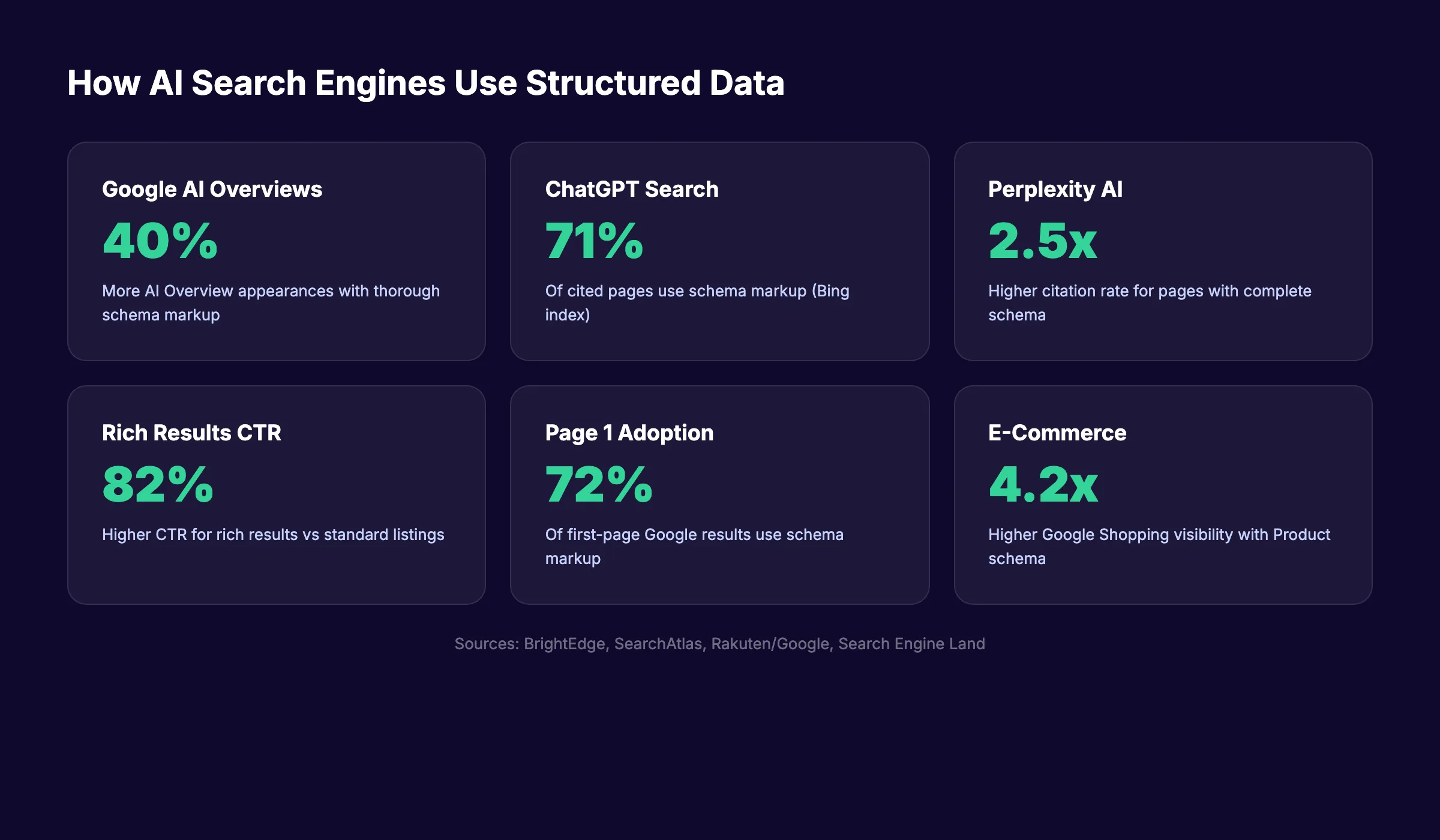
Pages with complete schema markup are 2.5x more likely to appear in AI-generated answers. Sites with thorough structured data see up to 40% more AI Overview appearances. These are not small gains.
We publish 3,500+ blog posts across 70+ industries and track every AI citation pattern. This guide covers everything we know about making structured data work for AI search.
Here is what you will learn:
- How AI search engines read and use structured data differently from traditional crawlers
- The 8 schema types that drive the most AI visibility in 2026
- A step-by-step implementation process for JSON-LD markup
- The 6 mistakes that block your content from AI citations
- How to measure structured data impact on AI search performance
Table of Contents
- What Structured Data Means for AI Search
- How AI Search Engines Use Structured Data
- The 8 Schema Types That Drive AI Visibility
- How to Implement Structured Data for AI Search Optimization
- 6 Structured Data Mistakes That Block AI Citations
- How to Measure Structured Data Impact on AI Citations
- What Comes Next for Structured Data and AI
- FAQ
What Structured Data Means for AI Search {#ch1}
Structured data is code you add to your HTML that labels your content for machines. It uses the Schema.org vocabulary to define entities like articles, products, people, and organizations. The format Google prefers is JSON-LD.
Traditional search engines used structured data mainly for rich results. Star ratings, FAQ dropdowns, recipe cards. That was useful but limited.
AI search engines use structured data for something fundamentally different. They use it to understand context.
Context Now Outranks Content
A 2026 study by BrightEdge found that schema markup improved brand presence and citation rates in Google AI Overviews. Pages with thorough markup got cited more often than pages without it. Even when the raw content quality was similar.
The reason is straightforward. Large language models process millions of pages. Semantic search means they need to understand relationships between entities, not just match keywords. Structured data provides those relationships explicitly.
Think of it this way. Your article says “John Smith is the CEO of Acme Corp.” A human reads that and understands the relationship. An LLM can parse it, but structured data with Person and Organization schema makes the relationship machine-readable in milliseconds.
From Rich Snippets to Entity Identity
The old structured data guide focused on triggering visual enhancements in search results. That still matters. Pages with schema achieve 20-40% higher click-through rates.
But the bigger opportunity in 2026 is entity identity. When you mark up your Organization, your authors (Person schema), and your content (Article schema), you build a machine-readable identity. AI systems use that identity to decide whether to cite you, quote you, or recommend you.
Read our full schema markup SEO guide for the traditional SEO benefits. This guide focuses specifically on the AI search angle.
How AI Search Engines Use Structured Data {#ch2}
Not every AI search engine processes structured data the same way. Here is how each major platform handles it.
Google AI Overviews
Google AI Overviews pull from indexed pages and the Knowledge Graph. Structured data feeds directly into both. A controlled experiment by Search Engine Land found that only the page with well-implemented schema appeared in an AI Overview. The page with poor schema ranked but never appeared. The page with no schema was not even indexed.
Google confirmed in April 2025 that structured data gives an advantage in search results. For AI Overviews specifically, FAQ schema and Article schema have the strongest correlation with citations. Our AI overview optimization guide covers the full process.
ChatGPT Search
ChatGPT uses Bing’s index to find and cite web sources. A study found that 71% of pages cited by ChatGPT use schema markup. ChatGPT favors pages with clear authorship signals (Person schema), publication dates, and organizational identity.
If ChatGPT can verify who wrote a piece, when it was published, and what organization backs it, it is far more likely to cite that page. Our AI search statistics post tracks the latest citation rate data.
Perplexity AI
Perplexity is a Q&A engine that cites web sources inline. It processes structured data to identify specific answers quickly. FAQ schema and HowTo schema give Perplexity clear answer candidates it can extract and attribute.
Claude and Grok
Claude (Anthropic) and Grok (xAI) both introduced web search capabilities. Both prefer authoritative, well-annotated content. Our guides on Claude search optimization and Grok search SEO cover platform-specific tactics.
The pattern across all AI search engines is the same: structured data reduces ambiguity, and AI systems reward clarity.
| AI Search Engine | Primary Index | Schema Impact | Key Schema Types |
|---|---|---|---|
| Google AI Overviews | Google Index + Knowledge Graph | High. Confirmed advantage | Article, FAQ, Organization |
| ChatGPT Search | Bing Index | High , 71% of cited pages use schema | Person, Article, Organization |
| Perplexity AI | Multi-source crawling | Medium-High. Aids answer extraction | FAQ, HowTo, Product |
| Claude Search | Web search | Medium. Prefers annotated content | Article, Person, Organization |
| Grok Search | X + web sources | Medium. Early adoption phase | Article, Organization |
Your content competes in 5+ AI search engines now. Structured data is the common language all of them understand. Start for $1 →
The 8 Schema Types That Drive AI Visibility {#ch3}
Not all schema types matter equally for AI search. Based on citation patterns across Google AI Overviews, ChatGPT, and Perplexity, these 8 types deliver the most impact.
1. Article Schema
Article schema tells AI systems exactly what your content is: the headline, author, publication date, publisher, and topic. Every blog post and guide should have it.
Required properties: headline, author, datePublished, dateModified, publisher, image.
The dateModified field is especially important for AI. Language models weight recency heavily. A page modified in 2026 will outrank identical content last updated in 2024.
2. Organization Schema
Organization schema defines your brand entity. It connects your name, logo, social profiles, and contact information into a single identity node. AI systems use this to verify whether a source is a real business or an anonymous blog.
Mark up your Organization on your homepage and About page. Use the same @id across your entire site so AI systems understand it is one entity.
3. Person Schema (Author Markup)
Author expertise is a ranking signal for both traditional and AI search. Person schema connects an author to their credentials, employer, social profiles, and published works.
Google uses author markup to evaluate E-E-A-T signals. ChatGPT uses it to decide whether to cite a source. If your authors are anonymous, you lose both.
4. FAQ Schema
FAQ schema gives AI engines pre-formatted question-answer pairs. Perplexity and Google AI Overviews both pull directly from FAQ markup to generate answers.
Place FAQ schema on pages where you answer common questions. Limit it to 4-6 genuine questions per page. Google penalizes FAQ spam.
5. HowTo Schema
HowTo schema breaks processes into numbered steps with descriptions, images, and time estimates. AI search engines love step-by-step formats because they translate directly into actionable answers.
Use HowTo schema on tutorial and guide content. Each step needs a name and text property at minimum.
6. Product Schema
Product schema covers price, availability, ratings, and reviews. E-commerce sites that implement Product schema see 4.2x higher Google Shopping visibility. AI shopping assistants (Google Shopping AI, ChatGPT product recommendations) rely on this data.
7. LocalBusiness Schema
For service businesses, LocalBusiness schema ties your business to a physical location, service area, hours, and reviews. This feeds Google Maps, AI Overviews for local queries, and voice search assistants.
8. WebPage and BreadcrumbList Schema
WebPage schema defines your page type and position within your site hierarchy. BreadcrumbList shows the navigation path. Together, they help AI systems understand your site structure and find the most authoritative page for a given topic.
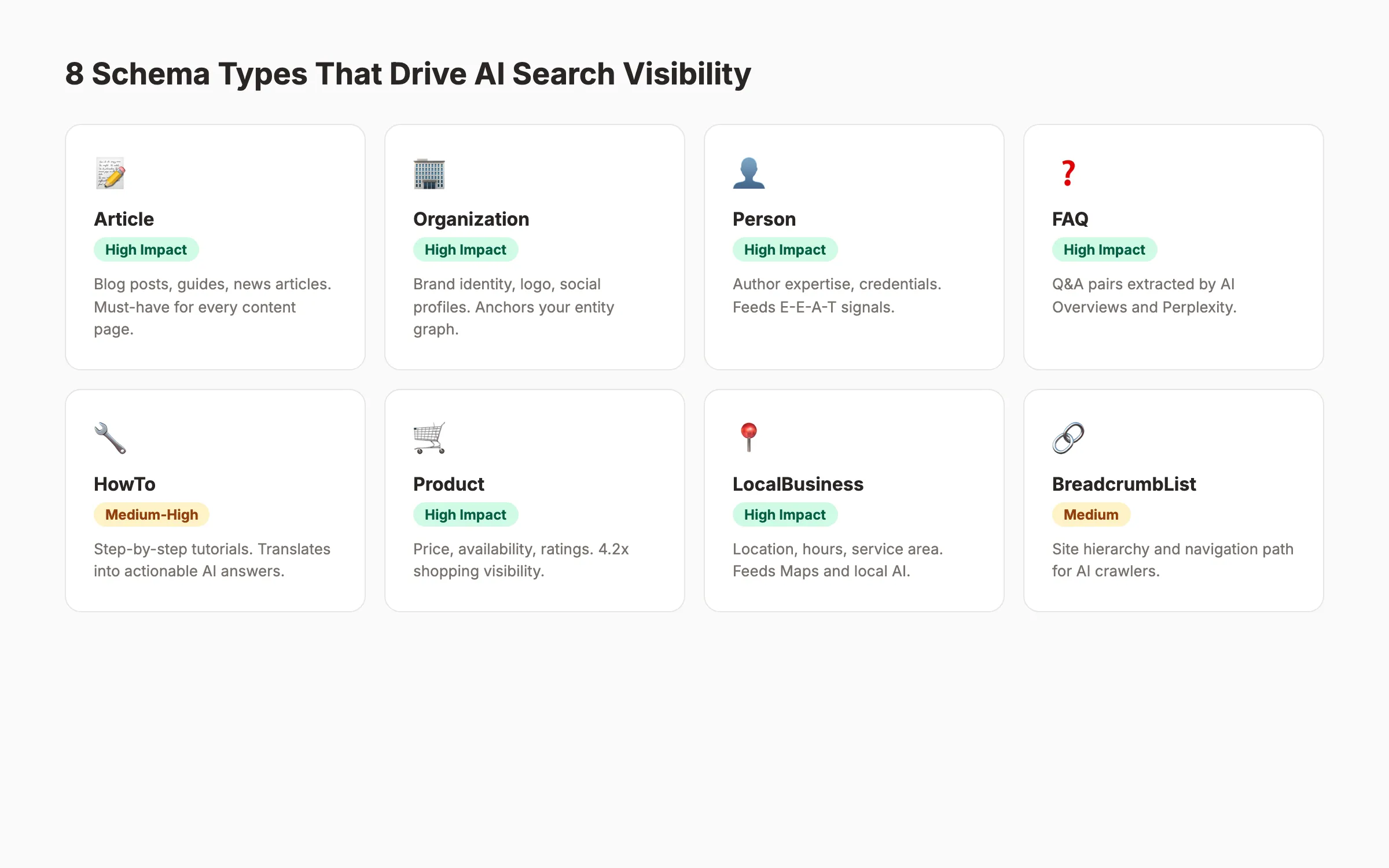
| Schema Type | AI Impact Level | Best For | Priority |
|---|---|---|---|
| Article | High | Blog posts, guides, news | Must-have |
| Organization | High | Homepage, About page | Must-have |
| Person | High | Author pages, bios | Must-have |
| FAQ | High | Resource pages, guides | Must-have |
| HowTo | Medium-High | Tutorials, how-to posts | Recommended |
| Product | High | E-commerce, SaaS pricing | Recommended |
| LocalBusiness | High | Service businesses | Recommended |
| BreadcrumbList | Medium | All pages | Recommended |
How to Implement Structured Data for AI Search Optimization {#ch4}
Knowing which schema types matter is step one. Implementation is where most sites fail. Here is the process that works.
Step 1: Map Your Entities
Before writing a single line of JSON-LD, map every entity your site represents. An entity is anything with a unique identity: your organization, your authors, your products, your services, your locations.
Create a spreadsheet with columns for entity name, type (Organization, Person, Product), home page URL, and key properties. This becomes your entity blueprint.
Step 2: Create Entity Home Pages
Each entity needs a “home” page. The single URL that defines it. Your Organization entity lives on your homepage or About page. Each author entity lives on their bio page. Each product lives on its product page.
Mark the entity home page with the most complete schema. Other pages reference this entity using @id.
Step 3: Write JSON-LD Markup
JSON-LD is the only format you should use. Google, Bing, Perplexity, and ChatGPT all prefer it. Place JSON-LD in a <script type="application/ld+json"> tag in your page’s <head> section.
Here is a minimal Article schema example:
{
  "@context": "https://schema.org",
  "@type": "Article",
  "headline": "Your Article Title",
  "author": {
    "@type": "Person",
    "@id": "https://yoursite.com/about/author-name",
    "name": "Author Name"
  },
  "datePublished": "2026-04-04",
  "dateModified": "2026-04-04",
  "publisher": {
    "@type": "Organization",
    "@id": "https://yoursite.com/#organization",
    "name": "Your Company"
  }
}
Use our free schema markup generator to build JSON-LD without coding.
Step 4: Connect Entities With @id and @graph
The real power of structured data for AI is not individual schema blocks. It is the connections between them. Use @id to create persistent entity identifiers. Use @graph to define multiple connected entities in a single JSON-LD block.
When your Article schema links to your Organization schema via @id, AI systems understand the relationship. When your Person schema links to the same Organization, the entity graph grows stronger.
This is what Schema App CEO Martha van Berkel calls a “content knowledge graph.” It makes your entire site machine-readable, not just individual pages.
Step 5: Validate and Test
Use Google’s Rich Results Test and the Schema Markup Validator to check your markup. Fix every error and warning before publishing.
Test with multiple tools. Google’s test catches syntax errors. The Schema.org validator catches vocabulary mistakes. Manual review catches logic errors like incorrect @id references.
Follow our GEO checklist to verify your structured data works for AI search specifically. Also review your internal linking strategy to reinforce entity connections across pages.
Step 6: Serve Schema in Initial HTML
AI crawlers and search engine bots read your initial HTML response. If your schema loads through client-side JavaScript, some crawlers will miss it entirely. Render JSON-LD server-side or include it directly in your HTML template.
This is especially important for sites built with React, Vue, or similar frameworks. Check our JavaScript SEO guide for rendering best practices.
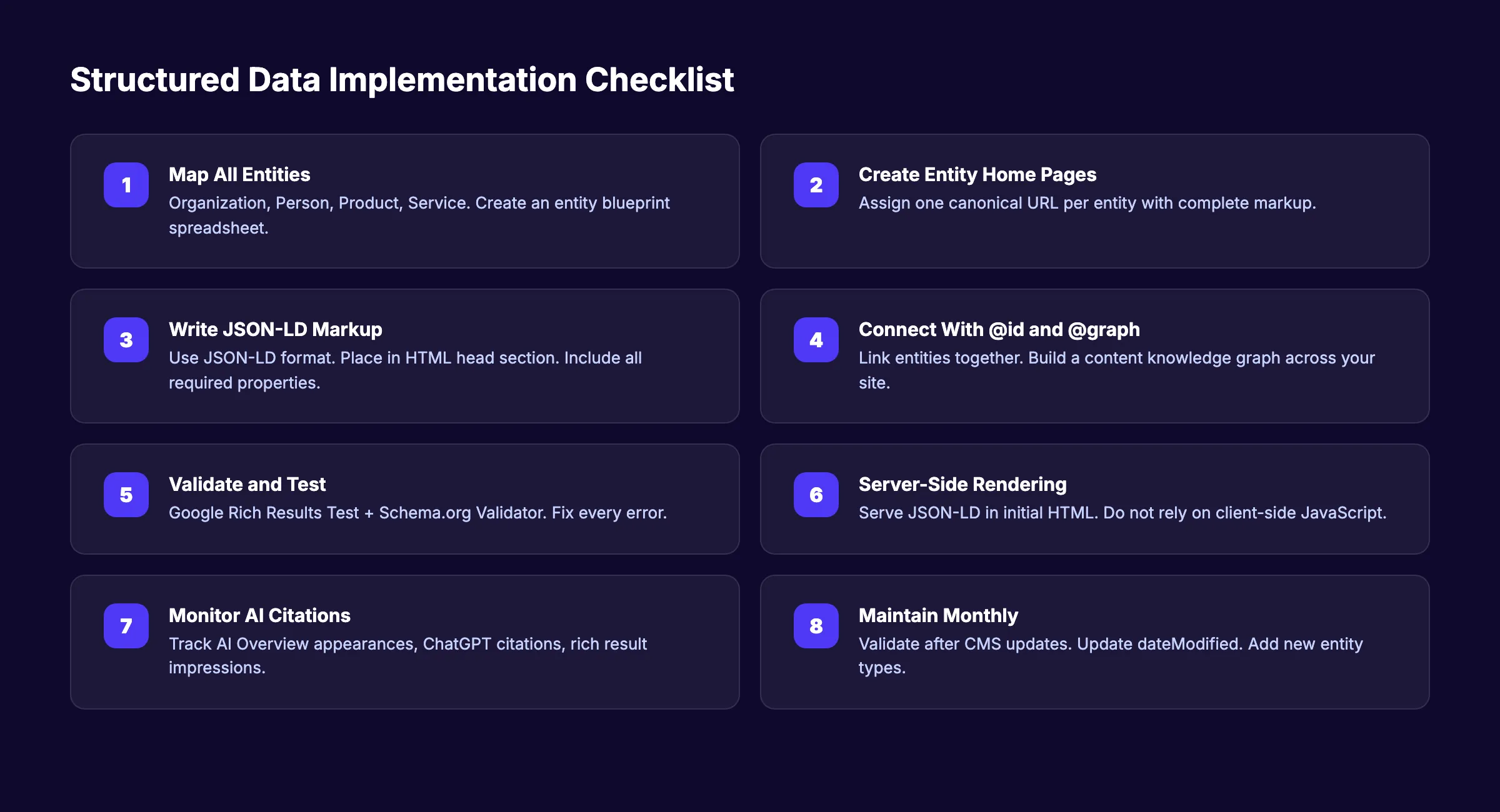
- Map all entities (Organization, Person, Product, Service)
- Assign entity home pages with complete markup
- Write JSON-LD for every page type
- Connect entities using @id references
- Validate with Google Rich Results Test
- Validate with Schema.org Validator
- Confirm server-side rendering of JSON-LD
- Test AI search visibility after 2-4 weeks
Structured data done right is a full-time job. We handle schema, content, and publishing for 30+ articles per month starting at $99. Start for $1 →
6 Structured Data Mistakes That Block AI Citations {#ch5}
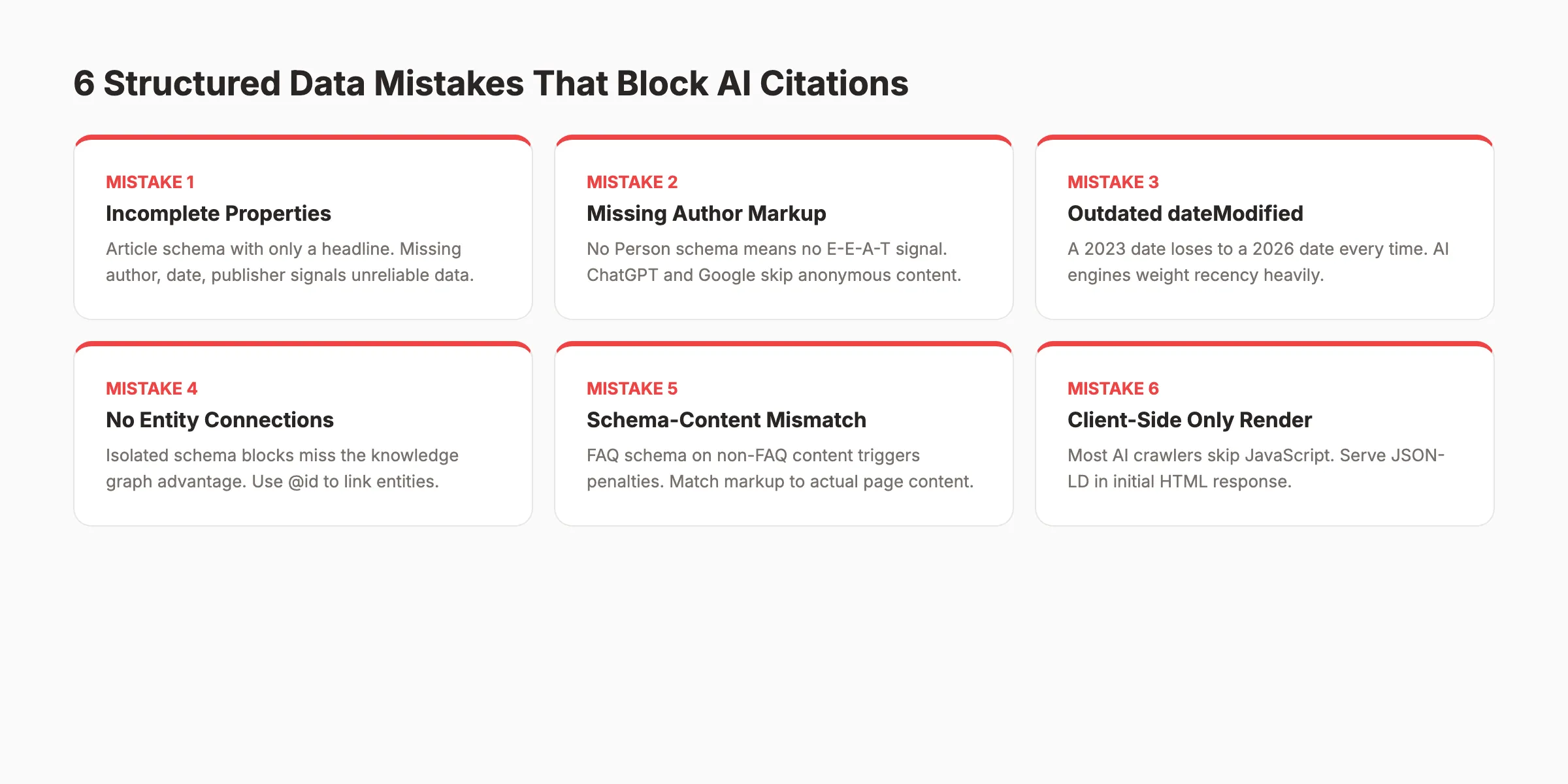
Schema markup is easy to get wrong. These are the 6 mistakes we see most often on sites that fail to earn AI citations.
Mistake 1: Incomplete Schema Properties
Adding Article schema with only a headline property is worse than useless. It signals to AI systems that your structured data is unreliable. Always include all required and recommended properties.
A December 2024 study from SearchAtlas found that sites with incomplete schema did not outperform sites with no schema at all. Half-done markup is not a shortcut.
Mistake 2: Missing Author Markup
Anonymous content is a trust problem. Google uses author signals for E-E-A-T evaluation. ChatGPT checks author identity before citing a source. If your Person schema is missing or incomplete, AI systems may skip your content entirely.
Mistake 3: Outdated dateModified Values
AI engines weight recency. A page with dateModified: 2023-06-15 loses to a page with dateModified: 2026-04-01. Even if the 2023 page has better content. Update your dateModified whenever you make meaningful edits.
Mistake 4: No Entity Connections
Individual schema blocks that do not reference each other waste most of their potential. Without @id connections, AI systems see isolated data points instead of a knowledge graph.
Mistake 5: Schema That Mismatches Content
Marking a blog post as a Product, or adding FAQ schema for content that is not actually a FAQ, violates Google’s structured data guidelines. Google may issue manual penalties. AI systems may flag your entire site as unreliable.
Mistake 6: Client-Side-Only Rendering
Loading JSON-LD through JavaScript frameworks without server-side rendering means many AI crawlers never see your markup. Googlebot renders JavaScript, but most AI crawlers do not. Optimize the first 200 words of your HTML response and ensure schema appears there too.
How to Measure Structured Data Impact on AI Citations {#ch6}
You cannot improve what you do not measure. Here is how to track whether your structured data is working for AI search.
Track Rich Results in Google Search Console
Google Search Console reports which pages trigger rich results and how their CTR compares to standard listings. A jump in rich results after adding schema confirms your markup is valid and indexed.
72% of first-page Google results now use schema markup. If your pages do not show rich results, your competitors likely do.
Monitor AI Search Citations
Tools like BrightEdge, Otterly, and Peec AI track whether your pages appear in AI Overviews, ChatGPT responses, and Perplexity answers. Set up tracking for your target keywords and monitor citation frequency.
Our guide on getting cited by AI search engines covers the full tracking process.
Compare Before and After Data
Run a baseline measurement before implementing schema changes. Track these metrics for 4-8 weeks after:
| Metric | Where to Track | Target Change |
|---|---|---|
| Rich result impressions | Google Search Console | +20-40% |
| Click-through rate | Google Search Console | +15-30% |
| AI Overview appearances | BrightEdge / Otterly | +25-40% |
| ChatGPT citations | Peec AI / manual search | Any increase |
| Organic traffic from AI referrals | Google Analytics 4 | +10-20% |
Use the Schema Markup Validator Regularly
Schema breaks silently. A CMS update, template change, or content edit can corrupt your JSON-LD without any visible error. Schedule monthly validation checks using the Schema.org Validator.
AI search traffic is growing 300% year over year. Make sure your structured data captures it. Start for $1 →
What Comes Next for Structured Data and AI {#ch7}
Structured data is evolving fast. Here is what matters for the next 12 months.
Model Context Protocol (MCP)
Anthropic, OpenAI, and Google DeepMind all endorsed the Model Context Protocol. A standard for how applications provide context to language models. MCP has been called “the USB-C connector for AI applications.” It standardizes how AI systems read and use external data, including structured data.
As MCP adoption grows, sites with clean entity graphs will have a direct pipeline into AI systems. Sites without structured data will be invisible.
New Schema.org Types
Schema.org releases new vocabulary types regularly. AI-specific types are on the roadmap. Watch for types that define content provenance, factual accuracy signals, and AI licensing permissions.
The Knowledge Graph Advantage Compounds
Every page you add with connected schema markup strengthens your site’s knowledge graph. This is the Content Compound Effect in action. Three months of consistent schema implementation builds an entity graph that AI systems recognize and trust.
The answer economy rewards sites that speak the language of machines. Structured data is that language.
FAQ {#faq}
Does structured data guarantee my content will appear in AI Overviews?
No. Structured data does not guarantee placement in any AI search result. It provides the foundation that helps AI systems understand, verify, and cite your content. Think of it as a strong signal, not a switch. Pages with schema are 2.5x more likely to appear, but content quality, authority, and relevance still matter.
Which structured data format should I use for AI search?
JSON-LD. Every major AI search engine. Google, Bing, Perplexity, ChatGPT. Processes JSON-LD. Google explicitly recommends it. Place JSON-LD in a <script> tag in your HTML <head> section and render it server-side.
How many schema types should I add to one page?
Add every type that accurately describes your content. A blog post should have Article, Person (author), Organization (publisher), and BreadcrumbList at minimum. Add FAQ schema if you have question-answer content. Add HowTo schema for step-by-step guides. Do not add types that do not match your content.
Do I need structured data if I already rank well in traditional search?
Yes. Traditional rankings and AI search visibility are separate systems. A page can rank position 1 in Google organic results and never appear in AI Overviews. Structured data bridges that gap by making your content machine-readable for both systems.
How long does it take for structured data changes to affect AI search visibility?
Most sites see changes within 2-4 weeks after Google recrawls the updated pages. AI Overview appearances may shift faster because Google’s AI systems reprocess content frequently. ChatGPT and Perplexity may take longer because they rely on Bing’s index, which has its own crawl schedule.
Structured data is no longer optional for AI search visibility. The sites that build complete entity graphs, use JSON-LD correctly, and keep their schema updated will earn the citations that drive traffic in 2026 and beyond.
Start with Article, Organization, and Person schema on every page. Add FAQ and HowTo where they fit. Connect everything with @id. Then measure the results.
We handle structured data, content publishing, and SEO for 70+ industries. 30 articles per month. $99. Start for $1 →
Related Tools & Resources
Free SEO Tools:
Best Lists:

Written by
Siddharth GangalSiddharth is the founder of theStacc and Arka360, and a graduate of IIT Mandi. He spent years watching great businesses lose organic traffic to competitors who simply published more. So he built a system to fix that. He writes about SEO, content at scale, and the tactics that actually move rankings.
30 SEO blog articles published every month
Keyword-optimized, scheduled, and live on your site. Automatically.
30-day trial · Cancel anytime
theStacc
Stop writing SEO content manually
30 blog articles, 30 GBP posts, and social media content. Published every month. Automatically.
Try for free$1 for 3 days · Cancel anytime