Thought leadership content that wins business in 2026. Formats, frameworks, distribution, and measurement — with examples from teams doing it right.
Most companies confuse publishing with thought leadership. They post a "5 trends to watch" article every quarter, share it on LinkedIn, and call it a strategy. Six months later they wonder why nobody quotes them, links to them, or remembers what they said.
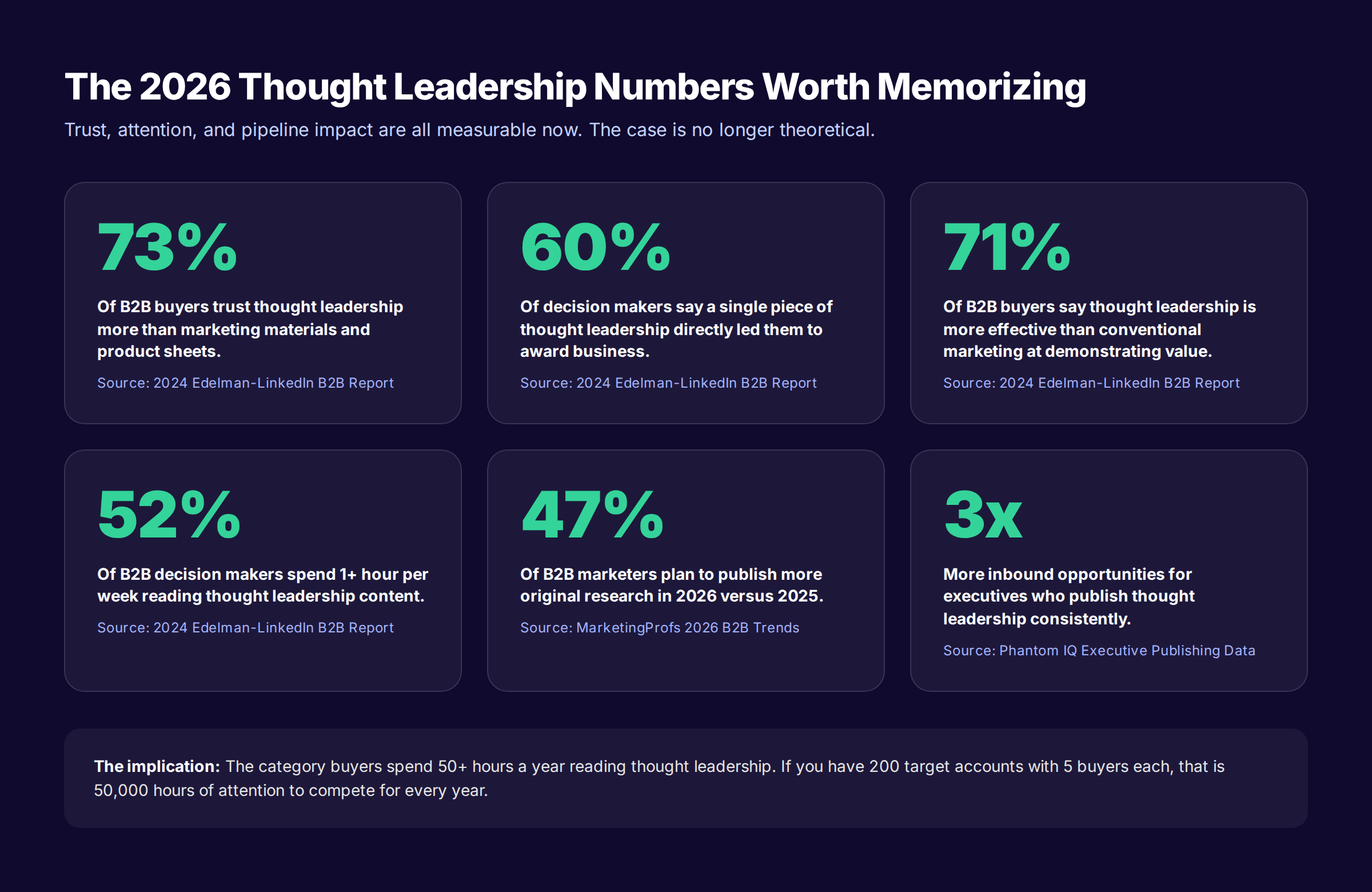
Thought leadership content is the small slice of content that changes how someone thinks. It is the post that gets forwarded inside a buying committee. It is the report that a competitor cites in a sales deck. It is the keynote idea that an analyst pulls into a research note. According to the 2024 Edelman-LinkedIn B2B Thought Leadership Impact Report, 73% of buyers trust an organization's thought leadership more than its marketing materials, and 60% say a single piece of thought leadership has directly led them to award a contract.
We publish 3,500+ articles across 70+ industries every month. We have watched what separates a post that disappears from one that pulls in inbound for 3 years. This guide is the system we use.
Here is what you will learn:
- The working definition of thought leadership content that survives 2026
- The 8 formats that actually earn citations and pipeline
- The 5-part framework for writing a single piece of thought leadership
- Distribution channels ranked by return on time
- Measurement: vanity metrics versus real signals
- How to scale thought leadership without losing the voice that makes it work
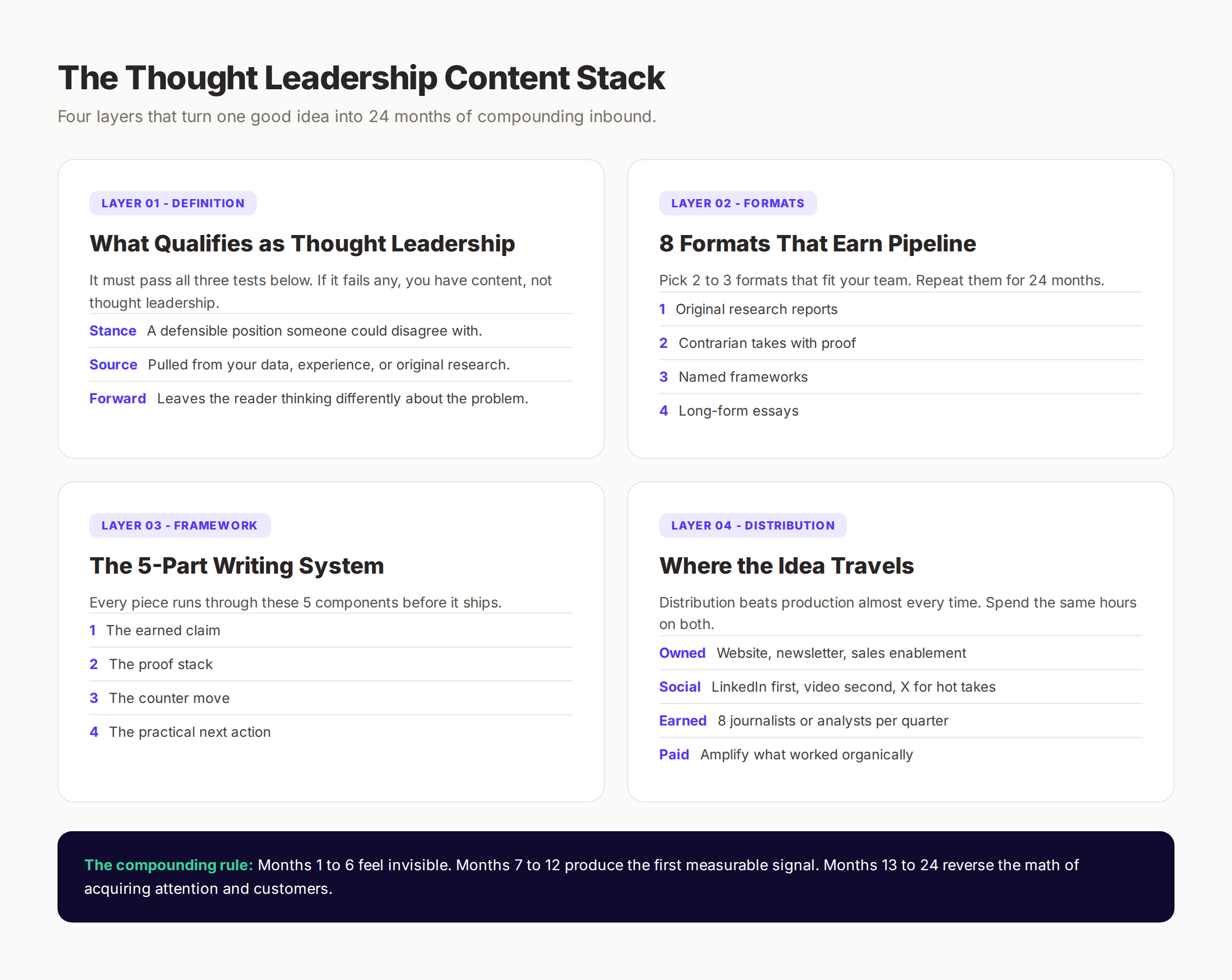
Chapter 1: What Thought Leadership Content Actually Is
The term gets misused so often that most teams cannot define it without resorting to clichés. Strip away the noise and you are left with a precise definition.
Thought leadership content is original opinion, research, or framing from a subject matter expert that changes the reader's mental model of a problem. It is not a recap. It is not a "how to" written from another company's playbook. It moves the conversation forward.
1A. Three Tests Every Piece Must Pass
Before you publish anything as thought leadership, run it through these three tests. If it fails any of them, you are publishing content, not thought leadership.
| Test | Question | Pass Criteria |
|---|---|---|
| The Stance Test | Does the piece take a position someone could disagree with? | Yes. A defensible claim. Not a list of "best practices." |
| The Source Test | Is the insight pulled from your direct experience, data, or research? | Yes. Lived experience, original numbers, or expert synthesis. |
| The Forward Test | After reading, does the audience think about the problem differently? | Yes. New frame, new metric, new sequence, or new tradeoff. |
A post that fails any test is general marketing content. A post that passes all three is thought leadership.
1B. What Thought Leadership Is Not
The confusion costs companies a lot of money in publishing effort. Here is the negative definition.
- Thought leadership is not a roundup of statistics with no synthesis
- Thought leadership is not a "trends to watch" post that names obvious shifts
- Thought leadership is not a customer success story dressed up as a blog
- Thought leadership is not an executive blog written by a ghostwriter who never spoke to the executive
- Thought leadership is not a how-to article unless the how-to introduces a new sequence or metric
When you stop counting those pieces as thought leadership, the volume drops by 80%. That is the point. Real thought leadership is rare by design.
1C. Why the Bar Got Higher
The bar moved because the supply of generic content exploded. Anyone can spin up 50 AI articles in a weekend. Buyers learned to ignore the noise. Now they only pay attention to content that meets three new conditions.
First, the content must be grounded in something the reader could not produce themselves. Original data, lived experience, or a synthesis of dozens of expert conversations. Generic frameworks pulled from other blogs do not qualify.
Second, the content must be visibly human. Buyers can sense voice now. They sense it through specifics, contrarian takes, and the willingness to name tradeoffs. A bland article reads as AI sludge regardless of who wrote it.
Third, the content must directly address the questions buyers ask in evaluation, not the questions they ask in awareness. Buyers want to know how you actually work, what your model costs, where you fall short, and who you are wrong for. The piece that answers those questions wins.
Chapter 2: The 8 Formats That Work in 2026
Format is not the same as topic. The right format multiplies the reach of a good idea. The wrong format buries it. After watching what gets cited, shared, and converted across our client base, 8 formats consistently outperform.

2A. Original Research Reports
A piece of research with a number nobody else has. You ran the survey, you analyzed the data, or you pulled a pattern from your internal system. The format is a downloadable report plus a public landing page.
The reason this format works is simple. A real number creates a citation magnet. Every piece that references your number links back. Every analyst pulls it into their research note. The same number can fuel a webinar, a podcast tour, a keynote, and a year of LinkedIn posts.
According to MarketingProfs, 47% of B2B marketers plan to increase their use of original research in 2026. The reason is that the content marketing industry is projected to generate $107 billion in revenue by 2026 and original data is the moat that protects a brand from AI-generated competition.
2B. Contrarian Takes
A piece that argues against the prevailing wisdom in your category. The format is a 1,500 to 3,000 word essay with a clear thesis and supporting evidence.
A contrarian take only works when you back it with experience or data. A claim like "growth marketing is dead" without proof reads as link-bait. The same claim supported by 18 months of client data, named examples, and a precise definition of what is dying becomes a quoted reference.
2C. Frameworks With a Name
A repeatable model that gives the reader a new way to organize a problem. The format is a named framework with 3 to 5 components, a diagram, and case examples.
The named framework is the most reusable thought leadership format. Once you publish a framework, prospects describe their problem using your language. Your sales calls get shorter. Your competitors get forced into a defensive position.
2D. Long-Form Essays Tied to a Single Argument
A 2,500 to 5,000 word essay that defends one argument with depth. The format is a single H1, no padding, ruthless cuts.
This format wins because nobody else has the patience to publish it well. The web is full of short hot takes and bloated SEO articles. A real essay that earns its length stands out.
2E. Case Studies With Real Numbers
A specific account of how you solved a hard problem for a named or anonymized client. The format includes the original problem, the false starts, the actual solution, the numbers, and what you would do differently.
The reason case studies belong on this list is the 2026 shift in buyer behavior. Buyers no longer accept hand-wavy claims. They want to see the receipts. A case study with named numbers, real timelines, and honest failures is more persuasive than 10 pages of value-prop copy.
Want a content team that ships 30 articles a month? We publish 3,500+ blogs across 70+ industries. The framework in this guide drives every post.
2F. Expert Interview Series
A series of conversations with practitioners in your category. The format is a podcast or written transcript with a synthesis layer where you extract patterns across guests.
The synthesis layer is what turns interview content into thought leadership. Anyone can publish a Q&A. Few people listen to 30 conversations and pull out the underlying pattern. The synthesis is your insight.
2G. Annual State of the Industry Reports
A yearly report that becomes the reference document for your category. The format combines original survey data, secondary research, expert quotes, and your analysis.
The annual report is a long-game format. The first edition gets modest attention. The third edition becomes a calendar event in your industry. The fifth edition is cited by analysts, journalists, and competitors.
2H. Short-Form Video With a Single Argument
A 60 to 180 second video that makes one clear claim with personality. The format is owner or executive voice, simple production, and a single sticky idea.
The 2026 data shows video is the format buyers want more of. 48% of B2B marketers say their thought leadership would be more impactful with more video. Short, clear, personality-driven videos outperform long written posts in reach and emotional connection. Pair them with your written essays to compound the reach.
Chapter 3: The 5-Part Framework for Writing a Single Piece
Once you pick a format, you need a system to actually write the piece. After producing tens of thousands of articles, the framework that holds up across categories has five parts.
3A. The Earned Claim
Start with the claim. The claim is the one sentence the reader will remember 30 days later. It must be defensible, specific, and earned.
A weak claim sounds like "AI is changing marketing." Nobody could disagree with it, and nobody learned anything. A strong claim sounds like "AI cuts the cost of an SEO article by 94% but the unit economics only work if you publish at least 30 articles a month." Specific. Defensible. Earned by experience.
Write the claim in one sentence before you write the rest of the piece. If you cannot, you do not have a piece yet. You have a topic.
3B. The Proof Stack
The proof stack is the evidence that earns your claim. It comes in three layers stacked from strongest to weakest.
| Proof Layer | What It Is | Example |
|---|---|---|
| Tier 1 — Original Data | Numbers from your work, your system, or your survey | "We tracked 412 client blogs. Articles over 1,800 words ranked 3.2x more often." |
| Tier 2 — Named Experience | Specific stories with named clients, dates, or contexts | "A dental practice in Austin doubled GBP calls in 8 weeks using this system." |
| Tier 3 — Cited Research | Published research from credible sources | "Edelman-LinkedIn 2024 report: 73% of buyers trust thought leadership over marketing." |
A great piece uses all three layers. A good piece uses two. A weak piece relies only on Tier 3. Stack your evidence in that order.
3C. The Counter Move
The counter move is the section where you preempt the smartest objection a reader will raise. This is the section most writers skip.
A reader who finishes your piece without seeing their objection answered does not get convinced. They get suspicious. They assume you have not thought through the case. A real counter move names the objection in their language and then answers it with the same proof stack you used for the claim.
3D. The Practical Next Action
A piece of thought leadership that ends without a next action is a lecture. The reader closes the tab and forgets. A piece that ends with a clear next action becomes a tool the reader will use.
The next action is not a CTA to your product. It is the smallest concrete step the reader can take in the next 7 days to apply your idea. Pull a metric, audit a workflow, rewrite a page, send a survey. Make it specific.
3E. The Voice Tax
The voice tax is the discipline of writing in your own voice instead of the safe corporate voice. Most thought leadership fails here. The ideas are decent but the writing is flat, hedged, and indistinguishable from any other brand in the category.
The voice tax has three rules. Use first person plural when you mean it. Take a position even when it is uncomfortable. Cut every sentence that could appear in any other brand's blog.
When you pay the voice tax, the piece sounds like you. When you do not, it sounds like nobody.
Chapter 4: The 2026 Statistics That Prove the Case
The case for thought leadership content is no longer theoretical. The numbers are now well documented.
4A. Trust and Influence
73% of B2B buyers say an organization's thought leadership is a more trustworthy basis for assessing capability than its marketing materials. 71% say thought leadership is more effective than conventional marketing at demonstrating value. The trust gap between thought leadership and marketing content is now the widest it has ever been.
The most striking number for sales teams: 60% of decision-makers said a single piece of thought leadership directly led them to award business to a company. One post can pay for a year of publishing.
4B. Consumption and Attention
52% of B2B decision-makers and 54% of C-suite executives spend at least 1 hour per week reading or watching thought leadership content. That is roughly 50 hours per year per buyer. If your category has 200 target accounts and each has 5 buying committee members, that is 50,000 hours of buyer attention to compete for every year.
The supply side is even more interesting. 47% of marketers plan to publish more original research in 2026. Customer feedback (53%) and CRM data (44%) are the top sources for thought leadership topics. Marketers are realizing that the data inside their own business is the moat.
4C. The Format Shift
The same research shows buyers want more video (48%), more live and virtual events (48%), and more interactive experiences (48%). The shift away from pure long-form text is real. Pure text still works, but it works best as the backbone of a multi-format ecosystem.
4D. Where the Money Goes
Companies that publish consistent thought leadership see real revenue impact. Published executives get 3x more inbound opportunities than peers who do not publish. Companies that publish 4 or more thought leadership pieces per month grow pipeline 2.3x faster than companies that publish 1 or fewer. The compounding effect is real and measurable.
Chapter 5: Distribution Beats Production
A great piece of thought leadership content that nobody sees has zero value. A mediocre piece with great distribution has more impact than a brilliant piece with poor distribution. After watching what works, distribution beats production almost every time.
5A. The Owned Channel Stack
Your website is the home of the piece. Everything else is a feeder channel. The order of the owned stack matters.
| Channel | Role | Investment |
|---|---|---|
| Website essay or report | Permanent home of the idea | Production, SEO, design |
| Email newsletter | Direct delivery to opted-in audience | Subject line, opening hook |
| Resource library | Long-term discoverability | Tags, navigation, search |
| Sales enablement | Used in pre-call and follow-up | One-pager, sales notes |
The owned channels carry the weight. Earned and paid channels feed traffic back to them. Treat your website as the only place the full idea lives.
5B. The Social Distribution Hierarchy
Not all social channels return the same value for thought leadership. The hierarchy that consistently produces pipeline.
- LinkedIn — Where B2B buyers actually read thought leadership. Personal profiles outperform company pages 5x for reach. See our LinkedIn content strategy guide for the full system.
- YouTube — Where the synthesis from a long essay lives as a 5 to 15 minute video. Long shelf life, search-driven traffic.
- X — Where contrarian takes spread fastest. Best for the controversial 280 character version of your core argument.
- Substack or owned newsletter — Where your most engaged audience reads the full thing.
- Reddit and niche communities — Where vertical-specific arguments find their tribe.
The strategy is not "be on every channel." It is "pick the 2 channels where your buyers actually are and own them for 12 months."
5C. The Earned Media Path
Earned media multiplies a single piece into 5 to 10 secondary placements. The path is mechanical.
Step 1: Identify 8 journalists, analysts, and podcasters who cover your category. Pull their last 6 months of work. Note the angles they prefer and the data they cite.
Step 2: Write a 200 word pitch that connects your piece to a specific angle one of them already cares about. Send it directly, never as a press release.
Step 3: Follow up once after 5 business days. Then move on. Pitching is volume work with a 5 to 10% reply rate even when done well.
Step 4: When a placement lands, mine the relationships. The journalist who covered you once will cover you again if you keep producing.
5D. Paid Distribution
Paid distribution works for thought leadership but only with a specific structure. Use paid to amplify pieces that have already performed organically. Never use paid to launch a piece cold.
The math is simple. A piece that gets 500 organic reads in its first 2 weeks is a signal. Boost it. A piece that gets 50 organic reads is a different signal. Improve it before you spend a dollar.
Tired of choosing between writing and ranking? We handle both. 30 blog posts per month, written and published automatically for $99.
Chapter 6: Measurement — Vanity Metrics vs Real Signals
Most teams measure thought leadership the wrong way. They count traffic, social likes, and email opens. Those metrics are easy to pull and almost useless for proving the impact of thought leadership.
6A. The Real Signals
The signals that prove thought leadership is working are slower, harder to pull, and tied to revenue.
Inbound sales conversations that reference the piece. When a prospect on a discovery call says "I read your essay on X," the piece is working. Track the rate at which prospects cite your content unprompted. A healthy program runs 20 to 40% of inbound calls referencing a specific piece.
Citation in third party content. Count the number of times your post, framework, or number gets cited in other people's content over a 12 month window. Search for direct quotes and named frameworks. Use tools like Sparktoro and Ahrefs to track mention growth.
Branded search volume growth. Branded searches for your company name and your named frameworks grow when thought leadership is working. Pull branded search volume monthly. If it is flat after 9 months of publishing, something is broken.
Pipeline influenced. Tag opportunities in your CRM with which piece of content influenced them. Run a quarterly report on revenue influenced by thought leadership. Our content marketing ROI guide covers the exact tagging approach.
6B. The Vanity Metrics to Ignore
Stop reporting on these. They make the deck look good and tell you nothing useful.
- Page views without time on page and scroll depth
- Social likes and shares without click-throughs
- Email opens without click-throughs
- Followers gained without engagement quality
These metrics are not bad. They are just not the metrics you should be optimizing against for thought leadership specifically.
6C. The Quarterly Review Format
The right cadence for measuring thought leadership is quarterly, not weekly. Weekly reviews force you to over-correct on noise. Quarterly reviews let you see real patterns.
Each quarter, pull the following for every piece published.
- ✓ Unique organic visits
- ✓ Average scroll depth
- ✓ Backlinks earned
- ✓ Citations in third party content
- ✓ Pipeline influenced (CRM tagged)
- ✓ Branded search volume change
- ✓ Inbound conversations that referenced the piece
Score each piece against the rest. Promote the top 20%. Kill or rewrite the bottom 20%. Maintain the middle 60% with quarterly refreshes.
Chapter 7: How to Scale Without Losing the Voice
The hardest problem in thought leadership is scale. One brilliant essay a quarter from a founder is easy. 4 pieces a month from a team of 5 contributors that all sound coherent is hard. Here is the system that survives scale.
7A. Build the Voice Document
Before you hire your second writer, write a voice document. Not a brand guide. A voice document.
The voice document includes the 10 sentences that sound exactly like your brand. The 10 that do not. The vocabulary you do and do not use. The opinions your brand will defend. The tradeoffs you accept. Every new writer reads the voice document before drafting anything.
A voice document that is shorter than 3 pages is too short. One that is longer than 10 pages is too long. Aim for 5 pages of dense, opinionated guidance.
7B. The 3-Layer Writer Ladder
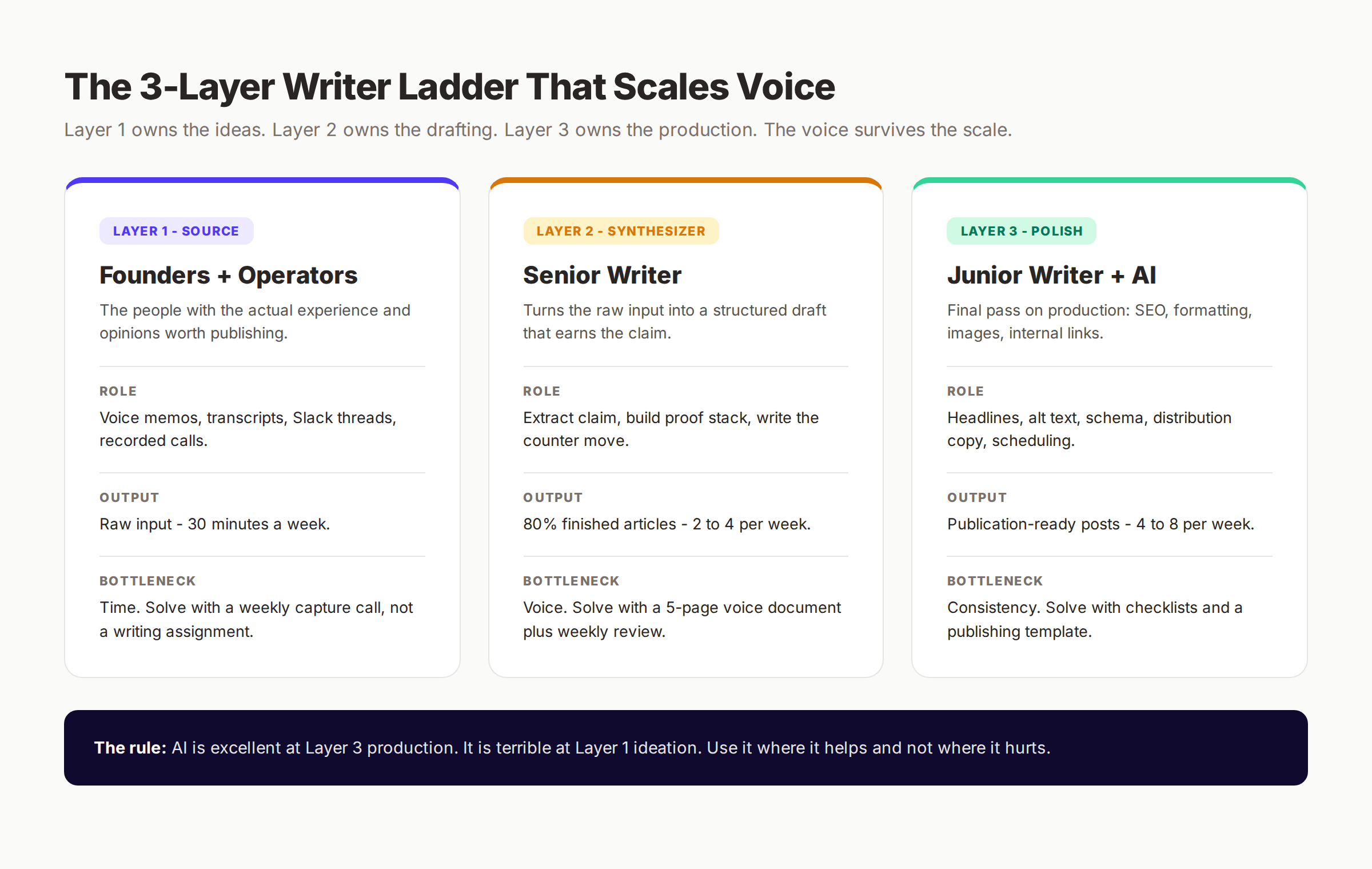
A scaled thought leadership system has 3 layers of contributor.
| Layer | Who | Role | Output |
|---|---|---|---|
| Layer 1 — Source | Founders, executives, practitioners | Insight, framework, point of view | Voice memos, transcripts, Slack threads |
| Layer 2 — Synthesizer | Senior writer or editor | Turns raw input into structured drafts | 80% finished articles |
| Layer 3 — Polish | Junior writer or AI-assisted | Final pass, SEO, formatting | Publication-ready posts |
This ladder lets you publish thought leadership at scale without diluting the voice. Layer 1 owns the ideas. Layer 2 owns the drafting. Layer 3 owns the production.
7C. The Source Capture System
The bottleneck in scaled thought leadership is almost always Layer 1. The founders and executives have the ideas but no time to write. The solution is a source capture system.
Schedule a weekly 30 minute call with the Layer 1 contributor. The Layer 2 writer asks questions. The call gets recorded and transcribed. The transcript becomes the raw material for 2 to 4 articles.
In our content operating system guide we go deep on how to systematize this. The short version: capture once, write twice, distribute many times.
7D. The AI Question
The 2026 question every team asks is whether to use AI to scale thought leadership. The honest answer is yes for production, no for ideation.
AI is excellent at turning a 3,000 word transcript into a structured first draft. It is terrible at generating original insight. The teams that win use AI as a Layer 3 production tool, not as a Layer 1 idea generator. For more on how we handle AI in writing, see our AI writing SEO guide.
Chapter 8: Common Failure Modes
After watching hundreds of thought leadership programs, the failure modes repeat. Avoid these and you will outpace 80% of the category.
8A. The Everyone Voice
The piece sounds like every other piece in the category. The fix is the voice document and the discipline to cut any sentence that could appear in any competitor's blog.
8B. The Topic Treadmill
The team picks topics because they are trending, not because the team has anything to say about them. The fix is to write a list of 8 opinions the brand will defend for 3 years. Publish only inside that list.
8C. The Ghostwritten Executive
A ghostwriter writes posts for an executive who never reviews them. Readers can sense the absence. The fix is to either get the executive to record voice memos or give up on the executive byline and publish under the brand.
8D. The Underdistributed Masterpiece
The team spends 60 hours writing a brilliant essay and 2 hours distributing it. Reverse the ratio. Spend at least as much time on distribution as on production.
8E. The Quarterly Drop
The brand publishes one excellent piece per quarter and then disappears. The cadence is too slow to build attention. Aim for 1 to 2 thought leadership pieces per month minimum.
8F. The Lecture Without a Next Action
The piece teaches but leaves the reader with nothing to do. Always end with a practical next action the reader can take this week.
Chapter 9: The Compounding Effect Over 24 Months
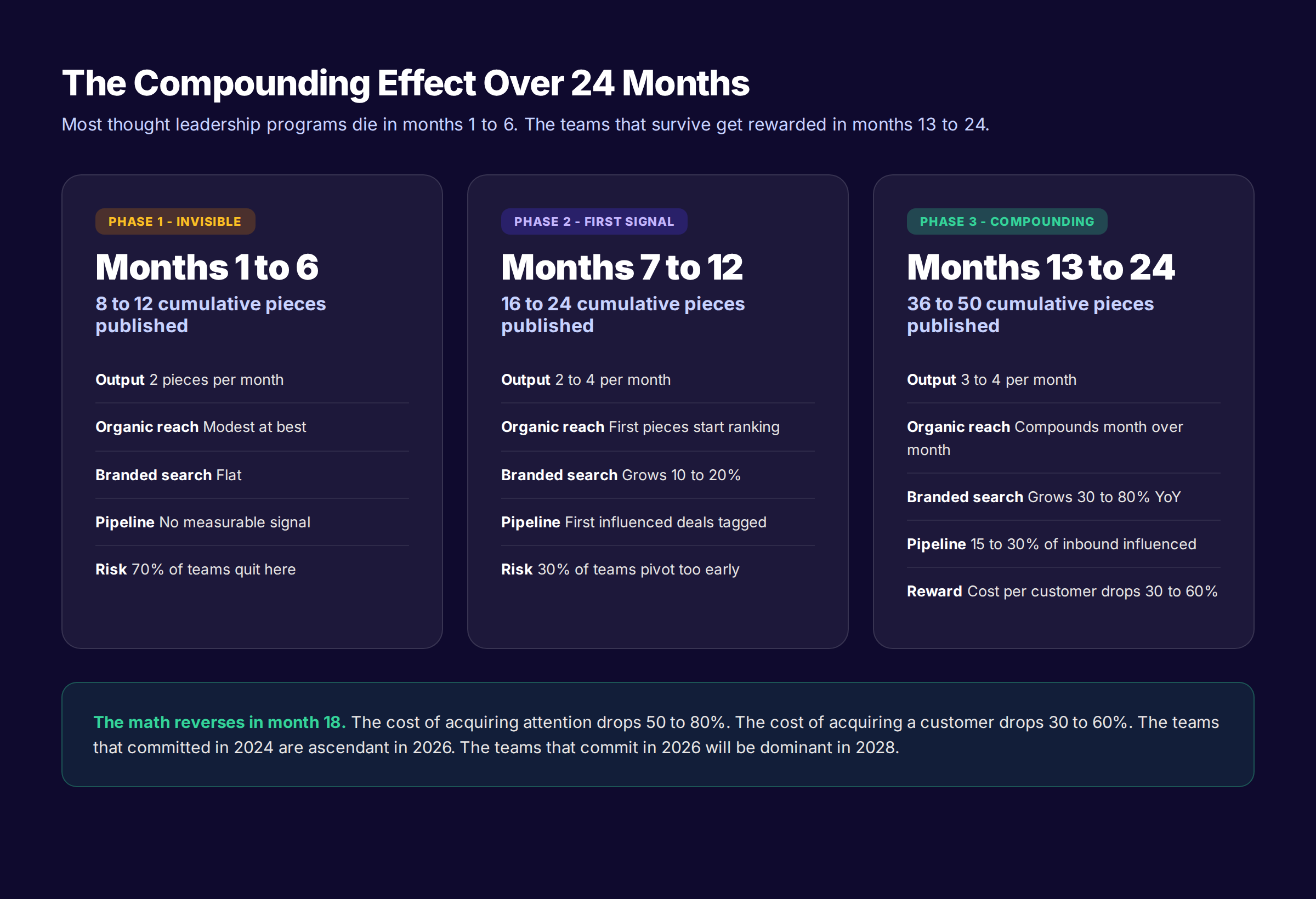
The case for committing to thought leadership content is hard to make in month 3. It is impossible to argue against in month 24. The compounding looks like this.
9A. Months 1 to 6
Output: 8 to 12 pieces of thought leadership. Most pieces get modest organic reach. A few get traction on LinkedIn. Branded search volume is flat. Inbound conversations rarely reference the content.
This is the phase that kills most programs. The output feels invisible. The team gets impatient. Leadership questions the investment.
The teams that survive this phase do one thing: they keep publishing on cadence. They do not pivot. They do not cut the budget. They keep stacking pieces.
9B. Months 7 to 12
Output: 16 to 24 cumulative pieces. The first few pieces start ranking in search. LinkedIn followers grow at 200 to 500 per month. A journalist or analyst cites the work for the first time. One opportunity in the CRM gets tagged "influenced by content."
This is when leadership notices. The first measurable signal arrives 6 to 9 months in. The team that committed in month 3 starts getting validation in month 9.
9C. Months 13 to 24
Output: 36 to 50 cumulative pieces. Organic traffic compounds. Branded search volume grows 30 to 80% year over year. Inbound pipeline influenced by content runs 15 to 30%. The brand gets quoted in industry reports. Speaking invitations arrive unsolicited. Recruiting becomes easier.
This is the phase where the math reverses. The cost of acquiring attention drops 50 to 80%. The cost of acquiring a customer drops 30 to 60%. The thought leadership content paid for itself many times over.
The companies that committed to thought leadership in 2022 are dominant in 2026. The companies that committed in 2024 are ascendant. The companies that commit in 2026 will be dominant in 2028. The compounding does not care about urgency. It only cares about consistency.
Chapter 10: A 90-Day Starting Plan
If you are starting from zero, here is the 90 day plan we recommend to clients.
10A. Days 1 to 30: Foundation
- ✓ Write the voice document (5 pages)
- ✓ List 8 opinions the brand will defend for 3 years
- ✓ Pick the first 4 pieces of thought leadership for the next 90 days
- ✓ Build the Layer 1 capture system (weekly 30 min recorded calls)
- ✓ Identify the 2 distribution channels you will own
- ✓ Set the CRM tagging system to measure pipeline influence
10B. Days 31 to 60: First Publishing Cycle
- ✓ Publish piece 1 (a contrarian take or original research)
- ✓ Publish piece 2 (a named framework)
- ✓ Run distribution for both pieces (LinkedIn, email, one outreach push each)
- ✓ Pull the first metrics report on both pieces
- ✓ Refine the voice document based on what worked
10C. Days 61 to 90: Second Cycle and Measurement
- ✓ Publish piece 3 (a case study with real numbers)
- ✓ Publish piece 4 (a long-form essay tied to a single argument)
- ✓ Run distribution for both pieces
- ✓ Pull the first 90 day measurement report
- ✓ Decide what to publish in the next 90 days based on what landed
By day 90 you will have 4 pieces of real thought leadership and one measurement cycle. That is the baseline you compound from for the next 24 months.
What practitioners are saying on X
AI search advice ages quickly. Here is high-signal public discussion from SEO and growth operators — context for your roadmap, not a substitute for primary data.
- @hridoyreh (Mar 2026): Widely shared SEO skill tree: foundations, research, technical, on-page, content, links, AI SEO/GEO, analytics, UX, brand, programmatic — useful map for stats and how-to posts. See the post on X.
- @jakezward (Feb 2026): 2026 SEO predictions emphasize AI Overview share-of-SERP, schema for LLM token efficiency, brand mentions in AI answers as a KPI, proprietary data as a moat, and content refresh beating net-new AI slop. See the post on X.
Grok, AI Overviews, and multi-engine visibility
For “thought leadership content”, multi-engine visibility still starts with clear definitions, sourced numbers, and extractable section answers. Grok additionally factors live X discussion — keep public claims consistent with this page.
- Google AI Overviews: Use passage-ready answers, tables, and FAQ schema where relevant.
- ChatGPT / Perplexity: Cite named sources next to key claims.
- Grok: Maintain accurate entity facts on-site and in high-signal X posts.
Publish content built for Google and AI citations. theStacc’s Content SEO module ships SEO-scored articles structured for rankings and generative engines — including clearer entity pages models like Grok can quote.
Frequently Asked Questions
Thought leadership content is original opinion, research, or framing from a subject matter expert that changes how a reader thinks about a problem. It passes three tests: it takes a defensible stance, it pulls from direct experience or original data, and it leaves the reader with a new mental model. A piece that does not pass those tests is general content, not thought leadership.
Strong examples include original research reports (the Edelman-LinkedIn B2B Impact Report is a category benchmark), contrarian essays that argue against industry consensus with data, named frameworks like the "95-5 rule" from the LinkedIn B2B Institute, case studies with named clients and real numbers, and short-form video where an executive makes a single clear argument. The theStacc team uses all five formats.
The 5 C's that show up in most content frameworks are clarity, conciseness, consistency, credibility, and call to action. For thought leadership specifically, we replace the standard 5 C's with our 5-part framework: the earned claim, the proof stack, the counter move, the practical next action, and the voice tax. The 5-part framework is more useful because it forces a defensible position rather than just clean writing.
Start with one sentence that captures the claim. If you cannot write the claim in one sentence, you do not have a piece yet. Then build the proof stack with original data first, named experience second, and cited research third. Add a counter move that addresses the strongest objection. End with a practical next action the reader can take this week. Pay the voice tax by cutting any sentence that could appear in a competitor's blog. Run the draft through our content writing tips guide before publishing.
Original research reports drive the most inbound and citations, but they require the most production effort. Named frameworks deliver the highest reuse value, since prospects start describing their problem using your language. Contrarian essays drive the most short-term attention. The right format depends on what you are optimizing for: pipeline (research reports), positioning (named frameworks), or attention (contrarian essays). Most teams should publish a mix.
The minimum cadence to build momentum is 1 to 2 pieces per month. Below that, you cannot compound. Above 4 pieces per month, quality drops unless you have a proper writer ladder. The compounding curve we see across hundreds of client programs assumes 2 to 4 pieces per month for 24 months. Slower than 1 per month produces almost no measurable impact.
AI is a strong Layer 3 production tool and a weak Layer 1 idea generator. Use AI to turn a recorded executive conversation into a structured first draft. Do not use AI to generate the original insight or the claim. The piece needs lived experience or original data to qualify as thought leadership, and AI cannot produce either. For our full take on AI in writing, see our does AI content rank guide.
The real signals are inbound conversations that reference the content (20 to 40% of healthy programs), citations in third party content (track quarterly), branded search volume growth (15 to 30% year over year is healthy), and pipeline tagged "influenced by content" in your CRM (15 to 30% of inbound). Ignore page views and social likes as primary metrics. Our content marketing metrics guide covers the full measurement system.
Length depends on the format. Original research reports run 3,000 to 8,000 words. Long-form essays run 2,500 to 5,000 words. Contrarian takes run 1,500 to 3,000 words. Case studies run 1,200 to 2,500 words. Short-form video runs 60 to 180 seconds. The wrong question is "how long should the piece be." The right question is "what is the shortest piece that fully defends the claim."
The Bottom Line
Thought leadership content in 2026 is rare by design and compounding by nature. The teams that publish 2 to 4 pieces a month for 24 months become dominant in their category. The teams that publish 12 pieces in 6 months and then disappear waste the investment. The math always favors consistency over intensity.
The good news is that the bar for entry has dropped. You do not need an in-house writing team. You do not need a 12-month content strategy retreat. You need a clear claim, a proof stack, and a publishing cadence you can hold for 2 years.
We publish 3,500+ blog posts a month for businesses across 70+ industries. The same framework in this guide drives every post we ship.
See thought leadership content shipped for your brand in 3 days
This article was researched and written by the theStacc Editorial team. Pricing, statistics, and frameworks were verified against public sources as of May 2026.
Related Reading
- Content Marketing Strategy: Complete Guide
- B2B Content Marketing Guide
- LinkedIn Content Strategy Guide
- Content Marketing Metrics That Matter
- Build Topical Authority for SEO
- Content Pillars Guide
- Content Operating System
- Video Thought Leadership for SEO
Related Tools & Resources
Free SEO Tools:
Best Lists:
Sources & references
- [1] Princeton / Georgia Tech et al. — GEO research (arXiv:2311.09735)
- [2] @hridoyreh on X — Widely shared SEO skill tree: foundations, research, technical, on-page, content, links, AI SEO/GEO, analytics, UX, bran
- [3] @jakezward on X — 2026 SEO predictions emphasize AI Overview share-of-SERP, schema for LLM token efficiency, brand mentions in AI answers
- [4] Referenced source — www.edelman.com

Researched, written, and published articles that compound organic traffic.
Weekly local SEO teardowns
One practical email a week. Map Pack, GBP, AI Overviews — no fluff. Unsubscribe anytime.
Explore this topic: Thought Leadership.